
Roland DürreTuesday May 6th, 2014
The Future of the InterFace AG
At the end of 2014, I will leave the InterFace AG in my role as active board member. My family has the majority of shares at InterFace AG. In order to guarantee continuity and stability, this should not change.
That is one reason why I wish to accompany the InterFace AG as a member of the supervisory board for some time. Here is my current analysis.
The InterFace AG is in a transformation phase. There are several reasons for this:
- Currently, the enterprise is growing immensely.
Naturally, two million Euros more turnover in one year also mean more employees, customers and partners. It looks like we will also grow in 2014. This means more contracts, more customer service, more responsibility for turnover, more administration and organization. Growth generally costs energy and money and means change.
- The enterprise turns regional.
Our regions Darmstadt, Nürnberg, Stuttgart and Rhein.Ruhr are fairly successful. Each of them develops its own culture and individual collective construct. We are now starting to open the door in other regions. The regionalisation also has an effect on the structural and procedural organization (structures and processes)..
- The market changes.
For several years, we established our service model for government agencies, (big) enterprises and IT providers.
These three market sectors currently undergo huge change.
The bidding process in government agencies gets more and more rigid for all parties concerned. On the whole, it is certainly not an advantage for medium-sized companies. Biddding concerns change their attitude towards their providers. More often than not, reducing costs will have priority over delivering quality. IT budgets dwindle, the specialized sectors get more and more relevant. It seems like “business administration” and “legal service” get more and more dominant – just like in society. Our traditional partners are the classic IT providers. New players, like Google or Amazon get more and more ever-present on the IT markets. I look forward to witnessing which providers will deliver IT technology and services in the future..
It seems clear that we have to acquire more and more new customers. Medium-sized companies and the IT suppliers of the future might become interesting material for the InterFace.. - More and more IT services become commodity.
It is hard or impossible to earn money with services that have turned commodities. Three years from now, we will probably earn a huge majority of our turnover with totally new services and products. This means that much has to be courageously tried and prudently developed..
- The business mode and rules of the game change.
It seems that the times of “Body / Expert leasing” slowly come to an end – also due to social and legislative changes. As alternatives, there might come service models, assembly sections or a “true” counselling service..
- The founder leaves the enterprise.
🙂 And to top it all in this situation, the founder ups and leaves the enterprise….
Mind you, the future is always unpredictable. But it is easy to see that the InterFace AG (like perhaps our society and many other enterprises, as well) are currently in a phase of strong transformation. Consequently, I see my next task in accompanying the firm as this takes place.
My personal observations of what happened in other firms show that this kind of change might not be totally unproblematic. Some enterprises I personally know quite well actually failed or at least suffered considerable damage when trying to do a positive transition in this kind of situation. But I also know a few firms that successfully coped with a similar scenario.
In life, you have to accept that you need to learn. Consequently, I believe there is a lot to be learned from these other enterprises and that experiences of others are helpful. The most important insight I won from observing these kinds of processes is trivial:
Everything will always depend on the people involved.
An enterprise is a social system which must not be allowed to acquire a life of its own. Instead, it must understand and consider the needs of the people concerned. It has to support humans in their development and make them bigger, rather than smaller.
Humans are prone to anxieties and will often develop fear, be it justified or unnecessary. This is how detrimental constructs can quickly get lives of their own and cause all kinds of misunderstanding and frustration. That is when the positive things, too, will easily be forgotten. Shared experiences and goals that should be important for all can easily become minor trivialities.
In my future role, I would like to counteract all unnecessary fears and mind games. And I want to use my role on the supervisory board to integrate all the colleagues in the enterprise, in the “extended management” and on the board of directors. I also see myself as a link between the employees, the works committee, the enterprise and the supervisory board.
We at InterFace must continue to develop our shared understanding and feeling. What do we want and where are we headed together? A living and practiced consensus is half of the way towards a successful future of the enterprise and its employees. Because it is and must remain our main goal to survive on a high level, even in hard times and to remain true to ourselves.
This is where I would like to say “Thank You” to all my fellow workers and companions on the way!
RMD
(Translated by EG)
Roland DürreFriday May 2nd, 2014
Starting a Business Today!
Nowadays, whenever I attend business contests and/or read business plans, I get the impression that……
… there is no Bavarian Constitution making it mandatory for a businessman that his business must be useful for the entire society.
… the only purpose all founders of a new company have is money and power (and, if they are male, women).
… the opinion of the shareholder value is still the only goal of an enterprise..
… even the tiniest bit of meaningfulness in an enterprise is very often missing.
Because, mostly, all I read and hear is numbers. The turnover and results are the focal issues. And the product, as well as the enterprise to be founded, are just means to an end. Said end is “making money”. Absolutely exclusively. And if there is no other way, then you get it by selling the new enterprise after a short time with enormous profit.
Those are the moment when I think:
Something is wrong.
I also read very often that you need a lot of money (… several millions of Euros … ) in order to build up a strong marketing sector and an ever-present market. Because this is the main problem.
And then I think: Why does nobody invent something we humans actually need?
RMD
(Translated by EG)
It is not our fault – consequently, we need tolerance, instead of moralization. Which is true for more issues than just sex.
Now is again a time when many declare their own public outing. Currently, those who do it are athletes and soccer players. Probably because the World Championships are coming up. In my opinion “Outing Yourself” is important and a good thing. I find it a good thing, even if it is always a welcome target for the media. Now, even films about Nymphomania and Satyriasis have become box office hits (see: SZ on Shame and Nymphomaniac).
The discussion continues: how much sexuality is normal? And what sort of sex is abnormal. If you enjoy sex a lot, you are often considered sexually addicted and consequently sick. Of course, matters are extremely bad if your sexuality is beyond the “normal” (hetero-) sexuality or its standards.
As I see it, the entire discussion should be totally unnecessary. Also, people getting upset about the consolidation of partnerships between homo- or heterosexual couples in society and law is something I am getting fed up with. Why can people living in relationships and communities they think are the best for them not just be left in peace?
It might make sense to set certain standards for default contracts and regulations like “matrimony”. Perhaps these standards can promote solidarity in partnerships or protect the weak (for instance: children). Providing rules for how small social systems, such as families, should live together might be justifiable under this light. But then, they should also make sense. Instead of being lies and just serving to cement moral (and consequently moralizing) constructs.
We must not foulmouth relationships in the way homosexuality has been discriminated against over many centuries. The “homo-marriage” is also a relationship of solidarity between two persons. And it is just as “normal” as a heterosexual relationship. And it is absolute nonsense to come up with categories such as “crime and punishment” for these relationships.
After all, sexuality is something very banal and natural. It is part of what we are and, naturally, has some influence on our lives and on what we do. Our ratio has to accept our own sexuality and to deal with it in a sensible way. And, if possible, in a healthy way – without discrimination or harm. Consequently, no feelings of guilt must be generated.
We should not forget that we, too, are just organic and mortal beings and thus fundamentally controlled by drives. Just like other mammals. We must not be afraid to admit this. After all, we, who are sometimes so cute (and sometimes less cute) are basically only animals, except that our brain is a little more advanced. Which is why we can “think”. To be sure, this is quite a miracle, but it is no reason to consider ourselves above creation and thus eventually do damage to ourselves.
It is also quite normal that the intensity of the sexual drive differs from individual to individual. Just like some people are more intelligent, stronger, faster, more musically gifted, more courageous, more fearful or more stupid, weaker, slower than others. With some of us, sexuality is weaker, with some of us, it is stronger. Probably due to experiences in early childhood or socialization. Or perhaps due to other factors we do not know about, but for which we are not responsible.
And it also goes without saying that sexuality will differ individually. After all, we cannot judge what is normal, can we? All we can do is believe in accordance with our own normality – or abnormality. But then, who knows what is “normal”? Much of what we believe is just a construct or often a mind game with terrible consequences. Basically, no honest person can actually objectively judge himself, especially not when it comes to normality. Teenagers, in particular, often have a very hard time with it. And as soon as you are grown-up, your education will kick in, your super-ego and morals will also have their say.….
It is really sad if then some people suffer because of their self-perceived (or because what others tell them to be their) “sexual addiction”. It is even sadder if someone has to suffer because of his or her homo-sexual nature. As a human being, you should be just as happy with your own sexuality as with your own life.
Basically, everything else should be a thing of the past in our age of enlightenment 2.0. Every one of us is individual and therefore different from others. This is also true for what excites us, to put it bluntly: to what makes us horny. Depending on our subjective conditioning and current situation in life, drives can have various causes.
As likely as not, it is not just humans of the same or the opposite sex that stir “sexual emotions”. Also, I presume there is nobody who is exclusively hetero-sexual. Only Pharisees can say such a thing. Depending on the nature or socialization, there are probably lots of things that are very sexually attractive to many persons. And not just persons of the same or the opposite sex.
Perhaps even a body part is enough to raise sexual appetite? Or an animal, an object, a picture or a symbol. A car or a motorbike, diamonds or beautiful clothes. Something you wear, the warm summer sun or the cold wind on your exposed skin, a certain melody. There are endless things which might sexually stimulate humans.
Often, these triggers are minor things, such as an enlarged picture of a nipple, a square metre of goose bumps, an earlobe (pierced or not pierced), half a centimetre of exposed leg, an ankle, a slim finger, a dimple, the silhouette of a body, the display dummy, or just a special thought.
There may be men who react to every pair of satin tights in the city and others who do not even notice the most beautiful girls in town. To make up for it, they probably react to something totally different. Sexuality differs individually, just like its intensity. But then, where is the problem with this?
So let us accept the “hyper-active” person, instead of calling him sick or addicted to sex. Let us permit people to do what they enjoy when sexually active. With the normal but central reservation that nobody must be harmed. Of course, that is also true for the partner. Just like it goes without saying that children are taboo and forced prostitution is a no-go.
But we should quickly stop all this moralizing about what is permitted and what is not permitted. And we should definitely not implement it in legislation as morally relevant. There is no justification to make others feel guilty. Just like there is no reason to feel guilty because of your own drive. We are what we are – and we just should try to promote our own life and happiness. That is also true for the people we live with.
Basically, we all tend to be hypocrites. But then, it seems to me that hypocrisy is rather wide-spread in our world, not just when it comes to sexuality. Because in our world, lies are a common thing, even beyond the topic of sexuality. Unfortunately, intolerance is often our bourgeois standard and people, along with their social systems, tend to make others “smaller”, rather than “bigger”.
For us, this should be a reason to be less hypocritical and autonomously promote civil courage, tolerance and freedom. And we also should fight against all those rules that say “this is how we do it” and “we do not do that”.
RMD
(Translated by EG)
Roland DürreThursday May 1st, 2014
Tweets on Twittering and Blogging #217
Here are my tweets of last week on
Blogging and Twittering, Wisdoms and Rules:
140508 You cannot work windmills with bellows – also true for twittering and blogging. #Twitter #Blogging #Wisdom
140509 We are all poor sinners – we twitterers and bloggers too? #Twitter #Blogging #Wisdom
140510 We, too, were once children – not to forget, perhaps even when twittering and blogging. #Twitter #Blogging #Wisdom
140511 Do not throw the entire parlour out of the window – not even when blogging and twittering? #Twitter #Blogging #Wisdom
140512 Take a second throw, and you will hit home – also true for blogging and twittering? #Twitter #Blogging #Wisdom
140513 It is easier to know than to do – also true for twittering and blogging. #Twitter #Blogging #Wisdom
140514 Knowledge, desire and competence make a good master craftsman – also true for twittering and blogging. #Twitter #Blogging #Wisdom
There is a new tweet each day. See twitter.com and “follow” RolandDuerre!
Enjoy!
RMD
(Translated by EG)
P.S
.
I took the proverbs from Alle deutsche Sprichwörter .
Roland DürreTuesday April 29th, 2014
brand eins in May
On the way back to Munich from the wonderful Zurich PM Camp in the slow EC train with the two smelly diesel locomotives, I had plenty of time.
Among the things I had taken along was the new “brand eins” edition of May. Here is my calculation: 1 + 1 is 2 – this time around, I had the magazine with me in the train before the month of its official publication and I read it in one go.

The title is “How did you like me?” – it is about the interface between the company and the customer. That means: customers want more – and consequently, the focal point is: In the customer’s interest.
I found a number of interesting articles in the new “brand eins” edition. This time around, they made it a thoughtful magazine, rather than a “revolutionary” one. Also, I feel it is an attempt at encouraging various forms of trade. Even if they probably no longer have a chance of success.
For instance, it contains many interesting examples and stories about the relation between enterprises and trade on the one hand and customers on the other hand. And when I read it, my thoughts are:
What a pity that some of the ideas are now dead weights (Globetrotter).
What a pity that much of the transformation realized in trade is probably just cheating on the customer.
What a pity that many feel better when they get a chance to believe in theories which may sound prudent, but will not be helpful in the long run.
What a pity that much sounds like “cheating on the customer”. They say and want to make the customer believe that they sell a new spirit wrapped in new paper, but when all is said and done, everything will remain the same.
What a pity that the wrapping mostly does not say what is actually inside.
What a pity that they try to raise expectations which are definitely not sustainable.
These were my ideas while I read the articles. And then I associated a number of thoughts with what I had read:
What good will it do me if the friendly sign on the defunct escalator says that the owner will try and repair the damage as fast as possible while I know perfectly well that what he actually means is:
“The damage has been registered and the process will be followed according to its rules. The time of repair depends on many factors and, consequently, cannot be predicted.”
What good will it do me if I have a faulty product with a good label. However, the central store selling the label will only help me by referring me to the web address.
What good will it do me if I want to buy the techno-shoes for bikers in the specialized shop and am even prepared to pay a higher price. Yet if I ask the salesperson how best to get access to the kickies, he or she cannot answer my question – even though I know that I can buy the shoes for half the price on the internet.
What good will it do me if I cannot pay with paypal or other modern means of payment, yet will only get free delivery up from a certain price – and then it takes longer than if I buy from Amazon?
But I am also worried about other things:
So how am I, as a customer, supposed to find something that is not wrapped in plastic?
How will I get the desired quality of food if it is no longer offered?
Where can I get simple service, for instance for my bike close enough from home to reach on food?
Consequently, I can easily imagine that there will only be two kinds of trade left in the future:
Internet trade and very regional trade based on trust.
And I can easily imagine then spending most of my money with local businessmen and service providers.
But have I not written often enough:
The future is not something you can predict – and this “brand eins” edition is again a wonderful reason to discuss the future at length.
RMD
(Translated by EG)
Roland DürreSunday April 27th, 2014
The First PM Camp in Switzerland
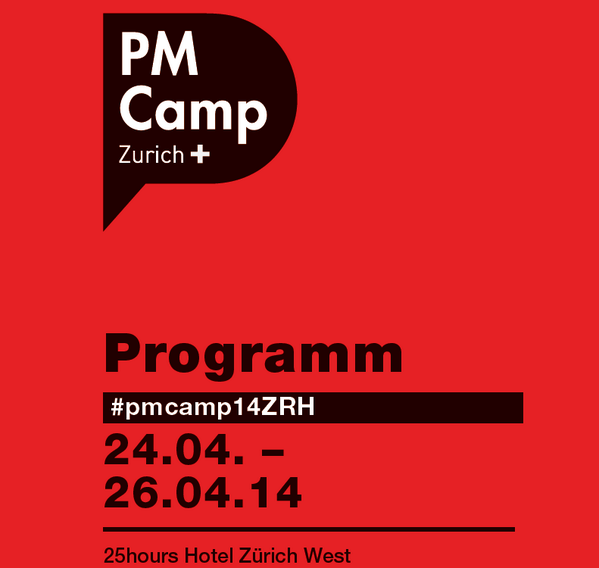 At long last, we did it this week – the first Swiss PM-Camp took place. I was part of it – and it was a wonderful experience.
Most of the attendants came from Switzerland – which means that I made many new acquaintances. It felt very good to be part of the event. In some way or other, much of what happened sounded quite familiar to me and I remembered our RISE workshops at Hochschule St. Gallen.
🙂 This time, PM Camp was not just short for Project Management Camp, but also for Premium Camp.
Because in Zurich, everything was premium quality: the location, the way people interacted with each other, the session quality, the food, the Friday evening party and the closing event. …
The venue was the “25hours”, a boutique hotel in Zurich West. We had truly creative surroundings with lots of space for an innovative exchange of ideas.
 In other words: the team around Silvio, Christian, Toni and Matthias has every reason in the world to be really content with this event. You did a marvellous job! Many thanks!
At the very outset on Friday morning, Mischa Ranseyer (here are his slides) fascinated the entire audience with his keynote on “Management in the 21st Century”.
Inspired by Mischa’s theses, we went ahead with many very illustrious and exciting sessions.
Naturally, I was also responsible for one of them. It is just too much fun taking up topics from other sessions and then mentally extending them in your own event.
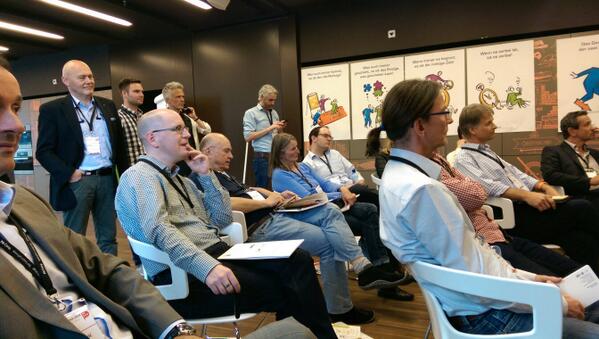 Zürich was our start into the PM Camp year 2014. Initially, we had a PM Camp where quality was the most important thing for all the fifty participants. It seemed a little like the motto had been “small but nice”.
Now everything comes in quick succession:
The next PM Camps will be in Stuttgart (May, 9th and 10th, 2014), Berlin (June, 20th through 22nd, 2014) and Bad Homburg (PM Camp Rhein-Main from June, 26th through June, 28th, 2014). After that, the first Bavarian PM Camp will have its premiere in Munich between July, 25th and July, 26th.<
 We have not yet set a date for Vienna, but in November, the PM Camp year 2014 will be closed with the great PM Camp DACH in Dornbirn (November, 20th through 22nd).
Whenever possible, I will be participating at most PM Camps. I am booked for Stuttgart, Berlin, München and Dornbirn. And, of course, I would be delighted to meet many friends.
So if now I raised your curiosity and you would like to attend a PM Camp for Project Management in order to share and increase your knowledge about management, entrepreneurship and shaping the future – and all this together with others while having a lot of fun and at high speed with surprisingly little cost – then you are welcome to contact me.
I am always at your service, both for more general information and very personal questions. Besides, you will already find quite a few articles in the IF blog which tell you about PM Camp in particular and barcamps in general. All you have to do is search for “barcamps und PM-Camp” in this blog.
Hoping to see you soon at one of our barcamps,
yours
RMD
(Translated by EG)
P.S.
Here are a few pictures taken during the weekend
And you can find more about the nice Zurich PM Camp on twitter – just look for the hashtag: #pmcamp14zhr
Roland DürreThursday April 24th, 2014
Tweets on Twittering and Blogging #216
Here are my tweets of last week on:
Blogging and Twittering, Wisdoms and Rules:
140501 It is all about how and who, not what – just like when you are twittering and blogging. #Twitter #Blogging #Wisdom
140502 It is not forbidden to reciprocate – something that might also be true for twittering and blogging! #Twitter #Blogging #Wisdom
140503 If you want to count the number of opinions, count the number of people – also true for twittering and blogging. #Twitter #Blogging #Wisdom
140504 Those you live wildly when young will live virtuously when older – also true for blogging and twittering? #Twitter #Blogging #Wisdom
140505 True motivation is the recipe for swift feet – also true for blogging and twittering. #Twitter #Blogging #Wisdom
140506 If you want me, come for me – that is also the right approach when twittering and blogging. #Twitter #Blogging #Wisdom
140507 If you want to find something, do not look too far – something that might also be true for twittering and blogging? #Twitter #Blogging #Wisdom
There is a new tweet each day. See twitter.com and “follow” RolandDuerre!
Enjoy!
RMD
(Translated by EG)
P.S.
I took the proverbs from Alle deutsche Sprichwörter.
Roland DürreTuesday April 22nd, 2014
Carl Heinrich Graun – Der Tod Jesu
Evelyn Gemkow (EG), who helps us with the IF blog by making it possible for readers all over the world to understand our articles, has a very special hobby: she sings with the “Arcis Vocalisten”, a choir of outstanding quality. And now, they are again preparing for a very special concert, along with producing a CD:
CD production and concert of the “Arcis Vocalisten” – “Der Tod Jesu” by Carl Heinrich Graun
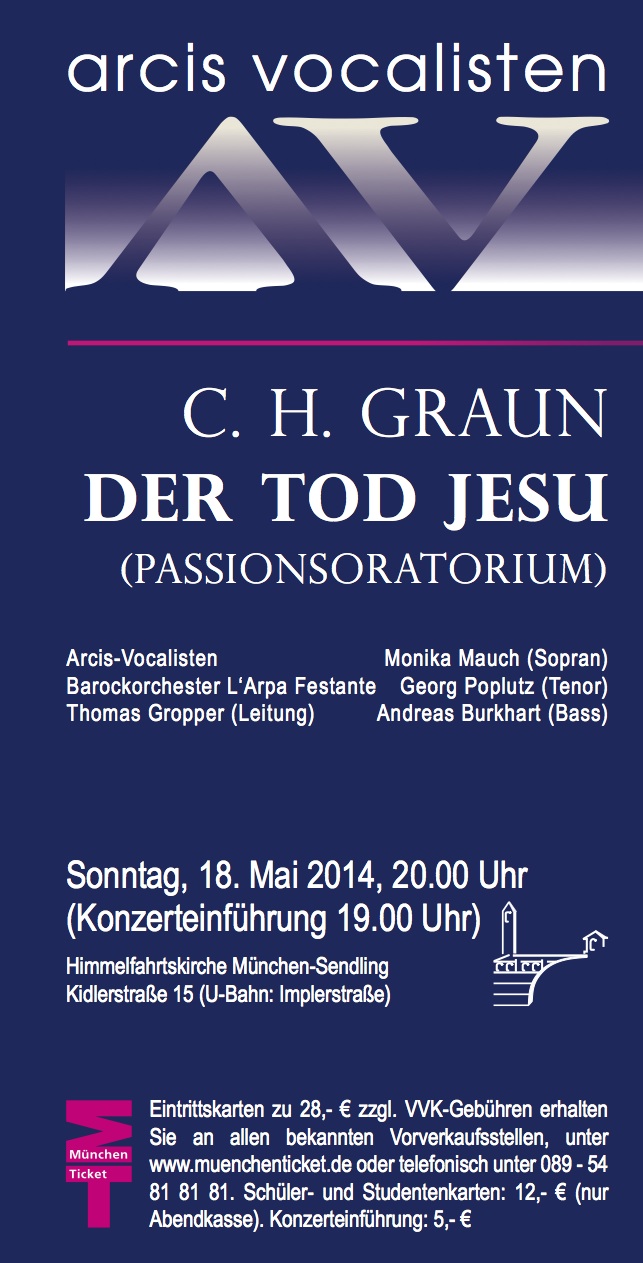 CD production and concert of the “Arcis Vocalisten” – “Der Tod Jesu” by Carl Heinrich Graun
For quite a few years, the Arcis-Vocalisten have now been cooperating with the “L’arpa festante” ensemble when performing pieces of the baroque and classic eras – to the huge benefit of the Munich concert audience.
With Carl Heinrich Graun’s “Der Tod Jesu“, the two ensembles, supported by the Bayerische Volksstiftung, now attend to a piece which – for good reasons – has been performed practically on a yearly basis on Good Friday in Berlin for almost three-quarters of a century. This is the third CD production realized by the baroque orchestra L’arpa festante and the Arcis Vocalisten in cooperation with the Bavarian Radio Station:
After Johann Sebastian Bach’s cantatas ”Aus der Tiefen“ (BWV 131) and ”Himmelskönig, sei willkommen“ (BWV 182), which were recorded in 2011, as well as the cantatas recorded in 2012 ”Weinen, Klagen, Sorgen, Zagen“ (BWV 12) and ”Herz und Mund und Tat und Leben“ (BWV 147), the two ensembles are now working on a joint project with a composer who, today, is only rarely heard: ”Der Tod Jesu“ by Carl Heinrich Graun (* May, 7th, 1704, † August, 8th, 1759). And the joint project again promises to turn into a huge musical success.
During the now numerous instances of cooperation between the Arcis-Vocalisten and L’arpa festante, it turned out that these two ensembles each found their ideal match. They are in perfect harmony when it comes to working on and performing old music. On the one hand, we have the Arcis-Vocalisten, about whom the “Süddeutsche Zeitung” wrote that they have a “huge repertory of finely tuned ways of expression”, along with “a constantly precise diction and narrative and musical homogeneity”.
On the other hand, there is the baroque orchestra L’arpa festante – one of the most traditional German ensembles specializing in old music. They stand out through the huge musical experience and virtuosity of every individual instrumentalist, as well as through their fabulous richness of colour and expression.
The two ensembles complement each other in an ideal way, and each new cooperation is a huge experience for all parties concerned, both on the musical and social level. So now the Arcis-Vocalisten and L’Arpa Festante turn towards Carl Heinrich Graun’s ”Tod Jesu“ – which is an impressive work, even if you only look at it from the perspective of its performance history. First performed on March, 26th, 1755 in the Berlin Cathedral, Graun’s Passion Cantata regularly was the constitutive factor of the musical Good-Friday program in the Prussian Capital for more than seventy years. This is even more remarkable because, in those days, remembering the works of composers from the early times was rather the exception from the rule. The audience generally was more fascinated by musical novelties.
This long-lasting popularity will immediately become understandable for the music lover of today as he enjoys listening to the work. While the libretto on which it is based is clearly a concession to the tastes of the time (which today sometimes might look over-affected), Graun’s composition still moves the senses of the contemporary listener very directly. The range of musical technique and musical expression used by Graun is huge – from the seemingly rather archaic double-fugue strictly in the old style for choir through arias in the gallant style as it started flourishing during Graun’s time, down to the opera-like, over-enthusiastic, exulting tenor aria.
At the same time, the work, as far as the underlying theological and narrative concept are concerned, is opposed to – or better: it complements – the Passions by Bach in a fascinating way. Naturally, the latter are the non-plus-ultra for the music lover of today when it comes to passion music.
On the one hand, Bach’s Passions mirror the events of the passion as a “historical” event, at the same time making the salvation history – the completion and execution of the divine plan with Christ as its centre and pivotal point – the focus of everything. Graun’s approach is totally different: Jesus is more a human among humans, a virtuous hero and benefactor in the middle of everyone, rather than the actor of an eschatological plan. Individual emotions of the divine human being Jesus are reflected and brought to the attention of the audience.
The actual events of the passion as a historical happening, however, are only mentioned as side-lines and indirectly. Music lovers need not wait for the CD to be produced by the Arcis Vocalisten and L’arpa festante, because the two ensembles will also give a performance of their joint Graun Project on
Sunday, May, 18th, 2014, at 8 p.m. in the Sendling Himmelfahrtskirche
under Professor Thomas Gropper.
As early as 7 p.m. Thomas Gropper will give an introduction to the concert, which is free for members of the Bayerische Volksstiftung.
The Death of Jesus – a passion oratorio of many facets with an impressive performance history, performed by the Arcis-Vocalisten and the Baroque Orchestra ”L’arpa festante“ in the Sendling Himmelfahrtskirche.
Tickets for 28.- Euros plus advance-booking fee are available at all the usual advance-booking outlets, under www.muenchenticket.de or by telephone: 089- 54 81 81 81. Students: 12.- Euros (concert evening only). Introduction to concert: 5.- Euros
RMD
Roland DürreFriday April 18th, 2014
Entrepreneur’s Diary #98 – Instrumentalising Life
Everything is subjected to instrumentalisation.
But why? An attempt at explaining.
Enterprises are social systems. You can distinguish them from other systems because their purpose is economic. As all social systems, enterprises tend to develop according to what is beneficial and useful for them, instead of according to what is good for the customers and employees. Too often, this will end in a “de-personalization” of the system, including the “de-humanization” of the interactions therein.
Naturally, in the long run, such a development will be more detrimental than beneficial. However, this is often forgotten, because everybody believes in short-term thinking. Only the next three months count – and everything beyond that is now irrelevant.
Why does this happen in social systems?
Every social system creates its own collective construct, just like the people create their own individual constructs. It determines the values of the social system and defends it against attacks both from inside and outside. The (collective) morals are an example for a typical result of such a collective construct creation.
Humans have to liberate themselves from personal and collective compulsions if they want to unfold their lives in its many possible dimensions. More often than not, the morals of a system as a massive construct block the way. There is a “you” which tells everybody what to do: “you do not do this kind of thing”” or “this is how you want to do it, there is no other way”.
This is how an ideological system develops. The reign of a collectively constructed system of values and ideas will be drastically overrated. And the collective constructs will continue to develop – but always with the main purpose of being beneficial for the system itself! Mostly, the end of the development is that the survival of the system gets highest priority. All other issues are radically subordinated. And this will eventually cause “fascist” structures. Those kinds of systems always give me pause.
Naturally, there are some typical consequences:
The persons inside the system will become comfortable. They will fall victim to their material independence. They get a feeling of security – which is often an illusion. This feeling causes the fear to lose something, which again increases the dependency upon the system. A vicious circle will develop. It causes cowardice and lack of independence, at the same time making courage and constructive disobedience rather hard.
Simultaneously, the systemic complexity of the vocabulary of concepts within the enterprise will be semantically emptied by the system agents, either knowingly or accidentally. The values are simplified, the prevailing value system will be made to serve just the economic usefulness. Along with it, all concepts and values are more and more emotionalized.
Based on this kind of change, the demagogy of the system agents will easily find the “right” arguments which tell you that all that matters now is the system – and what matters for the people is totally irrelevant. Maybe you could call this phenomenon “misled ratio” and perhaps it is the problem of our society and times? Because this “misled ratio” will easily let you forget that justice is also something that needs fairness at eye-level. Incidentally, the same is true for everything that concerns human beings. Because it leads towards “no alternatives”?
Systemic construct development will make the social system “enterprise” – just like many other systems – something that only serves itself. Of course, the important rule that humans – be it customers, employees or stakeholders – should not be there to serve the enterprise but vice versa does no longer play any role!
What can be done about this?
We must not allow “our systems” to make us totally addicted to them and incorporate them as part of ourselves. Also, we have to avoid being torn between unquestioned enthusiasm followed by bitter disappointment (introjection). No, we must try and strive towards a healthy identification with our system. This means that we have to pair loyalty with ethical control. Our interaction in and with the system has to be subjected to a conscious balance of values and we have to still be prepared to object and display civil courage.
What remains is the question:
How can you learn this “immunity against systemic forces”?
A good friend and mentor once advised me:
Judge yourself every day! Which of your activities today contributed more towards increasing your life in its many dimensions than towards minimizing them? For instance by making other persons feel better/greater? Or have you made other persons feel small?
Are you aware of using “interested sources”? Because the small and big systems, also construct their stories. This is how they create reality out of stories. The powerful want to consolidate their reign and will use the ideological myths and stories.
Consequently, you should always question those truths and mattes of course.
And not to forget:
Systems that make persons look small are just as bad as humans who make other humans look small. “Leader personalities”, in particular, should characteristically have the gift of making the persons they are surrounded by look great. In the same way, the social systems should aim at making “their” people look bigger rather than smaller.
RMD
(Translated by EG)
P.S.
The person who gave me this good advice was Rupert Lay. The ideas I related in this article have been strongly influenced by what I learned and developed from and with Rupert.
P.S.1
For more articles of my entrepreneur’s diary, click here: Drehscheibe!
Roland DürreThursday April 17th, 2014
Tweets on Twittering and Blogging #215
Here are my tweets of last week on
Blogging and Twittering, Wisdoms and Rules:
140424 Easy come, easy go – something that can also happen when twittering and blogging. #Twitter #Bloggen #Weisheit
140425 Your personality determines what kind of fool you are – this might also be true for twittering and blogging!#Twitter #Bloggen #Weisheit
140426 What you sow on the field is what will grow – poor advice, also when twittering and blogging. #Twitter #Bloggen #Weisheit
140427 The replies you get depend on what you ask – careful, bloggers and twitterers! #Twitter #Bloggen #Weisheit
140428 If you believe, you will get what you believe – also true for blogging and twittering. #Twitter #Bloggen #Weisheit
140429 The noise you make will echo back at you – also when twittering and blogging. #Twitter #Bloggen #Weisheit
140430 As one makes his bed, so he must lie – also true for twittering and blogging? #Twitter #Bloggen #Weisheit
There is a new tweet each day. See twitter.com and “follow” RolandDuerre!
Enjoy!
RMD
(Translated by EG)
P.S.
I took the proverbs from Alle deutsche Sprichwörter.


