
Roland DürreFriday January 16th, 2015
Golden Barbed Wire
Currently, it seems like both institutions and enterprises are in a state of inertia. And humans always seem to suffer. At least that is what diverse polls tell us. Also, I hear many laments during direct conversations. Frustration at work increases, more and more persons succumb to inner resignation.
I can easily understand that. The collective life in enterprises is increasingly subjected to being moulded into processes. This development has been going on for several years, step by step and consequently not really easy to make out. Yet it keeps getting stronger. Nobody can escape it. More and more regulations and written rules of behaviour are generated. There is a simple answer for every question.
Those who are still capable of feeling it feel dependent and incapacitated. A feeling of powerlessness spreads, dissatisfaction grows, you are frustrated and often do not even know why. At the same time, the systems protect you as never before. Security is all, risks are undesired. The total care through the system is the slogan of the hour.
Actually, the care is something those who enjoy it gladly accept. After all, it provides a comfort zone and promises security. Because you are in a protected area and basically there is nothing you need to worry about. Because you are part of a big “community” – one of many.
This is how the concern employee will feel comfortable. Yet this is often quite treacherous. But then, how does this situation arise? Both as a student and later as a regular employee, I spent almost ten years working for Siemens, where I personally made the experience of gliding into the world of security.
For me, the “lulling process” started with eating in the cafeteria. Usually, that was where I got good food at fixed times and for a reasonable price. And, like most people, I found “my” company cafeteria quite good. Also because it made my life easier.
Well, it means the cafeteria was the central point of the work day. It decided what we were going to eat. There were two standardized meals. At Siemens, we had one “simple” meal (green voucher, 1.20 DM) and a “higher-quality” meal (red voucher, 1.50 DM). The vouchers looked like those coins you can use instead of EURO coins when you need a trolley in the supermarket.
The vouchers were available from a very basic machine. If you paid 6 DM, you could choose between getting five green vouchers and four red vouchers. The same vouchers were available in yellow – for dessert. The price was 0.30 DM. For 1.50 DM, the machine gave you five of them. In those days, even dinner was available in the cafeteria – very comfortable.
The daily choice between green (basic) and red (better) meal became the most important part of daily life. The question “what’s to eat today” certainly gives diversity to the day. It suggests decisiveness and some last vestiges of freedom. Besides, going to the cafeteria at noon provided a break in the work routine.
This is what you get with big companies and institutions – all is provided for. You get food and warmth. The cafeteria as the tip of the iceberg consisting of a complete all-out provision by “Mama Siemens” or similar. “Mama Siemens” (as a metaphor for huge concerns) gives their people a place to work, a good income, warmth and light, and nice offices. At the gate, the security guards keep a watchful eye. The boss will select the courses his employees might find useful. And if an employee had a health problem, he or she could feel free to consult the company doctor. What more do you need?
This is what I experienced as part of the working population during my first years. I sat in a golden cage. We were domesticated and mollycoddled, like tamed pets. Until all this care – and if I am honest, there were other reasons, too – made me leave.
Many of my friends and colleagues did not manage to escape. They became prisoners inside the “golden barbed wire”. Initially, it was the company retirement money that attracted them. Then the dismissal protection. Without noticing it, they became zombies of the system that provided everything. Everything was pre-conceived and pre-arranged. No problems, no challenges.
Today, we also have set processes for everything: vacations, appraisal interviews, the hours you work, business trips, meetings, employments or notices, personnel-related issues, social media: everything is ready-made and served conveniently.
As soon as they reached their 50th birthday, if not sooner, they started looking towards the end with anxiety. And many were permitted to leave before they were sixty – well provided for, but basically too young to stop doing something meaningful.
And as systems always work: As soon as the regulations have started, they will never stop. Be it communication, creativity, development, marketing, sales: everything is standardized. „Best practice“ gives way to processes, bureaucracy will flourish endlessly, lateral ideas are not welcome.
Instead of “common sense” you get “this is how we are going to do it”. Creativity is replaced by planning. Transparency becomes an unwelcome threat. Everything must be measurable, even the suggestions for improvement. Customers’ wishes and the needs of your providers will fall victim to the Shareholder Value.
The system overshadows everything. Only what is useful for the system can ever be good – even if this is only allegedly so.
Consequently, the enterprises wear a mask that gets stronger and stronger. It is a fir tree they used to call structure organization – with mistletoes of structural concepts hanging from it.
To be sure, from the inside, those enterprises look different, because the industrious colleagues will ignore the fir tree with its mistletoes where necessary (which is quite frequently) and instead directly communicate with each other. This is how they see to it that the enterprise will be a success, after all – in violation of the rules.
Many enterprises remind me of the image of a city where the pulsating life starts to be structured by the construction of signs and barbed wire fences. Yet they leave enough – basically unlawful – holes for everything to still function.
It is called bureacracy!
RMD
(Translated by EG)
Klaus RabbaTuesday January 13th, 2015
Something is Rotten – In All States!
Introduction by Roland Dürre:
In Facebook, some friends of mine had an exciting discussion about #JesuisCharlie. Of course, we could not really find a satisfying solution to the problem in facebook (if such is possible at all).
Because the reasons for the dilemma the entire world is facing seem to be many. Here are some of the contributing factors:
We have a radical globalization which totally neglects all borders for trade, yet it leaves the borders for normal persons. The worker living in a low-wage country is the one who produces for the rich world, yet she has to remain in the poor world.
It seems like the wall-street mentality and the shareholder value principle, a rushed-through free-trade agreement, lack of freedom, corruption, lies, frustration of humans, second-hand emotions, manipulation through various systems, total marketing and powerful lobbyism, massively heterogeneous religions which seem to exist in different epochs, the distance between poor and rich, non-species-appropriate keeping of humans, a common feeling of helplessness, radicalization of societies, violation of feelings, the clear priority of profit, the tendency towards esoteric behaviour, the loss of enlightenment, the development of dogmata, lack of freedom, torture and much more are getting more and more the upper hand.
Wouldn’t it be nice to have a little order and clarity? What are the reasons? What can we do against it? There are numerous exciting questions one can ask.
This discussion motivated us to “give the topic a boost in the IF Blog”. Perhaps we will even manage a blog parade. As far as I am concerned, I will invite everyone to join us in a blog parade as soon as we have created a basis.
As a starting point, Klaus Rabba will report from his adopted home in France.
France.
The Paris atrocities catapulted the violence and terror from the Orient and from Africa right into the middle of our countries.
The public reaction is enormous. Up to one million people went marching on the streets in order to demonstrate for our hard-won rights: freedom of opinion and physical integrity.
France defends her ideals from the French Revolution: Freedom, Equality and Fraternalism.
So how is the social situation and what could society have done in order to prevent these atrocities from happening?
Arguments as published in a prayer-like way both by politicians and the media are amass and quickly found. Yet many of the enlightened but less politically aware citizens no longer want to believe them:
.
- Show tolerance towards those who think differently and believe in another deity.
- We are collective
- Equal Opportunities
- If you want to do it, you can do it
- Education is the key to integration
- Fight fascism
Nobody can seriously oppose any of these arguments unless he wants to find himself in the off or in the Brown corner. Yet this is not a good state of affairs, because urgent questions are pushed to the background.
Society.
As opposed to other European societies, the French society achieves extraordinary things in education. All children aged three will enter the full-time kindergarden very close to his or her home, the ”École Maternelle“. Children of working parents get lunch, there is a bed for the toddlers to go to sleep after lunch and no child is ever forced to leave the premises before 5 p.m. – even if the parents are not on time for pick-up. After 7 p.m., the children can be retrieved at the gendarmerie. All children attend the Maternelle, because otherwise they would have no chance of successfully starting school with their peers.
The years at school follow the same pattern and, basically, this should be the key to equal opportunities in education – provided the parents cooperate. More than ninety per cent of all parents play their role. So what about the others? Both in federal schools and universities, you find strict freedom of religion. Nobody is permitted to wear a cross, nor a headscarf or Kipa. Religion is everybody’s private affair. There is no state religion.
Equality.
Regardless of federal care, there are still holes in the social network. All societies have school deniers and other children who are not motivated by the educational model. This is where the state comes in, providing a huge number of educational measures and support facilities for these children. All well? No!
After you are sixteen, there is no more federal support. The adolescents are then on their own. If their families are not intact or the environment is not as it should be, school or education is terminated. Even in a homogeneous environment, this is a tragic thing to happen, so how bad is it in an immigration environment!
The rich send their children to catholic private schools or move into areas where almost everyone is rich, which means that those schools are the best in the republic.
Migration Background.
France has a long history of immigration. Lost colonial wars in Indochina and Algeria triggered the first immigration wave, since the collaborators had to fear for their lives. Which meant that France allowed them to immigrate. Civil wars in the former French Colonies brought more immigrants into the country. An open asylum policy also permitted persecuted persons from China to relocate.
As early as in the 1960ies, what you saw in the streets of Paris looked rather heterogeneous. Times of full employment camouflaged the basic differences among the immigrants – for the time being.
Increased unemployment, family members joining their families and the high birth rate among Arabian and African immigrants made the differences more acute.
While the Asian immigrants live extremely private lives and actually like the French educational model, the Arabians and Africans among the New French citizens have more problems. Religious differences were never much of an issue with Asian persons. None of the children took it as an excuse not to do well at school and they made sure they entered the workforce in well-paid positions. Some Africans and Arabians, too, managed to fight their way through the educational institutions and arrived at the universities, but relative to their numbers, there were too few of them.
Parallel societies grew in quickly built residential areas. These areas slowly turned into ghettos. In these parallel societies, a huge number of the various immigrants find a place to stay today. And all of a sudden, religion, too, plays a role in society which formerly was not obvious.
Today, these residential areas are the homes of varieties of people. Some of these immigrants have work, some families have an income, some not, and, above all, these people belong to various religions.
In such a conglomerate, the excellent federal educational models no longer work. Too many who terminated their school careers without having gained enough competence in language and orthography and without hope for the future live there. The first conflicts happen in these motleys, where loiterers molest those who work. Women and girls are the first victims.
Ghetto Culture.
In the less favoured districts, the young persons developed their own language: Verlaine. It is a rudimentary French where terms are phonetically jumbled; ”femme“ becomes ”meuf“, ”flique“ becomes “keuf“, just to give you an example. In these circles, “rap” plays a huge role – as well as a crude kind of Islamism which is supposed to increase the sense of discrimination.
The next step for the young men in this society is to become small-time criminals. Their aversion to the French society model is shown through strong aggression. It is directed against all policemen and firefighters, but also against emergency doctors. Cars are set on fire and the approaching firefighters are beaten. Emergency doctors often fare no better – so-called “no-go-areas” developed.
As soon as a member of these communities of strict enemies of society is wounded or killed when a criminal is chased, you get these notorious upheavals.
Anti-Semitism.
In France, and especially in Paris, there are Jewish communities. Not all Jews are rich and live in the classy arrondissements of the city of Paris. Many of them live in suburbs and belong to the lower middle class. This is the group of Jews the hatred of the Islamic fringe area youth focusses on. The conflict between Palestinians and the Jewish State has been carried into the French cities and results in daily aggressions.
The pressure is enormous – which means that thousands of Jews leave France every year and move to Israel. The Israeli Prime Minister Nethanjahu affronted France during his state visit when he encouraged all French Jews to come and settle in Israel because France is no longer capable of protecting them.
Extremism.
For extremism, it is easier to fall on fertile land in the underprivileged areas and the persons living there than in functioning communities or families. As everywhere, the converts are the exception to this rule.
Uncontrolled preachers from Northern Africa play a sinister role. The French legal system makes it extremely hard to expel so-called hatred preachers. Neither does the situation improve through the fact that Muslims, as opposed to Christians or Jews, have no organization that speaks for all the believers. President Sarkozy founded an Islamic Council in order to have a contact person for religious affairs of Muslims for the French Government.
The foundation of the Islamic Council was accompanied by unbelievable tribal factionalism, because the Muslims come from different nations, for instance Algeria and Morocco – and they oppose each other vehemently. Well, it would take more than this article to discuss the great Islamic Schism. It is a fact that the Islamic Council is only heard by a part of the believers, let alone the inner circles of the Ghetto. If you think the Muslim World is united, you are definitely totally wrong.
Economy.
Since the fall of the Iron Curtain, the world has changed, because there is no rivalling model against capitalism left. Simultaneously, an Intra-European job migration wave started. The economically strong countries attracted workers on all levels. At the same time, the work conditions were released, causing a ruthless wage dumping. Labourers from Eastern European companies work for a ridiculously low wage in Western Europe. The German economic policy is the driving force of this development.
As a consequence, more and more French companies, for instance in the food sector, close down, because they have to pay the legal minimum wage while German slaughterhouses provide the big European super market chains through low-wage labourers from Eastern European firms without social security. This development minimizes the number of potential jobs for small-time earners, which is what many immigrants are. Fortunately, France is one of the biggest tourist countries of this world and can offer many jobs in this sector. Without immigrants, the French gastronomy and hotel sectors would collapse.
Exterior Policy.
France promotes the French-Speaking regions of all continents and each year there is a world congress of ’Francophonia’. As a matter of tradition, the relations with former colonies have been preserved, both economically and politically. Except in Algeria, Indo-China/Vietnam.
The special feature is that the French language initially was the official language in the newly generated countries, and mostly it still is. Of course, economic interests were also nurtured and the regimes were supported with militia. They even introduced a Paris-supported currency in the francophone countries of Africa. Simultaneously, there was a constant emigration from these countries into the mother country.
All over the world, more than 10,000 French soldiers are doing active service at all times. The major part of them is stationed in Africa, where fighting is common. French soldiers try to de-escalate the atrocious genocide in the Congolese province of Kivu, keep the Ivory Coast from gliding into civil war, see to it that Mali will not be divided and stabilize the governments in Togo, Congo and Cameroun. At the same time, they control huge economic zones on the ocean. Along with the British Air Force, the French Air Force was the central power making Gaddafi’s downfall possible. If the situation had not totally escalated, they would probably also have become involved in Syria against Assad.
As a consequence of this policy, France became a target of Al Kaida, the Islamic State or Deash, as it is called in France.
System Criticism.
Globalisation with Wall-Street conditions advances forcefully. Societies like the French must join in the change unless they are content to become a deficit state which is downgraded by “rankings” and punished. This process is dire for all parties concerned, since the re-distribution from bottom to top which the new business model causes also results in the middle and lower classes having less spending capacity. Not to mention weaker social security.
The French policy fights this development, and so far there was neither a Maggi Thatcher nor a socialist like Gerhard Schröder who cut down on the social system with his agenda, thereby preparing the state for the global market. Much is at stake: for the educational model, for the civil servants, for the workers who get a guaranteed minimum wage.
The socially weak are the first victims of a rigorous austerity policy. Since the state and the economy are led by elites, the chances of immigrants for a lateral entry are practically nil. Those who leave the educational system and are older than sixteen will be left to fend for themselves. Immigrants with no inclination for education will be permanently excluded from upper movement, which only serves to increase the isolation even more. A second-chance education is possible, but it is even harder than the normal educational path.
Politics, media and intellectual circles keep believing in the multi-cultural ideal, meanwhile neglecting the self-isolation of groups in socially weak regions. By now, the French society is believed to be more responsible for the isolation than the immigrant groups who feel isolated yet do everything in order to preserve this situation.
The religiousness of the fringe groups is strongly apparent, providing potential conflict material during the fast month and the prayer times. Religion promotes isolation in a secular environment and prevents the establishment of inter-religious connections. Through the generations, immigrants insist on giving their children names from their homelands, instead of choosing neutral or French names.
In France, we have a state of sullenness when it comes to politics, which is obvious if you look at the low voter turnout. Many scandals in the leading parties and in the President’s Palace caused a loss of trust. Too many French persons believe their government is not capable of solving the most urgent problems.
So what can be done in order to achieve better integration or a sense of belonging together? Well, first and foremost you would have to practice honesty and openness on a daily basis. All members of the society must understand that immigrants are needed. At the opposite end, the new citizens must experience that they cannot continue living like they used to live at home without any changes. They must adapt. After all, people coming to Europe originated in societies where prosperity so far has not been generated. Consequently, what we need is a critical view of society.
In order to get the losers off the streets, you will need changes in the educational program. Naturally, you cannot lower standards in order to facilitate affairs for late-comers. That would cost the entire society. What you need is school courses where the different backgrounds of students are taken into consideration. Apart from that, socially unstable adolescents need guidance beyond their sixteenth birthday.
Children from broken families with an immigration background have a particularly hard future ahead. The attraction of getting money through crime – instead of waiting for success on the job – is ever-present. As everywhere in the world, drugs play a significant role. It is important not to send adolescents into normal prisons. Instead, you need open and self-dependant law enforcement.
Final Note on the Charly Hebdo Assassinations.
The assassins have an immigration background and were orphaned early. They lived in asylums and received professional training before ending up criminals. The radicalization probably happened during their time in prison, where a preacher had a strong influence on the assassins. This is something you cannot blame society for. After all, society met its obligation towards the orphans. When all is said and done, every individual person alone will decide if they want to commit murder or not.
KR
(Translated by EG)
Roland DürreSunday January 11th, 2015
“The Future of Computer Science!?” or “Our Beloved Data …”
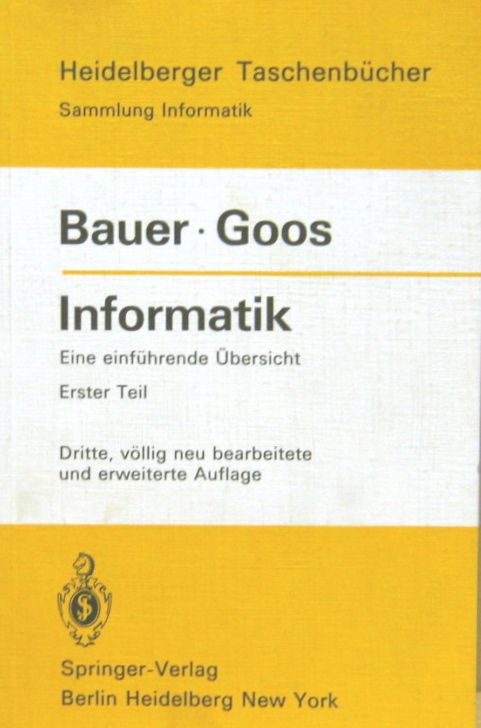 I consider myself to some extend as a third generation informatics pioneer. And I like remembering my first huge projects in the 1970ies. They were called START, ITS, Dispol or SNATCH.
In my private order of things, the second generation of IT pioneers is represented by F.-L. Bauer, whom I personally hold in high esteem. When I was a mathematics student at TUM (at the time it was still called TH for Technische Hochschule) in the fall of 1969, I sat in his lecture when I first studied my minor subject: computer science. Incidentally, the book you see on the picture is my personal copy bought at the time. As you can easily see, it has been read in quite often.
In those days, informatics was something totally new for me. And I probably chose the minor subject because I did not really know what it was. Simply because, in some way or other, it pointed towards the future.
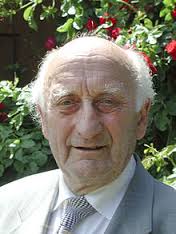 Almost as a logical consequence, I did not understand everything professor Bauer wanted to teach us during this beautiful lecture course. Very regrettably.
During the last few years, I was permitted to accompany professor Bauer when he gave several guided tours in the Informatics department of the Deutsches Museum. Those tours were held for our (InterFace AG) customers, friends and partners. Many things I had not understood as a young student became a lot clearer in the wake of those tours.
Incidentally, I count Konrad Zuse among the first computer science generation. I made his personal acquaintance at the end of the 1086 InterFace-Konrad-Zuse-Bike Tour. He gave us a great welcome, delivered a wonderful speech and presented us the picture you see here during the great reception at Hünfeld. Today, you can see the picture hanging on the wall at the InterFace AG building in Unterhaching.
 By now, informatics has moved on by “light years”. I was and still am a computer scientist with all my heart. For me, the combined meaningfulness of my work, my life and society has always been important. Consequently, the development and future of informatics is important to me. Articles written by third parties about the subject and by distinguished informatics representatives are, naturally, of special interest.
In the 14th edition of the TUM magazine “Faszination Forschung” – a first-class high-gloss TUM München magazine – dated June 2014, I found the article “Connecting the World”.
Here is the trailer:
In the future, everyday objects will be linked via the Internet, enabling them to interact autonomously. To realize this vision, computer scientists are developing virtual models they can use to test practical implementation and monitor the security, safety and reliability of connected systems.
The article describes the future of computer science on the technological level. It is basically about how systems can be coordinated in a future “cyber physical world”. Since I consider the article worth reading and a good basis for further discussion, I am providing you with the download: [download#109].
My friend and partner in the InterFace AG advisory board, Professor Dr. Manfred Broy, is cited in the article. You will also find his picture. It can be assumed that the content of the article is partly the result of the research supervised by him.
I do not totally agree with the article. To be sure, there will be remarkable future developments in our technology, perhaps even more remarkable than those described in the article. However, I do not believe in what applications are predicted. Instead, I assume that the society of the future will have to cope with totally different challenges than we assume today. And I am sure we will then find very exciting solutions. But those solutions will not be part of this “brave new world”.
Yet matters begin to get exciting (and for me alarming) when I read the reply written by Professor Werner Meixner. In a presentation, professor Dr. Meixner described how this article “strikes someone (him) who basically understands the meaningfulness of his professional life as a fascination with the natural sciences as a humanist value”.
This presentation is also part of an open letter addressed to Professor Dr. Manfred Broy with the title:
Where is informatics headed?
Like before, I am providing the link for downloading of the open letter by Professor Meixner:
[download#110]
Since I wish to motivate IF blog readers to read the articles, I will now cite a short but perhaps central part of the article:
All human decisions – and concerns know this quite well – contain an act of added value, which means they are valuable per se. The most important factor is that the owner of the produced value is the one who made the decision and is responsible for it. This is exactly the meaning of privacy and the consequence is the indisputable worthiness of privacy protection. All business behaviour is a consequence thereof.
In fact, I do not quite understand what the author wants to say. My attempt at analysing it dialectically results in me finding a random truth claim which is easy to disprove.
🙂 However, since I am a blogger, I never write open letters to anyone. Instead, I publish my personal opinion in my blog. Totally transparently, everybody can read it.
Here comes:
I find the TUM magazine article one-dimensional. The “open letter” gave me consternation.
In both articles, I find a concept of the world and humans which is no match at all with what I see in the real world. The first article reminds me a little of the nuclear energy euphoria (which at the time was controlled by business interests) more than fifty years ago. The second article glorifies a meaning of privacy and laments its worthiness of protection which – based on my experience in life and my knowledge of anthropology, neurology, psychology, philosophy and sociology – is not at all justifiable. Even theological reasoning would probably fall short
For all of us, the real challenges will quickly be others than those described. The dream image of a networked world will not help us to cope with all those challenges. Neither will the convulsive protection of our private data – which, basically, cannot be protected anyway.
The current news about the IS fronts, other wars and their consequences, refugees seeking asylum in the EU, the assassinations in France , or #Pegida and #Anti-Pegida in Germany are clear indications of a reality that quickly changes and that we have to accept. Also, we have to learn how to deal with this reality in a rational way.
A dominating global economy which creates free markets for products yet leaves labour unfree (a seamstress in Bangladesh cannot move to Europe and do her work there, even though the dresses she makes are exclusively sold in Europe) will come to its end. The rich persons of this world (we) exploit the poor more than ever in human history and the number of slaves is higher than ever.
The tensions generated by these contrasts will probably discharge themselves like earthquakes. It has already started. Basic conditions (climate, food and soil) in many regions already deteriorate and will geometrically continue to do so. Sooner or later, this process will catapult us into critical spheres. The tensions will become more and more noticeable.
In fact, we might be approaching a rough awakening from our current dreams faster than we had anticipated. It is my hope that here, too, informatics can help. Naturally, I do not yet know how this might happen. All I can do is imagine how it might be.
I think the IKT can only contribute positively towards the humaneness of mankind if it – above all – succeeds in supporting a highly complex, world-wide and truthful discourse which thus will render striking results. This is the only way to come to a consensus not based on enmity and exploitation. Instead, it should prepare humans (us) for the necessary changes in our mental concepts and life.
This is the only way to change society without violence. It is the only way to transform today’s economy into a “common-good-economy”. And it is also the only way to find solutions for a better copyright and patent system. Through the wisdom of the masses and against the simple-mindedness of the individual person.
[Note: perhaps our colleagues at Youmigo.de already understood this – which is why they wrote a wonderful APP for “world agreement”.]
As to the TUM magazine article: I would argue that we do not need a luxury world of networked technology which, when all is said and done, will only enslave us even more. As to Werner Meixner’s theses, I think he inflates the topic “pretty good privacy” like a profession of faith. However, instead of giving credible reasons, he remains dogmatic.
And I also believe that our privacy will be something we will be fairly indifferent about in the future. Because we will have other problems. Also, we humans will always move in the stress field of individuality and collectiveness. Either way. With data protection or without. And the only way we can manage to do that in a humane way is if we think and act in a value-oriented way. Dogmata and their prayer-like publication will not be helpful.
Here is another idea about personal data. Isn’t it a rather normal part of human civilization to collect information about people. After all, there were good reasons to come up with administration and, for instance, write down when a child is born. Of course, technological advancement made unbelievable things possible since they invented filing systems and cataloguing.
With “new” technologies, you can certainly collect a lot more data than formerly. Yet this is only the continuation of a development that started with the invention of writing on paper as a means to conserve and hand on information. Quite possibly, the invention of filing systems (certainly an IT invention) brought another impulse. And IKT yet another.
But: did IKT really make such an enormous difference? And how huge is the damage? And isn’t it just great that in general information can be made available by whistle blowers and that it was IT which made it easier?
I see a threat if “a-moral systems” (like unlawful systems) get hold of the data. But if it comes to that, no data protection will help us, anyway. Instead, we should see to it that “a-moral systems” never gain control over us. And that is a permanent social challenge for every citizen. Basically, you can only resist “commercial utilization” of data by being autonomous. But then, the same is true for the continuing threat of manipulation through marketing. And if you consume senselessly, it will only cost money, rarely your life.
Personally, I consider the avoidable damage the “old” technologies caused us during the last hundred years and still cause us permanently today significantly higher than the damage done by the new technology IKT during the last 25 years.
For instance, the technologies of the last century stole our piece. Does any of you still know a single place in Munich where you hear no “technology noise”? Yet the noise pollution is only a truly harmless example compared to the 1.2 million traffic fatalities each year – caused through motorized individualized mobility on a world-wide scale. And it is a fact that we also like to ignore other threats, such as the carbon dioxide content in the atmosphere.
In the same way we accepted the limitless noise emissions, we also got used to our (still very limited, regardless of all efforts) transparency. Limited, because even the networking systems used in industry and in the world 4.0 will find it hard to read our thoughts. And because, if we want to survive, we will definitely have to develop into autonomous persons in a self-determined frame.
Maybe the permanent calls for secrecy of data are nothing more than an outcry of protest, because, after all, you have to be against something, don’t you? And you are not courageous enough to actually stand up for the real threats.
But then, do not let us forget:
Only the new technologies provide us with a chance of networking and sharing our ideas with others. Which is how we can fight ignorance, intolerance, dogmata, irrationality and much more of the same.
RMD
(Translated by EG)
Roland DürreThursday January 8th, 2015
#JeSuisCharlie
Basically, I am reluctant when it comes to commenting such atrocious events. This time, however, I would like to share a few ideas. Simply because, to me, it seems like the public discussion is too oversimplified and prejudiced.
I miss people demanding from the investigating offices (or even better: the intent of said investigating offices) to investigate with a huge amount of transparency and publicity. At least parliamentary control should be guaranteed. To me, it seems like the argument that this is not possible because it would threaten the success of the investigation is not legitimate.
I would demand this because the past taught us again and again how cautious you must be with condemnation in advance of trial. Too often, we saw how in such situations offices have been pushed by individual interest or made “blind on one eye”. Even our enlightened Federal Republic of Germany gives us lots of examples: from the Octoberfest assassinations in 1980 through NSU. Consequently, you cannot and must not condemn in advance of trial in such a case as this.
It also seems remarkable to me that in the USA, a country where weapon enthusiasm and weapon lobby are ever-present, a country where the death penalty is a normal thing and where both individual persons and the executive powers react to violence with counter-violence, – that in this USA the pencil is now becoming the new super-weapon. In my opinion, this is cynicism and in itself deserving a caricature. The USA especially missed the chance of showing greatness too often, causing world-wide damage with un-thought-through politics.
So far, they are only looking for “alleged culprits” and talking “main offenders”. Even if it turns out that the culprits were Muslims, this does not mean the motivation had its roots in religion. Just like there are “insane Americans” who commit the crimes of a homicidal maniac, you will also get insane Muslims. Statistically spoken, you should actually have more of them, because there are more Muslims than Americans living on this planet…
I mentally associate this latest with assassination attempts in other countries. For instance I find public outrage rather minimal whenever a weapons fanatic in the USA massacres people in a school. And how quickly it is all forgotten in the media and then how easily the NRA (The National Rifle Association) has both the public opinion and the government again under control.
Last not least – I wonder why? – I remember the terror an Israeli army caused in Palestine not so long ago at the command of its government, laying in ruins an entire city.
Consequently, I would recommend even with this atrocious event in Paris that we retain a little serenity during the discussion. Maybe it is a good idea to first wait and see who is behind the scenes.
Imagine, for instance, what would happen if the murderer were “occidental warriors” of a French “Pegida” who staged the attack in order to make it look like “Islamic warriors”. That would be the occidental Worst-Case Scenario. And perhaps this cannot be? Also because Madame Le Pen and consorts would not appreciate it.
RMD
(Translated by EG)
Roland DürreWednesday January 7th, 2015
Entrepreneur’s Diary #106 – Re-Structuring & Number of Team Members.

“Beyond Leading”
A young computer scientist who works in the subsidiary company of a huge US IT concern told me a short time ago:
”My work is far less demanding that I would wish. The problem is that, in a little more than one year, there were three different superiors of mine. Consequently, the current boss does not even know me. Nobody really knows my true competence. It annoys me to be so misjudged and I am going to look for another job where my competence is appreciated.“
Huge enterprises and concerns organise themselves anew in ever shorter time intervals. They want to show that they are capable of and willing to react to changes. This is to increase efficiency and decrease costs. The intention is to make it clear that they understand the market and initiate new concepts. More often than not, the re-structuring is not really a consequence of some acute tragedy, but you will always find a reason.
Once in a while, a mere change of managing directors will suffice. After all, the newcomer has to show that he brings change. In the wake of such re-structuring it can easily happen that two thirds or even more of the employees suddenly have a new superior. One they did not know at all or just from a distance before.
I am rather sceptical about this tendency towards re-structuring in ever shorter time intervals. An “introductory phase” that deserves the name requires that you trust each other. And the first requirement of trust is getting to know each other. How else should you have at least some knowledge about the values, expectations, interests and needs of the persons you are working with, as well as their competence and special talents?
Today, leaders are responsible in a “disciplinary sense” for many more people than formerly. In times gone, a “boss” was directly responsible for perhaps seven employees. Today, it is often many times that number. Leadership did not get any easier through this, since, basically, there is just not enough time for the individual person. It is hardly a surprise that in surveys most of the employees say they would like to have more time with their boss.
The HR Department (“Human Resource”), relying on a sophisticated HR software, is supposed to compensate for the loss of time with your immediate superior. Said software also contains very detailed employee evaluations. The leadership work is pressed into artificial personnel processes. External support for leaders is used with counsellors from outside the company. They subject internal employees to a “profiling” and then have “professional” feedback discussions with them.
I very much doubt that this will ever work. On the contrary: if a stranger, for instance, “evaluates” an employee who has been in the company for a long time and then tells him what type of person he thinks said employee is, this will often cause bizarre or ghost-like situations. More often than not, those situations will cause frustration or at least “inner resignation”.
To sum it up, I would say all re-structuring in huge concerns, as well as in small enterprises, should be executed with a lot of sensitivity. Forming (too) big teams with only one leader should also be well-thought-out. In such a context, frivolous and radical measurements usually do more harm than good.
Change as it happens today will certainly call for a permanent change in your own organization, too (both in structure and processes), yet it should happen as a continuous process and after long consideration.
RMD
(Translated by EG)
P.S.
For more articles of my entrepreneur’s diary, click here: Drehscheibe!
Roland DürreMonday January 5th, 2015
As Time Goes By …
 I need only look back upon the thirty-one years of my life at InterFace AG to see: many things have changed over the years! On all levels and in all dimensions. Looking at society and technology, or the way knowledge is treated today, what I see is more than a little surprising.
Totally new disciplines became important and made huge progress – and, as I see it, they also changed the world. Along with technology, I am also talking sciences such as psychology, neurology, behavioural science, along with game theory and good old philosophy. Not to mention how values and morals, even the concept of life for the individual person as well as in society and collectively, underwent change.
These developments exacerbated each other, thereby increasing speed in a way that I would no longer call linear. In fact, I considered and consider it more like “geometrical or exponential”.
This is why the following model I discovered a short time ago is one I am in favour of. It is about the words knowledgeable and ignorant, as well as competent and incompetent.
You could assign these four characteristics to a matrix with four quadrants. The top line of the matrix is “incompetence”, the lower line is “competence”. The right column is “knowledge” and the left column is ”ignorance”.
The upper left quadrant would then mean “knowledgeable yet incompetent”.
If you take the real-life example of an adolescent who knows that he cannot drive a car, you get the result that he is “knowledgeable yet incompetent”.
The lower right quadrant means “knowledgeable and competent”.
In our example, the adolescent grows to become a young man and learns to drive a car. Now he knows he can drive a car. And he will drive a car. Consequently, he is “knowledgeable and competent”.
The lower left quadrant represents “ignorant yet competent”.
As the young man grows older, he drives his car a lot. Consequently, he will become very good at driving a car, yet he is no longer actively aware of said competence. Whenever he drives a car, he is “ignorant yet competent”.
The upper left quadrant represents “ignorant and incompetent”.
We already can imagine what the story will be in the upper left hand corner. The man has turned ancient. He certainly should no longer sit behind a wheel, because he is no longer fit to drive. Yet he is not aware of this. Consequently, he will continue to drive with “ignorance and incompetence”.
Well, isn’t that a nice example? Yet there is one disadvantage. It suggests that man is the one who, due to age-inflicted change, mutates from “knowledgeable yet incompetent” via “knowledgeable and competent” and “ignorant yet competent” to “ignorant and incompetent”.
More often than not, however, it is the world or the environment which quickly changes. Whenever you enter a new social system, you will immediately notice that you have to work towards “being able to participate”. You learn the new system and then you become part of it. Except that, even after a phase of being “ignorant yet competent”, you might quickly become “ignorant and incompetent’.
Because the rules and the actual functionality of the system changed so fast and so dramatically that you never even noticed it. That is when you will look stupid and no longer understand the world – in which just a short while ago you felt ever so much at home.
Well, once in a while I, too, feel I am getting caught in a chain carousel that rotates faster and faster all the time, making me feel quite dizzy.
RMD
(Translated by EG)
P.S.
The picture is called “Wellenflug auf dem Roonkarker Mart”. I found it in Wikipedia with the carousel article. It is originally be Wilfried Wittkowsky.
Ulf D. PoséSaturday January 3rd, 2015
Post by Ulf Posé on MINIMUM WAGES!
Hello and a good day to you all!
I also wish you a happy new year. On top of this, I would like to send you my ideas on the minimum wages. After all, the regulations regarding same have become active yesterday. This article is also available on Politik-Poker. Why don’t you take a look at the website anyway? You might find some things worth reading.
ULF D. POSÉ | 02.01.2015
At long last, we now have it: the minimum wages legislation!
I am sure that the occasional Sylvester rocket was launched to celebrate the minimum wages legislation. At long last, millions of persons can now afford to buy the necessities of life without federal subsidies.
At long last, the exploitation has come to an end. But is that really true? Are minimum wages really fair and do they actually make sense?
It is certainly a good idea to think about income minimums. But then, thinking about them should eventually result in a responsible judgement. There are two questions you need to ask:
1. What is the purpose of a minimum wage, and will the legislation actually help?
and
2. Can we all afford to pay minimum wages?
Well, the purpose of a minimum wage is that people can live without needing federal subsidies. This is not possible with the minimum wage set to 8.50 € by federal law. Not for singles, and definitely not for families with only one breadwinner.
As early as 2004, the border value for a minimum wage you would need was 1,704 Euros before taxes per month. That equals an hourly rate of 9.78 Euros. Even at the time, there were 44,000 regularly employed persons who earned more than that and still had to rely in extra support by the state. The independent “Institut für Arbeitsmarkt- und Berufsforschung (IAB)” formulated in 2005 in rather clear words: “Depending on the household context, we (might) still have to talk indigence, even if someone earns more than 7.50 Euros per hour”.
Consequently, the goal to make it possible for everyone to earn a living without state support has not been reached. That remains true for a minimum wage set to 8.50 €. And it also concerns far fewer persons than is always said.
In the past, it has been postulated – primarily by the unions – that around two million persons need Hartz IV money, regardless of having work. That would be almost one out of twenty.
According to a study by the independent Institut für Arbeitsmarkt- und Berufsforschung (IAB) in the year 2005, that is indeed the number of adults who get additional money from the state. But among those were masses of persons who only held 400-Euro-Jobs. Of those who really worked full-time, only 495,000 persons received Hartz-IV money.
In April 2006, the number was around 473,000 and in 2007 it was 526,000. That is still an enormous amount. But then, among those 495,000 full-time employees who needed to add Hartz IV money to their income, there were only 14,000 singles who could not live on their full-time jobs. That is 0.035 per cent, rather than 5 percent – which would have equalled 2.1 million persons if one had believed the unions. This is how you manipulate people when they make up their minds.
Consequently, what counts if you are talking federal support is the marital status. If someone has a partner who earns no money, and if, on top of this, he has two children, then he cannot feed the family with a wage of 8.50 Euros per hour. Not mentioning this in the public debate is probably making the people look stupid. It is definitely dishonest.
Now, politics introduced the minimum wages for all areas starting with January, 1st, 2015. Yet if I look at how public projects are assigned to companies, then I see that the cheapest one gets the deal. This alone is sufficient to make you wonder. How the authorities lie!! Moreover, a legally fixed minimum wage unfortunately supports the Marxist idea that achievement should be honoured regardless of its usefulness/uselessness. This might be understandable as a humane concept, but at the same time it distorts the concept of what is truly the underlying idea of earnings.
The next step is to answer the question if people can afford to pay a minimum wage. If you determine minimum wages that an enterprise cannot pay because their sales situation does not yield the necessary return, you will only promote illicit employment and fake self-employment.
If work is not desired because it is too expensive for the entrepreneur, then it will disappear from the market – and the entrepreneur along with it. This might be a bitter truth, but it follows a very simply economic logic. Income is created through supply and demand on the workforce market, along with the added value achieved by the work.
If the wages are higher than the added value, then it can no longer be financed: the demand dies. As soon as an entrepreneur is forced to pay wages he cannot earn by fulfilling his orders, the enterprise will have to close down – or else the state will have to support it. We experienced this over and over again when, after the East-West unification contracts, equal (or almost equal) payment was made obligatory in East and West Germany. Eventually, we had some areas with almost 40 per cent unemployment.
Just take the example of temporary employment. A temporarily employed person who has been leased to a car manufacturer in the metal/electronics-industry will get the high metal/electronics industry wage for putting products onto shelves. If, a week later, he does virtually the same thing, but instead of putting buffers for the metal/electronics industry onto shelves, he now puts water bottles onto shelves for a retailer, he will get less money – for the same job.
Wages are all sorts of things, but they are certainly never fair.
The immediate outcry is that this is not fair. Unfortunately, according to Ulpian, justice is the wish to let all people be treated fairly. But the truth is that wages can never be fair. Nor will they ever be fair. They are based on what is appropriate, not on what is fair.
Whether a wage is appropriate depends on the demand and the added value. Consequently, the added value of putting water bottles onto a shelf can be considerably lower than that of putting buffers onto a shelf.
Just like fairness is never a basis for wages, the same is true for achievement. If it were otherwise, then putting buffers onto a shelf would have to be considered the same achievement as putting water bottles onto a shelf.
The achievement principle is Marxism in its purest form.
Performance-linked payment is not an invention of capitalism. In fact, it has been invented by Karl Marx, who used it as a polemic argument against the market-value-utilization-value principle as propagated by capitalism. Unfortunately, we seem to have forgotten about this.
Performance-linked payment ignores that the usefulness of work is its determining factor when it comes to wages. If performance were the determining factor, then a managing director who does 100 per cent of what he is supposed to do would get less than a skilled labourer who does 130 per cent of what he is supposed to do.
I believe that in this ideological dispute, many persons follow Bernhard Shaw, who once said: “Some people are only prepared to die for things they really cannot understand”.
Minimum wages – so what about the self-employed?
If you wanted to be strict, a minimum wages law would also have to include a law that enforces that certain products must be bought, where the price is also regulated. Introducing a minimum wage would have to make it obligatory for all customers to pay a suitable price. No economist would ever consent to such a drastic Marxist measure. At the same time, the example makes quite clear what a grotesque discussion we are into.
When talking minimum wages, we totally ignore a huge part of the work force: the entrepreneurs and self-employed. We in Germany have 100,000 self-employed persons whose income is below the legal seizure exception limit. All of them are extremely hard workers.
They work an average of 59 weekly hours and they have extremely little vacation time: around 15 days each year. There are around 600,000 self-employed persons who earn less than 7.00 Euros per hour. On top of those, we have 213,000 freelancers who learn less than five Euros per hour. And those ‘rich‘ entrepreneurs are supposed to be paid the 8.50-Euro minimum wage in the future? Well, it seems that politics have no problem with self-exploitation!
In the debate about minimum wages, the political care for freelancers is totally forgotten. Why do we want to deny employers and self-employed persons something that is considered fair for wage earners?
I presume that our politicians do not wish to admit that they consider self-employed persons as second class citizens who need no support. Perhaps it is also a little unfair to constantly put pressure on our politicians. They have to meet the demands of the current lobbyists at all times.
And still it might be worth consideration from an ethical point of view if full-time work that does not enable the worker to meet his needs at the level of social welfare payments might not be humane after all – as even the social court of Berlin decided.
Is the minimum wage a job killer?
And there is something else you want to remember. Even if the purpose of the minimum wages, namely that you can feed your family, cannot be achieved; telling people that the minimum wages will always and exclusively kill jobs is not absolutely true, either. All over Europe, the experiences they made with minimum wages are as diverse as the amount of said minimum wages. Eighteen out of 25 EU members introduced minimum wages a long time ago, among them are England, the Netherlands, Portugal, Spain, Ireland.
Even in the United States, we have a minimum wage per hour. So you can see that, by now, we stood rather isolated. So far, the increase of unemployment everybody feared caused by introducing the minimum wages has not yet happened in countries where they have it. This can be proved empirically. At least that is the argument of the politicians and unionists. Unfortunately, however, pointing out how the minimum wages function in other countries as a good example is also accompanied by several information deficits.
For instance, in the US, the minimum wages are not a tool for fighting poverty. The income is increased through a negative income tax. Until the end of 2014, the minimum wages in the USA were 7.25 USD. From January, 1st, 2015, it is 10.10 USD (which equals 7.48 €). But will that be enough without federal support? In 2012, families with two or more children received a maximum extra amount of money to the tune of 4,716 USD (3,218 €) in the United States. The Brits gave their poor earners up to 1,730 British Pounds per person (2,342 Euros).
These additional support sums are actually in the same spirit as the one that underlies the Hartz-IV regulations. In other countries, too, the minimum wage system does not automatically make it possible for a family in the United States or Great Britain to be able to live on one income.
At the same time, the amount of the minimum wage is a determining factor. Years ago, the OECD found out that minimum wages can only marginally influence the poverty line. Among young persons, unemployment rather increased through the introduction of minimum wages. The OECD took a closer look at the consequences of minimum wages in nine countries and concluded that the minimum wage had a negative effect on the job situation in 24 cases. In 15 cases, there was either no effect or sometimes a positive effect.
Then the “Sachverständigenrat zur Begutachtung der gesamtwirtschaftlichen Entwicklung (SVR)” investigated minimum wages. The result is truly interesting. If less than two per cent of the employees were affected with the minimum wage (like in the USA and Great Britain), there were “usually no or only small negative effects on the job situation. Sometimes there were even positive effects”. But here is the clinch: in France, the situation is totally different. There, the minimum wage is so high (9.53 €) that 15.6 per cent of the employees are affected. The consequence: increase unemployment among women and young persons.
In the eyes of the SVR, France is a good model of comparison for Germany. So maybe we should start being afraid, because the SVR also said that the increase in unemployment was rather drastic after they increased the minimum wages. A survey by Laroque and Salanié points in the same direction. If the minimum wages are increased drastically, you get more unemployment, if you increase them moderately, that is not likely to happen.
Mind you, the minimum wages can also be a defence instrument against competition. Just think of the Post AG. They got rid of their most important competition for letter delivery through introducing the minimum wage. For good reasons, the Post AG was in favour of the minimum wage. In the Netherlands, the Post AG is a rather small service provider. And their opposition to the minimum wages was rather vehement.
In Germany, however, there is another sad factor: our love of regulations. So far, nobody can really say to what extent the extra bureaucracy of documentation will be a burden for the enterprises.
And yet: even if you take all these factors into consideration, you should not make it too easy for the enterprises. An enterprise that cannot pay wages above the amount paid according to the Social Welfare Legislation either suffers from poor market circumstances, or else it will have to ask itself if mistakes were made in management.
The market and the competition decide about the final profit an enterprise can distribute. If an enterprise cannot pay its employees sufficiently, then it is either operating in the wrong market segment or offering the wrong products or producing at the wrong place, or else it has made wrong decisions. A good example from the past is Schlecker. The crises cannot be the reasons why the employees are financially ruined by the management.
udp
Roland DürreFriday January 2nd, 2015
The New Year Frustration Splitters
Now we finally arrived in the new year. I am available and have many plans. Except: I can no longer listen to the radio. Because that would just end in frustration. Here are a few emotional ideas on the news of Sylvester and these days. There is quite a lot I no longer understand.
The Sylvester rockets took at least four lives in Germany. They became victims of pyrotechnic. We do not know how many lives the Sylvester gluttony cost. The total damage done during the Sylvester night this year, too, seems to have been especially high. What I mean is not the many fire crackers that have been uselessly and intentionally destroyed, but the subsequent damage.
But we shoot rockets, ignite firecrackers and fear terrorism and a “De-Europezation”. And Islam. “Pegida” plays a central role in all the news. Both for our Federal Chancellor and the labour associations. They do not want Pegida.
But only because it is bad news for the economy.
I, too, dislike Pegida. But my reasons are that it is inhumane, stupid and fundamentalist.
Yet the politicians say: we have to take people’s fears seriously. Because they are always looking towards the next election time. Consequently, they always fear that their majorities will become doubtful. This fear is certainly justified.
The fear of so many persons who will not and cannot understand the growth ideology and the insanity of our economic system is not taken seriously by “politics”. Because there is no alternative to growth.
The same is true for the fear of those who criticize the total electronic eavesdropping by internal and external organisations. And woe those who are worried about TTIP or who would want a different social structure.
Those people do not need to be “taken seriously”. Instead, you have to convince them! Today, this is still happening through adverts (aka enlightenment) by the responsible ministries. Well, I am certainly happy that we do not yet have federal re-education.
Another thing I find bureaucratic nonsense is the discussion about the minimum wage and the minimum wage itself. Not because I am opposed to it. In fact, I am totally in favour of fair pay for human labour. If possible on a world-wide scale and also here at home. Basically, I believe this should be self-evident.
Except – this is exactly what the concept minimum wages will not give us. Instead, it will give us even more bureaucracy, rules, control, penalties… And even more injustice.
Besides, the concept of minimum wages also fell victim to a profound mistake. As with many similar rules, they simply forgot to take inflation into consideration. And in a few years, we will all laugh out loud about the minimum wages, because they are so low. Or is it planned to increase them every year? What are the criteria? I know of no such plans.
Inflation happens. I notice it every day: at the bakery, on the market when I buy vegetables, in the swimming pool, when going places by S-Bahn or DB train, when I buy stamps from the post office in order to send my conventional mail, in pubs, etc. It is not really much of a consolation if the Diesel fuel – probably just for a very limited time span – seems to be rather cheap. And if you get huge amounts of money for hardly any interest.
The crazies in Brussels, too, frustrate me: they want to provide one billion Euros (in digits: 1,000,000,000,000 €) for growth and against low inflation.
So what is left for me to write about?
That health insurances are permitted to throw their savings around in 2015 when competing for more members and then, from 2016, will be allowed and even encouraged to generate additional income through tricky tariff constructions? And that then everything will be even less transparent and more complex?
About the post-Christmas populism practiced by the CSU? Or the helplessness of the Pope who discovered fifteen illnesses in his management system but does not know how to heal them? Or about the lunacy in the Ukraine and the Nato? About the demand by the Bavarian Government (in order to increase the rate of solved crimes) to have longer data storage (because of cyber criminality)?
No. As a matter of facts, even grumbling is no longer any fun!
RMD
(Translated by EG)
P.S.
I just heard an item of good news: As of today, Uli is a day release prisoner. I rejoice with him.
Roland DürreThursday January 1st, 2015
Entrepreneur’s Diary #105 – Communication Splitter
Some time ago, I witnessed a basically harmless example of “communication in an enterprise” which surprised me. I had to write down a few ideas related to it. Today, I am going to publish them. Here is the discussion of the “use case” as it is called today using modern entrepreneur’s German.
Let us assume you are the boss of an enterprise. And you have a new employee. You notice that the new employee regularly parks his car on one of the customers’ parking spaces. Which is something hardly anybody else working at the company is doing. This is not a good thing and it annoys you. So what do you do?
You have various measures at your disposal. Here are some of them:
- You write a notice in your in-house social media to all employees saying that “the customers’ parking spaces should not be used by employers unless there is a truly urgent reason”. If you have no in-house social media, you can use the old-fashioned email, writing the same content to “all”. And since you are the boss of a well-functioning and ISO-certified enterprise, you will simultaneously check and modify the process “introduction of new employees” in the management handbook. Also, the internal leaflet “welcoming new employees” will get the additional note that “parking is only allowed on the employees’ parking spaces”! Of course, all these activities have been run through the workers’ council.
This is how a huge enterprise would go about. It is correct as far as entrepreneurial processes are concerned. However, for small enterprises, it is definitely not the optimal solution, since this is exactly how you path the way towards bureaucracy. - You do not wish to make a huge affair of the issue and talk to the employee about his wrong behaviour in private as soon as there is an opportunity. As soon as you meet him in the corridor or elsewhere, you will – after the usual small-talk – tell him about how he violated rules: “In fact, there is something you probably did not know – you were repeatedly seen parking your car on the customers’ parking spaces”. And you will kindly ask that he should not do so in the future.
Basically, there is nothing wrong with this kind of procedure – or is there? However, I think it is not the best possible method. On the corridor, you might always have people listening who are secretly glad that the boss is giving the new colleague “a plain talking”. And if he finds himself between a rock and a hard place, the new employee will always say there was no other space available. Or else he might come up with the white lie of just not having seen the sign that says “for our customers only”. Or some such. - You go and see the new colleague in his office and have a four-eyes-only conversation during which you ask him if, maybe, he never saw the sign saying that the customers’ parking spaces are to be left to customers only.
:-) I find this last alternative the best of all: your frustration is gone and nobody is any worse for it.
Now let us assume that not only you as the boss (“direct supervisor”) but also the administrative boss noticed the parking space sinner. After all, she is responsible for seeing to it that these rules are adhered to, or at least she believes that is her responsibility. Her reasons are totally honourable, because she simply wants to help the enterprise to function smoothly. However, she believes that there are things you simply cannot do in life and therefore you should not do them in the enterprise, either. Let us call her a kind of moral police who is absolutely sure that morals are on her side.
WWhich of the following paths could (or should) the administrative head take?
- She goes and talks to the boss about the permanent violation of rules by the new employee. Perhaps because she does not wish to “dirty her hands”. After all, being the boss, he should know how to deal with these kinds of things (he also earns more money, doesn’t he?). And, of course, it is rather easy to understand that she herself does not wish to lecture the new colleague.
As I see it, this is a rather prudent way of dealing with the situation. The only potential downside is that the boss may see her as “sneak”. - The second alternative would be that she takes note of the colleague and puts him on a mental list. As soon as he has to see the administrator (and, believe me, the day will come sooner than you thought), she will give him the lecture. Of course in a very friendly manner. But then, it will definitely not be tolerated in a newcomer to have special treatment. Where would we end if that were to start?
Well, you might imagine that this is not an alternative I am in favour of. However, this is what I witnessed.
But then, there is also another possibility. - When they next meet face-to-face, she might tell the colleague in private that, in this house, there is the rule that customers’ parking spaces are for customers only and maybe he can remember?
Well, this would have been my favourite way of dealing with the situation. Especially if you find the right way how to say it. As always: C’est le tone, qui fait la musique.
But no matter what, it will always be a good idea to give a good example. Both if you are the boss of the enterprise or of the administration. Especially when it comes to these trivialities. Usually, you will find that the system works by itself. Because the “Newcomer” will notice it and comply.
Giving a good example simply means that you yourself refrain from occasionally using the better situated customers’ parking space. Because the rules that apply for all the others should also apply for the boss and the administrative head. And their friends, acquaintances and favourite employees.
This is the only way for us to remain authentic. And authenticity breeds trust. And trust is the one thing that will make it possible to work together in an environment of courage and joy.
RMD
(Translated by EG)
P.S.
There is a reason why I waited with publishing this story until now. Yesterday, I saw that a not totally unknown German concern moved and the customers’ parking fell victim to the move. Next to the new and very modern central building, they now have a very elegant and therefore expensive parking garage. Well, the customers can park there, can’t they? Bear in mind: customers are supposed to buy things and other than that, they might remain where they are.
P.S.1
For more articles of my entrepreneur’s diary, click here: Drehscheibe!
Roland DürreWednesday December 31st, 2014
A Good Start and a Successful 2015!
As every year, I wished all IF Blog readers and friends a “Happy New Year” when the year 2009 came to an end. That was exactly five years ago. My article at the time read:
Tonight, we are going to celebrate the turn of the year. We will bid the year 2009 good-bye and start the year 2010. A new decade awaits us. All the evidence points towards the world undergoing massive change in the coming years.
I would wish for the coming year that the imminent changes take place without violence.
May we remain free from war.
May our social values tolerance and freedom be preserved even in the difficult times that lie ahead.
And may we not admit into our part of the world the atrocities of an inhuman concept of society.
As I see it, none of the aforesaid is now outdated and I fear that all these wishes will be even more important for the next five years. Consequently, I am not going to add anything and wish all my IF Blog readers and my many friends and partners in exactly this spirit:
A healthy and successful year 2015!
May the ounce of luck which is so beneficial for all of us accompany you on all your ways.
 The beautiful picture has been arranged by Rolo Zollner! It, too, was part of the 2009 article.
Thank you, Rolo!
RMD


