
Roland DürreSunday February 22nd, 2015
At Eye-Level – A Film about Work-Life in the 21st Century.
 A team of five started an exciting project – and eventually it turned into a film: “At Eye-Level “ (Augenhöhe).
Here is the story: During a session of the 12th intrinsify!me “wevent” in Berlin about the work-life value of the 21st century, the idea grew that you should not only describe everything in words at all times. Instead, you should show it to people – in a film.
Five session attendants remained together and got active. They made the film “At Eye-Level”. I first heard of this project on the Berlin 2015 PM Camp during a great impulse presentation by Ulf Brandes. Later, I saw parts of the film during the Munich 2014 PM Camp. Two of the protagonists playing in “At Eye-Level” are personal acquaintances of mine through PM-Camps.
Thanks to enormously well-used “social media”, the project quickly earned great acclaim, even beyond the internet. The successful crowdfunding for its financing, too, had enjoyed a huge amount of public awareness and was accordingly very successful. The opening night on January, 30th, in Hamburg, too, had a huge audience. More than 400 (!) persons came to watch the film at the Hamburg Museum der Arbeit.
The film is about good topics. Perhaps its professional quality cannot hold a torch to documentaries with similar topics, such as by Geyrhalter, Wagenhofer (among other things the trilogy We Feed the World, Let’s Make Money and Alphabet) or Carmen Losmann (Work Hard – Play Hard). But neither does it need to – it is more a refreshing production on the level of TV reports by the ARD or ZDF, for instance about shipping electric waste to Africa.
The film is about persons acting different roles in their work-lives: entrepreneurs, managers, founders. But above all, it shows employees happy to be working for “good” employers. Because they can, for example, due to innovative working hours models, dispose of their own free time more freely than is common and therefore organize their own lives as they wish.
Unfortunately, though, the highly praised project “At Eye-Level” is also one where not all is gold that glitters. Shortly before the film was finished, two articles about Adidas and Unilever were added to it.
Adidas
Suddenly, you see Christian Kuhna in the film. I first met him at the open-up Camp in Nuremburg. His job with the sports giant is about social media, Moocs and the like and he has a small but very efficient team at his disposal
I am sure that the work-life attitude in Christian’s team is good and modern. Also, I am always impressed by the competence and positive attitude of all the salespersons in Adidas shops. But I am sure this is not true for the huge majority of persons producing for the concern.
Consequently, including Adidas in the film was a source of controversy among “crowd funders”.
Unilever
At the very end of the shooting, Unilever, too, was added. Even as early as the meeting in Munich, I was surprised to find the food giant presented as a positive example. There, Sven Franke – one of the protagonists – told us that Unilever had contacted “At Eye-Level” because they had established contact during the film “WORK HARD PLAY HARD” by Carmen Losmann. In that film, they had not made a particularly good impression and consequently, they wanted to make up for it. Well, no matter what, Unilever definitely is not the best material for this kind of film.
Sven’s reasoning was as follows: they wanted to show that even a huge enterprise can have a few niches where work-life might happen at eye-level.
Well, this might be a matter of taste. To be sure, every huge enterprise also has a few “islands of blessedness”. Even if it is only the team of directors.
However, it is also possible that Adidas and Unilever were included because they are “big names”. Which might have made the producers think makes the film more attractive. This is certainly also an acceptable decision. But if so, you should also communicate it as such.
When talking “big names” and these kinds of ideas, Tomas Sattelberger, too, comes to mind. He, too – just like he also currently seems to be publicly visible all the time – appears in the film. After all, everybody wants to hear and see a repetition of the Saul-Paul story. I do not know Tomas Sattelberger personally, but only from what I read about him in the press. Consequently, I cannot give a valid estimation. But in his roles as director of famous DAX concerns, he did not look like the typical representative for “eye-level” to me.
Well, so much about the small stains on the otherwise clean slate.
Mind you, please not to misunderstand me: I find the topic “eye-level” as formulated by Sven Franke or Ulf Brandes an excellent idea. The same is true for the activity and the result. Also, the enterprises concerned are welcome to the gain in reputation they got from it and I would be happy if those who initiated the project were also reimbursed in a material sense for the huge amount of energy they put behind it.
It is a true delight to discuss the individual film scenes under the “entrepreneurial” light. Especially the founder’s enterprises shown in the film might suggest that a proper firm is only possible where you have the “good tyrant”. The question I ask is: how can the entrepreneurial culture shown in the film also be structurally included in our social system – for instance in the sense of a “democratic enterprise”.
RMD
(Translated by EG)
P.S.
The picture is not from the film “Augenhöhe – At Eye-Level”. I took it from “WORK HARD PLAY HARD” by Carmen Losmann.
Roland DürreSaturday February 21st, 2015
METAPHOR.
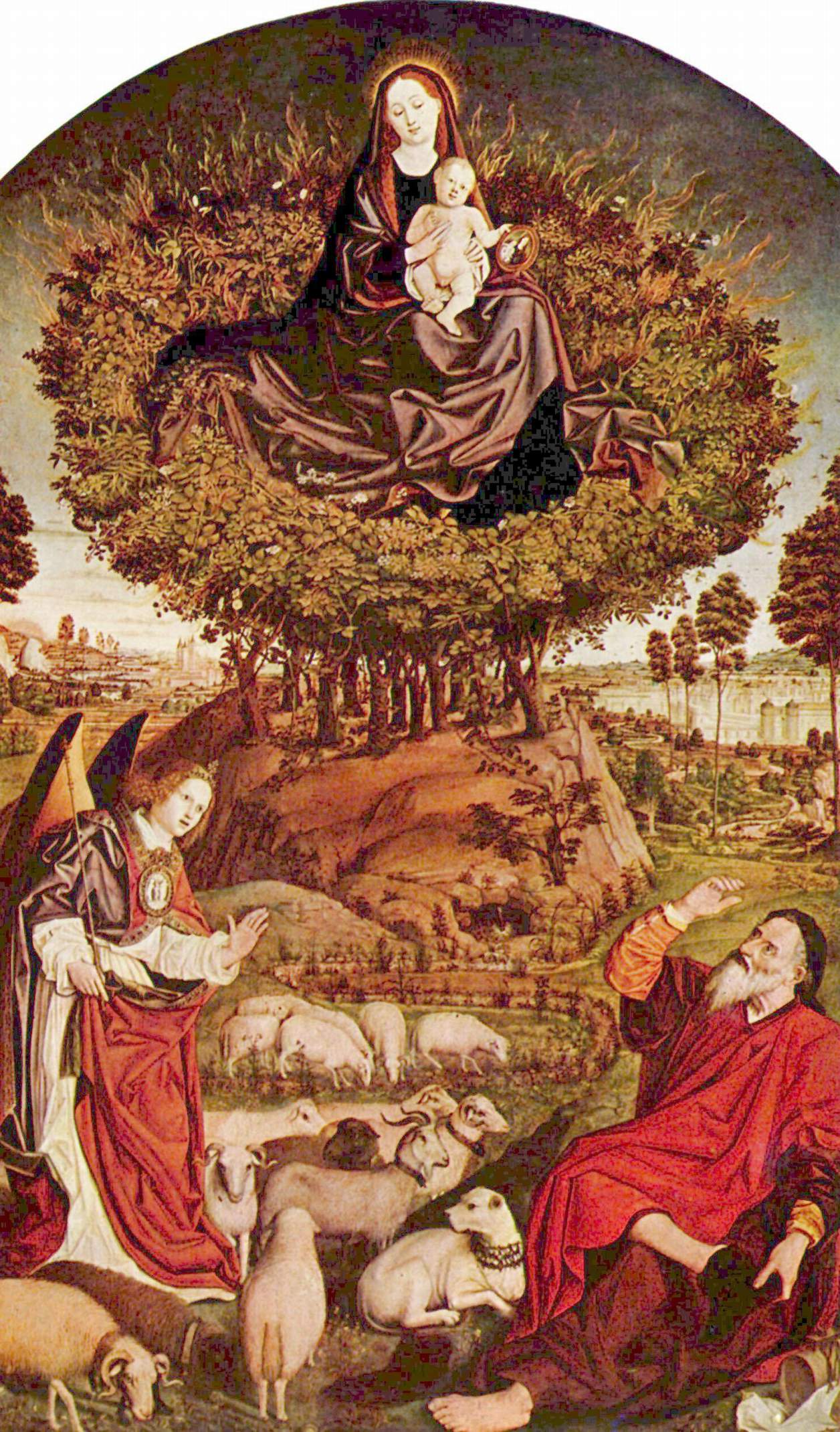
Triptychon of the Burning Thornbush, Middle Table
How often do I lack the words to really say something precisely? In the way I want to say it. In those instances, the power of a good picture would help. After all, we all know the following example of a metaphor:
“One picture can say more than a thousand words”
At least two of my friends have a special talent. They quickly understand complicated relations during a shared discussion and then can draw a graph of those connections on a piece of paper or into the pad in no time.
All of a sudden, the topic gets easy to understand, the valuable and beautiful visualization is a great help when it comes to literally get a grip through your eyes on often very complicated mental concepts, projects, plans, intentions, future developments and much more.
Unfortunately, being able to draw beautiful images is not one of my talents. Instead, I learned something else. Not too long ago, I participated in a philosophical colloquium organized by my friend Klaus-Jürgen Grün in Munich. It was about the value and meaning of words and metaphors (Metapher).
During this event, I understood that there is a huge power in metaphors, just like there is in images. And that metaphors are ideal for transporting a message in such a way that others will get convinced. Now I make use of this understanding – and consequently, I feel better when I have to formulate sentences. As before, I use slightly meaningless symbols drawn on a board or paper to support what I am saying.
I wanted to test my newly-acquired competence with a friend. I told him about the great film Alphabet by Erwin Wagenhofer and used a metaphor from this film:
“When we are children, we are 98% genius, after our training, only 2% remain”.
This is how I wanted to show him how sceptical I am when it comes to our educational system. However, it seems like I had not chosen an ideal example. After all, the term “genius” can be interpreted in various ways. This fact was a source of distraction from the statement I had intended to make and thus took away some of the strength of my metaphor.
My partner in this discussion immediately noticed this and the first thing he did was ask me for a precise definition of the term “genius”. Well, this actually put me in a tight spot and the only thing I managed to mumble was something like “thinking against the mainstream”.
The second time, I tried a different metaphor. It actually worked. It underlines a message I hold to be important for all your life:
“Do not preach water while you drink wine!“
We all know quite well that “water” and “wine” are. And the same is true for “preach” and “drink”.
Consequently, this is certainly a nice metaphor when it comes to pointing out your “model function”. And that is a function relevant not only for entrepreneurs.
RMD
(Translated by EG)
Roland DürreThursday February 19th, 2015
THE OPTIMIZATION OF HUMAN POTENTIAL.
Well, here is another story as life might have written it.

Master of Alexander’s Battle
I suffer under a person who would like to call himself “Business Coach”. Actually, he crossed my path rather unbidden and ever since then I do not seem to get rid of him.
He has an offensive way of talking and considers himself extremely important. His special competences are numerous – and he can already boast a great career.
He likes talking about “mutual appreciation of values and practiced respect for each other”. His motto is “Business Spirit” and he encourages people to “love”.
Many cannot understand him. They avoid him. Yet all he wants is do good and discover the best potential in all of us. Actually, he invests quite some energy into this. Also, he can be ruthless when working towards this goal. Whatever he says always sounds like someone who is very humane. Yet more often than not, his environment misunderstands him. I, too, cannot understand him. He is a lonely hero.
In real life, however, he takes advantage of every opportunity, no matter how small the advantage. He wants to be as great as possible. What he is after is – and he actually says so quite openly – “the optimization of the human potential”. With this motto, he wants to earn a lot of money. This is the future – and it is exactly what he is best at.
“The optimization of the human potential!”
This is something that makes me nervous. In fact, I cannot bear it any longer. It all sounds so familiar. Whenever I hear it, it gives me pause. Human potential is not something you can optimize and measure!
I sincerely hope that this concept will never prevail in my world. That is why I invented this person and wrote this fairy tale.
RMD
(Translated by EG)
P.S.
I took the picture from Wikipedia:
”Master of Alexander’s Battle 002“
The Yorck Project: 10.000 Meisterwerke der Malerei. DVD-ROM, 2002. ISBN 3936122202.
Distributed by DIRECTMEDIA Publishing GmbH.
Roland DürreWednesday February 18th, 2015
ANNOYING PEOPLE.
This, too, is a result of my meeting with Ardalan, which I wrote about in my last article. Among other things, he told me that he likes to “annoy others”.
Well, I was moved by his desire to “annoy others”. I thought about what exactly it means to “annoy others“! And what you could achieve by doing so.
The following Ideas popped up:
Many (probably all) persons constantly believe they own the truth…
Yet we assume that there can be no absolute truth. If at all, then what we hold to be true are our own personal certainties. These “certainties”, however, can differ hugely from person to person. In fact, they might even be opposites.
Especially dangerous are those certainties which have not originated with personal experiences but with future experiences (and consequently with things you so far only imagine). So if persons believe that they know something they have not yet experienced and then even continue by generalizing it and wishing to superimpose it on others, then matters can easily turn dangerous.
Such certainties might also be called “dogmata”. Here is my example:
Some people know exactly that there will be an after-life after death – even though they have never died. Or they know that asylum seekers are bad for Germany. Even though they never so much as knew one.
How better to annoy someone than by managing to disrupt his truths a little bit? By helping to question his certainties? And, above all, by stealing some of his security, which mostly is based on very simple and stupid dogmata?
If then I could do this with the person concerned not immediately noticing and instead him only slowly – but then so much more profoundly – realizing what happened as he ponders upon our discussion, this would be a masterpiece, wouldn’t it? It might actually be a very special way of “coaching”?
In the future, I am quite determined to “annoy people” like Ardalan does. And I will start today.
And you, dear readers, are my first victims!
RMD
(Translated byEG)
P.S.
Now I ask you all: would you like to join me when I am “annoying people“?
Roland DürreTuesday February 17th, 2015
ATTITUDE.
A short time ago, I met Ardalan Ibrahim. He is a friend of a friend of mine. How else do you meet people?
We spent two hours together. They were exciting and beautiful. Ardalan made a huge impression on me. Especially when he talked about “attitude”.
Many decades ago, my mentor Rupert Lay taught us to look back at regular intervals. And never to look back in anger. Simply as a life routine at the end of each day or each year. Meaning: instead of only always looking ahead. In order to also think about the past.
Because there is no today without yesterday. Just like there is no tomorrow without today.
So we want to remember:
What sort of day have I had today?
What did I do with my day?
Well, it helps a little.
This is how I came to think a lot about attitude and retrospective. And I also refined my regular habit of looking back. For instance, now when I reflect upon a day, I also ask myself if the consequences of what I did were mostly constructive. And which of them was destructive?
I differentiate further and ask myself:
In which roles was I active today?
Did I remain true to my “attitude”?
Attitude is an important thing. It sounds nice to have a “good” attitude. And the attitude to “remain true” sounds even better.
Yet there is more than one attitude. During a day, you are active in several roles. And in each of those roles, we live a specific attitude.
Consequently, we have many attitudes. Should they complement each other?
Thinking about my roles and attitudes in retrospective helps me to “give a new northward direction” to my star. I find the phrase “giving your star a northward direction” a nice metaphor. For me, “giving my own star a northward direction” is a very important step towards a successful life.
Well, this or something like this is what could be the meaning of “being human”.
Many thanks – Ardalan – you made me think..
RMD
(Translated by EG)
P.S.
On March, 19th, at 3 p.m., there will be an event by and with Ardalan Ibrahim in the Impact Hub München. I already wrote the day down in my calendar. It will probably be well worth attending.
Roland DürreMonday February 16th, 2015
The Cyclades in Munich
We had a nice winter – but now it is about time for winter to leave us. In my heart, at least, the yearning for sun woke – which is why I will be in Cuba between the end of February and Mid-March. This is where I want to ride my bike through the summer – and then I want to return home to spring. Also, I want to spend very little time in the internet during those two weeks. Instead, I want to open my eyes wide for reality and see many beautiful, but also serious, things.

Ermoupoli on Syros
But then, you do not have to go all that far, do you? After all, the Cyclades are now in Munich. A short time ago, a wonderful exhibition opened at the Archaeological State Museum. It brings you into the ancient European South.
You are brought back to Greece, which is a country currently spiralling down in free fall (see SZ of February, 21st, 2012). And as I see it, more than just the historical mistakes the Greeks made are to blame. The very arrogant and simplifying policy of the EU during the last years is just as much responsible. After all, in the wake of the introduction of the Euro, Greece had no chance of survival – which, incidentally, is true for some other countries, as well.
Consequently, visiting the exhibition might also be something you want to do out of solidarity. It gives you the chance of watching what happened during the last 5,000 years in a breath-taking way.
Venus by Milo, proof of how prosperous the islands were in Hellenic times.
“CYCLADES – EARLY ART IN THE AEGIS” 13.02.2015 – 07.07.2015
Here are a few sentences you will find in the preview (Vorschau).
Arranged like a chain of pearls, the Cyclades lie in the blue ocean of the Aegis. A mild climate with constant winds and fertile soil on volcanic stone were the roots on which a highly developed culture grew during the transitory time between stone age and bronze age, around 3,000 b. C.
Natural resources were the basis for the technological development in processing stone, extracting metal and working clay. Using ocean-going long boats, the islanders traded between the coasts of Asia Minor and Crete, making their islands the hub for cultural contacts in the Eastern Mediterranean.
…
The figurines and the objects found along with them made of stone, metal and clay are presented in accordance with the cultural insights found by scientific research. You are presented the concept of a fascinating world of islands which starts a dialogue with us, overcoming a time span of 5,000 years.
So this is where you want to go. And see yourself what a country which in today’s Europe is reduced to getting scolded by the teachers used to deliver. A country which is often pilloried, even though it did not do anything significantly different from what other Southern European countries did. In a European Union where far from all that glitters is gold – which is also true for the oh-so-superior Federal Republic of Germany that dominates all Europe.
RMD
(Translated by EG)
P.S.
I took both pictures from Wikipedia.
The first one is a picture of Syros: ”Syros ermoupolis 140707“ by Hans Peter Schaefer, http://www.reserv-a-rt.de –own photography. Licenced under CC BY-SA 3.0 through Wikimedia Commons.
The second one shows the “Venus de Milo Louvre“, a photo by mzopw. licenced under common property through Wikimedia Commons.
Roland DürreSunday February 15th, 2015
ME = BUSINESS ANGEL?
Isn’t it Strange?
I get more and more enquiries. Would I like to support an enterprise a little bit in the role of business angel, mentor, counsellor or some such? This truly delights me.
So.
Here are a few ideas of mine on the topic

Yours truly and Klaus Hofeditz during a closed session at the PM-Camp.org in January 2015 in Hamburg
I do not see myself as a business angel. Neither am I a counsellor or coach you can employ.
Yet I will gladly support my friends as a comrade who thinks and seeks. Preferably in homeopathic doses.
I want to have maximal success with as few sessions as possible. And I am happy if, perhaps, the constructive ideas will only come a few days (or weeks) after the event.
Working with the prudent protagonists of a young (or also older) enterprise, I am quite willing to find the important (and right) questions. Because that is what we need in order to find the suitable solutions and come up with prudent measures and activities.
Also, I will gladly support people in order to prevent them from wasting too much strength in the wrong direction, which would mean a loss of potential. And I also like helping people who belong together to find each other. Networking and building bridges!
I like working with nice teams. But not for a salary based on time slots. If, after a project has been finished, my “customers” get the impression that my assistance was helpful, it will make me happy to receive some sort of reward. In case of a significant gain, this reward might well be material and establish itself in the hideous form of Euros, Yankee-Dollars, Swiss Franken or Bitcoins against my invoice.
In other words: in the form of a value contract – as Gebhard Borck proposes (Gebhard is a good friend of mine and, among other things, author of the “Affenmärchen” and of a small book titled “Your Price” on “Value Contracts“).
Trust is something I find a wonderful idea – this is how, in my imagination, value contracts will be feasible without actual contracts! And no matter how things might proceed, I will always benefit from what I learn.
In the future, I only wish to work with people I perceive as responsible/constructive and representing the feeling of “together”. Persons with courage who enjoy working for what they believe in. It is nice if mental concepts and inner beliefs, as well as the values of the team, fit. After all, I also want to enjoy what I am doing.
I appreciate the ideas of the common good economy . Incidentally, I would also like to emphasize that the common good and making a suitable profit do not contradict each other. On the contrary: the common good and a certain profit supplement each other superbly.
Apropos success
For me, success is an important factor. Consequently, I can and will only take up the role if I personally believe in the active persons and the result they wish to attain. If I am convinced that it will work, I will gladly make myself part of it.
And you should not overestimate my contribution. I, too, am only human. And success is something you cannot force. Consequently, I would like you to not come with great expectations.
Well, those are my ideas about how cooperation could be agreed upon.
🙂 You might almost take this to be my General Terms and Conditions.
RMD
(Translated by EG)
P.S. The picture is by Franziska Köppe (madiko), who took it on the Hamburg-Altona PM Camp closed session. Next to me, you find Klaus Hofeditz, who is now promoting the first international project management camp (PM-Camp) in Barcelona #PMCampBar. And I feel privileged to be godfather to #PMCampBar and thus to support Klaus. This is also a way
Roland DürreSaturday February 14th, 2015
Changing Your Life-Style – But How?
The art of living as propagated by Rupert Lay, Hermann Schmitz and Wilhelm Schmid
Rupert Lay was my most important mentor. Even before I founded the InterFace AG, I first attended one of his seminars in Frankfurt early in the 1980ies. This is now more than 30 years ago. The meeting was the start of a long cooperation, leading to an intense friendship I am very happy with.
Carsten Lange (also a friend I met in the network created through Rupert) of Lange Communication pointed me towards a dissertational thesis. I contacted the author Stephan Thiele and we had a very nice discussion.
Here is the dissertational thesis by Stephan Thiele, also about Rupert Lay, for your download:
[download#112]
Written at and with a certificate from the Hochschule für Bildende Künste Braunschweig in order to earn the title of “Doctor of Philosophy” – Dr. phil. – by Stephan Thiele, born July, 3, 1966 in Zeven.
For me, it is very important to make material about or on Rupert Lay available for as many persons as possible. Especially also for all the friends I first met through Rupert. This is a reason why you will find many videos and presentations by Rupert Lay on my Youtube-Channel (Roland Dürre), some of them from the times of the “Ronneburg Circle”.
It seems to me that this dissertational thesis is an important contribution worth reading for all those persons who are willing to think about their personal concept of life. And you are always permitted to disagree. Even the author himself told me that he would formulate some theses and topics differently if he had to write them today.
Many thanks to Carsten Lange (who pointed me in the right direction) and Stephan Thiele (the author).
RMD
(Translated by EG)
P.S.
Since today the state of affairs for all humans is more critical than ever, it is absolutely imperative: ”You Must Change your Life” (after Rilke)
(by Peter Sloterdijk)
Roland Dürre
People.
A story as life could have told it.
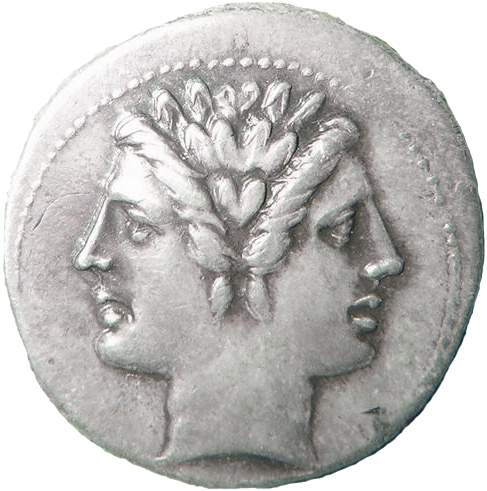
Coin with Janus Head (ca. 220)(ca. 220)
Two persons cooperate closely as decision-makers. A close partnership develops – it is going to last decades.
They are very different when it comes to values, experiences, interests and needs. However their talents seem to complement each other quite well. Their “mindsets” are very similar.
As far as daily routine is concerned, however, they are totally different. The one is more cautious and diligent, the other more agile and a little crazy.
Two protagonists from different worlds have found each other. You would think they complement each other ideally. But they are not doing all that well together. Early on, they occasionally find that they cannot understand what the other does. Mind you, those are just small matters, yet sometimes they cause frustration. But said frustration is not important. The stable relationship endures.
The goodwill of both parties makes the more and more frequent signs of mutual lack of understanding seem a minor inconvenience. Shared tasks have priorities before the personal feeling. Yet as time goes by, more and more conflicts arise. Once, they actually separate, but later the re-unite.
They are both part of a team with a complex task. Their positions make them responsible for a lot. They subjugate their behaviour under the common good. Morals make it mandatory for them not to show internal problems. But all those attempts are useless. As the years pass, the distance between them grows. It is a slow but continuing process. They hardly notice it themselves, neither does their environment.
Many years pass in this way, the speed with which the distance grows increases slowly. Then a solution seems to offer itself. A long part of the shared path lies behind them, the natural end of their cooperation is not far. Only a few more years are left for them to go together, then they will have managed it. Now all they need is a little stamina. Yet it turns out that this is nowhere near as easy as it sounds.
The one criticizes the decisions made by the other. First softly, than louder. The measures taken by one of them are counter-acted .by the other. Whenever they are a success, they are not goal-oriented. Wherever they fail, this is considered a proof of the path being wrong.
All their past achievements are questioned, the mutual effort is considered sub-optimal. Weaknesses and failure are often a topic of discussions. Simultaneously, the risks are pointed out and a bleak image of the future is drawn. He tries to prevent those danger scenarios from becoming reality.
The other party starts suffering under the situation. More and more often, he gets angry. He starts taking offense with the behaviour of the other. There are more and more decisions that he does not understand. Yet he does not know how to change this development. Besides, he is not sure if his perception is, perhaps, wrong. Slowly, he starts to get really worried about the future. The situation escalates, it can no longer be controlled. The resulting vortex takes quite a few companions with it.
And then what had to happen happens. There is a huge explosion. To be sure, it solves the problem – but much is destroyed and initially, all you get are losers.
RMD
(Translated by EG)
P.S.
The photo is of the “Janus coin“.
Licenced under common property through Wikimedia Commons
Klaus HnilicaThursday February 12th, 2015
To Pee Standing Up – or: The Emancipated Man
Carl and Gerlinde (XL)
Recently, when, as day was dawning, a ruling by the Düsseldorf Court flew into his house by way of the “Frankfurter Allgemeine”, Carl felt so much joy he would have liked to not only run down the street calling out to everybody, but also embrace every individual toilet bowl in every house in the neighbourhood!
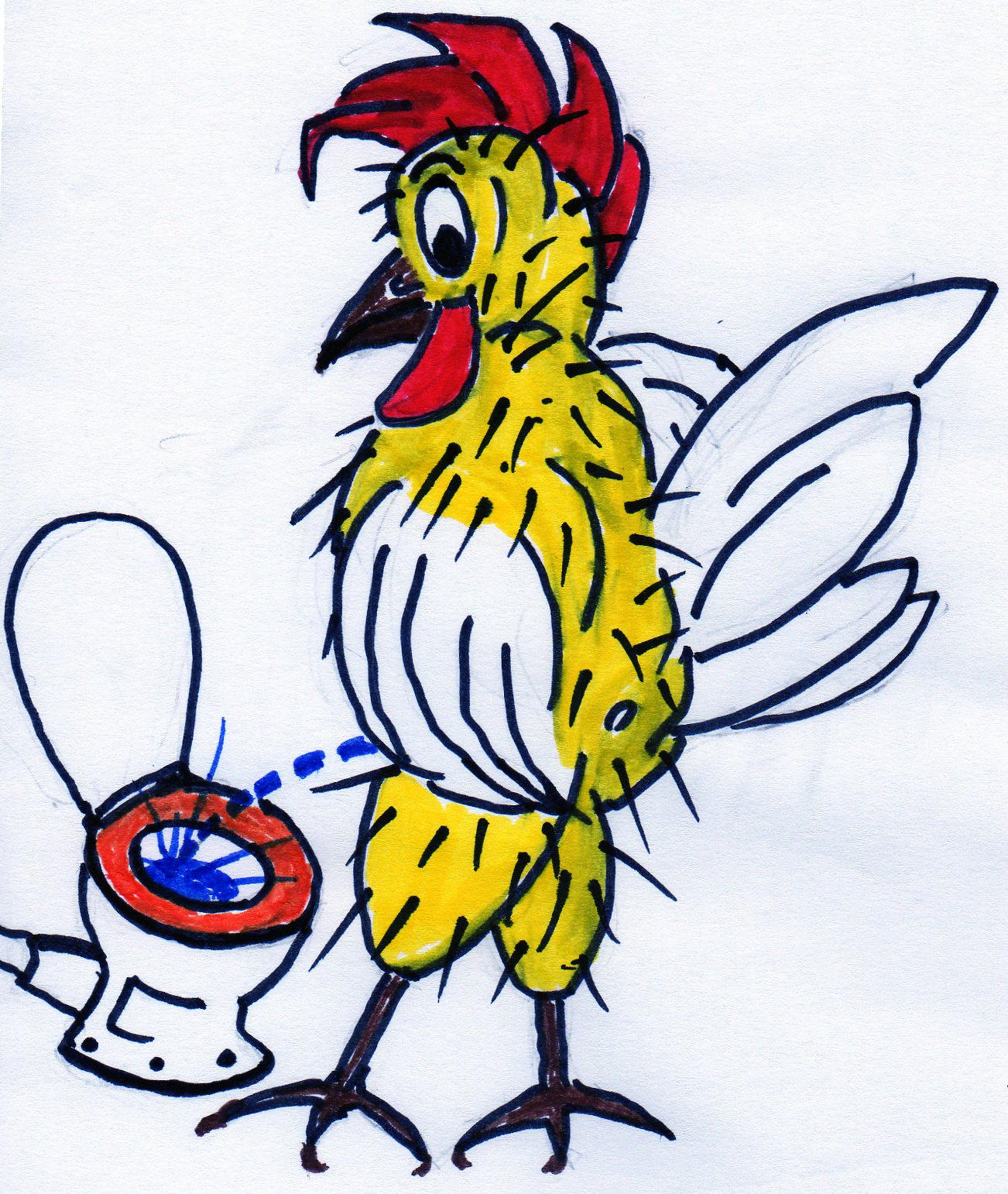 Because, at long last, justice had been done to him as a man by the German Legal System! It was the kind of justice he – and countless others of his species – had stopped believing in after all the ostracising and degradation they had been suffering from in this country which since ancient times had now been ruled and guided into a doubtful future by a too powerful, joyless woman …
And then – this unexpected gift of the heavens early in the morning, which left Gerlinde totally unmoved: she remained absolutely relaxed in her bed whispering something or other while all augury stood in favour of a final emancipation of men!
Of course, Carl asked himself how this was suddenly possible! What had happened? Was there something like justice in this country, after all? Perhaps a balancing power saw to it that, according to the law of entropy minimization, all injustice was minimized?
If so, then the nondescript message of the “Frankfurter Allgemeine” on this Friday morning might well have been a first sign! A sign indicating that there was actually hope for a better future, both for the human species and the subspecies “man” – while Gerlinde kept snoring.…
For Carl, however, said future crashed into his like a gunshot; after all, it was the official statement by the Düsseldorf judge Stefan Hank,
„….that nobody can forbid a man to pee standing up!“
It had the immediate effect that Carl suddenly not only defined himself anew as a human being, but in particular as a man! Meaning as a man who, at long last, was permitted to shed his water at home standing up! And that nobody could forbid it! Neither a mother, nor a wife, nor a significant other, nor the cleaning lady…
Naturally, this meant without the slightest doubt or room for interpretation that the still sleeping Gerlinde, too, had to take notice of the fact that he – Carl – just like all male creatures of this world – was entitled to pee standing up before the bathroom toilet!
As is often the case with great events, this totally new legal situation early in the 21st century, the clarification of which Gerlinde slept through without having the slightest idea, came in a totally inconspicuous way in the form of two simple sentences written by judge Hank. Those sentences were:
“Regardless of the increasing domestication of the man in this regard (that is: the man-woman relation), man who pee standing up are still quite a common occurance. Those who still practice this formerly frequent habit will still have to expect frequent arguments with – particularly female – flatmates, yet they need not fear that the marble floor in their bathroom or guest toilet will be vitriolised“. (see: legal document number: 42 c 10583/14)
Well, so it was perfectly clear! – If a marble floor did not get vitriolised, then the same was true for ceramic tiles on the floor. And if those were not vitriolised, then neither was the toilet bowl. This was a totally simple inductive conclusion even Gerlinde, should she ever wake from her sleep, would have to see – although, being a woman, access to logic thinking was not always a foregone conclusion with her.
Which stood in total contrast to Carl, who actually would not tolerate any attempt at domestication as mentioned by the judge. After all, you can never domesticate a man, can you? Let alone if you are a woman!
Well, this was certainly absolutely out of the question!
On the contrary; now when, at long last, he had it black on white in a court-ordered document that he was permitted to be totally man both in the bathroom and the toilet, he was absolutely determined to practice and relish this act of emancipation at all costs. And he was definitely not going to let himself be restricted by domestication or anything else.
Let his slumbering Gerlinde stand upside down (which was something she did when practicing yoga, anyway): he, Carl, was not willing to forego his right – to be totally man!
And he was going to really rub the new peeing situation in for his perky Gerlinde! He already knew it was not going to happen without intense words being thrown back and forth! It was as plain as a pikestaff, but it was worth the effort, Carl told himself. And he was rather proud of the serene and objective way he saw everything even before his first cup of coffee this morning.…
Well – and since Gerlinde was probably going to wake up soon, it might be a smart and prudent idea to make sure that the discussion was going to run without a glitch by not overwhelming her with the court-ordered facts before her breakfast egg. Instead, he was going to wait a little while and then, depending on how things were going to develop in general today, with a glass of champagne and the newspaper in his hand, present the new court-ordered ’ peeing situation’ …
Yes, that was definitely a better way to go about it! Even the much better way!
And on second thought – so Carl thought – basically there was the question why to confront Gerlinde with this issue at all? After all, she did not stand guard next to him when he was doing his business in the bathroom, did she? So why make much ado about it and talk endlessly?
”Hey – where do we live?“, he said to himself aloud before putting the “Frankfurter Allgemeine“ away and quickly again slipping back under the warm bedcover after this spontaneous intuition.…
After all, when using the toilet, he could do what he liked to do: if he decided to pee standing up, then he was going to stand up. And if he decided to sit down as he had always done in the past, then this was also just as well. On top of him then also obeying Gerlinde’s strict rules!
The important thing was only that he did not chicken out but took a clear position! And that is exactly what he was doing now in light of all this newly won freedom that gave him all the options: he could approach the toilet bowl standing up or sitting down!
Now, wasn’t that a great masculine feeling: not to be in the situation of the Federal Chancellor who always had “no alternatives”…
KH


