
Roland DürreSunday March 13th, 2016
For PEACE.
Looking for my personal heroes, I found Boris Vian quite early in life. In 1954, he created and sung a radical peace song – Le Déserteur. For me it was a great song in the early 1960ies, truly a “hymn for freedom and peace”.
In 2012, I wrote how it annoyed me that the #GEMA barricades youtube.
Here is the song:
Jacques Brel is another great singer of freedom songs. He, too, was a hero of my adolescence.
In 1974, Terry Jacks produced the Seasons of the Sun. The song is based on the chanson Le Moribond (“the One Who Dies “) by Jacques Brel.
https://youtu.be/YG9otasNmxI
But here Jacques Brel himself:
https://youtu.be/MB58PuNYO8o
Now I wonder who might serve as a model or idol for me. As I see it, Carl Amery and José Saramago are good candidates.
For peace!
RMD
(Translated by EG)
P.S.
I will write at some later time about John Lennon, Barbara and many more …
P.S.1
Because I was asked who is Barbara …
Roland Dürre
The Digital Mobility Revolution – CANZLER/KNIE
Can the digital revolution change the prevailing private-car-oriented order?
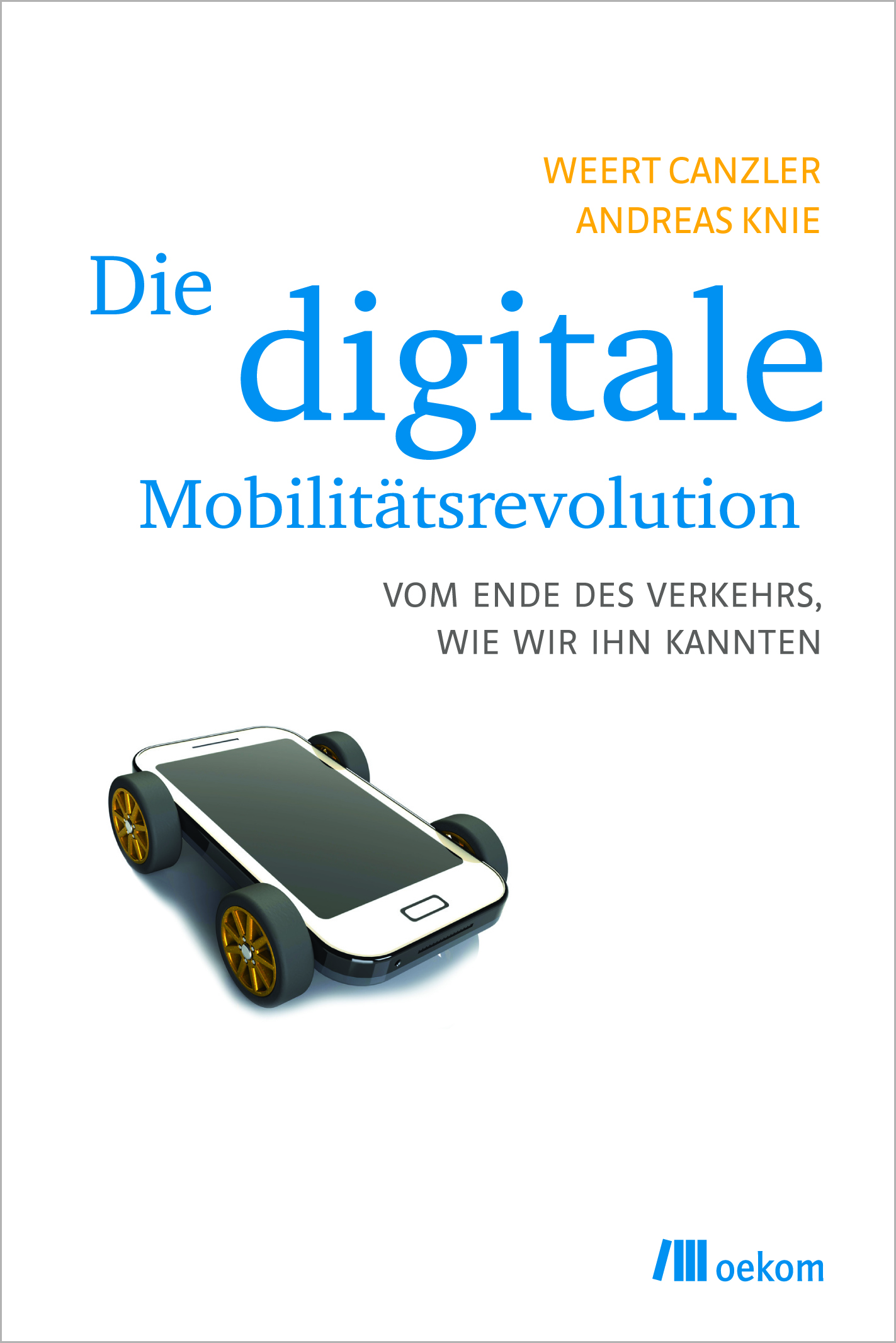 That is the central question asked in the book by WEERT CANZLER and ANDREAS KNIE. And, as I see it, they also answer the question.
But let me start from the beginning. Friends of mine had spoken with enthusiasm about the Oekom publisher and its founder Radloff for a long time. I took those comments seriously, yet had never found time to look a little closer. Until a few emails from friends reached me with actual book recommendations.
After that, I did some really extensive browsing through the Oekom website – and I was truly fascinated, both with the topics/titles and the authors I found. And, without any hesitation, I went ahead and ordered a few books, for instance the one by Anneliese Bunk and Nadine Schubert Besser leben ohne Plastik (The Better Life Without Plastic). (ISBN: 978-3-86581-784-6, first published: 22.02.2016)
Late in February 2016, they also published the small book:
Die digitale Mobilitätsrevolution
(The Digital Mobility Revolution)
The visionary sub-title is:
THE END OF TRAFFIC AS WE KNEW IT.
Since the paper version of the book only has 128 pages, it was the ideal reading material during my nostalgic trip to Augsburg on Regional Trains. I went to the beautiful City Market, then to the Inner City (where I also visited Sina Trinkwalder and her Manomama – All made in Germany, from the threat to the seams) on 4, Moritzplatz.
Last not least, I went to the venerable Augsburg Rosenau Stadium, where, even in my earliest childhood days, I spent many important hours. And behold – the FCA II was beaten to the tune of 0 : 6 by the SpVgg Unterhaching (my new soccer home) – which definitely was a good reason to celebrate in the Riegele near Augsburg Central Station with a Kellerbier.
It was nice. And reading the book during the train trip and back was just as nice. Because it says in an understandable way how our mobility has turned into something askance that is both evil and threatening our future. It also says how the “digital transformation” can and will help us to at least avoid the worst of it.
As I see it, the book is absolutely “state of the art”. It describes the current situation in a very rational way and makes short shrift of a number of very popular prejudices. It shows solutions that give you optimism, yet it also shows the absolute necessity for change. This is true both for our administrative, legal and bureaucratic world and our social (collective) and personal (individual) habits.
The authors Weert Canzler and Andreas Knie deserve praise for having written a book that is more exciting than some criminal stories, regardless of the subject matter being so demanding. And I also have a few suggestions when it comes to the content – perhaps for the second edition.
For persons who actually think about our mobile future, the book is certainly a must. This is, for instance, also true for persons who believe they might attend the AktMobCmp. Incidentally, the next one takes place in Augsburg on May, 20th and 21st!
RMD
(Translated by EG)
P.S.
Here is the Link and some information on the book.
Weert Canzler, Andreas Knie
Die digitale Mobilitätsrevolution
Vom Ende des Verkehrs, wie wir ihn kannten
144 pages, oekom verlag
München, 2016
ISBN-13: 978-3-86581-754-9
Published: 22.02.2016
The use of mobile devices increases all the time. More and more often, our smartphone will decide how we get from A to B. If you need a taxi, you use your Taxi-App and book online with services like Uber. In the future, the digital presence will be the determining factor: if something is not digitally published or available, it simply does not exist. Through digitalization, the cards in the game of transportation choice are re-shuffled. Since renting systems get more and more attractive and the car is in direct competition for customers with railways, busses and bicycles on shared digital platforms, the power structure within the transportation sector will change drastically. Consequently, the technological characteristics of cars will mean less and less. The authors show ways and chances of this network in post-fossil mobility.
Roland DürreFriday March 11th, 2016
“Inspect-and-Adapt“ Your Estimates!
 I always like visiting the Munich Techdivision. For me, this event, organized by my PM-Camp accomplice Sacha Storz, is very attractive. The next event is on March, 16th, 2016, between 7 and 8.30 p.m. They finish earlier than usual, because they want the visitors to have the chance to be back home in front of their TV sets for the Bayern Soccer Game. The location is the TechDivision offices at 73, Balanstr. (building 8, 3rd floor) in 81541 München.
Here is the official call for participation:
According to estimations by User Stories, project planning still plays a central role in agile software development. Imprecise estimations will, for instance, cause higher costs than planned or a longer production time than originally agreed upon.
During a TechDivision study, we investigated the User Story Estimates in four different projects. The goal was: identify problems and propose improvements. It is a rather well-known principle – after all, there is always an “inspect-and-adapt” framework in Scrum.
But: how can it be adapted to estimates? And how are the results of the study related to the #NoEstimates discussion?
I find the topic rather interesting. After all, I am a supporter of the provocative theory: “don’t estimate“– and I can find numerous reasons for this theory. In addition, I find it quite motivating that my own son Rupert will be the speaker.
About the speaker:
 Rupert Dürre is a consultant at the Swedish IT company Netlight. His interests are various areas of agile software development in requirement engineering and development practices, such as also the question how to organize teams in order to make an effective cooperation possible.
Note:
There is no admission fee for the event. Please register at the website: event.
Well, next Wednesday at 7 p.m., I will be at Balanstrasse and I look forward to seeing many friends!
RMD
(Translated by EG)
Klaus HnilicaThursday March 10th, 2016
Castle on the River – or: Schinkel’s Stag
Here is another interpretation of the famous painting “Castle on the River “(1820) by
Karl Friedrich Schinkel

Almost unnoticed, it appears,
beside the tree, our stag, and rears,
it lacks aggression, makes no sound,
takes in the castle, looks around!
And yet, it was the reason why,
when morning grass was not yet dry
the ranger met his sudden death:
the shot stopped everybody’s breath!
It happened at the time in anger,
too furious was the righteous ranger,
Instead of going through the head,
it was the knee the bullet met,
The one who cried was not the deer,
but the castellan from the rear:
“Be damned, stupid, blind marauder
and take payback in swiftest order!“
The man was dead, his friends so sad,
but nobody a memory had
of who shot whom and where and why?
They just said: people should not cry!
The mourning phase was deep and grey
castellan was still not too gay.
The coffin went by waterway
and people duly came to pray.
KH
(Translated by EG)
P.S.
The picture was taken from Google
Roland DürreWednesday March 9th, 2016
For Sale: Informatics Domains
At one time, I and some of my friends wanted to build an INFORMATICS PORTAL.
It was going to be a very innovative portal. Based on a 3-D browser, all users were to be provided with their “individual (and even three-dimensional) structured rummage table”. This “rummage table” was to be automatically fed by many sources (for example Heise.de or fefe.blog.de – just to name two of them) and chaired by us (a group of activists).
 The 3D Browser software was developed by IF Lab (the InterFace AG IT young academics in the laboratory) and was the technological basis for the InterFace history wall we had generated for our 30-year jubilee. It was a great piece of software, but it was never used for anything else.
Naturally, if you want an informatics portal, you need an informatics domain. My first idea was informatik.de. However, the person who owned this domain wanted money to the tune of a six-digit number of Euros. Consequently, this was no longer an option.
Then I considered informatik.org. A good friend of mine who, like me, had been one of the chairmen of the GChACM (German Chapter of the Association for Computing Machinery) owned this domain, which he loaned the GChACM for its website. The German ACM chapter then (as I see it, illegally) confiscated this domain and was not prepared to return it to said friend of mine. Mind you, this happened regardless of the fact that the association now only uses it as an alias for germany.acm.org. To me, such behaviour looks a little shabby. Consequently, Informatik.org was also a no-go.
So I reserved a few informatics domains for the portal that sounded nice to me:
informatik.cc as  in Cocos Islands on the Indian Ocean.
(http://informatik.cc)
“cc“ sounded nice to me, because we also have the famous dict.cc. Besides, “cc” reminds me of the good old Unix C compiler… From emails, everybody knows “cc”, too.
informatik.co as  in Columbia South America
(http://informatik.co)
“co“ rather appealed to me, it sounds like informatics&co.
informatik.io as  British Territory on the Indian Ocean.
(http://informatik.io)
Well, we all know the input/output problem, don’t we?
informatik.me as  Montenegro, Europe
(http://informatik.me)
The English “me” sounds a little like “my” (informatics).
informatik.mu as  Mauritius Africa
(http://informatik.mu)
This reminded me of the Bavarian Capital.
For several reasons, the dream of an informatics portal never became reality. But I still own all these domains, although I do not need them. Consequently, I would like to hand them on to an interested party.
The price is subject to negotiation and also depends on how I like the buyer. At the least, I would like to be reimbursed for what the domains cost me during the last few years.
If you are interested, just send me an email – an actual proposal is appreciated.
RMD
(Translated by EG)
Roland DürreTuesday March 8th, 2016
The Arcis-Vocalisten – March, 25th, 2016 (Good Friday) – St. John’s Passion!!!
Again, I am advertising something in the IF Blog!
But, as usual, it is only for something very special: the Arcis-Vocalisten!
Why?
Because their music is extraordinary and singing makes Evelyn (EG) so happy!
 (Translation:)
Due to its strong and unique power of sound, which Thomas Gropper and the Arcis-Vocalisten, along with L’Arpa Festante will realize, this Passion is even more moving and intense than other passion works. The passion story with its certainly dramatic content will almost by itself create an imaginary scenic concept where Jesus, Petrus, Pilatus, the Disciples and the people seem to actually perform on stage. St. John’s Passion is the shorter and at the same time more dramatic of the two – the second one being St. Matthew’s – Passions compositions by Johann Sebastian Bach. The mode of expression in the choirs and chorals, the story told by the evangelist and in the arias changes between upheaval and hateful outcries, humility and devotion – it is an ageless, exciting and fascinating work.
So why don’t you go and listen to it?
RMD
(Translated by EG)
P.S.
For IF Blog readers who want to be there, we offer a special discount …
Simply send me an mail with the header: St. John’s Passion.
Roland DürreSunday March 6th, 2016
Act!
Let me cite Seneca:

Seneca, part of double-herm in Antikensammlung Berlin (wikipedia)
Philosophy teaches us to act, instead of talking!
or
What we say should not entertain, but have an effect!
or
You want control, not tattle!
Seneca was an important teacher and thinker in ancient Rome. If my understanding of history is correct, then he wanted to help his students to become a bit more successful and happy in life. This is a nice goal. I gladly make it my own, both for myself and other people.
During the last year, I, again, spent much time abroad. I had a few great days when I attended a philosophy colloquium with Klaus-Jürgen Grün (Philkoll) that I found absolutely fascinating. As part of the jury during the business plan contest, I also learned many new things. On several PM camps, I exchanged experience and knowledge with many others. Many peer-to-peer meetings with friends, “mentees“, young persons who had just founded a start-up and many more were a chance for me to experience totally new worlds.
🙂 On the whole, I, again, learned more than ever before. And I am almost overwhelmed by all the things I now know. Mind you, this is regardless of me knowing that I know nothing. Consequently, I also have no idea how to best use my knowledge. That is bad news, because somehow or other I am now fed up with just thinking and talking!
I want to do something!
Together with friends, I would like to be part of a cooperative flow that actually has an effect! And that renders the right kinds of results. With enthusiasm for us and others. I am talking ideas that can actually be realized.
So here is what I propose: In the future, I will do no more philosophy seminars. To be sure, I return home from these seminars with a full heart, but I do not really know with whom to share all these exciting novelties that made such a huge impression on me. No more barcamps either. To be sure, I meet even more extremely nice and wise persons there, but basically, we all go back home happy because we have been reassured by all the others that what we think is the best thing to think and because of the intense feeling of togetherness we experienced. It is less about listening and coaching groups and individual persons.
Instead:
Let us do more and act more aggressively!
But how?
Well, I must admit that, initially, I had no idea. Consequently,I took a closer look at my own field of expertise – remembering all the things we software workers and IT experts already managed to pull off. In the enterprises, we abolished the German formal address “SIE” and the ties. To make up for it, we introduced refrigerators and coffee machines. We invented open source and wrote the agile manifesto. We started extreme programming and mobprogramming, as well as peer-to-peer-reviews. We triggered the agile, lean and open concepts. And we created entrepreneurial cultures based on respect and meeting at eye-level, where “participation” and “error tolerance” are no foreign words.
And we also came up with the Hackathon, where industrious programmers take their laptops and meet on week-ends, build up their WLAN and write, for instance, software for an NGO. And said software will already run on the following Monday, waiting for further development during the next Hackathon.
Incidentally, this is now also something they do outside the IT sector. I know a counselling firm where the gentlemen who usually are the advisors take a sabbatical once a year and meet for a long weekend in order to, for instance, build a kindergarden under professional guidance. I rather like this!
Why not establish a kind of Hackathon in this way where the result is not some software but a great business plan? One that has two components: the business idea and its application? Maybe that would be a contribution promoting, for instance, the solution of some of the problems all these refugee seekers will doubtless bring and turning them into something positive? How about, for example, paving the way for creating “refugee enterprises”?
All you would have to do in advance is define a few important requirements.
- The refugee enterprise must be in the common interest. After all, you want people to realize that something positive is happening – something that helps everybody.
- The refugee enterprise must not be a competition for established structures. Otherwise, you would immediately get a huge and very productive outcry.
- The employees must do something in the enterprise that is in accordance with respecting the dignity of said employees and…
- The refugee enterprise must be self-organized and self-controlled. In other words, there must be no management from the outside. That means the contribution of experienced entrepreneurs and managers cannot be operative. Instead, it must be restricted to helping them to help themselves, i.e. coaching and advising.
So what can we do?
We (between 20 and 30 entrepreneurs, managers and experts) meet for a kind of “hackathon”. But instead of programming, we generate a business plan. We spend two days in isolation. On the first day, we will come up with a business idea. And no later than on the second day, we will work out how to apply it. Let us call this kind of event a StartMaker. All we need is two days – and the right kinds of people. I already know some of them. And I am sure that something great can start from this idea.
So what do you think?
RMD
(Translated by EG)
Roland DürreThursday March 3rd, 2016
How Temptation Became Too Strong For Me To Resist at the f.re.e.
I try not to buy too many new things. For instance, I only get a new shirt after having disposed of three old ones. This is how my wardrobe and shoe cabinet get emptier and emptier. It is really a sensational feeling to see how the cupboards lose weight all the time.
Also, I try to do without unnecessary electrical devices and all other kinds of gadgets. Because I certainly no longer want to buy all those stupid things …
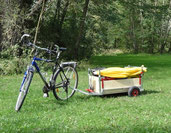 Three weeks ago, during the f.re.e, however, I reverted to being a shopping king. It was all because, all of a sudden, a wonderful bike trailer stood before my nose. I had been looking for a really sturdy one for a long time. One that you can fill. One that has enough space for a crate of beer and a lunch packet that deserves its name.
I found a true multi-talent. The inventors, Hans-Jürgen and Huber, named it Mobi-Table.
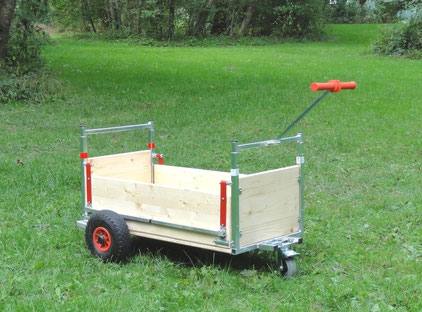 Mobi-Table immediately convinced me because of its manifold functions and possible applications. Using it as a transportation box, its length of 101 cm makes it quite suitable for taking with you in most medium-sized cars.
And – it is extremely easy to handle. None of the mobile and disposable parts have any bolts and thus everything can be re-arranged without tools.
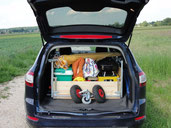 A special pin bolt will enable a frame part height variation if you simply press a button and the tyres can be removed in the same way.
Weighing 20 kilograms, this transport genius can carry an additional weight of 150 kilograms! If you lift the back frame, you can also use it as a hand cart for pushing heavy objects. Long or huge-size objects can be stowed between the two lifted frame parts, thus enabling a safe transport.
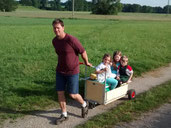 The Mobi-Table is also a wonderful handcart, extremely suitable if you have grandchildren – or for the All-Fathers-Day trip on Ascension Day.
Unfortunately, our family cannot use it in this way before May – because that is when our trolley will be delivered to us. The delivery time is that long. But perhaps we can actually go on a trip on Ascension Day.
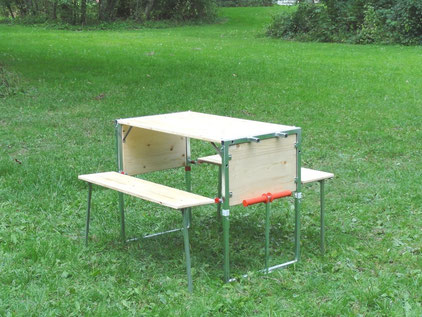 As soon as you reach your destination, the trolley will become a table/seat combination for four or five persons in no time. There is even a sunshade holder.
I was also delighted to notice that all frame parts are high-gloss galvanized and made of stainless steel or aluminium. The three-layer wood planks give me the reassuring feeling that they will easily cope with any wind and weather conditions.
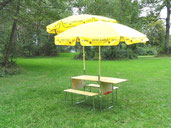 The engineering marvel is produced as a small batch series in Dasing/Friedberg near Augsburg. And everything you can see on these pictures was minutely examined and tried out by me on the fair. I can assure you: it is all true. This is not an April Fool’s trick, but a truly very impressive innovation for an alternative, mobile future.
The price is also moderate. You can get them for 379.00 € and the bike trailer with clutch is available for around 500.00 €. In my book that is very reasonable if you consider that it is good craftsmanship. Here is the link to the Website of thev Mobi-Table, where the product and its technology are described. There is also a PDF manual.
When I attend the #AktMobCmp on May, 20th and 21st in Augsburg, I will have my trailer with me for the exhibition!
RMD
(Translated by EG)
P.S.
I also found it impossible to resist buying a pair of Leguano barefoot shoes in bright canary yellow on the F.re.e..
Roland DürreWednesday March 2nd, 2016
AktMobCMP – Next Stop: Augsburg!
For Active Mobility in Everyday Life!
Shortly before Epiphany this year, we started the project “Active Mobility” with a barcamp. We spent two very intense days in the Unterhaching Kubiz. More than thirty persons shared their knowledge and together worked towards the so-called “remaining traffic” finally getting a chance to find its appropriate place in the public domain and in society, rather than having the entire transport policy focus exclusively on “motorized individualized traffic”. Considering that we hardly had a network on the topic, the start was quite a good one.
By now, we have found quite a few similar-minded persons. I mean people who, like us, walk distances or else go places by using mostly their own physical strength with vehicles such as bikes, rollers, inline skates, Skate– and Snake boards. They, too, need their space and places in the public domain. This is particularly true for vehicles that are a little “electrified”. As we see it, they are still part of active mobility.
We came up with great insights and actual results. All those who came enjoyed themselves and had much fun. The shared experience gave everybody courage. We also reached a number of partners from all over Germany who were not present but followed our procedures on the social media. The networking is now under way and we can really start.
 One of the “part-givers” (an artificial word from the world of anti-conferences and barcamps) was Günter Schütz from Augsburg. He already (not only) travelled a lot as an activist in favour of modern mobility in cities that are worth living in. And he is one of the promotors and makers of the bike kitchens we now have in Augsburg, Munich and other cities. It seems that the idea originated in the USA and was then carried to Germany via Vienna.
Günter spontaneously proposed to organize another AktMobCmp this year with his friends in Augsburg. And it took no time at all to fix the date:
The first Augsburg (AUX) #AktMobCmp will be on Friday, May, 20th, 2016 and Saturday, May, 21st, 2016 in the Zeughaus – Holl Saal (Room 112, first floor) near the Zeugplatz in 8615 Augsburg. Many thanks in advance to the Swabian Capital for sponsoring the great location through its Agenda 21!
And many thanks also to the host, the Transition Town Augsburg e.V. with the team around Günter, who took upon themselves quite a task (let me cite from the #AktMobCmpAUX or also #AktMobCamp2 – because we are not yet quite sure how to adequately name the day – website):
We want to see to it that mobility under your own muscular steam is no longer seen as “the remaining traffic”. We want to build a network among persons who want to promote active mobility in everyday life. We want to exchange ideas, relate our experiences, develop new ideas and make them heard. Such a thing cannot be done in the form of a congress or conference. That is why we organize anti-conferences and barcamps on active mobility.
The team also came up with a motto for their event:
Living together in the city!
Citation:
This is all about how we work both together and against each other in traffic. How can we organize ourselves in order to make it possible for both the motorized and non-motorized traffic to function not just alongside each other, but also together in such a way that there is as little stress and danger as possible in our cities?
As I see it, much remains to be done if we want to promote a “species appropriate” life for humans in the “smart and mega cities” of the future. And we will have to start with traffic and mobility. And all this is probably about how to make it work.
First and foremost, we now have to find many participants (part-givers) who will just come and join us. Perhaps, after more than thirty “initiators” in Unterhaching, we can now attract a three-digit crowd? I am also looking for sponsors, because Günter’s fee estimations are at the low end. In order to make it possible for persons with restricted budgets to participate, he set the prices between 30 € (reduced price) and 45 € (standard price).
However, there is also a fee donation, which means that, if you wish to support us, you can also pay more on a voluntary basis, for instance 60 € (+ 15). We want it to become a really great barcamp where you can feel comfortable. Consequently, extra money is needed, for instance from sponsors who support the nice party on the first evening!
Here is the short video recording of the Unterhaching #AktMobCmp. To me, it looks to be quite motivating for prospective participants – both activists and sponsors. I mean persons who want to get active and promote a future worth living for humans in their cities.
And perhaps we can even offer more attractions at the Augsburg #AktMobCmp. For instance, I can easily imagine a display of different bikes – such as burden bikes – or special trailers. After all, the great things that have been happening in the active mobility sector, in particular lately, are really amazing!
All ideas for the camp are extremely welcome. Just drop them at www.actmobcmp.org alias www.aktmobcmp.de! Or send a tweet to @AktMobCmp or #AktMobCmp (you can write it all with small letters). We are also present in Google+ as a community – naturally under “AktMobCmp“. In Facebook, #AktMobCmp is represented as a community. You will easily find it under “Aktive Mobilität im Alltag„, You will also find other exciting contributions around new and also very old (and consequently, very much appreciated) mobility. And the ADFC will again support us!
RMD
(Translated by EG)
Roland DürreSunday February 28th, 2016
From Digitalization to Thermomix
 Today, the word “DIGITALIZATION“ is basically a magic word. And it is, in fact, probably the most important term of our modern times. After all, digitalization changes our life at a high speed and with immens intensity. It can most certainly be compared with industrialization, which, a few centuries ago, brought a storm of change over the continents of this world.
Consequently, the digital change is the central topic in a global world. Even in the satiated and rich Bavaria, they established a “Bavarian Centre for Digitalization“ (Zentrum Digitalisierung.Bayern). Their website is certainly worth taking a look at. This centre has been initiated at the instigation of the Prime Minister and has a ten-digit budget at its disposal. It is supposed to enable the Free State of Bavaria to keep its world-wide top position. Or, to be more precise, to re-establish said top position after it has been lost in important areas.
I rather like the term “Digital Transformation“, because I see myself as a “Third-Generation IT-Pioneer” who, through all his life, has been part of teams that created “digital transportation”, initially as a programmer and later as a software and IKT entrepreneur.
As always when dealing with language, it is advisable to see the term as a “generic term” and then subdivide it in order to better understand it. Production is certainly an area that is affected by transformation. In this area, the change has already been labelled “Industry 4.0” (which is a little ridiculous). Digital transformation, however, concerns all areas of organized life, be it economy, administration, our mobility and communication, trade or the media. And, of course, it also concerns the way how we live together, changing our cognitive competence. Who among us is still able to do calculations (without using a calculator) and what young person can still find his or her way in the city (without using a GPS)? Thus, it changes our lives – both individually and collectively.
Digital change will be instrumental when it comes to how well this world functions – and consequently it will not stop before our front doors.
Now it also arrived in our kitchens. Of course not by providing the self-ordering refrigerator as some storytellers of the internet of objects have been predicting for years. Well, they do not even begin to understand, because this is actually exactly how innovation does not work.
No, the kitchen is another one of those areas where digitalization comes on soft paws. For instance first and foremost as a cooking box. Instead of as a robot that peels the potatoes and cleans the tables after the meal.
A short time ago, I found a device that tends towards “becoming digital”. It is the latest Thermomix version. It gets its recipes from the internet (well, the current version still gets it through the USB stick) and then steers the human through the cooking program by giving instructions.
RMD
(Translated by EG)


