
Roland DürreFriday January 20th, 2017
Media in my Life – Impulse and Inspiration ”brand eins“ and „enorm“ :-)
Two Magazines I Like – Or: Paper that Deserves to be Read.
brand eins & enorm!
I started “blogging” and publishing my experiences and ideas in the IF blog in 2008. It was a true delight for me to primarily do this for myself. Then I enjoyed noticing how many readers I have and also liked the many events and contacts that developed from it. Then I looked for and found a few co-authors, not many of whom actually remain to this day.
IF-Blog.de was also responsible for me finding brand eins. But more on this later in this article.
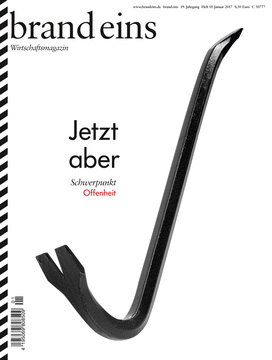
The January 2017 Edition
The history (Geschichte) of brand eins officially starts in August, 1999. In 2008, brand eins was already in its ninth year. In fact, the early stages of its history were even three years before that, in 1996. And yet, like many of my friends, I did not yet know anything about brand eins.
The beginning of the brand eins story was probably with an interview by Jost Stollmann (1996). At the time, Jost was the boss of Compunet; the InterFace Connection GmbH was twelve years old at the time. My personal connection with Jost Stollmann is not only that we are both IT enterprises. No: he was also one of Rupert Lay’s students.
At the time, Rupert drove a red Series-Three-BMW (including a 2.0-litre machine), which was rather extraordinary for a Jesuit pastor. In fact, his car looked a lot like my red Series-Three-BMW (including 2.3-litre machine). That was something we enjoyed very much. Rupert’s BMW, however, was not a business car, but a gift (or item on loan) from Jost. And Rupert very much delighted in his fast red BMW and especially in its origin.
Incidentally, Jost Stollmann remained faithful to brand eins – he gave more interviews with them (in 2009 and in 2012).
(Unfortunately, I could not find the 1996 interview anywhere. I would really like to read it. If any of you has a link or a pdf for it, you could make me happy by sending it).
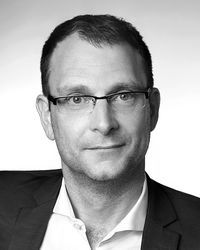
Florian Prange, Entrepreneur and Treasurer of FÖS.
brand eins is something I first came upon through Florian. At the time, Dr. Florian Prange had just started working for InterFace as a senior consultant. He was a very refined, young and socially active type of person. Today, he has his own enterprise and is treasurer in the board of directors of FÖS (Forum Ökologisch-Soziale Marktwirtschaft), which is also a very interesting address.
Florian liked my articles and consequently pointed me towards brand eins. In his opinion, my articles deserved a few more readers – and he thought that maybe this could be achieved through brand eins.
In fact, I did not know about brand eins at the time, regardless of the fact that it had already been on the market for nine years. For managers, the “must” magazines were the Manager Magazin or the Wirtschaftswoche. Both are anathema to me – and I saw that brand eins was totally different and much better.
Consequently, I was fascinated by brand eins and quite a few friends and business partners were given a copy or two of the magazine over time. Giving it to them was always a huge success – many had never heard about it and were surprised. They were happy to get totally new impulses.
It was even beneficial in terms of business. One of my friends (If-blog author Edwin Ederle) managed to be mentioned in one of their editions with his enterprise data2impact (Feine Klitsche). And the reviews (Rezensionen) on brand eins I wrote in IF-blog for quite a few years were also often read.
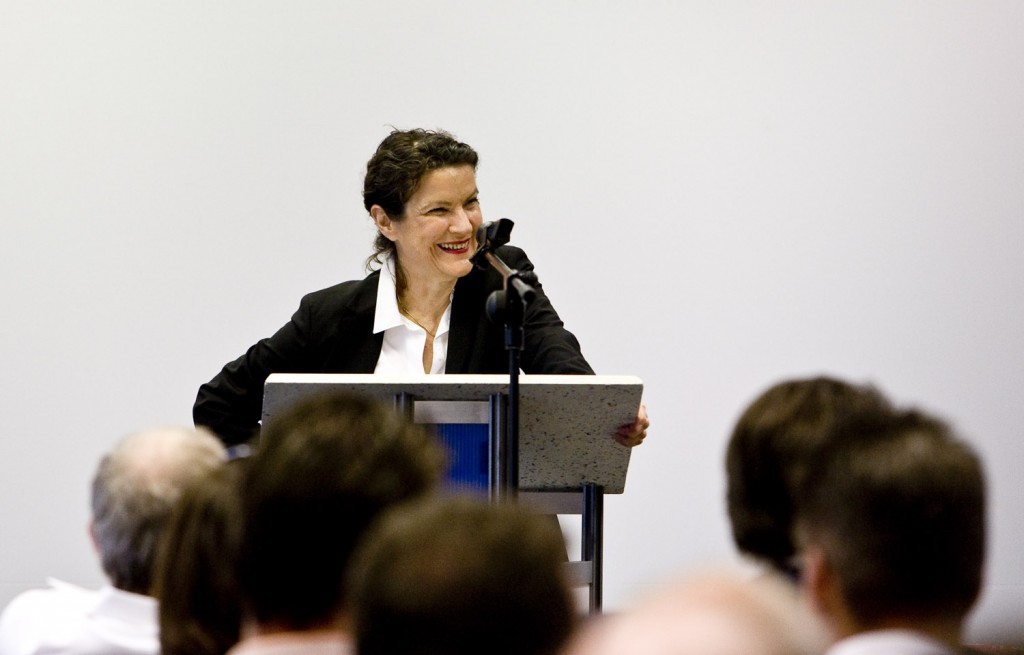
Frau Gabriele Fischer Giving a Presentation for InterFace (2009)
This is also how I first met Gabriele Fischer, the founder of brand eins. My contact with her led to a great presentation by Frau Fischer at the IF-Forum.
Unfortunately, Frau Fischer did not want to become a “Youtube-Toussie“ (this is how she herself formulated it), which means we cannot offer you a video documentation of her excellent presentation.
And this is how posterity will really miss something very important.
brand eins still exists today – and it is now the established business magazine, not only for managers! And it is still the only paper I deem worthy of reading. …
Wrong!
 I should have written: Was. Because now I found enorm . That is a magazine dealing more with life than with business.
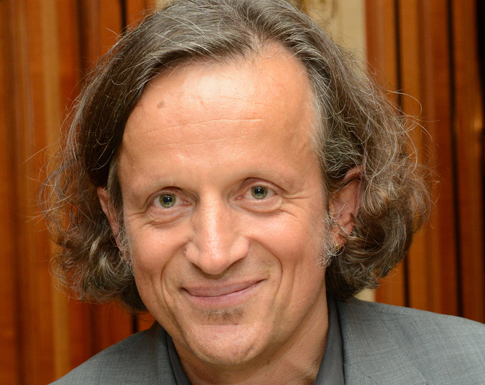
Here is how it happened. On Friday one week ago, I was introduced to Peter Felixberger (who, incidentally, is good friends with Gabriele Fischer). Among other things, Peter was also the founder of changeX.
Today, he is programming manager of Murmann Publishers. He is the editor and responsible for the edition of kursbuch.edition and of the magazine enorm, as well as publisher of »Kursbuch auf Weltreise« (Goethe-Institut). And there are many other things he does on top of that. My friend Andreas Zeuch also published his latest book at Murmann.
On that Friday, I had a wonderful conversation with Peter Felixberger. I noticed that there are many similarities between our ideas of value, interests and needs. Consequently, it was very nice for me to listen to him. He really made me quite enthusiastic about his publishing company and his products.
He also showed me enorm, which is a magazine directed at the age group between 20 and 40, but in my estimation it will find and has already found many followers among the younger and older readers.
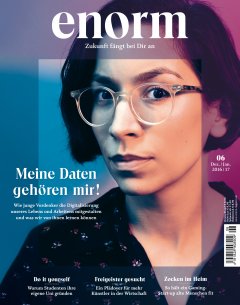 I can easily imagine enorm in less than ten years being as much of a success as brand eins is today. Consequently, I will now give you a short mini review of the current edition 06 (December/January 2016/2017).
What is it that fascinates me about enorm?
There are two elements that fascinate me: the basic concept of the magazine and the topics.
I would say the basic concept is one of fairness and considerateness.
I rather like the topics because everything I find in the magazine is of high relevance for me. The structure is GET-UNDER-WAY, BECOME-ACTIVE and LIVE.. Under the subsection “Against All Odds”, I find a beautiful collection of topics that I consider extremely important today. After all, enorm has been available since January 2010. You will find all the editions since 2010 in the archive archive on their website. Also full of important topics. Many articles, however, are “not yet set public” – dependent on the edition. I find that reasonable, because especially if you write about important topics, you should also be able to earn money with what you write. Besides, there is still enough to read.
Now I wonder if it is perhaps a good idea to make some enorm editions gifts to my friends and business partners – as I formerly did with brand eins. Especially in the departments with the impossible name “Human Resource“ (HR), enorm might perhaps be extremely helpful in small and big German enterprises when it comes to better understanding the values, expectations, interests and needs of the employees. And there is probably no enterprise that could not potentially benefit from such understanding.
Withbrand eins, it was possible to read all archived articles for free. That seems to be a thing of the past. But I find many brand eins articles on the internet – see also the two Jost Stollmann interviews. And the Inspiration section on the brand eins website also looks very attractive to me.
Incidentally, it is also very rewarding to follow both magazines on twitter. Here are the “accounts“:
@brandeins and @enorm_magazin. So: #FF!
Buy and Pay!
I think it is a matter of fairness to, once in a while, also buy paper articles. If you do not wish to read it yourself, you can make a gift of it. And that will inspire other persons.
So here is what you want to do: walk to the kiosk on February, 24th and buy the next enorm edition.
RMD
(Translated by EG)
Roland DürreWednesday January 18th, 2017
Making Tools with Tools that Again Make Tools that Make Tools … Computer Vintage
or:
If production nd development chains become too complex, they might easily break (down).
I got the ideas for this article during a short discussion about whether or not our developed society might – technologically – regress into the pre-electrical era. The person I discussed it with thinks such a thing is not possible. This firm believe made me thoughtful.

A small brother and a very small brother of the flat package I describe. The telephone shows how small the individual parts are 🙂
In the early 1970ies, I studied mathematics and computer science at Munich Technical University. I was also a student working for Siemens. After all, they had great computers and students could really make good money, considering the times.
My working place was in the “Koppstrasse” camp buildings. Our tests were conducted in the Feurich-Building – which was in the Siemens AG central building at Hofmann-Straße. Life in the camp was great, it was truly an F&E atmosphere, just like you would wish to find it today with a good start-up.
I already described my first project in the IF-Blog. It was about calculating the biggest possible Mersenne prime numbers. The task was one for people who liked working by themselves.
Then I became more and more part of the team and almost intoxicated by the challenges of our task. Together with other colleagues, I developed the PALOG-A- and PALOG-B systems.
PALOG is short for “PrüfAutomat für LOGik”. A PALOG-A device was supposed to test the function of “maxi flat modules” that were built serially. These modules had various functionalities in big computers. The functionality and correctness of the underlying logic had already been tested.
All we had to do was check if the serial production was error-free and if the manufactured components rendered the desired results reliably. I will explain the extended function of PALOG-B later in this text.
A maxi flat module is a huge board; it is rather broad and thick, but not very high. The boards you see on the picture are from a later time and were a lot smaller.
On one side, a maxi flat module had 128 pegs that had to be pressed into the rear wall of the big computer. The computer fed the board with digital patterns following the number of pegs, then the board returned a result and further processed it.
(I might be wrong and the number of pegs was only 64, but I seem to clearly remember 128.)
On the surface, the board was full of electronic modules that had a few larger or many smaller feet. These feet were pressed into the pre-arranged holes of the board. The entire construction was then brazed and soldered from underneath. In case of serial production, it was done by a dipping solder bath.
Sometimes, the building modules on the board we used had been developed and produced by Siemens. Some of them had to be bought. I particularly remember chips by Motorola that sometimes cost up to 1,000 DM.
If some of what I said here is not correct, please forgive me. I never specialized in hardware, instead always developing software.
The placement and soldering processes were far from trivial. Consequently, it was absolutely possible – and it happened quite frequently – that these maxi flat board modules rendered no or erroneous post-manufacturing results. Sometimes the individual parts delivered along with the products were also faulty.
But how can you find out about this? How can you test such a maxi flat board module?
Our method was quite simple. We sent bit patterns into the objects to be evaluated and then checked if the answer was the right (expected) one. Naturally, for reasons of efficiency, you cannot conduct such a test for all kinds of input patterns. It was the task of our software to generate relevant patterns that made it possible to prove with as few test steps as possible that the logic of the maxi flat board module worked correctly.

Back to the younger and smaller brothers of the maxi flat board module.
To this end, it was mounted in the PALOG-A machine and sent over the 128 pegs according to their functionality. The answers were compared with the desired results. If the actual test patterns were identical to the desired ones for all test patterns, then it was validated that the maxi flat board module worked without a glitch.
Seeking and finding the relevant test patterns was not at all easy and we developed it from the functionality following a rather “mathematical” procedure. The programming was a “cross” procedure on BS1000 and soon also on BS2000.
The actual patterns, along with the correct answers, were generated on process computers of the 300 series. Incidentally, they had a 6-bit assembler with two accumulators beautifully named PROSA. The “three-hundred-computers” were reputed to be incredibly fast.
The 306 was the top model. But even this Siemens machine that, at the time, was considered the fastest ever, easily took a week or more for calculating the necessary patterns.
In those days, the computer rarely ran for an entire week without breaking down. Mostly, it would break down within such a long time period at least once. Consequently, the software had challenges besides the algorithmic one, such as the reloading of the program in case of a system breakdown. At the time, this was not at all a matter of course.
Well, so far so good. At least, PALOG-A allowed a reliable validation about whether or not a maxi flat board module was free of errors. But quite frequently, we had poor product quality. What to do with that? The very fact that the construction elements were so expensive was a discouragement against destroying or dismantling them. Not much would have been won by this, anyway. Consequently, it was desired that all of them can be repaired.
If you wish to repair an error in a complicated flat board module, you will first have to find out where exactly on the board it is. In our case, you cannot simply solve the problem by logical thinking or code reading as in a program. Neither did we have a debugger. After all, the question is which individual part of the module is faulty, which soldering does not work, or similar problems …
This is where our system PALOG-B came in. Whenever a PALOG-A maxi flat board module was discovered to be faulty, it was transferred to the PALOG-B system. As soon as it arrived there, it was subjected a (so-called) PFAD procedure, i.e., it was processed with totally different test patterns. The returned data made it possible to circle the error on the board. This is how we managed to correct all possible mistakes by multiple circling. Afterwards, the board was again tested with PALOG-A – and if it worked, we celebrated.
I am sure you can easily imagine why the procedure was called PFAD. It is German for PATH and all the different input patterns had to run through the various paths. And as soon as you determined which of the many possible paths does not function, you are a lot closer to finding the bug.
I tried to describe the procedure as simple and comprehensible as possible. In reality, it was a lot more complicated and based on know-how that had been developed and handed down over many years.
Our software was only a small part of the design and construction software necessary for the efficient development and production of IT systems. At Siemens AG, they continued to work in huge steps. A few years later, the Siemens AG had an extensive work bench consisting of many software systems for the development of their chips. It was probably far superior to all the competition.
Unfortunately, I forgot the abbreviation, but I do remember that the application allegedly was the world’s most complicated software solution and contained the most lines of code of all the known programming systems.
And then the downward spiral for the data processing area started and all the know-how disappeared.
But then who cares about the “delights of yesterday”?
Let gone-byes be gone-byes!
I can easily imagine that the know-how and toll chain you need to develop and produce an Intel processor or an IBM Power today are by far more of a challenge than the rather limited flat board modules.
And it is quite possible that, today, not only a high tech processor, but also a “simple” electric motor or power generator simply cannot be produced without a similarly complex machinery. And what happens if – for whatever reasons – such a machinery breaks down?
This is where the circle closes and I return to where this article started. The total immersion of these tool and production chains in all technologies and sectors – chemistry, energy, farming, mechanics, pharmacy, physics,… – I can easily imagine that our system might collapse and we will have to start at ZERO. And that may not be easy.
RMD
(Translated by EG)
P.S.
I wrote the technological issues totally without checking back in any documents, only relying on my memory. Unfortunately, Wikipedia is not really much help with such exciting computer science topics. I find it a pity that, especially when it comes to the very technology that made Wikipedia possible, there is mostly no sufficient description of said technology to be found on its pages.
So please accept my apologies if I occasionally did not remember the correct abbreviations or made similar mistakes. There was nowhere I could look up anything that could have helped my memory. So much the more would I be grateful for any corrections and notes on the technology I described.
Roland DürreTuesday January 17th, 2017
Prognoses are Difficult, Especially if they Concern the Future.
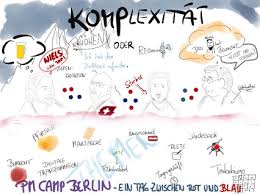
Complexity made by Visual-Braindump.de.
This sentence is not only said to have been spoken by Karl Valentin , but also by Mark Twain, Winston Churchill, Niels Bohr, Kurt Tucholsky (they all were rather intelligent persons). It clarifies a lot: prognoses are not at all easy – and the same is true for planning ahead. After all, planning is the little sister of the prognosis.
On Friday (February, 10th), I will give a presentation at high noon during the FORUM AGILE ADMINISTRATION 2017 in Stuttgart. The amusing title is:
“The inevitable unpredictability of the future“
Naturally, such a title was not something humble me came up with. Still, I find it suitable. After all, it sounds like the intellectual formulation of the simple truth that the future is not predictable. Just as they teach and write in the academic sociology and/or politics circles in their overblown way.
How am I supposed to plan for the future if I cannot even see the future? I will show you with a few examples how very seldom this will work.
I also would like to tell you how private enterprises will always make themselves scarce when matters get a little problematic. They are particularly keen on making themselves scarce if they managed to privatize good profit over many years and if then, as their life cycle nears its end, big deficits are on the horizon. Of course, deficits are something they want to burden society with, rather than face them themselves.
Whenever we are talking public agencies, this is not quite so easy. They have to survive disruptive situations, even in situations when a private enterprise would simply give up. Because life has to go on. Consequently, they need to maintain resilience, or do all they can in order to develop “anti-fragility”.
To be sure, resilience and anti-fragility are also just two additional buzzwords. They are supposed to make it clear that agile and flexible structures offer a huge advantage in times of change. And that strict processes can then easily kill a system.
I already have many ideas for my presentation. Now I am in the structuring and refining stage. I look forward to my presentation and my audience and would be delighted if I could welcome a few familiar faces in Stuttgart.
So here is all the information on the event. On the front page, you will find the program:

And details for the booking process can be found at the back of the page:
So I look forward to seeing you in Stuttgart.
RMD
(Translated by EG)
Roland DürreSunday January 15th, 2017
PM Camp Meeting 2017 – #pmcamp – Jan, 20th, 2017
 It is certainly not breaking news, but next Friday, we will have our 2017 PM Camp meeting.
Once a year, the representatives of all organizational teams for PM Camps meet. This year, the organizational team Dornbirn (Eberhard, Marcus, Stefan, Roland), are the hosts. InterFace AG supports them logistically.
Consequently, representatives of the organizational teams for the PM Camps at Barcelona, Berlin, Dornbirn, Hamburg, Karlsruhe, München, Rhein-Main, Stuttgart and Zürich will meet on Friday, January, 20th, 2017 between 8 a.m. and 4 p.m. in the Unterhaching InterFace AG building.
The PM Camp meeting is traditionally where strategic questions concerning the future of the PM Camp movement are discussed. Consequently, the goals of the meeting are:
- Looking back:
What was the development of PM Camps over the last year? Reports about format experiments in 2016. - Status Quo:
Where are we now? What is CURRENTLY important for us? - Looking towards the future:
What do we have to be careful about and what do we need to actively promote to make sure that the PM Camp movement continues to give relevant impulses for the PM scene on the whole?
I am telling you the date because I want to enable all friends of the PM Camp movement and visitors of PM Camps to voice their opinions and ideas during the PM Camp Meeting.
If you have suggestions that might impact the future of PM Camps, please do not hesitate to send me an email. I will collect all emails and introduce the ideas during our meeting.
I look forward to many impulses by and inspiration from you!
RMD
(Translated by EG)
P.S.
On the evening before (Thursday, January, 19th, 2017), those who arrived early will meet for dinner at 7 p.m. at the Unterhaching Althaching restaurant. If you feel like meeting old friends, please come and join us.
Roland DürreTuesday January 10th, 2017
BICYCLE Culture – an Interview with Roland Dürre
 I basically know Franziska Köppe from the EnjoyWorkCamp. It is a very nice barcamp promoting a new understanding of work that is held annually in Stuttgart. Franziska interviewed me about my bicycle enthusiasm. The result is something that is very important in my life – which is why I revised it a little bit and then saved it in my IF blog, as well. However, I tried to leave those parts that came from Franziska as they were in the original version.
Active Mobility – Promotion and Request

January, 3rd, 2017 – Are car drivers the coachman of our times? Mobility is undergoing change. Since the 1950ies, the automobile industry has been strongly promoted – especially by politicians. The sector is said to be “system relevant’”. It is closely linked to many providers, as well as with traffic planning and lobbyism. But is that “system relevant”? Start-ups and the crowd economy, as well as cultural changes with respect to the behaviour of not only our young generation threaten conventional business models. I talked about bicycle culture and his own contribution towards our future mobility with the entrepreneur and mobility activist Roland Dürre.
(introduction by Franziska)
The Interview
Franziska: Hallo Roland, please introduce yourself to our readers. Who are you and what exactly do you do?
Roland: I do not know who I am. It feels to me like I am a human being, an activist, a blogger, a coach, a maker, an entrepreneur. I love life and my family. I try to be courageous and to very much enjoy what I do. After my retirement from the InterFace AG, it is – even more than before – my task to hand down experience and, if possible, to help others – especially younger persons – to become happy and successful. I am grateful for all the beautiful things I experienced in my life and will be happy if this gratefulness will further increase during my remaining years.
Franziska: One of your passions is riding your bicycle. What is the meaning of the word BICYCLE culture for you? What connotations does it have in your life?
Roland: Both culture and RIDING my BICYCLE are beautiful things. They go together well!
But let us look at what car culture brought us. Driving a car, I am totally isolated from everything that is outside my car. Other people become anonymous objects in other cars. I actually know people who, conscious of their own isolation when sitting behind the wheel of their car, use swear words they would never use in their normal environment. That is something I can easily understand.
Riding my bicycle, I am used to greeting cyclists I encounter. When standing at a red traffic light, I often start a conversation with persons riding on the bike next to me. I try to be considerate. As I see it, pedestrians should always have right of way before cyclists. But then, cyclists should also have right of way before cars.
Riding my bike, I see more that is happening around me. That is true both if I am on a bike journey in foreign countries and in Germany. Social contacts are quickly established. Riding my bicycle, however, I also see how many animals, such as toads, cats and dogs are killed by cars. It always makes my heart bleed.
Consequently, I see a correlation between driving a car and being ruthless and inconsiderate. Whatever is in the way of a car will be killed. Carbon dioxide is emitted, fine dust produced – and it all happens just because people want to be comfortable. It is normal to have 1.400,000 million fatalities world-wide, because you cannot do without a car. But the truth is: you can! I experienced it in a self-experiment. And you definitely feel better without a car.
Here is a cultural provocation: Car drivers are the coachmen of our times. Coachmen were not very well-liked, because whenever any of the common citizens were in their way as they drove through the narrow streets of the cities, they used their whips to beat them out of the way. In those days, coachmen were considered “scum and riff-raff?!
BICYCLE culture – a quiet and clean world with happier and healthier people.
Franziska: It is probably true that most of us – especially those living in big cities – consider mobility as something that has to be connected with a car. Mind you, not too long ago, it was a matter of course that people went by bicycle whenever they had to go somewhere that was more than five kilometre away. Let us return to bicycles. What kind of world would come to mind if you were permitted to dream BICYCLE culture?
Roland: A quiet and clean world with happier and healthier people. From a change in mobility concepts, progress in other areas of life would automatically develop. One of the things I like to say is: If someone cannot even get a grip on his or her mobility, how are they supposed to get a grip on their entire lives? After all, you cannot get anywhere without the “desire and ability to live a responsible life”.
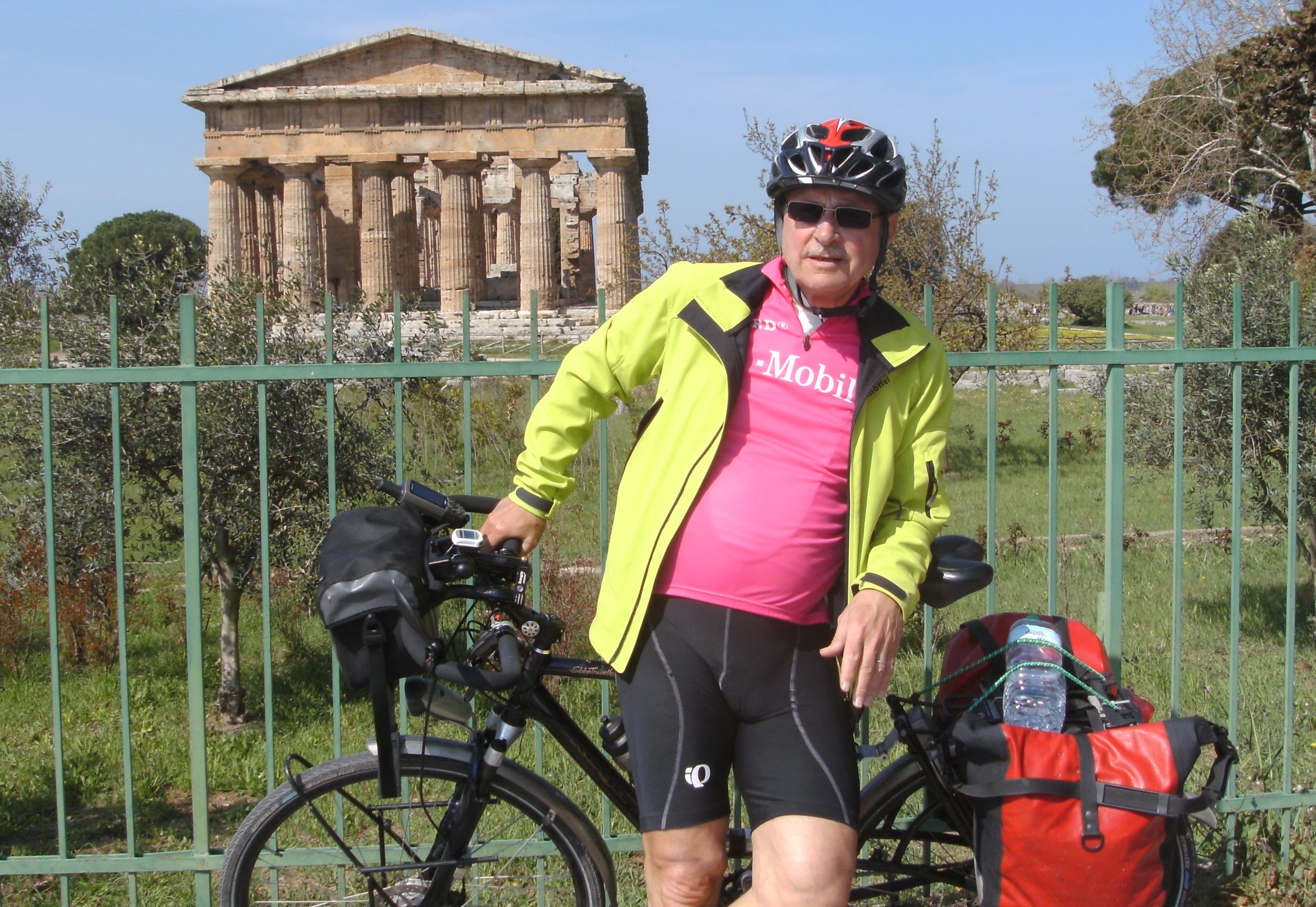
Roland Dürre on his way from Salerno to Pisciotta
Franziska: So far so good. Except that the reality in everyday life does not look quite so blue and rosy. You already said it: That is one of the reasons why you are actively promoting “active motility”– AktMob, as you call it ..
Roland: That is true. I know many streets in Munich where it is no fun at all to ride a bicycle. And on my big tours, it also happens time and again that I have to struggle through a street where I am really afraid I might die.
Mind you, AktMob is not just about riding a bicycle. It is about any sort of mobility that is not horse-drawn carriages, combustion motors or electronic cars. All that matters is that you are moving under your own steam. Be it with roller-blades, skate boards, hiking or using the
Franziska: In the traffic sector, cars as individual means of transportation have been promoted since the 1950ies. It was based on the political concept of the economic boom in Germany. Unfortunately, even this short time was enough to make our cities inhuman. Strange as it may seem, pedestrians and cyclist no longer belong to traffic in the cultural sense. Especially a look at kindergardens and schools every morning shows how absurd this sometimes is: children are driven by car because, due to all that traffic, it would be too dangerous for them to walk. How grotesque is that?
Cars as status symbols in the economic boom world.
Roland: What a good example! Cars were, indeed, not just an object that took you from A to B – especially for men. As soon as you had a driver’s licence and a car, you were at long last grown-up. It is certainly not totally wrong to call a car a phallic symbol. And sitting behind the steering wheel of a vehicle, men in particular feel omnipotent. Can you imagine anybody not liking that feeling?
But even more than that, the car was a status symbol in the economic boom world for Germany and the world where everybody was recuperating. The car is perhaps the best metaphor for bought happiness as a substitute for needs not being met.
When we were still young men and had no cars, we always got the impression that the beautiful young girls clearly preferred the men who owned cars – while they looked down their noses upon us non-car owners.
But the car was also a symbol for freedom – like the cigarette. And it was also a new private space – in the US, for instance, they say that there were several years during which more than half of the children were made on the backseats of cars. Even the Kinsey report said so. And these motorized vehicles certainly also were a nice thing when it came to our laziness. Well, and that such a god-like vehicle – especially when its marketing was also optimal and emotional – won over everything else is rather clear, isn’t it?
The critical mass – riding bicycles together
Franziska: With activities “We Are Traffic”, there are so-called Critical Masses on a monthly basis, both in Germany and world-wide. Cyclists make use of §27 of the StVO, which says that, as soon as they are more than 15 (critical mass), they may drive together. I am quite happy that this movement gets more and more popular in D-A-CH. For instance, it was a peaceful and joyful event for 3,290 cyclists last November in Germany. This year in July, the number had even increased to 13,371 [source: Daniel via itstartedwithafight]. Everybody can join – even if they only want to ride a short part of the way.

© Radlhauptstadt München – cyclists’ night 2016 [picture taken by Andreas Schebesta
Roland: I rather like Critical Mass! In particular, I appreciate the movement because it seems to be truly grass-root. And I am convinced that the only way to cause change is “from the bottom”. Politics and administration are paralyzed by lobbyists and their own rules and have neither a chance nor the desire to try anything. But – without someone trying something, nothing will happen!
Franziska: And yet you can find some bicycle enthusiast among the politicians, too. For instance look at your hometown. The city of Munich aspires to being called bicycle capital. This is also due to the commitment of Wigand von Sassen, who has now been responsible for the city bicycle campaign project since March 2009. Since they started with intense bicycle promotion, there has been a considerable increase in the relative number of cyclists among the total traffic. For instance, there are regular bike checks where you can have small repairs for free. In October, you had the cyclists’ night, in September the RadCouture… This is a lot of commitment in favour of BICYCLE culture. It shows a lot of courage and stamina.
But let us think in more modest terms. What can every one of us do? You do not always need grand gestures.
Driving a car – nothing but a bad habit?
Roland: It is definitely time for something to happen. However, I do not think the higher percentage of bicycles is due to an “intense” promotion of bicycles. In fact, I think that more and more persons discover that there are better ways of being mobile than using a car and also that a car eats up a lot of money. I see all those many cars as a prosperity reserve for the future where many of us will feel more “tightness”.
Driving a car is nothing but a bad habit. Basically, it is necessary for us to be willing and able to change our habits. Smoking is a good metaphor for the process. It is not easy and for many smokers unthinkable to become a non-smoker. And then you can do it against all the odds – and you will quickly feel a lot better.
Currently, I myself am a good example for how hard it is to change patterns you were used to and actually liked. On regional trips up to thirty kilometres, I only go by bike. But unfortunately also for short distances. So my personal mobility program is now “get off your bike and back to walking”. I want to do more hiking. And it is very hard for me to give up the old habit and not automatically mount my bicycle, even if I only have to go a short distance.
Franziska: It is certainly not easy to change behavioural patterns. When I was still an employee, I found it easy to mount my bicycle every morning and ride to the firm. To this day, it is not a problem for me to take the bike when I have business meetings (except if they are too far away, then I use public transportation).
It was easy for me because I knew I had to be there no matter what. But ever since I work in my home office, I find it very hard to mount the bicycle every day – just because I want the exercise. The requirement of having to go from A to B is missing. That makes it more natural for me to do my hiking round through the vineyards in the evening. It gives me peace to ponder and structure the day’s ideas.
Now I integrate this exercise into my working day. On the one hand, I offer public network meetings. We call it Walk to Talk. We meet at a green place and see what topics everybody brought. And then we run through urban greenery for 90 to 120 minutes.

I particularly delight in the fact that the people I coach, my mentees and my supervision partners appreciate this way of talking just like I do. That means that I can enjoy this exciting discourse surrounded by greenery (“Gehsprächs” im Grünen) between four and six times each month. But I would not object to it becoming more.
Incidentally, I would recommend this format to everybody – especially as a welcome deviation from meetings that far too often happen in closed rooms and sitting down. Which brings us to the topic work world = life world.
You have been an entrepreneur for a long time. What can a boss do in order to promote a BICYCLE culture? What are the important factors?
BICYCLE culture in the mobility and health management of enterprises – not an easy task for the boss
Roland (laughs): That is not at all easy. I am sure the most important factor is that you do not offer business cars as an allegedly attractive part of the salary. Unfortunately, I did it up from 1984. The InterFace AG has far too many so-called “business cars”. And it is not at all easy to take away acquired rights.
Services such as bicycle racks with roofs and/or showers in the basement are to be recommended. And you have to be a good example yourself. You have to infect people with your own enthusiasm for bicycles and for riding bikes.
Franziska: Riding bicycles is, indeed, catching. The last time I made that experience was when, in the company I last worked for, we founded an everyday cycling group. It worked like a bus line. The experienced cyclists offered to ride alongside the beginners. In no time, we had an ad-hoc bicycle repair shop and organized (after work) bike tours. Through joining in, I learned about shortcuts and secure routes to work, as well as all kinds of bike tricks.
It filled me with pride to notice how much I already knew after some time and how I could advise others. That was a huge motivation boost towards also surviving the wet-cold rain days with temperatures around the freezing point. There are considerably more dry days than rainy days. And as soon as you are on your way and have ample rain protective gear – the rain does not matter anyway. That is also something I only found out through riding my bike on a daily basis. Mind you, this is still not considering all the many natural panoramas and the intense experience of the seasons of the year.
In your experience, what is it that makes active mobility in everyday life hard or impossible? What – perhaps small – helpful advice can you give to overcome those obstacles?
Roland: Many things come to mind. There is, for instance, the wrong belief that children and heavy objects can only be transported by car. That is not true. Children are happier on the bicycle than in a car. Shopping is a lot easier if you take a bike trailer or a cargo bike instead of a car. Even two bike panniers will go quite some way.
Regularly taking a look at your mirror and your weight, perhaps even at your blood pressure, will soon convince you that it makes sense to exercise more often.
Franziska (laughs): Correct!
Let us get back to entrepreneurial thinking. Since many employees are determined by numbers, data and facts, I am often expected to ask about it. What advantages do you see for the boss to consider “active mobility”?
Roland: Well – it has been proved that persons who exercise regularly in fresh air have considerably fewer sick days. Isn’t that something to convince you? They will also arrive at work in a better mood and more emotionally balanced. And riding a bike also gives them an enormous amount of creativity.
Strong together – AktMob promotes active mobility in everyday life.
Franziska: Early in 2016, you had the AktMobCmp in Unterhaching in order to bring active persons around “active mobility in everyday life” together. In 2017, you will organize evening events and the next AktMobCmp is also currently being organized. What are the topics you will discuss there? Who were – and who are – the participants?
Roland: The invitation addresses everyone who thinks in terms of taking responsibility for our future. The way we think about mobility directly reflects on our way of life. AktMobCmp is a BarCamp – which means we do not know the topics and sessions in advance. This openness, however, makes it possible to get many nice and tangible results on the personal level.
AktMobCmp 2016 — BarCamp for active mobility in everyday life.
Franziska: In other words, you organize and moderate the ActMobCmp as a BarCamp in order to provide space for everybody’s topics. What is special about this particular event format?
Roland: The Barcamp format is characterized by the persons who come organizing their meeting and their sessions according to their individual needs. There are no invited presentations that have been selected by a committee. Everyone is allowed and supposed to contribute. The organizing team only has the role of host who makes it possible to meet at all. The social control is with the participants. I already experienced several times how a session that was abused for marketing purposes was empty in no time.
Franziska: And then there are sessions where humans are made to work intensely and productively in order to solve a shared problem. That is what I like about BarCamps. Especially if the organizers believe in the self-organization and self-control of the participants practiced in those anti-conferences.
For you, this belief grew over the last few years because you experienced it yourself. Because this AktMobCmp is not the first BarCamp you have organized. You are one of the fathers of the PM Camp movement that brings together people all over Europe who exchange ideas on project work. What fascinates you about the BarCamp idea?
Roland: The great thing about BarCamps is that you discover many new things. After all, all the participants are willing to open up and share their knowledge. As a general rule, all participants will go home happy and richer. What you experience will continue to have an effect on you. You have made new friends with whom you remain in contact. This is how, on BarCamps, humans and movements are linked and thus gaining more and more strength.
Franziska: I know exactly what you mean! Since some of my readers are BarCamp newcomers, can you give a few examples?
Roland: Well, there are movements such as eye-level (Augenhöhe), intrinsify.me, EnjoyWork with EnjoyWorkCamp, entrepreneurial democrats (Unternehmensdemokraten), common good economists (Gemeinwohlökonomie) and many more, all of whom I met at BarCamps. Along with those who support and promote them. This is how I made new friends at BarCamps, for instance Nadja Petranovskaja, Dr. Andreas Zeuch, Dr. Eberhard Huber, Gebhard Borck, Dr. Jens Hoffmann, Maik Pfingsten, Dr. Marcus Rainer, Dr. Niels Pflaeging, Roger Dannenhauer, Dr. Stefan Hagen and many, many more.
We, too, first met at a BarCamp (EnjoyWorkCamp?) didn’t we? You will find posts, podcasts and videos of all these persons online. Reading those will automatically make you understand why you need to connect yourself with others and do things together.
Franziska: I think the first time we met was at the Dornbirn PM Camp. But our first really intense discussion was during the “EnjoyWork” initiative. Consequently, I find it even more exciting to have gone into more detail about a few topics we share. Many thanks, Roland, for the exchange of experience.
I wish you well and for your ACtMob to be a huge success – and a good bike-chain at all times.
Roland: Many thanks – it was a true pleasure!
RMD
(Translated by EG)
Some more links:
- Roland Dürre [Profil via Lebens- & Arbeitswelten mit Zukunft]
- AktMobCamp [BarCamp für aktive Mobilität]
- Radlhauptstadt München [Initiative der Stadt München zur Förderung der Fahrradkultur seit 2009]
- Critical Mass [Fahrradkultur-Bewegung mit dem Motto “Wir sind Verkehr”]
Roland DürreMonday January 9th, 2017
PEACE
PEACE must not become a religion, because then we will quickly become un-peaceful.
That is also the reason why there must be no project PEACE.

Seems to be a powerful symbol für peace. May be to powerful.
As you all know, I was going to start a project PEACE. Well, more than ever, I am in favour of PEACE. But no longer as a project.
In the last few months, I have had many dialogues with wise and peaceful persons. Like me, they are convinced that peace is the most precious commodity for us humans. And I learned a lot from them and thought a lot about what I can do for PEACE.
Here is what the current state of affairs regarding my ideas is:
I no longer believe that peace can be brought about by organizations and projects.
A short time ago, a strong lady came to me and said:
“Roland, I am now retired, I have lots of time and I would like to support you in your project PEACE”.
I had to tell her that, according to my understanding of PEACE, there cannot be a successful PEACE project:
The only possible project is to live for PEACE yourself.
Very individually and initially only in private. So I asked her to start her own “project” and simply live for (and work towards) her own und all our PEACE. Consequently, I believe there have to be many small peace projects. Everyone first and foremost works on them for himself or herself and individually.
And that you have to deliberately refrain from coordination and mutual agreements. That would be dangerous and quickly cause manipulation and ideology. And it would probably do more harm than good.
So it is my idea that we all should not organize anything. Instead, we should open our sensors wide and be considerate and free – perhaps as a swarm with others who want PEACE. That sounds religious. I do not like religious patterns.
But perhaps PEACE can work if peaceful persons live their beliefs exclusively for themselves and if the convictions they have are based on their own ethically responsible judgement and on the values of humanity (such as the Golden Rule, the Biophilie principle, human dignity being unalienable …).
I think even “peace-loving” people must NOT actively try to convince others towards being PEACEFUL or act as missionaries. All humans have to come to their own conclusion about PEACE being the requirement for everything else. Otherwise it will not work.
And, above all, nobody should be willing and able to sacrifice themselves for what they believe and thus become martyrs! Because this is not how PEACE can work. Consequently, no organization and no project for PEACE can be a success and actually bring PEACE. In fact, perhaps even the symbol for PEACE I chose and inserted at the beginning of this article is questionable and might be criticized.
It is not easy for me to formulate my complex ideas. If I succeeded in making a little clearer what moves me, then that will make me happy.
And I will continue to strive towards my own PEACE..
RMD
(Translated by EG)
P.S.
Perhaps this is a process – can we call it evolution?
Roland DürreFriday January 6th, 2017
Are Car Drivers the Coachmen of the Future? Or is it better to GO BY BIKE?
Or is that already true for the present?
On January, 3rd, Franziska Köppe interviewed me for her blog FAHRRADkultur.
Here is the result:
Franziska’s message is “bike-riders will live longer lives”. Consequently, I certainly hope that she is right and that our life will not be terminated ahead of time by some motorized vehicle. And that it will not happen that, to make up for it, one more white bicycle will be sitting on a street or crossroad.
I hold Franziska in very high esteem. Consequently, I was a little cautious during the interview. My worst provocation was perhaps (citation from the interview):
“Car drivers are the coachmen of our times. Coachmen were not very well-liked, because whenever any of the common citizens were in their way as they drove through the narrow streets of the cities, they used their whips to beat them out of the way. In those days, coachmen were considered “scum and riff-raff“?!
I abide by all I said in the interview. Let me add that the more I live (and I mean “live” in the truest sense of the word) without a car, the more I am aware of how stupid and irrational it is to drive a car.
And that is true for many dimensions:
- For the lie behind the image and reputation you subconsciously want to gain through owning a car.
- For the challenging work you have to do as you sit behind a steering wheel, although you have grown used to it and thus ignore how strenuous it is. More than this: you actually lie to yourself and claim that you “enjoy the experience of driving” or “relax behind the steering wheel”. Your car is perceived as your “best friend” and a place where you “feel at home”.
- For the horrendous deprivation of exercise and fresh air you subject yourself to as a car driver. That is also true for the physical damage caused by constantly sitting and the negative consequences, including spinal problems.
- For senselessly wasting time, especially if you drive a car. Using public transportation, you could take far better advantage of that time.
- For the physical (considerably more than one million fatalities and far more seriously and not so seriously wounded persons) damage world-wide every year, as well as the psychological risk (double stress for instance when using the telephone while driving a car).
- For how unfree a car makes you – it is the millstone around your neck – because you always have to go back to where it is parked.
- For how you depend on the car: whenever there is a problem and it does not work, your personal world is under threat of destruction.
- For how much of a burden a car is: How often do I hear people say – I have no time because my car needs to be picked up from the service/taken to the service. And the weekend is spent polishing it because you love it so much.
- For how ruthless car drivers treat their environment and society. Neither pollution nor waste of energy are considered, the external additional costs of mobility are considerably higher if you drive a car than if you go by any other means of transportation. And we all pay the price.
- For the fact that you accept the risk that you might kill or injure people, doing enormous damage to yourself in the process.…
- … and for a lot more …
For me, driving a car thus gets more and more synonymous for living your life the wrong way. But:
Life is too short to live it the wrong way!
I know from personal experience that people who consider their car part of their own body like a wheelchair that has become essential to their life will under no circumstances agree with many of the points on this list. I can also relate from personal experience that it was very similar with smoking for me … you only really understand how bad it was when you no longer do it. But you know how hard it was to break with the habit.
RMD
(Translated by EG)
Roland DürreWednesday January 4th, 2017
Travelling through Central America in December – Summary & Notes
Here is the last part of my report with some information, comments and advice, giving you the gist of the trip.
The Caribbean
The ocean and the sun, a wonderful climate, warm water from above and below, an exotic world – all these things have been a dream of mine, especially in December – and that was the most important reason for making the trip.
Travelling by ship
Going by ship is ideal for the Caribbean. MeinSchiff 4 is a hotel that covers distances at night and mostly lies in the harbour in the day. This is how we were able to leisurely visit eight countries and ten harbour cities. We did not need a single visa. The only passport controls were when we entered and exited Germany and when we departed from the R.D. (Dominican Republic). All you need for mainland visits is the ship identification. Our passports remained in the strongbox of our suite.
The ship
Mein Schiff 4 is a German speaking ship. It is modern and well organized. The crew emanates a positive atmosphere. However, it also seems to be a product of convenience, following strict processes that are probably the same on all cruisers. You probably cannot do it any other way with 2,000 guests. The safety drill is good, but the question arises if it would actually work in case of an emergency.
The suites are spacy and functional and make a good impression. Most of the suites have a balcony. In former times, cruise ships were built in a more horizontal style. The lower decks were, for instance, reserved for the huge communal areas, such as restaurants, theatres and shops, along with the crew cabins and utility rooms like kitchen, laundry and much more. The upper decks used to belong to the passengers. Since the ships were rather broad, there were several corridors with outside and inside cabins for the passengers.
With ships now becoming broader and broader, this concept is changing. On the vertical level of modern ships, there are now the crew and service areas in the inner part of the ship at almost all central levels. That is a separate area with its own staircases and lifts. This makes it possible to have even larger community halls in the lower decks. Now the passenger area is exclusively at the outside, quasi built around the crew tower.
Consequently, almost all the suites now have balconies. We very much enjoyed ours. Whenever we stayed in our room, fresh air from the ocean drifted through the open balcony door. That was especially appreciated at night, when we were able to taste the air of and listen to the sound of the ocean without having switched on the air conditioning.
MeinSchiff 4 has two swimming pools. They are both on deck number 14 (there is no deck number 13). One of them is external and surprisingly large with 25 metres. Unfortunately, they are both operated with sweet water, rather than with ocean water. Naturally, the water used on board is won through osmose and/or distillation from ocean water. Consequently, it is not very good for the mucous membrane and the rest of the skin. That is why I hardly ever used it.
The gigantic reclining chair deposits on the diverse sundecks and inner decks are quite impressive. They almost reminded me of refugee camps. Having to service more than 2,000 passengers, you probably cannot do it any other way. Regardless of the multitude of reclining chairs, however, the German towel syndrome was ever-present. Even early in the morning, most of the reclining chairs held towels and other small supplements such as books, sun-blockers, caps or similar things to signal that they were taken. Apparently, nobody was bothered at all by the fact that the on-board instructions clearly said you should not do this kind of thing.
“Welcome back in Germany“
After a long day on the mainland, it feels good to be back on board. The crew will then say: “welcome back in Germany”. On the ship, it is also very much the same as in Germany: at least at first sight, everything seems to be well-ordered and clean – and that is probably true for normal circumstances. All the advertisements clearly follow the “German mainstream”.
But even more than in Germany, the service is provided by people from all over the world. For instance, I meet many service persons from Eastern and Southern Europe, but also from Asia. But you can look wherever you want: room service, restaurant or bar – you will never meet a German employee.
The persons working on the ship mostly do not have a German employer, either. Mostly, they are employed by agencies, for instance in Switzerland (officers), in in Cyprus (service) or in Manila (nautical). As on Meinschiff, they will then be body-leased by the holders. Naturally, this procedure is not TUI specific. The entire sector is doing it in the same way.
The work schedule, too, can only be considered in accordance with German work law if you interpret it very lavishly. They work ten hours a day and seven days a week. If necessary, extra hours are a matter of course. They only have a few days off. If someone’s work was exceptional, they get a special day off – which then, as a rule, is used for mainland visits.
The employees are happy with their jobs and their salaries. There are no deductions for social security. The countries where they are employed have very tax-friendly conditions for seafaring men. Additionally, they offer a surprisingly cheap health insurance for the mostly young persons, even if it only covers the absolutely necessary medical costs. Incidentally, this is the reason why there is no other European country that employs more seafaring men than Switzerland.
Basically, everyone who is employed on the ship is a seafaring person, regardless of where exactly they work: in the nautical, hotel or tourist sector. Consequently, they enjoy a fair net income, even though the pre-tax income is not really high. The cost of living is low, they also get tips, and they see the world. What more could you want?
All inclusive
For cruises, the TUI has an all-inclusive business model. There are both advantages and disadvantages to this concept. You often consume more than you wanted to (or should?). To make up for it, the procedure is rather simple and you really save money if you consume much. On the MeinSchiff 4 , the “all-inclusive” is actually honest. (Almost) Everything is included in the price. Even at the bar. Be it the excellent quality cocktails, the long drink, lots of beer and wine, there is a huge selection of market products, all of which is included in the price.
Only few things cost extra, for instance the specialties in three restaurants. At the bar, only very few and particularly famous spirits and wines are not included. It is true for freshly pressed orange juice and champagne.
Of the food, caviar and spiny lobsters are not included. But then, you can get caviar every week as part of your normal breakfast. Freshly pressed orange juice and the water on bottles labelled “Mein Schiff” cost extra. In the restaurants, however, both sparkling and non-sparkling water are included. There are water fountains on all decks where you can fill the carafes that will be found in your suite.
Food
The food was good quality. It is the same level as in good German cafeterias. More like Münchner Rück (MR) or Allianz than like Siemens AG.
In the (also included) “fine restaurants”, such as the big main restaurant, a several course meal is served on “posh” dishes. The food is the same (good) quality but made up to look good, too.
Self-service and service are well balanced. In several restaurants you can have both in neighbouring or secluded areas. The service does not cost extra, which means it is included in the total price, which is also true for GOSCH at the rear of deck 12. We liked staying there, especially because they had a huge open-air section. The grill bar, one deck up on deck 14, exclusively open-air, was our second favourite place. Along with the two bars nearer to the bow on the swimming pool and one deck up with their really exquisite cocktails, also all open-air.
Exercise
If you want to have enough exercise on the ship, there is a simple trick: only use the stairs and never use the lift. If you stick to that rule, you will, due to the 14 decks, the reception area on level 3 and the exit at water level on deck 2, remain in shape.…
Entertainment
The on-board entertainment is like everything else. Well organized, of acceptable quality, German mainstream like Helene Fischer. To be sure, this is not necessary my favourite, but most of the people on board seemed to like it. The same is true for the band – all of whom were certainly good musicians, but they did not seem to enjoy their own music very much – at least that was my impression. Local music – and also local food –, however, is not something you will get on such a German ship. I am sure it would not have been too hard to, for instance, take a reggae band on board between the two Jamaican harbours.
I must not forget the German Soccer League. They have public viewing on a huge screen with English comments in the open-air arena as well us under deck. Consequently, we had between one and two German Soccer League matches on Fridays, Saturdays and Sundays, which actually makes sense on days at sea. Of course, you get beer along with it – in huge bowls, the iced three-stripes beers from Jamaica is sitting there for you to take. The rule is: get one and drink it. If you do not like the three-stripes beer, you can also get Korona (from Mexico – my personal favourite) or one of the InBev brands (Becks, Franziskaner …). All free thanks to “all inclusive”.
For me, however, the most cherished entertainment on the ship was the great view from the top. Especially when we lay in the harbour or driove into or out of it, I was able to really collect my “great views” and spend hours just looking.
This is not what you saw from the big ship, but from the ferry after crossing the Panama Channel from the Pacific Ocean to Panama City.

Hier der Blick nicht vom großen Schiff sondern nur von der Fähre nach Durchfahrt des Panama-Kanals vom Pazifik auf Panama City.
Internet
From past experience, I know that, on board a ship, the internet access is usually via satellite and consequently not acceptable for an intense user like me. I never tried it on MeinSchiff, which means I have no idea if it was good or bad. But it was definitely rather expensive.
Consequently, I recharged my mobile phone whenever I was on the mainland. One possible way of using it are hotspots near the harbour that take a few USD for hour passes. However, I would recommend you go into the towns and either use public free hotspots or look for a coffee house where you get WLAN as part of the deal.
Digital
MeinSchiff 4 is a rather digital ship. You will find huge touch screens all over the ship. They inform you about the ship, the restaurants and the current program. The pictures showing the crew are displayed digitally and only printed after you order them. It is easy to use the ship App. Using it, I can also book trips and see how much money is on my on-board account.
Bicycle
There are no bicycles you can rent for mainland trips on MeinSchiff 4 . That was a special MS Europa service I very much appreciated. On MeinSchiff 4, you only get bicycles for specially organized tours. But you can have those both as normal trekking bikes and e-bikes. They even had e-rollers on board. But then you have a huge number of persons riding in single file on those trips, which is not an idea I am in favour of.
Renting a bicycle was possible only once at the harbours we arrived at. It seems like in Central America this is not a very popular thing to do.
Mainland trips
Everything is on offer – hiking tours, bicycle tours, bus tours, tours with boats of different sizes. You can book a jeep tour and a monster truck tour, even plane tours. In Cartageno I noticed that there was a city tour on MeinSchiff with simple electronic scooters on three tyres.
The focus is on getting to know the country and the people, as well as cultural, historic, geographic and geological sightseeing. Many trips include the visit of an adventure or amusement park.
The trips are well organized – which, of course, always depends on local agencies. They also explicitly state this in the terms of business. The tour guides speak German or English. More often than not, the linguistic competence of the local guides is less than satisfactory. The tours are not cheap, but then the countries you visit are not cheap, either.
During our private tours, we often had nice and very positive contacts with the local population.
Day and night
Due to the time of year, the sun is in the south in December. Since the Caribbean is north of the equator, we had eleven hours of sunshine and thirteen hours of darkness. However, that is not a problem, because ten hours of sun every day are absolutely sufficient.
The guests
We probably had a good average make-up of passengers, which means we saw a representation of our society. Basically, we are talking those persons who can afford to go on a long-distance vacation. In that category, MeinSchiff is actually quite an economical option. Regardless, I got the impression that some of the vacationers must have been saving money for quite some time in order to treat themselves to this trip, or perhaps some of them even had to borrow money for it.
Barbara said she saw a lot more tattoos than in the Unterhaching swimming pool. For me, that is not a problem, even though, personally, my attitude towards tattoos is a little on the sceptical side. Consequently, there is no tattoo displayed on my body, not even the beautiful IF logo.
Most of the persons we came in contact with were very agreeable. It only happened once that I had to suffer through a few AfD slogans during a meal …
Miscellaneous
- Sun blocker:
Always a good idea, although the many cloudy hours made it easier to avoid sunburn. - Protection against mosquitoes:
Not necessary. - Diamonds:
Can be bought all over the place, even in blue, with money returned. But they also cost a fair penny. I do not have the know-how to judge if buying jewellery would be profitable. - Cigars:
Smell nice, but are also quite expensive – but I no longer smoke (except once in a while, unfortunately). - Coffee:
Can be bought all over the place – but it is always rather strongly roasted and consequently not necessarily the right thing for the German mainstream taste. - Rum
Can be bought all over the place – plenty of it. And it tastes rather nice.
This is it as far as IF blog.de in the Caribbean by ship is concerned until my next trip comes up.
RMD
(Translated by EG)
Roland DürreMonday January 2nd, 2017
Travelling in Central America between December, 17th and December, 23rd (Second Week).
In this article, I will tell you about the second week of our cruise through the northern Caribbean on the MeinSchiff 4. In an earlier IF Blog Post, I wrote about my adventures from the first week of this trip, between December, 9th and 16th. Those first seven days were over on December, 16th with our arrival at Roatán in Honduras. We had explored the area on our own and had taken a long and beautiful walk along the Westbays.
From Roatán, we started the second week in the evening with a day at sea on December, 17th. Puerto Limón in Costa Rica was our first destination.
December, 18th – Puerto Limón – Costa Rica – – BOAT, BUS, ON FOOT
Arrival time 7:00 /departure time 22:00; organized trip
Today is the fourth Advent Sunday and we arrived in the beautiful and warm Costa Rica. We booked a one-day trip.
The first leg is by boat to the Tortuguero Channels and then up to the Varagua Rainforest by bus. We are lucky, because our guide is from Germany and her name is Susanne. As a young girl, Susanne got stuck in Costa Rica in 1981, where she married a Costa Rican. Consequently, she has spent 35 intense years in this special country. And there are quite some stories she can tell.
Today, she is a grandmother and lives in Costa Rica with her family. It is her true pleasure and happiness to feed the hens with her grandchildren.
Apart from that, she is active in organizations that promote environment protection and trying to make tourism beneficial for the local population. And she works as a guide for ship tourists.
I said we were lucky because there were three groups doing the same tour. The second one was listed as English-speaking – which meant it was only for people who actually understood English. Unfortunately, however, the guide of that group hardly spoke any English (and, of course, no German). The third group was “German speaking”. However, their guide hardly spoke any German (and no English at all).
Bad news for nature …

This is a sad trip to the Tortuguero Channels, because what you see will soon no longer be …
The things Susanne told us about the Tortuguero Channels makes me rather sad. Costa Rica has a unique richness in species – perhaps due to its geographical position. Even from the boat, we can really appreciate it. You can see sloths with two or three toes, special water birds, crocodiles and much more, all of which we see at the riverbank. We admire the Mangrove Forests (Mangroven-Wälder) and understand how important they are for the eco system.
And then she tells us that this entire idyllic scenery will soon be no more, because at exactly this spot a new gigantic container terminal for the new and rather big industrial harbour will be built. And that the houses along the riverbanks are so dilapidated because the inhabitants have left the area a long time ago.
Apparently, the Costa Rican administration believes that such a gigantic infrastructure will be necessary in the future. Nobody really knows why. But that is irrelevant. And now, the big project will be realized after many years of protests, which means many hopes are shattered. It happens regardless of intense and international protest with many good arguments.
It was my general impression on this trip that most of the cranes in the harbours of Central America I saw seem to sleep an eternal “Big Sleep”. Even later, in Panama, which, as we know, is an important business and reloading point for merchandize, most of the cranes were idle.
But this seems how matters are on this world. Politics – pushed by lobbyists and industrial corporations – believe they can boost the local economy with huge infrastructure investments. And as soon as the things are built, they usually experience the great hang-over.
Intel produced many chips in Costa Rica. Now the Asians produce them. Who else? When all is said and done, countries such Costa Rica need tourism to survive. And tourism needs nature (incidentally, even in Panama, tourism does more for the economy than the cash cow Channel).
Regardless, the Costa Ricans are quite upbeat. They greet people with “Pura Vida“, which means something like “pure life”. Whenever people meet in Costa Rica, they tell each other “Pura Vida” and are happy. That is what I, too, will do in the future.
After the boat trip, we continue by bus to the Varagua rain forest. Even the trip by bus is an adventure. Through extremely bad and narrow streets with many sharp corners, the bus fights its extremely slow way up the hills. The bus driver exudes a serenity that is absolutely imperturbable. He gives no indication of impatience, regardless of the fact that, occasionally, this trip really makes you breathless.
As soon as we arrive at the top, our mood improves. Not only are we served a fair local meal, but it is also a beautiful place. The sheer nature experience of seeing the rainforest leaves us stunned.
We have a very diverse program. Night animals such as the red-eyed frog can be seen in a building where it is night in the daytime. There is a wonderful voliere for many colourful butterflies and a small zoo with all kinds of reptiles. We learn a lot about the colours of butterflies, the poison of frogs and snakes, life in the rain forest and much more.
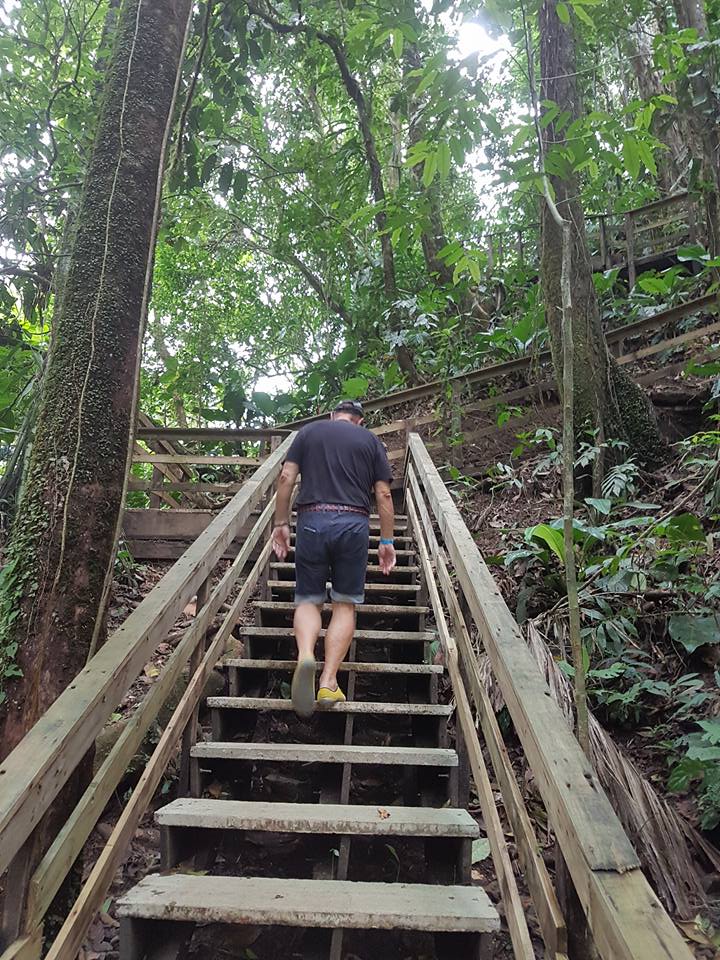
I am a little thoughtful as I climb the 350 steps up from the Puma waterfall to the cable car station.
One of the highlights of this tour is the presentation given by a young gentleman. He tells us what he as a scientist and his institute do to ensure the survival of, for instance, frog species that are threatening to die out. He explains his Spanish slides in Spanish. Susanne gives us excellent translations of what he says, just like all her explanations are always valuable and entertaining.
Another highlight is the way down into the valley by cable car that goes down steeply to the Puma waterfalls through the rain forest. Among other things, we see numerous monkeys doing gymnastics on the trees at eye-level with us. It is the “pura vida“ – even if it makes me a little thoughtful that we no longer can experience the beauty of the original rainforest with its gigantic trees. Instead, all we see is the secondary or tertiary rain forests. Because the huge tree giants of the original rain forest were removed by homo sapiens a long time ago through overexploitation.
As an alternative to this trip, we could have booked a journey with an old-timer train. That is also one of the things Costa Rica has to offer. Apparently, the railways were destroyed during the great earthquake in the early 1990ies. The company that did the calculations about whether or not re-building would be profitable was the biggest coach owner in Costa Rica. Consequently, the only small stretch that was rebuilt for tourist purposes was in Puerto Limón. The rest was abandoned.
December, 19th – Colón – Panama – – BUS, BOAT
Departure time 7:00 /arrival time 17:00; organized trip;
Taking nine hours, the journey from Puerto Limón to Colón was on the short side. And we had booked another organized trip in Colón. After all, Barbara and yours truly wanted to be on the Pacific Ocean again – even if only for a short time – and see the skyline of Panama City. More than anything, we also wanted the experience of sailing on a segment of the Panama Channel.
Apparently, we were not the only ones who wanted that. The trip was rather overbooked. Sixteen busses were waiting in front of our ship exclusively for the ship passengers. The passengers were assigned to busses in an almost military-style way in the ship theatre. Everybody wants to ride on the Panama Channel (or at least on some of it). And, as I see it, the trip was well worth the money.
From Colón it is about one hour’s drive to Gamboa. We have a wonderful guide. She exudes pure life. To be sure, her English is a little limited, but you can easily understand what she says. Her presentation is great, once in a while she even shows considerable cabaret talent. It is a true pleasure to listen to her and time flies during the bus ride.
We pass Manuel Noriega’s jail. To me, the building looks like something between a castle and a stronghold. Gamboa is almost exactly the midway point of the 82 kilometres of length that the Panama Channel measures between the Atlantic and Pacific Oceans. In Gamboa, we were transferred to two huge ferries (at least they are considerably bigger than the tour boats we were used to). They are to bring us to the Pacific Ocean. These are simple ships with open decks on two levels. Since the day is warm and the ships are rather crowded, the seats under the shadow are very sought after and quickly become a rare luxury.
Unfortunately, the guide on the ship is nowhere near as good as the guide on the bus was. The loudspeakers have been set too loud and the journey is rather tedious. They cannot exactly predict how long the ride will take, because it depends on the traffic. If a water giant comes along, she will be given right of way. After all, these huge ships also pay enormous amounts of money for the transfer. For the really huge ships that, due to recent construction projects, can now also pass on this part of the way, the toll fee is allegedly up to one million USD.
The duration is an estimated four to five hours. Passing the water-gates on the way to Panama City, even though they allow us to overcome a difference in altitude of around thirty metres, does not really fascinate us. After all, we are quite experienced with the house boat and consequently know about water-gates. Besides, we have often experienced the quiet Rhein-Main-Donau Channel and, a short time ago, we visited the Oder Ship’s Lift during our bike tour from Penemünde to Berlin. Consequently, the sluices are less impressive in our eyes than the artificially created lake scenery.
The narrowest part of the channel, the Gaillard Cut, is part of our way. The two peaks – at least one of them has been cut – are really worth seeing. Near the sluices, we pass rather crowded channel observation points. There is plenty of activity.
As we are on the way into the Miraflores Lake there is an announcement that comes as rather a surprise: today, passing the channel was very quick and we will be at our destination in 45 minutes. That would mean only 3.5 hours total traveling time. But before we pass the Puente de las Américas the channel administration stops our ferry.
We have to wait for a gigantic container ship. We wait almost two hours for her to pass, then we continue on our way. This is how, eventually, the trip is almost five hours, after all.
As we exit the Miraflores Lake we are on the Pacific Ocean until we come to Balboa, which is the most remote of a small series of islands that are connected with the mainland through a dam. We are standing at the stern and see the Puente de las Américas get smaller and smaller. On the larboard side, the silhouette of Panama City slides past. It is all rather impressive.
In Balbao we leave our ferry and again board our bus. Our super guide is there to welcome us and makes the time on board the bus pass quickly. The bus runs on the motorway all the way from the Pacific Ocean to the Atlantic Ocean until we are back at the ship – on time for our departure at 6 p.m. Said departure is particularly enjoyable, because at 18.00 hours local time you can still see quite a bit of Panama in the light of the setting sun.
December, 20th – Cartagena – Columbia – – ON FOOT / TAXI
Arrival time 9:00 /departure time 20:00; private tour;
The last two days were spent doing two one-day trips that actually were quite exhausting. Consequently, we want to be a little leisurely today and thus set out on our own.
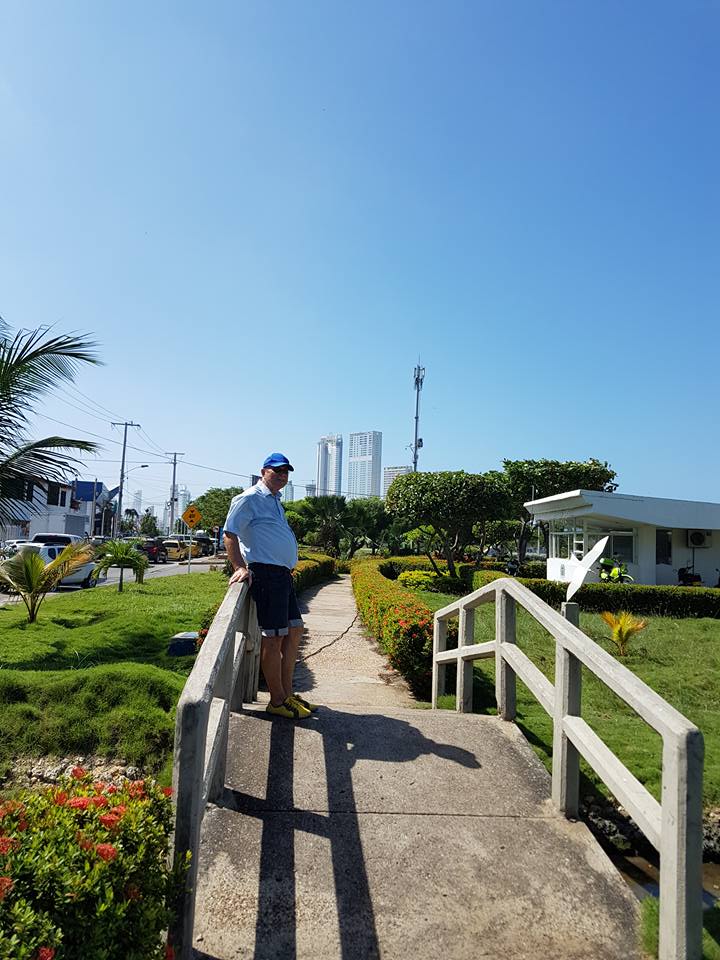
Shortly before the old city after a longish hike from the container harbour. One more bridge – and then we will have reached our destination.
With more than one million inhabitants, Cartagena is a truly huge city. The silhouette of the city contains many skyscrapers and is no less impressive than that of Panama City. However, there is also a comfortable old city – partly still enclosed in the original, well preserved city walls – that beckons with many museums and other attractions.
Our ship lies in the container harbour. The city map at the harbour information centre lets us conclude that the way to the old city is almost ten kilometres. However, the way looks pretty straightforward, so we start walking. And again, many taxi drivers try to tell us that the way is far too long on foot. By now, however, we have quite a bit of experience when it comes to resisting the calls of the sirens …
The traffic is dense on the two-lane one-way road. The pedestrian’s paths, too, are rather full. More often than not, we walk faster than the cars can drive. We feel relieved when we pass a bus with an “organized trip” from our MeinSchiff 4.
Many small yellow taxis are also stuck. In this country, they are considered public transportation. But there are also many public busses. I discover that quite a few of the yellow taxis are electronically powered. They are the KIA brand.
It is a very impressive hike to the old harbour. We pass the entrance and see a huge portal in the city wall. Here it is: the old city. It is rather tempting: there are museums, bars, pubs and shops.
We take a lot of time strolling around and window-shopping. Afterwards, we are really tired. So we want to go back to the ship to enjoy the time and look for a taxi. We quickly find it and later spend a wonderful late afternoon on board the ship.
Now our journey will soon come to an end. We have to go back from Columbia to the Dominican Republic. Our next to last destination before the return flight from La Romana is Santo Domingo. It is quite a way to go there, which is why we start our last day at sea, on December, 21st, at 8 p.m..
It is a wonderful exit. We can see the lights of Cartagena and Columbia for a long time and slowly take our leave from Central America. Even though we are no longer in Panama, I buy myself a Panama hat for the German and Greek summer of 2017.
Barbara also weakens and gets a wonderful lady’s hat – also for the hot summer of 2017. After short but determined haggling with the flying hat merchant, we get both hats for the total sum of 14 USD. At the airport, my hat is 20 USD – the ladies’ hats are a lot more expensive.
December. 22nd – Santo Domingo – Dominican Republic – – ON FOOT
Arrival time 8:00 /departure time 20:00; private tour;

Two days left until Christmas Eve.
The end of our journey nears. There is one full day on the Caribbean left, along with one night on board our ship – and then we go back, away from this warm weather. We want to arrive in Munich on Christmas Eve and then celebrate with our children and their partners.
Today, we take another walk. This time around, the way from the harbour to the city seems rather short. So this is our last stroll in Central America. Not at all far from where our ship lies, a swimming bridge spans the arm of the sea that leads to the harbour. And then we arrive.
Regardless of Santo Domingo being a huge city – with many people living around the city – it also has a really charming old city. It really invited us to do some strolling. It is not very extensive and has only flat buildings and a few parks.
In one of the parks, they are recording a film. Parts of the street are kept empty, which takes a huge effort by the filming crew. There is a lot to see for us. Again and again, we meet a group from our ship with the guide walking at the front and holding his sign over his head.
Bars and pubs with “free WLAN” can also be found. Consequently, we go and drink a coffee, at the same time giving our cell-phones some nourishment. The invoice comes in local currency and also in USD and EURO. What a small place the world has become!
Incidentally, the abbreviation for the Dominican Republic is R.D. – my initials. I see baseball caps, t-shirts and other products to remember the place by all over the place. They all carry my initials. Consequently, I succumb and buy an R.D. baseball cap. It will be a Christmas present for my son Rupert Dürre (another R.D.)
As for the rest of the day, we enjoy being together and look forward to Christmas.
December, 23rd – La Romana – Dominican Republic– – BOAT
Arrival time 8:00 / Transfer to the airport 14:45; organized trip;
This is our last day. A few days ago, we booked an organized trip for this morning. It is a boat trip including snorkelling and visiting the beach. It is scheduled to be finished at 2 p.m., which should give us enough time for the direct transfer to our plane.
We already packed yesterday evening. The luggage had to be in front of our doors by midnight and has already been picked up. I also added my backpack with the warm clothes. Consequently, we are all set and all we have to do at the airport is identify our luggage and then hand the two suitcases over at the check-in counter.
Again, the trip is well organized. Our boat is already waiting for us at the stern of MeinSchiff 4. We have a crew of three, a lady from Switzerland and two locals. Everybody is really in high spirits. On the way, we get cola, sprite … and lots of rum. Cuba libre! For food, they took Pastelitos, that is some kind of filled pastry.
Our first stop is for snorkelling, then we drive to the beach. The area with the blue reclining chairs is for us. It costs 2 USD to use the reclining chair, lying at the beach on your own towel and swimming in the ocean are included in the price. A “Costa“ cruiser is sitting on the beach and busily “tendering” guests to the mainland who apparently are mostly Italian. The place is as busy as the Munich Marienplatz
This is the day before Christmas Eve. It is all about eating, drinking, sunshine and enjoying the water, along with “being at leisure”. We particularly enjoy this last time of the tropic atmosphere on the ocean and go into the water more often than on the entire trip. Then the boat takes us back to the ship – adieu Caribbean!
The boat gets us back to the ship on time. On the 12th deck of MeinSchiff4, we eat our last hamburger at the grill bar and wash the remainders down with Corona. Then we go to our bus that takes us to the plane. After all, we want to celebrate Christmas at home under a green tree tomorrow.
At Christmas Eve, we are at the airport S-Bahn train platform at 8.30 a.m., waiting for the line 8 to Munich East. There is no problem with changing to line 7, all trains are on time. Around 10 a.m., we arrive in Neubiberg. My first activity is riding my bike to Butcher Schlammerl in Ottobrunn and buying some Weißwürste. Then I ride to Baker Schlank in Putzbrunn to buy Brezeln to go with them. Lunch is on – and – Christmas Eve can come!
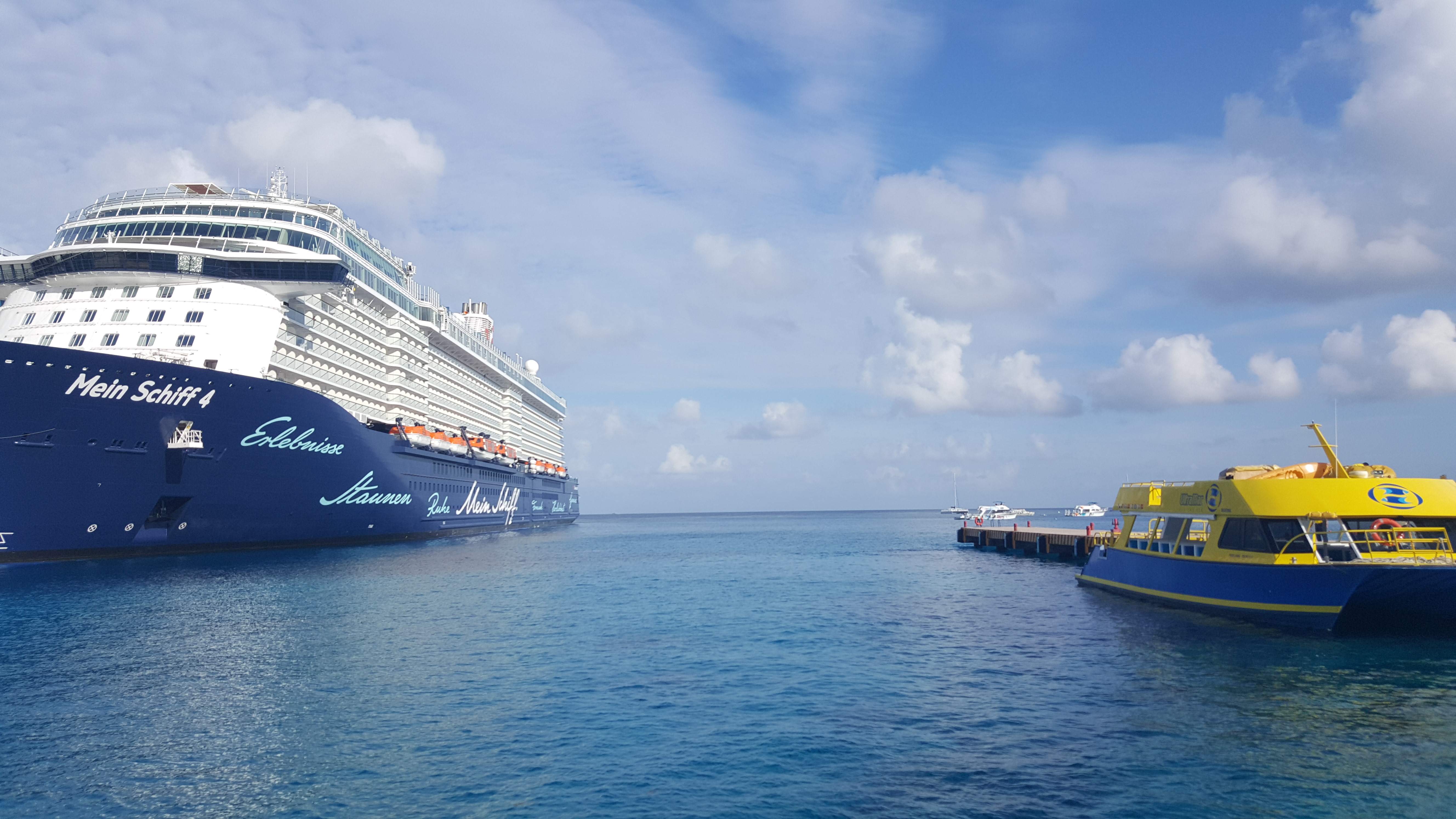
The hotel that was our abode for 14 nights and drove us through the Caribbean.
This is all! I will write another article and give some advice on the cruise ship – and then I will get back to other topics.
For instance what is basically the system-theoretical problem in our society.
RMD
(Translated by EG)
Roland DürreSaturday December 31st, 2016
May everything you try turn out fine in 2017. And may you do everything in love and respect, always considerate and thankful!
My Personal Wish for 2017:
Gratitude and Considerateness, both for You and Others.
Many years ago, I already noticed how important it is to be considerate, both towards yourself and other persons, in what you do, but also towards the entire creation. I also started realizing quite some time ago that appreciation is the basis for peace and that appreciating yourself is the first requirement if you want to be able to appreciate other people.
But it took me almost 66 years to discover that the ability to be grateful is probably the most important requirement for a happy life. Today, I am infinitely grateful for all the things I was allowed to experience and learn in my life.
Consequently, it is my personal wish for 2017 that the degree to which I am thankful will and can continue to grow. And that is exactly what I also wish all my friends, and especially the IF blog readers!
So:
For 2017, I wish you loads of beautiful things so that the degree to which you can be thankful will grow at your heart’s desire. And I wish us all the ability to be very grateful!
Health is also a very important commodity. So I also wish you all very much health!
As opposed to this, the small piglet is just supposed to bring a little luck. May the portion of luck that gives us the extra joy always accompany us all!
Best wishes for the start of the New Year and the same for the entire 2017!
 Einen guten Rutsch und ein gelingendes Jahr 2017!
RMD
P.S
I use this beautiful picture every year as an illustration of my new year wishes. It was originally designed by my dear friend, the photographer Rolo Zollner. It is listed as “common licence“, which means that you all can use it, provided you tell all your readers where you found it and who designed it.
May it bring as much happiness as possible to as many persons as possible, and in particular to Rolo!


