
Roland DürreMonday April 3rd, 2017
A Very Special Task!
The Solution will be Supplied Later!
A short time ago, a good friend of mine came up with a brainteaser. He did not know the source, otherwise I would gladly have cited it. My friend was not able to solve the problem, neither was I. But it is a truly exciting scenario. And it has a surprisingly simple solution, including a beautiful mathematical reasoning. It also gives us a nice metaphor for our lives.
Among other things, it shows that mathematics can also, once in a while, be quite useful. Here is the story:

Here is a female criminal. On her card, the number 1 is written. But she does not know this. After all, she only knows the nine other images with their numbers.
A – not dislikeable – gang of 10 persons constantly violates the prevailing moral concepts in an outrageous manner. The gang members are creative and wise – this is how, with great finesse, they remain unmolested by the arm of the law for their abominable activities. That is lucky for them, because the legal penalty for their crime is death by strangulation.
In the public perception, the gang soon has a legendary reputation, and is idolized by quite a few simple people. For the authorities, this development is totally unacceptable. Consequently, the increased manhunt of the authorities, along with a growing arrogance and flippancy among the gang members led to the capture of the group.
All 10 gang members are quickly sentenced to death due to their abominable behaviour in a show trial. However, there is a way for the ten comrades in crime to save their lives – through an appeal for clemency. The head of state who decides upon said appeal is a very prudent and well-meaning woman. She is very wise; there are even some rumours insinuating that she may to some extent sympathise with the gang.
Actually, she works hard to come to a fair decision. She hands down a conditional amnesty (a little like a “Judgement of God”):
Before the verdict is executed, the ten members are permitted to see each other once more. There is a farewell meeting, the ten gangsters can spend the afternoon before their execution together and without supervision.

Here is a male criminal. On his card, the number 2 is written. But he does not know that. After all, he only knows the nine other images with their numbers.
As the meeting starts, the gangsters are told how the amnesty will work. A picture of each of the members is taken (two of them can be seen here). On each of those pictures, a number from the set 0 – 9 {0, 1, 2, 3, 4, 5, 6, 7, 8, 9} is drawn. Each number can be used several times. Consequently, it is possible that the same number is written on all the pictures. Or that only some numbers are used, for instance {1, 2, 3)}. Or maybe only the even or uneven numbers. Whatever. But perhaps all numbers have been used. Nothing is impossible.
After the meeting, each of them is taken into solitary confinement until the time of execution. Each of the ten gang members is shown the nine pictures of the other nine members – but not his own one. And then they ask him the number on his own photo. And if even one of the gangsters gives a correct answer for the number on his card – all of them will get the amnesty.
Initially, you will think that the gangsters have quite a good chance to avoid their punishment and enjoy clemency over justice. And there is no doubt that their situation will have improved. After all, chances are not too bad that one of the ten will guess correctly and thus free them all.
But it is nowhere near as easy as that. Matters may turn out poorly. And there is one thing the wise regent forgot (or perhaps not): by applying a simple agreement, the ten gangsters can make sure that one of them will inevitably say the right number, as written on his picture. And this is how he can guarantee that he and his comrades will enjoy the amnesty.
It is a small problem: what agreement makes it possible for the gang to use the meeting that was meant as a farewell to make sure that “their heads” are out of the sling with a 100% chance?
I will publish the solution in a few weeks – and until then, I look forward to having many email solutions sent to me!
RMD
(Translated by EG)
Roland DürreSunday April 2nd, 2017
On April, 14th, 2017 in the Herkules-Saal: St. Matthew’s Passion with the Arcis-Vocalisten
and Great and Unique Soloists and Orchestra!

In 1729, when Joh. Seb. Bach first played his “St-Matthew’s Passion” during the Good Friday Vespers in the Leipzig Thomas Church, the audience was overwhelmed. The huge cast with soloists, two choirs and orchestra, along with the moving expressiveness surpassed all that had ever been conceivable. Bach tells the Tale of the Woe Jesus lived in a very haunting way. It is a top work of musical history that forms the drama of what happens in the Passion to become one musical-theological entity.
“Between emotionally sung arias and salivating tuba choirs: humanity versus injustice and death. With his Arcis-Vocalisten, Thomas Gropper gains graphic expression, even though he does without martially blaring avowals. The chorales are permitted to stream in wonderful sensuality, which is a much more convincing way of giving the secret of faith a voice” (“Klar und lyrisch”/SZ 4/13).
The Arcis-Vocalisten are a very special choir, not only because Evelyn (EG), who translated many IF Blog articles, is one of them.
And to top it all:
IF Blog readers who would like to delight in the concert can get a special discount. If you are interested, just send me an email with reference to “Arcis-Vocalisten”.
RMD
(Translated by EG)
Roland DürreSaturday April 1st, 2017
Totally New on April, 1st: Martin Schulz’s Program.
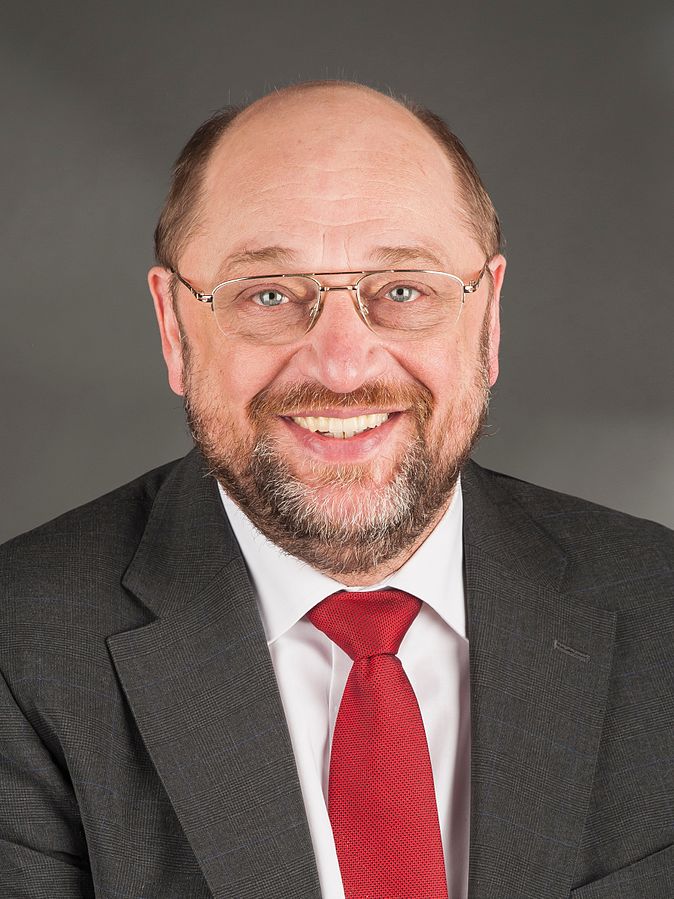
Martin Schulz – February, 28, 2014 – picture taken from Wikipedia.
When I was young, I often went to the “Republican Coffee Shops” and similar dubious places. In those days, we had many Jusos who could be found in huge numbers in these places.
Together, we finished off quite a few litres of red wine and made smoke of many Rothändle cartons. From those days, there are still a few and mostly already rather old social democrats among my friends.
Some of them are even older than I and they like telling tales. One of them sent me a document that reveals the secret of the new SPD electoral program under Martin Schulz.
Here are the most important parts of his social-democratic program as a short and catchword-like excerpt:
- A clear NO to the increase in armament spending of the FRG to 2% of our gross national product as required by the Trump USA. On the contrary – they want a step-by-step decrease to finally arrive at less than 1% and a considerable reduction of weapons exports.
- More money for education.
- Strict prohibition of lobbyism and political decisions and legislation being influenced, along with a ban on the influence all kinds of institutions, such as employers’ associations, unions or churches have.
- Strong regulation of marketing, especially if it is easy to misunderstand and manipulative.
- Less taxes and fewer of those contributions that make work more expensive.
- No tax on general income up to 50,000.- and on work-related income up to 100,000.-. To make up for it: far higher taxes on income exceeding 250,000 € per year.
- An obligation to disclose and make transparent all anonymous and exorbitant property, be it privately owned or owned by legal entities.
- New regulations for inheritance tax in such a way that the income gained from an inheritance increases with each generation (example: an additional income tax of perhaps 10% on gains from directly inherited assets, then 20% if you inherited in the second generation, etc.).
- Massively more tax on speculation gains and all sorts of gambling (currencies, raw materials, food, enterprises,…)
- Infra-structure: ProBahn, ÖPNV and active mobility.
- Tempo limit on motorways (110 km/h), highways (80/km) and inside towns and villages (30 km/h as a default upper limit).
- Adjustment of taxes on petrol and diesel with a relevant increase – to make up for it: no stupid road toll.
- Abolishing the subsidies for the automobile industry (business cars).
- Gender equality that deserves the name
For Europe, too, his plans are great:
- A Europe of regions that is no longer the plaything of national states. Instead, a division of the big nations and an establishment of federal states with a maximum dimension as big as Bavaria.
- The reduction of central power systems (Brussels) and sub-centralized power systems such as Berlin, etc.; Instead: a network of subsidiary local and regional systems.
- Reduction of the overflowing System EUROPE and the huge advantages for EUROPE officers when it comes to income.
- And best of all: the central EURO is to be abolished and replaced by local EURO varieties. They are adapted to the regional circumstances and constitute a floating currency network. Externally, they are represented by an average Euro.
Martin Schulz states that the values that underlie all his activities are:
- A healthy scepticism when it comes to the belief in eternal growth, Taylorism and globalisation.
- Enlightened, agile, slim and open thinking and behaviour.
- Solidarity versus egotism, transparency beats secrets, courage beats fear.
- Not only respecting other humans, but also appreciation and meeting at eye-level!
- Less administration and bureaucracy and instead more political organization based on social consensus.
Well, if it comes to discussing such a program “FUTURE FIRST”, I will gladly participate. And I would actually think about, at long last, again voting for SPD (notwithstanding the “Who told on me?”-question). But now, unfortunately, another equally trustworthy source revealed to me that the document, unfortunately, is only an April-Fools-Day joke I fell for. In fact, neither the SPD nor Martin Schulz want any of these things.
RMD
(Translated by EG)
Roland DürreSunday March 19th, 2017
Let me Say a Few Words …
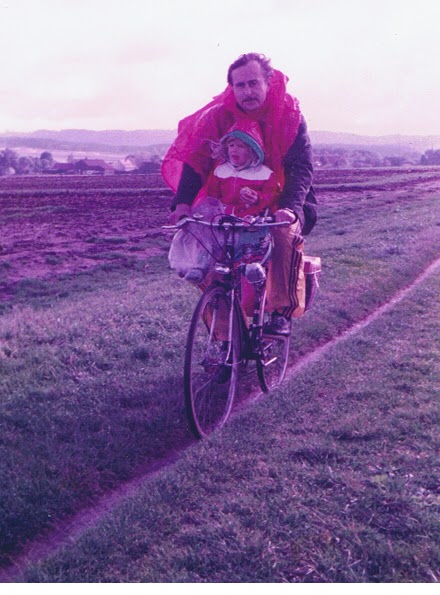
Travelling in this world (1984)
What I heard on my travels.
Maybe something to think about.
Although or perhaps because I (almost) no longer go anywhere by car, I travel the world more than ever. And I experience many exciting and beautiful things. In particular in connection with the persons I meet when travelling. From them, I hear so many wise, new and important things.
And whenever I hear something that goes right to my heart, I remember it and write it down. To this end, I created a document that I can read everywhere. This morning, I read some of it while sitting on my Sunday sofa – and here is what I thought:
“What a pity that nobody else can read this“.
So now I am going to copy a few sentences/paragraphs from there – mostly written in the last few days – and share them with you.
Social solidarity is the central issue. It is the only way to make sure we can live together in peace. My formats – both the ones I realized and the ones I envision – aim at promoting tolerance through participation. I want to abolish prejudices and experience the added value of doing things together.
(Simon – speaker, trainer, moderator, doer, founder of the Kempten Founders’ Village, world-improver, expert for the young generation, spouse and father – whom I met one week ago in Kempten. Here is an excerpt from an email he sent to me).
The worst managers are those who are proud because they saved their enterprises from many wrong decisions.
(Founder – I do not remember who said it, I only remember I heard it last week during a business plan award ceremony)
Transition & Speed!
(Stefan – entrepreneur, IT expert, chess and billiard player, father; motto for the next year)
Re-write the script of his life
and
Human – you really have reason to be proud!
(Sociologist – in the Bayerischer Rundfunk; about the social change caused by the young generation)
What if no meaning is found – if only nameless horror remains?
(Walter Benjamin – philosopher who made me thoughtful; he is being listened to and read a lot)
A problem is a state of affairs that cannot remain as it is (and consequently must be solved)
and
Management seminars are “trickster seminars”.
(Gerhard Wohland – @GerhardWohland, learning counsellor; every truth is tomorrow’s error; spoken on the Dornbirn PM Camp 2016)
Optimism is something you always have room for more of – at least as far as I am concerned.
(Andreas Stichmann – Interview partner on the radio, author, word-game prize winner, literature; I just heard him on Bayern2 “radioTexte – Das offene Buch“)
I wish you all a nice and peaceful Sunday!
RMD
(Translated by EG)
Roland DürreFriday March 17th, 2017
We Cure the Symptoms and Ignore the Sources.
Long Live Populism!
or
Talking Instead of Acting?
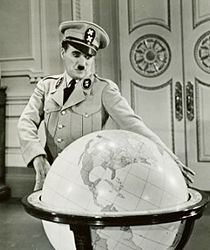
Charly, the Great Dictator.
Now I witnessed the first (electoral) campaign events with Martin Schulz. Even from the distance, I got the impression that this is another and admittedly talented attempt at using the general uncomfortable feeling of many persons as a resonance body for someone’s own goals and demanding a few improvements where small details are concerned that, however, only equal a treatment of symptoms if you look at the entire picture.
In these speeches, I perceived what is probably generally called populism and what is probably the last remaining recipe for success in the current generation of politicians. Apparently, nobody ever got the idea of asking what caused the problems and then introducing change in a social consensus through political activities.
Consequently, Martin Schulz is the next populist looming on the horizon for Europe. This time it is a candidate for the one “party of the people”. Again, the motto in the speeches I heard is the same:
We are appalled by the symptoms and enjoy to point out what went wrong, but we do not dare to approach the sources.
After all, that would be system-critical and call for change. Which is an absolute no-go. Especially for the SPD. Because that is something the comrades forbade themselves many years ago. After all, they want back to power. And even when they were part of the government, they avoided all “system-critical” issues wherever possible. Because “holy” practical constraints and systemic necessities stood in the way of change.
The environmental catastrophe and destruction of our planet (plastic, climate, …) and the social polarization of humanity with all its consequences such as flight because of destroyed living space and more left them just as untouched. In fact, they would like to just leave these issues out of the government altogether. Because it would only have be a nuisance.
“Social Democracy First” is rhetorically easy to communicate. Except: it is a little harder to actually realize and then to work on the causes. After all, you do not want to be (too) inconvenient and you also would not wish to hurt anybody, would you? These topics do not even appear in the electoral slogans, because bad news are not popular. Especially if you can no longer ignore them.
Regardless of the fact that reality, too, might well be a good topic for populists. See the video below. But if you talk about reality, you cannot be afraid of your own courage. You have to be able to bear the truth. And you are ill-advised if you fear that it might cost you votes. So what you need is courage. But currently, it seems that cowardice is more popular. Fear happens between the ears and it reigns over the world in a truly demonic way.
So here, yet again, I am trying to describe the reasons why our society drifts apart into fewer and fewer rich and more and more poor people. Which is exactly where you should get active if you call yourself a social democrat.
The reasons for polarisation are:
- The free speculation with everything: currencies, enterprises, food, raw materials, property, copyright, all sorts of rights …
- A property legislation that protects individual “mental property” in an exorbitant and excessive way;
- A general understanding of ownership that seems to have totally isolated itself from the maxim of “ownership is also a responsibility”;
- The social legitimacy of illegitimate influence on common-good interests exerted by interest groups (aka lobbyism as a criminal act of advantage theft);
- Propaganda, including the seduction and manipulation on all levels, also of the sub-conscious, as a normal business method (aka marketing). Seduction that aims at making the concerned persons behave in contrast to their will and ratio.
Although we know better, we still believe that
- Growth beats health;
- Taylorismus beats task-identity;
- Shareholder Value beats common-good economy.
When will we understand that
- the interests of the stakeholders (customers, employees, …) should have priority over the shareholder interests and that
- In a society with a future social togetherness instead of private property preservation must have the highest priority both for all individuals and the entity?
So why do politicians never talk causes but instead only make loud populist noises? And why do they always only write in their programs about minimal corrections and symptoms that need to be cured? And why do these methods actually make them successful?
🙂 Here is an example for POPULISM I rather like. Even if Harald Lesch is only partly correct (and I can easily imagine it), my aforementioned “social fear” might soon no longer play a role at all, because surviving will be more important.
Yes – this is exactly the speech I would like to hear from a politician…
RMD
(Translated by EG)
Roland DürreSunday March 12th, 2017
Entrepreneur’s Diary #120 – Change Ordered from the Top!?
How not to practice innovations management.

It is quite possible that I still believed in institutions and administration when this picture was taken.
Bureaucracy and administration paralyze concerns and medium-sized enterprises. Agility gets lost, Taylorism flourishes. This is how all systems will, sooner or later, make their survival the central goal of their thinking, functioning and behaviour. The interests of the important stake-holders “customer” and “employee” will be suppressed, the enterprise will become inflexible and fragile.
Then the determining factors and environment will change, once in a while even disruptively. The “management” is totally surprised by what happens. A business model that used to be very reliable and beloved is suddenly questioned. There is no better one on the horizon. More and more helplessness grows. Everybody expects a miracle. Innovation and agility are praised as the saviour. Everything must get better.
As a consequence, nothing happens. Except that new programs that follow old patterns are created. The administration gets one or several additional staff departments. They will then be responsible for “change” or innovative management. The new world is now communicated by the central administration with lots of noise. The propaganda machine starts running. On a slide used by the director, you will, for example, see:
„The board identified priority areas to improve in 20xx to become the company we want to be.“
Then comes a list of innovations. As a general rule, you will find CSR (corporate social responsibility) and similar nonsense. Mostly, you also get something about performance or profitability. Once in a while, the customers are also mentioned: you want to become customer centred. Occasionally, they will also sing the praise of “new values” and a different “culture”. But above all, you will always find lots of buzzwords in these works. And that makes you wonder why expensive counsellors get so much money for such weak formulations.
The best case is if things that have been looked down upon for years suddenly become epiphany. I mean terms such as taking responsibility, eye-level, respect and appreciation. Agile and lean, openness and transparency are repeated in mantra fashion. Modern methods and informal communication are propagated. Except that nobody tells you how this is supposed to work. Neither is anybody keen on actually installing these concepts, because the system does not really want any of them. In fact, the system wants to establish and improve its own power. No matter what it costs.
I have come to that stage where I can relate numerous stories about how enterprises have become more and more bureaucratic and administratively complicated. On the other hand, I do not know a single instance where they successfully returned to the simple, agile and open enterprise.
That is the reason why, in social systems – be it enterprises or societies -, I no longer believe in transition or transformation towards less bureaucracy and more life. Basically, it cannot be done from the top, anyway – and they will not allow it from the bottom. Consequently, I will no longer waste my time and energy in old structures. Instead, I will only support concepts where something new is created. Innovation is creative destruction. As in evolution, new things will only happen when an old generation dies out and a new one evolves. That is just how it is.
Please understand my article as an optimistic message. All you have to do is have a little patience, then everything will work out just fine.
RMD
(Translated by EG)
P.S.
For more articles of my entrepreneur’s diary, click here: Drehscheibe!
Roland DürreSaturday March 11th, 2017
Kässpatzen, Allgäu, Founders’ Scene and Digitalization.

Night is coming (Founders’ Villa in Kempten).
Yesterday, life again threw me towards the Allgäu. Thanks to Alexa, I was invited to see the “Kempten Founders’ Villa“ (Gründer-Villa Kempten), where I met young activists of all sexes and age groups. I met founders, entrepreneurs, persons looking for their own way in life and “world improvers” I very much liked. The feeling was a little like: “act local, think global“:
It was a beautiful experience that made me optimistic towards the future.
Because on March, 10, they had another one of their monthly meet-ups at the founders’ villa. On those occasions, what they do at the Founders’ Village is “networking”. You also get home-made Kässpatzn – and the invitations were issued by the two initiators and founders of the Founders’ Villa Simon Schnetzer (youth researcher) and Thomas Herzhoff (agency boss). Consequently, the Kässpatzen had been made by the two bosses Simon and Thomas personally in the comfortable Founders’ Villa kitchen.
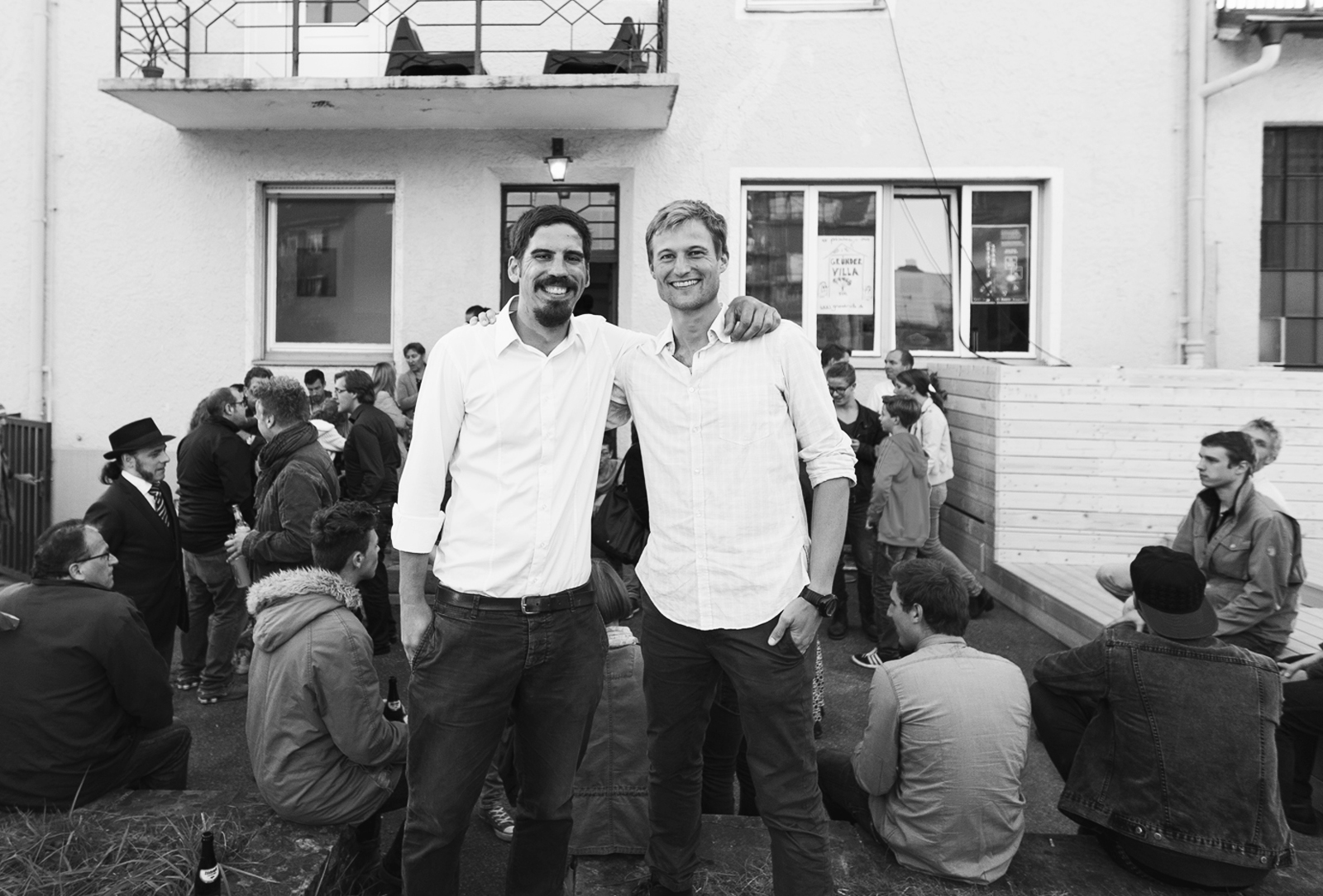
Simon Schnetzer (right) and Thomas Herzhoff (founder of the Founders’ Villa).
And I can truly confirm: the Kässpatzen were excellent. They were just as tasty as in the “Oberen Mühle“ a little deeper in the Allgäu, in Bad Oberdorf (part of Bad Hindelang). And that is definitely some achievement!
And the many nice discussions were just as good as the food. Among the people were truly great types. They had very diverse interests and exciting dreams for their future.
Besides myself, there was another guest for whom it was also the first time. He introduced himself and his new role and told us that he is now supposed to found the “Kempten Digitalization Centre”. It is an activity sponsored by the Swabian Government in Augsburg and also subsidized by the Free State of Bavaria. The opening ceremony for the “digital office” or whatever is to be established is scheduled for June, 19th. However, he said he does not know if he can actually open on that day. Too many issues are still unclear.

The Kempten Founders’ Village lives.
Well, his words made me smile. So many things happen in the Allgäu. They have innovative enterprises and companies with a world-wide reputation. A founders’ scene starts to come to life.
The people are creative, looking for and finding alternatives and changing the world. They try things and do things. And then the people in Augsburg, the capital of Swabia, sends them a “digitalization centre” that is supposed to teach them digitalization. Probably “Digitalization for the Allgäu” as a gift from the Bavarian State Government.
The very term “digitalization”! From the times when watches and tachometers became digital. Years later, ISDN was introduced. But that, too, was a long time ago and those technologies have been archived in the Deutsches Museum long ago. Digitalization is ancient. Young persons have progressed way beyond that.
And in the Allgäu, the “Founders’ Villa” is a much better metaphor for forming the future than a centre that now wants to start digitalizing the Allgäu.
So let me, again, express my gratitude for the kind invitation to all and in particular to Simon and Thomas for their hospitality in the Kempten Founders’ Villa.
RMD
(Translated by EG)
P.S.
I took the pictures from the Kempten Gründer-Villa Kempten website.
P.S.1
In this article, I tried to describe how activities sponsored by the central administration reach in the “provinces”.
Roland DürreSunday March 5th, 2017
Additional Note on AGILE
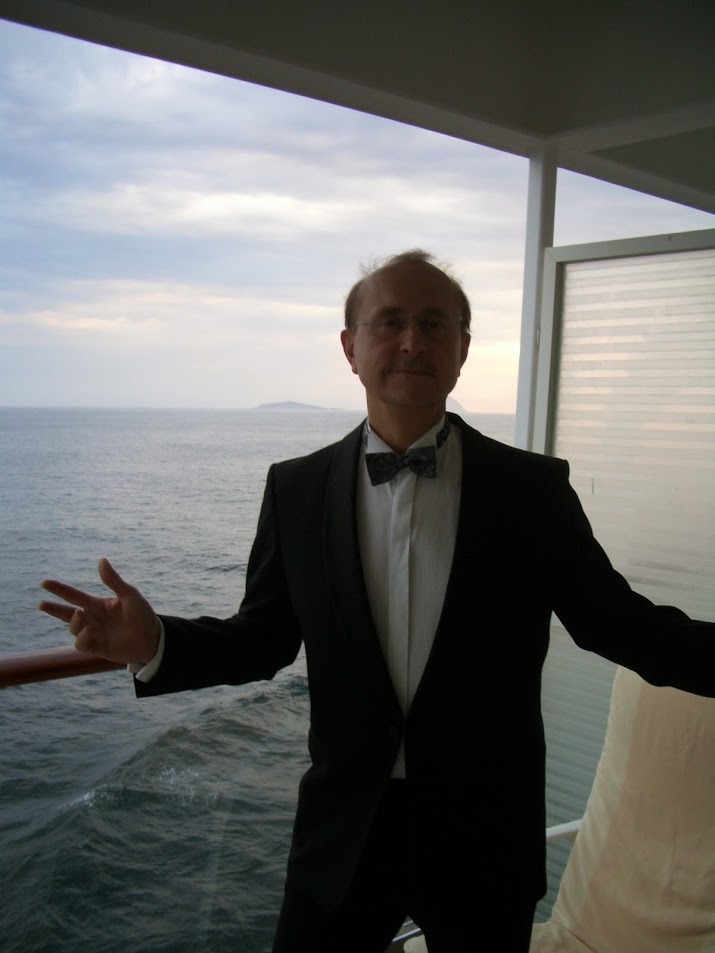
AGILE on the MS EUROPA 🙂
I already gave you a long IF-Blog report about my presentation at the FAV (Forum agile Verwaltung) at the Hochschule der Medien in Stuttgart on February, 10th.
In this presentation, I tried to point out how “agile” has always been normal if considered a “life-ruling value” that – due to the industrial revolution and technological progress – has only been pushed to the background during the last two centuries. But now, it returns in full force.
I left the military complex out of my presentation. It seemed to me that in the military world the dogma of precise planning and strict hierarchies is particularly dominant. But that, too, is not the case. Especially those involved in the military do and have to think in an agile way. One of the instances where this became obvious were the military successes of “agile and networking teams” (for instance the Vietcong) against the forces of super powers that were far superior technologically and in numbers.
But let me first cite Graf von Moltke (about strategy 1871):
»… No operational plan will ever look further than the first meeting with the enemy with any amount of certainty. Only the layman thinks he sees an idea that has been thought through in all its details until its well-predicted end in advance when looking at an entire campaign. You have to think ahead, but you cannot plan ahead.«
Colonel general Kurt von Hammerstein-Equord, also a famous military strategist, recommends when addressing his officers:
“Liberate yourself from working on the particulars. You will want a few not so wise persons to do that. But take a lot of time to think things through and to get a very clear picture in your own mind. See to it that all your ideas are realized. That is the only chance for you to really lead.“
And he continues by saying:
“I distinguish between four types of officers: prudent, industrious, stupid and lazy. Mostly, these characteristics come in pairs: One sort is prudent and industrious, They must become General Staff. The others are stupid and lazy; they are 90% in all armies And best used for routine tasks. Someone who is prudent and lazy will qualify for the highest leadership positions, because he has both the clarity and nerves for difficult decisions. You want to avoid those who are stupid and industrious, you cannot give them responsibility, because they will always do enormous damage.“
That, too, sounds like absolutely agile leadership to me!
In general, you can say about the military sector:
Decisions and work should always happen on the lowest possible hierarchical level
In other words:
Delegate! Let others decide and work!
Formerly, they called this the Subsidiarity Principle (Subsidiaritäts-Prinzip) in management. It was extremely important, but it seems to have been forgotten by now.
Note:
After this digression into the military world, I wish to point out yet again that, more than ever, I am convinced that war is nonsense and peace is an absolute necessity. In the last fifty years – perhaps with the exception of a few small blue-helmet UNO activities – there was not a single armed conflict that improved matters in the least. As a rule, the situation was worse after the war than before.
The only case I know (which I actually witnessed) where bloodshed was prevented was probably the NATO intervention in Yugoslavia. That was a lucky case that can be seen more like an exception from the rule. And it caused the disintegration of Yugoslavia, which certainly nobody had initially declared their political goal.
RMD
(Translated by EG)
P.S.
Parts of the ideas and cited sentences in this article are thanks to the inspiration the presentation of Frank Rebers on the Westerland Bike Management Camp in Westerland (Sylt) in February 2017 gave me.
Roland DürreFriday March 3rd, 2017
Work Space. Fun Space.
On Ash Wednesday, Nils Hilze and yours truly were invited to a business lunch at Munich LinkedIn in the Sendlinger Str. 12. Nils is @kojote, I am @RolandDuerre (in Twitter).
We had a “blind date” with @LinkedInDACH (gh). Here is how it happened: I had told Nils about a meeting at LinkedIn. He found it exciting and twittered that he, too, would like to make the LinkeIn experience – and lo and behold – we were invited. We did not need too much persuasion, we came quite willingly.
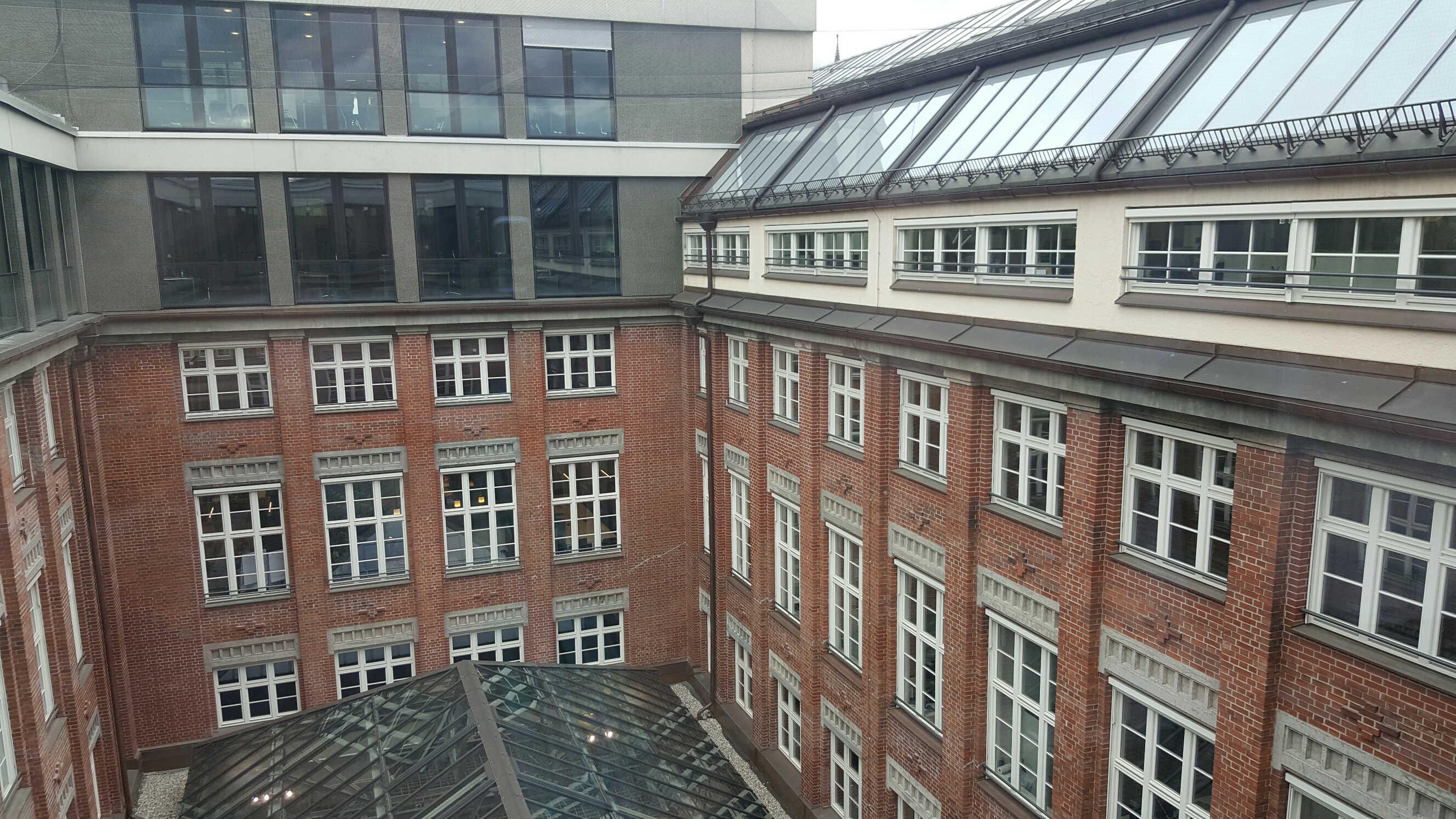
View from LinkedIn down to the interior courtyard of the former SZ publishing house on Sendlinger Str. 12. We are on the white level.
Our visit started with a tour through the LinkedIn offices. They are beautifully situated in the heart of Munich. We were able to both inspect and try out the facilities. Nils tested the hammock and I was allowed to play with stones.
We were totally fascinated. There are many quiet areas in the beautiful and big offices, even the attention given to details of the furnishing makes it very attractive, and yet everything was also totally practice-oriented. The truly lavish choice of things for the employees to do and explore create a sense of style and class.
I started thinking: around thirty years ago, I was also in these offices. In those days, the offices still held the rotation printing machines of the then so powerful SZ. It is a historic place that makes you aware of the change of time. Technologies disappear and are replaced by others. Innovation is really creative destruction.
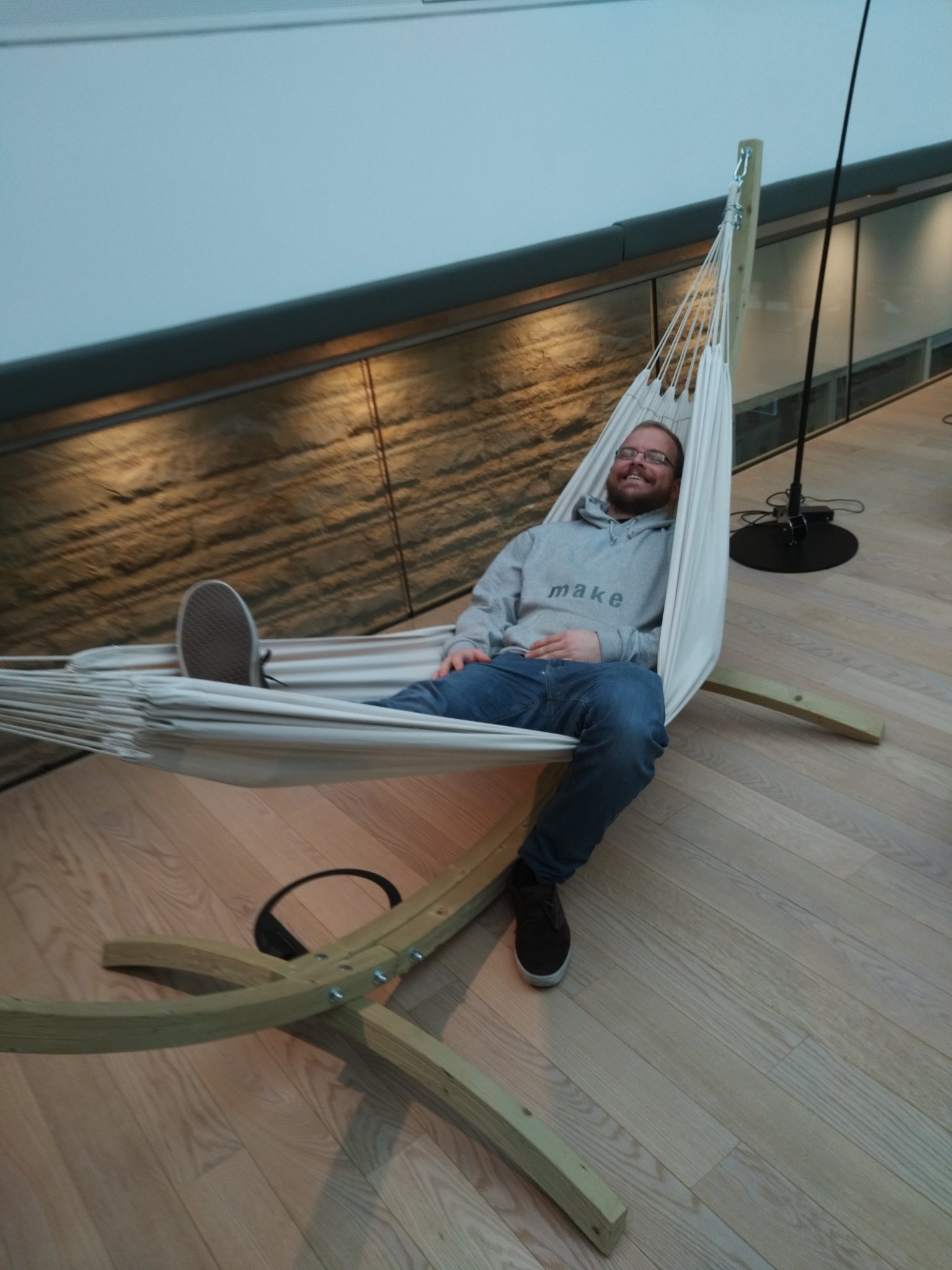
Nils enjoys life at LinkedIn to the brim.
Our hostess told us that all LinkedIn offices around the world are uniquely equipped (and yet they give you a huge sense of belonging together). They try to consider the local and historical specialties of the place when designing the offices at all locations.
Consequently, I could now relate many great details about the LinkedIn office. But the nice atmosphere I felt everywhere is a lot more important. Whenever entering a new company building, I always try to simply stand still and let the environment have its effect on me. And this is how I get a first impression that mostly is not too much off the mark
And in this particular building, I got the impression that all the employees were really rather happy. Thinking back to my own start into work-life, I would really have appreciated being able to start in such an enterprise. But mind you, I am not really in a position to complain – it was not at all bad at Siemens Koppstrasse. It was a lot better than in many offices I saw since then.
I noticed an interesting similarity. Due to my activities, I also occasionally stay at simple “coworking spaces“ such as ImpactHub at Gotzinger Platz. There, too, the start-ups have lots of fun when they work. And, of course, there is a huge difference between the LinkedIn offices and those at ImpactHub. Where in one firm you see upper-class furniture and electronically height-controlled desks, you have beer-garden tables and benches that will be folded up whenever more space is needed in the other. One company offers elaborately designed reclining cabins, the other simple wooden plank compartments.
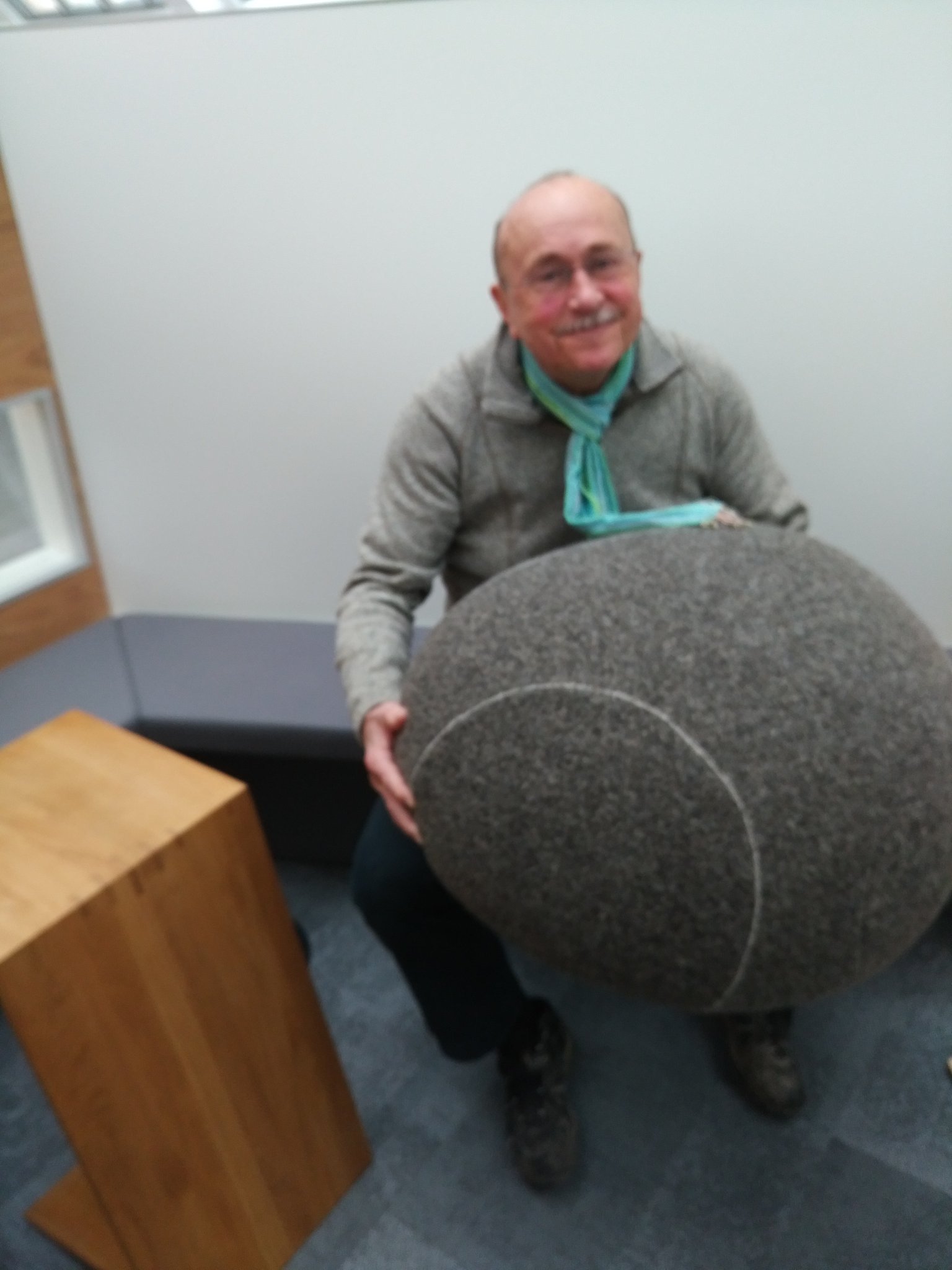
And I always enjoy playing with the rocks from the Bavarian Alps.
But in both offices, the principle is the same: they want their employees to enjoy their work and be well looked after. Both are huge offices with lots of room, also for moving around. Occasionally, you will even see an employee rolling around on his scooter.
And the smell is the same in both office buildings: #newwork. The division of the office space takes different work situations into account. You have space for solitude and space for communication, small and big team offices, everything is a part of the whole. Food and soft drinks are offered as a standard service, everybody can help himself.
At ImpactHub, you get the coffee in a simple thermos and the shortcake or the cheese sandwich along with it for little money; at LinkedIn, they have the huge espresso machine that delivers excellent coffee. And you do not only get shortcakes but also excellent and very diverse food. And if it is fairly priced at ImpactHub, it is, naturally, free at LinkedIn.
Incidentally, I did find a downside (both at LinkedIn and ImpactHub). Due to the great location in the middle of the city, those who come by bicycle have a problem at LinkedIn: where to park their bike? But, knowing that LinkedIn is a modern enterprise, I am sure they will soon solve this problem, too.
At ImpactHub, due to the location, you basically assume you cannot have this problem. But no! They have an evil neighbour living on the opposite side of the street. Along his totally derelict property wall, he fights – totally irrationally – against parked bicycles. Even my bike was already in danger of being towed away.
However, modern persons like being mobile with their bikes … and they want to know that their means of mobility is safe while they work.
There is one thing I know – I already look forward to my next date at LinkedIn. And I also always enjoy visiting the ImpactHub.
RMD
(Translated by EG)
Roland DürreThursday March 2nd, 2017
My Friend, the Marten.
My Friend is Back!

Ermine (Mustela erminea) in summer pelt.
I have been driving cars since I was eighteen. And through all those many years, I had one arch-enemy: the legally protected marten.
Countless numbers of times, I wanted to start my car – and it did not start. Because that animal had bitten through a wire.
As the years went by, I spent quite a lot of money on the repairs. And there were also many things I tried in order to prevent it from happening! Every evening, I put a grate underneath the car (and in the morning, I had to remove it again). I tried quite a few voodoo methods, which were just as useless as high-tech in the form of small ultrasonic devices in the car. I truly tried everything in order to keep my enemy away from my car.

Here you can see a stone marten. Whereas the picture above shows a weasel, who also belongs to the marten family.
Now I finally won the battle. I no longer own a car. And that saves me a lot of money. And besides, I no longer have the problem that I despair in the morning because my car does not start.
Once in a while, I have a flat tyre when I want to climb my bike. That is not a problem, because I can easily take another bike. After all, I have several. And whenever I have a puncture, it is not because of the marten. Mostly, it is because of a glass splinter or a sharp piece of split or some small piece of metal.
Consequently, I made peace with the marten. At least that is what I thought!
And what happened yesterday? In the morning, my heating system notified me that my solar water warming panels are defunct. The mechanic said the damage is not covered by the maintenance contract because it was caused by a marten. He said this kind of thing happens quite often. And I had to pay.
Well, he is back …
RMD
P.S.
I took both pictures from Wikipedia.
The beautiful picture of the weasel (top) is from the central media archive Wikimedia Commons. Copyright is with James Lindsey, the source is
http://popgen.unimaas.nl/~jlindsey/commanster.html
The stone marten image (Martes foina) is by Atirador.


