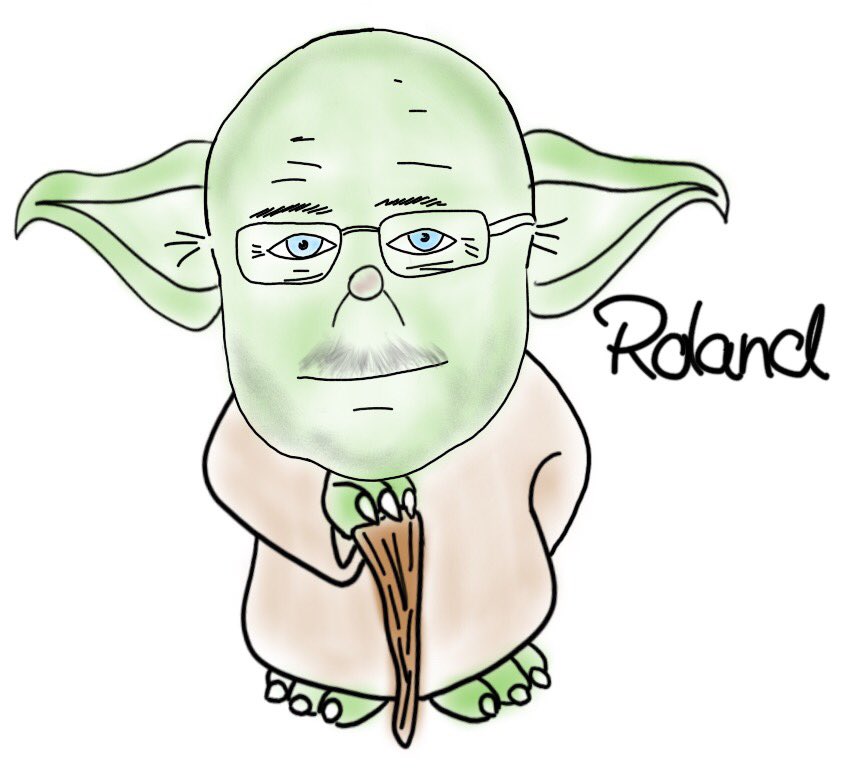
Roland Dürre
Wednesday August 9th, 2017

Diversity – The Blog Parade of the Berlin 2017 PM Camp

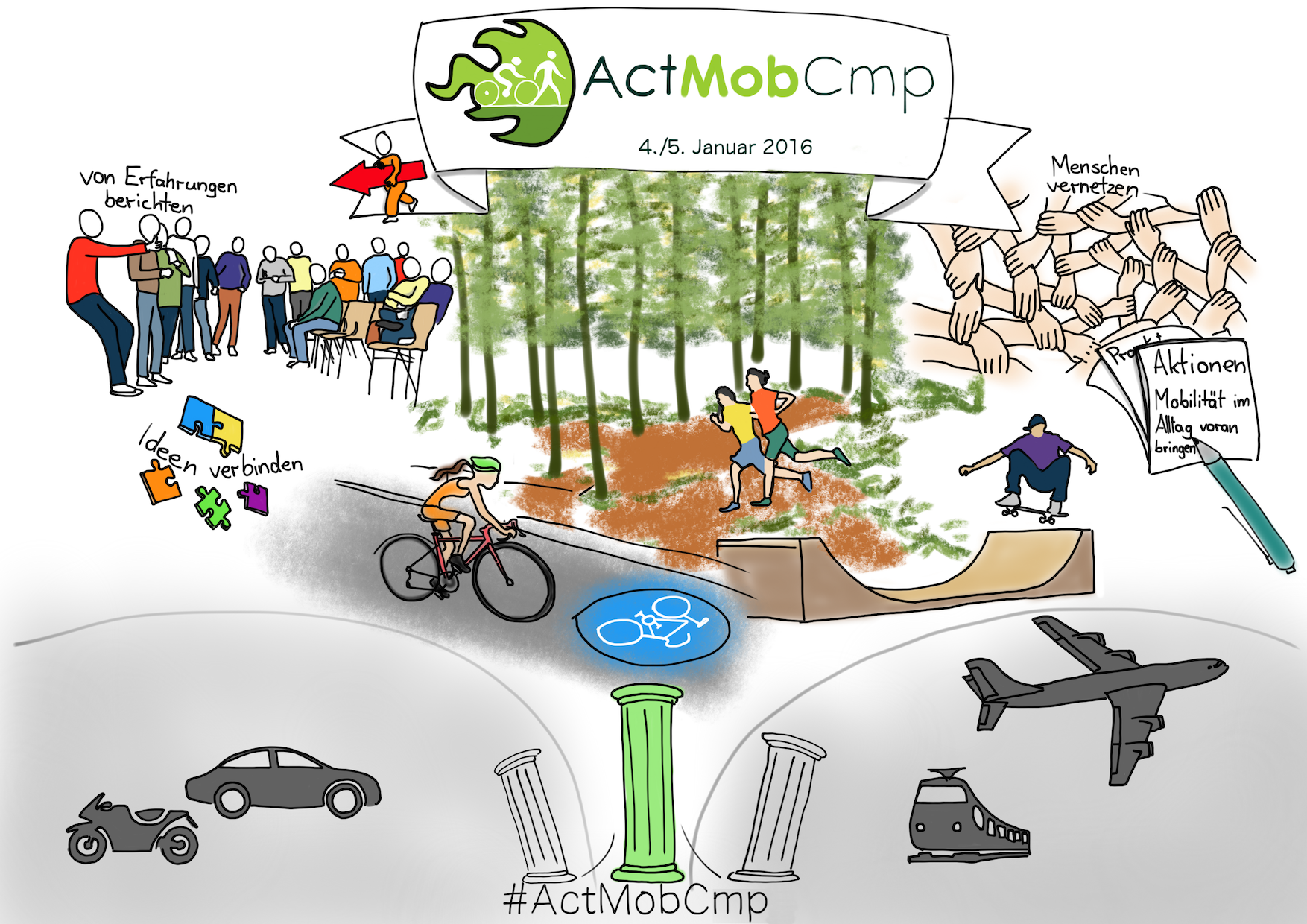
Drawing by Christian and Daniel – created during the last PM Camp in Dornbirn. (©Visual-Braindump 2016)

As one of the initiators of the PM Camp movement, I still follow the development and events around the PM Camp, even though the original Dornbirn PM Camp is a thing of the past. And although project management is no longer something close to my heart.

I believe that, a few years from now, the same will be said about the project management certificates as about the drivers’ licence:
🙂 Wise people will no longer need it – which is lucky for them.

The Berlin PM Camp was always one of those I particularly enjoyed and also often attended. It will next be held between September, 7th and 9th, 2017 (7. bis 9. September 2017). I rather like Berlin as a city of DIVERSITY, just as I also very much like and appreciate the Berlin Orga-Team. And when Heiko calls for the Blog Parade
“DIVERSITY – in projects and beyond …“
I will, naturally, contribute.

As an inspiration, I quickly read Dr. Eberhard Huber’s article on DIVERSITY this morning (together with Dr. Jens Hoffmann, Dr. Marcus Rainer, Dr. Stefan Hagen and yours truly, Eberhard initially formulated the PM Camp idea and then we put the idea into practice with a few more ladies and gentlemen).

http://www.pentaeder.de/projekte/2017/08/09/pm-camp-berlin-2017-und-die-vielfalt/

Roland Dürre
Saturday August 5th, 2017

Theatre, States and the Church …

On Thursday, August, 2rd, I went to a debut performance at the Sommerhausen Torturmtheater. Currently, they are playing a piece by  Philipp Löhle. The title is “Der Wind macht das Fähnchen“.

This time around, four female actors play on the small Torturmtheater stage: Judith Riehl, Nadia Schwienbacher, Christian Buse and David Lindermeier. Other active persons were Oliver Zimmer as the director and, of course, the great Angelika Relin, without whom this entire enterprise would not even exist.


Visiting the Sommerhausen Torturmtheater.


And Barbara and yours truly enjoyed the privilege of being present at the debut performance. We very much enjoyed a special performance. It was an evening as it will never return and it made me truly happy.

You cannot miss this performance. It will (only!) run until September, 30th, which means you already want to plan your trip to Sommerhausen. Here is the pre-view:


“Here it is, my whole pride” – the family. An experiment for the brave? 
In the year nineteen-hundred-and-some-uneven, when the world was still a better place, the story begins. Father, mother, son and daughter can be seen smiling in fast-motion as snapshots are taken at the breakfast table or during the Italy vacation. However, the bourgeois image is tricky, because as soon as hard times come, nobody stands up for the other. The family, too, depends on economic ups and downs. Everything collapses when father miscalculates the future of the modern “internetwork” and – consistently – gives notice. And it is this of all consistent acts he hands down to his son for life at the moment of truth.  
After crisis and separation, there is re-unification and new family portraits, seemingly in total harmony, but the idyll now has cracks. Irreparable cracks.


I had already been fascinated by the last play I had watched: “Eine Sommernacht”. Now it was even better – if that is possible. There is always great theatre at the Sommerhausen Torturmtheater. “Das Fähnchen“ is an exciting comedy with plenty of whit and intrigue!


It was a great theatre evening.


The beautiful conclusion of a wonderful day we had spent on our bikes. After approximately a hundred kilometres on our bikes on our way from Klingenberg to Sommerhausen, along the river Main with a few shortcuts through rolling hills, we arrived at Sommerhausen late in the afternoon. There was still time for refreshments and relaxing. And half an hour before the comedy started, we arrived at the Torturmtheater.


Some theatre before the theatre performance.


We enjoyed the always impressive theatre foyer and were looking forward to the performance. It was not altogether by force (it was not really necessary to listen carefully) that I listened to a conversation between a middle-aged gentleman (perhaps between forty and fifty) and an elderly couple (perhaps between sixty and seventy, with the lady not really saying anything, instead only reproachfully looking at her husband). For me, it was like a “small private theatre before the real theatre started“!

It was a dispute where the younger gentleman kept noisily finding it outrageous how the church behaved and what special rights that were no longer acceptable it took for granted. The other person tried to speak in defence of the church in a softer voice.

The younger gentleman criticized the church tax as a consequence of the concordat that seems to have been first installed in the 1930ies after negotiations with the Nazis. He found it annoying that leading church managers, like cardinals and bishops, get paid by the state.

The other gentleman pointed out that, after all, the church was socially very active with good deeds and that this was probably worth the price the state pays. Then the older gentleman said that the protestant church was probably better than the Catholic church. The younger gentleman countered that the protestant church actually made quite a huge profit with the Diakonie. And it continued in that manner.

Then the younger one found it lamentable that children had three hours of religious instruction at school where they were indoctrinated. The older one defended this system by claiming that school, basically, was not just there to teach knowledge, but also to give young people values. None of it was really high-level, the arguments were the same as always and nothing new. Not really exciting. Not even the values.

(After all, in my opinion, introducing values is actually part of teaching knowledge. But then, I learned a long time ago not to become an active participant in these kinds of discussions).

So I started thinking about the experiences I myself had had with the church. That reminded me of my friend and teacher Rupert Lay. I learned so much from him, above all that I have to appreciate my own qualities and take myself seriously. And that I have to be an autonomous person who is not easily manipulated.


The Jesuit Rupert Lay.


Rupert’s goal in life was to be there for the poorest of the poor. However, for him, that were not only the homeless and those who were ostracized from society. In his opinion, especially top managers belonged in this category. Which is probably correct. For me, it is hard to imagine any other profession (with the possible exception of pastors) where you have so many crazy people as among the directors of the German and international concerns. Sorry, but when I say “crazy”, I mean people who suffer from massive psychic illness and disorders.

Rupert Lay was mostly concerned with managers who had stayed sane. The “sick ones” were sorted out during his preparatory seminars. They never were allowed to attend his advanced seminars. After all, they would probably only have been a nuisance and would not have understood anything.

The really expensive fees you had to pay for Rupert Lay’s seminars were all transferred to his order, the Jesuits. And since Rupert Lay generally structured his activities to look like pastoral care, the tax office did not benefit either. At the time, some civil servants at the tax office found this extremely unfair, but apparently even they could not win against the power of the churches.


Heinrich Henckel von Donnersmark – Stage Name: Augustinus – and Rupert Lay.


I was also reminded of Father Augustinus, whose secular name was Henckel von Donnersmark. He was a baron. I knew him as well and liked him very much. Even though Rupert Lay was a Jesuit while Augustinus was a Premonstratensian Chorister. Both of them were the protagonists for ethics in business. I rather liked that. They were important counsellors of German top people in industry and politics. And they also made a good name for themselves as excellent speakers and management trainers.

Rupert Lay saw the system church a lot more critical than the “nice” Augustinus. Consequently, we (the Ronneburger Kreis) invited them to Frankfurt for a dispute. And we were quite surprised, because in the end there was far too much harmony. Basically, they kept telling the opponent that he was right.

For me, Augustinus was the best orator I ever knew. I well remember one of his presentations in Wiesbaden in the 1990ies for ICL – at the time a relevant IT producer from Great Britain. He had introduced himself as manager of “the enterprise Catholic Church” and described his role as that of the “lobbyist of the most powerful and oldest enterprise of the world”. Quite some self-irony.


Churches talk about peace and love.


On the other hand, the presentation also gave me an insight about myself that I see confirmed to this day. The church is an enterprise that has peace and love written all over its statutes. Quasi as Marketing. They have been doing this for more than 2,000 years. In all these years, it thrived with this message and became really rich and perhaps also powerful. I find it extremely sad that, in all those 2,000 years, it never managed (and perhaps never even wanted) to make the world a little more peaceful and love-oriented. On the contrary: to this day, the Catholic Church, along with its competition on the market, cause the opposite of peace and love: war and hatred.

Consequently, that was the time when I first understood that I do not wish to associate myself with a system like the church. Nor will I say more about it.

Just like I will never again vote for CDU/CSU because they are the reason why we had re-armament in Germany. The same is true for the SPD and the Green Party. I will not vote for these parties because they broke an important taboo when they allowed fighting missions abroad for the ‘German Armed Forces.
Basically, everything is quite simple:

RMD
(Translated by EG)

P.S.
And if you want to go to Sommerhausen by train, you want to look for the railway station of Winterhausen. From the Winterhausen station, it is only one kilometre to the theatre on foot..

Roland Dürre
Wednesday July 26th, 2017

Shouldn’t Business Serve Humans?!

In Unterhaching, we have a great soccer club, a number of IT enterprises such as the InterFace AG and even world-famous companies. One of them is Wrigley.

Let me relate to you what I learned over the last few weeks. I did not make any attempts at verifying the story, but it is quite possible that things I heard in the form of reports or gossip around here are the truth.

I am sure the degree to which Unterhaching has become considerably more famous even beyond Germany is due to the Spielvereinigung Unterhaching.

Besides soccer, we also have volleyball, gymnastics and several other successful athletic areas in Unterhaching – as well as several more interesting enterprises and a wonderful outdoor swimming pool and much more.

The Unterhaching Civic Office is certainly glad that the famous Wrigley enterprise has its European headquarters here. And perhaps in the future, you will have to say “had”.


The big concerns want power. To this end, they like to swallow up other concerns.


It is quite possible that, with its profit of 35 billion US dollars in 2016, Mars falls a little behind Nestlé (turnover in 2015 was 88.8 billion). That is just more motivation for Mars to catch up with the big rival.

Currently, they are preparing for the merging of the animal hospital chain VCA Inc. (Veterinary Centres of America). Mars wants to spend 9.1 billion US dollars, including the debt. It is supposed to further strengthen the business area “animal health”. To me, it looks more like mania and misdirected late capitalism. I can imagine only too well (or rather, too badly) what the leading US food giant wants to achieve by the merging.


Food producer invests in animal hospital. Shame to him who evil thinks.


Wrigley was swallowed by Mars as early as 2008. Initially the European headquarters remained in Unterhaching. Another important Mars location is obviously in Viersen near Düsseldorf.

Now, Mars wants to centralize a few of its activities in London. One of the consequences will be that people now living in Unterhaching or Viersen will have to move to London. This might hurt some residents of Unterhaching, for others it will be an exciting challenge.

But then, this is what you get in a global world and economy. After all, most of the people seem to like it, since they support it – at least with their consumption habits.
But that is not what this article is about. What gives me pause is the reason they give for moving to London.


Big concerns assume that, in the future, the central key towards success in our competitive world will be the quality of marketing.


To the concern, that seems useful, and even necessary, because it assumes that, in the market for PROVISIONS, only an enterprise that has the best MARKETING can establish itself and perhaps even add to its turnover. And among the top managers, they assume that the most efficient and effective marketing firms basically sit in London. Consequently, they seek close proximity to them – and go to Great Britain. Regardless of the Brexit and such. In my opinion, the Brexit is more an operetta than anything else.

PROVISIONS concerns are, first and foremost, after turnover and results (profit). And, in the eyes of the concerns, MARKETING is the determining factor in this field. Everything else, like the quality of food and the consequences for your health, only plays a minor role.


Business should serve the people, not vice versa!


For the concerns, only one thing is important: the people must buy the cheaply produced mass food at a price that is as high as possible. To make it attractive for the masses, it is made “convenient” and optically seducing. Enriched with aromatic ingredients, “the taste of the world“ is generated and realized. “Cheap” is more important than quality, optical appeal and wrapping is more important than the content, uniformity beats diversity, mass has priority over class, storage life beats freshness, logistic feasibility has priority over taste. …

Thus, there is a strong LOBBY that forbids the legislators in Europe and Germany, for instance, the clear marking of a product if it contains substances that may be detrimental for your health.

And what do the people do? Nothing. They believe what marketing says and buy like lemmings all the products by Mars, Nestle and co. Unfortunately, this is also true for Unterhaching.

RMD
(Translated by EG)

Roland Dürre
Thursday July 20th, 2017

A Day With Love …

Exactly one month ago, I turned 67. Few people brought me a present, because my friends accept that I already have all I need. And that I do not care for useless gimmicks . I appreciate that this is how my friends treat me.
Luckily, once in a while, there is a person who makes an exception to this rule.
🙂 I am grateful for these exceptions, too. Paul, for instance, gave me the book:

A Day With Love by Moshen Charifi

It was a good thing to get this book because I often have the impression that I was born into this world equipped with many eyes. I already saw and experienced very much with my eyes.

Unfortunately, however, those eyes closed more and more as my life continued. Perhaps it was because of my socialization at home or at school or for whatever reasons.

Now, as I grow older, I get the impression that my eyes re-open to some extent. It is a process that you probably can also describe as “learning”. Consequently, I believe that “learning” can also be a synonym for “living”.

To say it in a nutshell: so far, I read half of the book and I notice that reading it has again re-opened several of my closed eyes. And this is how it also, again, added to my happiness.

The content of the book is quite banal, and yet it is totally breath-taking.
On a beautiful summer day, “LOVE” and “INFATUATION” meet to go for a walk. “Infatuation” wants to learn from “LOVE” and “LOVE” – who formerly also used to be “INFATUATION”, is happy to share her knowledge with “infatuation”.

While walking through the wonderful summer, they get into a dialogue about love. The experienced “LOVE” supports “INFATUATION” as she seeks it.
This dialogue turns into a wonderful and great metaphor that helped me to become a little more peaceful and happy.

I almost wrote “I found a little more love”. However, this sounds a little too strong for me and I also do not yet know if I am already prepared to accept such a huge thing (or if I will ever be).

The dialogue between LOVE and INFATUATION is full to the brim with small but wonderful insights. For instance, “infatuation” explains one of her weaknesses by the fact that she does “not want to lose face”.

However, the reply LOVE gives – in my words – is that you cannot lose face, you can only lose the mask that camouflages your face. Actually, I do, indeed, have many masks and I am always happy if I manage to lose one of them.

This is only one example out of many insights, all of which are part of the metaphor.

For me, the special quality of the dialogue between INFATUATION and LOVE is remarkable and particularly beautiful. It is the ideal pattern of how peaceful communication can be. It has not happened often that I witnessed and understood in such a nice way how non-violent communication can work.

I was deeply moved by how LOVE kept trying to hand her experience and knowledge down to “infatuation” in a way that was not indoctrinating. Without any form of arrogance or presumptuousness. How LOVE manages to relate to INFATUATION. And how she absolutely refrains from hurting or making INFATUATION look smaller because of her superiority.

And it is just as nice to read how INFATUATION reacts, replies after thorough contemplation and asks clever questions. And how LOVE again deals in a precise way with these questions.

Rarely have I understood so well – without any theoretical indoctrination – what the words consideration and communication mean.

Now I will imitate Paul and give the book to a few other people.

RMD
(Translated by EG)

P.S.
My only regret is that I have never met the author Moshen Charifi. But who knows, perhaps that, too, will happen one day!

Roland Dürre
Wednesday July 12th, 2017

Why We Need Christophine! (I)

On June, 21st, I went to the “Schiller-Town” of Marbach. I spent the night in Freiberg/Neckar and on June, 22nd, I continued towards Marbach. A friend from long-ago days – Thomas Kleiner – was nice enough to accompany me during travels. Thanks to him, I met Lorenz Obweser and Ruth Martinelli and almost 20 children aged between six and ten. Because I sat in a classroom of the Free School “Christophine“ in Marbach. However, the term is misleading, because in the Christophine, nobody just sits the entire morning. On this morning, I experienced something so beautiful and great that I was moved to tears.

I experienced how

SCHOOL

can function in such a way that you enjoy going there! Even the children and teachers!

But first the bad news:

I have now spent some time being a little sad. My grandchildren are wonderful and rather wise small persons. But in a few, or a little more than a few years, they will start school. And then the sad part of life begins for them. I, too, do not know how to protect them from the destiny that most German children have to endure after they are six years old.

Because school – both as I remember it myself and how I experienced it when my seven children were there – is atrocious. Not only in Germany and many European countries, school is something really backward-oriented and truly evil. With few exceptions, this diagnosis is true for the entire world, and especially for Asia.

School, as we have it today, will damage our children just like it damaged us. That ruins our society and is detrimental to our future. Many persons only recover step by step when they are adults, some never.

In the following, I will relate to you what I find so evil about the classical school system and give reasons why we need to change this system if we want to gain social progress in the form of peace and more justice.


Everyday life at school in Germany (and perhaps world-wide) is worse than sad!


In our system, education means “trained authoritative learning in a quasi-military format”. Knowledge -bulimia prevails. It starts as early as primary school. Luckily, it is no longer quite as bad as it was in the times of the German pedagogue Dr. Moritz Schreber.

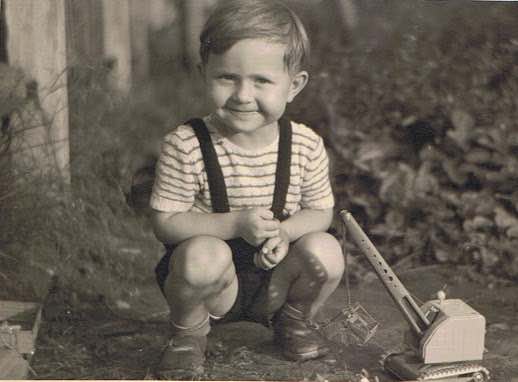
Roland on his first day at school (with the bag of sweets).

But they still drill students. You have to sit and cannot unfold. An hourly scheduled is pressed upon the children. Self-organization and self-determining are prevented. There is no way for the children to learn and practice when and what they want.

Agile, slim and transparent are words schools do not know. There is a clear hierarchy between teachers and children. Incidentally, the mechanism goes from bad to worse. This is why school has more and more problems. If that happens, the children are blamed and their poor socialization is cited as a reason. The parents get the blame.

Because they failed in their duty to bring the children up properly. Well, once in a while, this is probably true, but in the majority of the cases, it is not true. In those cases, parents suffer under school just as much as their children.


At school, achievement is the absolute maxim, often even worse than in real life.


The achievement-oriented society is already practiced. Everybody is evaluated, graded and judged. In primary school, it is all about achieving grammar school level. That will only work if the child adapts to the system “school” and submits to it. The ordering principle of school is clearly hierarchical. The magic word is authority. You learn obedience.

The children learn that you have to more or less accept everything you learn, along with the process.


Whenever school does not function, the teachers and society blame the parents.


Because the parents never taught their children how to respect others. Especially the teachers. As I wrote before: sometimes that is true, but usually it is not.

In order to enable the children to manage the transfer from primary school to grammar school in this miserable situation, there is an army of – mostly black-clad – private tutors who, during the few free hours, give the children an extra hard time. And thus – mostly under many tears – they are pushed more or less successfully over the threshold to the grammar school level.

I was often a “child that had no respect”. And I often doubted what they told me, and I also said what I thought. And time and again, I was punished for it. Because the teacher is always right. At school, there is collective obedience. After all, an order is an order you need to carry out. I, too, made that experience.


More than once, they also gave me accusatory feedback about my “being different”. Mind you, all I wanted is: be me.


Later in life, I reversed the roles. I justified the “bad habits” I had also been punished for in an intellectually tricky way, calling them “civil courage” and “constructive disobedience”. Those were attributes that made me exceptional.

But, basically, the school system is based on suppression. There is an order. There must be an order, because humans need order. However, it is not there for the student but for the system, and therefore against the student.

Because this is the only way for the system and the teachers to make students a homogeneous mass (that is at least what school thinks). Between eight and nine, everybody has to do calculations and between nine and ten, everybody has to read. Between ten and eleven, you have physical exercise and from eleven to twelve, you write. And between twelve and one, you get religious instruction. At school, you have to sit and “behave” most of the time. Otherwise, you get punished.

All this is justified by postulating that there is no other way of doing things. It is the only way you can learn efficiently. But that is a huge lie!


The full-time school makes matters even worse. All those free afternoons in our youth that should be reserved for playing, thinking, experiencing and living are no longer available.


Now we get the full-time school. More and more often, children will also be transported to have lunch and “levelled-out” with convenient food. The schools look like barracks and are not places where you can flourish and meet at eye-level.

Schools are organized and managed following military examples, the small persons are administered, their value is the same as that of recruits during basic training in times of compulsory service. The new buildings at grammar schools (or rather: educational plants or barracks) I know at Neubiberg, Ottobrunn and Höhenkirchen-Siegertsbrunn also reflect this attitude in their architecture.

You have long corridors with many doors that lead to the many classrooms like hoses. You often cannot open the windows and the air conditioning creates bad air that gives the “teaching staff” headaches. Looking at these educational plants, you are reminded more of barracks than of free places where you learn something and practice for life. And since these buildings have been constructed with little money (during the bidding, the price is the most important criterion, which means the cheapest architect will win), it will not be long before you notice the first signs of decay.

To make up for it, the administrative overhead grows and grows. This is how education becomes more and more expensive – but not much of it reaches the “final customer: child”.


All social systems need structure. Both children and grown-ups look for something to lean on. But the structure of schools should support children, instead of working against them.


At school, nobody considers the great diversity potential that small people have. For reasons of efficiency and because of limited budgets, it is neither possible nor desired. They scale and measure, certify and grade. What is taught is achievement.

In short: they indoctrinate you because you need to function. After all, society needs consumers. Autonomy and the ability to criticise are not welcome.

Once in a while, something happens that gives you hope. Because the teacher is really a nice person. But the best teachers are few and far between and sooner or later they will capitulate in front of an educational system that has de-personalized itself. And the best they can hope to do is perhaps minimize the damage that the system produces. And teachers will be selected for their good grades. However, those with the best grades are seldom pedagogically the best. The best will then try to find a job in a private school or drive a taxi or do some private tutoring.


Children, too, should be treated as if they were humans!


I actually once heard this lapse of the tongue (although it was not from a teacher but from an entrepreneur who did not say “children” but “employees”). To be sure, I certainly was only a lapse of the tongue. However, I strongly believe that, deep down, it was what the person who said it believed and felt.


Economy is now learning that motivation will only work intrinsically . At school, they practice 100% extrinsic  patterns. That cannot end well.


Today, everybody, be it Allianz or Siemens, wants to change work-life. #newwork is fashionable, promoting a more innovative and creative approach. One of the protagonists of this movement is Thomas Sattelberger, the “Saul/Paul” of the #newwork-movement. He promotes himself like no other and runs through the country with his message of salvation. After his concern career, the thing that made him most famous was “Augenhöhe, der Film“.

Now he visits everybody and criticizes what he witnesses in local enterprises. Justly so. He would like to crown his life’s work with a seat in the German parliament – for the FDP (is that a fitting combination? FDP and #newwork?). It will make me happy if Mr. Sattelberger, as soon as he sits in parliament, promotes agile and humane schools. But that is another thing I do not really believe in.

For instance, most of the enterprises would like to become more agile, slim and transparent. At least that is what the colleagues of HR (Human Resource – another one of those ugly terms used in the modern working environment) preach. They look for innovative employees who are creative in order to enable their enterprises to manage the transition caused – among other things – by digitalization. At HR, they talk about eye-level, #newwork, intrinsify.me, democratic enterprise, common-good economy, “shared mobility“ & “shared economy“ and many similar issues. They dream of a network of self-organized teams, of a new entrepreneurial culture and communities of shared values. The latter are also quite popular in politics. There are many more catch-words of this type in the new world of old enterprises.
Except how do you expect that to work out if our offspring is trained to do quite the opposite as soon as they start school?


Enterprises want agile, critical and creative people. Yet that is exactly what schools beat out of the young students?


But nobody talks about #newschool, about self-organisation at school, about democratic classrooms, about teaching at eye-level and similar things. At least in Germany, this is not desired. It is taboo!

Terms such as #home-schooling, #un-schooling #no-schooling gain popularity in Europe. They find more and more supporters. More and more people “school” their own children (see also the video of a presentation by Bruno Gantenbein for me).

In Switzerland and some other EU countries, home-schooling is a process that is well established and supported by the administration. Germany is the only EU country where home-schooling is prohibited! Because in this country, they fear alternative schools and alternative thinking as much as the devil fears holy water.


Perhaps there will soon be a disproportionally high number of self-owned and free schools in our country.


But perhaps that is a good thing. Because it creates huge pressure. If there is no chance to escape, then there might possibly be more willingness to change something than in other countries.

Roland without the bag of sweets.

But back to the enterprises. How are we supposed to find these new agile, creative, open, … employees if agility, creativity and openness are the very characteristics that our schools kill most efficiently?

Because in our schools, children are treated as raw material that needs to be formatted. The input is curious and free creatures. The output is small professionals. They function as an obedient and easily controllable society supposedly needs them to function. Consequently, the first thing they will be is: diligent labourers, brave consumers and law-abiding citizens – whose first priority it is to always accept what the upper echelons decree.


We demand elites who solve our massive problems, but at the same time we are content with mediocrity and foul-mouth populism. And we promote mediocrity in schools.


Why is it that children must realize very early that life is no pony-farm and that they are part of the achievement system if they wish to make something out of their lives? That they must follow practical constraints, just like their parents and all the other grown-ups?

They are measured and graded. It is always about being better than the others. Success is everything. It is all about managing to reach the next step in the ladder of an irrational career. No matter what it costs and how it is done.

Emotions, erotic, life, love, the competence to solve conflicts, being able to listen … all those things play no role in the curriculum. You have to become a professional resource for the fight on the business front. And you learn that it is better for your wealth, growth and safety not to say what you think and perhaps not even to think.
And as soon as they understand this, they visit the tattoo factory just to protest, because there they will finally get something permanent. As a last substitute activity before they give up their own lives. …


Good entrepreneurs (leaders, managers, … ) will want to make their employees look bigger on a daily basis, rather than smaller.


I rather love the principle of “acting in a biophile way”. That means (in my own words):
Always behave in such a way that what you do will contribute more towards the lives of other people becoming more, rather than less, in many dimensions.

Perhaps the Golden Rule (Goldene Regel ) is even easier to live than the biophile maxim:
“Treat others the same way you yourself would like to be treated“
Or in the negative form:
“If you do not want it to happen to you, don’t do it to others!“


“Biophile Maxime of Behaviour” and the “Golden Rule”? Why don’t we use it for our children? Why don’t we make them big, instead of small?


From early on, children are made to look smaller, rather than bigger. Not just by the teachers, but also by their parents. I witness all the time how children are massively instructed by their parents about what is right and what is wrong. Ranting mothers scold their children for totally normal behaviour. There is stupid moralizing and indoctrination. What is appropriate and what is not! What you do and what you do not do! What is possible and what is impossible. What you can see/hear and what you cannot see/hear under any circumstances. What is evil and what is good.

For what behaviour you will end up in hell and for what in heaven. And as soon as a child is six and enters school, matters continue in the same way, only more professionally.


Nobody is interested in hearing what small people want and do not want.


At school, you undergo formatting in that they form you according to the current image of a good grown-up. Children have to fit into our world. They learn to survive traffic. They become young consumers who define themselves by what they own and how they look. They have to function, but they are not allowed to be and do what they themselves want to do and be.

At school, ratio and your IQ dominate, they are always in the foreground. It is all about developing an understanding of all the absurdities our life offers. You have to accept the absurd as a matter of course and thus become part of the absurdity.
Social life and the common good only play a minor role. Emotions and eros, love and friendship are not practiced, the same is true for the competence to solve conflicts. Because our systems are based on adaptation. They survive by interchangeability, uniformity, (financial) metrics and the fact that the citizens follow social patterns blindly like lemmings. The ability to criticize things and be autonomous in all you think and do will only be a hindrance.


We will only reduce the latent enmity inside us if we socialize our children differently.


School is one of many places where the old role-plays prevail. Boys still have to be small heroes and cannot cry. Girls are expected to be humble and tolerant. Today, you can show emotions, but it is better not to do so.


If you want to be a success, you have to become Mr. or Mrs. Poker-Face!


Emotions are something you should not allow to get too near, it is seen as a detrimental and annoying weakness. You have to be strong and may never show your weakness. This is how the heart is surrounded by iron rings. If you like someone, it is better not to show it, the universal love for creation is considered a crazy idea. Standing upright as your outer shell is part of the education, but unfortunately not taught as a higher inner value.

This stupid socializing of our offspring will never minimize the wide-spread sickness Alexithymia. A short time ago, a man my own age cried next to me when he told me how his grandchild had died during her birth. I am not sure if that is something I would still be capable of. However, if I watch a sappy film, I start to cry. Isn’t that terrible?

As many others, I fear that I am dependent on “second-hand emotions”. That is doubtless a result of my early and long upbringing. Consequently, I now practice consciously opening myself to real emotions. At the age of 67, that is not easy.


Humans are the crown of creation. But they have to fit into the world.


I am glad that the world changes – at least in the developed and privileged societies I know. It seems to me that more and more persons have a yearning for new “social success patterns”. Well, they are something we badly need, because the old patterns are exactly what brought great misery to this planet.

Schools are the only places where this news has not yet found its way into. And the situation also gets worse and worse at the universities. There are numerous #newwork but no relevant movement #newschool. Many people who work in the educational industry (active teachers and administrators of the educational bureaucracy) told me that the situation has been getting worse for many years.


Schools must serve the children, not vice versa!


Curricula and rules given by the educational ministries make it harder by the year to do justice to the small persons. Additionally, you have an ever increasing administration that eats up the time that should have been spent with the students. This is how the system also becomes more and more expensive and more and more inefficient.


This was the bad news. Here is the good news.


In my next article, I will write how the citizens fight back and create totally new things. Because they actually exist: the Christophine.

But you will read more about this in my article Christophine 2, which I will hopefully  publish here soon. I will describe a school that, as far as its motto and its practical work is concerned, has absolutely convinced me. A school that proves that things can work differently – and work quite well, too.

RMD
(Translated by EG)

Klaus Hnilica
Saturday July 8th, 2017

Marriage for All? Not for Carl…

Carl and Gerlinde (Instalment # 51)

“No – please not! You can have anything you want, but not marriage… “ Carl heard his Gerlinde moan when, for the n-th time, he again lay on his knees and looked up at her with true dogs’ eyes asking for her slim hand.

Standing straight but as pale as a corpse, and wearing a hideous pink-coloured dress made of Lace of Brussels, Gerlinde just murmured: “No, please not! You can have anything you want from me, but not marriage! Anything you want, but not marriage … !”, while at the same time nervously fingering the margarite chaplet she wore on her head with pointy fingers. But Carl just stared at her through glassy eyes and tried to fit yet another golden ring on her right ring finger, although they were all far too big and consequently kept falling from her perspiring hand all the time. When, finally, he almost managed to do it and her right hand was quasi equipped with a beautifully sparkling, golden finger, she gave a beast-like howl, shot up and ran through Carl and towards the front door…

Carl woke up soaking wet with perspiration!

His inside was smattered; it took him half an hour to calm down at least a little bit.

Gerlinde, who had just run through him like a North-Korean rocket, lay next to him snoring comfortably. Occasionally the sound that squeezed itself through her throat sounded more like a bark! Following their mutual agreement, he would poke her right upper arm in such a situation until she moved to lie on her side and the sound from her lips would dwindle down to a spring-like purring …

Unfortunately, this “wedding nightmare” was a dream Carl suffered from more and more often recently!

To be precise, he had been having it since June, 30, 2017, which was the day the German parliament, after Angela Merkel’s quick “change of marriages”, had decreed with a considerable majority that the right to marry is now to be established for persons of the same sex. Yes – ever since then, this nightmare kept returning in periodically changing intervals!

Nor was it helpful to discuss matters with Gerlinde – or with Hannelore and Kurt! On the contrary – the “nightmare frequency” even increased after such discussions, because Carl saw himself more and more being moved into a “depressing offside position”. After all, it was now a fact that everybody could marry – except if you were relatives – and thus rise to the superior category of “spouses”. A status which included all the significant characteristics, such as your realty property, garden, car, child, dog – and, naturally, also your spouse, whom, when talking with others or at business dinners, you could simply introduce as “my wife”!

If you belonged to this category, you knew that you had made it: you had actually arrived in real life and had fulfilled one of the most important norms of our society! No matter how long this norm lasted?

Couples like he, Carl, and his reluctant Gerlinde, were actually often looked down on with a mixture of pity, rejection and secret envy in this “normative society”. In fact, sometimes – as he saw it: far too often -, they were even considered to be in a state of “Not – Yet”! Which meant that, regardless of their advanced years, they still had not yet found the partner for life and that, due to this lack of commitment, their life was just in a phase of limbo: these couples had not yet arrived in real, actual life.

This was especially true for Carl with his “courtesan”, as some of their friends frequently called Gerlinde to his face whenever their alcohol level had reached the mark at which truth not only lay on the tip of their tongue, but also found its way beyond their slimy lips.

But then, what exactly was the position of his Gerlinde?
Was she his girl-friend? Or his life partner? Or his cleaning lady or lust object? Or what? …

For his Gerlinde, however, all those questions were something she could not have cared less about! For her, Carl’s bickering was neither understandable nor reasonable. In her opinion, all the problems he had with this non-existent and socially accepted term for couples that suggested they were one unit were just due to his being uptight! And his age! To be sure, both were naturally rather strongly related, as she herself often pointed out with a forgiving smile.

And whenever she had no arguments left, she was quick to cite some US study or other where it was scientifically proved that men, as soon as they tied the knot, unfailingly and inevitably started putting on weight – and not in small amounts, either!. And that was something she wanted to avoid at all costs, because a married obesity was something she definitely had no need of. Compared to that scenario, the almost slim Carl, in the “Not- Yet” state, was a lot better!

Although, as far as this was concerned, Carl was totally of another opinion than Gerlinde and still lamenting his unexplainable and singular non-married status, he had to admit that Gerlinde’s bizarre “obesity prejudice” soon started making his nightmares even more horrible: because now, whenever he urged her to marry him – she actually suddenly replied: “Yes, I will”!

At the very moment when he feels how this smiling “Yes” starts warming his soul, he is overcome by an irrepressible flatulence that blows him up like a hot balloon and makes him rounder and rounder – until there is a big bang and he bursts with a loud plop. And then he feels how his embarrassment about being finally liberated is even stronger than his anger about Gerlinde’s outburst of hilarity …

KH
(Translated by EG)

Roland Dürre
Wednesday July 5th, 2017

About Weapons and Cars

On July, 13th, we will again meet for an “AktMobCmp“ and dream of peaceful and active mobility. I take that as a motivation to write a polemic article against cars and weapons. On the other hand, it is not at all polemic. If it were not so sad, it would actually be hilarious.

CAREFUL – I know about cars! “My Porsche (from Distler) and I!“

Each year, millions of new cars are distributed around the planet. Most of them arrive at the customer, but more and more just sit there waiting. Sometimes many thousands of them in the desert (see CAREFUL – I also know about weapons – pistols, guns, machine-guns and bazookas.). Sometimes hundreds of them in our small world, at the small and medium-sized “second-hand car salespersons” that you find by the dozens along all the bigger and smaller streets that lead to and from our smaller and bigger cities.

But also the “registered” cars are only used sporadically, Mostly they sit around, often looking very stupid and blocking ways. They use up immense space plastered with concrete and steal the people their living areas. I do not find that nice. Except if all those cars were driving around all the time, that would be an unimaginable catastrophe. So it is probably better that they are sitting around.


Because it just does not make sense that the world is being packed with and overridden by more than one billion “motorized vehicles” and that there are probably already more car seats than humans.


Something must change – because this planet cannot survive it. But money reigns over the world – and cars are an excellent way to make money. After all, cars are perfect for the ego of the consumer-oriented person you find in our “modern and developed society”.

CAREFUL – I also know about weapons – pistols, guns, machine-guns and bazookas.

It is similar with weapons. Here, too, an unbelievable amount is produced each year. I truly do not know if the world spends more money on cars or on weapons. Both sums are probably unimaginable.

Weapons, too, are first and foremost status symbols. Perhaps even more so than cars. What the pistol or the gun is for Jim and John, the intercontinental ballistic rocket is for the powerful. And they all upgrade all the time. Even in Bavaria, because the state is becoming unsafe. The police because your Jim and John becomes more and more violent. And the NATO and its enemies because the general state of the world becomes more and more dangerous.

Both weapons and cars, however, are not only good for your ego. With weapons, too, you can really make a profit. Luckily, weapons – as opposed to cars or just like cars (?) – are mostly produced in reserve. From the business perspective, that makes no sense in the long run, because you must actually use them. So you will need wars. And whenever, through a huge effort, you actually get peace somewhere, you will want to create war somewhere else. It does not really take a huge effort. And if you want to remain in business, you will never want wars to end!

Luckily (for us) wars generally take place in a part of the world that is quite far away from us. Because we find war is a bad thing. Here in Europe, they declared war taboo. To be sure, we earn good money with wars, but we do not want to see the results.

Even if there is a little bit of terror, we overreact. Well, this is an absolute no-go. After all, we already have enough victims of our wars on the motorways and streets of our republic. That is enough. So we wage wars as far away from our borders as possible. And we are especially keen on fighting terror.


But woe if the weapons are used everywhere. That would be called world-war. That would mean an end to comfort and “over-and-out”. For all of us.


The cars already play at “world-war”. World-wide, they murder considerably more than a million persons each year (they say the number is 1.25 million, with many times ten-fold as many seriously wounded).

That is probably more than, so far, all weapons together manage to kill every year – even if we count and sum up with normal weapons victims (like in the USA), with those caused by terror attacks and those of all the “just wars” for or against some brain-damaged concepts.


There are absurdities both with weapons and cars! And if it were not so sad, one would have to find it hilarious.


For instance, there is a very modern cannon sitting on a very modern ship. Let us guess which “non-evil country” owns them. However, you are not allowed to use the cannon, because every shot costs 800,000 US-Dollars. It is particularly embarrassing if the ship we mentioned gets stuck in the Panama Channel. That was the Zumwalt (2016).

But there must be a time when the cannon of the Zumwalt has to be used. I am not all that familiar with it (after all, I served with the air force), but perhaps such an expensive shot will be worth it when, later on, a Chinese aircraft carrier is shot down. Allegedly, they are building quite a few of them now. Well, one would assume that the first shot has to be on target.

The MOAB, which, incidentally, was originally not called the mother of all bombs – the Pentagon would never come up with such a cynical name – too, had to be tried out at some time. And since they knew no better, they chose Pakistan. Because such a poor country cannot really fight back, and besides, it has to be liberated from the Taliban.

So they allegedly destroyed a huge subterranean Taliban complex. And because they had protected the civilians optimally before they threw the bomb, they knew the exact numbers of killed Taliban shortly after the bomb had been delivered. How wonderfully absurd.
As far as cars are concerned, I see the absurdities on a daily basis in the streets of Munich. Some of them are called SUVs and sometimes they have more horsepower than a truck or bus. And their emissions land right in my face and in my lungs, just like the smoke used to when someone sat opposite me eating their Pizza in the restaurant and smoking a cigarette.


A friend of mine suggested that they should first transfer the emissions of cars into the inside of the cars, before releasing them into the atmosphere. Riding my bike along the Rosenheimer Strasse, I am quite inclined to vote in favour of that idea.


With cars, we have a new development. Because even the terrorists, who are not very well-educated, have now found out what a good tool cars are when it comes to doing their job: the car as the best of all bombs. They use it more and more often. The cities and towns already start protecting their squares and pedestrians’ zones with bollards. Maybe we should invest in enterprises that make bollards?

I close my article with numbers from the German Federal Statistical Office about the war on our streets .


WIESBADEN – 239 persons died in traffic accidents in April 2017. According to the Federal Statistics Office (Destatis), this was eight fatalities or 3.2 % fewer than in April 2016. The number of injured persons decreased by 12.0 % to circa 28.300 compared the same month last year.
The number of persons killed between January and April 2017 was 867, which is more or less the same as in the same time period 2016 (865). Roughly 105,600 persons were injured during the first four months of 2017 on German streets, which is a decline of 2.9 % compared to the same interval in 2016. The number of accidents also declined. In the first four months of 2017, the police counted 790,400 traffic accidents, which is 1.4% less than last year. In 81,300 of these accidents, humans were injured (– 2.7 %) and in 709,000 accidents, there was only material damage (– 1.2 %).


Well, at least they say the number decreased. Regardless of the number of persons killed going up. But then, why bother with two more fatalities?

RMD
(Translated by EG)

Roland Dürre
Sunday June 25th, 2017

#AktMobCmp – July, 13, 2017

I propose a #AktMobCmp meeting for the evening of July, 13th, 2017.

Here are some ideas in preparation!

POSSIBLE TOPICS

For me, the following topics/theses are of interest.


Why do people still drive cars? Does it offer any advantages? Or is it just a huge case of self-delusion? Because we are being manipulated and fall victim to lobbyism?

A few days ago, I rode my bike around the lake Starnberger See. It took me a few hours. First, I went from Neubiberg to Starnberg by S-Bahn train. Then we rode our bikes around the lake and took the S-Bahn train back from Starnberg. It was a wonderful summer day, everything just beautiful. But near the lake, all the cars were hell. All the parking spaces were taken, nothing could be done about it. And there was no end of stress – among the car drivers.

I am fairly mobile. Especially in Munich. But also in Germany, Europe and occasionally even in this world. And I can always manage without using a car. Doing without a car as a mobility tool has only advantages. When all is said and done, you feel a lot better without a car!

Here is one question that might be worth answering:
What requirements must be met for a car journey to make sense, i.e. for it to offer considerable advantages over alternative mobility?


Why do people still dare to go places by car? In the process, they accept horrendous collateral damage, either without thinking or because they are arrogantly egomaniacal, not only in the social sector, both inflicted on third parties and on themselves?

Or:
Would the following metaphor fit? Driving a car is on the same level as smoking in public buildings, and not only if it happens in the city? Whenever I ride my bike, all those cars pollute my lungs, just like the smokers used to when they sat at the dinner table across from me.

When sitting behind the wheel of a car, we consciously take the risk that we might probably injure or kill other people. It still happens far too often.
When we drive a car, we produce pollutants that harm other people. People who do not want any involvement with cars at all.
Cars are noisy, which significantly reduces the quality of life where we live, both in cities and villages.

Cars give those sitting in it and especially the driver a whole lot of distress.
Going by car robs the people the opportunity to exercise and thus makes them obese.
Here is a tweet I read that is probably not all that hilarious: perhaps you should, before getting rid of them outside, first transmit the exhaust fumes of a car into the car.

At this point, I do not have a “moralizing” discussion in mind. Instead, I want a very basic and constructive judgement of values.


Pedelecs (e-bikes) are a stroke of genius!

The combination of body and machine
For rational and efficient mobility and logistics, e-machines are perfect.
Especially with lower speeds and for slim mobility, electric vehicles offer an excellent alternative.

Maybe we could make 90% of our intra-city individual and logistically necessary mobility a lot better, cheaper, healthier, nicer and more efficient by using e-bikes and other suitable electric vehicles (scooters, trucks, large taxis as part of public transportation,… )?

(I am well aware of the fact that electric mobility – e.g. the e-car – is not a solution individually. The very damage done to the environment and CO2 output that the production of a single huge battery – such as for a Tesla or even for an e-UP – creates shows that this will not be a solution for fast and long-range communication).

Is it possible that our massive switch from riding a bicycle to driving a car in post-war Germany was caused by all those many and strenuous inclines? And that, since the invention of the e-bike, the bad weather is the last remaining argument against riding bikes? And that it is actually quite easy to solve this problem (since it is part of being human)?

And is “high-power mobility” – being able to quickly cover medium and long distances – basically not about “shared economy” but about “shared mobility”? And has shared mobility not been invented a long time ago, although there is definitely room for improvement?


Here are the format and the method I suggest for our next meeting:
How about a practical exercise in building vexillae? All these topics can be discussed and processed using the technology of building vexillae. The ars construendi vexilla is a dialectic method for coming to reasonable agreements (rational consensus) in groups. And that is something you can – or better: must – realize in an agile way and at eye-level!

How do you feel about it? What would you prefer? Which topic, which method. Do you have better ideas and/or additional recommendations? Should I organize the planned meeting and invite people?

If so, I would organize a room for July, 13th in the Munich area, write a program and publish the time and program in Meet-Up and on the AktMobCmp-homepage .

Or should we just leave it be, because it does not make sense, anyway? And because there is not the slightest chance for a better life without air pollution and noise? Because the car lobby governs the world?

Then I would cancel the meeting and perhaps also terminate AktMobCmp.

RMD
(Translated by EG)

Donated by Visual BrainDump (Christian Botta & Daniel Reinold). Click on the picture to enlarge.

Roland Dürre
Wednesday June 7th, 2017

Just a Few Questions.

Roland on his first day at school

When I was young
I had only a few questions.

And I was often sad.

The questions have become more.

It has become harder to answer them.

The older I am,
the more I appreciate
and enjoy life.

And I no longer look for answers.

Because I understand less and less.

But the questions remain …

  • Why do we hate? After all, we know that the person who hates will suffer from it, while the person who is hated has no problem with being at the receiving end of hatred?
  • Why are we greedy but never content? After all, we know that greed makes us unhappy, while being content makes you happy?
  • Why do so many people exactly what they do not want to do?
    Why can lobbyists and marketing experts manipulate people so easily?
  • Why is it so easy to control us?
  • Why do we act against what our body, our brains and our heart need?
  • Why do we not act following the principle: “Give first, take later”, instead following the principle “An eye for an eye”?
  • Why are we set against enjoying work”?
  • Why do we call for an order that suppresses us?
  • Why do we believe we could indeed act responsible if there were no rules but that it is always the others who, unfortunately, cannot?
  • Why are we ready to sacrifice freedom for a little more security?
  • Why are we not prepared to live in the here and now, instead destroying the here and now because we think of the day after tomorrow?
  • Why do we not enjoy our happiness, instead destroying it by fearing future misery?
  • Why do we plan for events that will not happen anyway?
  • Why are we afraid of things that only happen in our minds?
  • Why do we destroy the bodies of people that could easily be our own?
  • Why do we even make our children look smaller, although we know that we ourselves would not wish to be made to look smaller?
  • Why do we buy plastic yoghurt containers although we know that plastic destroys the world?
  • Why do we drive cars although we know it makes us lazy?
  • Why can we not give up habits that we know are evil?
  • Why do we speak in favour of what is wrong although we know it is wrong?
  • Why do we make war, although we know that wars usually do not solve problems?
  • Why do we wage war in other countries, although war has become unthinkable in our country?
  • Why do we help terrorism to grow, although we detest it?
  • Why do we ruin our planet, although we know we only have this one planet?
  • Why do we not give our body what it needs? How about sufficient sleep and exercise and a healthy diet?
  • Why are we afraid to experience our body with lust?
  • Why do we treat time so sluggishly, although we know that time is a commodity that will never return?
  • Why do we refuse to think, although we have brains?
  • Why do we think we are the crown of creation?
  • Why do we think our certainties and convictions are truths?
  • Why do we turn a world of nature into a world of culture by replacing the natural sound of the ocean with the cultural sound of a noisy mega city?
  • Why do we believe growth is a solution, although we know that “less is more”?
  • Why do we expect help when we are in need, but do not help others when they need us?
  • Why do we keep poisoning the air we want to breathe every day
  • Why do we crave security yet love solitude?
  • What is social interaction?
  • What is love?
  • How can we solve the balancing act between “individually and collectively”?

These are probably far too many questions.

However, if you give me another twenty minutes, I am sure I will find more.

And still, I cannot answer them.

But now I would really like to read your questions. And which of my questions are important for you?

Or do you even know some answers!?

Thanks!

RMD
(Translated by EG)


I learned much from Rupert – also how to build syllogisms and vexilla (I took the picture before 2010).

My first introduction to building vexilla was through my teacher and friend Rupert Lay. He closely accompanied my learning and my development for far more than ten years.

Through him, I made the acquaintance of quite a number of the important managers and entrepreneurs who were active in the German economy in the 1970s and 1980s. I also learned to appreciate them and they taught me a lot.

It was also where I learned how many fundamentally important things were achieved in his seminars. In these seminars, you practice the ancient Greek dialectics based on the construction and analysis of syllogisms (Syllogismen) and on the dialectic technology of building vexilla (Fahnenbildung).

In the Projektmagazin – which, incidentally, I find quite a stroke of genius – there is also an article (one of them by Elisabeth Wagner) that is very much worth reading. It describes how, through building vexilla, you can develop ideas and solve problems in a very baffling way and very efficiently.

Basically, building vexilla is just a dialectic philosophical method and has been used in this discipline for thousands of years. As we know, philosophy tries to analyse, understand and give meaning to the world  and the human existence . In a nutshell, I would say it tries to answer the questions: why, for what reason, to what end, how? And that will also help you when you are looking for new ideas and solutions.

The combination of “agile” and “classic dialectics” is a stroke of genius – in almost all cases, it will render excellent results. This is how you can actually achieve “empowering of the people“.

Again and again, that was my experience when moderating start-ups. Especially for an agile team where the individuals work at eye-level, building vexilla is a fantastic tool for gaining new insights in a creative way. Once on a while, you will even mange to get rid of wrong (and often deeply rooted) prejudices.

Here is how you want to proceed in eight steps if you build a vexillum. I like applying them.

  • Formulate the desired theory and define the central terms of the theory.
  • Collect requirements that need to be met at first sight if you want agreement with a certain and exactly defined event or project. You want a list that is as finite as possible.
  • Definition of the terms you used and common agreement.
  • Evaluation of the requirements following the criteria: useful, necessary, sufficient.
  • In case of different opinions with respect to the quality or applicability of requirements, you need to look for alternatives until all the requirements get a consensus. It is permitted to delete requirements that turn out to be unnecessary.
  • Test if all requirements belong to one language game and determine the end function. 
Example for an enterprise: 
regulative – keep the common good out of danger; 
ethically – realize biophily, 
economical – improve the results
  • Test if all the requirements are met or if they can be met with acceptable cost. 
You want to keep in mind that only the actual realization of a project will show if your assumptions have been correct. Consequently, the vexillum can also contain requirements that make a later correction or omission of an earlier decision necessary.
  • In the ideal case, you will find a sufficient requirement as the result of building a vexillum. You will not always manage that. But the sum of necessary requirements that, taken together, will qualify as “sufficient” is also a satisfactory result.

If you wish to try the technology of building vexilla and need assistance, I will gladly help you.

RMD
(Translated by EG)

P.S.
For more articles of my entrepreneur’s diary, click here: Drehscheibe!