
Roland DürreSaturday January 5th, 2019
RADICAL.
Long Live the Radical Heretics!
When Hans Bonfigt’s article was discussed and commented on, the term “radical“ played an important role. This motivated me to become contemplative about the word RADICAL. Because, to me, it seems that being radical is very important.
According to de.Wiktionary.org/wiki/, similar words are either [1] hard, ruthless, reckless, stubborn, or [2] clearly, thoroughly, noticeably, definitely, all-encompassing.
{
Laut de.Wiktionary.org/wiki/ sind sinnverwandte Wörter entweder
[1] hart, rücksichtslos, unerbittlich, unnachgiebig
oder
[2] deutlich, gründlich, merkbar, merklich, umfassend
}
I found no useful definition of the word “radical” in (the German) Wikipedia. In the political context, there is a link to radicalism . Sociologically, radicalism is a characteristic of change, see social change.
Well, at least in the German Wikipedia, there is no definition of the often-used word “radical”. This shows clearly how difficult the discussion of the term is. To me, this sounds almost logical, since we humans are famous for having arguments about things the meaning of which we do not know. Simply because we tend to put particular emotional stress on terms that we do not understand or cannot define.
Let me make some guesses as to what radical might mean. Or rather, how I understand it. It took several days of contemplation for me to come up with an answer. Then I discovered that, to me, “radical” is particularly important when it comes to thinking. That means we are talking radical ideas. Which, as I see it, Hans Bonfigt time and again does not apply.
To my way of thinking, “radical ideas” mean that our ideas can develop in straight lines without having to consider moral fields. In other words, our ideas should not be influenced by the restriction: “You do not want to think along these lines“.
And I believe that radical ideas will soon make you a heretic. I rather like heretics if they are capable of questioning their own so-called truths.
Let me describe a few theoretical results that can spring from radical ideas.
- Religions and God were invented by humans. How can a person call something an absolute truth if he himself invented it?
- Who are those who benefit most from war? The weapons industry. Consequently, the weapons industry needs war. And whenever there is no war, it will see to it that there will soon again be war.
- First and foremost, I must be considerate of myself. Because only if I love myself, I can also love other people. Consequently, martyrdom is socially detrimental and should not happen – nor should it be glorified.
- Humans are not evil. If anything, then their actions are evil. Consequently, you should not condemn humans but instead their actions.
(Rupert Lay once said that Hitler was probably not an evil person, because maybe he mostly followed his conscience. Perhaps his conscience was rather alien, if not pathological. To be sure, Rupert said it during a festive presentation for famous guests of a big German Bank. And legend has it that he was then interrupted by the managing director and escorted from the premises. Because he had broken a taboo – there are things you cannot think, let alone say).
Well, I guess I had better stop writing before someone comes and escorts me from the writing stage.
RMD
Roland DürreWednesday January 2nd, 2019
2019 – My Personal Jubilee: Fifty Years of IT
Today: why the locomotives lost their “E” and their “V”.
After having graduated from high school, I started studying mathematics and computer science at THM (Technische Hochschule München – today: TUM Technische Universität München) in 1969. Computer science was a totally new subject and this was the first year it was taught. You could only take it as a minor subject. Consequently, I take the year 1969 as the official start of my “informatics” career and that means I can celebrate fifty years of personal digitalization.
However, this was only the official start. Because I had concerned myself with computer science a lot earlier than that. And I do not mean the time when I learned to read and write, although the invention of the written language is doubtless also an informatics topic. The written word made it possible to save ideas, stories and other content “digitally”. Consequently, it is informatics.
What I mean when I am talking my first contact with informatics happened when I read a children’s book. It was probably one of the “Famous Five” stories by Enid Blyton. It was always about some villains who eventually were caught by a group of children/adolescents. And in one of the books the villains were smugglers who communicated with their team of smugglers on an island through Morse signals.
So Morse symbols (Morse-Zeichen) were the first code I learned when I was still very young. From the informatics aspect, the Morse code is something special, because it does not have a fixed word length. These days, whenever I give a presentation about codes, I often start with this so pragmatic Morse code.
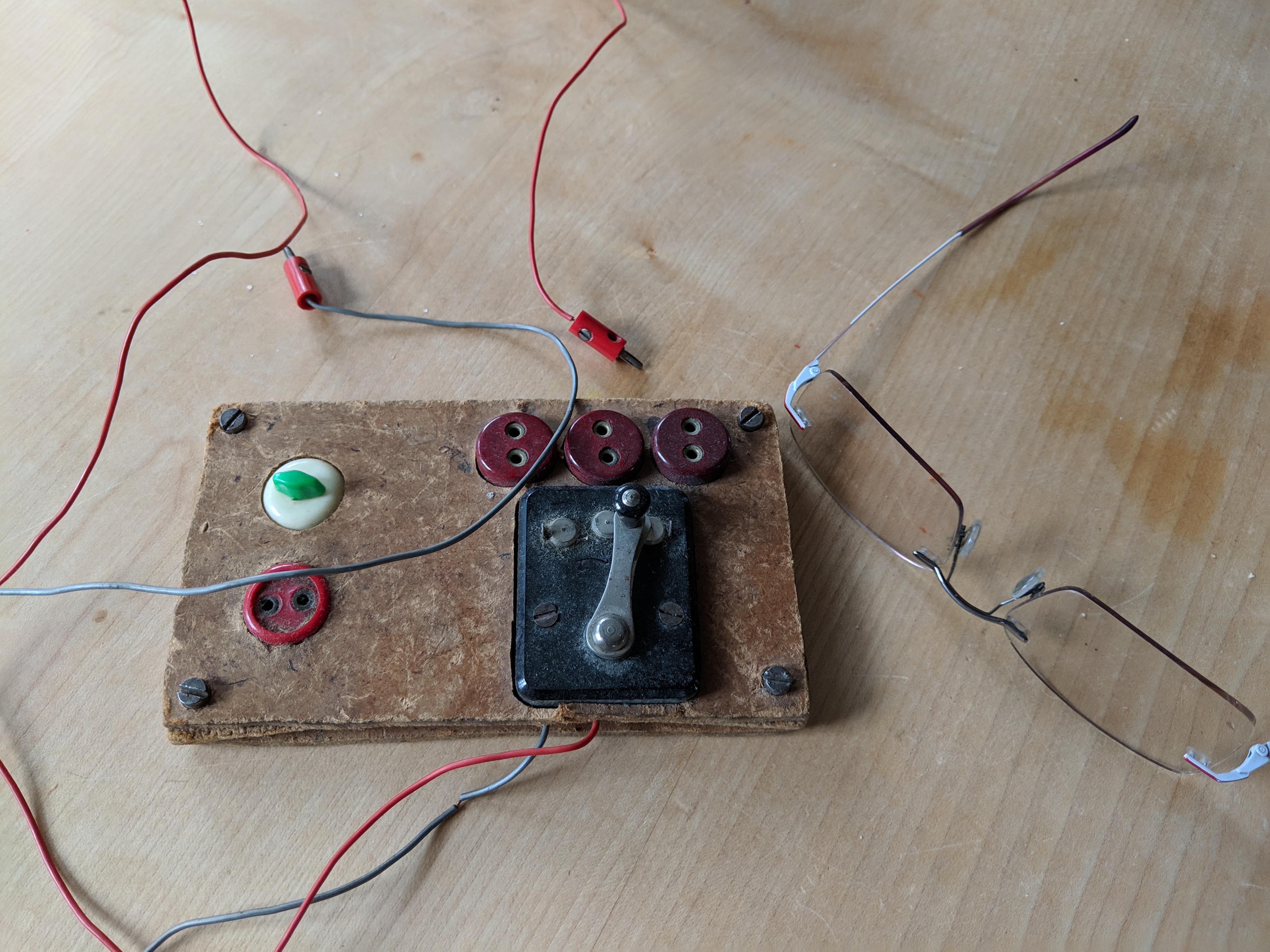
Simple control panel for three tracks and a railway station lamp.
Playing with model railways (with my Märklin model), I also learned a lot. My father designed a control panel for my model railway. It had two plywood boards, four screws and nuts from the “Stabilo set“. It also had a distributor with three exits, four electrical outlets and one lever. This must have been before 1960.
With this control panel, you could, for instance, transfer electricity to one of the three (1, 2 and 3 in separate circles) tracks at a railway station. Simultaneously, you could switch on and off the light in the station (today, they do it with IOT). There was even a glitch we used as a feature: if the levers were not precisely arranged, you even had electricity for two tracks! Of course only for 1 and 2 or 2 and 3.
My father had designed this for me because he felt that the Märklin panels were too expensive. I also only had manually worked switch points, rather than electronic ones. Well, this limited my automation drive, but nevertheless, you could do work on a few informatics gadgets.
As early as 1962, I founded a Pfiff-Club (Pfiff-Club) with some friends. We tried lots of informatics things. And we also did some true automation on a shared model. There was also a DB newspaper with exciting topics that the Club got every other month from the Deutsche Bundesbahn. It was always very eagerly anticipated.
There are several other digital things I learned from my father. He worked at the Deutsche Bundesbahn and brought the old graphic time tables (of Swabia and Bavaria) home. They were meant to be used up as note paper (also for cutting patterns for dresses to be made) – but for me, these unique drawings of train routes, along with the actual time tables, became very exciting reading material. It was absolutely informatics.
Even better were the technological DB magazines (I forgot the titles and unfortunately none of them is still available to me) my father brought home from work, I think four times each year. It was a little like “Pfiff-Club for grown-ups”. For me, it was exciting to read because it said many things about the real railway management.
It was about new railway control centres and new switch yards, and always about future technologies. About new locomotives and railway cars. In each of the magazines, you could find a particularly important topic as a highlight. I remember the opening of the as-the-crow-flies-line (that must have been around 1963), Roll-In-/Roll-Out Ferries, new sleeping compartments, the attempt at creating twin vehicles that could move both on the street and on railway tracks, new signalling and security systems and much more that definitely had an informatics background.
And in one instalment of the magazine, they celebrated the introduction of the new data processing technology at the Deutsche Bundesbahn. Let me explain:
In Germany, they used to have only state-wide railways. Some of them had their own locomotives. The Bavarian S3/6, one of which can still be admired at the Deutsches Museum, is a famous example. With the merging of the state railways to become the Deutsche Reichsbahn, there came a uniformity. The purpose of this merging had been to make the entire system more efficient through higher numbers.
Since the beginning of the railway was the steam locomotive, they noticed that the categorization would have to be between types 0 and 99. They called these types model ranges. Famous model ranges are, for instance, the 01 and the 03 (both are express train locomotives), the 10 (incidentally, that was the old Bavarian S3/6) and the 50 (a locomotive for freight trains). To the best of my knowledge, the last steam construction that actually took up work was the BR 10, but it did not work long.
With the advent of other drive systems, they put initial letters before the names. Electric locomotives received an E and the combustion motor (diesel) was given a V in front of the number. That meant the E-locomotives were now called E10 or E18 (fast train), E44 (passenger train) or E63 (switch engine) and the Diesel locomotives were now called V200 (multiple purpose locomotive) or V60 (switch locomotive). Other vehicle types were the VT (diesel railcar), the ET (electro railcar) and ETA (electro railcar with accumulator) – and more.
AND THEN THEY INVENTED DATA PROCESSING …
The species were something like CLASSES and the individual locomotives were the OBJECTS of a class. As with all huge technological devices, each OBJECT of a CLASS had its individual distinctive features that became more as time went by. In this system, the classes were described by the first two letters, then came – with a space that we today would call “blanc” – the object classification. That was the number of the individual locomotive, mostly in the same sequence as they were built. With most of the produced units, this number was a three-digit number, if the type was very successful, you occasionally got four digits.
Various BWs and BAs were assigned to the locomotives (objects). This is where they were serviced and maintained. This information was (incrementally) documented with tags on the locomotives, the same went for technological specialties as, for instance, for the compartment temperature or the compensating air (that kept the tyres away from the brakes through air pressure).
One significant difference between individual (steam) engines of a series was, for example, how they were lighted – with coal or oil. Naturally, this was quite a determining factor for the use, because a steam engine that was powered with oil could not make use of coal. If you were a member of the Pfiff-Club and spying out locomotives, you would be able to recognize the type from a long distance. Consequently, I am not sure if the lighting of a locomotive was also documented with a tag. For me, it was self-explanatory.
And there was a central register for all locomotives. In my imagination, this is a very big collection of very thick file folders. One for each locomotives – and they become thicker and thicker with time. All those data were to be transferred to electronic data processing.
And thus, there came a day when the magazine’s highlight was the information that, with the introduction of electronic data processing, the “number tags“ on the locomotives were no longer to have letters but numbers instead. Now all the locomotives got new number tags – and the old tags became well-loved collector pieces for the Pfiff-Club and other railway friends.
The number was probably the key to the locomotive in the then perhaps still sequential database. I think that must have been around 1965 – and even then, I found it rather annoying that electronic data processing (informatics) could not process letters.
? And this is how the E10 became the 110 and the V200 became the 320. What a pity.
RMD
(Translated by EG)
P.S.
After my learning years at Siemens, I had the chance to be part of the team that wrote the proposal for an X25 network based on a separate BASA cable network of the Deutsche Bundesbahn at the Munich Bundesbahnzentralamt (BZA). That must have been in the early 1980ies and it was a really great project. However, the end was not really glorious. …
(but I will write more on that at another time)
Roland DürreMonday December 31st, 2018
(Deutsch) Und schon wieder geht ein Jahr zu Ende! DANKE!
Another Year is Over! Thank You!
My Dear Friends!
Vivat the New Year!
Here is what I wish you, along with a little wish of mine for 2019!
May this piggy bring you all lots of happiness! It has been my Sylvester talisman for many years in IF Blog.
A good start!
Enjoy the new year!
Enjoy the world and honour creation!
Do not shun common sense!
Be free!
Live in lust and joy!
Be autonomous and follow your stars!
Do what you want to do!
Think first of yourself but then also of the others!
And, please, do not become martyrs for a “good cause”!
Do not act right but instead do the right things!
Consequently:
In six words and two sentences:
Enjoy life!
and
Be totally happy!
And I mean every minute of every day and night of your life in the new year 2019!
And here is my wish. Unlike my ”Christmas Greetings 2018“, it is not only for the “old white men“, but for all the people! I would wish that, in 2019, we all act a little more rationally than in 2018 and in the years before, perhaps as I suggest in my DontBuy Article!
Because it is simply a no-go that we destroy the planet with canine madness and kill each other in wars.
But above all
MANY THANKS
To all of you!
RMD
P.S.
The picture is a true click-pig. It is the first thing you get on google. Zillions of people have seen it. It was arranged by my friend Rolo Zollner. He created it for IF Blog and it is listed under Common Licence, which means you can use it if you cite the source and author.

Arrangement and picture by Rolo Zollner.
Roland DürreSaturday December 29th, 2018
This Way or That Way?!
We have the choice. Continue as before or continue to live?
Here is something I found online:
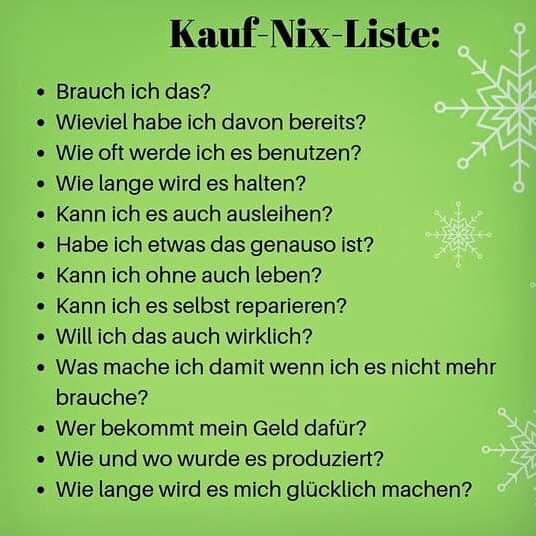
Here is the translation:
Buy-Nothing List
- Do I really need this?
- How many of the same product do I have already?
- How often will I actually use it?
- How long will it remain in working order?
- Can I let someone else borrow it?
- Do I have something similar?
- Can I live without it?
- Can I repair it myself?
- Do I really want it?
- What will I do with it when I no longer need it?
- Who gets the money I pay for it?
- How and where was it made?
- How long will it make me happy?
There are two opinions:
A)
If this Mem becomes common consent, Germany can close its doors in one week.
The reason is evidently that our system will no longer work.
B)
If this Mem becomes common consent, your children and their children might at least have a chance to live off what this earth could offer.
? The reasoning is that consumption mania leads us away from ourselves. We are part of nature!
We have the choice!
It does not seem to be an easy choice.
Why?
When, on Silvester night, the rockets will again go up, I will think about it. For the new year.
RMD
(Translated by EG)
Roland DürreFriday December 28th, 2018
“Me” in Two Variants – The Physical one and the Digital One.

InterFace Christmas Card 2014.
This year, I again received a lot of mail on Christmas. Some of them were general Christmas Greetings and some were very personal. I tried to reply to all the greetings. If there are persons who did not get a reply from me, I ask their forgiveness.
A highly appreciated friend of mine wrote something special. His greetings started as follows:
The “Online Roland” differs considerably from the underlying human being I know and hold in high esteem.
In this letter, I read many nice and appreciative things. That made me quite happy. Between the lines, however, I quite clearly found a certain helplessness because of my “digital schizophrenia“. Because I seem to betray values in the digital world that are important in my personal world.
Well, reading about my “digital schizophrenia” made me thoughtful. After all, for me, my biggest riddle is my own personality.
The “digital thoughtfulness” started with the IF Blog. You all know that I sometimes strip quite naked . Why am I doing this?

Christmas in 2009
My answer is simple. Basically, I write the IF Blog only for myself. It is a kind of diary. And since I believe that transparency is not just a virtue but a necessary requirement for a better social co-existence, I publish my ideas. I do not want to press my ideas on anybody and I also do not want to be a missionary – even if sometimes you might get that impression on reading my articles. Also, I do not really care about a high number of clicks.
(Even though it makes me quite happy that my short Christmas Greetings (Weihnachtsbotschaft) – according to a rudimentary measuring – has already been read by several hundred persons, even if wordpress, due to technological specialties, counts less and less readings (since it only counts the direct number of downloads on an IP address)).
| Seite | downloads | |
|---|---|---|
| /rd/einen-guten-rutsch-und-ein-gutes-neues-jahr/ | 214 |
This was yesterday
I consider this happiness a very normal human trait.
What is important to me is that, at least in my own perception, I mutated from idealist to egoist. Because I believe very strongly that I can move a lot more if I feel well myself. Consequently, my first duty is perhaps to do well by myself. After all, only those who treat themselves well can treat others well (incidentally, you can exchange “treat well” with many other terms, for instance: only if you appreciate your own value can you appreciate another person’s value).
And since the coming year is the last year before I turn seventy, I believe my time is too precious to waste it on being against something or getting annoyed with someone. Or even worse: getting angry with someone or something.
So the ideal of my life lies in the serenity I will need during the next few years in order to be able to die in peace. In the IF blog, I created my own categories What I dislike! (Was ich nicht mag!) and What annoys me (Ärger), where I wrote articles about what I find frustrating.
I learned that frustration is not something that agrees with me. Just as it helps neither others nor myself if I am against something. Both concepts will make me smaller. Mind you, this is not resignation. It simply means that there are more important things than getting annoyed or hating something. I am always mindful of the paradox of hatred:
”If you hate someone, you do not harm him/her, but you ruin your own life”.
Naturally, I really like all the things in this world. This is especially true for the consequences of “technological advance“. And digitalization, which some people love much and others condemn with a passion, is only a current manifestation of said “technological advance“.
In 2019, I will celebrate my fifty-years-of-digitalization. It will then have been fifty years that I played an active part in digital development. That is something I feel very comfortable with. To be sure, I, too, detest such results as “military drones” that come down from the heavens and kill people and destroy their homes. The nuclear bomb, too, is basically a digital product, and I do not like it at all.
On the other hand, I feel quite comfortable with social media, etc. One of the reasons for this is that, by now, I think I am autonomous enough not to buy things I do not want. I believe I have now become resistant against marketing. This is true for the Fang-Gang (FANG is short for Facebook, Amazon, Netflix and Google – I am sure you need include a few others, too). And the discussion of yesterday and today during the 35th Congress of the Chaos Computer Club – Hashtag #35c3 – which, incidentally, I think is among the best German social discussion platforms – is also something I like. Even if, as far as I know, politicians shun the 35c3. I wonder why.
Talking of how technological advance is a danger, the first thing that comes to mind which I really find threatening is the MIV (motorized individual traffic). On top of my life, I feel that my lungs, too, are in danger. I only need to leave my house and approach the Putzbrunner or Rosenheimer Land Straße, and will immediately get gas poisoning. Ask any lung doctor for the facts! For me, those who drive a car are like smokers who blow their poison into my lungs.
But then, what good will it do to become upset? I live my life without using individualized vehicles and thus I demonstrate that you do not really need them. It is quasi the inherent “thank-you” when I experience how good this is for my health.
I have exercise in fresh air. I get extra time that I know how to use well. Basically, I try to find routes that are as far away from poisoned air as possible. Even if this occasionally means a detour. But at least I do not have to get annoyed with the fat old men and women driving their SUVs.
And that is exactly what I also do with other things in life. I detest fascism and nationalism, but I am not categorically against the AFD or other forms of latent fascism. I believe that God and religions were invented by people. And I cannot understand how anybody can consider something “the highest” if they themselves invented it. But I know that this belief of mine, too, is just a belief and nothing else.
So how can I oppose people who firmly believe that God created the world a few thousand years ago exactly as it now is and that he made the strict rules which turn around the world and which he clearly communicated through his ministers and diverse messages (the stories of humanity)?
If then a fanatic who is particularly receptive to this kind of indoctrination kills a few people, then I find this no worse than the daily killing that happens on our motorways, highways and other streets. And even these killings on the streets are not a reason for me to categorically oppose all SUVs and their drivers. And for all those who kill (some even say: murder) carelessly, I do not feel hatred but compassion.
It is clear that I am in favour of both a reduction of speed in the MIV sector and a reduction of religious indoctrination of children and other people. And that is also how I live as a model. Just as I am in favour of peace and love. And I find it good to always question what is allegedly the truth or what goes without saying. And that is what I try to do myself, as well.
Except: I no longer want to be “against something“. Just like I also never again want to be angry with anyone. Because both sentiments just make me feel miserable. And that is not at all what I need in life.
RMD
(Translated by EG)
Roland DürreMonday December 24th, 2018
Merry Christmas (2018)
 Most of us know the Christmas Story (Weihnachtsgeschichte) by Charles Dickens.
The story tells us how Christmas cures the old miser Scrooge. What a nice Christmas Spirit! Is there anyone among us who, on listening or experiencing this story, did not have tears in their eyes?
Consequently, I would wish for this Christmas that the miseries of the old “white men and women” may be cured. Whatever their names: Seehofer, Trump,….
This is the spirit in which I wish everybody freedom and wisdom for 2019!
But for tonight I wish us all a Happy Christmas. And on December, 31st, I wish us all a Good Start of the New Year! And always all that is good and well and beautiful.
RMD
(Translated by EG)
Roland DürreSunday December 23rd, 2018
TWITTER.
The article Hans Bonfigt wrote as a reaction to my ideas about Old White Men (alte weiße Männer) is a kind of ”torrent of hatred” against the Green Party and against Twitter.
? Basically, I am not sure that I understand the connection between Twitter and old white men. Perhaps it is because the current President of the US is very active and a certain CSU Minister of the Interior also announced that he will become active? Both of them are more the exception than the rule when it comes to “old white men”.
Let me name a few positive aspects of Twitter. In a later article, I might well voice my personal opinion on the danger of a fascist eco-dictatorship triggered by the Green Movement and Parties.
For Hans, Twitter is a No-Go. Well, I am fine with that, because I think I know Hans quite well. Although this in itself is an absurd statement, because nobody should profess to “know someone else quite well”. Mostly, we do not even know ourselves well.
I believe Hans is never on Twitter and consequently does not know much about the service. At least I never found his name in twitter.
Back to the “short-message-service”, which, according to Hans Binfigt, is the “toilet wall of the internet”.
Let me try to describe it rationally: In Twitter, you only see your own timeline, i.e. what people whom you follow have published on the internet. In other words: you decide what you see in Twitter by what you select.
Occasionally, I also follow people who publish nonsense or hatred. Simply because I am curious. But mostly, I do not stay there long, because it is really unnerving.
Consequently, one might say that I live in a Twitter bubble of like-minded persons – which means I restrict my choice of persons to those that have the same set and system of values as I. They are quite compatible with me. But then, is that not what we always do in life? We all know the proverb: Birds of a feather flock together . We like to look out for like-minded people. That is also true for the regulars‘ table.
To me, the people I like following on Twitter seem to be very constructive and critical persons. And I receive a huge number of clues and great articles and blog contributions from them. If I wanted assistants or personal reporters to deliver it in the same quality, I would need quite a bit of qualified manpower.

Screenshot of my twitter account in the morning of December, 23, 2018.
Screenshot of my twitter account in the morning of December, 23, 2018.
In my timeline, you will find media, the international press, publishers, the police, enterprises – among them the Deutsche Bahn – and many people who, like me, use the internet as a network where they can participate. I seem to remember the definition of WEB 2.0, where participants become people who contribute. This is definitely a change that also happens in real life – as is demonstrated quite nicely as classical conferences become Barcamps.
Above all, I follow people who do what I do: as soon as there is something they believe in or something they like, the share it in their timeline. This is how I get a huge number of clues and pieces of advice: they point me towards well-written articles or blog contributions, interesting statistics and facts. And it makes me feel that I am a Prime Minister or politician for whom the assistants select what they think he will find interesting in the world.
Many Twitter partners of mine attend congresses and share (twitter) the most important content of the presentations on a hashtag. That is when I leave my timeline and go into a topic mode. For instance, during my Caribbean Trip in November/December, I found it quite easy to follow the Munich IT summits. The same was true for the CDU party convention.
And many people were there live (either physically or watching TV) and they wrote very diligently. That was very exciting and a lot more efficient than having to spend the time in front of a TV set (which is not easy on the Caribbean, anyway).
On reading the articles, I notice that the quality is extremely high and that many good people are taking part. I would say that, especially on Twitter, you will find the elite, rather than the lowest of the low.
RMD
(Translated by EG)
Roland DürreSaturday December 22nd, 2018
TOLERANCE and CONFORMISM.
Hans Bonfigt wrote a comment about my article on “Old White Men“ (Alte weiße Männer). To be sure, you can disagree about what he writes. However, for me, his article was an important impulse.

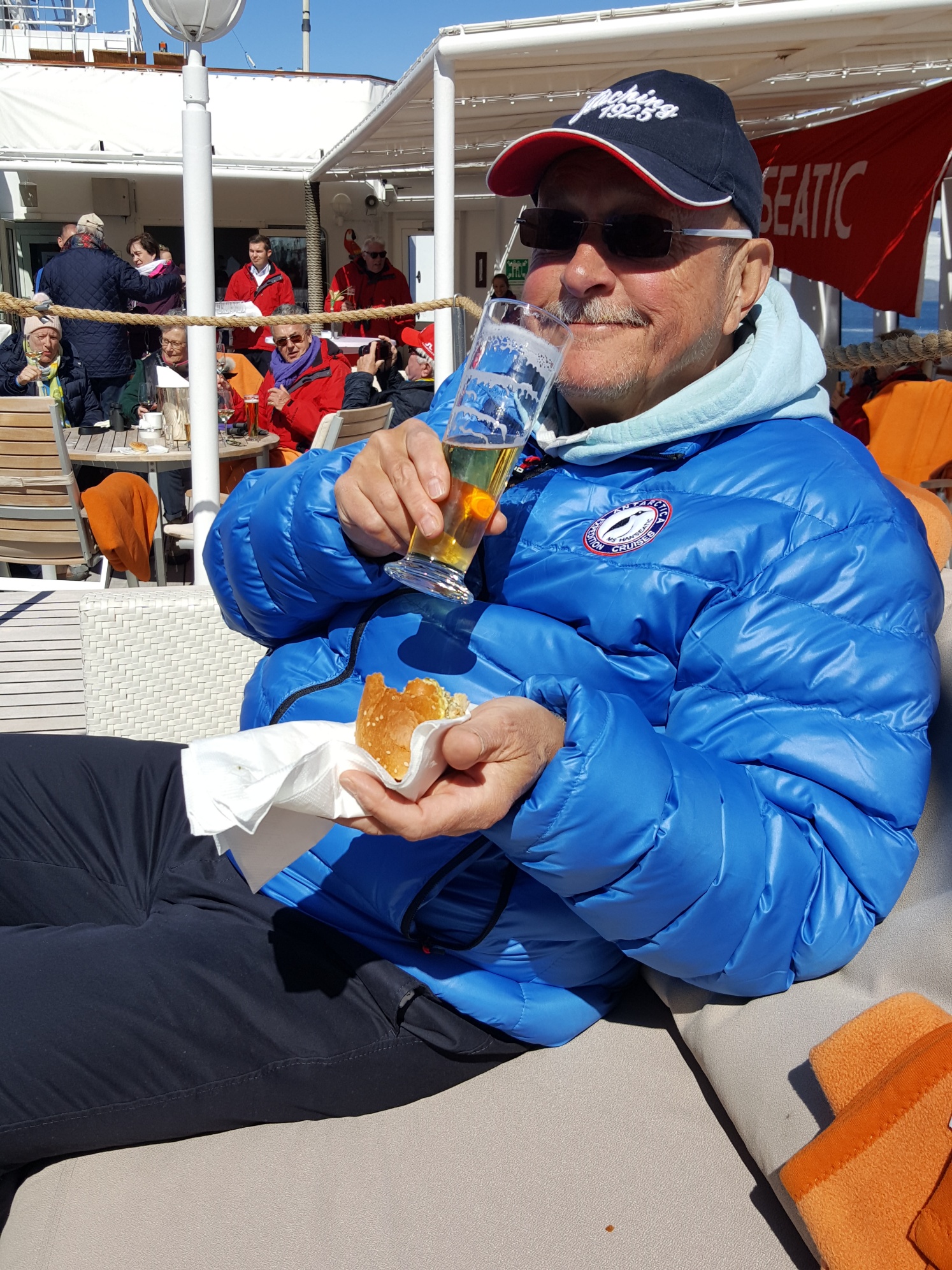
This picture was taken on October, 3rd, 2012 in the forest restaurant. I am wearing the cap I just imported from China (this is also my Twitter calling card picture).
When he said that “we tolerate everything except intolerance”, he really hit home. As I understood Hans, the important question in his article was: who exactly is allowed to define tolerance (or fascism, racism, colonialism)?
I believe there is an answer to this question. Let us first take a closer look at the terms:
Intolerance is the opposite of tolerance (Toleranz). Tolerance (forbearance) is a virtue, consequently, intolerance (the opposite of tolerance) is an anti-virtue, the opposite of a virtue.
”Fascism“, “Racism“, “Colonialism“ (Faschismus, Rassismus, Kolonialismus) are not virtues. They are systemic concepts of the world that describe ideologies and governments.
Ethically, “tolerance” is easy to define. If you want to judge if a statement or an attitude is tolerant or intolerant, you have to do a personal and independent weighing, following “ethically responsible values”. “Ethically responsible” means that the values you autonomously found must be in accord with the global community, for instance with the UNO Convention or the “Golden Rule” (Goldenen Regel).
Social systems depend on CLARITY. That is true both for enterprises (social systems with an economic goal) and parties (social systems with a political task). The problem is: what happens if the clarity becomes the collectively shared concept?
That is exactly what we want. We find it nice if the enterprise where we work or the party we give our vote emanates a “collective clarity“. “Collective clarity” is conformity. It is the small (subversive) sister of clarity. And conformity is a nice basis for “fascism”, “racism”, “colonialism” – just as it is also a good basis for “slavery” and “fiefdom”. That makes everything a little complicated.
I think we want to be careful. We need to see to it that the VALUES of our CLARITY are in accord with the world-wide consensus of values. That is also true for tolerance. And if and when the time comes that the world’s conformity will bring forth a world-wide fascism (no matter what kind of fascism), then the only thing that will probably help is resignation or resistance. Which will then trigger the interesting (ethical) question if such a resistance must be non-violent or if violence is the only way to make such a resistance a success.
Once in a while, I get the impression that this world-wide conformity is what we already have in the economic dimension.
Consumptionism and capitalism have spread throughout the world like a religion. Some also call it a predator capitalism that, by using its weapons marketing, lobbyism and corruption, has already conquered the world. And here, too, we again have the tricky situation that we must decide if non-violent resistance is enough.
I am convinced that the only way to counteract the upcoming world-wide conformity is diversity and variety.
Many thanks to Hans Bonfigt, who inspired me by sending his ideas.
RMD
(Translated by EG)
Roland DürreFriday December 21st, 2018
(Deutsch) Weihnachtsgrüße
Roland DürreMonday December 17th, 2018
Old White Men.

Next year, I will be 69 years old, which means I have been one of the “old white men” for quite some time.
Well, “old white men“ are the opposite of my idol. It is not what I want to be. So what should I abstain from if I do not wish to be an “old white man”?
But then, what exactly is an “old white man”? Historically speaking, we have had these “old white men” for a very long time, indeed. And they have always brought misery over their micro-cosmos and/or the entire world.
I count the Prussian Emperor as much among the “old white men” as the generals of the courageous armies. The same is true for the upper echelons of the Catholic Church.
Nowadays, I count the German “National Hero” Konrad Adenauer among the famous examples, or, to be totally up-to-date, Donald Trump, the “America First” president of our most beloved ally, the USA, also known as “God’s Own Country”.
Among the German and Bavarian politicians, too, you can find a number of them. Most of us suffer under them. I leave it to you to imagine whom I mean.
Even “God” was presented to me during my catholic education as an old wise man. Basically, this is no surprise if you read the (man-made) “Holy Scriptures” of the monotheistic religions (Christendom, Islam, Judaism). What you read will fit extremely well with the “old white man” as a deity.
Let me try to define what exactly an “old white man” is. Here are three special characteristics shared by all “old white men“.
“Old white men” have three characteristics:
- Old white men are afraid!
Although they actually have made it in life and could in theory live without sorrows, they are very much driven by fear. Their fears happen between the ears. The reasons for the fear change with time, but they will always return. For example: at one time, the evil Russians are the enemies, then the immigrants, and then again the evil Russians. And so on. Due to their fear, they cannot stop and let the power go. - Old white men judge and condemn.
Because they know everything. If they meet someone, they will immediately know if the other person is competent or not (mostly the other person is not competent). They also know why this is so. Whatever someone says or does will be judged and condemned without much contemplation. They always know what is right and what is wrong. And that is why they think they need to make sure that the others, too, do the right things. Of course by their definition. Thoughtlessness is closer to their lifestyle than consideration. Experience is used selectively to prove their prejudices, counter-arguments are ignored. - Old white men are cynics.
A long time ago, I learned the sentence “cynicism is the emotional manifestation of the intellectuals”. I think this sentence is still true. However, its meaning has turned around. “Old white men“ have often lost their emotions. They believe they can compensate this loss with cynicism. Naturally, this cannot work. Because cynicism is the opposite of emotional empathy.
Now you might say I forgot the characteristic “male“. Well, that is not what I think. In fact, more and more often I see women who think and act like “old white men”. Besides, stating that they are male would be a tautology (Tautologie) when we are talking old white men, it would sound like a Pleonasm (Pleonasmus). Which means it is no good as a criterion for defining anything.
RMD
(Translated by EG)
P.S.
In Otto Scharmer’s Theorie U, I read that the three highest barriers against finding yourself are “permanent judging, cynicism and fear”. Well, doesn’t this sound a lot like the “old white man”.


