
Roland DürreSaturday March 10th, 2012
On Gene Technology
A short time ago, I again heard someone speaking in favour of gene technology. Well, maybe some of it was not to be dismissed lightly, since it sounded quite plausible.
But still:
The future sounded too beautiful and clinical. Too many simple problem solutions were promised. The strategies looked too easy. Consequently, the number of “abstract” reservations I already had are now more than before – and my personal discomfort grew.
Reservation No 1
Gene technology accelerates the development – whereas what we really need is some “deceleration”.
The longer I live, the more I come to the conclusion that we would really benefit from a “deceleration process”. Because “haste makes waste”. Consequently, I feel sceptical with everything that increases complexity or even speeds up the process. It would be better to “de-complicate” and to simplify our lives. We live in the “here and now” to an extremely huge degree. But we should also accept that there is no “today without yesterday” and no “tomorrow without today”. And that you have to be patient with the “tomorrow”.
Reservation No 2
Food is subjected to patent and licence regulations.
There are already concerns who announce that it is their entrepreneurial goal to dominate the sector “food production”. Will there be a “Foodle” after “Google”? Mind you, when I mention Google, I also include Amazon, Facebook and the other firms that want to rule the world.
Reservation No 3
Top quality is no longer the most important issue about food.
I get more and more horrified when I see the things we serve. And then I hear about retro tomatoes as the last hope for the return of sensible food. When I was young, Brussels sprouts still tasted bitter. Where did it go, the soft bitterness of Brussels sprouts? And there is much more of the same … In my opinion, there is a general trend towards a rapid increase of negative trends such as superficiality when it comes to taste through gene technology. It is also quite sad that quality will eventually be beaten by quantity.
Reservation No 4
It is dangerous to excuse negative effects by saying “they already happened, anyway”.
It reminds me of what was said about: “antibiotics are already in the soil because of the excrements from the cows raised with antibiotics”. Since this is already the case, why not let the soil be contaminated by plants that have been mutated with gene technology? Of course, I oppose this, as well. I believe first and foremost we should reverse the original wrong-doing.
Reservation No 5
We get more and more remote from a life appropriate to our species.
Gene technology is one of the developments called progress that create a more and more functional and efficient world. A simplified cultural world substitutes a natural world appropriate to the species. And it happens to a larger extent than ever before. Metaphorically spoken we are approaching some sort of modern “Resopal World”. It promises all kinds of things: longer life, improved health, …
But what is so nice about getting even older by using new medication while all we get is more time for suffering from lingering illnesses and dementia?
In this article, I consciously refrained from using “sturdy” arguments against gene technology. Instead, I focussed on the more “moral” issues.
RMD
(Translated by EG)
Roland DürreFriday March 9th, 2012
What Annoys Me … #22 Deposit and No Deposit
There she is sitting and grinning at me. The no longer intact glass bottle lying on the cyclist’s path. It has probably been thrown out of a car as it passed. And on the wide bottleneck, you can read the following note:
No Deposit!
Including the fat exclamation mark. It seems like this is supposed to swing your decision to buy towards a deposit-free product. According to the motto: take me and you will not have the additional problems with the “can deposit”.
That annoys me. They actually emphasize – as a distinctive characteristic – that a product will not take part in the deposit process. Even if our excuse for a can and bottle deposit system is far from perfect, it is at least better than none at all.
😉 At the same time, the note “no deposit” is a very visible piece of information for the growing number of poor deposit-bottle collectors: do not make the effort to pick it up. Regardless of the fact that politicians keep telling us that effort must again pay.
Mind you, it all happened because of a few leaks in a deposit bottle law that is already, basically, questionable. A law that forces people to not throw plastic bottles in the container with the rest of the plastic (which, incidentally, I assumed should also be subjected to proper recycling). Instead, they have to take it back to the shop, so that it can then be shipped to China in a controlled manner. Where it will then be used as raw material for synthetic clothes.
It is also just a fairy tale that cleaning glass bottles is more detrimental for the environment than using a one-time plastic deposit bottle. Why don’t you go and ask a medium-sized brewery, such as at Aying, how environment-friendly they clean your beer bottles today.
So what do I do about it?
I drink water out of the tap. It is the same place where, in our country, coffee and tea originate. An additional advantage of this is that I need not carry crates and can go shopping without a car. And if I go a long distance, I carry the good old thermos.
As a matter of principle, I no longer use plastic bottles. To be sure, it limits my freedom of choice a little – for instance I cannot drink the fruit-mix drinks of the pious firm Adelholzner that comes in half-litre bottles. But that is also something I can easily put up with.
And beer out of a plastic bottle should be just as much a taboo for a beer connoisseur as beer out of a can!
RMD
(Translated by EG)
Klaus HnilicaThursday March 8th, 2012
Carl for President
Carl and Gerlinde (XX)
At three in the morning, when Carl woke soaking wet from his own perspiration, he just knew he was the right person for the job! Especially since, just a few seconds before he had opened his eyes, the Federal Chancellor herself had nodded at him and displayed slightly raised corners of her mouth – which, to him, looked like an extra token of appreciation – . …
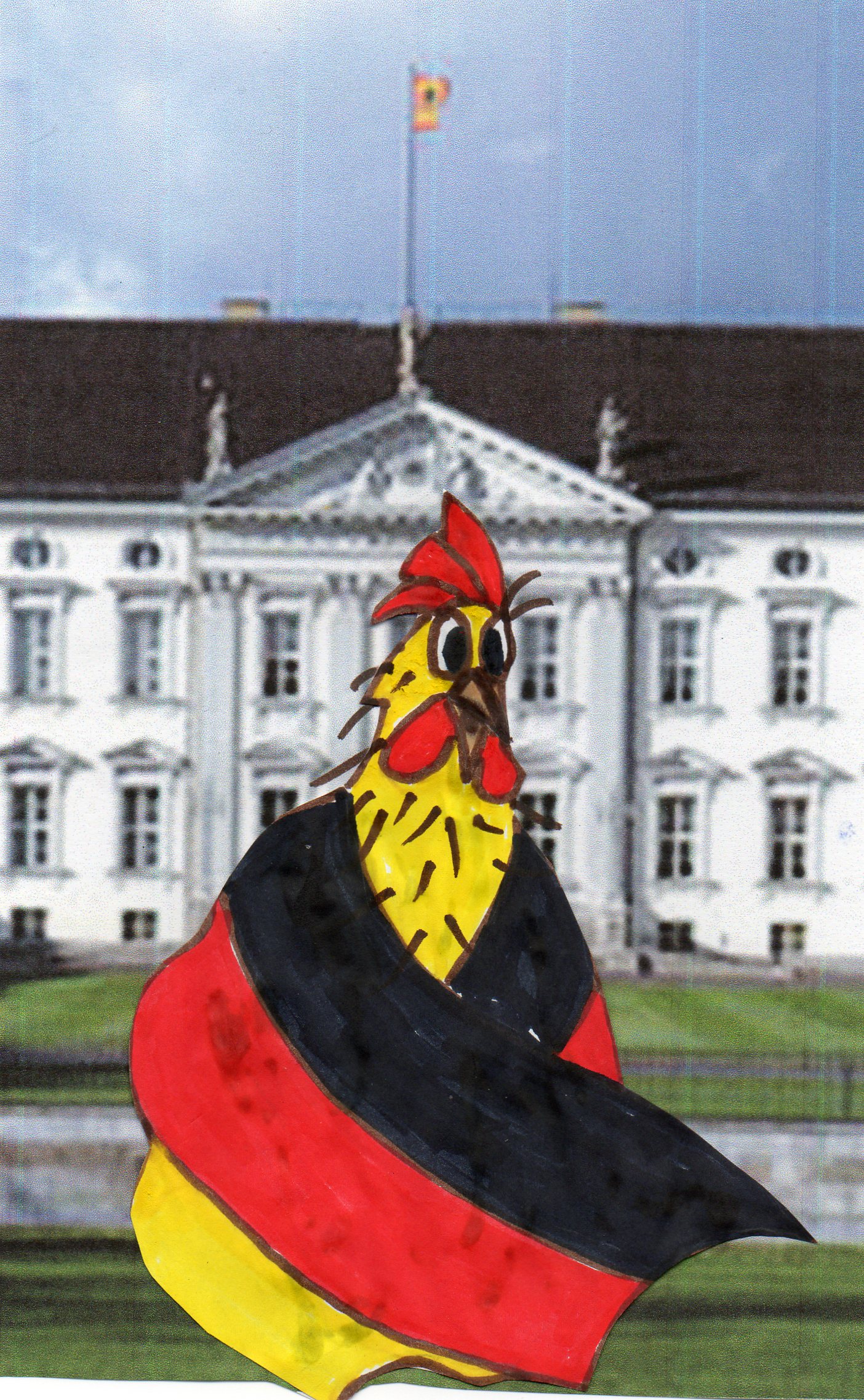 Well – it was not really a miracle, was it? After all, he, Carl S., was not only a presentable man of years, but also an extremely honourable citizen of this beautiful nation. And the Federal Chancellor seemed to be especially appreciative of one fact: the mortgage on his house had been paid off years ago, he was totally debt-free and professionally, he was really well grounded, fit for real life!
To be sure, he was no pastor! Neither had he ever been Prime Minister or Federal Judge! To make up for it, as opposed to these other gentlemen, he knew full well where the money came from, especially the tax money. And he also knew how to spend it economically. That was certainly not a bad portfolio for holding the office of Federal President, was it?
In the past, his eminent professional status had often been confirmed by all kinds of persons: after all, being in charge of the sales department for high-quality men’s and ladies‘ underwear at ’Triga’ was definitely not something to be ignored! Not to forget how much he earned!
He was sure the Federal Chancellor would be happy with the fact that, given his income, he would not really be depending on this ’life-long honour gratuity’. In fact, he would not need it. On the other hand, if they offered him those 199,000 Euros each year, who was he to say no?

Looking at this particular sentence, ’for life’ was definitely not something to be ashamed of. Neither were the office for himself and the service persons and office car! It goes without saying that, like his predecessors, he would spend quite a bit of this ’honour gratuity’ on donations and the promotion of worthy causes. After all, as Federal President, you have no time to spend all that money, anyway: in winter, he would stay in sunny Africa or Australia and in summer in one of those glamorous Starnberger See mansions. With friends, because, as we all know, a Federal Persident has plenty of them. More than now with just Hannelore and Kurt!
And then there were all those discreet donations and promotions – the people liked it, didn’t they? In particular if, for instance, they were also good for strengthening the role of women in in society. They always had a hard time getting on equal terms with the men, anyway! Just think of women playing soccer and you have to laugh out loud. And what about women boxing or ski-jumping….
Yes, that was exactly where he would lavishly give generous donations to the tune of one or two thousand Euros each year! He certainly felt deeply for this matter and he was sure the entire nation would very much appreciate it!
Incidentally, his family situation, too, was a perfect fit for this political office. He was divorced, if only once, but that was certainly better than not at all and he had two children with Inge: René and Kora. He had never been interested in them! Well, you can certainly see how well-suited he was, even if, of course, you did not have to make much ado about it: after all, a Federal President had to be clever, he thought to himself. At long last, he switched on the bed lamp and – even if there was nobody whose sleep he could have disturbed – tiptoed into the bathroom …
And with respect to this constantly talked about ’unlawful acceptance of benefit by a public official’ – he was sure there was no reason for him to worry. Talking thus to himself.Carl, as if to emphasize it, energetically pressed the “economy“ lavatory water lever …
Because for him, in free business, this was absolutely not an issue! But still it might be advisble to wash one’s hands in innocence! And considering how the nationwide discussion currently ran, it was actually clear that he had to think about the occasional incident that happened in his professonial life. If he was honest, he had to admit that he definitely had taken a few staples home from the office, he said while he sniffed at his fingers and walked back to his bedroom. The same was true for those strange clear plastic binders – or what were they called? – and two Indian rubbers a year ago – and that pencil sharpener for the broader version of pencil. It had not been altogether upright, Carl had to admit. Nor had the Leitz folder two months ago and all those unauthorized photocopies paid by the firm been altogether upright! Not to mention all the private telephone calls and internet surfing! Oh my God – all the places he had visited online! That would certainly have been embarrassing for a Federal President if found out, he said as he looked at Gerlinde’s empty half of the bed, before quickly seeking refuge under the warm bedcover.
In fact – perhaps, considering everything in the light of the energy-saving-lamp, it was really about time to wipe the slate clean!
As in “tabula rasa“!
But then – weren’t the delicious pieces of cake Frau Wolf surprised him with in the office also something he had to count among his dept? After all, there was hardly a single day when he did not lavishly indulge in one of them without the slightest trace of shame? It all was a true delight for Frau Wolf, but, of course, truly a discredit in the eyes of some strict TV commentators. These ladies saw – or rather smelled – fraud in such behaviour, except if he had discreetly dropped three Euros into the empty plate for the income-dependent secretary in order not to make it look like bribery. Yes, if the journalist Frau Schauster had dug deeper in his case, he would have looked rather stupid in no time at all. …
But vacations in vacated mansions that belonged to friends are something she could definitely never have dug out for him and Gerlinde. No matter how deep she dug! But hey, wait a minute – was that correct? Had not he and Gerlinde, four years ago – it had been really exciting – spend three days in the Hannelore and Kurt’s flat, because those two had unexpectedly been called away and the paperhanger had been in the flat? And, following Frau Schauster, they probably would have had to give their friends a hundred and fifty Euros per person and then, in order to behave honourably in the Schauster sense, deduce from that money whatever he and Gerlinde had done in the field of housecleaning and spent on miscalleneous things, such as adhesive tape, etc. at the usual prices. Not to mention the tax declaration for the possible monetary advantage? Yes, in the light of the 25 watt bedlamp, this looked like a truly dark spot in his otherwise really clean slate. Carl had to admit it to himself and would actually have liked to drink a glass of cheering-up schnapps right there in his bed.
But then he calmed down without the schnapps. After all, journalists did not find out everything – and as far as this instance was concerned, Hannelore and Kurt were absolutely to be trusted; besides, neither of them was friends with Peter Hintze. He was sure that having received help from that man would not have been a good idea!
And as to Gerlinde – there was no way she was going to endanger him in this respect! That is, there would have been no danger if she were to be found… But, hey, all of a sudden he was standing up straight in his bed, near the middle of the sleeping space: was there not a totally different problem he had to solve? And that problem certainly weighed a lot heavier that this negligible tax issue? It so happened – and no talking or ostrich algorithm was going to help against that – that he did not have a ’First Lady’! Because his future ’First Lady’ had decided to make herself scarce without a single word twelve weeks ago now! Which meant that he, Carl, was actually the first would-be Federal President – who had no ’First Lady’ to accompany him? Now how to make that plausible to the Federal Chancellor – and to Rössler and Seehofer…
In the light of this fundamental problem, all his other competence was basically marginal? That did not only go for his economic competence, but also for his horrendous international experience. After all, he had sold ladies‘ underwear all over Europe for many years, hadn’t he? And for a Federal President, international experience was paramount, wasn’t it?
But then there were also a few silver linings if you looked close enough! Because he had, for example, never been in Greece! Somehow or other, the Greek did not appreciate the ’Triga Underwear’ – probably because they used to wear those white capes in ancient times. Well, so it could not be disputed that he did not know Greece, which meant that he was totally neutral when it came to the rescue umbrella. This was definitely an area where nobody could find fault with him. And the Federal Chancellor was sure to appreciate it, too, because she definitely could not afford yet another misstep in whom she appointed. Perhaps that was why she had lifted the corners of her mouth in such an encouraging way …
And he had to admit – when his iphone rang in the morning to wake him up and neither the Federal Chancellor nor Gerlinde were at the other end, he was a little disappointed after all the things he had experienced during the night. Under these conditions, he was no lnoger in any mood to play Federal President for anybody. Definitely not!
KH
(Translated by EG)
P.S.:
And two weeks from now, on March, 21st, 2012, we will finally have news about Gerlinde. So stick with us.
Roland Dürre
Tweets on Twittering and Blogging #107
Here are my tweets of last week on
Blogging and Twitter, Wisdoms and Rules:
120322 It is good to be at leisure after all the work has been done – especially true for twitterers and bloggers. #Twitter #Blogging #Wisdom
120323 After long drought follows plenty of rain – good news for bloggers and twitterer. #Twitter #Blogging #Wisdom
120324 When the rains have ceased, there will be sunshine – so do not despair, twitterers and bloggers. #Twitter #Blogging #Wisdom
120325 Every bird takes its time when building the nest – so please stay calm, twitterers and bloggers? #Twitter #Blogging #Wisdom
120326 Giving in will avoid the war – something you should not forget when twittering and blogging! #Twitter #Blogging #Wisdom
120327 It is easy to be wise after the event – also true for twitterers and bloggers! #Twitter #Blogging #Wisdom
120328 You will find nobody who will not give good advice afterwards – also true for twitterers and bloggers! #Twitter #Blogging #Wisdom
There is a new tweet each day.
See Twitter and “follow” RolandDuerre!
Enjoy!
RMD
(Translated by EG)
P.S.
I took the proverbs from Alle deutsche Sprichwörter.
Roland DürreWednesday March 7th, 2012
My Favourite Paper …
… has not yet been invented.
Two weeks ago, I heard a very competent presentation about the future of print media in general and daily newspapers in particular on the Sylt Biike. To me, it seems that the future of the daily newspapers is a rather hopeless affair, especially if you consider what I heard there. No matter if you look at the development of sales or the income by advertising, they are on the decline.
I took this as a motivation to think about my personal “dream of a daily”. Here is what it would have to be like:
I would like a classic, rather small size. Bigger than the “modern size“ of those terrible compact papers, but not quite as extensive as the Süddeutsche.
This paper would have to be of outstanding quality. More or less like “Zeit“, better than SZ and FAZ. As few pictures as possibe and no colour. To make up for it, I would want excellent comments.
It would have to be clearly structured and reliable in its build-up. In order to make it easy on the eyes, it would have to have a reasonable font – perhaps Serifen? And high quality print.
A cosmopolitan paper with a natural European-German focus. A critical paper containing ideology-free and non-dogmatic articles. Written by critical journalists who are courageous enough to question what is generally considered self-evident.
But the most important factor for me would be that it is completely free of adverts!
If such a paper came, I would wish to have it available both on paper and in Kindle format.
Perhaps the paper version could be a daily (including Sundays) to be delivered in the morning, whereas an electronic version might well come out both in the morning and in the evening. Or “dynamically flowing“.
And, at least for the electronic version, I would like to see a “very regional“ local sector. Ideally, it would be written by people living there. I am sure the people connected with local networks would be happy to provide the local information.
This is the kind of newspaper I would gladly subscribe to – and I would be quite willing to pay a steep price for it. And perhaps I would even return to collecting it?
To be sure, this newspaper would also not be able to stop the downward spiral of the media printed on paper. But perhaps it could – by its marmgin existance – postpone the end of the newspapers as we know them.
RMD
(Translated by EG)
Roland DürreTuesday March 6th, 2012
brand eins in March
 On my return from the short (three days) skiing vacation at GAP, I already find it sitting on my “to read“ stack – the March “brand eins“. And this time it has a highly erotic title page. I must admit that the lipstick has an erotic effect on me. Only on me?
And the title:
Deciding What Is Important.
It is about the
“Main Focus Relevance”.
On reading the title, I am reminded of the interesting but still basically stupid question that is sometimes even asked during a job interview:
You have a long todo list. What will you do first – the important things or the urgent things?
The expected (and perhaps correct) answer is, as we all know:
“The important ones!”.
And the reason for this is that only important things can be really urgent.
When I hear relevance, the first thing that comes to mind is wikipedia. There you have relevance criteria (Relevanz-Kriterien), that determine which terms, facts, data, people, enterprises,… have enough relevance to be included in wikipedia. When I started my “carreer“ as a wikipedia writer, I tried a sort of self experiment (Selbstversuch): I wanted to enter myself.
🙂 And the next thing I knew was that I, as a person or entrepreneur, have not the slightest relevance.
Perhaps it would be different today for me as a blogger …
But let us be serious. For me, the question what is relevant or not is like a modern search for meaning …
And since I had a little time yesterday for really important things and brand eins is really relevant for me, I decided to do some browsing through brand eins.
Consequently, here I am, opening the magazine and reading the editorial by Frau Fischer:
Among people who make themselves important
Immediately, my pulse rate goes up. Yes, we will remain among those who make themselves important.
And then, here is the inside of the magazine … The good question:
Do enterprises hoard too much money?
Exciting. And there is more, such as:
Work without traffic jam • whose fault is the debt • main issues and asides • the man who advertises his life • empty calories • away with all the stuff • to have, but well …
An old acquaintance of ours, Gunter Dueck appears along with (the computer is not very original) the world of numbers. And as always, all is worth reading somehow. So, again, here is my recommendation: go and fetch the brand eins at the next news stand.
Indeed. Go and buy things at the news stand. Because I, being a MacbookAir and Kindle user, cancelled all newspaper and magazine subscriptions in paper form. With one exception. I am (naturally) talking about brand eins. After all, brand eins is the one paper that combines the attractiveness of magazines with a reasonable content.
And here I already hear some of my critical readers ask why I always sing the praises of brand eins.
Well, it is easy:
It happens quite frequently that I also browse through other magazines. Not only manager magazin and WirtschaftWoche, Brigitte and Bunte, Spiegel and Focus, but also Playboy or some Fitness-Magazines. Whatever you will find on the market. And then I always throw them away after a very short time. It is the “content“ that makes the difference.
The only thing where I sometimes remain (a little) longer is the Playboy humour page. Incidentally, it also no longer contains truly masculine jokes these days. Which brings us back to where this article started – erotic appeal.
RMD
(Translated by EG)
Mähnicke & Six Monday March 5th, 2012
(Deutsch) Der tägliche Wahnsinn: Für und gegen den Frankfurter Flughafen? Zwittern!
Werner Lorbeer
Desert Tec #015: How to Physically Transport Energy!
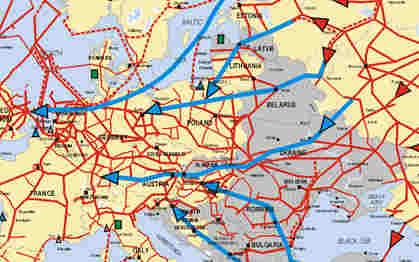 At long last, “power to gas” is recognized among politicians, too.
Basically, here is what it means: using wind energy, water is separated into H2 and O2 through electrolysis. Being a very tiny molecule, H2 is hard to store. Still it could already be used for energy transport, because the gas pipelines are allowed to hold a H2 rate of 5%. After a possible methanation, it will be identical with natural gas, anyway.
What are the advantages?
The natural gas industry is quite capable of solving its storage problems.
There are pressure storages and caverns which, allegely, can store the demand of two months (200 TWh). It is a realistic option that can be immediately realized without destroying nature. All we have to do is build storage lakes.
Besides, there is the advantage of increasing Germany’s energy transport capacity by 80 per cent through the already existing gas pipelines instantly, without having to build a single new energy line.
Another potential positive aspect is the methanation of H2 gas through CO2 or CO, which might again serve to economize matters. The process will produce “bio-gas”, i.e. reactively produced methane which, when burned, will return the CO2 to the atmosphere “in a CO2 neutral manner” (I put the “quotes” because this is just a modern euphemism).
The enormous advantage of methanation is that the entire transportation could be based on the already working technology of natural gas cars or fuel cells. The car production problem for electric vehicles, the unmentionable and really disgracefully huge ecological footprint of battery technology would be solved. And as a potential energy source for electric vehicles, we might take the fuel cells worked by bio-gas.
A crucial argument in favour of this concept is also that the energy content of 1 kg battery is only 2% of that produced by 1 kg of natural gas. The very weight of batteries threatens to eat up all the technological advance made by light-weight technology.
So here is my point of view in a nutshell: what really gives me pause is that they say we cannot afford a change in energy politics. Currently, the European nations eat the capital they have saved up for breakfast by “rescuing Greece”. At the same time, they forget that there are far more urgent problems that need solving and that you certainly cannot finance both of them simultaneously.
At this very moment, the target demands of the Bundesbank against the EZB are higher than the entire external German capital. According to Prof. Sinn, these are payment requests that “can never be called in” (as he said in the Augsburg IHK Konjunkturgespräch). And then there will be an additional 300 billion Euros for the change in energy policy. Dear China, can you, please, help the poor Europeans.
It is high time that we use the calculator for planning the change in energy policy, instead of the subsidy cart! I believe power to gas might be a really good option.
wl
Roland DürreSunday March 4th, 2012
No Bread for the World
 When I asked him for a good speaker, one of my friends working at the „Bayerischer Rundfunk“ advised me to consider Herrn Wilfried Bommert of the WDR. After some initial emails to and fro, we had a nice chat on the telephone.
The result is that he will visit us and give a presentation at the IF Forum 2012 on the general idea of
“Sustainable Living (and Surviving)”.
His presentation will be titled „Feeding the World“.
In order to learn more about Herrn Bommert, I bought his book “Kein Brot für die Welt” (No Bread For The World). In it, he gives background information on the food crisis.
Incidentally, it is the first ebook I ever bought for the “normal“ price.
Now I read it on my Kindle. It tells you in a very informative and objective way how we humans treat our most important property. I was truly moved by what I read.
The current state of affairs is worse than I would have imagined. And it is hard for me to imagine that any upright person, after having read the book, can still be in favour of, for example, building a third runway for Munich Airport.
I very much recommend for you to read the book:
Roland DürreSaturday March 3rd, 2012
Entrepreneur’s Diary #75 – Meetings 2.0
After three years as a working student for Siemens, I (with a university degree in mathematics and computer science (TUM)) started as a “freelancer” with the same employer. In other words, I signed a tenure contract with them.
This situation was a more intimate connection with Siemens AG than I had had before. Consequently, I started getting more interested in my environment at the company. The first thing I noticed was how thick the telephone book was. Besides, among the leaders, the doctorial title and double-names were more common than with “ordinary ranks”.
But I also noticed in the organization chart that there were eight leadership levels above my own status. I was basically at the lowest of nine levels. As a proud post-graduate freshman, I found that a little strange.
In terms of mathematics, however, it made sense. Let us assume that the average number of teams, groups, departments, main departments, etc. a leader can control is five.
That is a rather high number. In those days, the lower teams had an average of five employees. Five elevated by the factor eight is 390,625. A main department, however, was only three departments. So it makes sense that you actually need many hierarchical levels in order to control 400,000 persons. In my memory, the Siemens of then was rather bigger than that.
Even in those days, we had many meetings. On my (the lowest) level, however, we worked. We had no time for meetings. My boss, who was in charge of all our groups, also did a lot of technical work. But he also had to attend diverse regular and sometimes also spontaneously arranged meetings.
The boss of my boss (a main group leader) was also available for technological work, but had to attend significantly more meetings than my boss. You saw the person above the main group leaders (I no longer remember their title) only once in a while, because mostly they had to attend some meeting or other.
Those working on the floor above us were known to us exclusively from pictures, because you only saw them in person on special occasions. Of course, the gentlemen (I cannot remember a single woman on the “higher echelons” in those days) were always travelling and attending meetings.
In other words: in former times, the higher your hierarchic position was, the more meetings you had to attend, and vice versa. In the lower echelons they were 0%, in the elevated echelons more than 100 % of your office hours.
The sum total was not bad. Because the huge majority of employees actually worked. Meetings were basically restricted to the so-called “overhead”. While the leaders hurried from meeting to meeting, they had excellent assistants, who, when I started, were still called secretaries. Basically, they were all women, and they represented their bosses quite adequately in the enterprise. Consequently, the system worked fairly well.
Of course, at the time we did not yet have all that nonsense with automatic calendars. And there were precise minutes of all meetings, distributed according to a very sophisticated system. In fact, some people actually read them!
Today, matters are different. Sharing the workload and Taylorism are disappearing among brain workers. In the enterprises, the work environment is more democratic. Hierarchies have become less pronounced. There are no longer any secretaries. The “overhead” is now shared by all in a “socialist” manner.
As a consequence, the brain workers now (have to) spend all their time in meetings and/or waste their time with administrative stuff. That is also why all the “important people” work 12 or more hours each day and will sooner or later fall victim to burnout.
And the overhead: I guess it is now considerably more than 30 years ago. Good new times. We run and run, but actually we tread on the mill.
Well, maybe “social media” will give us the opportunity to economise on many hours of meetings and yet to work towards one end more efficiently than in the old world. And then it might give us back more room for our own private lives and at least make more shared interests possible.
In my personal life, it happens. Using the most simple activities in facebook, I only take seconds for tasks that, in former times, would have required an intense dialogue, for example, on the telephone. And without “the new world” I would not even know many of my new friends.
RMd
(Translated by EG)
P.S.
Neither does the development stop in front of office doors. Just compare the situation at Siemens Hofmannstrasse or later at Neuperlach with the modern office buildings for brain workers (for instance at BMW). Even the increased number of meeting halls and the arrangement of team work-spaces in modules is remarkable.


