
Roland DürreMonday March 11th, 2019
Who Owns the Internet … ?

Ob er die Antwort wüsste?
Roman copy of a Greek Plato portrait, probably by Silanion and now displayed in the Academy after Platon’s death. Glyptothek München.
I generally claim that, before you can look for solutions, you need to ask the right questions. Currently, I am wondering – not only in my presentations – about the future of digitalization.
I fear that the internet is threatened on several levels. So I come up with central questions.
Here is a very central question:
Who owns the internet?
I mean this exactly as I write it. My smart phone and my computer, which are both also part of the internet, belong to me. But who owns all the connections and computing centres you need for the network? And who is master over the definitions? Who will decide upon a change in protocols if this becomes necessary due to a change of users? Who is in charge of security? Who is responsible if the infra structure becomes deficient?
Well, I already asked the question several times. Because I do not know the answer. I asked some very knowledgeable people who usually know all about digitalization and related topics. But they, too, could not give me an answer.
But perhaps my readers know the answer?
In that case, maybe you can also answer some of the following questions:
Who owns Wikipedia?
Our huge thesaurus infra structure. It is unique in its independence and freedom. It is also free of advertising. It belongs to no concern and no party. It is designed on an honorary basis and financed by donations. A wonderful example of open source. It is actually something the community could be proud of.
What are we going to do when there are no longer enough Wikipedians left to maintain its growing infra structure? When the technology becomes antiquated and the system breaks down? Who will get or take possession of the Wikipedia empire when it collapses?
Maybe you have more exciting questions? For instance: what will we do when Youtube or other services are terminated?
I look forward to reading your answers.
RMD
(Translated by EG)
Roland DürreSunday March 10th, 2019
Facebook: Enemies of Vaccination Get Less Room .
Under this caption, I read what Heise.de says:
Now, facebook, too, joins in the battle against the growing number of enemies of vaccination. The US portal announced first measures.
And then:
More and more resistance
With this step, facebook follows Pinterest and Google, who have similarly started to cut down the space for vaccination enemies on their platforms. Pinterest no longer shows any hits if you type “vaccination“ or “vaccine“, a short tima ago, Youtube announced that it will cut off the money flow for video channels of vaccination enemies. Based on information of the world health organisation and the US centres for epidemic plague control and prevention, facebook will now start measures against vaccine hoaxes.
This news is an excellent example for modern times. We also want to introduce upload filters in Europe. Facebook, Google and Pinterest profess to know what is better for the world. And they decide who can say what they think and who cannot.

It was not the candle that made me immune against polio but the oral vaccination.
When I think vaccination, I immediately think polio. In my childhood, I saw this cruel illness in many children. And, of course, for me, the oral vaccination against polio was a huge blessing. After all, I knew that this was how many people were protected against the fatal results of the illness.
Consequently, the vaccination against polio was a huge success for me – also for the pharmaceutical concerns.
The thing that was almost as bad when I was young were children suffering from the consequences of Contergan. Initially, this was also a terrible illness. At the time, we did not know that the deformations were caused by a very questionable pharmaceutical product.
This is how I developed a very early mistrust against pharmaceutical concerns and their products. After all, they had shown with Contergan that they did not look too closely when it came to business. I fear that this industry will gladly make money with vaccinations, even if said vaccinations are not exclusively beneficial. This means that, regardless of the fact that I am not a vaccination enemy, I sometimes have my doubts if all vaccinations make sense. Thinking of the flu, the first thing that comes to mind is Tamiflu, of which we know that the most important healing it caused was for the balance sheets of the Swiss pharmaceutical concern Roche.
Every autumn, I ask myself if I should register for the flu vaccination. After all, being now almost seventy, I belong to those who are particularly at risk. However, I always decide against it because I read that the immune systems of older people have a very well working immune memory.
There are vaccinations that I consider extremely necessary and reasonable (hepatitis, polio, yellow fever, …) and there are others that I consider detrimental. And since, also due to the DVSGO (data protection), we have no medical practice that is based on big data, it is rather hard for me to decide.
But I am happy to see that such topics are discussed critically – and I find it a catastrophe if the powerful think they need to act. In fact, looking at the prospect of upload filters makes me want to yell:
Nib Things in the Bud!
Something is wrong with the internet if powerful concerns want to and actually can influence the process of opinion building. And if this becomes the initiative for legislative procedures.
RMD
(Translated by EG)
Roland DürreTuesday March 5th, 2019
After Mardi Gras, There is Ash Wednesday.
Property, violence, justice, safety and abstinence …
It does not matter if you run, ride a bike, ski or drive a car. If you hit someone, then this is violence. Speed is violence.

Stone mask from the pre-ceramic stone age around 7,000 before Christ. One of the world’s oldest masks (Musée Bible et Terre Sainte, Paris)
Today is Mardi Gras. You can wear masks. You can wear costumes. Fool’s freedom means that you can take another role. And you need not stick by all the rules and keep up all the moral laws.
That feels nice. For several weeks, they have now made laws that look arbitrary to me and that I cannot understand. Because now the Great Coalition have changed from the argument mode to the working mode. Since laws mostly are not very good, I preferred the argument mode.
After they took the German Citizenship away for IS fighters, there is an EU-wide attack on the internet. But they also discuss the great liberty of German car drivers, the speed limit. A Swedish (?) producer restricts the cars to 180 km/h. Somehow or other, this is unimaginable in Germany. Basically, I do not even understand why cars that drive faster than 130 km/h are allowed on any streets at all.
Because I am personally against all speed. Both in life and in a car. For instance, I would feel a lot more comfortable if cars were allowed no more than 30 km/h in towns and no more than 70 km/ on highways, along with a maximum of 120 km/h on motorways.
But on the other hand, I am against all sorts of prohibitions. How can I solve this dilemma and still give a good reason for limiting the speed of vehicles? By introducing the factor violence! After all, in our times, the application of violence is a monopoly of the state. That is also true for weapons (let us ignore for the sake of argument that there are many exceptions, even in this country). This means that humans consciously agreed to not use violence and that only the state can use it in very clearly specified situations.
Well, knocking down a pedestrian or cyclist is just as much an act of violence as driving into another car. And that is exactly what people in civilized countries have agreed to forego. That makes it quite simple when it comes to speed limits and limitations for objects of the MIV (Motorisierter Individual Verkehr), part of which are also electrically powered vehicles, such as e-bikes.
What is left in our times that actually moves people? As I see it, the answer is: property, justice, safety and abstinence.
Property.
Does it make sense that legal persons have the same rights to property as actual persons? That ideas – we know they should be free – can become private property? Or that even data are considered private property? What about common land? What exactly belongs to the common land and how to treat it? What about the self-possession of persons? Or will we get a new form of fiefdom?
Justice.
Arithmetically, it is impossible, at least that is how it seems ever since Aristotle. But what is suitable? Should society award social credits in order to regulate it? Or should some be expropriated?
Safety.
What is safety. Perhaps protection from violence? That would mean we come full circle. We do not want violence against us. If I am a pedestrian, I do not want to be hit by a car or bike. And so on.
Abstinence.
Everybody knows that, if we want to save the planet, we will not only have to change many of our habits, but also practice abstinence. And what do we do? We fly more, drive bigger and bigger SUVs and eat bigger and bigger portions of meat.
Besides property, justice, violence, safety, power and abstinence, there are many more inter-related topics. They are so complex that the only chance to contain them is a new social consensus.
Tomorrow is again Ash Wednesday. Then the hilarity is over. I already dread the political meetings with their speakers. They will again bark and beat. Both men (CSU) and women (Grüne, SPD). Because this is all about the sovereignty over the regulars’ table. And not about peace and social consensus.
It is really sad – so take off your mask and atone.
RMD
(Translated by EG)
Roland DürreMonday March 4th, 2019
Agile, Digital Uproar – or – New Robes for a New Emperor.

Aebby
(Dr. Eberhard Huber)
This is the title of an article Aebby (Dr. Eberhard Huber) published in his projekt (B)LOG. It is a censorious discussion of the current “agility hype“.
For me, “agile“ describes a quality that is excellently described in the agile manifesto. Unfortunately, agile (just like digital and innovative) has now become part of the Business Theatre instituted by the top managers of German Enterprises. They deal with all kinds of things, but they totally neglect the people working in the enterprise and the customers.
The Business Theatre is usually staged by the (top) management. It is a kind of self-portrayal practiced in enterprises and civil offices without any semblance of truth. As a consequence, you often get totally surreal decisions.
For our topic, this means: if agile is fashionable, then they decree the institution of agility. They pretend it is as easy as if you decree that the company cafeteria should get a new layer of paint.
Then they employ a few agile prophets in HR (Human Ressources) who are supposed to not only make the enterprise and its employees innovative, but also agile. And since the agilization of the enterprise must be just as measurable as its innovative potential (and everything else), a stupid counsellor gets the task of developing an agile KPI (Key Performance Indicator. Again and again, it is an exciting but mostly hilarious performance on the stage of the Business Theatre.
- Well, so be it. With his article, Aebby says what I feel about more than the following three topics:
- Agile has nothing to do with methods and/or technology.
- Successful projects have always been agile in the past.
- Self-organization is only one facet of agile work.
Well, I would like to put three exclamation marks behind every one of these sentences. Let me continue citing Aebby – on sprints:
Here is my favourite citing:
Sprints – that sounds nice and fast.
Sprint after sprint without guaranteed pauses will kill any human body.
All of this is beautifully and correctly expressed. I strongly recommend that you all read the article. In my own words and understanding, agility is something like the art and culture of life. Here are a few additions to Aebby’s article:
Fast sounds nice. But then, today, you have to be fast anyway. And fast has nothing in common with the term Sprint. After all, the agile manifesto was written by software developers, just like SCRUM was invented in software development. And they wanted to develop a better software.
What they meant in SCRUM when they said Sprint was the distance between two integrations. Initially, the developers programmed their modules separately. As soon as the modules had reached a certain level, everything was integrated and a new build was created.
If you had huge projects, the distances between two integration dates was sometimes half a year – often more. If the new build did not work properly, the error had to be found by means of regression if you wanted a running system. That meant you had to reset the entire development step-by-step as far back as the last step. This was an immense effort in work and time. I remember a project where, for more than half a year, we had no running system. Naturally that is fatal.
Consequently, a main reason for introducing short integration times was that you wanted a running system with the current development standard at all times. You never wanted to lose your feet. Consequently, you had to shorten the time between two builds considerably. That is what SPRINT means. It is misleading, because it is not about speed, but about stability. It is not about being fast. More often than not, you reach a goal more efficiently by taking small steps than with big ones.
Agile working certainly does not tolerate working without plan or concept. Mind you, instead of using the word ”planning“, I would prefer to call it a well-thought-through and diligent procedure. Agile is the ability to observe and learn. You absolutely need to be able to always follow what is going on and react to undesired developments with a level-headed reaction.
Sometimes, you do not really know the actual details of innovative projects with totally new functions at the outset. That is especially true if you want to utilize new technologies that might have disruptive effects and thus bring a high degree of research to the project. Then the only way to deal with the development is agile. This was often so in IT. In this case, it would be better to call it an iterative culture of trial and error, instead of agile. It means that you build roust prototypes, then test them, learn from it and improve them.
RMD
(Translated by EG)
P.S.
Aebby’s article was also part of the Blogparade by the Projekt Magazins.
Roland DürreSaturday March 2nd, 2019
Turn of an Era: The End of the Digital World ?
What will happen when the digital era comes to an end?
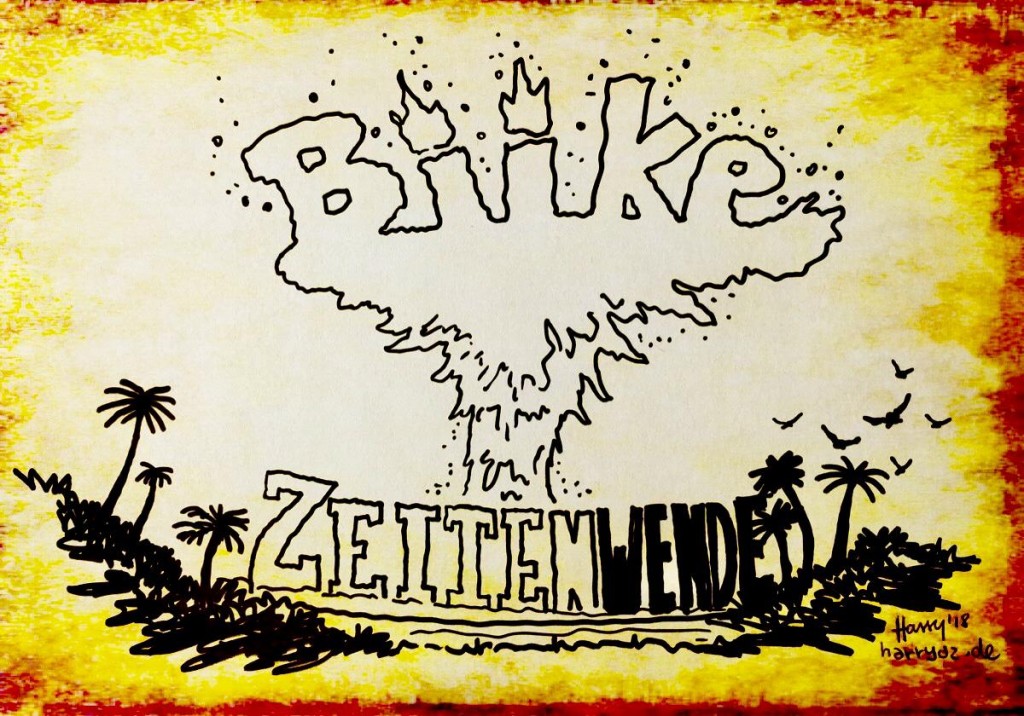 Im Jahre 2019 habe ich nach einem Jahr Pause wieder am Biike-Camp in Sylt teilgenommen.
After one year of abstinence, I again took part in the Sylt Biike-Camp in 2019. The Biike Camp takes place on Sylt annually, along with the traditional Biike-Brennen. It is a huge meeting of entrepreneurs, counsellors and leaders. It is organized by Tedic, the brothers Krickel first founded it around the turn of the millennium.
This time around, the motto was The Turn of an Era. Again, it was more than worth the effort to go there. I was invited to give a presentation on the second day of the event. They had suggested the topic:
”Entrepreneurial Leadership in the Post-Digital World”
I will write down my presentation in the following paragraphs. I started by introducing myself, then I tried to analyse the title in two columns.
Personal introduction
Since, on the first day of our meeting, it became clear to me how very much most of us (including myself) are formed by the car, I started by introducing all the cars that I ever drove in my life. In other words: I related my former car and current bike culture.
? And in the process, I also discovered a few things about myself.
Then I mentioned the computers I use (Mac and Chrome, no Windows).
So I have double mobility – MIV (motorized individualized traffic and on the network). Both tells a lot about the life of a white old man.
And, of course, I also had to speak of my personal history. I told the audience about duerre.de and if-blog.de and mentioned that I consider myself a late founder (I was 34).
With respect to my InterFace history, I referred the listeners to the Wikipedia entry on InterFace AG.
In order to be able to react to the content of the other presentations with the highest possible degree of flexibility, I abstained from using slides with content. Instead, I mostly worked with Wikipedia.
It was my plan to tackle the topic “entrepreneurial leadership in the post-digital world” in a dialectic way. In other words, I wanted to analyse the individual terms post, digital and world (column 1) and entrepreneurial leadership (column 2).
I. The post-digital world
(Column 1 – what is the meaning of post, digital, world?)
Before today, I only knew the term post factual. Post digital was news to me. For me, post factual means that we live in the era of totally irresponsible babble, which is part of the new dishonesty (Rupert Lay).
You can even see it if you look at legislation. China is not the only country where legislation is introduced in such a way that it can be interpreted at random. Perhaps this happens on purpose?
Digitalisation has become a matter of course. Everybody talks about it. A short time ago, I read: digitalization is a technology that cannot be turned back. In other words, without digitalization and soon also AI, nothing can be done in the near future.
It seems that we are totally dependent on digitalization, as we depend on electricity and electronics. In the same way, a life as most of us want it would not be possible without digitalization. Every piece of technology contains a huge part of software, there is no technology without any software inside.
If I have discussions with the bee savers in Bavaria about the provocative thesis that “it might already be too late“ to save the planet, then they tell me that, thanks to digitalization, we might actually be able to save the planet. ? So we have really great expectations when it comes to “digital“.
I like to refer the audience to Wikipedia when it comes to explaining digitalization. You will find an article by Thomas Kofer – at the time he wrote it he was a employee of ZD.B – where he tries to explain the term. He invested many man-years to write the article.
Then I look for the term post digital online. In Wikipedia, you will not find this kind of nonsense. To make up for it, you find something in Accenture. Here is what they say about post digital:
”The advent of technology identities is leading to a new generation of business offerings.“
Are they really serious? If you click on their link, you find more such BBB (Berater-Bullshit-Bingo). For my presentation, Accenture is definitely not helpful.
Digital and digitalisation are currently buzzwords. They are very famous – and there are no two identical definitions on the market.
So let me investigate the word post. I find that it is “if a composite of adjectives – sometimes also with nouns and verbs – specifies that something happens/ed at a later time“.
That is correct – post is a preposition that specifies adjectives. Well, I understand that much.
Digitalization is said to be irreversible. Because if there is no digitalization, there will also no longer be any technological industry. After all, in all technological products today, you have software, i.e. digitalization – and soon also AI.
Consequently, there can be no post-digital era, because it would mean the end of our technological world. Especially not if the digital world has made itself autonomous as AI. Which is what many expect.
On AI
Artificial Intelligence, Deep learning, Big Data are at the top of the current buzz-words list. The world, or at least all those who want to be heard, talks about robots and bots.
So here is my question:
Who of you knows the three letters T, A and Y?
If you connect them, you get the word and name Tay.
Many in Germany talk about AI, but most of them do not know what it is. Consequently, nobody knows the Tay. As I see it, that is symptomatic for the entire current discussion.
Tay is – or better: was – the twitter bot of Microsoft. Microsoft developed it – and then it was quickly de-activated because of misbehaviour. Both the first and the second version. It was a few years ago.
Today, it looks like Microsoft does not want to be part of AI. They capitulate before Amazon and Google and terminate their system/project Cortana. Because to the great and mighty IT concern Microsoft, AI looks just too big.
Simultaneously, the Free State of Bavaria declares that they want to start an AI offensive. Microsoft gives up because Google and Amazon are too far ahead. And Bavaria wants to make up for it. Just like China. Except – China, unlike Bavaria, will actually succeed.
To illustrate it with an example I tell my audience about the Chinese News Anchor Bot.
Nobody in the audience of AI experts knows it. Well, that comes as a surprise to me.
So much on AI
What exactly could the end of digitalization and AI look like?
Here are a few mental experiments:
The first step towards digitalization was when language was first written down. Consequently, “post digital” might mean that, in the future, the majority of the people cannot read or write fluently, but only rudimentarily? As I see it, that is distinctly a possibility. Would that be good or bad? Can there be a good or bad – or are we just full of traditional prejudices?
Because:
Why would anybody want to learn something nobody will need any longer? So: why would we want to learn how to read (and practice it all the time, because otherwise it gets harder and harder) if most of what you want to know is available as an ebook or podcast and the remainder is read to you by a speaking computer? A computer that simultaneously translates everything. The asynchronous and synchronous communication is done via spoken language, anyway (oral messages). That is nice, because spoken language transports more than written language. And then, naturally, language will no longer play a role at all?
If that were to happen, then a modern society can easily forego reading and writing, but it certainly could not forego digitalization.
Then I think about “post digital”. On the level:
What or who could destroy the internet?
(besides the EU regulation mania that is pushed by the FRG)
Two things come to mind
– Engineers become priests.
Isaac Asimov already introduced the concept in his futuristic novels (for example in the series on Trantor): The people who maintain the systems no longer understand the machines. They only perform memorized (maintenance) rituals.
I can easily imagine such a concept, because even today, in computer science, that is what programmers do. They do a lot of clicking – and they have no idea what exactly they are doing. The complexity overwhelms us, it is easily possible that the world will lose its know-how.
– The end of Moore’s law.
It is very simple:
IT consists of the three components: computer, connection and storage.
Those are the three relevant IT components. With respect to storage, we have arrived in the nano dimensions, you cannot become any smaller because of the dimension of the atoms. With respect to connections, we now work with the speed of light. You cannot go any faster. I deliberately chose the term computer. Because a modern processor (for instance by Intel) contains so much that I like to use the metaphor of the mega city of New York.
We want to make the computers faster by using the quantum computer. Except that, so far, it does not really work. And it will probably never be able to do much more than decode. But that is good enough for the countries of this world, because basically they only want one thing: monitor us.
That is how the end of Moore’s laws could put a stop to our AI dreams. In the past, the multiplication of resources in small time periods spoiled us. The time has definitely come for this indulgence to be over.
So what is important in the digital world?
As I see it, the first thing that comes to mind is Wikipedia – and there are several reasons for this:
– Wikipedia – the thesaurus of world knowledge.
Wikipedia is great. It is currently free of advertising (with the exception of a few articles they smuggled in about Bayern players’ wives), it is administered on a completely honorary basis and financed by donations, independent of concerns, etc.
That makes it one of the last bastions. We need it every day, because there are no thesauri left. Regardless of some weaknesses, for instance when it comes to the topic of digitalization/IT, Wikipedia is still great.
However, now comes the
BUT:
It is written mostly by old white men, in other words: there are few young persons and only very few women. Wikipedia is like a knowledge infra-structure. As with many infrastructures in our world (streets, bridges, railway tracks), the need for maintenance and renovation increases, but the resources decline.
Wikipedia is threatened by ageing and additionally by the copyright (update filter) and lobbyist pressure.
What will happen if Wikipedia breaks down? Who will then take over Wikipedia?
One of the three dominant German media concerns? The Federal Government? EU and UNO might also be candidates. Or the internet giants Google, Amazon, Facebook, Microsoft …
Just imagine advertisements being permitted in Wikipedia. If I were the owner of Wikipedia, I could well imagine other great business models.
– Services such as Youtube, Vimeo, Facebook++, wechat …?
(I deliberately left out email as a service, because in my opinion nobody needs them any more)
So: What will happen if all these things no longer exist? A short time ago, I read about a murder threat against the youtube boss because of her statement that, as a consequence of copyright legislation (update filter), she may have to terminate the service in the countries concerned!
You should remember:
regulation mania is detrimental.
For all of us!
Instead you should:
Correct the underlying deficits. That is: you should look for the errors, and then initiate reform. For instance when it comes to copyright legislation.
And let us have less DGSVO …
À propos world:
I am sure you remember: only about half of the world’s population have internet access. We still have two worlds: one with the internet and one without. They are approximately the same size.
But in the internet, there are also two internets (more like a vertical separation). The Chinese one and ours.
Many tourists first notice this as they arrive at Peking airport and want to use gmail for sending greetings home or if they want to chat. It does not work.
Then you will try VPN. But VPN service providers are delivering poor quality or else they are very expensive. Mostly both. So unless you have a VPN of a concern that still works in China, you are not very lucky. Googlemaps does not work at all. It can get difficult. Lost in China. But fear the not: the practical Chinese AI will help.
À propos China:
They are now doing a lot with AI. Among other things, they are now inserting humans into a Social Media – System that is omnipotent (wechat). And then they award credits for social behaviour, both positive and negative. Will this lead towards a digitalised dictatorship– or will the human dream of adequate justice come true? As we all know, it became clear as early as with Aristotle that an arithmetic justice does not make sense in social life.
Well, I believe that, along with Chinese technology, Chinese culture will reach us. And I wonder if what I related above is not too far-fetched for us, either.
Besides:
The use of the internet is collectively and individually totally diverse. As I see it, we still have horizontal divisions.
In a developed, prosperous and intellectual world, the internet is used totally different from how it is used in a poor and educationally remote world. That is how the internet is extremely divided. We have home office users, pornography watchers and internet gamers. Maniacs and fanatics, etc. It is all just as it is in real life. Mind you, that does not mean that intellectuals never watch pornography.
And also, there must and will be an unbelievable number of smart devices on the internet (everything that can activate WLAN is smart and will need a network: cars, lightbulbs, refrigerators, scales). It all happens on a system of antiquated protocols that were initially planned for totally different purposes. And nobody knows who is actually responsible for the change of interfaces.
How is that supposed to work?
I am sure this is a good question.
But let this be it about digital and post-digital. So now I will move to entrepreneurial management, i.e. leadership and social co-existence.
II Entrepreneurial leadership
(column 2 – what exactly are: enterprise and leadership?)
Enterprises
A young person once said to me that, for him, an enterprise is an organized mass of people who have a goal or purpose.
That is not a bad definition. We call enterprises or public offices social systems with an economic or administrative purpose.
With enterprises, their size is an important criterion. We have concerns and small enterprises. Their nature and functionality differ hugely.
In our concept, we assume that, as a matter of course, an enterprise has several employees. Not only a constitution and capital. And that the employees, like the customers, are human beings. In other words, that an enterprise has people working for it. For the customers, this is no longer true. Mostly, small enterprises do business with other enterprises. It is called B2B.
Enterprises without people – is such a concept realistic? Only with robots and bots? Everything that humans need will be outsourced, i.e. bought from the providers. And the customers are also no longer humans, but instead, for example, autonomous cars and their managers. Is that imaginable? You would no longer need participation and the work regulations (maximum hours, enterprise constitution, labour contracts, …) would be obsolete.
I know founders (teams) who want to build up an enterprise where everything is automated. Basically, the entire enterprise will only be some software!
No employees, only robots (and providers and partners). Everything else is outsourced – the programming of the product and the marketing/sales. What remains is a small back office with one assistant – the leadership is limited to this one person.
Then you will need no leadership in the sense of human resource. A mere jamming session with the founder team is all you need. Just like jazz. The founding process and the enterprise will become a game with providers, customers and money providers.
I know these kinds of business plans from BayStartUp. I would say they are fashionable. Just like the design of portals or apps used to be fashionable. Or the use of 3-D printers…
In all the business plans I know, the necessary and to-be-written software had enormous importance – I cannot remember a single business plan where it was not a fundamental reason for the USP.
Leadership is, per se, only possible if you have people (employees). But perhaps we will not need them in the future.
For this presentation, I would like to assume that the majority of enterprises will still have employees in the future. Then it makes sense to talk leadership.
The broad range of leadership.
Hierarchy versus Network.
(teams working in a network)
Secrets versus Transparency
Group based (model German Reichswehr – Siemens) versus Team based (micro organization with self-organization)
Taylorismus
(detailed pre-definition of working methods ”one best way“, exact fixation of the place and time of delivery, extremely detailed and divided tasks, one-way communication with determined and strict content, details requirements with respect to final goals for every individual without obvious connection between these details and the general goal of the enterprise – along with quality control)
versus
Involvement
(as the sum of being made part of the whole, being included and the integration of task… ).
Processes versus self-organization (Henry Ford – the caste of engineers as the predecessors of management caste)
Feudalism versus self-determination.
Being someone’s property versus belonging to yourself. That is the theory of power. There are two classes: the wise ones and the stupid ones. With Henry Ford, the farmers were the stupid ones. Powerful machines made them jobless in farming and thus they had to work for him. Not even clocks were something they were familiar with. The engineers had to teach them everything, from being on time to how the tools needed to be handled. Every single procedure at the conveyor belt had to be shown to them. And the caste of engineers are the forefathers of the manager caste.
Evaluation:
As you all know, I always preferred the red option. Yet in practice, nothing is just black and white (in this case red–blue), which means we mostly need to answer the question if an organization is more red or more blue. I also do not believe that red is only for the “creative“ processes and blue only for “simple” processes. I know enough examples that prove the opposite, for example Buurtzorg for nursing services. More than 10,000 employees in the Netherlands do the work that is allegedly simple.
Digitalization supports both red and blue !!! It supports communication at eye-level and can also take the role of the boss in a hierarchy. That is also why there is a fear that adssRobots might rule over humanity.
I am convinced that all efficient structures, both blue and red need a powerful digital infra structure.
The blue world needs it for realizing processes and command structures, the red needs it for realizing an infra structure that enables a management of experience and enlightenment for all. I do not use the term knowledge management, because this is about enlightenment and experience.
And I see a huge potential for AI in both worlds.
Outlook for and review of history Because especially with social topics, you have to consider yesterday, today and tomorrow.
Yesterday: (before 1900) In the European countries, there was fiefdom, in the new world, there was slavery (also in God’s own country).
During a trip through the Caribbean, I saw Curaçao. I visited the Kura Hulanda Museum and learned a lot about slavery. It officially existed until the early 20th century. In many countries, they still have it.
But also in Europe and Germany , we had many centuries of serfdom . Basically, it is the same as slavery. Only few people were free, most belonged to someone else. The majority of the population lived in the country and produced food (90%). Not in the city – “city air makes you free” (10%).
In the cities, progress had its origins. Because this is where the free craftsmen – wood and iron, levers and wheels (wheelbarrow) had their networks and cooperated with each other. In the country, most people were owned by someone else. Mostly, they were farmers and worked on the land. Which is why they were owned by the land. It was actually quite simple – the people belonged to the person who owned the land.
Both the land and the people were of the feudal class – the nobility and the church. It lasted until the end of the 19th century. This, too, is part of our glorious Christian tradition. Sadly, this is often forgotten.
But here is what beats everything:
Slavery and fiefdom were not abolished for humanitarian reasons. Instead, they found that it became too expensive, inconvenient and costly. This also explains why they fought the American Civil War. Naturally, the end of slavery was promoted by the resistance of the parties concerned. It was both individual and collective resistance.
Well, that was the moment when my idealistic concept of the world was destroyed for good.
Today:
Consumism is the world’s most powerful religion. Without work, a person is worthless and beyond society. There will be less work in the future. I think especially of well paid administrative workers in offices and the financial industry and similar tasks. Even today, RPA (Robotic process automation) is extremely relevant.
In the developed societies, the people who have a job (or/and capital) are still really well off. But the rich who are well off become fewer and fewer and the poor become more and more.
Tomorrow:
It will depend on what works better whether enterprises will have leaders who are blue or red. It is not about ethics, morals or #newwork.
And, of course, the development will also depend on the economic and social situation. On the other hand, it might also be simply about survival!
The future
I will not try to predict the future.
I am sure others are better qualified. My favourite is and has always been the Brave new World by Aldous Huxley.
If you do not know the book – here are three options you have.
- You can read the book (or listen to the audio-version), that is the classic approach and will take some time.
- You can visit the theatre (there is an excellent performance at the Volkstheater München) which would mean you need a ticket – the work is rarely performed
- Or you can read about it in Wikipedia ? which is the easy, quick and free way What could come next?
In the dwindling upper classes:
- Money becomes an electronic number (a digit on your smartphone).
- Power and feudalism will remain.
- The upper class will work with courage and joy in a developed society.
- Work will be part of self-fulfillment. “newwork” might happen?
- All efforts are taken to multiply your property and to fight impoverishment.
Time becomes a personal value.
For the masses, it will be different!
- No work or precarious work.
- Work on call. Whenever the robot is out of order. Or if there is extra need. For instance at the harbour in Mombasa or in the calium mine in Tunesia, where masses of people stand in the queue offering their service for minimal wages. Or:
- Thanks to BGE (unconditional income) you kill time by playing games. Or by just chilling.
The polarisation between the poor and the rich will increase – the world-wide tendency is clear. The rich become richer and fewer and there will be more and more poor. That is quite drastic.
Turn of an era :
Money feudalism, robots and poor people will probably be the drivers of a future turn of an era. There will be a BGE and it will not be enough, which means that the people will have to improve their income by doing precarious jobs.
New combination of feudalism and slavery?
Those who have money can find self-fulfillment with courage and joy, probably on an honorary basis. Other than that, all they will need to do is increase their prosperity. They simply have to see to it that they avoid impoverishment.
The others either have a BGE or not and earn extra or struggle for existence?
Topics
(that move me)
- Education Should children use a smartphone as early as possible?
- Schooling Schools have become worthless. What will have to happen?
- Science and higher education The structures of and life in academia are still feudalistic. Will that be good enough for the future? My answer is: no!
- Societ: #Newwork is far away because our genes are still in a feudalist pattern.
- Men still dominate and have all the power.

In front of Westerland (Sylt) taking a walk on the beach. But where are we headed?
RMD
(Translated by EG)
P.S.
I dedicate this article to the Biike-Team around Kai Krickel.
P.S.1
At the end of the two days, the speakers were asked to formulate a concise message for the audience. The thing that came immediately to mind was:
”Love it, change it or leave it“!
Roland DürreMonday February 18th, 2019
Love it, change it or leave it!
The Projekt Magazin invited me to enter in this year’s blog parade.
Since I like the organizers of Projekt Magazin, Petra Berleb and Regina Wolf-Berleb very much and since I also love their product, I agreed with pleasure and will write down my ideas here.
 The Blogparade topic is:
Our work is now agile/digital/self-organized!
More success through new freedom in the project, or just much ado about nothing?
I will just copy and paste the questions and ideas from the invitation and then give my own comments.
Here are the questions and my answers:
What flexibility for trying other approaches and consciously choosing new and easier ways do you have in your projects?
During my years as an employee at Siemens and Softlab, I was extremely lucky in that there was a cooperative trust culture in the areas I worked in, which means I had a lot of leeway. And since I usually worked successfully, the freedom grew.
;-). Because if you are a success, you are mostly right. That was in the 1970ies and the early 1980ies.
Except that the situation in the enterprises started to get worse. As I understand it, the reason for this lay in the widespread systemic increase of various trends that complemented each other. For instance when priority was given to the shareholder value and when there was an increased belief in the introduction of processes. I also mean the use of Key Performance Indicator systems (KPIs) for enterprise control that increased bureaucracy and the certification of all sorts of processes. More and more Taylorism created silos that paralysed each other.
The goal was to get rationally controlled, perfect and powerful enterprises that were thus brought into a position that gave them the chance to not only survive, but also become number one in the harsh competition. The employees were provided with target agreements, which was based on the assumption that you could motivate people through material promises. What a concept of humanity is that?
The enterprises wanted to be in a position where they can control (manipulate) the market – and eventually the consumer. Today, they look like over-regulated and trained powerful elephants. Creativity, courage and joy have disappeared like the multitude of species in nature. To these enterprises, it comes as a surprise that they are now overtaken and left behind by new enterprises.
As a small programmer, I was not able to change my elephants. In order to prove that shared work is also possible with another philosophy, I had to found my own enterprise.
My first step towards founding an enterprise was trying to find a like-minded partner. That was not easy. After I had found him, Wolf Geldmacher and yours truly founded the InterFace Connection GmbH (today: InterFace AG) in 1984. In the IT sector, it was easy to found an enterprise, partly because we were in the possession of superior knowledge that was very well paid.
The name Connection stood for a group of conspirators who wanted to move together and do something great in an agile way and at eye-level. And I still believe that you have a lot more leeway as an entrepreneur – if the incoming money is more than the outgoing money. And in those days, this was certainly possible in the sector digitalization, even and especially if you did some unconventional things.
To what extent do enterprises leave their project leaders, scrum masters and product owners and counsellors enough leeway when it comes to their choice of procedure in project planning, communication and the way they organize the cooperation in the team (self-organization)?
Naturally, this depends very much on the enterprise. Especially huge concerns have problems with this. For a successful medium-size enterprise, it is often something that goes without saying. For instance, some huge enterprises have decided they want more agility and want to achieve this through Change Management. They often invest a lot. More often than not (almost always), the concept fails. If they are lucky, they get biotopes, but those will soon dwindle and disappear.
I get the impression that it is very hard or even impossible to change huge, often non-personalized social systems. Especially, it will not be a success if the initiative comes from above. Personally, I am not sure if you can actually teach the elephant to dance (Elefanten tanzen lernen cited: Dr. Marcus Raitner).
And what are the successful approaches?
That is very easy: you have to trust that the people in the enterprise can actually do it. You need no experts. Everybody must be competent in their specific trade (in our company, this was programming). But everybody should also be willing and allowed to also deal with the special topics, such as delivery on time, quality, knowledge about the customers, integration, the building, security,… And you want to ask everyone to participate in everything: writing the manual, teaching customers and planning the product. Even ambitious goals. And you will want to let people participate when you get the result. You will celebrate successes, but you will also have a party after a downfall, by way of consolation.
The underlying question is also whether or not the hype about agile enterprises and the demand to have a culture that puts more the humans into the centre will be taken up and realized in the long term by organisations. Project teams in particular have the chance to initiate change in an enterprise. Can and should they simply work changes? Will anybody appreciate it if they try to break obsolete processes, strict hierarchies and silo-thinking – or will they then be considered saboteurs who bring disorder to an enterprise?
I am trying, both in private life and in projects of my professional life. After all, I want to be happy, don’t I?
What you need is joy at what you do. That includes work. For joy, you need courage. If I am in a situation that I do not love, then I need to change it. And if I can see that this will not be possible, then I need to leave it.
However, I am well aware that the principle “love it, change it, or leave it” is often easier said than done if you are dependent upon someone. The problem is that you are dependent.
Apart from this, I am interested in your motivation if you try innovations in your projects. Are you doing it because you get the impression that the old processes are not what we need in the future? Or are you doing it because you want to have a sharper profile as an project manager and entrepreneur? Or is it because it is what your boss and the members of your team want?
For me, this does not need motivation. All we need is openness. And if I attend a Barcamp such as PM-Camp where other people report what innovative things they did and if I like what I hear, then I am keen to try it myself.
RMD
(Translated by EG)
Roland DürreWednesday February 13th, 2019
Meetings & Conferences!? (Entrepreneur’s diary #130)
I no longer attend as many meetings and conferences as I used to. Consequently, I also no longer suffer under pointless loss of time as I used to. The question is: What is worse? Conferences or meetings?

Innovate Session at the (Zurich?) PM-Camp
I do not know. Both are usually boring. But you absolutely have to be there.
At conferences, you meet speakers who are enthusiastic about something that is news to them, but it is often extremely old news to you.
Others demonstrate what great personalities they are and distribute their knowledge in huge quantities. Or else, they have boring stupid jokes and useless information.
The presentations are often stiff, the slides are just routinely read out. You can clearly see that the mostly male speaker did the same presentation often before. He just changed the place, date and event on the slides this morning.
In my opinion, traditional conferences are a leftover of feudalism. On a classical conference, two castes meet – the speakers and the listeners. The speakers are paid and enjoy other privileges, while the listeners must pay and shut up.
More often than not, you get a terrible noise background – always one-way. During the breaks, you actually interact, but then you will soon be sent back to the lecture halls by the “orderlies”.
I prefer anti-conferences, such as OpenSpace and Barcamp.
There are fewer conferences and workshops than meetings. You attend a workshop with something in mind, because you want an advantage or you want to meet someone. You can actually skip it. On the other hand, if there is one of the often terrible meetings, you have the obligation to attend. The only way to avoid them is if you are very high up in the hierarchy.
And whenever you are sitting in a meeting, the “important people“ will often be late or start the meeting by giving their attention to their smartphones. As soon as everybody has arrived, the meetings can start. They end because the scheduled time is over and one of the important people has his/her next meeting. You rarely get much more than poor compromises.
Here is what I recommend with respect to meetings.
Both big and small concerns have far too many meetings. A wise friend of mine is trying to do something about this. He gives his customers the following rule:
Whenever there is a meeting, all the attendees ask the question: Does this meeting really make sense? If more than one person says: no, then the meeting is immediately to be terminated and everybody goes back to work.
Even in big concerns, this concept is very successful. If we want this procedure to become a success, then we need a little civil courage. But in a halfway civilized world, it actually works.
If everybody thinks they should have a meeting, you need a format. Because without structure, you mostly only get small talk. And thus, you will only get a result with a lot of luck (and after a lot of time). The format depends on what the goal of the meeting is.
Is the meeting because you want to find solutions and reason (creative) or is it more for team-building (mental)? Do you want the meeting to give you courage? Or is there a hard decision that needs to be made and cannot be made merely rationally because of a multi-dimensional problem (please remember that, per definition, decisions will always be made under uncertainty)?
You might decide upon the ars construendi, a game, a debate, etc. You might want support through dialectic rules and suitable tools (visualisation, haspic experience, … ).
And if the meeting is important but nobody knows why, then you can ask the important question. What exactly is our problem? Incidentally, this question is not asked often enough.
And then you choose the simplest of all formats and make it a lean coffee. I also recommend a common time-boxing for each topic and an accompanying review of all decisions. Time-boxing means that you want to decide in advance – before starting the debate about a topic – how many minutes (!) you are going to give the problem. And with “review of decisions”, I am referring to a constant evaluation whether or not the priority of topics you decided upon is still relevant or if there have been changes.
You should use the first three minutes of a meeting to come to a common decision about which of the established communication formats you want. And then you can start. And sixty minutes later, you are finished. If you need ninety minutes, it is high time to stop and answer the question: what went wrong?
I can guarantee that, if you apply these rules, your meetings will be shortened considerably and, in return, they will give you more results. And you will actually experience that they can be fun. And sooner or later, these meetings will actually give you the shared flow that you need so badly for a successful co-existence
So: have courage and just try it. And if you are a little helpless, then why don’t you take an easy, agile and unpretentious moderator. There are many of them around.
RMD
P.S.
For more articles in my entrepreneur’s diary, click here: Drehscheibe!
Roland DürreMonday February 11th, 2019
2019 – My Personal Jubilee: 50 Years of Digitalization “My Hypes“

A positive example: Hype Cycle following Gartner Inc.
I have now spent fifty years doing digitalization. Among other things, I witnessed many hypes.
In this article, I will write about the hypes I remember. Mind you, this is not a scientific work. It is more something to bring a smile to your lips.
Let me report.
First: what exactly is a hype?
It is quite easy:
There is a trigger. It can be a technological advance, a single event or a mass hysteria…
Then the gold-rush will begin. And, more often than not, there will be a bitter ending…
It often ends with:
A waste of effort.
Here are a few indices for hypes:
- The number of newly founded enterprises on hype.
- The amount of investment capital in the hype environment.
- The number of presentations given by politicians, analysts and other wise-guys on the topic (mostly they do not understand anything about it).
- And others (all you have to do is think a little, then you will come up with enough).
Currently, everybody is talking digitalization. It is a mega hype that consists of many sub-hypes.
Hypes around Digitalization
In the 1970ies, I worked at Siemens in “industrial informatics” (that is how I called it). It was really engineering stuff. We programmed in the classical way. For instance operating systems, modules for remote data processing and computer networks, databases and transaction monitors.
All this is not very exciting. And it is also rather hype-free. Simultaneously, hypes like small computers that could play games, were invented. That was decidedly more exciting.
AI
The first hype I experienced consciously from the outset was the AI hype. Everyone who considered himself modern did a bit of Artificial Intelligence. For me, in the industrial computer science, the topic was out of reach.
In those days, the magic word was expert systems. It was particularly popular in such sectors as medicine. The workshops on AI were full of digital dreamers.
On top of the expert system, there were also nice exotics – some friends of mine, for instance, worked on a system that was supposed to hear from the noise of a chopper if all was fine inside. Well, if I am correct, I have to write that is what they tried – the project never became reality. So this is another one of those hype fates.
Those were the days when two programming languages divided the AI community into two: For the one group, Lisp was the only true AI language, for the other group, Prolog.
As far as Prolog was concerned, I soon saw that the hardware was not yet good enough for the costly back-tracking. Regardless, much was done with Prolog, especially in Japan. As far as I know, the projects were mostly academic – and not much was actually achieved. There was also a hobby version. It was called turbo Prolog (in analogy to Turbo-Pascal). At the time, one of the InterFace enterprises was the InterFace Computer GmbH. They probably had the world’s best Prolog. And the development of IF Prolog actually ruined the enterprise. To this day, I know nothing about Lisp.
There was no definition that indicated how artificial intelligence differs from normal intelligence or from algorithmically determined software. As you all know, there is another AI hype today. And whenever I ask one of the speakers how he would define artificial intelligence, I seldom get a good answer. Later in this article, I will give you my personal definition – but I am not sure that this is any better than what I usually hear from the experts.
In my life, I knew many hypes. Big ones and small ones. There were so many of them that I definitely cannot remember them all. Here are some of them (those that I remember):
Very early, there were the hybrid calculators. The synergy between analogous and digital concepts was supposed to open up new dimensions. This hype ended before it even seriously started. Then I remember the Ontologies. They were sponsored like no other informatics topic. Risc processors were supposed to make servers faster. Object-oriented programming was a hype and it had a few smaller children, such as object-oriented databases. Some of it disappeared, some became the generally accepted standard.
There was a time when everything was about what colour your office was. To be sure, today this is all self-evident, but my HIT/CLOU customers from the finance sector were really enthusiastic about the colour “RED” (for the red numbers on their balance sheets …).
The wish to have colour also promoted the client-server hype. It was based on colourful Windows PCs and, as I see it, it was to a huge extent due to people wanting to play Solitaire on their computers. The “organizer“ was hype until the smart phone replaced it as a combination of organizer and mobile phone. And on all these devices, you can also play solitaire.
Then there was the hype of rich clients (basically, today every smart phone is a rich client).
At the same time, the internet came. And later the WWW2. So we had two hypes simultaneously. The difference lay in the fact that some people had discovered that the internet was not only made up of consumers. This had been the case from the outset, because without someone offering something, there is nothing to read.
For twenty years, I have now regularly served on the jury board of BayStartUp (that is the enterprise that organizes the Business-Plan-Competition in Bavaria – and it now also has other things on offer for people who want to found an enterprise). So there I see what hypes are currently en vogue. Here are some of them:
There were times when most of the young entrepreneurs wanted business models around APPs in order to later develop PORTALS.
Two years were mostly about 3D printers. In between, we also had the 3D spectacles and the accompanying infra structure. … (Incidentally, 3D printers are a good example for how a patent can encumber the development of something and how, as soon as the patent has run out, the technology will prevail). As to 3D spectacles: there was one under the Christmas Tree three years ago at our home. At the time, I found the possible content rather weak – and it probably did not improve with time.
There was also a time when block-chain was totally fashionable. It might even take a top position as far as hypes are concerned – especially if you also consider the speculation money that was thrown into it.
One of the less noticed hypes is probably currently the use of sensors. After all, they will see to it that we will soon no longer talk about a human-machine interface, but about a world-machine communication instead. The humans will then only be part of the world (hopefully not a too disruptive part).
Many fellow hypers already warn against the dictatorship of machines. However, it will probably not be more damaging than the man-dominated governments.
Today, it is quite clear:
The current hype is again AI. In combination with big data. This is how we are warned against an atrocious world – and how we paralyse digitalization with data protection. This deprives us of many social chances. And we forget that AI and big data are only technological progress. Which always changed society. Mostly, life became easier.
To be sure, it was always important to tread carefully where technological progress was concerned. Humanity has not always succeeded in this.
This is why I also like Bertrand Russell:
» Every increase in technology will also bring an increase in wisdom, provided it does not decrease human happiness. «
I like to mention the motorized individual traffic. It destroys the planet and causes 1.3 million fatalities every year and several times that number in injured persons. They probably lacked wisdom when they invented it.
But then, who could have known this a hundred years ago? I believe technological progress will always cause change. And where there is change, there is always risk. However, if you consider the risk, you should not forget about the chances. Especially since mostly you only see the true disadvantages a posteriori. This is why I believe you should be cautious (wise) but not fearful (stupid) when it comes to hypes.
To me, the entire hype about data protection and data security looks like a good example of a very special kind of swarm stupidity – I adopt this term from Gunter Dueck.
From Philosophy to Technology.
The hardware that is used for digitalization still works with the same principles as in the 1970ies. The enormous progress we perceive as far as calculators, connections and storage (the holy trinity of IT) are concerned is a consequence of Moore’s Laws (Moore’sches Gesetz of 1965). This explosion in pattern recognition is a fantastic basis for many applications.
The principles his kind of AI follows are fairly old. Turing described it many decades ago – I think in the 1940ies.
It caused huge progress in the recognition of speech, which, basically, is nothing other than the interpretation and application of patterns. This is the central requirement for the new kind of software that is self-learning when it comes to translating languages and steering a car. Basically, it simply was not possible in old times by what we then had in terms of hardware.
For instance, Deepminds Alphazero-AI managed to beat the best Asian GO player, and after a short time it also managed to hammer Goldfish (the best chess game) . Mind you, the Chinese now woke up as far as GO is concerned. They now invest money and manpower in unbelievable quantities to promote AI. And they will soon take over the Americans with their old Watson and perhaps also Googles Deepmind.
? And just like the Chinese, the Bavarians now also woke up … and they want to show the Chinese what they can do – which is something to make the experts in digitalization smile. To be sure, the videos show a lot of space science. Eventually done by robots. For both, you need IT and AI. And that is not something you get for a few million euros. You will need to invest billions.
Of course, in Bavaria, they not only gave a nice performance. They also backed it with activity. So they installed a ministry for digitalization and made a young lady named Judith Gerlach the State Minister for Digital Affairs in Bavaria on November, 12th, 2018.
Mrs. Judith Gerlach was born on November, 3rd, 1985 in Würzburg. She is married and Roman-Catholic and the mother of two children.
She is young, since she turned 33 years at the end of 2018. And it is certainly to her credit that she has two children. After all, I, too, learned a lot about digitalization from my children.
Her CV shows that she is a highly qualified lawyer. This makes me a little thoughtful, because it sounds more like data protection than like high technology. I wonder if she knows what exactly an operating system is. But perhaps her counsellors know all about it?
On the page you find if you follow the link above, the State Minister wrote:
“I see extremely good chances for Bavaria. We already put ourselves to the top of the queue in many sectors of digital development and we will continue to focus all our power in order to develop new technologies and use them in a socially responsible way. To this end, the new Ministry of Digitalization serves as motor, coordinator and think tank.“
Judith Gerlach, MdL State Minister
If she knew her business, she would never have written such a sentence. Or else, she would have asked someone to proofread it before publication, for instance someone sitting in the Bavarian ZD.B, which is also a foundation of the Free State and where people actually know something about it.
But then, being competent in the legal sector, she always has a good excuse. How is she supposed to know where Bavaria (or Germany and Europe) are digitally situated if compared to the world standard?
Perhaps it is a new (old) hype that we now use legal experts for the social design of our technological advancement (digitalization is nothing else)? That guarantees at least that the AGBs (and data security) will be perfect.
You will find information about the international position of Europe if you take a look at the Economic Partnership Agreement EU-Japan ( EPA, or JEFTA ) that was recently signed.
A single sentence states that Japan will lower the custom duty rates for European farming products and in return Germany will lower those for high tech products from Japan.
The trend seems clear: Bavaria and Europe are on their way to becoming farming countries. Maybe along with being a tourism country. We are certainly nowhere near the top when it comes to high tech exports. This is not only true for international trade agreements, but also for the technological reality.
Just look at the problems we have with 5G and Huawei. I remember my first Siemens job. Communication was a hype. And at the time, nobody could do anything without Siemens in communication technology. Today, however, nothing can be done without (red) Chinese technology. Nobody will pay anything today for yesterday’s joy.
The aforementioned sentence by the State Minister sounds like mockery:
We (Bavaria) are already at the top of digital developments in many areas.
The opposite is true.
To me, it is a surprise that the powerful VDA (Verband der Automobilindustrie e.V., Behrenstraße 35, 10117 Berlin) did not sabotage the EPA/JEFTA agreement. After all, the Toyotas might now well enjoy a price drop of 10 %. Mind you, I do not think the Japanese will be stupid enough to let the German Idiota drivers benefit from what they saved in duties (excuse the primitive pun).
Is it possible that the VDA currently has other things to worry about, because by now our holy cow Motorized Individualized Traffic has become a sector where others are miles ahead in technology?
The trade agreement is very beneficial for Germany as the world’s number three meat exporter. Especially with respect to pork, we are far ahead of everyone else – and this will soon also have the label “animal welfare” authorized by the Federal Ministry of Food and Agriculture (BMEL). Maybe this will cause a new pork hype.
I think it is all rather surreal?
RMD
(Translated by EG)
P.S.
So now I still owe you my definition of AI:
As I see it, an Alg-SW becomes an AI software
if it realizes its functional added value through learning and practice. In other words, it must collect and analyse many patterns that can then be correlated and evaluated with results in order to build up a huge amount of knowledge from experience.
This is probably a little like the human brain works.
P.S.1
Here is my first Jubilee Article after 50 years of IT.
Roland DürreTuesday February 5th, 2019
The Future and Gambling.
Is there anyone who does not like bets? Especially if you are really an expert? As most German men are when it comes to soccer?
For me, the future has always held a special fascination. One of my early dream jobs, along with film producer, was futurologist. Later, I became a programmer and IT entrepreneur. My specialty was digitalization – which means I tried to predict its future. Mostly, my predictions were wrong, because the technological development was faster than I had expected. The only exception were the flat-screens. I was wrong about them, too. It took a lot longer than I had predicted for the flat-screen to replace the CRT monitor.
Occasionally I also tried to predict the future outside the field of IT. There is a nice story about this. It was a bet where I won a box of champagne – which I never received. Regardless of the fact that they say betting debts are honorary debts.
Here is the story.
 This is the year 1993. The Focus just appeared for the first time. It is said to be an alternative for Spiegel readers, the German news magazine created and sold by Hubert Burda Media.
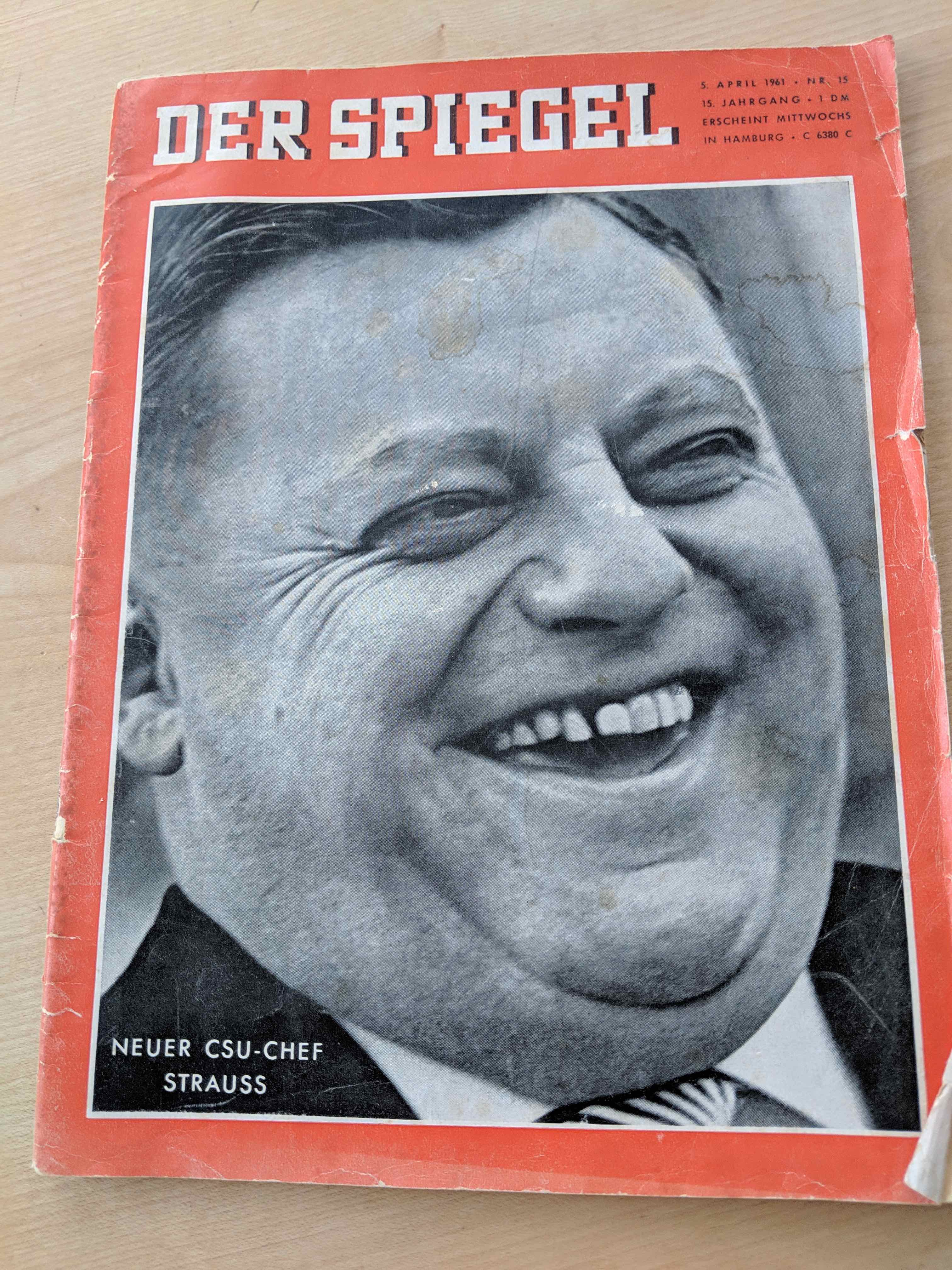
April 1961 – when the news magazine actually still was a news magazine.
One of my highly appreciated employees – let us call him A. – bought an early edition of the news magazine FOCUS and read it on his way home from a customer. He showed me the magazine because he found it an outrage. He was quite appalled by the superficiality and partiality of the magazine.
A. believed that the project FOCUS will have to fail and that the magazine would quickly disappear from the market.
Spontaneously, I tended towards agreeing with A. To me, the sorry effort also looked atrocious. I agreed with A: The FOCUS is too colourful, to garish and too simple. It is superficial and primitive.
But then – is that not what our society has come to? And the future? Consequently, I contradicted A. We had a dispute and eventually we made a bet. The bet was formulated and the loser has to pay a box of champagne.
A. and Roland betting. Roland assumes that the FOCUS will be a success and that the magazine will still exist ten years from now. Andreas bets that the FOCUS will have disappeared before ten years are over. The loser has to give the winner a box of champagne.
I make an entry in my diary and wait. Ten years later (2003), I stand as the winner. However, I do not get the champagne. A. ignores my demand.
Today (2019), after more than 25 years, they still both exist: the Spiegel and the FOCUS. Here are the current edition sales numbers (the Spiegel is still the winner).
Spiegel: The number of sold copies is 712,268, which is a minus of 32.6 per cent since 1998. Focus: The number of sold copies is 413,276, which is a minus of 47.2 per cent since 1998.
I do not know which of the two is the winner in online readers. It is no surprise that the hard paper copies get fewer. It seems that this is true for almost all newspapers and magazines (with the exception of very few, such as the brand eins). The number of copies printed (sold copies) and the advertisements therein (in T€) is on the decline.
As I see it, the Spiegel has moved towards the FOCUS. That is not an encouraging conclusion with respect to the quality of journalism in the one-time news magazine. The same is true for the fact that the best stories are those that have been made up.
RMD
(Translated by EG)
Roland DürreMonday February 4th, 2019
Values, Morality, Principles – What Exactly do these Words Mean?
Freedom? Morality? Principles? Facts? Certainties?
Using beautiful terms and buzzwords, both politicians and the marketing of huge concerns try to impress people (and motivate them to buy things). The former do it because they want our vote, the latter because they want our best – the funny stuff.
Consciously treating language shabbily is part of this “new dishonesty“.
Language is supposed to have a manipulative effect. There is an endless number of terms that are very suitable if you want to seduce people. These terms are used whenever someone says something great. In particular, it is used by people who believe they are in possession of the truth (if you are precise, you will have to call it certainty). They use terms they themselves do not really understand, but still they hope that, by using those terms, they can sell their certainties.
They will not concern themselves with what these words actually mean. Instead, they just parrot them. Consequently, we should put all statements that are put before us under really thorough scrutiny. After all, we live in times of irresponsible blabbering.
In 1983, I was lucky enough to attend a very high-profile management seminar on dialectics in Frankfurt under Rupert Lay. In those days, Rupert Lay had the reputation of being the German Nestor as far as “Ethics in Management“ was concerned. It was a very modern topic, almost “hype”. I learned a lot during that seminar. And I tried to continue learning for the rest of my life.
I was 33 years old when I learned language, i.e. when I learned what exactly it means to use language properly. Well, that is rather late, isn’t it? The six other seminarists were all top managers from industry or presidents of associations or politicians in high office. They were all around thirty years older than I. That means they were all a lot later than yours truly, doesn’t it?
After a short warming-up discourse, they all agreed that freedom was their most important property and that they would immediately die for it. When I distanced myself from these two statements, I was treated like a pariah. To be sure, I was the youngest, had the longest haircut and did not wear a tie. Consequently, these older silvery-haired gentlemen could not really take me seriously, could they?
Unfortunately, the entire affair was symmetrical. Because to me, these six persons looked very much controlled from outside, which means they were the opposite of free. To be perfectly honest, I thought my six co-participants in the seminar were the prototypes of unfree persons. They were typical system agents who were caught in their fascist jails.
This did not bode well for the entire seminar. Regardless, this seminar is where I started to see philosophy and rhetoric as something important in my life and to appreciate their value. Thus, I learned to listen carefully, to analyse language and to treat difficult terms with caution, rather than negligently. And ever since then, that is what I have tried to actively do.
Concerning the image below:
Be not afraid, my blog is not going to turn into advertising CDU. I will never vote for or support a party the members of which, shortly after WW-II, conspiratorially and in secret meetings prepared for German re-armament, and then realized it against the protests of the people (and to the benefit of the German Armament Industry).
Because I believe that those were the days that a unique chance for us people was lost for good, just because some people were scared.
No, this is about the text on the poster, or rather the text on the tweet.
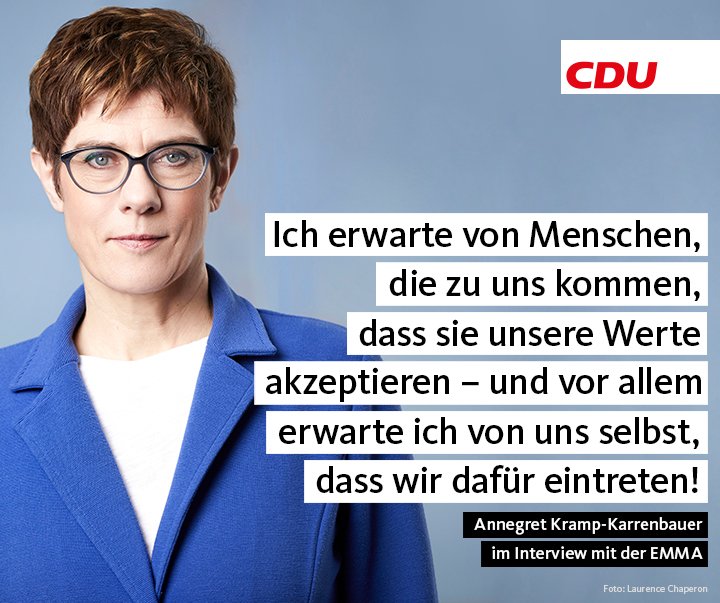 The picture illustrates a tweet that was shared by the verified account of the CDU (excluding Bavaria) @CDU.
Frau Annegret Kramp-Karrenbauer forwarded this tweet under the account @akk . That is how it ended up with me.
Here is the text as it was shared by @akk at @CDU– Tweets with this picture:
In an interview with @EMMA_Magazin @akk admonished the readers: “I expect people who come into our country to accept our values – and above all, I expect us to fight for our values”.
To me, it seems like a sentence directly from marketing. In some way or other, it is a stroke of genius in its bi-polarity. After all, it contains a demand that seems to be easy to accept.
Those who “come to us” should “accept our values”. We, “since we are “us” because we are here already”, should fight for our values. Of course, the weak point in this sentence is the term “values”. What exactly are “values”. What exactly are our values?.
Why do we expect those who come to our country to know our values if we ourselves do not know them?
As I see it, it would be a huge social obligation to work out a consensus about what our values are. Even if you probably cannot solve this problem.
Here are a few ideas.
If I want to understand the meaning of “value”, I first look for related terms, such as morality and principles. I am looking for a general term (because it is easier to understand and describe a word if you have a general term you can use in order to distinguish between the less general terms. That is what you learn in the first semester if you study philosophy).
In Wikipedia, you will find an overview on the individual letters of „VALUE“. The first cube contains an enumeration of how the word VALULE Is generally used. For our purposes, this is not helpful. Incidentally, this cube is not even complete: you will, for instance, not find what the “value” (content) of a variable is in the game with words used by programmers.
In our context, the second cube of the article is relevant. Here is what it says.
(Wikipedia – value – version of February, 3rd, 2019, second column of text)
Value stands fo:
• Ethics, i.e. characteristics and qualities that are considered morally desirable
• social norms , i.e. social regulations for how to behave.
• christian values
• Ethical values, see: ethical law
Well, I do not really know why Christian Values are part of the definition. I would find “religious” values more appropriate. You could exemplify them by using “Christian Values”. And you would then have to include the values of other religions. Perhaps you could also describe these values as mindsets. Consequently, our values would be described as our mind sets. But do we have a common mind set?
If, in our historic tradition, the Christian-Occidental values are propagated, then I always remember that, until the end of the 18th century, the Christians were also among those who supported and used serfdom , which is just another word for slavery . Well, at least in my eyes that does not make the tradition any better. Bear in mind that mostly serfs were also dependants .The landlord was mostly also the owner of the farmer. And who owned the land?
I like the first entry in the upper cube ethics a lot better. We learn that this is all about our concepts of values. So what exactly are concepts? Visions or hallucinations? The entry also shows us how easily you get into close proximity of morality that judges if we apply values. After all, morality is something that believes in possessing the truth about what is good and what is evil. Can you tell me what is good and what is evil?
In Wikipedia, you will also find on morality:
Morality is about mostly actual behavioural patterns , conventions and rules or principles of certain individuals, groups or cultures. . A violation of morality is called immorality. Amorality is the denial or the purposeful refusal of moral principles and can culminate in the total absence of moral feeling.
So now we are again dealing with patterns, conventions, rules and principles! So let us continue – which means we end up with an article about principles . Now things are really getting complicated. Consequently, we will only take one sentence:
Generally speaking, a principle is a maxim or a basic rule you stick by.
So now we can ask:
Did the author (I am sure it was not AKK herself who wrote it) really mean values with this beautiful advertisement? Or morality? Or principles?
Or does it mean that those who come to our country had better stick by our rules and regulations and that it is our job to see to it that said rules are not violated?
- Which makes it sound quite differently.
I strongly suspect that the person who wrote this sentence did not even know what he or she actually wanted to say.
Because he or she did not think of such a thing (and perhaps was not even competent enough to think of it). It was simply going to be a nice marketing slogan that sounds nice and makes a good impression. Insofar, it is a good match with the general dishonesty in our communication.
If you are interested in finding out how Frau Annegret Kramp-Karrenbauer interprets the sentence on the poster, why don’t you send her an email @akk and ask her?
RMD
(Translated by EG)


