
Roland DürreSaturday November 17th, 2012
Looking Back – Wilfried Bommert at the IF Forum
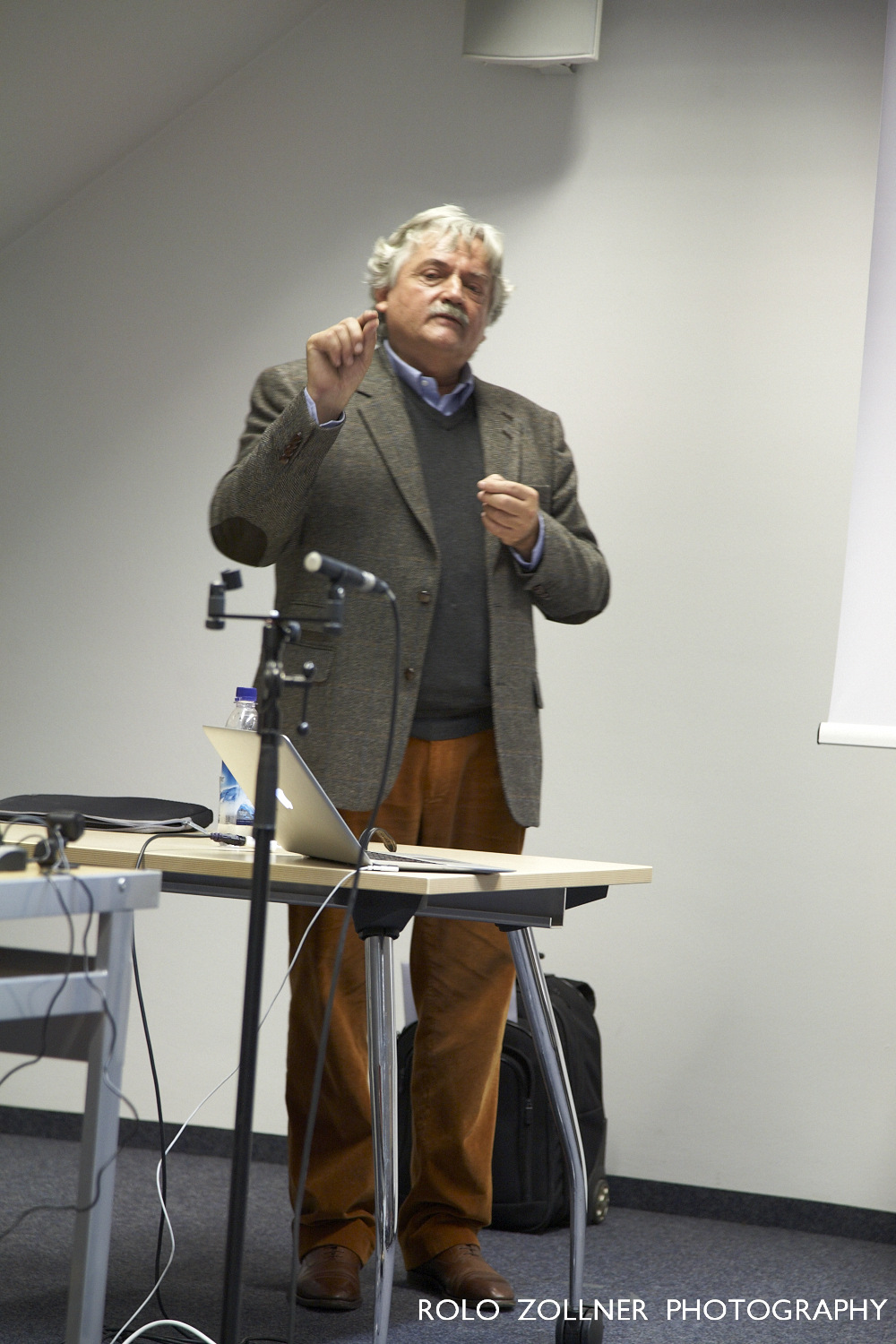 Last Tuesday, Wilfried Bommert of the WDR was our guest at Unterhaching. Wildfried Bommert is a well-known expert when it comes to “feeding the world”. He also published several books on the subject. Currently, he and a few partners are establishing the Berlin “Institut für Welternährung”.
Our last presentation in the series “living and surviving in a sustainable way” was yet again another highlight of the 2012 IF Forum. Herr Bommert deliberately kept his presentation very short and concise. We had planned this, because, after all, we wanted to produce an attractive video recording for Youtube as an extra value.
I think we succeeded. Every single sentence uttered by Herrn Bommert was right on target. Without employing unnecessary emotions and questionable judgements, he reported facts in a very objective way and came up with simple, logical conclusions.
Consequently, there was a long discussion after the presentation. It was extremely constructive and passionate. And we agreed: the messages sent by Herrn Bommert are important. He demonstrated in a very simple and rational way how feeding the world dangles on a thin string. And how easily this string could and perhaps will break.
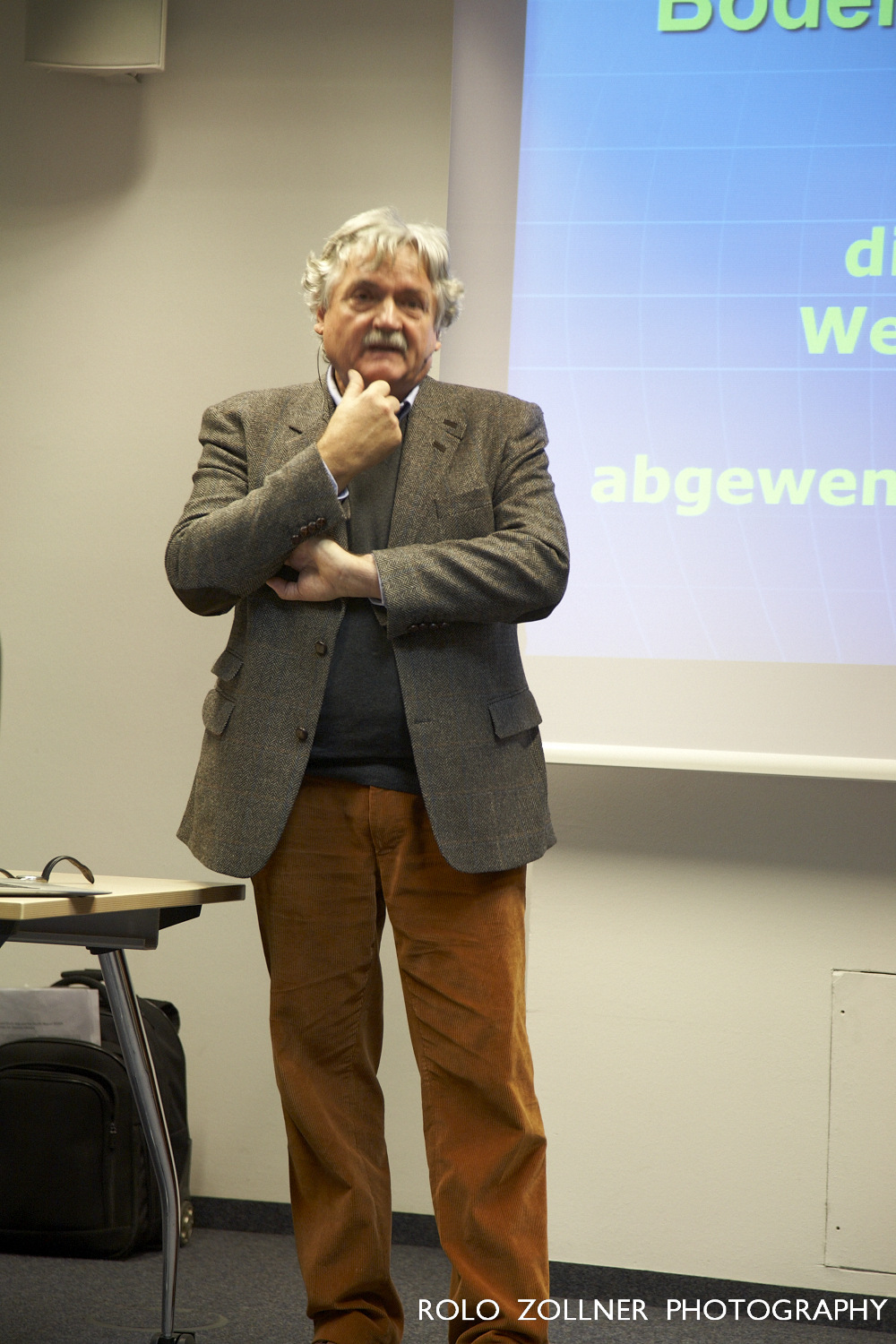 However, Herr Bommert also showed us ways to change matters. And he also showed us that it is, indeed, possible for us to prepare for the time after our stupid and eventually fatal economic habits will have caused a collapse. Consequently, his finishing lines after a very thought-inspiring list of facts and judgements were rather nice and optimistic.
With Vienna sausages and meatloaf (of course from the butcher Schlammerl of Ottobrunn), we spent quite some more time discussing things in small rounds. And finally, when the hot spiced wine and ginger bread were served – also from a local bakery: Götz of Taufkirchen – the general atmosphere was one of courage in view of a possible future and joy about all the interesting information and the culinary delicacies.
I already look forward to watching the video recording by Friedrich Lehn. As soon as it is finished, we will make it available for you on all our diverse Youtube channels.
RMD
Here are a few pictures to refresh your memory and maybe arouse your appetite for the video.
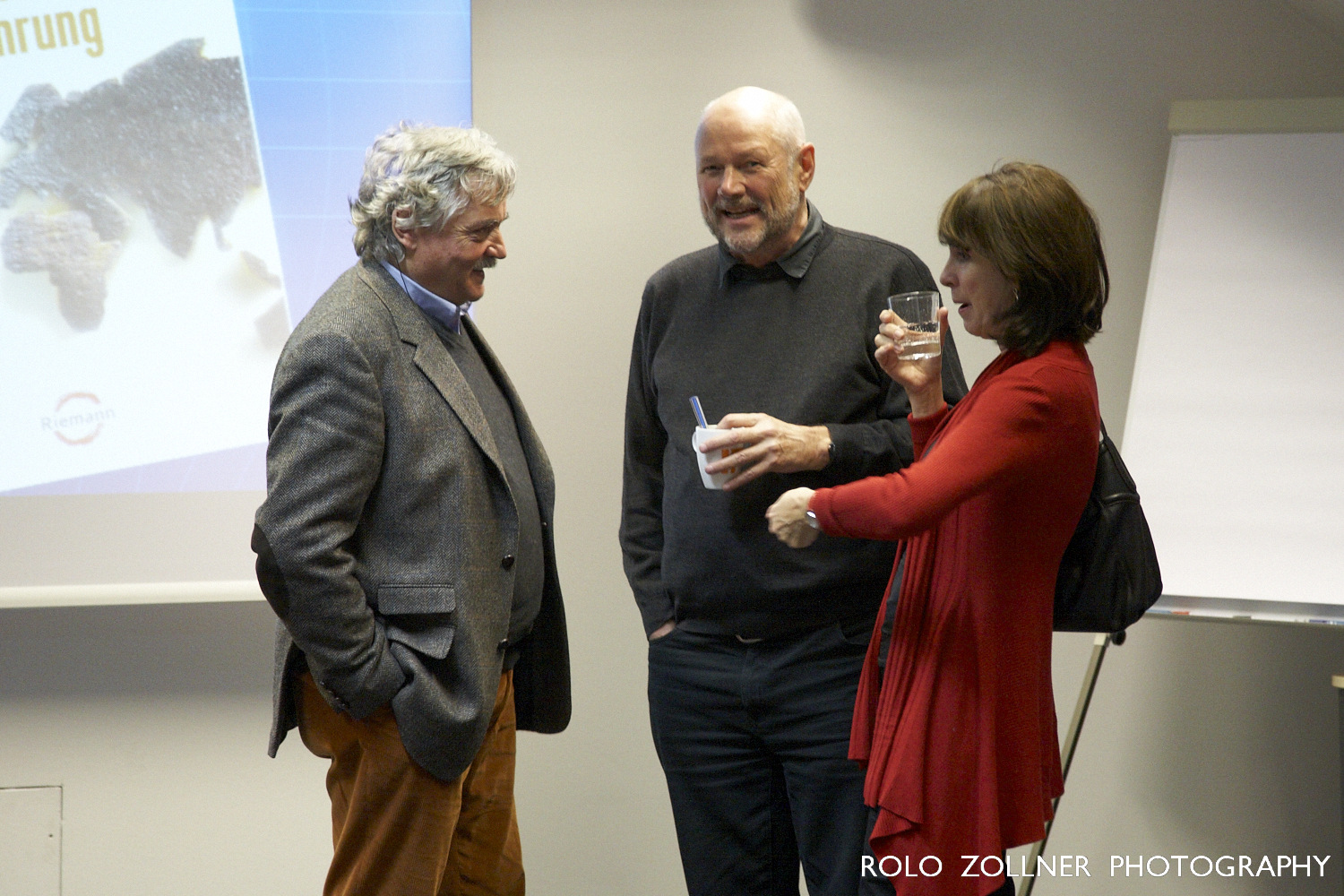
Wilfried Bommert talking to Mr. and Mrs. Gerlach. Thomas Gerlach works for the Bayerischer Rundfunk. He was the one who first introduced Herrn Bommert to me.
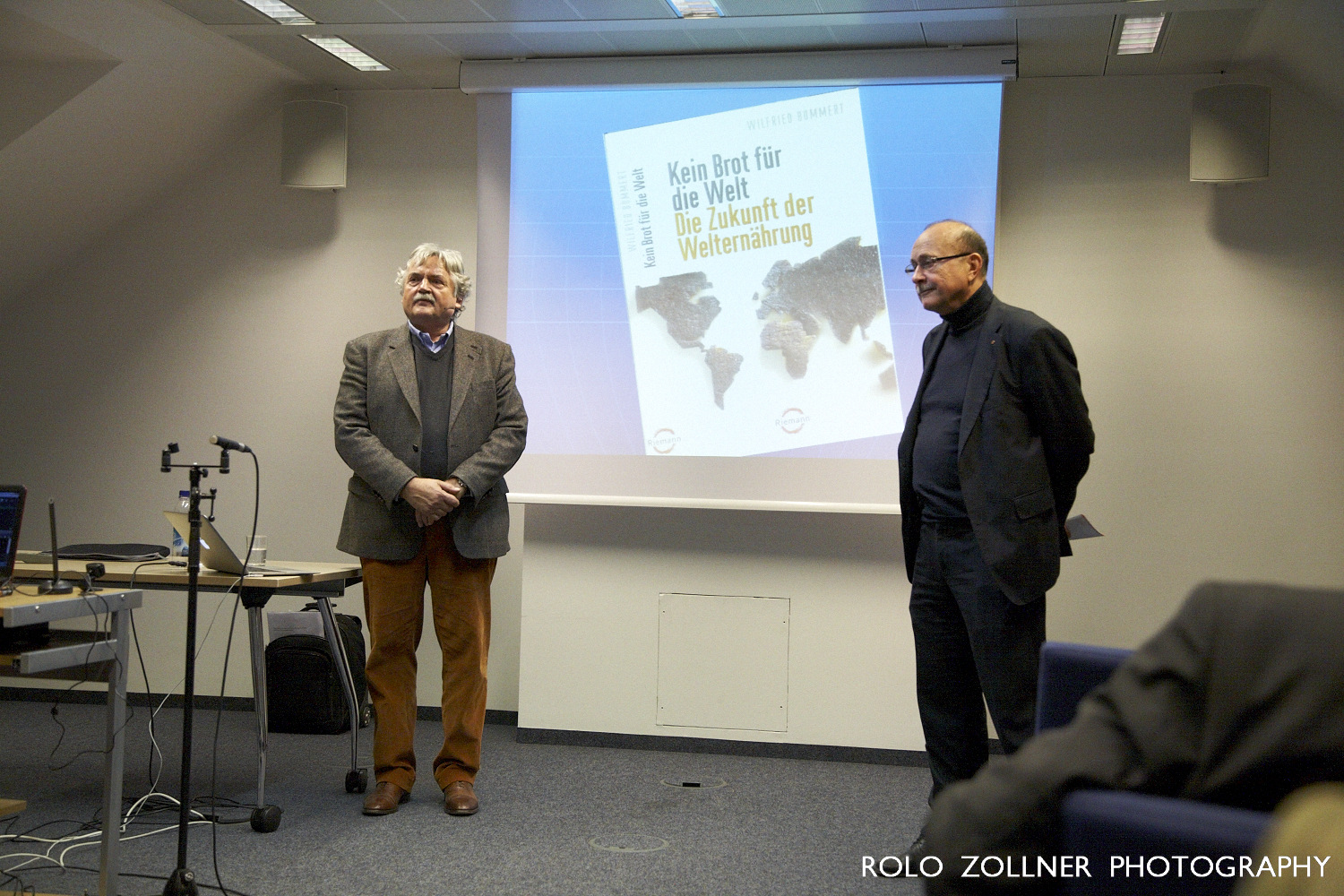
The introduction to the presentation. It will start right away …
As so often, all pictures were taken by our Rolo Zollner.
Roland DürreFriday November 16th, 2012
Presentation “Change in Management” – November, 22nd, 2012 – Universität der Bundeswehr München
As part of the EAA colloqium “Current Developments in Technology and Business“, I will give an autumn-trimester-2012 presentation at the University of the Armed Forces at Munich. I will talk about:
The Change in Management
How change will not stop before enterprises.
My presentation will introduce the world of leadership, innovation as a form of creative destruction, management, project management, organization, social systems, entrepreneurship and entrepreneurial culture.
In their organization, enterprises often follow a paradigm that belongs in the last century. To this day, hierarchical tree structures are prevalent. Since those are not terribly flexible, these enterprises are forced to execute so-called “re-structurings“ in short intervals. As a general rule, those are doing more harm than good to the enterprises.
We all should start thinking in new ways. The organization must become a dynamic network where humans in the enterprise live their relationships at eye-level. I will introduce the “Eight Theses for Management Change” as first written down by Hans Ulrich, the founder of the St. Gallen Management Model.
And I will describe how communication must function in a modern enterprise if it wants to have an impact on our future. Part of the concept is the use and utilization of innovative conference and communication formats and – last not least – the internet, including the “Social Web”.
My presentation will be held at the lecture hall 33/0101 and start on the dot at 18:15 hours. It is an open event, so guests are welcome. Of course, I would be delighted to have a big audience – just send an email to me if you are interested.
I will give a more or less similar presentation at the Bavarian Ministry of Culture in November. Said presentation, however, will be part of a non-public event. Consequently, I can only invite interested persons to the University of the Armed Forces.
Here is the full schedule of the EEA Colloquium (3) at the University of the Armed Forces in 2012. Some of the topics sound really great, so I strongly recommend you take a look at the list.
RMD
(Translated by EG)
P.S.
EAA is short for Electrical Drives and Actuators. Univ.-Prof. Dr.-Ing. Dieter Gerling
Roland DürreThursday November 15th, 2012
Tweets on Twittering and Blogging #141
Here are my tweets of last week on:
Blogging and Twittering, Wisdoms and Rules:
121122 Faithfulness is scarce game – also true for twitterers and bloggers? #Twitter #Blogging #Wisdom
121123 Faithfulness is a rare guest, keep it close if thou it hast – important advice for twitterers and bloggers. #Twitter #Blogging #Wisdom
121124 Faithfulness is bought with faithsulness – also true for twittering and blogging! #Twitter #Blogging #Wisdom
121125 Drink when you are near the fountain – especially when blogging and twittering! #Twitter #Blogging #Wisdom
121126 Dry cough is fatal for a trumpet player – also true for twittering and blogging! #Twitter #Blogging #Wisdom
121127 Better eat dry bread and be happy than meat and be unhappy – also true for twittering and blogging. #Twitter #Blogging #Wisdom
121128 Dark clouds are likely to bring rain – also true for twittering and blogging #Twitter #Blogging #Wisdom
There is a new tweet each day. See twitter.com and “follow” RolandDuerre!
Enjoy!
RMD
(Translated by EG)
P.S.
I took the proverbs from Alle deutsche Sprichwörter.
Roland DürreWednesday November 14th, 2012
Time is My Most Precious Commodity …
Currently, I actually realize how true this is. After all, I am flying from appointment to appointment. Some way or other, I seem to have no space left for dealing with private things and taking care of myself. Occasionally, I do not even know any more if perhaps a little dys-stress comes creeping along with the eu-stress. This is also why there are currently so few IF blog articles. Mind you, this is regardless of the fact that I love writing and enjoy using every free minute for the IF blog.
This was the bad news. But the good news is coming up now:
I am travelling a lot, experiencing many different things and learning plenty of new things. Consequently, I receive many impulses. All of them are taken down and I already look forward to the quiet days when I can again generate small articles out of all those ideas.
RMD
(Translated by EG)
Roland DürreMonday November 12th, 2012
(Deutsch) 2-Wochen-News #31: Für Kurz-Entschlossene: Morgen – 13. November – IF-Forum
Roland DürreSunday November 11th, 2012
VDE, VDI, GI, GChACM, GPM, GfWM, BITKOM …
The Dornbirn PM Camp made me thoughtful in various ways. For instance, I remembered something I experienced early in November.
Felix Köbler, a young and highly motivated computer scientist who is also doing research but will probably soon “take the plunge and become an entrepreneur“, gave a presentation for the VDE (Electrical Engineering Association) on “Crowd Sourcing”. It was a well-advertised contribution on an exciting future-oriented topic.
The presentation was held at TUM. I was interested in watching the presentation for various reasons and consequently rode my bike to the old and dignified TU building at Arcisstrasse 21 on the evening of November, 5th.
It was a truly great presentation. He gave a very nice description of the diverse and substantial potential for change by future tools, applications, as well as interface and user strategies. Consequences on the social level were described using an example, before the potential for the use of modern technologies offered by Web 2.0 was outlined. And he also told the audience all the things you can do with “Apps” and “Gamification” using “Mobility and Cloud Applications”.
So here is the bad news: there was hardly an audience! I knew most of them personally and therefore could safely assume that they mostly came because they wanted to hear the speaker. Those few among the audience who had come on the instigation of the VDE university section were few and far between. Moreover, this (small) group of visitors were rather over the top in terms of demographic development.
Mind you, this is Munich. We are not precisely talking the smallest German city, are we? Besides, Munich very much wants to be High-Tech oriented. Considering this, the attendance was rather a disappointment.
In Munich, you can also find many great things. Young engineers and entrepreneurs of the IT sector actually like coming to Munich. For instance, a short time ago there was a Barcamp for “Games”. Allegedly, it went quite well and a surprisingly high number of (happy) visitors were there.
Which means that the lack of enthusiasm for the presentation was not due to the fact that our “global” Munich has now suddenly turned bourgeois and saturated. The real reason is that the associations that at one time were so great and strong get less and less accepted in the age of the web.
Yesterday, at our Dornbirn PM Camp 2012, I met a “true” engineer. He told me he still held a membership at the VDI (Association of German Engineers). A short time ago, they sent him a letter offering the badge of honour for his 25 years of membership. So he decided it was about time to attend one of the VDI events. He returned with the feeling “never again – this is not what I can identify with”.
To be sure, associations like the VDE and VDI have attractive websites. They look quite nice. Nevertheless, these associations are on a downward spiral. One indicator is the high average age. The events have a low attendance and the publications are rather dry. The members are usually passive and only remain members because they are so used to it or because they are sentimental about it – after all, the “good old times” want to be remembered.
But then, this is something we (older) computer scientists know quite well from our associations: GI and GChACM. Those, too, can make as many efforts as they want. They are on the downward spiral. And whenever I ask my young students, they either do not even know what the GI is, or else raise their eyebrows. Neither does anybody read the GI Informatik Spektrum. Even if they try to artificially improve it by using strange posters that show persons like Steve Jobs.
Apparently, Steve is a great German computer scientist.
Basically, all that remains to be asked is which way the new associations will go, since they are dealing with current topics such as knowledge or project management. The GfWM (Society for Knowledge Management) or the GPM (German Association for Project Management), for instance, are absolutely “in” at this time. The GPM even managed to install itself as a “standardising and normative institution for project management”. Thanks to its certifying power, it seems to have an almost market-dominating position.
Incidentally, I believe that this, too, will not last long. They will get the funny stuff for a few more years, and then the downfall will come, along with the slow process of misery. Just like the other associations have already experienced it.
I only hope those associations the only purpose of which is lobbyism will meet the same destiny.
For us computer scientists, there is, for example the BITKOM (Federal Association for Information Business, Tele-Communications and New Media, e.V.). Just look at the term “Information Business”. Nomen est Omen. BITKOM is “our” lobbyist. Above all, they want to promote the IKT (Information and Communication Technology). In other words, they want to convince the politicians to spend a lot of money on IT infra-structure. However, to me it seems that BITKOM is not particularly successful. Just compare it with the nuclear and airplane industry in former times.
Even though Bitkom calls itself “The One And Only Hightech Association“, we do not really need them.
RMD
(Translated by EG)
P.S.
If you are among those who are looking for alternatives, here is some advice.
P.S.
The first is a Barcamp, Open Space or some such. Having the right kinds of seminar rooms is a necessary requirement. One of my next articles will be about seminar rooms and rooms in general.
Roland DürreFriday November 9th, 2012
PM-Camp12
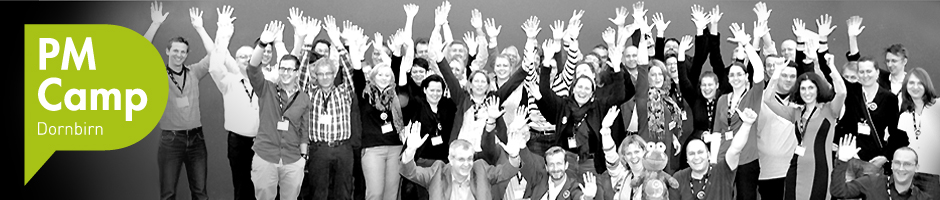 I was definitely a little nervous about my role as co-organizer of the PM-Camp 2012 when the core team (yours truly along with Eberhard, Jens, Marcus, Stefan, so far without Eileen who, unfortunately, was still travelling) met for the last organisational meeting shortly before the evening event started.
Would everything go well? Maybe there are too many participants, after all? Will everything go as smoothly as it did last year? Will we manage the spontaneous building of trust between the participants? Will the catering be as we hope? Will the atmosphere be as good as it was in 2011?
And then, this morning, it started. And everything was great. Just like last year. Now the first day is behind us. And after many super “sessions“ with much that was new for me, I am truly tired. It was absolutely worth the effort – and now we look forward to the great evening party!
If you feel like it, here are some live pictures and video recordings of the PM Camp on the Website .
Incidentally, the twitter tag of the PM Camp 2012 is #pmcamp12. On this site, you can experience live a little of what make PM Camp so special. Of course, today and tomorrow, there will be quite some activity.
RMD
(Translated by EG)
Roland DürreThursday November 8th, 2012
German Essays
For me, the one subject at school that made me most miserable was German.
Basically, my self-assessment in German was not so bad. After all, my orthography was – in my opinion – a lot better than that of many classmates. And I also found that I could express what I wanted no worse than the average students in the class.
Except that, far too often, my ideas were the “wrong ideas”.
😉 At least that is what my German teachers thought.
The main problem was the German essay. Even the way our teachers set our tasks and the given titles were strange. Incidentally, I found it strange if a young and creative person was forced to write something under a special title. Isn’t that outrageous? I would have preferred to write my opinion on some topic or other and then creatively find a title that fits with what I wrote.
But no. Teachers asked 24 students to artificially generate essays on the same and often questionable and very unrealistic title, before marking them. Once in a while, we also had to write interpretations about texts that looked very alien to us – both by famous and less famous authors. However, we were not allowed to write down what moved us personally about a text or what we might have found disgusting. Instead, we had to write what the current doctrine said. Of course, that was not really what I felt most enthusiastic about.
In my opinion, the stories told by the great narrators were sometimes abominations. I can remember masterpieces by Kleist I really found sick. But at school, the great master was beyond all reproach in German lessons. And whenever I criticized about his writings what, to me, looked rather grotesque and stagy language, all I got in return was lack of understanding – with the consequence of being graded poorly.
It got even worse when the topic of a German essay had something to do with values, moral, ethics or the like. How often I realized that the German teacher had a value system that was totally different from my own! Differentiated, abstract terms had totally other meanings for the teacher (him) than for the student (me). When it came to judging what was “good” or “evil”, “right” or “wrong”, miles lay between our opinions.
And when finally the German essay was graded, the time had come for the concept of the teacher’s and the student’s world to clash. Sometimes it happened consciously – the teacher could not or was not willing to understand what he had read. Often, the rejection was subconscious, because the student’s ideas were so incompatible with the teacher’s concept of the world. If I was lucky, the teacher would shake his head in incomprehension when reading my work – before, from his point of view, tempering justice with mercy. All of this was not very beneficial for my grades in German.
Consequently, German became the one subject for me which is most suitable for outlining all the old-fashioned and outdated things about our school and learning processes. All we ever do is make students learn things without being convinced of them and then again forget them. You have to adapt to the teachers‘ prejudices and be prepared to make pre-fabricated opinions your own. But woe to him who shows civil courage or creativity, or – this is the worst case – both. As a general rule, this will be your downfall. And your grades in German will deteriorate. It is certainly a lot better to just keep quiet.
And here is another cheekiness: our German essays remained the property of the teacher or the school! At one time, I wanted to publish one of my essays in the school magazine. We are talking one of the essays that had been graded poorly. I got in real trouble for it.
Neither was I allowed to keep my masterpiece: the graduation essay in German. At the time, the best you could hope for was that you took legal action, which might have given you the right to see the corrected essay. A huge bureaucratic effort was necessary – and in the end it made not the slightest difference to the fact that my “intellectual property” had been confiscated by the Free State of Bavaria. And not just temporarily, either!
Well, so much on intellectual property.
RMD
(Translated by EG)
Roland Dürre
Tweets on Twittering and Blogging #140
Here are my tweets of last week on:
Blogging and Twittering, Wisdoms and Rules:
121115 Dreams are ten a penny – actually, this is not just true for twitterers and bloggers “in the crowd”. #Twitter #Blogging #Wisdom
121116 Not trusting everyone is a good way to avoid being cheated – also important for twitterers and bloggers. #Twitter #Blogging #Wisdom
121117 It is a good thing to do what you are good at – also true for twittering and blogging! #Twitter #Blogging #Wisdom
121118 Let everybody use his talents – just like the courageous bloggers and twitterers! #Twitter #Blogging #Wisdom
121119 Good faith is better than cash – especially true for twittering and blogging! #Twitter #Blogging #Wisdom
121120 A faithful hand will see you through the entire land – good advice for twittering and blogging. #Twitter #Blogging #Wisdom
121121 Trust will give you bread, betrayel will give you misery – that is what it should be like when twittering and blogging #Twitter #Blogging #Wisdom
There is a new tweet each day. See twitter.com and “follow” RolandDuerre!
Enjoy!
RMD
(Translated by EG)
P.S.
I took the proverbs from Alle deutsche Sprichwörter.
Roland DürreMonday November 5th, 2012
Next IF-Forum 2012 – November, 13th
By now, we have also agreed on the day for the 3rd 2012 IF Forum of our series “Living (and Surviving) Sustainably”.
 Herr Wilfried Bommert will speak on Tuesday, November, 13th, 2012.
His presentation will be about “How to Feed the World“. For a title, he selected:
Catching Up On Good Soil!
How we might avoid the world food crisis.
Here are a few preliminary ideas by Herrn Bommert:
Ever since 2008, the price for food world-wide only knows one direction: up. The global financial crisis and the dwindling oil reserves further push the price spiral up. Concerns selling energy, raw materials and money reach for the fields of the world. They buy or rent huge areas in Africa, Asia, Eastern Europe and South America, thereby again causing massive price increases for food. Consequently, we get famines, revolts in more and more countries that cause political instability and a collapse of world food affairs.
This vicious wheel would not turn if we did not actively contribute by our consumption habits. Our longing for biological fuel and our hunger for products from industrial farming, our money invested in farm and soil stock, they all support the global hunt for the fields of this world. It is up to us to put a stop to this mania currently prevalent in food and soil markets.
Dr. Wilfried Bommert has been working as a WDR journalist since 1979. He is head of the environmental sector at the WDR-radio station and also wrote the book: “Kein Brot für die Welt – Die Zukunft der Welternährung”, 352 pages on paper, first edition published on October, 5th, 2009 at Riemann Verlag (QUERDENKEN) .
RMD
(Translated by EG)


