
Roland DürreSaturday October 13th, 2012
Who is Scared of the Boogey Man?
Everybody is scared of the “Cloud”. Because the Boogey Men inside the Cloud eat our data and/or use them in an illegal way. Our precious personal data!
It is particularly bad if the Cloud is outside our country. After all, there is no control possible. The US secret service might well read our data. However, matters are not really improved if the Cloud sits (hovers over) Germany. Perhaps the US secret service cannot read our data in that case, but the German secret service certainly will. And, basically, I do not care which secret service reads my data.
Why are we feeling so protective of our data? I cannot understand it. Nothing has as little importance in my life as my data. If there is anything you wish to know about me, just go ahead and ask! It will be my pleasure to answer – even publicly. Most of the things about me will be found at duerre.de or if-blog.de, anyway.
If I were the anxious type, I would certainly be scared of Clouds. But I mean totally different Clouds. Those I am actually dependent on. Those that are the basis for all I truly need in order to survive.
Water
Water comes through the tap. It gives me access to the water Cloud. It is rather insecure, isn’t it? Evil-doers could pour poison in it at many places. To be sure, we only know the poison terror at the water station from the cinema – but it could easily become reality. An evil terrorist would be all it takes to kill us all.
Bottled water from the supermarket will not help, either. This Cloud, too, has too many weak points. An evil-doer would easily find ways in. Today, hardly anybody still has his or her own well. Incidentally, it would not help, because the Cloud of dioxins or radioactivity is already on its way to poison it, anyway.
Nor is it a brilliant idea to drink beer instead. Too often, it comes from the InBev Cloud. And on a rather risky way at that. Until finally it ends up in the safe haven of my refrigerator.
Food
All food, be it deep-frozen, corn, all kinds of basic nourishment, vegetables and fruit, fish or meat, canteen food: all comes from the Cloud. And once in a while, something unfortunate happens there. Sometimes the Cloud produces chicken that contains a little dioxin, sometimes it is the deep-frozen strawberries. They come from China and make our children sick. I certainly cannot understand why we in Germany would need to eat deep-frozen strawberries from China. After all, there are enough apples, pears, plumes… right here in the country. But the Cloud makes it possible. And certainly not from the neighborhood.
But we trust in the Cloud. It will certainly feed the entire world and continue to do so tomorrow, as well …
Energy
Electrical energy comes from the electrical socket. It is the interface to the Cloud. The fuel comes from the pump at the gas station. When the Cloud will no longer supply us with electrical energy, the lights go out. When the pump at the gas station provides only drops, the cars will just stand around and be useless.
We do not know where the electrical energy or the fuel originated. Neither do we want to know. The Cloud will certainly provide. With or without an about-face in energy politics. Besides, energy is, after all, not quite as important as water or food. Nothing serious is happening if the electrical energy is sometimes polluted.
Money
You cannot eat money. For life, it is even less important than energy. Most of us have too much, anyway. Which is why we buy all kinds of useless things we do not really need. Whatever is left of our money will be stored at the bank. That is how we learned it! For too many years, we have been instructed that the only person hiding her money in her socks or underneath the sofa is the stupid grandmother. No! Apparently, we think the money Cloud is very nice and even system relevant. And consequently, we hand our entire money over to it. Because we want the Cloud to let our money work for us. And when we do not have enough money, we go and get it there.
Water, food, energy, money and much more comes from the Cloud. Basically, I cannot imagine anything today not coming from the Cloud. And still we have no problems sleeping soundly …
Only when our data are inside the Cloud, we cannot sleep any more. Why is that so? Are we scared of our data? Why are we so afraid that others might get to know who we really are? Do our data remind us of our evil deeds? Quasi like a modern bad conscience?
I must confess that I generally fail to understand the sometimes collective sometimes individual hysterical reaction when it comes to personal data. And, to me, it does not matter if these data are in the Cloud or somewhere else. I still have quite a few plans for my life. But I would never, ever agree to do the job of data protection commissioner.
RMD
(Translated by EG)
P.S.
In my book passphrases and passwords for internet pages such as Ebay or for the bank are not data, but keys. And, of course, you should always be careful with keys. Even though I must admit that I am actually quite careless with my house keys.
Roland DürreWednesday October 10th, 2012
News of the Day – the Price of Electrical Energy
In the morning, I often enjoy listening to Bayern 2 on the radio: die Radiowelt. Today, everybody seems to be upset about the price of electrical energy. I see that a little more diverse:
As I perceive it, a quite substantial “Inflation” is taking place. No matter if I go eating out or go places by underground train, everything gets more expensive. Even electronics products, such as mobile phones and laptops do not seem to get less expensive if you take the “State of the Art” into consideration. Not to mention realty. Salaries and incomes, too, are on the way up, at least nominally (wage agreements, doctors). To make up for it, the small number of poor persons grows.
This inflationary situation – even if statistics cheat to make it look lower – is quite easily explained. Just look at the money policy of the EU administration. Or the development in other currency zones, such as the dollar, the RMB (Chinese yuan), or other economies with whatever small currency you choose to look at. All over the place, prices climb. Be it in China, the USA, or elsewhere. And, after all, we are part of a globalized world, aren’t we?
If, in an environment of inflation, a product kept its price stable, it would in fact get less expensive. The only way I could say something got more expensive would be if the increase in price were considerably above the inflation rate. Under this light, all you should be able to say is you have a relative price increase, one that remains after you have considered the “true” inflation rate.
Looking at the increase in prices for oil, you notice that the price for electrical energy is actually far behind. As I see it, it is a good idea to have the price of electrical energy climb as long as most of it is still produced from fossil materials. When, at long last, the moment arrives when we can produce electrical energy exclusively in an environment-friendly way, it should be cheaper.
For me, however, it seems doubtful that this will ever be possible to the extent we allegedly need it. That means it is still absolutely obligatory for us to treat energy in a responsible and efficient way. And that is an area where regulations and laws are mostly not really helpful. Sad as it may be, it is a fact that rational thinking mostly only happens through the purse (like a man’s heart is won through the stomach).
What is really annoying, however, is the fact that we now have a modified co-called electrical network regulation (StromNEV). It says that those enterprises that use up more than ten Gigawatts of electricity each year and need the full capacity for a minimum of 7,000 hours each year will no longer have to pay the network organizations for the transport of electrical energy, which, basically, is an additional subsidy. And the number of these big subsidies has increased drastically.
This caused Germany to become an expensive country in terms of electricity for those who need small amounts. Yet, for those who need huge amounts, it is rather attractive.
Naturally, those who use up small amounts are now worse of in terms of money, while we are counter-acting the goal of using energy more efficiently on a huge scale. Incidentally, this has nothing at all in common with an about-face in the energy sector. All it means is another subsidy for dedicated interest groups.
It sounded like a confirmation to me when, this very morning, I heard a CSU politician say on the radio that even Norwegian enterprises now started transferring their electricity-intense production parts to Germany.…
Incidentally, the author assumes – and I am sure this is totally unprofessional – that most of the enterprises that use up huge amounts of electricity need it for such “reasonable” things as the production of beer and drinks cans. That alone makes me furious. Because beer is definitely one of those things that you must never drink out of cans. Mind you, our throw-away society is something I detest, anyway.
RMD
(Translated by EG)
Roland DürreWednesday October 3rd, 2012
Still Fresh News That Seem To Stick With Me …
Regardless of all the information flood from the media (paper and internet), via social media (Twitter, Facebook, Google+) and radio and TV, some of the recent news linger in my memory. To be sure, they are also more important than those news I forgot. But some way or other, they also scratched at a surface inside me. Consequently, I wish to write down a few ideas on them …
Our Federal Chancellor and Gorleben
(Zeit and SZ)
They installed another one of those committees of enquiry. Even our Federal Chancellor was asked questions. Because, at the time, she was the minister in charge. It was about the desperate situation at Gorleben. Except that, so far, nobody really takes notice. Of course, the committee cannot really present any results.
Because back then nobody could know that things might not go as well as planned. Regardless of the fact that everybody with even an inkling of scientific knowledge and a little common sense had to have known that the combination of nuclear waste and salt mine could not work. Now we see the result. Taking the waste out would cost more than anybody could pay – and probably it could not be done anyway at this late time. At some time, there will be radio-active alarm and the potable water in the region will be a thing of the past.
To be sure, our Federal Chancellor conceded that the situation was not really solved to perfection at the time (or something like this). Instead of just admitting that she made a huge mistake when she was still environmental minister. After all, we all make mistakes, don’t we?
Lawsuit against Church Tax
(Spiegel)
I was surprised to see that a judicial theatre as absurd as this is actually worth making the news. Some wisecrack had the idea that he should not be asked to pay club fees, because the club is something like common property. Because it is the Church of Jesus Christ. What a strange idea. Like if I were to play in the chess club tournament of a small town without being a member of the chess club. Because, after all, chess is common property, isn’t it?
Such an idea can only originate with someone who is both a lawyer and Christian. Mind you, the church does not even charge entrance fees for its events, such as the mass service.
Speaking of church, it comes to mind that there might be a few more lamentable/offensive facts to write about. For instance that many church officials and dignitaries are still paid by the state, that churches still enjoy special dispensations from taxes, that we still have compensation payments for the church by the state for dispossessions that happened during the second half of the last millennium, and much more of similar kind. But it seems nobody is interested in these kinds of things.
Offended Religious Communities
(Welt and 20min)
Much has been written on this. The range is from absurd arguments about numbers (when it comes to the consequences of circumcision) to illogical legislative proposals. It seems that religious communities need their special treatment and thus have to get it. Some need it in order to mutilate their toddlers without violating the law. Others need it in order to “protect” their feelings. And our Federal Chancellor is wondering whether she should banish a not very impressive video recording, because it might just be a danger to public safety.
Stale Air in the Airbus 380
(dw)
This is also one of the things the media will make good use of. But why? Lufthansa does not only fight part of their employees (and UFO), but also stale air. Mind you, isn’t it logical that it must be smelly in such a huge airplane? After all, an Airbus 380 is a new and complicated system. It is not yet fully mature and consequently still has (must have) its flaws. I could imagine worse than stale air. It sounds like an error that can be found and corrected.
Stress Test for the European Nuclear Power Plants
(Focus)
The “stress test“ for nuclear power stations (note the martial choice of words) is finished. We can now read the report and it tells us that there are scandalous safety risks in more or less all the European nuclear power plants. However, the stress test only tells you half of the truth. Important criteria have been left out.
Mind you, not that it matters. Because, according to the report, the repair of all the discovered defects would (once again) cost the unimaginable sum of 10 to 25 billion Euros. This kind of money is not available; or rather, nobody is prepared to spend it on safety. Neither can the EU put pressure on anybody in this important instance. Consequently, nothing is going to happen. There is no such thing as safe nuclear power. Period. All you can do is hope nothing serious will happen. Well, it is what the Japanese did, isn’t it? Except that they were not lucky.
To make up for it, the EU comes up with a few more new regulations and laws. Yet no reasonably minded European will ever stick by them. And, as a side-effect, Europe is divided in order to “safe“ banks with sums that make those aforesaid 10-25 billion look ridiculous.
But the banks, again, need some extra money – and the Euro rescue fund gets larger.
(SZ)
Of course, the money for the banks will not be enough for Spain and the proud nation will have to seek shelter underneath this strange Euro rescue fund.
NSU and the Protection of the Constitution
(Handelsblatt)
The things I keep hearing on this make me speechless. “Civil servants” and politicians lie shamelessly. It can almost be assumed that V-persons working as civil servants were not only the culprits, but also the agitators. Nobody seems to be interested in finding out where the real persons behind the scenes sit.
To make up for it, the telecommunication of the citizens is recorded and data stockpiling secretly makes progress.
IRAN blocks Gmail
(ARD)
Again, I am reminded of data security. And then I ask myself what I fear more: enterprises using my data in order to sell something to me (ha, ha), or the state confiscating my means of communication? Or – what is worse – the state working espionage against me at random. Because in this country, the administration is permitted to do exactly what they want to protect us against from Facebook&Co.
Consequently, we fear data abuse “in the cloud“ as the devil fears holy water. And we fight the devil with Satan. Because there is no data security when it comes to the state and its executive organs. The many terrorists alone make it impossible. But perhaps the short-term blocking of Gmail by the Iranian authorities was just a means of fighting world-wide terrorism?
BND building will cost 100 billion more than planned
(Welt)
This, too, is nothing special, is it? Except that the biggest building the state ever planned is for the BND. But it is certainly no surprise that it is (so far) the biggest miscalculation. Basically, huge projects will always end up costing a lot more than planned. This is true for philharmonic houses (Hamburg), airports (Berlin-Brandenburg), railway stations (S21) and also buildings where the “Federal Investigation” is done and the constitution is supposed to be protected.
As a general rule, there are probably two reasons for this: firstly, the cost has been voluntarily kept low in the planning phase in order to make them politically acceptable. Secondly, they certainly do know that the number of errors will not increase linearly with the degree of complexity. It can probably even be calculated. Except that nobody can tell in advance what kinds of errors will occur and how much they will cost.
And finally, again our Federal Chancellor – with a pleading in favour of the e-car.
(Bild)
This is particularly delightful. By the year 2020, we are supposed to have one million battery powered cars. To be sure, they will look more like Pedelecs, instead of cars in the modern sense.
Physical laws (such as energy density) are opposed to it. If we want to compete against vehicles powered by fossil material with e-mobiles, we will first have to make individual traffic e-mobile adaptable.
Light and slow e-mobility can only be attractive if you adapt the traffic. You will have to make it softer and slower. Consequently, the best promotion for e-mobility would be a clear speed limit, for instance 30 km/h inside cities, perhaps 50 km/h in rural areas and 90 km/h on motorways. This, however, would mean a de-emotionalisation of the false God car. Something most Germans, including their boss Merkel, cannot imagine…
Economy and Sport
I find it particularly easy to remember the economy sector. Here, the story is quite simple: there is more than enough money available, the banks almost drown in it. Fuel prices climb (which I find good), property gets more expensive (I cannot judge this) and the stock prices climb (I could not care less). Officially, we have as good as no inflation. Only the prices do not know that. Consequently, everything gets more expensive all the time.
Here is more news from the economy (FTD): dpad and Neckermann (according to Quelle) are now definitely bankrupt. dpad used to be DPA, which, along with API was perhaps the world’s most renown press agency. There came a time when it merged with the “Deutschen Depeschendienst”.
As I see it, all these bankruptcies were more or less a matter of course. And, naturally, there was no rescue umbrella for them. As opposed to the financial institutes – most of which definitely are also now well into their dotage.
In Europe, the spiral goes downwards all the time. Only Germany goes up. This cannot be a good sign and it makes me wonder.
And with sports, matters are even simpler: the FC Bayern will always win. Except in Belarus.
Now the article I was going to write on our day of jubilee is a lot longer than I had intended. All I wanted to do was remind you of the fact that not all is gold that glitters in our highly-praised black-red-golden country. National intoxication will not help us. We have to sit down and do our homework for a Europe that is unified in freedom. If I were asked my opinion, I would quickly abandon the Third of October as a national holiday. Instead, I would come up with a common European Holiday. And now I will go to the forest pub by bike and celebrate October, 3rd among Jazz music and a litre of Oktoberfest beer. And tonight, we are going to eat a “truly authentic” Chinese dinner.
RMD
(Translated by EG)
Roland DürreFriday September 28th, 2012
The Oldest Firms …
A good friend of mine sent me the following scan of an SZ graphics. The source is Hoppenstedt and Henokiens.
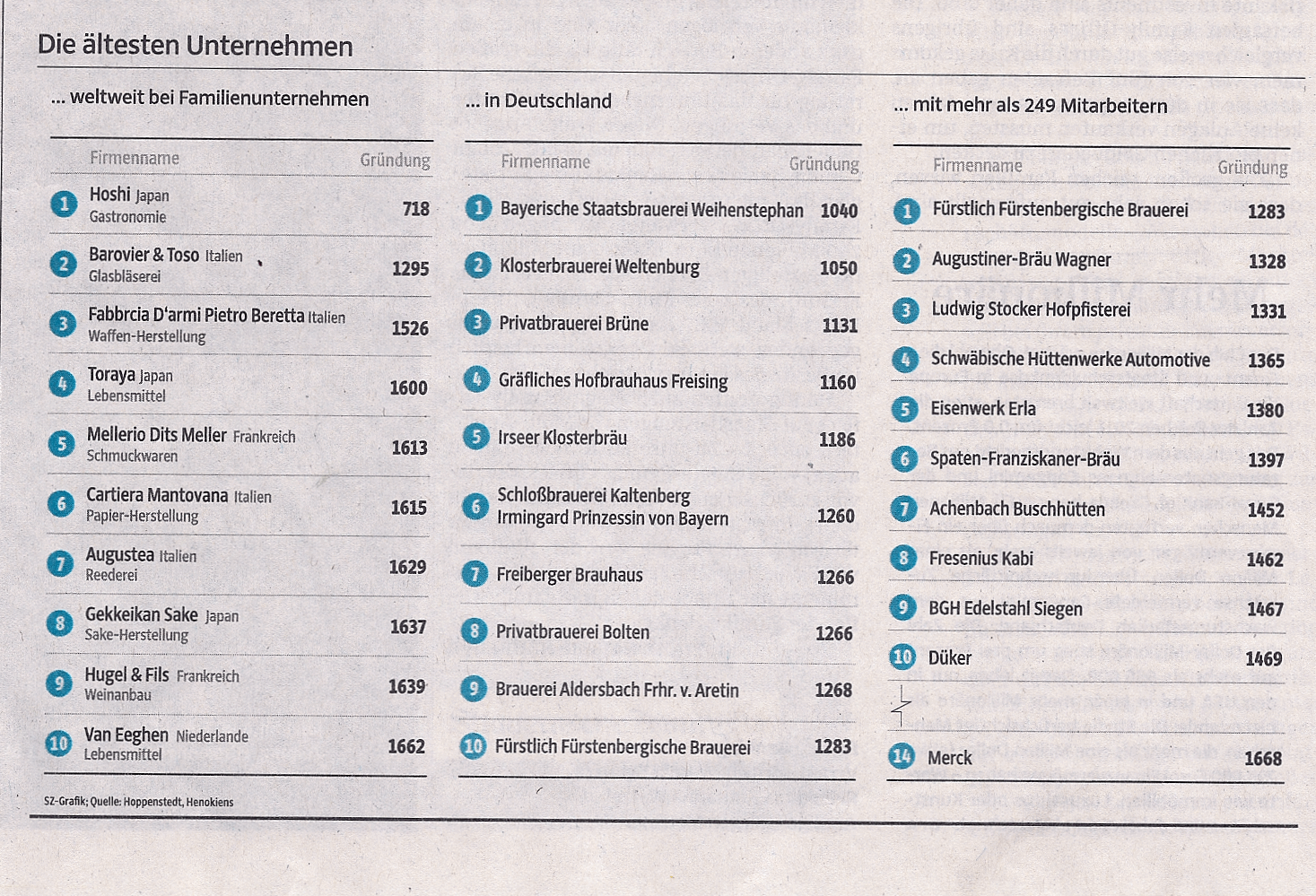
To me, the list looks rather interesting. They are among the German “Top 10″ when it comes to the oldest enterprises, with the exception of breweries. Seeing this, you could easily conclude that an enterprise can only exist extremely long if they produce and/or offer a sensible and really continuously sought-after product.
So here is what the entrepreneur can learn from this:
First and foremost, you have to determine your own personal success criteria, along with those for your enterprise. If “longevity” is a central issue, then the entrepreneur should, first and foremost, see to it that his enterprise offers a product to the market that will always be in demand.
And as I see it, this is all but easy. So here comes the negative (and on purpose cynical) conclusion: since most enterprises throw things onto the market that basically nobody needs and that will – in a constantly changing world – quickly be nothing but ballast, it does not make sense for most enterprises to think in terms of sustainability and longevity.
In reverse, that means:
Maximize your profit in the here and now! Suck the enterprise dry as long as you possibly can.
And that is exactly how it is often done. Vivat the throw-away mentality (not just for enterprises).
RMD
(Translated by EG)
P.S.
For comparisons, just click on the image.
Roland DürreWednesday September 5th, 2012
Family Policy
When I was at grammar school, our “social studies“ teacher told us that one reason for the world’s overpopulation lies in the fact that many countries know no social – in particular retirement – systems. Consequently, the only way for people living in those countries to prevent poverty in old age is to have many children. Collectively, of course, this will then cause even more poverty and thus generate a vicious circle.
In those days, this theory sounded absolutely plausible to me. “Give poor nations reliable retirement systems and the problem of overpopulation will solve itself”. Later in life, I heard exactly this kind of message again and again. That, too, sounded plausible to me.
Today, I hear that we in Germany have too few children. National family policy aims at increasing the number of children per woman. I do not wish to comment on this. After all, there are many children living in this world.
However, I do not believe the reason for our lack of children can be found in our retirement systems. Mostly, I receive another message: the fear of the future and of a life-long commitment; a change in the willingness to agree to a lasting partnership; trivial ego-centrism; giving consumption priority in life and focussing on (what seems to be) self-fulfilment. Socially spoken, intelligent young women in particular – even if they live in a partnership – consider it the normal course of events in their lives to practice the “no-child version”.
You might feel about this however you want to. In my opinion, everyone must make their own decisions, also with respect to how she realizes her emotional and emphatic need: in a partnership, as an artist or by living with pets – you name it.
It seems, however, that our Federal Family Minister had the same “social studies” teacher I had. She sticks to what I learned at school. Reversing the conclusion, she says: if a reliable retirement system will produce too few children, then all I have to do in order to have more children is abolish this retirement system.
Now isn’t that a logical and reasonable policy?
RMD
(Translated by EG)
Roland DürreTuesday September 4th, 2012
Office Nap
🙁 Once in a while, I suffer from bad dreams.
Those are the times when I am trapped in the middle of a large, anonymous and complex economic machinery the production of which is controlled by Taylorism and the behavioural leadership by profit maximization. With not the slightest regard for casualties. It always reminds me a little of Charly in ”Modern Times“.
The world all around me has submitted to the iron rules of capitalism and unrestrained market economy.
All the people are looking for new castes. Apparently because they only feel well in a feudal system. They are all busy looking for innovative status symbols. Perhaps because medals, awards and titles have lost their values?
This is when I feel a little like I were living in the drowned GDR socialism. Except that people no longer believe in five-year plans. Neither do they sacrifice themselves as heroes of work for fulfilling the plan and for the party victory – or even as soldiers for the victory of their homeland.
No, the humans featuring in my (nightmarish) dreams want to be “heroes of consumption”. They fight for the total pleasure society in a standardized and globalized world – always hunted by what seem to be their needs and troubled by what seem to be their obligations.
🙂 When it is worst, I wake up. And then I am happy to realize I am sitting at my InterFace office desk and it was all just a dream?
RMD
(Translated by EG)
Roland DürreFriday August 10th, 2012
Greece and Rules for Mountaineers
A few days ago, the one politician in Bavaria who is probably just as famous and powerful as Horst Seehofer gave his opinion on the EURO crisis:
”For Germany, the economic damage will be a lot more in the long run if Greece remains in the Euro zone. An old rule for mountaineers can be applied: if someone is hanging at the other end of your own safety rope and just in the process of taking you with him into the abyss, then you have to cut the rope.“
My source (Quelle) for this citation was FOCUS online.
To me, this comparison sounds tasteless and macabre, but also stupid and dangerous. On top of being totally wrong.
Let us think about what would happen if Greece went back to its Drachms?
Here is my guess:
First and foremost, there would be a small state boycott. In history, we have often had it – not just in Greece, but also in many European countries, as well as on other continents. I am sure it would cause another three months of negative growth for Greece. But then there would be an end to negative growth and the Greek economy would get back to continually growing. Because the Greeks are not really as bad as they are made out to be. They would also retrieve their pride – and could (at long last) make a new (head) start.
The positive example set by Greece would motivate a number of painfully indebted countries, such as Italy, Portugal, Slovenia, Spain and some more to get stupid ideas. Why not imitate Greece? Consequently, they would quite quickly follow the Greek example and leave the EURO zone.
And then the entire picture might quickly change. All of a sudden, Germany (or a small “core Europe”) would hang over the abyss. With a huge rock of debt hanging from their necks. Held by a rope team that gets weaker and weaker. With members who – following an old rule of mountaineering – would cut the rope. Until finally core Europe would collapse.
RMD
(Translated by EG)
P.S.
If it is a consolation: this would not be too bad, either. Nobody would die from it. Except some banks. Like the entire economy, they would then be nationalized. After all, we have all seen it in the past, haven’t we? Socialism and communism have been considered dead, but would replace the imagined victor capitalism. But fear thee not! That, too, would only last until the next revolution. So, please, not to get nervous. Life goes on.
The important thing is that the European countries will then again become friends, rather than get stupid ideas like war. Life and love, the seasons and the rivers, however, would all continue on their normal way.
Roland DürreWednesday August 1st, 2012
Certifications – Mania or Reasonable? – II
Here is a little cynicism on the certifying mania. But who knows – maybe you can actually make a lot of money by this nonsense? After all, in this strange world of ours everything is possible. But first and foremost: here is the basic question.
What is the most important quality needed if you want to work and lead people in social systems with responsibility?
As I see it, candidate number one for “higher tasks” is the attribute “being human”. Along with many special qualities.
If you see it under this aspect, the first criterion for selecting someone for a demanding job is human quality. Now would it not be handy to have a certificate that proves such a competence without any doubt? Just imagine how much time could be saved when you have to interview candidates!
So why not certify “being human”? Dependent on the standard I need for any open position, I could define what level of humanity I need. Does it have to be class A? Or maybe class B or C will suffice for a particular job?
Consequently, we should now constitute an “Association for Being Human” (ABH). And then we can certify humans. With multiple-choice tests. For the higher levels, we have to add some intensive questioning. The person to be certified will have to write an essay with pen or pencil. On values or some such thing. And for the really high level, the entire affair will also contain an assessment! Because it definitely has to cost something for a person to become a certified human. And if someone pays, they are entitled to get something in return!
The current lamentable situation in politics and management can also be solved by using certified humans. Because we will demand level A for the key positions in our administration and society! If you want to be Federal Chancellor, you will definitely have to be an A+ or AAA!
And the system can be extended to our heart’s content. Only people with a valid mother/father certificate can have children. And since we are at it, why not develop a “grand-parental” certificate, as well?
In order to get a grip on the volatility of modern marriages, we use a “partnership certificate”. It will evaluate your potential to deal with conflict and also issue a “health and marriage licence“. For those with lower qualifications, the only alternative is the temporary marriage. It includes a fee coupon. Now wouldn’t that solve so many problems? And after five years, you have to renew the certificate – if you proved a success, you can have an extension of the marriage.
If, however, you want to found a company, you have to get an entrepreneur’s licence in advance. Dependent on the goals of the business plan, there will be all varieties of certification levels.
Maybe you could even certify “being Christian”? Or perhaps, even better, create a new religion – of course it would have to have strictly certified members who were recruited in different castes?
Brave new world.
I think modern certification habits are a mania without making any sense at all – in other words, they are madness.
RMD
(Translated by EG)
Roland DürreMonday July 30th, 2012
Certifications – Mania or Reasonable? – I
More and more technological disciplines now force people to spend more and more time certifying things, even in areas where social competence and responsible behaviour are extremely important. Mind you, we are not just talking well-organized supervision by experienced coaches, either. What we are talking here is systemic formalisms based on a mixture of “multiple choice tests” and “credit points”. This is all about putting your cross somewhere and playing “Payback” for the career.
The ingenious business started with technology concerns that created dominant knowledge with super-complicated products, wishing to profit twice by selling them. Associations and clubs followed this egomaniac example.
Having initially been founded as a professional institution or as a platform for shared interests and for exchanging knowledge and experience, they now – on their way to power – become institutions that define “reality“. Using approaches of “best practice”, standards that are supposed to simplify complexity are developed. Since this does not work, the standards are then further developed theoretically and based on speculation, until they are totally detached from reality.
The entire affair grows more and more out of hand. Complex tools are created and often extended by absurd functions. To be sure, nobody likes them, but at least they constitute the basis for yet more certificates.
As soon as an institution has acquired a certain amount of power, its certificates will be compulsory and have to be bought at a high price. Since everything is moving fast these days, the time of validity is limited. You get an extension through “credit points”. More often than not, the association supports its own interests when issuing certificates. You have to attend the right kinds of events, pay a mostly quite significant fee and then you get a new licence.
Many are glad to participate in this game. A certificate is the easiest way to prove your knowledge and competence without actually having said knowledge and competence.
However, certification primarily helps those who issue the certificates. These enterprises and institutions will become rich and powerful. They determine what is right and wrong. Even for very abstract activities that actually require a lot of experience, courage and responsibility. They, too, are simplified, standardized and certified. Of course, it is mostly not a success.
Consequently, the “certified party” usually has nothing but one advantage on his side: he gets a licence. That has a soothing effect on potential customers. So the service provider has a certificate. Consequently, we can assume that he has the required qualities. It makes for sleeping soundly at night – before you are totally surprised at how many projects fail.
Basically, all the certificate tells you is that the owner of said certificate attended some course or other and accumulated enough points. And that he is capable of filling in a multiple choice test and sometimes a little more than that successfully.
It used to be different.
Machines (like cars) were certified. Initially, only the TÜV was permitted to issue the certificates.
Humans were not certified. For them, we had education and professional training. At school and university, in dual educational systems.
Humans had to learn and practice. They gained experience. After the apprenticeship, they were made craftsmen. They learned with a master craftsman and later became master craftsmen themselves. By writing a final thesis or manufacturing a master-piece, they proved their competence and skill.
Then they had the responsibility to constantly keep their craftsmanship up to the latest standard by experience, additional learning and openness. For those craftsmen, the pride in their own work and the desire to remain competitive were motivation enough to never stop learning.
But what happens today?
Schools and universities fail more and more often. Our traditional and by no means worse educational systems suffer greatly. The doctorial title is nothing but a humorous title. As soon as you are passing the Australian “immigration desk”, you will see an “immigration officer” smile benignly. The black belt worn by the project manager is worth twice as much as your doctorial title.
Certification is a way of privatizing education and training – with the logical consequences. Standards will see to it that we have uniformity and commercialization. Education will become “convenient” and “fast food”.
The consequence is that people will be satisfied with just functioning in a closed system. If you “obey”, you will be rewarded. Generative and creative aspects will be pushed aside.
This suggests that you can simplify existing complexity. Like you can make up for knowledge and experience with a simple “cooking recipy” and replace it with a little “best practice”. Problems are no longer found and looked into – they are just solved. Except I have no idea how that is supposed to work.
All you have to do is get a licence. In the same way as you acquire a driver’s licence, a hunter’s licence or a fisherman’s licence. And then you are what it says on the licence. Except – even with simple things like driving a car, it does not really work, does it?
So how is it supposed to work with complex leadership responsibilities?
Maybe it is more mania than reasonable?
RMD
(Translated by EG)
Roland DürreSunday May 20th, 2012
InterFace AG, Probably the World’s Best IT Company :-)
My Bike Tour (Radl-Tour) from Lübeck via Stralsund to Berlin took us to the Baltic Sea and then along the Lake Country around Müritz, where we saw many hospitable places.
And whenever we passed coffee shops and pubs, there were always signs saying: “Home-Made Cake“. Whenever I tried some of that cake, it sometimes tasted quite acceptable, but it was certainly not “home-made”. At least not in the sense of “baked by yourself in small numbers“. Because that is my definition of “home-made”.
For me, this is another example of the “new dishonesty” that keeps spreading. Well, basically it is not so bad, but for the purist, it is annoying.
On the same bike tour, I also found another very alluring formulation. It seems to get very fashionable:
Probably the world’s best XXXX.
Why don’t you look around yourself?
Sometimes, XXXX is for beer, sometimes for a certain sort of ice-cream, a special cake, an exceptional meal, a beautiful view. Basically, it can be used for all kinds of things. Just like “probably the world’s best” is often exchanged for “probably the world’s most beautiful” or some other superlative form.
When I first saw it, I actually found the sentence quite nice. When, however, I had to read it for the fifth time on one bike tour, I found it just as annoying as the “home-made cake”!
Those are the times when I, for a change, wish we had a very strict copyright and intellectual-property right. And whoever comes up with these kinds of sentences should be permitted to sue all the users of his sentence and get a lot of money from them. Now that would be the best punishment for imitating nonsense.
Except when you can actually prove that your cake has been home-made. Or if – to the best of human estimation – you actually have the world’s best of something to offer.
RMD
(Translated by EG)


