
Roland DürreSaturday November 12th, 2016
Interview for the DOAG-TV on “Digitalization”
 Between November, 15th and November, 18th, 2016, the DOAG Conference and Exhibition will be for the 29th time in Nuremburg. I was there and was permitted to give a presentation – and I was also interviewed by DOAG-TV. Here are the questions and my answers:
When and where, as you see it, did digitalization basically begin?
For me, digitalization started with the “written language”. A few thousand years – maybe 5,000 years – after language had evolved, they found a way to write it down. Then came the information carriers for written language , such as papyrus, paper and IT, along with machines such as the printing press, the lead set and eventually the internet.
Incidentally, written texts were first used for business purposes (merchandize). Business is the inventor of all things – not war. If anything, war is just an extreme sort of business – and, as I see it, a totally questionable and perverted one.
In those days, times were already “digital”.
Where are we today, and what does digitalization mean for the “analogous” creature “homo sapiens”?
Humans are and will always remain analogous creatures. Through the “cultural techniques” such as reading and writing, humans became a little digital. But never quite fully. After all, to this day humans cannot really manage to translate digital experiences into their analogous concepts of mind. Just think of the secret of the big number. Linear is hard enough, geometrical is quite difficult, logarithmic is impossible. Can you imagine how much money 200 quadrillion Euros is (it is the sum by which the EU countries indebt themselves anew each year)?
We lost the competence to calculate mentally or on paper as soon as the pocket calculator was invented. Who of us can still do it? Who can still extract a root or do a logarithmic value by hand?
Looking ahead: what will digitalization bring us?
Strangely enough, digitalization might actually make our lives analogue again. In former times, we translated digital data into analogous signals by modem (modulating and demodulating) before sending them on through a cable. And at the opposite end of the cable, the modem again re-translated them into digital data. Today, we translate analoous signals (noise and images) into digital data for transportation, split them into small data packages, send them through a package network, collect them and then re-arrange them in order to reconstruct the analogous signal from digital data (which is why we no longer have any static).
What will we have in the future?
- In communications: facilitation gets more and more important. We will have more images and less written words. We will talk more and draw and write less. Audio will become more and more relevant – also as part of asynchronous communication. Podcasts and video recordings will continue to grow.
- A “rudimentary illiteracy” will spread more and more. Language will benefit. Strong metaphors will become important, along with the awareness of “restricted code” and “elaborated code”.
- Control of language and gestures will become dominant.
Well, this is what the future might be like. Or maybe not. After all, we cannot predict the future.
So much about my interview! I will give a presentation at the DOAG Conference on Wednesday about “Digitalization – A Huge Error”. I already collected so much exciting material that I do not know what to tell people. That makes me nervous. But then, I will first be interviewed on Tuesday. As soon as my interview is online, I will, of course, set a link to it on the IF Blog. And I am quite curious what it will be in the end that I am going to talk about.
The picture was taken during my last presentation on the GOAG Conference of 2015.

“Commemoration of my Presentation of 2015 (created by Christian Botta)“.
RMD
(Translated by EG)
Roland DürreFriday July 15th, 2016
Project PEACE. Two Possible Scenarios.
Project PEACE is under way. Consequently, I will now write down a few ideas on it. They are meant as impulse and inspiration – just for contemplating and joining in the thinking process. Perhaps even for joining us in the activities.

There are many ways to start joining the PEACE project. Let me describe two very different scenarios that show how you might wish to approach the topic PEACE.
SCENARIO 1 – Hands On.
One way could be to, as a first step, just do it the conservative way and found a start-up that collects money. This is how they usually do it in the “common-good sector”.
A series of very commercially oriented companies persuades people to donate money for common-good oriented companies, mostly by sending begging letters, calling people on the telephone, appealing on TV, talking to them personally or similar methods. Those who raise the money get a certain percentage of the collected money from their customers – and this is not really a low percentage.
In the same way, we could found a start-up enterprise that is responsible exclusively for collecting money for the project PEACE on the internet. There are enough ideas how to go about it. Of course, one requirement for applying such a strategy is absolute transparency with a complete disclosure of all moneys.
“Project Peace” could then spend the money for advertising and activities. However, such a strategy would quickly turn the project PEACE into a capital-oriented and thus vulnerable “enterprise”. Basically, that is not what I want. Which is why I would prefer organising the project PEACE without money (see: #nocapital). Consequently, I prefer another concept.
Concept 2 – Soft, Quiet and Prudent.
A second approach is that we look for persons who “think like we think” in a very unobtrusive way and make them enthusiastic about our project, thus creating a “quiet and nice” snow-ball system. Naturally, we are also looking for people who have a “multiplying power”. But that is not a necessary requirement. On the contrary: all persons are equally appreciated and we need them all.
What I like is that, especially for the goal PEACE, you need values such as mindfulness, humility, neutrality and consideration to an extremely huge extent. Adversely, capitalisation will basically always promote the interests of individual persons or collective systems.
I rather like soft, quiet and prudent.
Consequently, I prefer the second scenario, because it is the more honest and perhaps in the long run the more successful one. Another reason is that the very kind of idea I described in the first scenario can basically be seen as part of the problem. And to say it with a metaphor: you do not want to and probably cannot “exorcise Beelzebub with the Devil”.
But even for “soft, quiet and prudent”, you will probably need a few requirements, such as a nice logo and a manifesto for PEACE. Along with a “value and culture paper” and perhaps a few simple and basic rules. And this is where professional assistance would be very welcome.
A possible way.
We could start a “snow-ball system” for PEACE using the “principle friends of friends”. If this got under way, it might be a way towards reaching the great goal!
RMD
(Translated by EG)
Roland DürreSunday May 15th, 2016
The Mobility of the Future – Augsburg – May, 21st, 2016 (barcamp)
 #AktMobCmp
In the last few weeks, the topic “active mobility” suffered from too little attention by me. Instead, I was busy doing something about #FRIEDEN and DIGITALE TRANSFORMATION, seeing my grandchildren and my mentees, giving a little support to start-ups and attending to private interests such as riding my bike through Italy. And much more.
I am truly sorry about this, because I keep receiving news and new information that show how badly we need to do something:
- The fine dust pollution in all the cities of the world is extremely high and still rising.
- Due to the ever smaller size of pollutants through modern technology (we are talking nano dimensions), they are more unhealthy than ever.
- The climate catastrophe gets more real, closer and ever more threatening.
- Our autonomy in life is restricted, our way of life is more and more determined from the outside.
- This is how, controlled from the outside, we sacrifice what is important to us, giving it to foreign institutions that manipulate us and put their own interests above ours.
- The metrics of money and profit are onmi-present and rules the entire world and all areas of life.
- The way how huge concerns manipulate us and rule over us gets more and more outrageous.
- Fear becomes the determining drive of a strongly increasing irrationality in society and politics.
My conclusion:
As far as I am concerned, I am fed up with the new dishonesty and evil double morals. We need a huge transformation that begins with our cognitive perception. Mobility is an ample metaphor for the current development and the fact that transformation is absolutely necessary. It shows all the things that go wrong and how we badly need to change our opinions and habits for our own good.
The next chance to do something is in exactly one week! On May, 21st, 2016, the next Camp für active Mobility #AktMobCmp will be held in Augsburg. Since it is during the Bavarian Pentecost Holidays, the organizers cut the camp down to one day. They are happy to welcome all visitors …
On this day, the interests and needs of all participants will be very intensely discussed in the format of a barcamp. The “part-givers” will share their knowledge and leave after a day of shared realizations, ideas and plans, not to mention all the new friends they will have found.
So here is my personal plea to all the “friendly persons” who want to take responsibility for the future: try the Augsburg.#AktMobCmp. If it is only your inertia that keeps you from attending, please overcome your “inner weak self” and come! Register here.
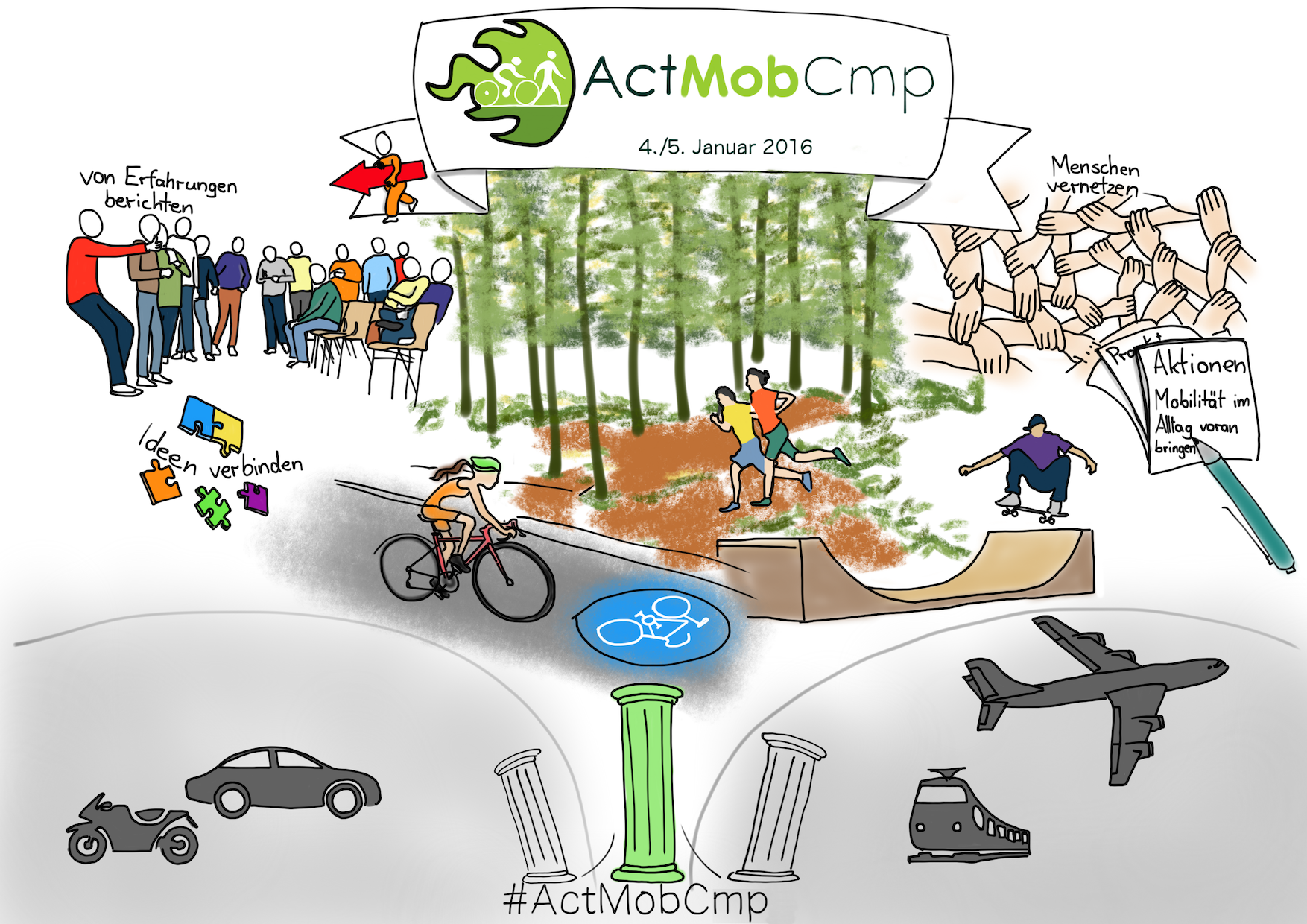
Donated by VisualBrainddump (Christian Botta & Daniel Reinold) Click on the image to enlarge.
Early last year, we started with a very nice camp in Unterhaching.
We will continue in 2017 – probably on January, 5th and 6th, again in the Kubiz Unterhaching.
Starting in September, our preparations will gain new momentum. We will do some massive advertising and invite many people and institutions we know well by now. And I guarantee that this barcamp will, again, bring many persons together, be extremely enjoyable and bring fundamental additional knowledge.
RMD
(Translated by EG)
Roland DürreTuesday May 10th, 2016
Future, Evolution, Transformation & Digital!
One week ago on Saturday evening, we started on our way to Italy, leaving the train on the next morning in Orvieto. It took us three days to get to the congress venue at Castel Gandolfo by bike. Riding our bikes to the Albanian Ocean in the south-west of Rome was a great preparation for the international
“10th NETWORK MEETING OF THE PETER PRIBILLA FOUNDATION (MAY, 4th – MAY, 6th 2016, ROME)” I was lucky enough to be part of.
The workshop was intense and challenging. Consequently, we spent the day afterwards being truly at leisure and indulging in luxury in Labico. Subsequently, we rode our bikes through Italy for three days. The first leg was from Labico to Terracina (around 80 km). Then we continued to Nettuno (about 75 km). From there, only about 50 kilometres were left to ride to Ostia, which meant that we arrived there early in the afternoon and had plenty of time to see the ancient Ostia by bike and generally enjoy Ostia.
During the three days riding through the provinces of Roma and Latina during the wonderful Italian early summer, I had a lot of time for contemplation. It was a truly special meeting.
Tomorrow, our voyage will be at its end. We are going to Rome. There, the night train that is supposed to take us back to Munich by Thursday morning is already waiting for us. Let me write down a few memories of today’s meeting.
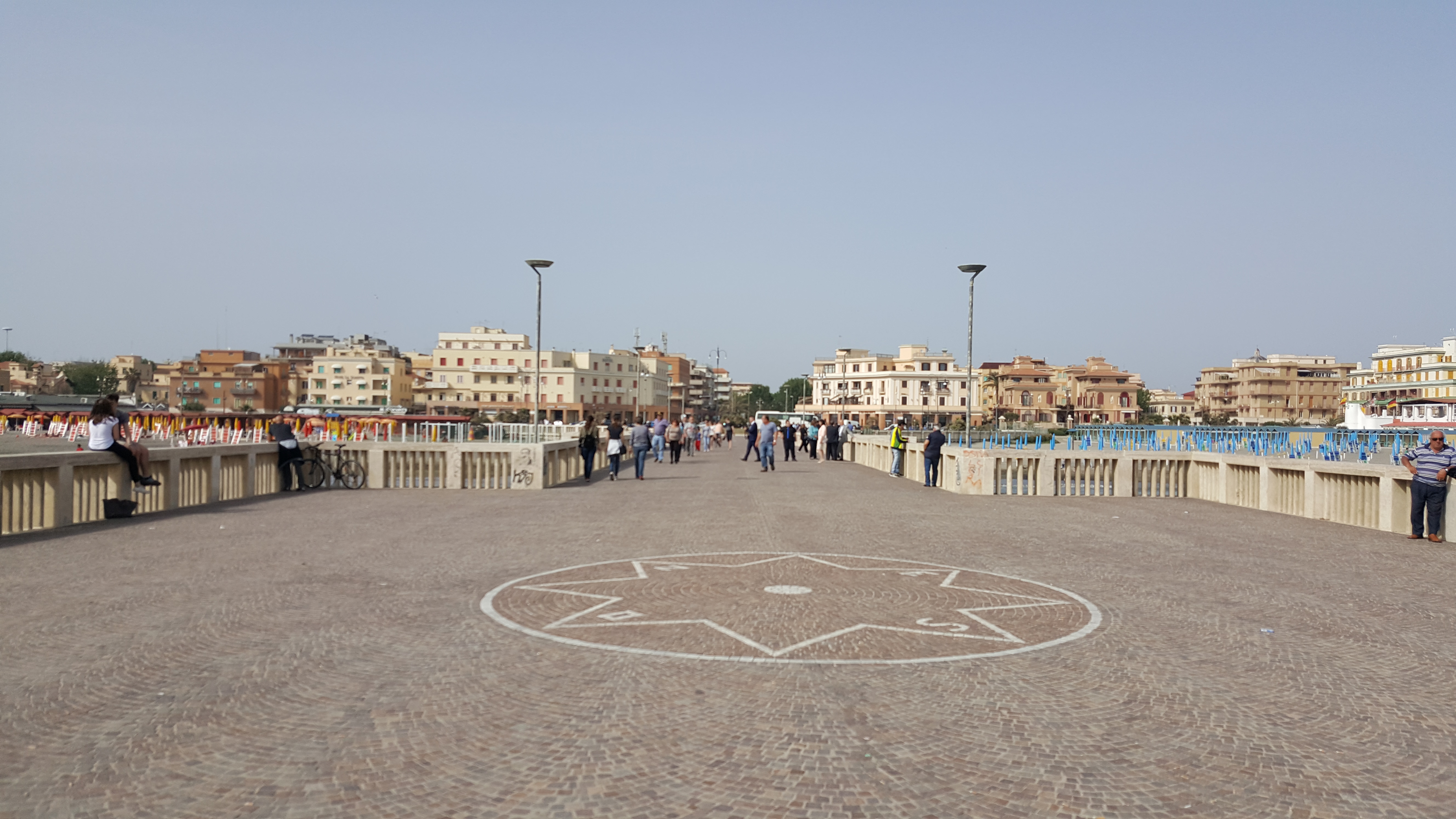
Lido di Ostia, picture taken and scenery admired from the central ocean bridge :-).
The meeting was sponsored by the “Pribilla-Foundation“ and about “Digital Transformation“: After all, this is a transformation that concerns all of us ever more, making us aware of change that is happening and growing at rapid speed.
The workshop was opened with an impulse presentation by Manfred Broy, who is the director of the Bavarian Digital Centre (Digitales Zentrum.Bayern). He gave a precise “sweeping swipe” on “digitalization”. Based on exciting facts, he pointed out to us what is currently happening. I was allowed to give one of the three (3-minute) short responses to the presentation. Here is a short version of what I said (with a few additions, because three minutes is actually quite a short time):
“The digital transformation will probably have a massive influence on the evolution and our future. It might even help on the way towards finding the necessary great transformation humanity needs badly.”
I came up with a theory on all the terms marked in this sentence – that is: I formulated my “basic beliefs”. Here they are:
- Future
As I see it, the future cannot be predicted!
That is also the first theory formulated by the great and unfortunately already dead management scientist Hans Ulrich from St. Gallen who revolutionized the theory of management in the 1980ies with his essay “Eight Theories on Change in Management”..
It may well be possible to predict the future correctly once in a wile if you use the tools of science and your common sense. That is: you might receive a “message from the future”. Yet you will never manage to correctly interpret said message.
To me, the future of humanity can be described using the metaphor of a boat on a river. The river is in the “white area”. The boat moves down the river.
You can measure the speed at which the river flows and also, for instance, the stream gradient and other data. But still, all those data will only give you limited information on what is going to happen. Using a spy glass to look into the distance will also only be of little help. It is not predictable how the river will continue on its way (will it become broader or will it find its way through a narrow gorge and become a torrential river, will there be a bend or a waterfall or will it suddenly disappear totally underground?).
And in this metaphor, we do not even know if humanity is the boat or the river (or maybe just a swarm of fish?). - Evolution
Evolution is useless. Perhaps it tries to make sure there will always be life, but we do not know why and for what purpose.
As I see it, evolution cannot be controlled – just like the future is not predictable. Basically, we cannot install a “steering committee” and tell them ”Please control evolution!”. It simply will not work (just like, incidentally, it does not work with huge enterprises and social systems). - Transformation
I think in a next step, evolution will have to and will undergo another huge transformation. This is necessary if humanity wants to survive. It will come, disregarding the question of whether humanity will continue to live or not. We know nothing about this transformation, except that it will bring basic change and come as a huge surprise. The time for this transformation is ever nearer. It will probably happen within the next few generations. - Digital Transformation
It would be nice if digital transformation could become a positive driver for this great transformation. I see quite a good chance. Even now, the world changes through digitalization – and in my opinion said change is for the better.
The friendly persons build networks, the combination of digital + social makes it possible to cooperate constructively in a way that was hardly possible in former times. Thanks to the “digital” world, something like “enlightenment 2.0” develops. To me, this looks to be more important than the “buzzword” of “industry 4.0” which, after all, is only “normal” technological progress.
What remains is the question: how can we contribute towards digitalization changing the world in a positive way?
Of course, I do not know the answer. It is my belief that we should not talk too much but instead act. Every one of us should act in his own specific way, following his personal inclination. And we all should do it together and connect with all the ”friendly persons” in our society – for instance those persons I actually met in huge numbers at the nice meeting in wonderful surroundings!
RMD
(Translated by EG)
P.S.
During the meeting, I mentioned a book that might actually help you a little to understand how totally different even our “small” children think – and how helpless the ancient concepts of thinking and teaching and education have become.
(Re-Invent Yourself! A Declaration of Love for the Network Generation by Michel Serres).
Roland DürreThursday March 3rd, 2016
How Temptation Became Too Strong For Me To Resist at the f.re.e.
I try not to buy too many new things. For instance, I only get a new shirt after having disposed of three old ones. This is how my wardrobe and shoe cabinet get emptier and emptier. It is really a sensational feeling to see how the cupboards lose weight all the time.
Also, I try to do without unnecessary electrical devices and all other kinds of gadgets. Because I certainly no longer want to buy all those stupid things …
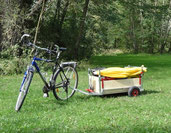 Three weeks ago, during the f.re.e, however, I reverted to being a shopping king. It was all because, all of a sudden, a wonderful bike trailer stood before my nose. I had been looking for a really sturdy one for a long time. One that you can fill. One that has enough space for a crate of beer and a lunch packet that deserves its name.
I found a true multi-talent. The inventors, Hans-Jürgen and Huber, named it Mobi-Table.
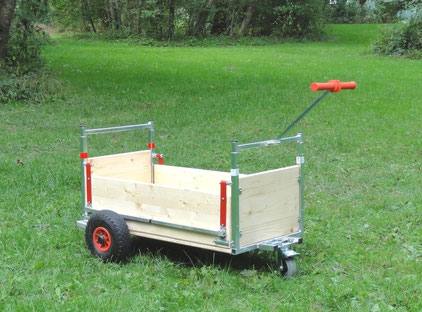 Mobi-Table immediately convinced me because of its manifold functions and possible applications. Using it as a transportation box, its length of 101 cm makes it quite suitable for taking with you in most medium-sized cars.
And – it is extremely easy to handle. None of the mobile and disposable parts have any bolts and thus everything can be re-arranged without tools.
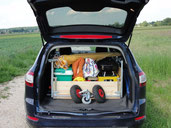 A special pin bolt will enable a frame part height variation if you simply press a button and the tyres can be removed in the same way.
Weighing 20 kilograms, this transport genius can carry an additional weight of 150 kilograms! If you lift the back frame, you can also use it as a hand cart for pushing heavy objects. Long or huge-size objects can be stowed between the two lifted frame parts, thus enabling a safe transport.
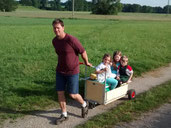 The Mobi-Table is also a wonderful handcart, extremely suitable if you have grandchildren – or for the All-Fathers-Day trip on Ascension Day.
Unfortunately, our family cannot use it in this way before May – because that is when our trolley will be delivered to us. The delivery time is that long. But perhaps we can actually go on a trip on Ascension Day.
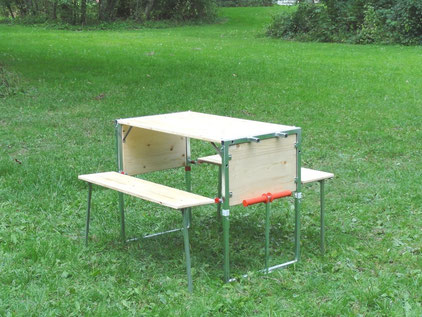 As soon as you reach your destination, the trolley will become a table/seat combination for four or five persons in no time. There is even a sunshade holder.
I was also delighted to notice that all frame parts are high-gloss galvanized and made of stainless steel or aluminium. The three-layer wood planks give me the reassuring feeling that they will easily cope with any wind and weather conditions.
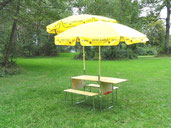 The engineering marvel is produced as a small batch series in Dasing/Friedberg near Augsburg. And everything you can see on these pictures was minutely examined and tried out by me on the fair. I can assure you: it is all true. This is not an April Fool’s trick, but a truly very impressive innovation for an alternative, mobile future.
The price is also moderate. You can get them for 379.00 € and the bike trailer with clutch is available for around 500.00 €. In my book that is very reasonable if you consider that it is good craftsmanship. Here is the link to the Website of thev Mobi-Table, where the product and its technology are described. There is also a PDF manual.
When I attend the #AktMobCmp on May, 20th and 21st in Augsburg, I will have my trailer with me for the exhibition!
RMD
(Translated by EG)
P.S.
I also found it impossible to resist buying a pair of Leguano barefoot shoes in bright canary yellow on the F.re.e..
Roland DürreSunday February 14th, 2016
Current Topic: Cheap Oil – Motor for the Economy or Obstacle on the Way to Transformation?
On Tuesday, February, 16th, 2016, Dr. Martin Held and my friend Jörg Schindler will give an exciting presentation on:
Cheap Oil – Motor for the Economy or Obstacle on the Way to Transformation?
at the orange bar.
Admission from 18:30 hours | starting at 19:00 hours | finale at 20:30 hours in the orange bar, Green City Energy, Zirkus-Krone-Straße 10, (6. OG), Munich
Admission: free.
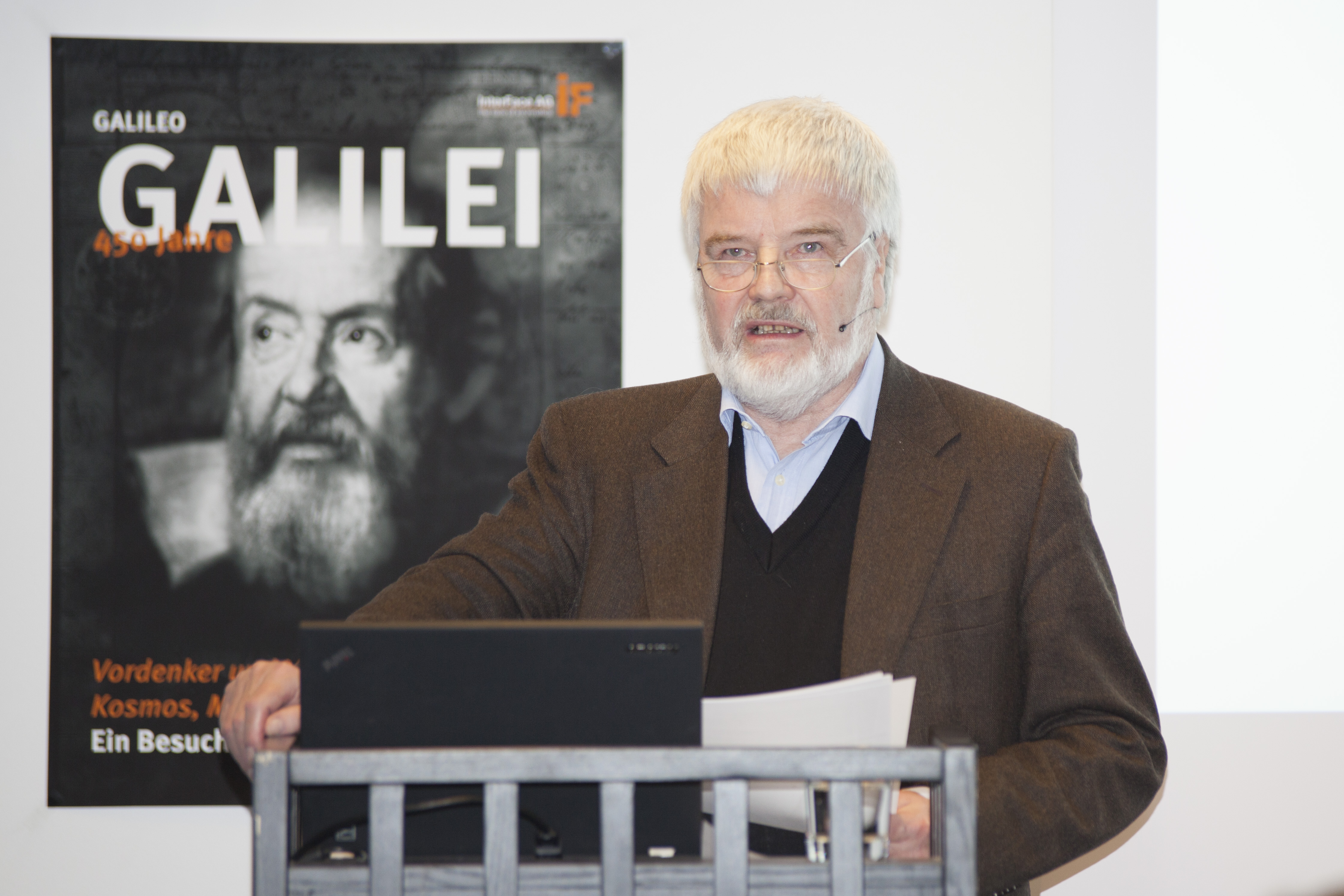
Jörg Schindler at the InterFace AG IF Forum
Are you a car driver, property owner or entrepreneur? Everybody is happy about the low oil prices and the resulting cheaper energy.
It saves money and, in the short run, has the effect of a great global economic stimulus plan. For the economy, they also expect positive impulses.
Except – the central traffic sector will remain extremely dependent on oil. This is a problem that cannot be solved by simply pulling the lever, following the motto “no more oil, electricity instead” (keeping everything else as before).
Instead of triggering the transition to post-fossil mobility, the oil production is now extended to arctic seas and ever lower oceanic altitudes at a high ecological risk. The low prices are misinterpreted and seen as fortuitous boom boosters, providing an extra motivation to again do some serious “upgrading”.
What are the reasons for the oil prices falling so drastically? What price will our society have to pay for this prolonged fossil resource consumption? Will this make a halfway tolerable transition towards a post-fossil, sustainable development (Great Transformation) even harder to achieve?
The speakers Dr. Martin Held and Jörg Schindler say that the most important factor for a successful Great Transformation is in danger: the adaptation time. What are the alternatives? Who could start working on said alternatives? What is the role of the civil society when it comes to the future transformation process?
For registration, please send an E-Mail to andreas.schuster@greencity.de or call 089/890668319.
The speakers are:
Dr. Martin Held (discussion group: Die Transformateure – Akteure der Großen Transformation, board member at ASPO Deutschland e.V. and long-time head of studies at Evangelische Akademie Tutzing, Tutzing)
and
Jörg Schindler (discussion group Die Transformateure – Akteure der Großen Transformation, board member at ASPO Deutschland e.V. and long-time managing director of Ludwig-Bölkow foundation, Neubiberg)
RMD
(Translated by EG)
P.S.
If you cannot come to the presentation but still wish to invite the speakers at another time, I will gladly connect you. Just send me an E-Mail .
Roland DürreSunday January 31st, 2016
Imagine you could just pick up any car that is sitting at the curb and drive wherever you need to go.
Here is a film I would recommend all those who still believe in cars should watch.
My friend Marcus (Dr. Marcus Raitner) frequently writes about important project management topics in his blog “Experiencing Leadership“ (Führung erfahren). This week, he took a further step, writing about “on ownership and use “ (Vom Besitzen zum Benutzen). In my opinion, this is another article extremely worth reading!
That gave me a rather absurd idea. Let us assume everybody could use any car that is sitting around. During this fictitious concept, let us also forget about the fact that cars need a regular infusion of gas and that they have to be maintained and repaired. There are some sorts of fairies who see to all this. For instance the millions of jobless who do not know what to do with their time.
Let us forget our personal and emotional relationships with our cars (my Golf Diesel is my best friend).
No. We just want to go somewhere and, in order to get there, we take the next car sitting at the curb. When we reach our destination, we get out and leave the car where it is.
Now if any of you fears there might not be enough cars, then I would suggest we also mentally include the one million cars in Germany that are sitting around stockpiling or on the huge lots owned by the car-dealers.
Well, if we did that, we all would suddenly see with absolute clarity what absurd “luxury” we indulge in. All the gigantic amount of money, metal, consumption, energy that is used up by these tin boxes. How this mass reduces our living space and minimizes our quality of life.
And I would continue going by bike and wriggle through the tin avalanches. Because I need to enjoy movement, very much appreciate fresh air and dislike being locked into small rooms – where I am forced to be motionless yet attentive. Incidentally, I also rather disliked it when I was a child.
RMD
(Translated by EG)
P.S.
Let me, again, point you towards our movement #AktMob and its camps #AktMobCmp.
Roland DürreSaturday January 16th, 2016
ASK AN ANSWER.
Jolly Kunjappu
Is a good friend of mine. We first met during a charity event organized by the Munich Chess Foundation. The Munich Chess Foundation (Münchner Schachstiftung) is concerned with the poorest children of Munich. In cooperation with several schools, they try to teach chess to those lost children. An experienced street-worker told me that some children who have been deprived of mental stimulation and therefore live at the fringes of society are best approachable through chess.

Jolly gave a wonderful presentation for the foundation – or rather for the children supported by the foundation. I was invited, listened to him and afterwards made his personal acquaintance. Immediately, it became clear to me that we are like-minded mentally, spiritually and with respect to our activities. Consequently, we also became friends.
 Now he wrote a book. It is bi-lingual (German and English) and the title is ASK AN ANSWER. Shortly before Christmas, it was sitting in my post box, with best wishes from the author. In the book you can read about the ideas Jolly has had over many years, sometimes concisely, sometimes he elaborates a little more.
And, similar to when I read Seneca, I find all his ideas very interesting. Thus, ASK AN ANSWER is a very fine-tuned message in favour of a better world where Jolly writes with a lot of respect yet rather clearly.
It was a wonderful Christmas present. I enjoyed reading and browsing through it during the “quiet days”. Also, it gave me courage and joy.
And I am particularly happy that, next spring, we will cooperate when it comes to introducing ASK AN ANSWER at InterFace. Jolly will be the centrepiece and I hope to create a suitable background.
And if you cannot wait until April and instead wish to read the book as soon as possible, feel free to send me an E-Mail.
RMD
(Translated by EG)
P.S.
It is quite possible that the book can also be bought at the Indian Mango. That is the Munich Zweibrückenstrasse restaurant owned by Jolly. You can eat quite well there and at the same time do a little reading. Well, if that is not double the pleasure, then what is?
Roland DürreSaturday December 19th, 2015
Theses about the Future and History of Cultural Competences
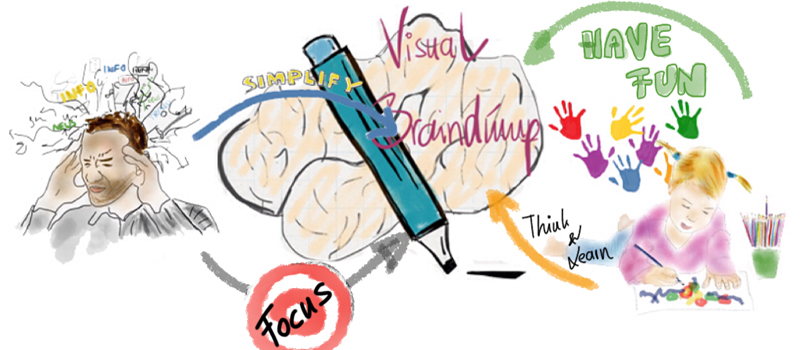 I learned at school that we have some “basic cultural competences”. Allegedly, they are the necessary basis for human progress. For instance calculating, reading and writing.
How about these competences today?
Calculating
Who of us can still do the multiplication tables by heart? Who of us can still do calculations without using paper for summations, subtractions, multiplications and divisions? Especially if there are several digits and you have to “store” some interim results?
Who of us is still versed about the formal methods for subtractions and multiplications on paper, or summations of long number colonies? I mean without having to spend a long time thinking how you used to learn it. Or who can still extract a root? Using nothing but pen and paper? These are the kinds of tasks you can use in a job interview if you quickly want to drive even academically educated candidates to extreme desperation.
As I see it, doing calculations is a cultural competence that is currently disappearing. Well, neither do we need it any longer, because our small electronic helpers can do a so much better job of it.
Consequently, many persons only have a rudimentary knowledge of calculations. Children do not learn it any more. Perhaps if they had “unschooling” conditions (or a Sudbury school), they might be interested in such exotic things as doing calculations by heart. Intrinsically motivated and as a game.
On the “normal” schools of this world, however, it will no longer work. Because they develop more and more into quasi military educational institutions with absolutely hierarchical structures. Where children are instructed (or rather: drilled) following a certain pattern. (Naturally), this is no way to force something on children that is hard to learn and apparently no longer needed.
Consequently, the cultural competence of calculating will only remain in a very rudimentary form. And I do not find this sad at all. After all, my teacher, F. L. Bauer (second generation computer science pioneer) taught me that, even a few centuries ago, the art of multiplication was taught at universities only up to a low one-digit number. Incidentally, at the time they used logarithmic tables – which resulted in imprecise results.
In other words: if I want to be happy, I do not need cultural competence I have to take pains to acquire. And I mean cultural competence that gains me nothing excerpt a headache at the end of the day!
Reading & Writing
This cultural competence is not yet as extinct as calculations. However, not only the “developed” countries have a drastically increasing number of both true and “rudimentary illiterates”. As a logical consequence, they now demand as part of barrier free access for public announcements for web design that the website has to be readable for “persons who only have rudimentary knowledge of reading, as well” in the USA.
This is another development that looks logical and clear to me. Audio and video are on the ascent, of course, the podcast beats the post, youtube & co beat the newspaper, etc.
Incidentally, these explanations of mine are not meant ironically. I am dead serious. Matters will continue in this direction. Here are some more steep theses of mine:
- The high times of reading and writing arrived with the PC and the laptop.
Writing with pen and paper has always been and is just atrocious. Written documents were optimized for the person who writes them, rather than with him. In former times, both the light for reading and the eyesight of the readers were poorer. Consequently, writing a document – and penmanship – were very time consuming and have thus become redundant. Only printing presses and later Johannes Gutenberg with his invention of movable metal letters brought the breakthrough for written media. Later, the typewriter made it a bit easier to produce readable written material, and so did the computer – regardless of sub-standard software like word. Thus, we had a last peak of writing that started with “vi” and is now at its end. Just look at the texts created on mobile telephones and tablets (aren’t they identical today?). - It is easier to learn how to draw and sketch than to learn how to read and write.
Most technologies disappear after they have reached their peak. The written word will suffer the same fate. It will probably be replaced by drawing and sketching. Many people say they cannot draw. That is wrong. It is quite easy to learn how to produce pictures and express yourself in picture language. - Our technology is currently maturing towards drawing and sketching.
So far, the only way to draw halfway decent pictures was on paper. There were disadvantages to this. The electronic assistants were not yet capable of supporting us in the same way as “word processor” supported an author. But now the tablets come – and suddenly drawing electronical pictures is easier than drawing on paper. Just like it happened in former times with writing. Undo, versioning, layout layers and many great features make you forget the erstwhile huge handicaps of drawing on paper. And it seems that they have only just started! - Our future belongs to images and sounds.
Images say more than a thousand words. This was an experience made by early marketing, when they had posters on mobile vehicles such as trams. Adverts with text had failed on trams, because the trams had always turned the corner before the people could decipher the texts. It was a lot easier with pictures and very few words. - Perhaps there can be a consensus through pictures.
As I see it, this is a very important side effect. Successful communication is probably the hardest of all challenges. We have tried for millennia to find consensus through linguistic and written communication. And we have failed just as long, as history proves. Why don’t we try pictures instead?
Here is my statement:
The future belongs to pictures and sounds. It will become socially as unimportant to write as it is now to do calculations. Rudimentary reading will be totally sufficient for understanding additional information such as for instance precise details. The main reason for this development is that the digital world, at long last, can create and make available pictures as easily and quickly as a simple calculator makes calculations or as the current collaboration tools make the use of documents available. This is how, in the long run, drawing, drafting and sketching on tablets (and their successors) will replace the “cultural competences” of reading and writing in the same way as the calculator has replaced the “cultural competence” of doing sums.
“Because it is so easy!”, or “Because that is how it is!”.
🙂 Even if then the IF Blog will have to become a podcast or/and an image blog.
RMD
Note:
Even today, films, for example, create more consensus than the great novels did in former times. And the more the art of reading gets lost, the more important audio and video will become.
(Translated by EG)
P.S.
I took the picture from the website of Visual-Braindump (Christian Botta & Daniel Reinold).
Roland DürreSaturday December 12th, 2015
Climate Conference
Today, the climate conference (I almost wrote: climate catastrophe) comes to an end. Allegedly, it was a success. Listening to the news, however, I do not understand what is supposed to make it a success, or even what will change in the future.
Consequently, I will now comment and write what I, personally, consider absolutely necessary. I will limit my suggestions to us here in Germany, because you should always start with your own front door, shouldn’t you? As I see it, it is basically quite simple, about the climate. All you need is a little courage and then you would have to act.
Let me start with the oil lamp. It is the best example for a product that needs fossil energy. It is made of iron. So you need raw materials and energy for its production. As soon as you use it, you will constantly consume oil.
Consequently, the early producers soon understood that the best thing you can do with a lamp is give it away for free and then earn through the supply. It is a wonderful business model that, to this day, has proved its efficiency in many sectors.
The reason why an oil lamp is such a bad idea is that it is perhaps one of the most expensive technologies for making the nights shine a little brighter. And because the poorest of the poor use exactly this method in order to produce their light.
This is where I also see a problem. Because light is particularly important. After all, it makes it possible to read and continue with your education when it is dark, after you have finished all the day’s work.
So you need energy both for creating and maintaining the system. Consequently, what you want with many products is a way to avoid fossil energy both in the production and processing stages of a product.
As a logical consequence, we need to look at what the systems use up while running in the same way as at what energy you need to invest initially for the production. Let us first look at the running consumption:
- The first rule:
As of now, the consumption of all fossil energy must become subject to considerable and equal taxation. It is important to include all fossil energy, which means that kerosene must be taxed just as much as gas or diesel gas. This will also necessitate another equality process, namely a higher tax on diesel gas. And if the EU complains because, due to the low oil prices, a detrimental recession comes, then there is an easy way out: taxation on the cheap oil. Remember: Energy must become more expensive, because otherwise it does not pay to save energy through technology and to economize by doing without! And I am sure that those countries that start the process will have a technological advantage. - The second rule:
All subsidies supporting the purchase and use of systems that need fossil energy for their production or processing must be terminated. The best example is the immense added value tax subsidy for so-called “business cars”. But I also mean the enormous subsidies for the entire automobile traffic, where, among other things, all consequential costs are socialized. - First additional measure:
In order to promote awareness for the changes, we need an immediate and drastic speed limit. I am in favour of the model 200 (motorways: 100 km/h, highways: 70 km/h and inner cities: 30 km/h). This measure would immediately drastically reduce the fatalities due to motorized individual traffic, as well as cause a considerable reduction of fine dust pollution. - Second additional measure:
Along with this, the people must be made aware of how beer out of cans and yoghurt out of plastic containers (and such) are the opposite of improving your quality of life. That “active mobility” is more likely to make you happy than the weekend in London or the short trip to New York or to the DomRep. That it is certainly nice to go to Australia, but that there are wonderful regional alternatives.
Perhaps the medicine against the poison of cat-gold salespersons and happiness whistlers (also known as the marketing industry) is to campaign in favour of making people understand that there is no simple “buy happiness!“. Even if this is constantly suggested through exquisite methods and techniques of manipulation and the use of billions of euros. - We also must again remember that a long-term use of products also saves fossil energy. Especially with infrastructure objects, it is often forgotten that a long-term use is more efficient than building something new. For instance, Munich rejoices about its new concert hall that is to be built opposite of the Munich East Railway Station. Yet they totally forget that this means another cost and energy intense huge project – one that will probably again cost a lot more than predicted. Just like they totally forgot that the discussion about the concert hall basically started with the question how to continue with the Gasteig. If it now is to be demolished (because Munich, after all, does not need two music halls for big concerts), then this would be the economic nonsense par excellence. And it would also be anything but good for saving fossil energy. But then, the continuing use of the Olympic Stadium – which, incidentally, also needs renovation – is something that does not interest anybody, either. With the possible exception of the city treasurer. Perhaps it is enough if, a few years from now, these buildings will serve as monuments commemorating the times when we in Germany still believed in the unifying power of Olympic Games and everybody was in favour of them.
- Investments promoting the use of fossil energy will, of course, also have to be stopped immediately. There must be no Third Runway at Munich, just like the plans for Memmingen Airport are nonsense for more than just ecological reasons.
- First note: I often hear that the problems can be solved by electric mobility. Naturally, that is also nonsense. In production, electric cars are far from sustainable. When running, they need an inefficient amount of electricity that will still be produced by burning coal for many years all over the world. To be sure, electric drive might well be a good chance for supporting active mobility and in infra-structure, for instance when it comes to organizing delivery on the last mile. But it is certainly very stupid “bullshit” if you wish to exchange individual mobility with combustion motors for battery vehicles at a ratio of 1:1. Neither will the fine dust caused by the tyres on the roads or the noise caused by the friction disappear if the car is powered with electricity.
- Second note: Other arguments, too, are well known to me. The situation of the citizens living in the country, the detrimental effect on the automobile industry, the loss of jobs, etc. Here, too, I say: this is all nonsense. There has to be and there will be change anyway, and mostly those who adapt to it earlier are better off. To be sure, it seems to me that lowering our standards of living is inescapable, but we still have quite some reserves in that sector. And we should be more concerned about the destruction of the rest of the world, with the detrimental consequences for us. Or about the strong polarization of our society into poor and rich that is accompanied by a reduction of the middle class and a movement into the poor sections for many. And we should think about how to fight concerns in all sectors that have become independent and manipulate and ignore a cowardly federation of states through lobbyism and other measures.
- Third note: Now I see yet another argument on the horizon: what good will it do if we do all those things and others do not follow suit? For instance the evil Americans, Chinese and Indians? They continue to pollute the air with carbon dioxide. Well, I think someone needs to start. And the others will later see what it gains them. And as I see it, they will all follow suit quite quickly and we can profit enormously through the business.
Well, it is the same as always. It might be a nice gesture to sign the Paris Treaty. Except – we must not forget to actually do something and we have to START NOW. And I mean every one of us individually!
RMD
(Translated by EG)


