
Roland DürreTuesday November 23rd, 2010
Game Theory – The One-EURO-Game.
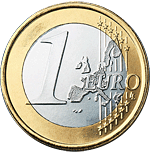 The bank is selling 1 € at auction. The minimum bid is 0.01 €.
There is no minimum progress for bidders. So you are permitted to add 0.01 € as you bid.
Rule:
The last bidder (the winner) and the one before last each pay the amount of their last bid to the bank.
Examples:
1) The Euro sells for 0.40 €. The last bid before the end was 0.30 €. So the bank gets 0.70 € for the Euro. That is a loss of 0.30 €.
2) The Euro sells for 0.90 €. The last bid before was 0.85 €. So the bank gets 1.75 €. That is a profit of 0.75 €.
It seems that the bank has good chances of making a profit. The maximum profit possible for each auction is 99 cents (well, if bidders are extremely “unreasonable” – or if the Euro has a collector’s special value, there are, naturally, no upper limits).
But if the players are reasonable, all players will always contribute one additional cent. And the bank will then make a total profit of 99 Euros after 100 games.
Well, a nice game. But what do we learn from it?
Nothing! Or a lot? I do not know. Perhaps this is another nice mental game – but where is the meaning behind it?
RMD
(Translated by EG)
P.S.
🙂 This article is part of my series “grumbling about the game theory”.
Roland DürreThursday November 18th, 2010
Pareto
Click here to find the frequency of occurrence for lotto numbers. I also copied the data at the end of this article.
🙂 Well, lotto numbers are definitely not Pareto:
The 20 % of numbers most frequently drawn are definitely not 80 % of all the numbers drawn.
Pareto would mean that 20 % of the most frequently drawn numbers equal 80 % of all numbers drawn. Using this classical example, this would, of course, be nonsense.
It cannot be done in the same way with lottery numbers. Except if you were to manipulate the lottery balls and drum. It makes total sense, too. Because Pareto is the 80/20 rule and it only applies for a few phenomena occurring in the “nature of society”. And even there, you never get exactly the mathematical result. Lottery numbers, however, are not a sociological thing.
And, indeed, there are a few examples for 80/20. Yet I am sure I could come up with an equally suitable example resulting in 60/40, 70/30, 90/10 or even 97/3 for every 80/20 instance. Or I might construct one. You want to bet?
It is very easy. Whenever people do or own the same thing and whenever it is possible to divide this individually at a considerably differing rate, there will be a number of persons whose part as a sum total is higher than that of the others.
Roland DürreMonday November 15th, 2010
Game Theory – The Ultimatum Game
The ultimatum game (Ultimatumspiel) is a practical application of the game theory (Spieltheorie) for business and behavioural research.
Here are the rules:
The recipient E gets a certain amount of money z from a donator S. He has to share the money with a pre-determined partner P. E has to divide the money at his own discretion between himself x and the recipient y. The division is fixed only from E.
The following criteria must be met:
mehr »
Roland DürreFriday November 12th, 2010
Game Theory – Falcon and Dove
The evolutionary game theory (Evolutionäre Spieltheorie) is a late development in the field of game theory. This kind of game theory has its roots in biology. When I did some internet research on the topic, I found an LMU Munich paper written by my son Maximilian and Peter Czauderna. It was really by chance, I never knew he had been working on it. Here is where you can download the paper – which I consider well worth reading:
[download id=”86″].
Let me briefly explain the falcon/dove game:
Roland DürreWednesday November 10th, 2010
Game Theory – The Prisoner’s Dilemma
Is there anyone among you who has never heard of it? The prisoner’s dilemma (Gefangenendilemma) as a central component of the Game Theory (Spieltheorie)?
For those who do not know what it is about, here is a short description of the so-called cover story:
Detlev SixFriday October 8th, 2010
Politicians Get Their Legitimacy From Their Distance to the Voters.
98% of us think that politicians have lost contact with the people (wow, that is what I call a vote). The underlying idea is that politicians listen less and less to what people think and what they want. Is that so? And if it were so, would that be good or bad?
Let us take a look at what happens if the people govern. There are two instruments which appear more direct and consequently nearer to the people than our representatives in parliament.
Folk light in the form of opinion surveys. Folk unfiltered in the form of a plebiscite.
Both will render the same result.
Detlev SixTuesday September 7th, 2010
The Eternal Hunter Inside Me.
I love the evolutionary theory. What I like best about it
is the fact that it offers a home
to (almost) any new hypothesis (commonly: allegation),
while at the same time there is no way to prove it.
It does not come as a surprise that the evolutionary theory has become the milking sow on which thrives a romantic craving for theory, particularly in disciplines poorly equipped with theories.
Consequently, it has now also found its way to high blood pressure – in my case 160 on 100.
Roland DürreSaturday August 7th, 2010
Wikipedia #12 – “Ageing!” or “A German Problem?”
In my last presentation, standing in front of quite an audience, I again asked the question: Who in this room uses Wikipedia? Every finger went up in the air – there was not a single person in the room who does not use it! Wikipedia has grown to be a very important factor. The world can no longer be imagined without Wikipedia.
In Wikipedia, so you would believe, you will find everything. After all, the number of words available in Wikipedia is several times higher than that found in any other encyclopaedia. Of course, even Wikipedia cannot contain everything. Once in a while, you discover relevant cultural assets that cannot be found in Wikipedia. Basically, it would be our duty as citizens to support the creation of the missing articles.
Wikipedia changes the world. Techniques and terms you cannot find or will only find poorly described will get less and less important. If some innovative concept has not been described in Wikipedia, it will hardly stand a chance of developing into something significant.
Thanks to the democratic structure of Wikipedia, this phenomenon is mostly self-regulative. There is a functioning democratic control mechanism. And, of course, the representatives of all areas of expertise know that their knowledge had better get into Wikipedia if they want to remain relevant. Because technologies and cultures described in Wikipedia, as well as persons and social systems, gain new meaning.
But Wikipedia faces a massive threat!
Roland DürreWednesday July 28th, 2010
A Follow-Up on My Presentation – Comments #4 Technological Advance
In this series, I will comment on the written feedback I received after my presentation. Also, I will answer the online questions asked by students I had no time to amply reply to during said presentation
Lehren für Unternehmensführer – das Leben, das Wissen, die Informatik und die Ethik
(Lessons For Managing Directors – Life, Knowledge, Computer Science and Ethics)
„Innovative Entrepreneurs“/ Summer Semester 2010
Leadership in growth-oriented enterprises
Here is another item of feedback I consider very important
“I, however, do not agree with the speaker when he gives the prognosis that not much will happen in the future as far as the “object“ is concerned.”
This is absolutely correct. I am afraid I failed to make it clear in my presentation that I meant this prognosis to refer to the traditional goals “further, faster, higher” in the “physical” (old) technologies. As I see it, the “further, faster, higher” is probably at the end if its rope. What I see as a future scenario is for the classical engineering disciplines to be about “more economical, lighter, easier”.
In this context, I like to refer to the term “Cheap Design” as introduced and made public by Rolf Pfeifer in his interview. Rolf Pfeifer is the founder and director of the Artificial Intelligence Laboratory at the Department of Informatics/University of Zurich. He gained a reputation through, for example, his cheap robots. Using totally innovative approaches, these robots show new ways in robotics and Artificial Intelligence. I recommend that you read his book: “How the Body Shapes the Way We Think: A New View of Intelligence” (Bradford Books).
Edwin EderleSaturday July 24th, 2010
(Deutsch) Keine Panik im IF-Forum: Frau Fischer begeistert Zuhörer


