
Roland DürreSaturday October 20th, 2012
Video: Dr. Eberhard Huber at the IF Forum “Project Coaching”
Our last speaker at the technological IF Forum on September, 25th was Dr. Eberhard Huber. He managed to summarize all the results and information gathered during this wonderful afternoon in an excellent manner before we finished with a discussion in the “Fish Bowl”.
Now – “at last but not at least” – the recording of his presentation is also available on Youtube.
The Third Technological IF Forum was about “Project Coaching“, with the motto “best of PM-Camp“. So now we have made all the videos from this event available.
Many thanks once again to Eberhard for his presentation. It contributed hugely towards the success of our IF Forum.
Eberhard’s motto is “project“ in a team – here is the link to his blog “projekt (B)LOG“.
RMD
(Translated by EG)
Roland DürreTuesday October 16th, 2012
Video: Dr. Marcus Raitner at the IF Forum “Project Coaching”
After the introductory presentation by Dr. Stefan Hagen at our technological IF Forum, Dr. Marcus Raitner (Esc Solutions) saw to the second part of the first section. It was quite exciting and very impressive to watch how the arguments and explanations of the two speakers complemented each other. The presentation by Dr. Marcus Raitner, too, is now available on Youtube.
The Third Technological IF Forum is about “Project Coaching“, which included “Best of PM-Camp“.
I would also like to, again, thank Marcus very much for his presentation. He contributed hugely towards our IF Forum becoming a success. Marcus is also the author of what is, in my opinion, the most beautiful blog for project management world-wide – misc.raitner.de.
RMD
(Translated by EG)
Roland DürreWednesday October 10th, 2012
News of the Day – the Price of Electrical Energy
In the morning, I often enjoy listening to Bayern 2 on the radio: die Radiowelt. Today, everybody seems to be upset about the price of electrical energy. I see that a little more diverse:
As I perceive it, a quite substantial “Inflation” is taking place. No matter if I go eating out or go places by underground train, everything gets more expensive. Even electronics products, such as mobile phones and laptops do not seem to get less expensive if you take the “State of the Art” into consideration. Not to mention realty. Salaries and incomes, too, are on the way up, at least nominally (wage agreements, doctors). To make up for it, the small number of poor persons grows.
This inflationary situation – even if statistics cheat to make it look lower – is quite easily explained. Just look at the money policy of the EU administration. Or the development in other currency zones, such as the dollar, the RMB (Chinese yuan), or other economies with whatever small currency you choose to look at. All over the place, prices climb. Be it in China, the USA, or elsewhere. And, after all, we are part of a globalized world, aren’t we?
If, in an environment of inflation, a product kept its price stable, it would in fact get less expensive. The only way I could say something got more expensive would be if the increase in price were considerably above the inflation rate. Under this light, all you should be able to say is you have a relative price increase, one that remains after you have considered the “true” inflation rate.
Looking at the increase in prices for oil, you notice that the price for electrical energy is actually far behind. As I see it, it is a good idea to have the price of electrical energy climb as long as most of it is still produced from fossil materials. When, at long last, the moment arrives when we can produce electrical energy exclusively in an environment-friendly way, it should be cheaper.
For me, however, it seems doubtful that this will ever be possible to the extent we allegedly need it. That means it is still absolutely obligatory for us to treat energy in a responsible and efficient way. And that is an area where regulations and laws are mostly not really helpful. Sad as it may be, it is a fact that rational thinking mostly only happens through the purse (like a man’s heart is won through the stomach).
What is really annoying, however, is the fact that we now have a modified co-called electrical network regulation (StromNEV). It says that those enterprises that use up more than ten Gigawatts of electricity each year and need the full capacity for a minimum of 7,000 hours each year will no longer have to pay the network organizations for the transport of electrical energy, which, basically, is an additional subsidy. And the number of these big subsidies has increased drastically.
This caused Germany to become an expensive country in terms of electricity for those who need small amounts. Yet, for those who need huge amounts, it is rather attractive.
Naturally, those who use up small amounts are now worse of in terms of money, while we are counter-acting the goal of using energy more efficiently on a huge scale. Incidentally, this has nothing at all in common with an about-face in the energy sector. All it means is another subsidy for dedicated interest groups.
It sounded like a confirmation to me when, this very morning, I heard a CSU politician say on the radio that even Norwegian enterprises now started transferring their electricity-intense production parts to Germany.…
Incidentally, the author assumes – and I am sure this is totally unprofessional – that most of the enterprises that use up huge amounts of electricity need it for such “reasonable” things as the production of beer and drinks cans. That alone makes me furious. Because beer is definitely one of those things that you must never drink out of cans. Mind you, our throw-away society is something I detest, anyway.
RMD
(Translated by EG)
Roland DürreWednesday October 3rd, 2012
Still Fresh News That Seem To Stick With Me …
Regardless of all the information flood from the media (paper and internet), via social media (Twitter, Facebook, Google+) and radio and TV, some of the recent news linger in my memory. To be sure, they are also more important than those news I forgot. But some way or other, they also scratched at a surface inside me. Consequently, I wish to write down a few ideas on them …
Our Federal Chancellor and Gorleben
(Zeit and SZ)
They installed another one of those committees of enquiry. Even our Federal Chancellor was asked questions. Because, at the time, she was the minister in charge. It was about the desperate situation at Gorleben. Except that, so far, nobody really takes notice. Of course, the committee cannot really present any results.
Because back then nobody could know that things might not go as well as planned. Regardless of the fact that everybody with even an inkling of scientific knowledge and a little common sense had to have known that the combination of nuclear waste and salt mine could not work. Now we see the result. Taking the waste out would cost more than anybody could pay – and probably it could not be done anyway at this late time. At some time, there will be radio-active alarm and the potable water in the region will be a thing of the past.
To be sure, our Federal Chancellor conceded that the situation was not really solved to perfection at the time (or something like this). Instead of just admitting that she made a huge mistake when she was still environmental minister. After all, we all make mistakes, don’t we?
Lawsuit against Church Tax
(Spiegel)
I was surprised to see that a judicial theatre as absurd as this is actually worth making the news. Some wisecrack had the idea that he should not be asked to pay club fees, because the club is something like common property. Because it is the Church of Jesus Christ. What a strange idea. Like if I were to play in the chess club tournament of a small town without being a member of the chess club. Because, after all, chess is common property, isn’t it?
Such an idea can only originate with someone who is both a lawyer and Christian. Mind you, the church does not even charge entrance fees for its events, such as the mass service.
Speaking of church, it comes to mind that there might be a few more lamentable/offensive facts to write about. For instance that many church officials and dignitaries are still paid by the state, that churches still enjoy special dispensations from taxes, that we still have compensation payments for the church by the state for dispossessions that happened during the second half of the last millennium, and much more of similar kind. But it seems nobody is interested in these kinds of things.
Offended Religious Communities
(Welt and 20min)
Much has been written on this. The range is from absurd arguments about numbers (when it comes to the consequences of circumcision) to illogical legislative proposals. It seems that religious communities need their special treatment and thus have to get it. Some need it in order to mutilate their toddlers without violating the law. Others need it in order to “protect” their feelings. And our Federal Chancellor is wondering whether she should banish a not very impressive video recording, because it might just be a danger to public safety.
Stale Air in the Airbus 380
(dw)
This is also one of the things the media will make good use of. But why? Lufthansa does not only fight part of their employees (and UFO), but also stale air. Mind you, isn’t it logical that it must be smelly in such a huge airplane? After all, an Airbus 380 is a new and complicated system. It is not yet fully mature and consequently still has (must have) its flaws. I could imagine worse than stale air. It sounds like an error that can be found and corrected.
Stress Test for the European Nuclear Power Plants
(Focus)
The “stress test“ for nuclear power stations (note the martial choice of words) is finished. We can now read the report and it tells us that there are scandalous safety risks in more or less all the European nuclear power plants. However, the stress test only tells you half of the truth. Important criteria have been left out.
Mind you, not that it matters. Because, according to the report, the repair of all the discovered defects would (once again) cost the unimaginable sum of 10 to 25 billion Euros. This kind of money is not available; or rather, nobody is prepared to spend it on safety. Neither can the EU put pressure on anybody in this important instance. Consequently, nothing is going to happen. There is no such thing as safe nuclear power. Period. All you can do is hope nothing serious will happen. Well, it is what the Japanese did, isn’t it? Except that they were not lucky.
To make up for it, the EU comes up with a few more new regulations and laws. Yet no reasonably minded European will ever stick by them. And, as a side-effect, Europe is divided in order to “safe“ banks with sums that make those aforesaid 10-25 billion look ridiculous.
But the banks, again, need some extra money – and the Euro rescue fund gets larger.
(SZ)
Of course, the money for the banks will not be enough for Spain and the proud nation will have to seek shelter underneath this strange Euro rescue fund.
NSU and the Protection of the Constitution
(Handelsblatt)
The things I keep hearing on this make me speechless. “Civil servants” and politicians lie shamelessly. It can almost be assumed that V-persons working as civil servants were not only the culprits, but also the agitators. Nobody seems to be interested in finding out where the real persons behind the scenes sit.
To make up for it, the telecommunication of the citizens is recorded and data stockpiling secretly makes progress.
IRAN blocks Gmail
(ARD)
Again, I am reminded of data security. And then I ask myself what I fear more: enterprises using my data in order to sell something to me (ha, ha), or the state confiscating my means of communication? Or – what is worse – the state working espionage against me at random. Because in this country, the administration is permitted to do exactly what they want to protect us against from Facebook&Co.
Consequently, we fear data abuse “in the cloud“ as the devil fears holy water. And we fight the devil with Satan. Because there is no data security when it comes to the state and its executive organs. The many terrorists alone make it impossible. But perhaps the short-term blocking of Gmail by the Iranian authorities was just a means of fighting world-wide terrorism?
BND building will cost 100 billion more than planned
(Welt)
This, too, is nothing special, is it? Except that the biggest building the state ever planned is for the BND. But it is certainly no surprise that it is (so far) the biggest miscalculation. Basically, huge projects will always end up costing a lot more than planned. This is true for philharmonic houses (Hamburg), airports (Berlin-Brandenburg), railway stations (S21) and also buildings where the “Federal Investigation” is done and the constitution is supposed to be protected.
As a general rule, there are probably two reasons for this: firstly, the cost has been voluntarily kept low in the planning phase in order to make them politically acceptable. Secondly, they certainly do know that the number of errors will not increase linearly with the degree of complexity. It can probably even be calculated. Except that nobody can tell in advance what kinds of errors will occur and how much they will cost.
And finally, again our Federal Chancellor – with a pleading in favour of the e-car.
(Bild)
This is particularly delightful. By the year 2020, we are supposed to have one million battery powered cars. To be sure, they will look more like Pedelecs, instead of cars in the modern sense.
Physical laws (such as energy density) are opposed to it. If we want to compete against vehicles powered by fossil material with e-mobiles, we will first have to make individual traffic e-mobile adaptable.
Light and slow e-mobility can only be attractive if you adapt the traffic. You will have to make it softer and slower. Consequently, the best promotion for e-mobility would be a clear speed limit, for instance 30 km/h inside cities, perhaps 50 km/h in rural areas and 90 km/h on motorways. This, however, would mean a de-emotionalisation of the false God car. Something most Germans, including their boss Merkel, cannot imagine…
Economy and Sport
I find it particularly easy to remember the economy sector. Here, the story is quite simple: there is more than enough money available, the banks almost drown in it. Fuel prices climb (which I find good), property gets more expensive (I cannot judge this) and the stock prices climb (I could not care less). Officially, we have as good as no inflation. Only the prices do not know that. Consequently, everything gets more expensive all the time.
Here is more news from the economy (FTD): dpad and Neckermann (according to Quelle) are now definitely bankrupt. dpad used to be DPA, which, along with API was perhaps the world’s most renown press agency. There came a time when it merged with the “Deutschen Depeschendienst”.
As I see it, all these bankruptcies were more or less a matter of course. And, naturally, there was no rescue umbrella for them. As opposed to the financial institutes – most of which definitely are also now well into their dotage.
In Europe, the spiral goes downwards all the time. Only Germany goes up. This cannot be a good sign and it makes me wonder.
And with sports, matters are even simpler: the FC Bayern will always win. Except in Belarus.
Now the article I was going to write on our day of jubilee is a lot longer than I had intended. All I wanted to do was remind you of the fact that not all is gold that glitters in our highly-praised black-red-golden country. National intoxication will not help us. We have to sit down and do our homework for a Europe that is unified in freedom. If I were asked my opinion, I would quickly abandon the Third of October as a national holiday. Instead, I would come up with a common European Holiday. And now I will go to the forest pub by bike and celebrate October, 3rd among Jazz music and a litre of Oktoberfest beer. And tonight, we are going to eat a “truly authentic” Chinese dinner.
RMD
(Translated by EG)
Roland DürreSunday September 30th, 2012
brand eins in October
 On Wednesday, it had already arrived – the new brand eins. And again, it had to wait until the weekend. My “Post-China-Travel-Stress” …
On the brand eins website, I find the title page of the October issue in the colours grey, green, blue – and a dull beige. Now wasn’t I lucky? Because my brand eins is the “Green Version“ –and green is my favourite colour!
This time, the parcel inside a cellophane wrapping is particularly thick. On top of the October brand eins, I also find 92 pages of a brochure with the title:
“PROSPERITY IN NUMBERS – A Balance“.
Well done! It looks interesting and contains a lot of numbers. It was published and financed by the Initiative Neue Soziale Marktwirtschaft (INSM) and revised by the brand eins Knowledge Department. The INSM is an independent federation consisting of representatives from politics, economy and science without party affiliation – whatever that might mean. It is financed by the employers of the metal and electrical industry, which means that it is some kind of lobbyism.
But so what. The brochure is an interesting collection of numbers and statistics. And, as we all know, you can only trust statistics if you yourself forged them.
The title of the magazine, however, sounds rather attractive to me:
Wanted: Wisecrack
I instantly feel addressed. After all, I, too, am – very much as I regret it myself – often some kind of wisecrack. Sometimes, I get annoyed with myself for it. Yet I have to live with it, because by now, I can probably no longer change. “Focal Point: Experts” also rings a bell with me. Isn’t there more than one topic on which I feel I can act the self-appointed “expert“?
Inside, as always, the first thing to read is the editorial by Frau Fischer: Drilling deeply and seeing far is the title. That sounds nice – I, too, would always like to do that. In fact, I seldom manage – but perhaps others are better at it than I am.
And here they are, the often truly unique articles on all kinds of topics and sectors: experiences and discoveries, experts, financial politics, money (laundering), health, power, media, enterprises and knowledge. There is also something for IT experts – what more could I desire?
In a nutshell – it is again a magazine absolutely worth reading. So here I am once again singing the praise of the “brand eins experts”! I will continue with my reading tonight – with a fresh litre of Oktoberfest beer in front of me.
RMD
(Translated by EG)
Roland DürreFriday September 28th, 2012
The Oldest Firms …
A good friend of mine sent me the following scan of an SZ graphics. The source is Hoppenstedt and Henokiens.
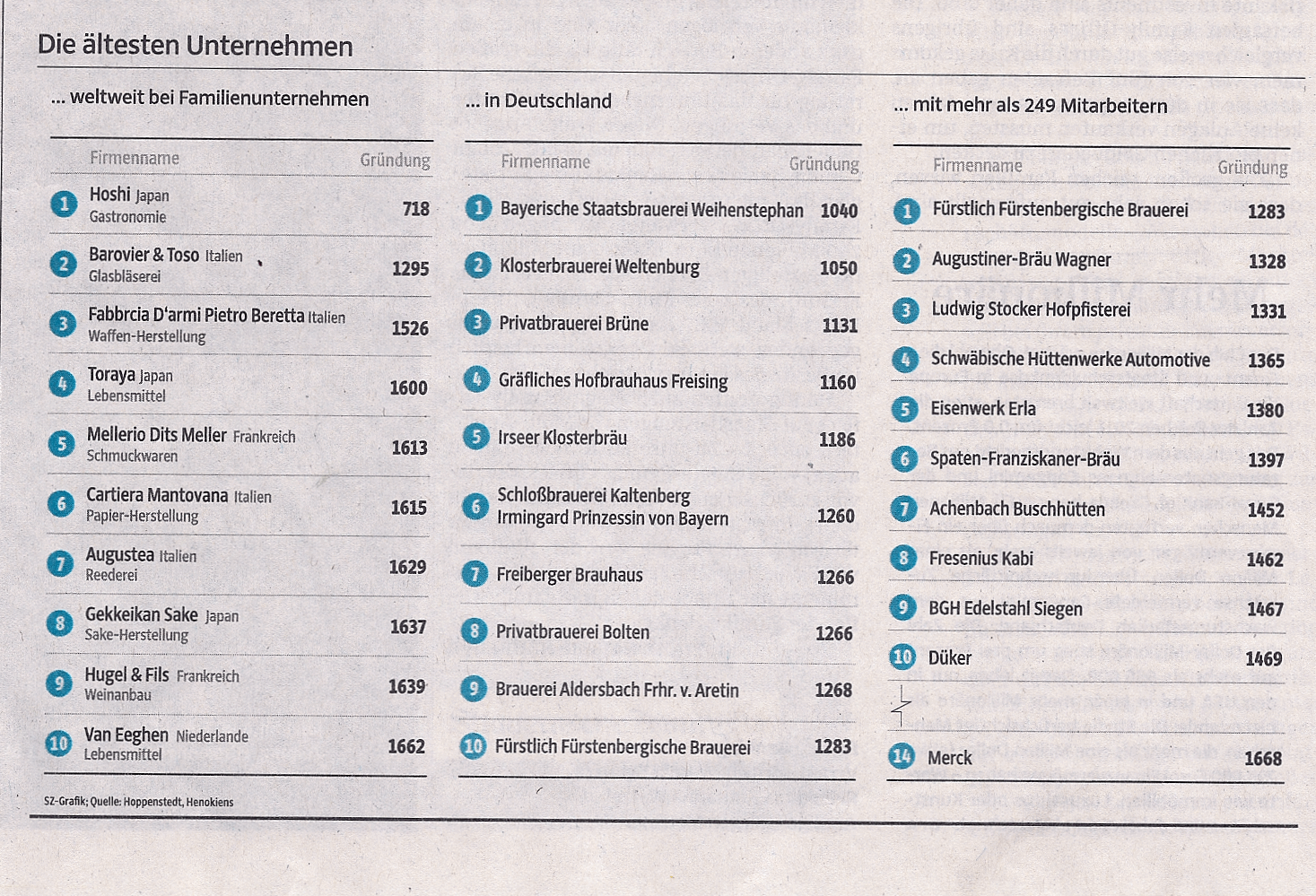
To me, the list looks rather interesting. They are among the German “Top 10″ when it comes to the oldest enterprises, with the exception of breweries. Seeing this, you could easily conclude that an enterprise can only exist extremely long if they produce and/or offer a sensible and really continuously sought-after product.
So here is what the entrepreneur can learn from this:
First and foremost, you have to determine your own personal success criteria, along with those for your enterprise. If “longevity” is a central issue, then the entrepreneur should, first and foremost, see to it that his enterprise offers a product to the market that will always be in demand.
And as I see it, this is all but easy. So here comes the negative (and on purpose cynical) conclusion: since most enterprises throw things onto the market that basically nobody needs and that will – in a constantly changing world – quickly be nothing but ballast, it does not make sense for most enterprises to think in terms of sustainability and longevity.
In reverse, that means:
Maximize your profit in the here and now! Suck the enterprise dry as long as you possibly can.
And that is exactly how it is often done. Vivat the throw-away mentality (not just for enterprises).
RMD
(Translated by EG)
P.S.
For comparisons, just click on the image.
Werner LorbeerFriday September 21st, 2012
Desertification Caused by the EEG: Desert Tec #18
 More than 240 different prices paid for those who feed in solar energy (source: Handelsblatt). Financial promises made to investors in the solar industry over 20 years at a total sum in the multi-billion range. Whoever feels like it can feed in energy at a fixed price which, according to economic theory, must cause a surplus. Simultaneously, those who feed in cheaply are now forced out of competition. Consequently, they, too, have to be subsidized.
Electrical energy gets so expensive that they now have to start thinking about compensatory money. One measure influencing the market is followed by the next. We are now in the desperate situation of a central planning economy without owning the glass ball of omniscience.
At the same time as this planning economy takes place, technological progress is being pigeonholed – the many bankruptcies in the solar industry tell their own story.
Is there a chance for solar energy? I think yes. It is very simple: stop all subsidies and re-establish the market economy.
Will that mean the end of solar technology? No way! Latest developments show that solar energy can actually be produced based on polymer solar cells. OLED technology in energy production. As I see it, the current cost for the products will be around 15% of what Si-based solar cells cost.
Organic solar cell-based printing methods for producing solar energy will be something you can use in a totally different way when constructing buildings and making them energy-autonomous.
http://www.solarserver.de/solarmagazin/solar-report_0807.html is an interesting source if you wish to read about the development on this extremely fast-growing technological sector. In the future, we will be able to weave solar panels, then print them and install them at proper places. And it might all happen at perhaps 10% of what it costs now. For the economists among us who believe in planning, this is definitely a reason to come up with a new legislation:
Every citizen must take a certain amount of energy from the network in order not to make the EEG a failure?
wl
(Translated by EG)
Roland DürreWednesday September 19th, 2012
China – Episodes I : Pay My Beer!
About the raftsman who would like to have a lunch break.
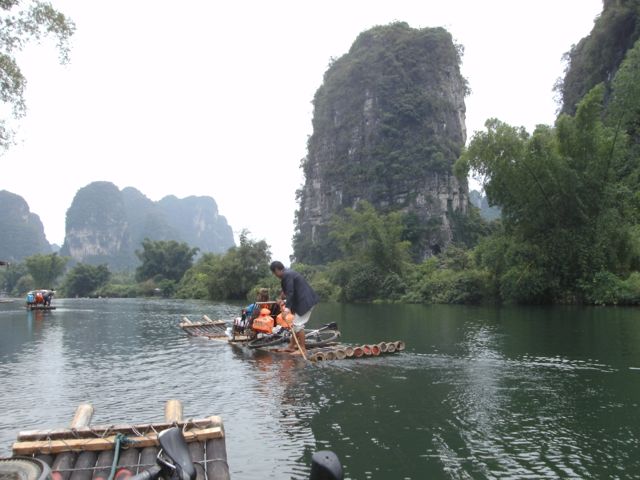
 There are three of us going down the river Yulong on two rafters. We pass our hotel on our way towards the destination. Shortly after this, our rafter stops at a floating snack platform. He fastens the rafter and jumps over.
A lady from Malaysia who is also on vacation is already sitting there and doing the translation for us. The raftsman would like to have a short lunch break. Do we mind? We are assured the journey will soon continue.
We are on vacation, so there is plenty of time. Of course, we agree. We drink a glass of beer while he eats his fish. As always, we are treated in the most friendly way.
It seems that the raftsman and the snack saleslady know each other quite well. The food on this floating island looks delicious. They advise us to buy some fish.
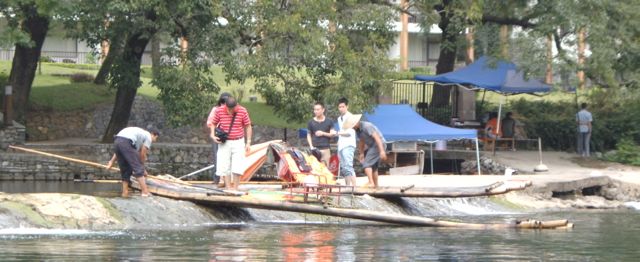 Since, however, we have made our plans already, we are going to eat later. Still, we take one bottle of beer (595 cl) for the three of us.
Regardless of the fact that we know quite well how, in places like these, beer is extremely expensive, rather like at the Munich Marienplatz.
Then we continue. I want to pay for the beer. As expected, it is rather expensive. I nod my head without bargaining and get my purse.
 The snack saleslady is encouraged by this. Now she thinks I should also pay for both glasses of beer our raftsmen have had. She tells us all this with real nice gestures and a very friendly smile.
I refuse. And I seem to get my way. The raftsman gets on the rafter with us and we continue on our journey. And apparently, the raftsman never paid for his snack.
My insistence not to pay, however, does not make the slightest difference with his friendliness. After all, this is just him not making even more profit. All you can do is try, isn’t it?
I could relate quite a few similar stories to you.
RMD
P.S.
Incidentally, my totally harmless rafting trip was illegal. It was not permitted for children under six and adults over the age of 60. A poster announcing this rule – like many others – is posted quite prominently. Yet nobody seems to care – which is also true for other rules, such as you have to wear safety belts, you may not carry a camera or electronic device… – these rules are simply ignored.
Roland DürreSunday September 9th, 2012
brand eins in September
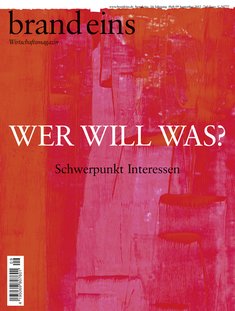 This time around, my “brand eins” copy had to wait in its plastic cover for almost two weeks. On Sunday evening, when we arrived back in Munich on this second day in September, the first thing I had to do was unload the camping stuff. Then followed three intense days in the office, many appointments, etc. – No time for reading.
On Thursday, September 6th, however, I went to Switzerland by train – which finally gave me some time to read “brand eins”.
The September issue is titled:
WHO WANTS WHAT?
The focal point is INTERESTS.
Well, that sounds good, doesn’t it? After all, I certainly believe in the prejudice that our complex society is hugely controlled by interest policy, i.e. by lobbyism. And you all know that is something I hate very much, because I think it causes both my and the “common man’s” normal “interests” to be subdued in favour of systemic powers.
Now wouldn’t it be an important task for journalists to unsnarl the jumbled-up of imagined (group) interests – which probably even have gained their own lives by now – and isolate their dimensions? Consequently, I get more and more eager to read what it says in the magazine. I quickly tear up the cellophane cover with my long fingernails and get under way.
The editorial by Frau Fischer is titled “We only want your best!” Immediately, the old saying comes to mind: “Your Best, Your Money!” And, indeed, the article by Frau Fischer finishes with the formula “Good Products for Good Money!” This is a formula I can easily live with. After all, I have no problem spending my money on good products. Except that I do not appreciate being cheated and deceived!
Here is my experience while reading the current issue:
It is a true pleasure for me to read the magazine as I ride the train to Lindau. Every now and then, I look up from the magazine and see the soft Allgäu countryside gliding along the ALEX windows. And then I go back to reading the next article in the magazine.
I find the focus article ”What You Want“ on page 40 by Dan Ariely particularly remarkable. The ADAC overview shortly before this article, is also rather exciting. Apparently, the “C” has nothing to do with “Club”, neither is it anything like a “Christian C”; in fact, it is clearly for “Cash”.
There is also, at long last, an article about the Board of Trade I have so little love for (“The Keepers of the Grail”). We are forced to be members. And then this club usually supports the opposite of what I consider right. For example, they lobby for the Third Munich Airport Runway.
You see how far we have come in this country? – I am forced to be a member of some lobbyist association. Incidentally, the club euphemistically calls this forced membership “obligatory membership”. What a truly nice phrase.
And the more I browse through the magazine, the more exciting articles I find. Unfortunately, they all support my prejudice of the “interest-controlled society”. Now that hurts a bit. On the other hand, I am glad brand eins is actually telling me I am not dreaming all these things.
Basically, lobbyism is not a nightmare. It is reality. And I certainly need no “Zwickt’s Mi”, das kann doch alles nicht wahr sein” (Wolfgang Ambros 1975) in order to realize it.
RMD
(Translated by EG)
Roland DürreFriday September 7th, 2012
Some More Details on the IF Forum of September, 25th, at Unterhaching
In less than tree weeks!
On September, 25th, there will be another very special technological IF Forum in our Unterhaching building. After 2010 (AGILE) and 2011 (LEADERSHIP), this is the third “Technological IF Forum”.
In 2012, the protagonists of the PM Camp will visit Munich (Unterhaching) on the 12th of September. They will bring with them the “Best of PM Camp”.
The day is about:
Projects and work, coaching and success!
Here are the agenda and a short introduction of all speakers and their papers:
Presented by – Roland Dürre
14:00 – 14:15 Welcome (Kornelia Hietmann)
Segment I
14:15 – 14:45 Integrated Project Management (Dr. Stefan Hagen)
14:45 – 15:15 Post-Industrial Project Management (Dr. Marcus Raitner)
15:15 – 15:45 “Fishbowl” on Segment I
Break
Segment II
16:15 – 16:45 Systematic Creativity (Jens Hoffmann)
16:45 – 17:15 Purpose, Nonsense and Chances of Life (Nadja Schröer-Petranovskaja)
17:15 – 17:45 “About Onions and Cultures” (Dr. Eberhard Huber)
17:45 – 18:30 Fishbowl on Segment II
Afterwards:
Happy Hour (discussions, fun, laughter, beverages and snacks)
Now let me introduce the speakers to you and give a short summary of their presentations:
Dr. Stefan Hagen will open up the first section with his presentation about “integrated project management“.
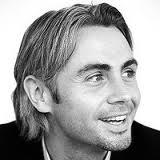 Stefan is the founder and owner of the Hagen Management GmbH.
In the truest sense of the word, Stefan lives his life
Project Management – Organization – Strategy
Consequently, he is also the author of the perhaps best-read German project management blog (pm-blog). In his IF Forum 2012 opening statements, he will plead for “integrated project management“. Here is a short summary of his theses:
- Problems arising in project management can probably only be solved using a conventional approach and methods. Just look at the poor success rate.
- Integrative approaches will be necessary. Basically, this means we have to look beyond our own horizons.
- Horizontal Integration: classic and agile approaches;
- Vertical Integration: humans in (social) systems.
- Stefan will mainly discuss systemic principles currently neglected in an unpardonable way in most projects.
- His conclusion is: we need a “change of level“ in order to generate better frameworks for successful project and team work.
The ideas introduced by Stefan will be completed by “post-industrial project management” as introduced by Dr. Marcus Raitner.
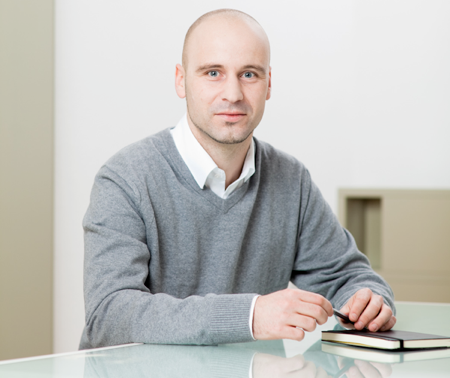
 Marcus wrote his dissertational thesis in Informatics at Passau University.
After five years as a senior project manager with a huge IT service company, he started a new career as senior partner and board member of the esc Solutions GmbH in 2010.
His focus is on IT project management and IT project coaching.
Dr. Marcus Raitner has his own quite famous PM blog. He is on the organizing team of the PM Camp and initiated openPM.
Read what Marcus says about his own presentation:
Many projects are two-class systems: a few persons do all the intellectual and leadership work, while all the rest of the people just execute it. That is what I call planning apartheid. You cannot miss the similarities with the organization of huge enterprises: industrial project management with the main goal of efficiency. Industrial project management will work quite well if the complexity is so small that the creativity of the planning class is sufficient for overcoming obstacles. Except that most of the projects are far beyond this level of complexity. What then?
After the presentations by Stefan and Marcus, we will conduct the “Fishbowl”. Together, we will process all we have heard.
Then, we will take a break.
The second part will be opened up by Jens Hoffmann.
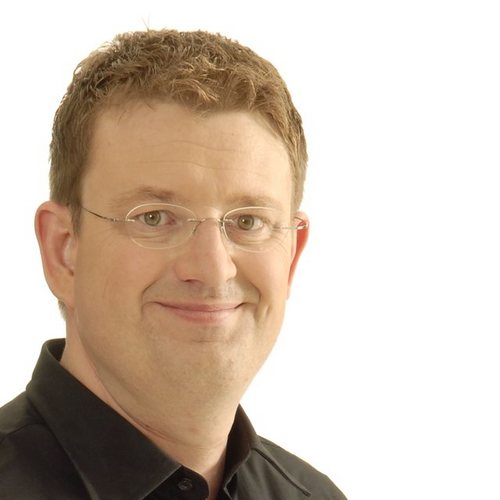
 Jens, born 1967, is managing director and founder of the Hoffmann Consulting GmbH. Originally from Düsseldorf, he started his career very young – at 20 – with Munich Microsoft, before joining Roland Berger & Partner in 1987. He soon advanced to the posts of project leader in Frankfurt, Vienna and Zurich.
In 1999, he founded the Hoffmann Consulting GmbH. It specializes on consulting services for IT communication. His main areas are governance, risk management, compliance and business innovation (Business Model Design, Product and Service Innovation).
One of his most important topics is creativity. That is why he will talk about
Systematic Creativity
Identify new challenges and solve problems efficiently.
Here are some ideas on his paper for you to take a look at in advance:
Just like the enterprises that provide them, products and services, too, get more and more interchangeable. Technological and social competence are matters of course, but creativity is the one skill currently most on demand. Your competence at identifying and addressing the needs of your customer – and then to solve problems efficiently – will certainly determine whether you are a success or not.
For many people, the connection between creativity and business is something they find hard to get used to. Jens will give you an overview about how creativity can be integrated into business as a process and then be developed and used systematically, either by individual persons or in a team.
When Jens has finished, we will all be looking forward to hearing Nadja Schröer-Petranovskaja speak.
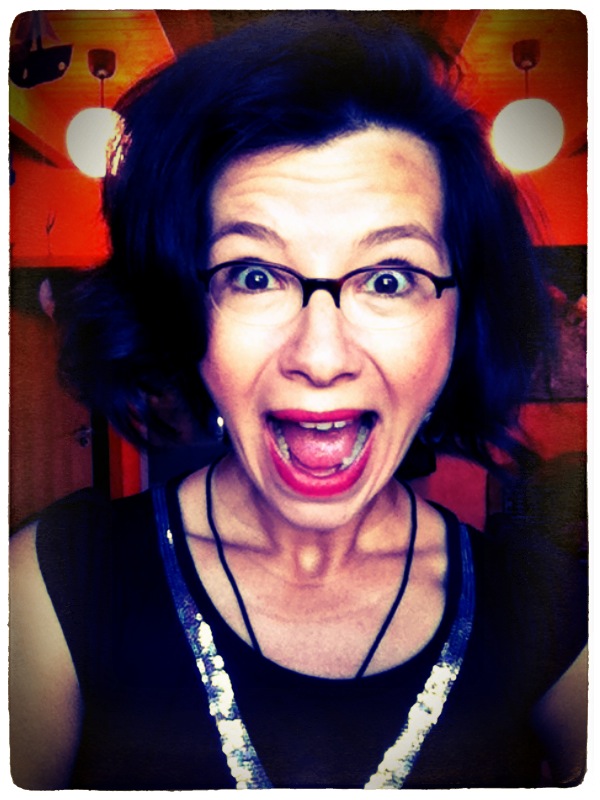 This is how Nadja sees herself:
Human, Russian, psychologist, project leader, business muse, photographer, mother, author, blogger.
She is always looking for something and finding it between countries, (entrepreneurial) cultures, along their inhabitants and sectors. Nothing is pre-assigned with her, except that:
It must make sense.
Freedom-loving, lazy and courageous.
She will tell us her ideas about:
Purpose, nonsense and chances in life!
Nadja’s presentations are always very special affairs. I very much look forward to her impulse presentation. Said presentation will give us new questions, combine facts and introduce new propositions about how we might design the rest of our lives.
Incidentally, this is the one question that I am mostly concerned with these days.
Our cycle of presentations will be closed by Dr. Eberhard Huber.
 Dr. Eberhard Huber is the embodiment of experience and knowledge. He can look back on: 25 years of project leadership, having been trainer and coach for project management, group dynamics and team development, project management in research and education (at the universities of Mannheim and Magdeburg), and practice.
His Credo is:
Making a team out of a group of people, developing cooperation that is more than just an accumulation of individual competences, often depends on a few lucky coincidences, the leadership qualities, or the project leader’s charisma. This is where team-oriented project leadership comes in. It accompanies the process of building a team during the project.
Team-oriented project leadership that leaves room for and promotes self-organization will enable you to really make proper use of all the potential you have at your disposal.
This time, Eberhard will tell us about
“Onions and Cultures”
His “onions“ will actually close the circle opened by Stefan. Culture and the active promotion of culture can serve as one solution for the change of level Stefan demands. Eberhard chose the title “onions and cultures“ deliberately, because the plural is important for what this will all be about.
Now is the time for our second “Fishbowl“. We will finish the exciting afternoon together and recuperate from the strains of the intense work during our Happy Hour!
I find it great to have the chance of presenting this super event. I look forward to an exciting and beautiful day with Stefan, Marcus, Jens, Nadja, Eberhard and many friends and partners.
RMD
(Translated by eG)


