
Roland DürreTuesday May 11th, 2010
Poverty & THE EURO
I will try to give a definition of the term “poverty in the EU”, before explaining how the Euro promoted said poverty. To be sure, at first sight this might sound heretical – but do not judge before you have read!
In this country, you are poor if
- your increase in “prosperity” is less than average,
- your possibility to participate in social life is reduced,
- you can only start a family if you are prepared to forego a considerable amount of consumption and
- if your chances of a good education are poor (permeability of educational classes).
There is a huge increase of this kind of poverty in all EU countries. If you see it under this aspect, Greece is probably not the poorest country in Europe. Real poverty, as defined by homelessness, hunger and misery, is (still) more the exception than the rule in the EU countries.
Roland DürreMonday May 10th, 2010
Gamblers
These days, gamblers get too much attention. They are artificially enhanced. They are projected as the concept of the enemy and as the great threat. Especially “politics” incant that gamblers are the enemies. Allegedly, they are the new evil ones who speculate with the bankruptcy of countries. Without scruples and conscious of what they are doing, they accept the breakdown of our currency as a possible consequence, just in order to make a huge profit.
(The very idea is probably nonsense. What would be the currency for them to receive their profit in, if they destroyed the currencies?).
It seems like the fear of “international gambling” is spreading through the country (or at least through politics, provided the politicians do not, again, tell lies). The general credo that the Euro must be protected from gamblers is the new holy task of the occident. And we risk our necks for it. Well, you always need a reason for rushing headlong into disaster, don’t you? Wars have been started for more stupid concepts.
I believe there is something of the gambler in all of us. It would be a lie if I said that gambling is totally alien to me. At least, I never gambled with stock. With the exception of four Siemens employee shares, I never even earned stock (except those of my own enterprise).
The few “gamblers” I know personally are all absolutely nice, honest and very wise humans.
In my opinion, politics and the public opinion are (again) punishing the wrong people:
No gambler could ruin “our” currency if it were not quite ill already. But the malady itself is not the fault of the gamblers. It is something we all together have caused. All the gamblers do is make transparent something we all have known for a long time.
Roland DürreSunday May 9th, 2010
Debt Ceiling
If you enter Debt Ceiling Law Exceptions at Google, you arrive at the homepage of the German Government and will find a “pdf“ file.
Following it under “exception”, the following text pops up:
Art. 109 Abs. 3 S. 4, 115 Abs. 2 S. 2 GG say that a credit up to 0.35% of the nominal gross domestic product is exempt from the restriction regulation. Consequently, the Federal Government may indebt itself up to this sum.
Moreover, credits can be raised for cyclical reasons. In that case, the cyclical variations have to be symmetrically balanced between boosts and downturns.
Last not least, money can also be borrowed in case of natural catastrophes or exceptional emergencies that cannot be controlled by the state and have considerable influence on the federal financial situation.
The last two paragraphs arouse my special interest. It certainly does not call for a particular political talent to find an exceptional emergency as a reason for borrowing money.
Roland DürreWednesday May 5th, 2010
There Is No Alternative
Now the money pipeline to Greece has been installed. On May, 19th, the command will be: “Money, March”.
However, there are very tough conditions and they are controlled rigorously at regular intervals of three months. If Greece fails to meet the target, there will be “most dire” consequences. That is what our minister of finances said.
But what are “most dire” consequences if there were really no alternatives? Because “there is no alternative” to saving Greece. That is also what our minister of finance, Schäuble, said.
Of course, this is nonsense. There are always alternatives. But how are our politicians supposed to know this?
Presumably, there was also “no alternative” to cooperating with Herrn Schreiber (who was sentenced to eight years in prison today).
Saying that there is no alternative to a certain action is the same as building a comparative form of practical constraint. May I propose “there is no alternative” as faux-pas phrase of the month?
RMD
(Translated by EG)
Roland Dürre
Electric Cars
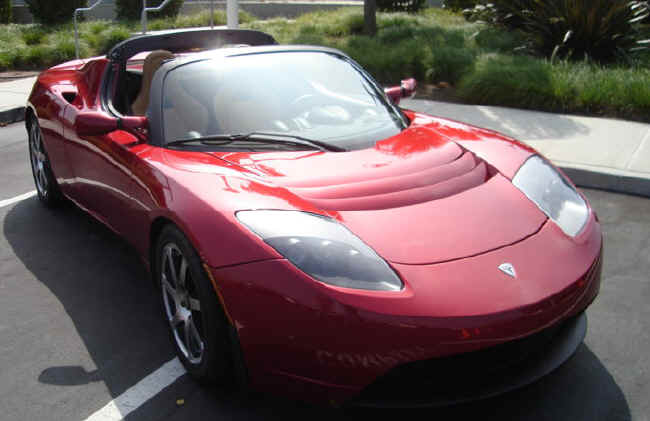 According to our Federal Chancellor, there should be 1,000,000 electric cars on German streets by the year 2020.
To me, it seems unlikely that we can even get anywhere near that number of cars powered by electricity and still being equipped with anything remotely like the standards of modern cars with combustion motors (driving performance, heating, air conditioning, electrical appliances and functions, not to mention cruising range).
Roland DürreMonday May 3rd, 2010
Greece
Now we saved Greece (?).
And what comes next?
Greece is forced to implement an extremely rigorous austerity programme. It will be hard to put into practice. Instead, the Greek economy will face a recession.
Friends of mine wonder if it might not be a good idea to re-organize the summer vacation they had originally planned to spend in Greek. This psychological effect will lend extra strength to the recession in Greece. The recession will more than make up for the success of the austerity programme. The domestic consequences and in particular the next elections in Greece will have quite a sobering effect on all of us.
So what will be the consequence for Germany? You can take it as a given that the Federal Republic of Germany will also have to pay higher interests. Firstly, because the demand for money will increase all the time. Secondly, because the credit-worthiness of Germany will not get any better, either.
It is quite easy to conclude what an increase of interest rates will mean for our households.
RMD
(Translated by EG)
Roland Dürre
The Euro
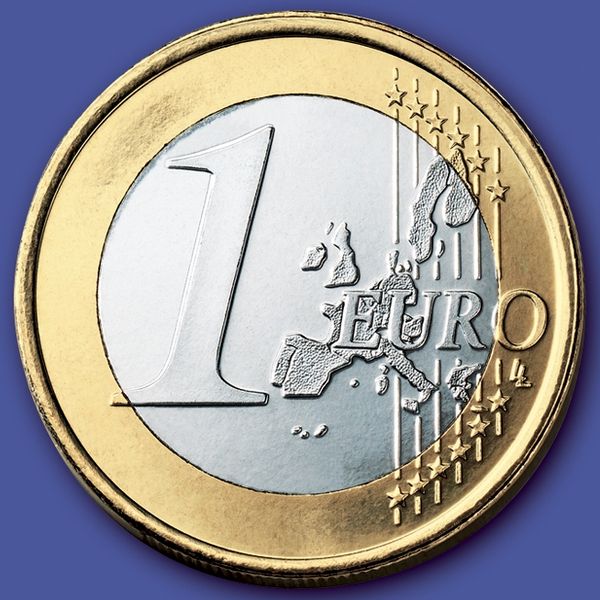 The status of Germany as a privileged business country we enjoyed over the last 50 years is dwindling. However, I think that is not solely due to us. We in Germany are still just as adept, creative, and full of ideas, competent, industrious and competent as we have been before.
The general structure has changed. Our economical power is on a world-wide decline. To be sure, the prosperity we achieved during the years of the economic miracle and the high standard of living we have grown used to did not happen exclusively because of our industriousness. We also benefited from cheap raw material and labour from abroad. And we also enjoyed a super reputation through the D-mark being a stable currency.
Roland DürreSaturday April 24th, 2010
Beer
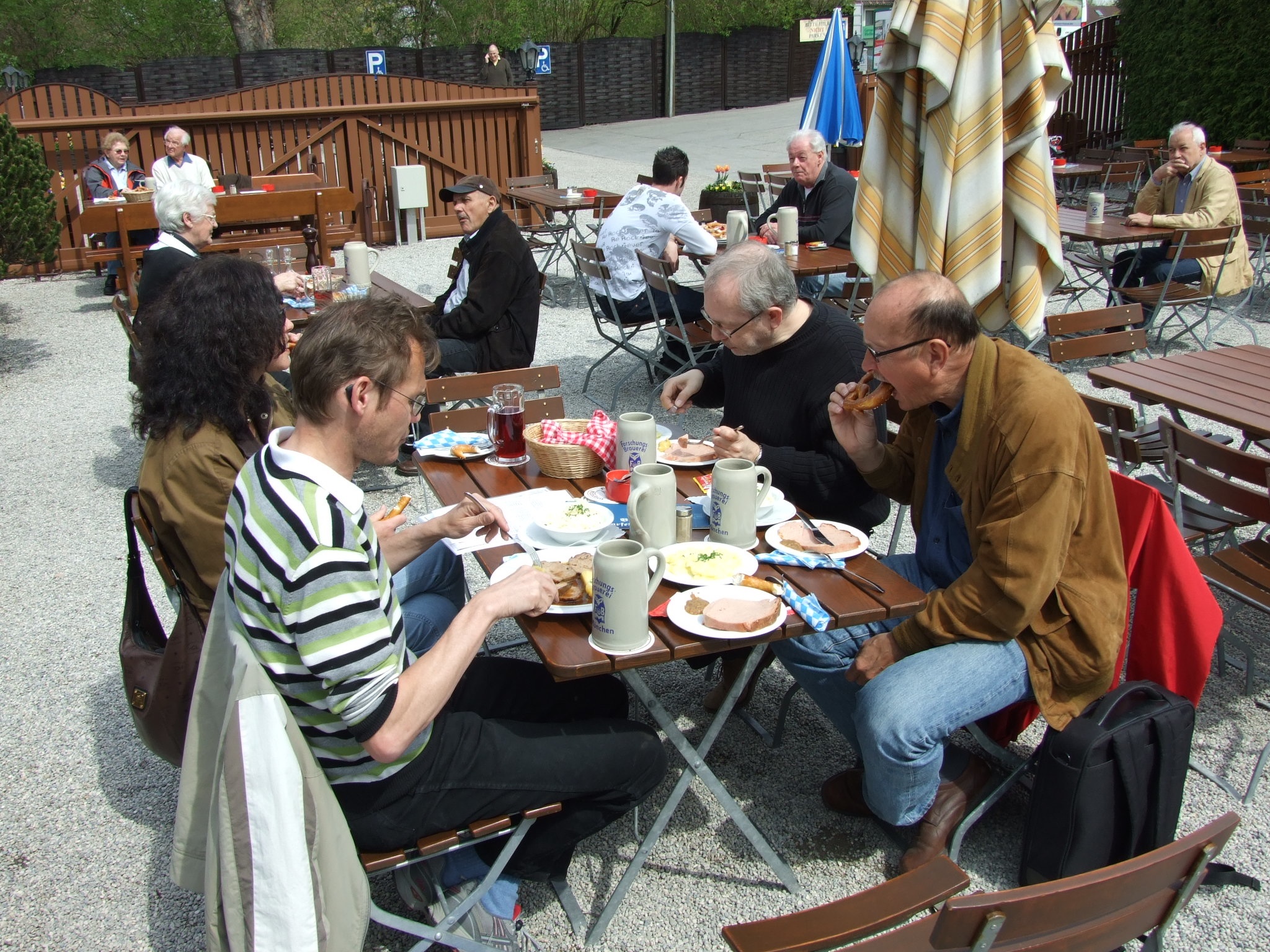 Yesterday was the “Day of German Beer” (Deutschen Bieres). In 1516, which, apparently, was 494 years ago, they introduced the Bavarian Beer Purity Act (Reinheitsgebot).
In order to give this important day the appropriate value and test a good mouthful of beer, we met in the Forschungsbrauerei at noon.
Among the participants were Dr. Edwin Ederle – you all know him well as one of our IF blog authors (E2E) – representing the entrepreneurial fraction. Jochen (Dr. Hans-Joachim Köbler) and his wife Rita represented the scientific sector.
The most famous participant, however, was the extreme athlete Harald Hofmann. Among other things, he is a long-distance runner. His favourite distance is the marathon. Along the way, he also won the Ottobrunn-6-Hour-Run on March, 21st, 2010 with 78.290 kilometres! For him, good beer is always a welcome fortification for athletic challenges.
Gastautor(en) Monday April 19th, 2010
The End Does Not Justify All Means
From our guest author Alfred Doll:
 The purchase of pinched bank data causes a stir – it is a classic decision dilemma between law, morals and ethics.
Currently, politicians, lawyers, journalists and the German citizens are excited about the fierce discussion about whether or not stolen bank data of potential tax evaders should be bought. On the one hand, there is the argument of tax fairness, on the other hand, there is due process of law, political risk and the question of making crime attractive. It is a judgemental dilemma and an excellent example showing how responsible decision should be arrived at and how not.
Both lawyers and data protection specialists call the intended purchase of illegal data unlawful. The term “concealment of stolen goods” has also been frequently heard.
Our state should remember its constitutional principles and see to it that the law is adhered to, instead of breeding more injustice. We expect our constitutional government to keep laws decreed in parliament. If now we have to balance between two violations of law, namely between tax evasion and illegal data acquisition, then that means we have a true dilemma situation.
It can only be solved by either finding alternative solutions or by taking the higher good/value as an orientation. We are confronted with an ethical evaluation of goods that must be approached dialectically.
As an alternative, we have to find out if the unlawful purchase of illegal data is really the only way to prove that tax has been evaded. I am sure that is not the case. To be sure, it might well be the easiest and most obvious way in the current situation, but it is not the “Ultima Ratio”.
If we, nevertheless, assume that there is no alternative way for the state to prove the tax evasion, then the question of the higher good/value has to be asked. It is not a given that the decision is based on the actual worth in money, in this case the 2,5 million Euros for the data purchase as opposed to the up to 100 million Euros in back duties. What counts is the ethical value: is the principle of constitutional rights a higher value than a certain amount of money?
The considerations would certainly have to be different if we were, for instance, talking about stolen data of drug dealers. A new balance of goods between constitutional rights and the protection of our citizens would have to take place. Is the state allowed to buy something from criminals in order to protect the population? Which good/value has preference? The duty of the state to protect its citizens, or the principle of constitutional rights? As we see, there has to be an individual balancing of values in order to arrive at responsible decisions and behaviour. You cannot say: “we have been there before, let us do it again in the same way”.
The representatives, first and foremost among them Frau Dr. Merkel, came to their conclusions both as evaluators and models: if there is an economical profit, you can buy from criminals.
So what right do these politicians have to demand from entrepreneurs and managers that they follow constitutional and social principles when making decisions and deciding how to behave, instead of just following the economical advantage?
I hope that our readers will be more careful and responsible when faced with similar decision dilemmas. For all those who are not quite sure, atunis offers an extensive range of dialectical methods for decision finding.
ad
(Translated by EG)


