
Roland DürreSaturday January 12th, 2013
Entrepreneur’s Diary #85 – The German Letter “V”
This is a very short article. Because, after all, entrepreneurship is a simple thing!
First you need Verstand (brains). In order to understand things and use your knowledge.
Without Vernunft (reason), however, brains will not be very much use.
Using brains and reason, you build up Vertrauen (trust).
With time, the willingness to take Verantwortung (responsibility) will grow.
And before long, the pact with Victoria, the goddess of victory, is a certainty!
Incidentally, these “V”s are also quite useful when it comes to life as such.
RMD
(Translated by EG)
P.S.
For more articles from my entrepreneur’s diary, click here: Drehscheibe!
Klaus HnilicaThursday January 10th, 2013
Pauline is Crying…
No, she is not really crying, it is more like a tiny, voiceless whimpering. The only reason tears were still streaming out of her swollen eyes was that her small, rounded body dressed in the bloodied, white kitchen apron was permanently shaken by an invisible power which immediately pressed even the smallest tear appearing behind her lids out of her eyes.
 And although Pauline had been cowering in front of her grey metal locker in the windowless dressing room for kitchen help all the time, she was not able to take off this abominably dirty kitchen apron or to wash the sticky tomato paste off her face.
Mind you, the Lower Austria State Government’s canteen kitchen had been tidied and made ready for tomorrow a long time ago. All her colleagues had left hours ago and she was sure nobody was left in the building except the security people.
But she – only sat there whimpering, wiping her eyes and staring into space.…
She was terrified of the way home! On the other hand, she refused all help: she had said she could do it, although she had known well enough that she would have to walk all the way. Even in the terrible state she was in today. Nothing else was even possible.
After all, during the last months of this miserable year of 1945, there was hardly any electricity in the Russian occupation zone of Vienna. So the tram was not an option. And even if the tram came, it would not be faster than walking, since it had to drive through the heap of rubble that was the fourth district. Starting from the first district, where she worked, even she with her dog tracking walk was faster to reach the fifth – British – district than the tram.
And regardless of having to walk she still usually carried leftovers of food home with her – it was the least she could do, wasn’t it? – and distributed it to the poorest in the house. But today, she was sure that her strength would not be enough to take anything home with her. In fact, she had to be happy if she herself managed to get home at all.
And if it had not been early October now, when the Russians had taken over their monthly assignment for the first district, this drunken Russian soldier would certainly not have sneaked into the empty kitchen.
Appearing from nowhere, he seemed to suddenly stand in front of her: gigantic, wearing an untidy, dirty uniform, the hood far back, underneath which two angry eyes and a broad, fear-inspiring smile with hideous, broken front teeth had leered at her.
Pauline was shocked – and cried! And already he stood next to her, grabbed her by the neck like a rabbit, shoved her onto the only chair in the kitchen and pressed his second smelly paw over her mouth.
”Nix schreien/No cry – Mamuschka“, he hissed into her face, exuding an abominable smell of schnapps, so that she could hardly breathe. Frightened, trembling and moaning, Pauline moved like a snake in her death struggle in a frantic attempt at freeing her mouth. But her helpless attempts at pulling at his animal paw only seemed to amuse this terrible Russian: he found it hilarious to take turns pressing her neck and her mouth and nose. And the more her face turned blue, the more amusing he found it.
Suddenly, he seemed to be distracted and let go! Pauline gasped for air. She hardly dared to feel her painful neck and sore mouth with her numb fingers.
Some way or other, the Russian seemed to have changed his mind!
All of a sudden, he looked at Pauline without malice, mumbled something about hunger and ‚nix essen/no eat’ and staggered through the tidy kitchen searching for food.
But nothing was here – everything edible was in the cooling chamber.
Since neither he could understand her, nor she him, Pauline just shook her head and pointed towards the locked cooling chamber door while he rampaged the cutlery cupboards. Pauline was incapable of saying anything or uttering a single syllable.
At that moment, the Russian was unfortunate enough to stumble over the unmentionable five-liter bucket of tomato paste the clumsy Maria had not stowed away. The bucket fell over and the Russian fell down. Nonchalantly, he opened it, reached into it with his fingers, tasted it and looked at Pauline – who moved from side to side on her chair and was as white as chalk – with a smile on his face.
It was almost like she had seen it coming. Suddenly, he took up the bucket, grumbled ”Tomaten/tomatoes – Wangen rot/cheek red – Mamuschka“ and simply held the entire bucket of tomato paste to her mouth..
”Du trinken/you drink – Mamuschka- viel trinken/much drink…“
Pauline struggled. She turned her head away as much as possible and pressed her teeth together; but this monster pressed the bucket against her lips with such force that they split and started to burn. She had no choice but to swallow at least some of it. And then some more and some more, and still some more. …
Again and again, she tried to push the bucket away in order to breath. Each time she did this, the red tomato brew ran over her chin and neck and into her blouse and down the kitchen apron. Bellowing, the monster ripped open her blouse and put the bucket down. But as soon as Pauline had had a little rest, the Russian was again there, pressing the bucket between her teeth even more ruthlessly. And Pauline swallowed and gasped and felt herself sinking deeper and deeper into the sour tomato brew.…
Suddenly, the Russian stopped!
As fast as lightning, he pressed the bucket between Pauline’s feet, ran squeaking to one of the sinks, let himself fall to the ground and then returned to Pauline with a devilish grin on his face. Between his fingers, he proudly dangled a fearful and struggling mouse by its long tail.
Paralyzed with terror, all that Pauline registered was how he laughed and dangled the shrieking mouse over his open mouth as if about to swallow it. But then he immersed it in the tomato paste in front of her feet until it stopped moving. Visibly content, he held the mouse up, tumbled back to Pauline and then pushed her head back by the hair with his other hand, before moving the dripping and quivering mouse closer and closer to her mouth …
Then – there was a thundering order in Russian and a cannonade of abuse! Four hands grabbed the monster and dragged it away with the quivering mouse. Pauline moaned and struggled for air with wide open eyes. The remaining Russian soldier, wearing an immaculate Russian uniform and saluting her asked if there was anything he could do to help her…
Pauline, dripping tomato paste all over the place, mechanically shook her head no.
The Russian apologized in broken German and said you could find pigs everywhere – unfortunately also in the Red Army. But he himself had a Mamuschka in Moscow and knew how she felt. He was going to get help.
He quickly saluted before returning to his comrades who had already disappeared along the corridor, while Pauline spat and spat and gasped and was sick again and again in quick succession.
And then she was finally able to sob. …
KH
(Translated by EG)
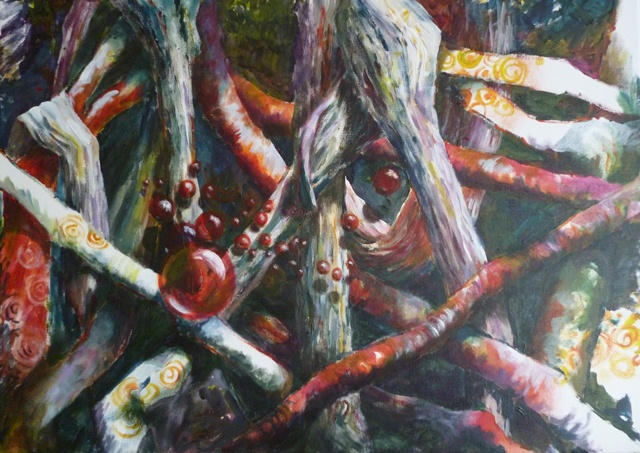
Picture: Martina Roth, Mystisch, Acryl auf Leinwand, 64 x 45 cm
Roland DürreMonday December 31st, 2012
My Catholic Upbringing
It is one of the lessons I learned that the quiet days of Christmas and the New Year are quite suitable for re-evaluating your own life compass. Where am I heading towards? I tried again this year. Incidentally, however, there is no tomorrow without today and no today without yesterday. Consequently, my pondering led me back to my roots. This is about things that particularly moved me during my course of life. And I remembered times long past. Now, in order to put a lid on them as well, I will publicly describe those times. Maybe others who experienced similar things can benefit, too.
When I was eight years old, they prepared me for Holy Communion – also known as First Holy Communion (Erstkommunion). After a fairly normal catholic upbringing (not very intense, more sanctimonious), I – along with other Catholics in my class – was massively instructed during religious education lessons at primary school.
We were in the third form. After Christmas, the preparations for the momentous event got really under way. The first step towards First Holy Communion was to make us all extremely familiar with the martyrdom of Christ. I remember highly sadistic self-adhesive pictures. We had to buy them and then illustrate hand-written texts in our “Passion Exercise Book”.
After Easter, the “bootcamp” gained momentum. First came confession. We had to practice intensely for this. Confession would make us clean. Since confession makes us free from all sin, it must happen shortly before the First Holy Communion. For example on Saturday afternoon if you intend to take the Holy Communion on Sunday. And then you have to do everything in order to prevent sinning during the night from Saturday to Sunday – for example against pinching a bit or having unchaste thoughts (in fact, at the age of eight the latter was not yet a problem). We also practiced doing penance after the confession. You had to say the Pater Noster and the rosary slowly and humbly.
The re-education continued. After the confession came the Holy Communion. We learned that, for a good Catholic, it is the highlight of the week. Even if the week was really bad, it does not matter. Because we live for the Sunday, when the Lord comes to visit us. For an eight-year-old, there were quite hard weeks in 1958. Except that mostly Sundays were no better, either.
But this was not a problem, because, after all, we only had to suffer the misery of this earth until death would deliver us. And then we, as chosen Catholics, would get to heaven. To be sure, it was not easy, because the devil was after us pure souls everywhere. Always and everywhere, sin and atonement were present. So first and foremost, we had to get through. Which is why there was confession and Holy Communion.
Then we practiced Holy Communion. You were not allowed to eat breakfast before the Holy Communion. Mental purity and physical abstinence were absolutely indispensable requirements if you wanted to host the Lord.
He came in the form of an oblate, the Host. The pastor put it onto our tongue. That was also something we practiced. We had to let the body of the Lord melt in our moths, because “you cannot bite the body of the suffering Jesus with your teeth“ – said our religious instructions teacher.
Well, that is what it was like. Those were all things they pushed into our childish brains. For a certain span of time, they were even a success. Because when you are nine years old, you still believe what the grown-ups tell you.
Today, I am glad to have discovered shortly after my First Holy Communion that I cannot really find much use for the “punishing variant” of God. Neither did I, at the time, think of a ”loving one“. However, it did not take long for me to discover that God was easier to find between the massive trees that grew in the quiet of the Wittelsbacher City Park than in our Church of St. Antony. And my decision was made. When I had confirmation – that is the second certification a true Catholic has to suffer – I already was in a state of inner rebellion. I only suffered the ceremony under protest.
That is how I experienced it. Today, I wonder what would have become of me if I had ”purified myself“ every Saturday and then “received the body of the Lord” on Sunday. How would I then have been supposed to suffer life?
Consequently, I am very happy to have put a lid on my Catholic past when I entered puberty.
RMD
(Translated by EG)
Roland DürreTuesday December 4th, 2012
Here is Another Video Recording Showing Rupert Lay on Youtube: “Responsibility and Trust”
Yesterday evening, I uploaded another recording of a presentation by Rupert Lay to Youtube. Rupert Lay gave this presentation on May, 4th, 2003 at Bad Boll. It was about:
Responsibility and Trust
When responsibility and trust in an enterprise dwindle – reasons, consequences, what to do?
I was there when the presentation was originally held and would be happy if as many of you as possible would watch it.
Both presentations were given by Rupert Lay for the Ronneburger Kreis . The video recording is by Bernd Sielaff and Friedrich Lehn did the editing.
RMD
(Translated by EG)
Roland DürreSunday November 25th, 2012
Parties, Pirates and Party Programs – Help!
It was always held against the Pirate Party that they have no program. So what are they doing? They are coming up with one.
In my opinion, they are making a mistake!
If a truly different party comes up with a program, then the program should be: “we have no program!”
Such a party should be capable of deciding upon values (as shared by all members) based on ethical responsibility and agreed upon as a consensus. And then they could “make these values their own”. One would assume that is enough work.
Why do we need values instead of programs?
Give people a program and they will assume they are right and possess the truth. That is a dangerous assumption, because there is no absolute truth. And if someone or a group of people claim they possess the truth, your inner red light of warning should immediately start blaring full throttle.
So – do not give us programs!
I would very much prefer a commitment in favour of values – and in addition to this a statement or, even better, a promise, for example:
All our decisions will be based on a responsible, ethical balancing of interests. We will, to the best of our ability and using our common sense, always strive for neutral technological competence and feel bound to act according to those aforesaid values!
Now that would be a nice commitment, wouldn’t it? If I were a party member, I would propose a “five-point manifesto”. It might, perhaps, be something like:
- We will – on purpose – dispense with a program.
- We trust in the values found by enlightenment, its knowledge, reason and honesty (transparency).
- We respect the German Constitution (or even better: The Bavarian Constitution) and the UN Charta .
- We will follow common sense and use the “Golden Rule “.
- Our decisions will always be based on a responsible balance of interests, our behavior will always follow our values.
That would be it!
But I do not think it makes any sense at all to establish a new party. Still, I certainly could list a few values to guide a new party:
- demanding the freedom to live by the rule of: “living self-responsibly and being able to do so“,
- managing to have a violence-free society with fear-free areas, with a minimum of punishment/vengeance and without wars,
- at long last make men and women “equal“,
- make all relevant levels, and in particular the public area, as transparent as possible
- and
- promote a social climate with a relative right to property and freedom of trade.
Incidentally, many of these issues have been wonderfully formulated and written down in the Bavarian Constitution . Unfortunately, it has become a little utopian . Neither is it valid any longer, because the German Constitution has precedence. Still, it is and will always be a truly beautiful piece of text.
But back to parties. If now the Pirate Party also come up with a program, then I truly no longer know whom to give my vote to. So the only remaining option for me is to join the majority of non-voters.
Because I definitely do not wish to give my vote somewhere between mechanical function and measure catalogues and dogmatic statements of belief. Both are cunningly served in a camouflage packet. I call them camouflage programs, because – as we now again see with the Pirate Party – the really hard-core topics have to be excluded, anyway. Otherwise, a compromise is not possible. A social consensus cannot be made out, just like there is not the slightest hint of a social outline.
This is not about demanding that “everybody must unconditionally be provided with the means to survive“ or “that all nuclear power plants be closed down in three years”. Neither is it about parental money or educational money. Or “A Free Ride For Free Citizens“, depending on what you believe in either for car drivers or those who go by train.
Not to mention meaningless declarations that you intend to solve conflicts without using violence. And whenever it gets difficult, you want the masses to decide. Without before having generated the necessary transparency.
No, this is about having a reasonable concept in management and still make more good decisions than bad ones. And in that respect, programs will not be any help. This seems pretty clear, because change comes at such enormous speed. How can I decide today what I will do in two years’ time if by then the facts will be totally altered? I am fed up with seeing people speculating about an unpredictable future, also in politics.
Consequently, what I want when I vote is a decision in favor of values. And I would like to trust that my representatives and the politicians want to and can and will act according to their values.
Mind you, I, too, am not in the possession of absolute truth. Still: I believe these ideas are worth being discussed. On the other hand, let me say:
Dear Pirates!
Maybe that is why you get these poor results in the current polls? Because you are now turning into a “normal party“. And we certainly have enough of those already. I do not think we need yet another one. Consequently, the word might soon be: easy come, easy go.
RMD
(Translated by EG)
Roland DürreSunday November 18th, 2012
How I Prepare for the Presentation “The Change in Management”.
In November, I will be talking to various groups about the “Change in Management“. The following text grew as I prepared the material for my presentations. It is a description of the environment and is supposed to help the audience as an introduction – or maybe as an accompanying “reader“.
Over the last few years, modifications, in modern German called “change” gained in speed in geometric dimensions. The internet changes the world in a way never experienced since the “industrialization”. Post-modern times are at an end, we are quickly entering the “information times” (if that is what they are going to call it a hundred years from now).
A large part of said change is about business. The way we work undergoes change. Young enterprises – offering totally new business models, entrepreneurial cultures and unheard-of products and services – rise and dominate the world in the shortest possible time. Just think of Apple, Dell, Facebook, Google, HP, Microsoft, Oracle, SAP and many, many more. And all that remains for Siemens & Co is to look on with growing envy.
Neither is this the end. Highly qualified persons no longer wish to work under a binding employee contract. Some of them merge and work on an honorary basis, sharing their special expertise and knowledge for common goals. For instance, experts from a totally new field, the software industry, first started getting together and building small associations in the USA with ”free“ and ”open“ products in the GNU time. And this is how huge movements grew. Today, the world is unimaginable without them.
Initially, it was typically “simple“ software tools, such as the (GNU) compilers of the 1980ies. But soon enough, the show really started to get under way. The famous “lamp” software was generated: Linux, Apache, MySql and Php. Yet this is only the tip of the iceberg. Today, we have a huge “Open Source” movement consisting of many small and big communities. And this is where the most wonderful things are developed on an unbelievable scale. And all of a sudden, products that were generated in someone’s leisure time and on an honorary basis actually displace the commercial ones. Now these products are the accepted standard all around the world.
Naturally, less complicated technological parts, too, can be linked as huge software systems, such as automobiles. They can be developed openly in an “engineering” way and assembled locally. And it will only be a question of time before the first open e-mobile will cruise the streets in huge quantities.
This development is supplemented by non-IT open source movements. The most famous one is probably Wikipedia. But Wikipedia, too, is just the tip of the iceberg. You can hear the battle-cry everywhere:
“Knowledge is the only commodity that grows as you share it!”
Simultaneously, many NGOs (Non Government Organizations) are started. Among many peoples, they already enjoy a better reputation than the local government. New catchwords are: community, belonging, collaboration. The prefix “co” in particular, as found in co-operation, has become a favoured part of words. Terms such as co-creation, co-working, co-programming start having lives of their own.
New strategies such as “crowd sourcing” develop, trying to make use of the ”intelligence of the masses“. In doing so, they create a true mega trend. The internet dominates the world. Pads, smartphones and laptops are “in”. The market for apps is exploding.
A short time ago, I read that more Germans can imagine life without a car than without Facebook. Even the “Golden Calf ” (Goldene Kalb) of the last century, the car, seems to be on its last leg.
The same happens in business. Enterprises with a totally different philosophy suddenly push the traditional ones to the side. In private life, functions, career, ties, status and titles get less and less important. To make up for it, the need to live your own life as you yourself want it grows. Using the words of Old Frederik: the people want to “be happy in their own façon”, kissing late capitalism and marketing economy good-bye. As I see it, this is a very nice understanding of freedom.
But how could this have happened?
Very simple – we are living an evolution. And said evolution will not leave persons and their forms of living and group-forming out of the equation. Some people have many antennae and therefore witness quite much of the social development. Using their special training and knowledge, they think about and write down the developments of “yesterday, today and tomorrow”. As a general rule, we are talking philosophers and people trained in similar sciences doing their jobs as “observers of evolution“.
Philosophers also formulate contemporary thinking and describe the predominating values of the last thousand years. And those have changed considerably as the centuries went by.
In Medieval Times they said:
“Whatever God wants is good!”
Basically this is a rather simple rule, except you have to know what “is God’s wish”. Then came Utilarism with Thomas Hobbes (Leviathan) stating
“Whatever is good for humans is good!”
Well, basically, this does not sound bad, does it? Especially if you are a human. But then, Kant did not like it. He felt it was not as easy as this. What you need is something like moral standards. So he came up with a very categorical formulation:
The Categorical Imperative (Kategorischen Imperativ):
“All finite and rationally gifted creatures, and therefore all humans, should judge their actions according to the question if said actions can at all times and without any exception follow a prevailing maxim, thereby respecting the rights of all parties concerned, also if only as an end in itself!”
With his evolutionary theory, Darwin provoked the precise Victorian data and Nietzsche was in a hurry about enlightenment (Aufklärung). And we already knew that humans are just ordinary creatures that developed from ape-like ancestors and that they should ideally strive to abolish all uncertainties, answer questions and correct errors through knowledge acquisition.
During the postmodern era, enlightenment became a radical concept and now it can probably no longer be neglected. But the process continued.
After the war, for instance, came Habermas. He said something about the dominance-free (ethical) discourse (Diskurs) as a basis for communication and knowledge acquisition and came up with the following fantastical rules:
- No outward constraint must ever hinder a discussion.
- The best argument will prevail.
- Every participant gets the same chance to take part in the discussion.
- Every participant must be capable of “self-presentation without affront“ and make himself transparent for the others.
- Every participant must verbalize the basic decisions of his or her life and be prepared to accept criticism. (There is a highly sophisticated system of thesis and anti-thesis, the duty to give reasons for all statements, etc).
- Nobody enjoys privileges because of his or her age, experience, authority, etc.
- Every participant must be willing to exchange behavioral expectations with all others. Every participant must be prepared to switch roles with all others.
- The discussion will continue until a consensus is reached. As soon as the new truth has been accepted, it will dominate the life and behavior of all participants.
As I see it, the most important issue for our current development is the term “dominance-free discourse“. It probably originated with Habermas. To be sure, the primary literature is a little clumsy, but still nice reading. If you want to read more, I recommend this small speech (Rede). It contains a few nice suggestions.
And then, there was also an Adorno. Here is a citation:
“If the opponent will not give in, he is disqualified and accused of not possessing exactly those characteristics that were stated as the basic requirements for the discussion. These requirements will be twisted in such a clever way that the other party cannot help but be persuaded; thus, the discussion turns into a farce. Behind this tactics, there is an authoritarian principle: the dissenting person must accept the general opinion of the group. Untouchables project their own untouchability to the one who does not want to let himself be terrorized. Using all these methods, actionism becomes part of the trend it believes and professes to oppose: bourgeois instrumentalism that fetishes the means, because its practical ways cannot bear the reflection on the ends.“ (pp. 180-181).
The citation was taken from the essay: „Marginalien zu Theorie und Praxis“ (1969) and was published by Suhrkamp in the small book: “Kritische Modell 2″ by Adorno. Other than that, you will find plenty of material if you read “Strukturwandel der Öffentlichkeit” by Habermas, written in 1962.
In my opinion, Adorno and Habermas described quite well what happens today. And today, web 2.0 also helps a lot. And interactive bloggers and twitter, as well as social media like facebook and persons linked in the net are just a logical consequence. But this is only the beginning.
In economics, Hans Ulrich, “devisor of the St. Gallen Management Model“, described the coming change particularly well. I find his eight theses on “new ways of thinking in management” particularly worth reading (you will find them in: Hans Ulrich “Management – Aufsätze 2. Teil von 1981 – 1998″) :
- Accept uncertainty and the unpredictability of the future as a normal state of affairs!
- Extend the borders of your mental horizon!
- Use the categories “both”, instead of “either-or”!
- Think multi-dimensional!
- Use self-organization and self-control as future models for enterprises!
- Consider managing as a meaningful function!
- Focus on what is really important!
- Make use of group dynamics!
Today, it is all about producing more knowledge in order to shape a common future. Consequently, in order to find the right questions, we need and have new communication formats. That is our first creative responsibility, because only after we actually know our problems, we can start looking for solutions.
There was a time when requirements like the “dominance-free discourse” were considered utopian and unsatisfiable. Today, they have become reality and are lived in the internet, as well as in the non-inter-world. New formats, such as jam session, barcamp, open space, fish bowl, Pecha Kucha, Ignite and many more spread all over the place at high speed. They replace many meetings, conferences and in the end even institutions, thereby leading towards a hybrid culture that combines real and virtual life.
These were a few ideas as a pre-view for my presentation (Vortrag) to be held, among other places, at Munich University of the Armed Forces this Thursdays.
RMD
(Translated by EG)
Roland DürreSaturday November 17th, 2012
Looking Back – Wilfried Bommert at the IF Forum
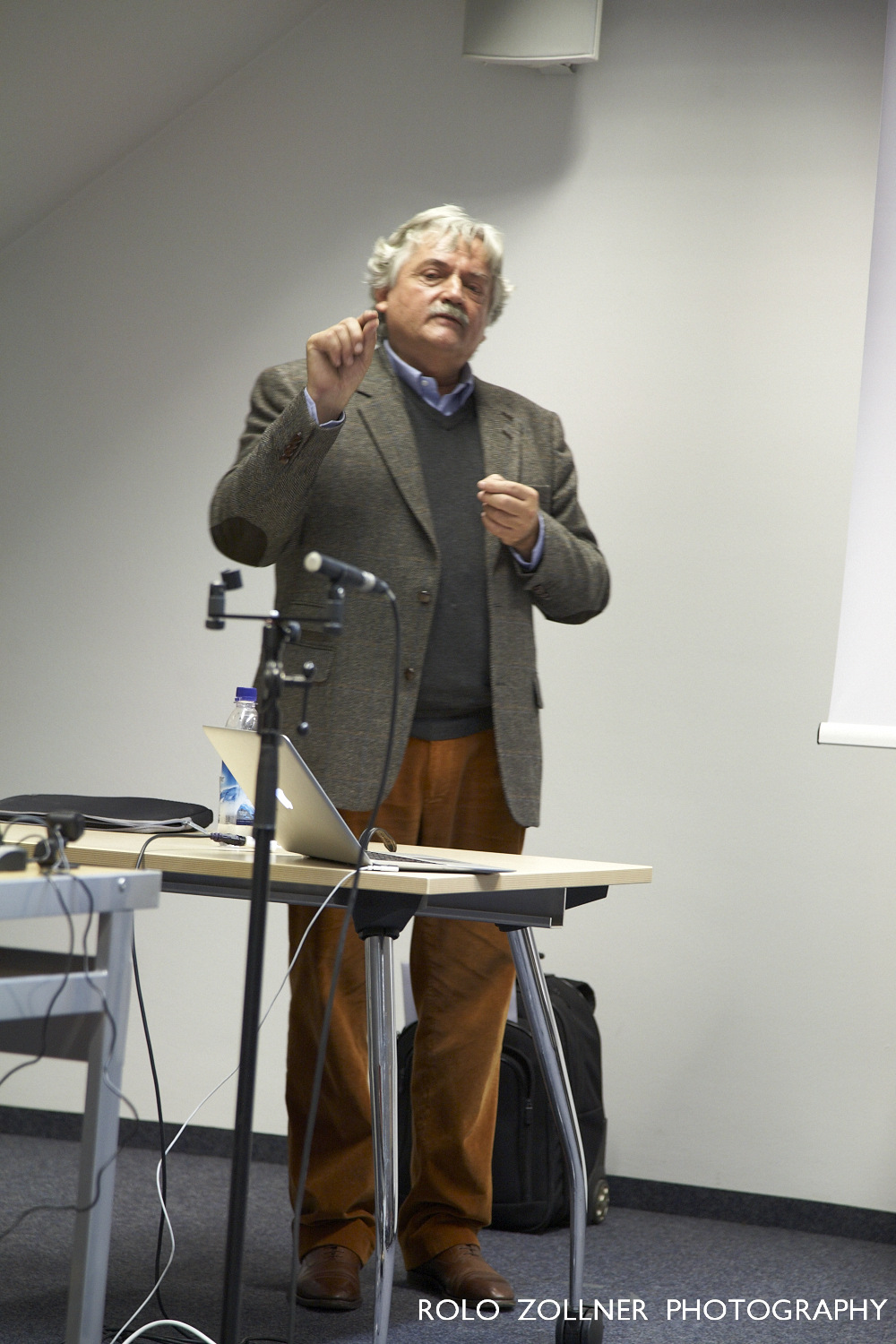 Last Tuesday, Wilfried Bommert of the WDR was our guest at Unterhaching. Wildfried Bommert is a well-known expert when it comes to “feeding the world”. He also published several books on the subject. Currently, he and a few partners are establishing the Berlin “Institut für Welternährung”.
Our last presentation in the series “living and surviving in a sustainable way” was yet again another highlight of the 2012 IF Forum. Herr Bommert deliberately kept his presentation very short and concise. We had planned this, because, after all, we wanted to produce an attractive video recording for Youtube as an extra value.
I think we succeeded. Every single sentence uttered by Herrn Bommert was right on target. Without employing unnecessary emotions and questionable judgements, he reported facts in a very objective way and came up with simple, logical conclusions.
Consequently, there was a long discussion after the presentation. It was extremely constructive and passionate. And we agreed: the messages sent by Herrn Bommert are important. He demonstrated in a very simple and rational way how feeding the world dangles on a thin string. And how easily this string could and perhaps will break.
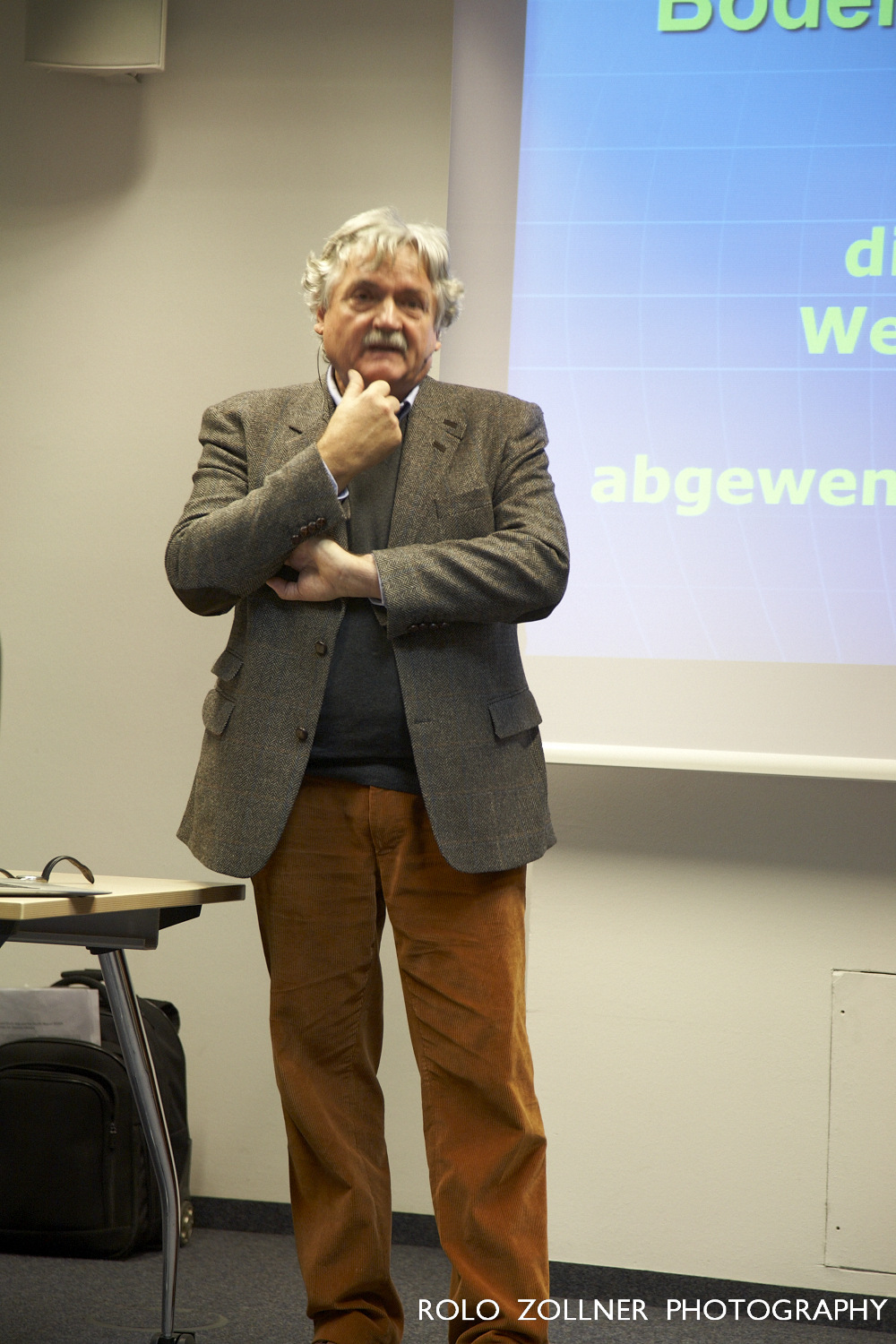 However, Herr Bommert also showed us ways to change matters. And he also showed us that it is, indeed, possible for us to prepare for the time after our stupid and eventually fatal economic habits will have caused a collapse. Consequently, his finishing lines after a very thought-inspiring list of facts and judgements were rather nice and optimistic.
With Vienna sausages and meatloaf (of course from the butcher Schlammerl of Ottobrunn), we spent quite some more time discussing things in small rounds. And finally, when the hot spiced wine and ginger bread were served – also from a local bakery: Götz of Taufkirchen – the general atmosphere was one of courage in view of a possible future and joy about all the interesting information and the culinary delicacies.
I already look forward to watching the video recording by Friedrich Lehn. As soon as it is finished, we will make it available for you on all our diverse Youtube channels.
RMD
Here are a few pictures to refresh your memory and maybe arouse your appetite for the video.
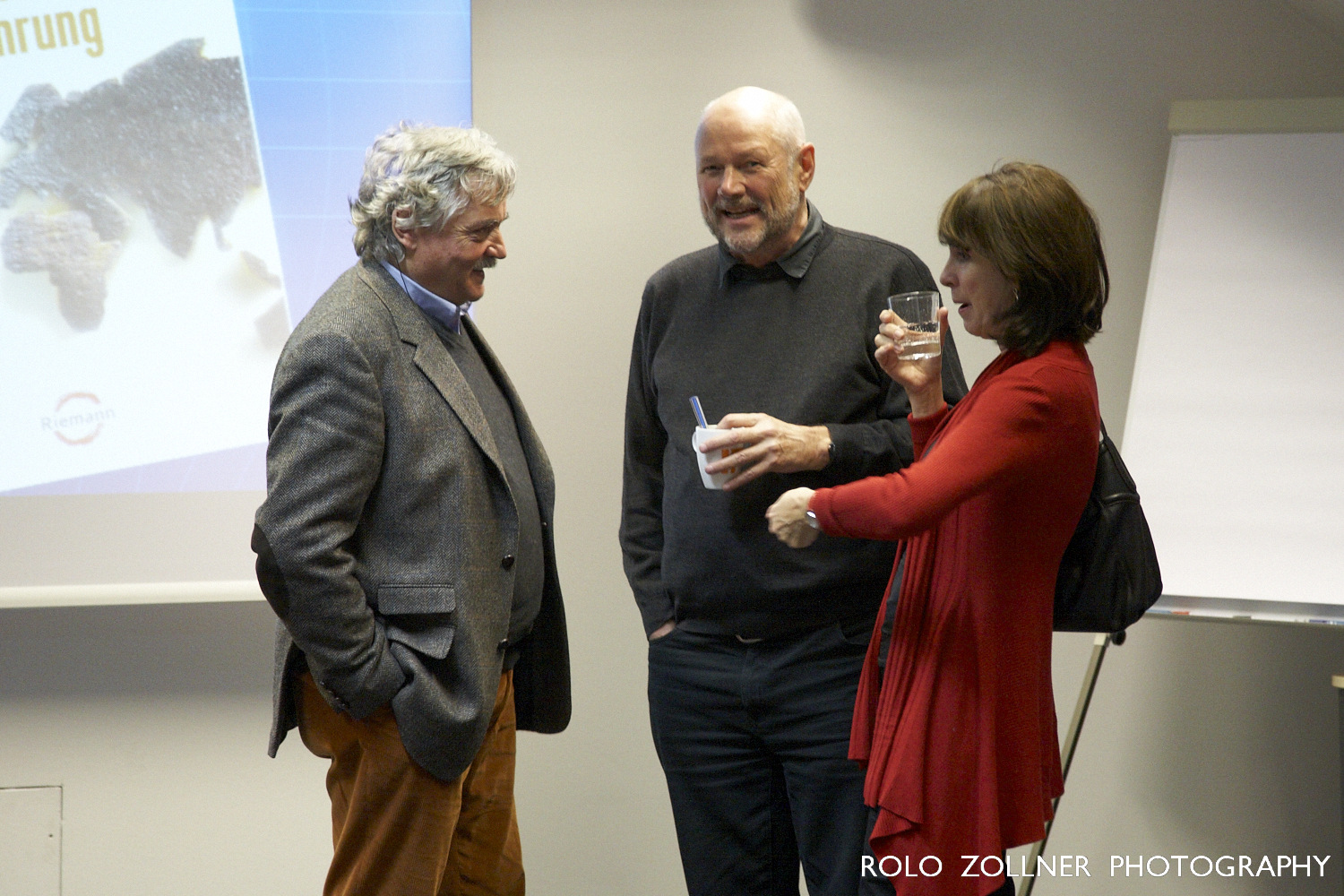
Wilfried Bommert talking to Mr. and Mrs. Gerlach. Thomas Gerlach works for the Bayerischer Rundfunk. He was the one who first introduced Herrn Bommert to me.
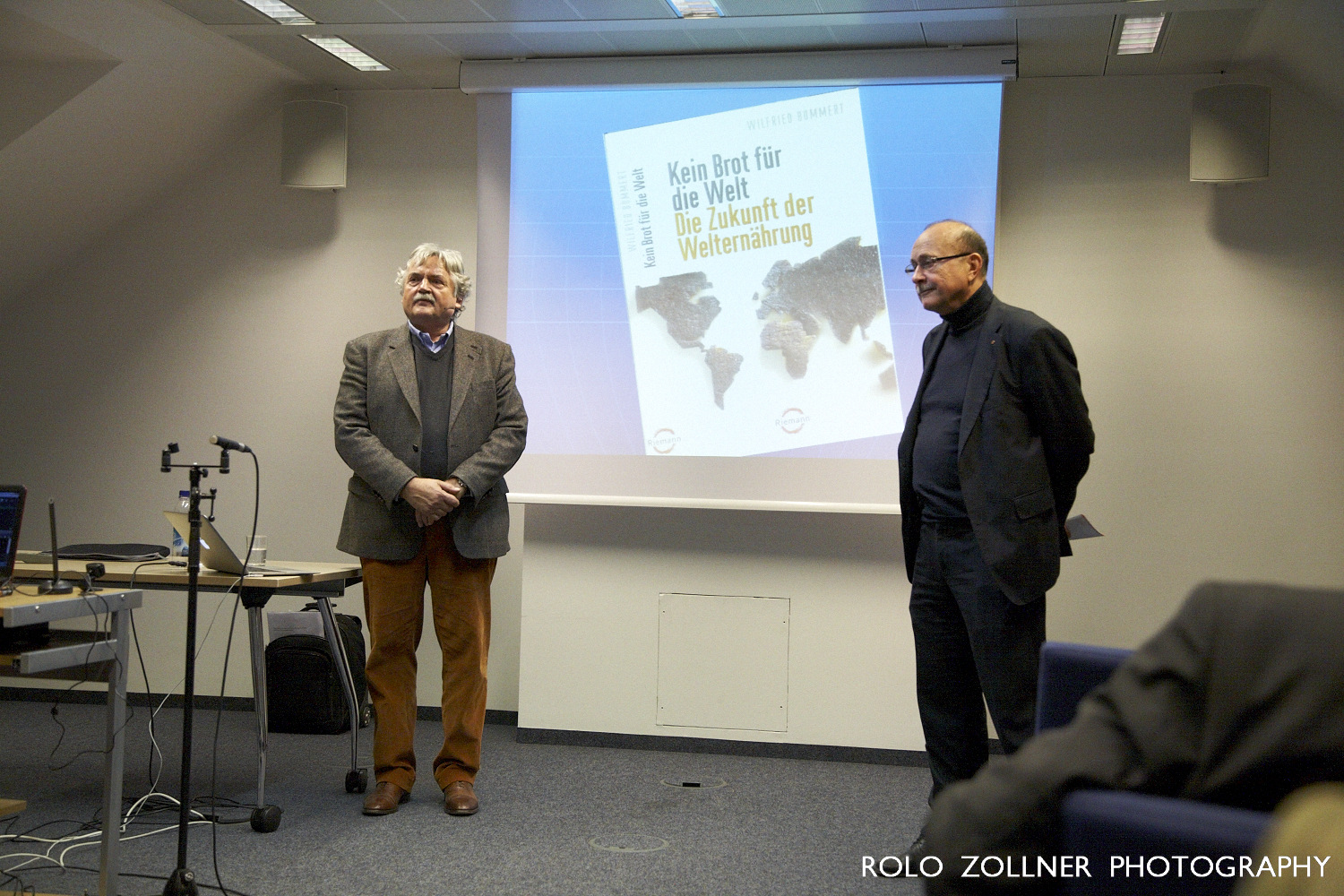
The introduction to the presentation. It will start right away …
As so often, all pictures were taken by our Rolo Zollner.
Roland DürreWednesday October 24th, 2012
Students’ Fees …
I am again listening to the radio news on Bayern 2. We will soon go to Mali and fight Islamists and Djihadists. Of course, we will not send fighting troops, but we will send soldiers. For technical support. Well, we have to do it, don’t we – since, again, the safety of the Western World is at stake… You know: terrorism.
It is an unhealthy report, but is fits well with the general picture.
The thing that surprises me most this morning, however, is the latest news about students’ fees. Mind you, I have not really made up my mind about students’ fees. There are just too many arguments in favour of and against them. Also, I do not know if students’ fees are relevant for the educational standard of a nation.
But I do find it interesting how the process of forming a political opinion works in our Bavarian bureaucracy. We have a party that, in my personal perception, is rather on the conservative side and daringly calls itself “Free Voters”. This is just as much a lie as a party calling itself “Christian“.
This party wants to look good with an emotional issue. So students’ fees seem a good idea. Basically, abolishing students’ fees is not something that would go well with the “Free Voters” program, but all is allowed if you want political success, isn’t it?
Well, a plebiscite will make you visible. Consequently, the “Free” party wants to initiate a plebiscite for the abolition of students’ fees. The authorities say no, for whatever reason. Of course they will go to court – and, of course, in the end the plebiscite will be permitted. Why should a plebiscite against students’ fees not be permissible?
But as soon as we have a judicial decree, the avalanche will start rolling. The parties assume that a majority of citizens will vote against the students’ fees. And this is how the massive pro-students‘-fees front will go down like a land slide. Just because a court of justice said so.
Is that the right way of developing social consensus?
RMD
(Translated by EG)
Roland DürreSunday October 21st, 2012
Ownership – Personal Data – Copyright – Ownership – The Law– Content …
Even with actual objects, no matter if mobile or not, ownership is all but a simple issue. From the ethical, moral, rational viewpoint, etc. …
It gets even harder when we are talking ownership of non-material, abstract, content or even “mental“ things. For life and survival, the latter basically is of no consequence – as opposed to a warm meal, clothes and a place to stay. And a little love. But there I remember: love, too, is something abstract, non-material. Can you own love? The phrase itself shows you how stupid the concept would be.
Debates about ownership of data and content are rather confusing. What exactly is this: data and content? And how can you own them? Who owns the date of birth of a human being? Does it belong to the mother (or the father), or to the child, or to the authorities where the child lives? Is it important who owns those data? Is the date of birth important at all? Does it exist at all in the course of the universe?
Who does a story belong to? Does it belong to the one who tells it or to the audience? What exactly is this: an idea, a concept, an invention, a story? What is its value? You cannot eat or drink it. So can it be something similar to money? A commodity of exchange?
Or is this about how something abstract can be made into money? Does such a thing as a unique story exist at all? Or is not everything based on something you experienced or learned? What can one individual person claim to be his own and what belongs to us all? Is the idea already the achievement, or is the value only created after it has been edited? Does something like justice exist?
Copyright and patents can be interpreted as the result of cunning businessmen’s work. They demanded that their interests be protected and then they put it into practice through good lobbying. Their – certainly understandable – goal was to gain a maximum of riches with a minimum of effort. Just like a Russian neo-oligarch who can become a billionaire in 10 years.
But is this goal (which actually was achieved) legitimate? Should you be allowed to “earn money” with the help of rights that have been scaled beyond all proportion – as otherwise is only possible if you are backed by capital? The motto would be: “here I am sitting at the beach and enjoying life while my money is working hard and very successfully for me”.
Except in this case it is the rights that work hard for those who own them. Historically, the entire copyright is simply another attempt at separating income from work and increase profit geometrically or even on a logarithmical scale, instead of linearly. Probably (and of course), it is all detrimental for the common good, i.e. for the people living on this planet and the planet itself.
So it is just a new method for increasing profit infinitely. Infinitely? Yes! We are talking billions – and for average citizens, one billion Euros feels like an infinite amount of money.
Thus, the interest group “intellectual property“ managed to initiate strange regulations and make them pass as law. The result is the current situation in the patent and copyright areas. These regulations have been promoted with arguments such as: otherwise there will be no progress. Mind you, those arguments were probably never true, but now, in the internet age, they have been definitely proved wrong. By now, “progress“ happens through a free sharing of knowledge. Even slogans such as “protection of intellectual property” will not make the slightest difference.
This is how knowledge and stories were confiscated (bought?) and privatized. The producers of content and illusions, in particular, claimed special rights in our cultural circle during the primitive times of media and start-up periods – and then they politically pushed those rights through with a strong lobby. Isn’t it remarkable that those laws are called “Micky-Mouse-Legislation”?
Many violations against laws thus passed, such as illegal copying, could be called self-defense. All you have to do is claim that the free sharing of knowledge is a necessary requirement for an innovative collaboration as part of the evolutionary development of humans.
Since my trip to China, I often feel Chinese. Chinese persons look upon themselves as one big family with no secrets. Regardless of the fact that there is no doubt they live in a dictatorship.
You have to share knowledge voluntarily in an open and free manner, simply in order to advance together! Isn’t the entire human race one family for which, basically, there may soon be nothing left but the struggle for survival?
RMD
(Translated by EG)
P.S.
P.S.
Two lines out of the wonderful song “Imagine” (John Lennon):
…
Imagine all the people
Sharing all the world … (yuhuuuh)
…
Roland DürreTuesday October 16th, 2012
Video: Dr. Marcus Raitner at the IF Forum “Project Coaching”
After the introductory presentation by Dr. Stefan Hagen at our technological IF Forum, Dr. Marcus Raitner (Esc Solutions) saw to the second part of the first section. It was quite exciting and very impressive to watch how the arguments and explanations of the two speakers complemented each other. The presentation by Dr. Marcus Raitner, too, is now available on Youtube.
The Third Technological IF Forum is about “Project Coaching“, which included “Best of PM-Camp“.
I would also like to, again, thank Marcus very much for his presentation. He contributed hugely towards our IF Forum becoming a success. Marcus is also the author of what is, in my opinion, the most beautiful blog for project management world-wide – misc.raitner.de.
RMD
(Translated by EG)


