
Roland DürreWednesday October 4th, 2017
Wheel, Lever, Wheelbarrow, Gear-Wheel, Crank, Steam Engine, Electric Motor, Digitalization …
A few thousand years ago, homo sapiens invented the wheel and – a little later – the lever. It took us humans a few more millennia until the wheelbarrow was invented – although it is, basically just a combination of the wheel and the lever. After that, it did not take too long for such basic things as the crank and the gear-wheel to be invented. And the steam engine, the Diesel motor and electricity…
And with the information and communication technology, we really got under way.

This looks like they took me to the photo studio – and I was probably wondering what was going to happen.
I often wonder when our house had its first electric motor. I am sure it was no earlier than 1955, when we moved from the country to the city. I still remember that, in the late fifties, a spin-dryer for our laundry basement was a modern achievement – and it definitely had an electric motor.
As far as I remember, there were no other electronic devices (Elektro-Geräte) in our household at the time. Until we got the first Märklin model railway. Then things really started to happen.
Up until then, the mechanical devices in our household all had a hand-crank. And complicated gear-wheels. For example the meat chopper, the coffee grinder, the machine for making cream. The drill, too, was hand-worked.
Consequently, I admired gear-wheels very much …
There came a day when our teacher took the class to see the Renk Zahnradfabrik
(it must have been in my third or fourth form)
– today, it is a stock-market enterprise and part of MAN AG.
The school was next to St. Anton’s church and not far from the “Wittelsbacher Park“. In this park, you could see something special: the “Rudolf Diesel Hain“. It was a quadrangle that had the size of an allotment garden and cypress-like plants grew all around it. There was an entry and an exit and inside were huge rocks from Japan. On copper plates, one could read what the Japanese People had written to thank the Great German Rudolf Diesel for his invention of the motor (at least that is how I remember it) that saved mankind world-wide from debasing and hard physical labour. That is why they had made the City of Augsburg – where the great man had been born – a present of this rock.
The Rudolf Diesel Hain was a nice piece of nature that became my cherished refuge when I could not be bothered to attend weekly mass on Sundays.
For me, the tour of the plant was very exciting. It is definitely something special to see how iron is processed – and the people working in the business were just as special. After the tour, the tour guide gave our teacher a rather heavy gear-wheel (perhaps 20 cm in diameter). It must have weighed several kilograms.
I assume that the gear-wheel was a throw-away product. It seems that the wife of our teacher was not too enthusiastic about the strange thing he brought home.
When school started on the next morning, he put it on his desk and announced: now you all will write an “adventure report” about our trip. And the winner (the student who wrote the best report) was going to get the gear-wheel as prize.
I was absolutely over the top. Because I absolutely had to get this gear-wheel. To be sure, I was the total outsider, because writing was my Achilles’ Heel. Since I had learned to read before starting school and was already through with most of the Karl May books, I found the school books rather boring.
But what is all this if there is a prize you absolutely want to win? Nothing!
Consequently, this was an essay I wrote with more effort than I ever again did anything in my life. I wanted that gear-wheel, still remembered my fascination with the trip and wrote the script for the play. I even tried to avoid formal mistakes and took care of my punctuation – which were things that, in those days, I generally could not have cared less about. I even took special pains with my handwriting. I strongly suspect that those became the only pages in my exercise books that were not poorly scrawled.
Since that day, I know the meaning of the word “motivated”.
I had to wait a day or two, then came the decision. And – lo and behold – I came in first and won the gear-wheel. And I was the happiest person alive. I remained the happiest person on the way home. However, when I arrived at home, the only comment my mother had when she saw my good grade on the essay was “there you see: if you make an effort, you really can write a good essay”. The gear-wheel was not at all appreciated. On the contrary. The comment was: “What a peculiarity are you bringing home this time?”
Well, my teacher had probably met with the same indifference a few days earlier when he brought it home. But that was not really much of a consolation for me.
The gear-wheel got a special place in my room. It smelled nicely of machine oil.
I still remember how, perhaps ten years later, my mother forced me to throw it out. It was a really nice gear-wheel.
RMD
(Translated by EG)
Roland DürreSunday May 7th, 2017
Quo Vadis – Digital Transformation?
Personal Statement.
“Digitalization” is a topic I also often talk about in my presentations. Consequently, I will also again attend the Oberland IT Camp next Friday (May, 12th). This is both in order to enlighten some people and – above all – to learn many new things and make new experiences.
Here are some of my ideas from several presentations, discussions and debates around digitalization. I am sure it would be enough to fill an entire book, which is why some of my ideas are only in catchwords. However, it should suffice for those who know a little about the issue.
Digitalization – a great misunderstanding?
No tomorrow without today, no today without yesterday!

My presentation during the evening event BICCnight it at media in the foyer of the Funkhaus Bayern, München on 22/07/2011 (picture taken by: Stephan Goerlich) – For the video, see below.
Abstract:
If you want to understand the present, you need to know how the present came about. The history of digitalization is very old. During the last fifty years, the development speeded up tremendously, and in the last two decades, there was yet another boost. All indicators suggest that, at least in the next twenty years, the acceleration will continue.
Digitalization
“Digitalization” caused a massive change in our society. It did so in a different way than but to a similar extent as the “Industrial Revolution” in the last three centuries. As we all know, the second great “transformation through technological progress” still lies ahead. It will, again, totally change our individual and social way of life.
Consequently, it cannot do any harm to ask the following questions:
What exactly is the meaning of digitalization? How did it happen? What changed so far? Where are we today? What does digitalization mean for the “analogous” creature “homo sapiens”? What will come next? And is it possible that the new technology will transform us back to a “creature that communicates purely analogously”?
In my presentations, I discuss these and other questions both on a technical and sociological level. I try to make my presentations easily comprehensible and entertaining. I am also brave enough to give prognoses and suggest a few answers. But above all, I try to provoke people and make them thoughtful.
Thus, many questions arise. They can be answered in quite different ways.
From here: more in catchwords.
What is the purpose of digitalization?
After all, humans communicate analogously, don’t they?
In our brains, language and thinking are analogous processes. A relatively short time after language was first used, there came the wish to write down numbers, ideas, thoughts and stories. Initially, it was probably also because it was an application that was economically useful. Later, it was used for handing down and making available for a broad public through the times all “knowledge”.
This is how images, symbols, digits, numbers and a systemic stock of signs (alphabet) were created. The goal was always to “lay down in writing” language (ideas, stories). Because you wanted to transport them through time and space with more than just by word of mouth. And when reading them, the “brains” had to “de-cipher” them into analogous language.
All stock of signs can be bi-jectively represented by the minimal set of numbers {0,1}. Digitalization means basically that what is analogous can be represented by something digital and then transported and processed, but, above all, again “made analogous”. That is how it started. However, today the digital world has come such a long way that it serves us totally analogously.
The history of digitalization:
Written language as digitalization of language: 24 symbols.
Stone, clay, papyrus, paper as information carrier.
Formerly: one monk dictates, many write down.
Then: printing press, movable letters.
Sound is mechanically stored (wax disc, hurdy-gurdy, record disc, chiming cylinder).
Information was transported through physical transport of the storage elements.
Interesting exceptions were linked signals based on optical and acoustical means (mirrors on watch towers along the Italian coast, drum chains) – usually with a reduced information width (for a certain purpose).
Then electricity came…
Transfer through cables via electricity or wireless
Storage: still mechanically (punched tapes).
Later: first magnetic sound carriers (currently disappearing).
Protocols:
The history of transmission protocols alone would fill an entire book. Here are just a few catchwords:
MORSE-Code (3 values, short, long, pause=end; variable sign length, maximum of four).
For transfer and later publication of content (material and method).
TELEX (mechanical – electrical)
CCITT-Code (5 Bit-Code, 31 symbols with 24 letters plus special symbols)
Telephone/Telefax – both were analogous with cable transmission.
ISDN and packet switching (X25) came later.
Long distance data transfer was by modem through the telephone network.
(modulation of digital signals into analogous signals and back through de-modulation at the other end of the connection).
Then digitalization came for data transfer, too. Basically, it is all about sampling curves in same-distant intervals (grids) – this is also how sound = music = language is digitalized.
At the same time, the universal machine (computer) was invented. Basically, it could do more than just calculations. In fact, it could do everything.
Pandora’s box opened.
The CD came in 1982, ISDN in 1989 (Pilot as early as 1979).
CD is short for Compact Disk, initially it was called DD for Digital Disk.
When ISDN was first introduced, both the population and the parliament were very much afraid because now total supervision was possible! Today, ISDN has been replaced – as TELEX has been in the 1980s. And everything can be more or less supervised – and is being supervised as the necessity arises.
Data processing, too, became digital as a matter of principle and data display consoles were added to the mix.
I saw my first colour data display console on the Hannover Fair in 1980. It had been produced by Tectronix, looked like a big Oscillograph and cost as much as a small terraced house in Munich.
It was now possible to multiplex on one cable; then, at long last, data remote transfer based on packet switching comes (Datex-P X25). For the first time, networks become “clouds” – up to now, they had always consisted of numerous linked lines.
The future belonged to screen texts. The blanking interval of TV was made use of. After all, during the time the cathode ray needed for going from the bottom right to the left, no data were transferred. This was utilized for embedding data into the TV program. By using a simple back channel, they were even able to create an interactive communication through the TV with screen text computers. Even graphics was possible. Simple images were coded on the line and column screen through codes that were based on alpha and mosaic tables. To be sure, the result was a little plump and it took a long time to generate a page, but at least it worked. Nevertheless, BTX was soon overtaken. But it was certainly a good tool for watching soccer results and simple news for many years.
Another “service” – teletext with a more achievement-based point-to-point protocol (Datex-L) and standardized visual display units as stations was to become the predecessor of Telex (also known as: wire based with output on teletypewriter). But that was a product that failed before it was even operational
Note:
I experienced two “goose-bump moments” on the Berlin IFA (Internationale Funk Ausstellung): first with coloured TV (1960s) and then with the CD (in the 1970s). Both times, I experienced something that had seemed “unbelievable” for me. Again, reality pushed its way closer to our living rooms, the real world started getting mixed up with the virtual world.
Technological Advanced is Under Way:

Here my father’s original “Transistor-Radio”. We used it in IF-Blog as label for our Radiophilosophie.
I will never forget my father’s transistor radio. Because this was some progress that really made him happy. It was a small Grundig device with six transistors. It ran on UKW and MW, was small, had batteries. Now you could receive radio waves everywhere – even abroad. That was important in times of cold war.
Incidentally, coloured TV was first broadcast in 1967. And for us black-and-white watchers, it was something like a technological miracle (although we had been taught – and even understood – the technical principles in physics).
Citation:
When coloured TV started in 1967 Körting offered the cheapest colour TV, a device with 14 tubes plus image tube and with a two-transformation unit concept.
And then matters developed from there.
Digital music (the gramophone record was replaced by the CD, the CD was integrated into the iPod through MacIntosh and iTunes).
We got wireless telephones and then later digital telephones.
In addition to synchronous communication, there was now also asynchronous communication.
Note:
Here is a video recording of my presentation in the Foyer of the Funkhaus Bayern in Munich on July, 22nd, 2011 that fits quite well at this point. The wonderful title was::
What’s new, pussycat?”
Then came solutions that we still know today …
e-Mail
Internet
telephones with pictures
Social Media, FB, Google, Wikipedia …
Today, this is all really ancient stuff.
But there was also lots of rubbish:
The obligation to save emails, data collection and data security (almost ridiculous and a thing of the past, because today it is a matter of course)
Then came BIG DATA and with it another huge misunderstanding.
Just look at sentences like: “Data as crude oil of the future”, “big data engine will make dollars out of data”. All these sentences are bullshit at best.
Along with these developments, the calculator replaced having to do your sums by heart, on paper or with a slide rule.
And they say that, soon, the cars will all sit in the queue without anybody behind the wheel while the manager uses the underground train, which brings him to his meeting on time while the car arrives late. …
But what is the trend?
There was a time when I would have written: snapchat, wechat and the likes are what determine our future. But today, all of these, too, are a thing of the ancient past.
Tomorrow!
This is probably only about developed societies – the others will become poorer and poorer and will have totally different things to be concerned about. But here, much (all?) might change:
Chat kills E-Mail
Podcast kills Post
Audio kills reading & writing
Video kills Audio (telephone)
… ???
The classic form of mobility will change drastically.
3D will change everyday life.
Documents will probably soon disappear.
Money will become truly virtual.
Ownership, property and legality will become virtual – with all its consequences.
The golden rule will be: “Whatever is simple and useful will win“
The Messie culture will leave the real world (property will only be a burden) and become virtual.
We will leave physical values, a well-filled digital stock is more important than strange physical values that only cause stress.
Many hypes that today annoy people will become matters of course – or will totally disappear.
Even more than now, people will talk about things they do not know anything about.
Machines will determine what happens.
New tools will determine trends.
Learning and education will change drastically.
What will happen to schools and universities? Perhaps some of them will survive as nostalgic remainders from former times.
Smart Solutions will work for us and we will not even be aware of it.
Smart Solutions will make “shared economy” possible, perhaps thus saving the world? Or maybe they will at least postpone the apocalypse a little?
Through self-sufficient learning, systems of artificial intelligence will become faster and more intelligent – and will humans, to make up for it, become more and more stupid?
New technology will make the world go round even without humans, because it will directly communicate with the world.
In society, we will get “conspiracy theories” that have totally new dimensions. Humans will use more and more audio, video and three-dimensional experiences. The competence to read and write quasi automatically because it is a cultural competence as a matter of course will disappear. Rudimentary illiteracy will develop. Most people will forget how to read and write, just like they already forgot how to do sums by heart or on paper a long time ago. Because you simply will no longer need it.
But then, what technologies already play an important role today and will probably become really relevant in the future?
Or: What do we wish to focus on today?
Sensors!
Up until recently, the entire IT always communicated only with humans or, at best, with other “digital systems”. By using sensors, IT can now suddenly work directly with the world – it no longer needs humans as in-betweens.
Smart Solutions
In the context of solutions, Smart means the combination of “digital technology” and “social change”.
Short: smart = social + digital
More advanced solutions that, today, are named by buzzwords like augmented, merged or virtual reality.
All kinds of autonomous and integrative systems, probably totally different from those we even imagine today. Which probably means something other than the self-driving car. Let us just wait and see!
The problem will always be the user interface. For instance, if you look at the poor grades even much-used “German Apps” get, then you can easily conclude that the development of Apps has a very good future.
Let me conclude with a warning and a
theory:
The future – based on digital technology – will bring the “analogization” of everyday life and an enormous social change through smart solutions!
Warning
Digitalization is a very old thing! It was in the ancient past! Issues like data security are dead. Discussing it will only deflect us from actually following the current developments. And from giving the quasi automatical social change a humane orientation.
As I see it, we really should have discussions and debates about this. But, please, think first, then talk!
RMD
(Translated by EG)
Roland DürreThursday February 16th, 2017
In 1985: object-oriented – Today: agile, digital, lean, open, social.
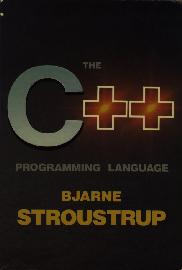
In the autumn of 1985, I was the first to bring this book to Munich after having bought it at the Uniforum fresh from the printing machine.
A short time ago, I retrieved it. It reminded me of having been at Uniforum conferences with friends of mine in February 1985 (Dallas, Texas) and in 1986 (Anaheim, California). It was great. In those days, the Uniforum was the one and only UNIX conference in the USA. We were thousands of enthusiastic visitors from all over the world. I experienced a huge atmosphere of dawn at the time.
There was also a small sensation. Copies of the very new book on C++ by Bjarne Stroustrup (see left on the picture) right from the printing machine were delivered in the middle of the conference and sold directly from the palette. I bought a few of them and took them home. They were probably the first C++ books to ever reach Munich.
This brings to mind: in the 1980s, I constantly gave presentations on software development. At the time, the change in programming was the central topic, and the catchword used most often was OBJECT-ORIENTED.
I also wrote quite a few presentations on “OBJECT-ORIENTED” for IT managers. Among them was a “high-up” at Siemens AG in UB D at D AP (or was it already SNI at the time?). He was asked to tell his “team of leaders” what exactly OBJECT-ORIENTED meant. Afterwards, he said the presentation had been well liked – but it certainly did not really make a difference.
Today, everybody programs object-oriented. In fact, it is even a little too much for my taste.
Later, I gave up my “programming career” and became something like an “entrepreneur”.
 Now I was no longer preaching the gospel of technology. Instead, I spoke about leadership and management. And in particular, I talked about the “smart” pentagram that consists of the terms “agile”, “digital”, “lean”, “open”, “social” and how they interact.
For instance, I related why courage and joy in those working for an enterprise is also a central requirement for economic success. And I also told the people how necessary mutual respect and appreciation of each other are (not only) in an enterprise. Why meeting at eye-level and shared participation and responsibility are the basic requirements for innovation. And why humans are not resources. And how change can only happen in an agile environment.

“Pro Agile“on the DOAG Podium /Yearly Conference in 2013.
I explained why processes, rules and bureaucracy are obstacles to the necessary change. I also explained what a huge damage Taylorist developments cause in an organization and how much waste (as opposed to “lean”) is created by an overwhelming administration and the rising bureaucracy in an enterprise as a consequence of those developments. And that it is totally useless to have endless meetings.
And that departments such as “human resource”, “customer relationship management”, “marketing”, “legal service” etc., basically do not guarantee the success of an enterprise. In fact, they come closer to endangering it.
And that the young and well-educated persons of today prefer working in an enterprise the central element of the culture of which is trust.
I can easily give you good reasons for all I said. After all, I myself was part of the scenario when we software developers made a (as I see it: central contribution) towards a new understanding of work that now spreads more and more to other sectors (#newwork). And this is how it helped to change the world.
I wonder if my call for “agile, digital, lean, open, social” as a “smart” pentagram will do any good? I am not sure.
I also got the impression that my audience mostly saw it in the same way. In fact, it would make me happy if we in the German Industry were to talk less about industry 4.0 and more about entrepreneurial culture. Be it 2.0 or 5.0.
Even the big bosses must understand that our enterprises and we ourselves can only survive well if we are prepared to question what we used to consider certainties and to change what we were used to.
Of course, I understand that it hurts to question hierarchies, cherished sinecures and structures you have become used to. Especially if you are the boss. But please keep in mind: we no longer live in the times of Henry Ford’s conveyor belts and even the prime time of the Chicago slaughterhouses is coming to an end.
RMD
(Translated by EG)
P.S.
I took the star from the central media archive Wikimedia Commons.
Roland DürreTuesday February 7th, 2017
Hacked By XwoLfTn …

Logo of the Chaos Computer Club, the most influential association of hackers in the German-speaking world. Security questions are their main field of interest.
Now it happened:
IF-Blog has been hacked. For the second time. Here is what happened each time: The headline is overwritten – and so is the text. The last time, it was my article America Firs that got under attack.
The headline was replaced by
Hacked By XwoLfTn
and the entire content was overwritten by
Hacked By XwoLfTn – Tunisian Hacker.
Before that, it was my EURO story (EURO-Geschichte). With the same result. The headline and the content were the same as this time.
I was able to reconstruct both articles, which means I am glad that nothing worse happened. But you can see they actually exist: evil guys on the internet. The Chaos Computer Club (CCC) – which I hold in high esteem – is again correct. And so is my friend Hans Bonfigt.
Unfortunately, I do not yet know if we are talking an individual person who wants to annoy me or another Bot doing damage. Looking at google and realizing how many blogs are affected by the same effect, I rather fear the latter.
As soon as possible, I will now install the latest wordpress version. And I hope that helps. And if any of you are wordpress experts – or even better: if any of you know what exactly happened, I would be grateful for any advice you can give me!
Many thanks in advance!
RMD
(Translated by EG)
Roland DürreSaturday November 26th, 2016
Vintage Digitalization: Email and Telephone. Or: No More Email and Telephone Terror!

““Die Winderhitzer der Völklinger Hütte”. Also Vintage”
Regardless of the fact that I consider email vintage technology, I still have some email addresses. Many useless and stupid messages arrive.
It is my task to then delete those emails and ask my communication partners if, please, they could use other ways of communication.
Today, something happened that made me smile. I received an email from a beloved and long-time friend whose technological competence I rather appreciate.
He sent an email to a lot of people ( (all@XYZ.de):
Hi,
Could you please leave us alone with this totally irrational discussion!!!!!
I, too, said what I think about mail distributors and internal mail in the survey about new communication forms.
This is another typical example illustrating the fact that intra-company emails are total nonsense and why email distributors inparticular should be immediately made redundant.
To all, and I really intended to write this!
Incidentally, the “totally irrational discussion” was about the problem with rechargeable i-phone batteries and their exchange.
I replied as follows:
Your email made me smile. 🙂
After all, I totally agree with you – except that I am even more radical. Email is no longer a general communication channel. Instead, it is a totally old-fashioned one which – it goes without saying – should no longer be used in modern enterprises.
Emails to third parties should only be sent in those few instances where in former times you actually wrote a letter, sent a telegram or went to a public phone booth. Everything else should be done with tools that are adequate to the task.
Best wishes and a nice weekend to you!
Yes, I, too, dislike emails. More often than not, they have huge footers made even larger by artificial nonsense and totally uninteresting advertisements or stupid legal disclaimers.
I hate email dialogues that cause a constantly growing series of email incarnations through more and more dialogue steps. With every reply, you create a new email that contains the same as before, with the addition of the last reply. When the internet was first introduced, they made an attempt to make the design of email communication a little more agreeable. For example there was the so-called tofu rule.
Unfortunately, however, “tofu” was only applied by very few users and consequently failed.
As a general rule, communication will be carried out as a “thread“. Ever since we have the perfect chat, email is mostly obsolete. In the “peer2peer“ thread, I can always immediately see what has been recently said. That is also true for persons with whom I rarely communicate – where it is extremely valuable. Threads are also a good tool for more than two persons who wish to communicate. If you use email, you immediately get a catastrophic flood of “cc”-s and “bcc”-s.
Moreover, I enjoy using images, audios or small videos in my daily communication. How cumbersome is this both for the sender and the recipient if you use email? Just look how easily bbm, wechat, whatsapp, the FB “messenger“ or Skype, the twitter “dm“ (direct message) etc, work. Not to mention Snapchat, the system with the most modern and simple of all user interfaces.
Even better for structured communication, even in bigger teams/groups than chat systems are “communities”. There are many communities in the internet, for instance in Google+. They show you how it is done. And how you can communicate well and yet very structured and highly efficient with very simple means within an organization. And how you can do totally without the email nonsense, rather than flooding the non-interested and non-concerned parties with spam all the time!
Note also:
The telephone is also OUT. I only use my telephone after having made an appointment in advance to do so, if there is something important I need to do or if I want to talk with someone and pay full attention. Consequently, I no longer use the telephone in the car or in public places like trains. And even for important issues, I only use the telephone if image telephones (Hangout, Facetime, Skype, Cisco, Citrix …) are not an option because the person at the other end prefers the good old telephone.
In case you forgot: the “telephone” function on the smartphone is also just an app for synchronous spoken communication that enables your connection with addresses made up from telephone numbers (digits) and through “voice-over-IP“.
Consequently:
If someone calls me and I reply with
“Now who interrupts me in my work?“,
then I kindly ask you to forgive me.
I continue to be available on the telephone for all those who need me. Here is my physical telephone address 0049 171 4850115 (unfortunately, the symbol telephones have now been out of fashion for a long time). But, please, only call if it is really important and totally urgent!
In all other instances, please ask yourself if it might not be enough for you to use asynchronous (spoken) messages through one of the chatters I use or, if it is about a specific topic, for you to send a message to the respective community.
RMD
(Translated by EG)
Roland DürreThursday October 27th, 2016
#Digitalisation – The Filter Bubble“.
 We live in times of irresponsible blabber. I feel it with special intensity whenever I hear how even self-appointed prophets speculate about digitalization. How much nonsense we have to read. Then, I also notice how many persons jump the bandwagon, uncritically repeating what they have heard or read. Thus they promote fear at places that will only deflect from the real dangers.
For me personally, the “digital change” is just the continuation of the change that has been caused by technology in the age of the complete electrification of our planet (or something similar). Since I myself experienced said change and was even part of it, I often try to contradict all the nonsense I often hear repeated by individual persons.
For me, for instance, a “driverless” car, be it a truck, bus or car, is nothing other than technological progress where iron is replaced by IT. Basically, the new vehicles simply do without tracks, instead using IT in order to reach their destination without a driver. That is far from witchcraft – it is simply engineering.
A harmless example of how panic is created is, at least so I see it, the much-cited “filter bubble”. In their Sunday speeches, more and more people state that a huge danger is looming because of it and that we are manipulated by algorithms. Here is a text I copied from a Wikipedia article (version of October, 27th, 2016, german)
The filter bubble or informational bubble is a term used by the internet activist Eli Pariser in his book of the same title. According to Pariser, the filter bubble is generated because websites try to predict what information a user wishes to find by using algorithms – based on available information about the user (for instance about his location, history of searches and click behaviour). The consequence is an isolation from information that does not match the position of the user.
So – tell me what is new about this!
I, for instance, have been living my filter bubble since I was a small child. As soon as I was able to read, I went to the library (first the catholic library, later the public library) and borrowed exactly those books that matched my VEIN (values, expectations, interests and needs).
As a reader of newspapers, I soon preferred the SZ over the Münchner Merkur. Later, I learned that newspapers try to write exactly what their readers want to read…
When I was an adolescent, I went to the “Republican Club” meetings, rather than the “Young Christian Party” and fraternities.
This is how, due to my limitations, I maneuvered myself into my private “bubble”. At the time, the radio got me out of it. At Silvester Evening, for instance, there was the Lach&Schieß, coming up with totally new ideas and unheard concepts and thereby drawing my mind towards completely different issues.
What used to be the radio in the form of “public broadcasting” is now the internet. I communicate with other persons, read their blogs and, once in a while, even listen to their PodCasts. In that respect, I am a little old-fashioned, because I actually still do some reading, not wishing to run around with headphones all the time. But even my behaviour will not have an influence on the future. Consequently, audio will win against the written word when it comes to knowledge transfer and exchange of opinions.
This is how I see and do many new things on the internet. Because, basically, the internet is not just google and facebook. Above all, it is about persons who blog and podcast their evaluations and their lives and who provide me with many ideas that, indeed, counter my prejudices and remind me to be tolerant. And this is how I learn to respect and appreciate opinions and persons that and who I just used to dismiss without any good reason.
My friends are like me in that respect. I feel rather well living in that bubble. I could not care less about the algorithms. Nor do I see a great danger in them. More often than not, I get the impression that the internet is made to be the big culprit just in order to camouflage how massively we are controlled by manipulation and lobbyism. Because it actually makes you more free and autonomous, thus being a danger to prevailing structures and systems. Consequently, they also do not like the idea of freedom of the internet and see to it that online freedom is torpedoed with all possible arguments – no matter how stupid.
RMD
(Translated by EG)
Roland DürreFriday March 11th, 2016
“Inspect-and-Adapt“ Your Estimates!
 I always like visiting the Munich Techdivision. For me, this event, organized by my PM-Camp accomplice Sacha Storz, is very attractive. The next event is on March, 16th, 2016, between 7 and 8.30 p.m. They finish earlier than usual, because they want the visitors to have the chance to be back home in front of their TV sets for the Bayern Soccer Game. The location is the TechDivision offices at 73, Balanstr. (building 8, 3rd floor) in 81541 München.
Here is the official call for participation:
According to estimations by User Stories, project planning still plays a central role in agile software development. Imprecise estimations will, for instance, cause higher costs than planned or a longer production time than originally agreed upon.
During a TechDivision study, we investigated the User Story Estimates in four different projects. The goal was: identify problems and propose improvements. It is a rather well-known principle – after all, there is always an “inspect-and-adapt” framework in Scrum.
But: how can it be adapted to estimates? And how are the results of the study related to the #NoEstimates discussion?
I find the topic rather interesting. After all, I am a supporter of the provocative theory: “don’t estimate“– and I can find numerous reasons for this theory. In addition, I find it quite motivating that my own son Rupert will be the speaker.
About the speaker:
 Rupert Dürre is a consultant at the Swedish IT company Netlight. His interests are various areas of agile software development in requirement engineering and development practices, such as also the question how to organize teams in order to make an effective cooperation possible.
Note:
There is no admission fee for the event. Please register at the website: event.
Well, next Wednesday at 7 p.m., I will be at Balanstrasse and I look forward to seeing many friends!
RMD
(Translated by EG)
Gastautor(en) Tuesday October 6th, 2015
My Friend, the Software Cheat …
Yesterday, I received mail from Hans Bonfigt. Hans is much appreciated by me for being an excellent software and IT man. He is quite famous for his stubbornness and drastic language. This morning, he wrote to me:
Dear Roland, I hope you are fine!
A short time ago, I wanted to reply to your recent forum comment on the VW affair and your assumption that it is probably a novelty for software being used to manipulate. During a longish train trip, I took down a few – unstructured, brainstorm-like – observances on my blackberry. The final result gave even me pause.
Even if I probably do some damage to myself and although it is still a little early for a life confession at 55: here is a guest article for your IF blog.
Yours,
Hans Bonfigt
I, the Software Cheat.
 The relevant part of my life can easily be summarized in one sentence: quite often, I successfully combined basic insights from scientists like Newton, Gauß, Boltzmann, Steiner, Euler and Shannon with the technological knowledge of my customers in order to generate programs that were supposed to help the experts towards working more efficiently.
This is how, with exactly said paradigm as a mental concept, I started developing software in 1980 – for calculating electronic motors, parable springs or lifting ranks, or for controlling temperature, passage, pressure and location.
As far as I was concerned, things might have continued endlessly in that way…
As early as in the 1970ies, my old man had made fun of the “academic proletariat” by pointing towards an FAZ cartoon: loser type wearing doctoral cap is holding the door open for decadent opera goers and the title is, “Dr. rer. pol. Rolf Wüllweber, dissertational thesis supervised by professor Steiner, ‘The socio-cultural meaning of the Loden coat with special focus on the late Weimar Republic seen in the light of modern insights on socio anistrophy and abstraction analysis‘. Maybe he should have listened to his professor Steiner when he said: “Wüllweber, all you can do with this dissertational thesis is become a doorman.“.
All of a sudden, everybody studied something and nobody had any use for those affected pseudo theorists. Those empty nuts could not be used for doing a good day’s work, consequently they made their clandestine ways through the companies in the departments documentation, “communication”, internal regulations (note by the lector: product planning) …
At Siemens, this species allegedly even invented a “greeting order”, telling people who had to greet whom first where, when and following which protocol determined by rank (next note by lector: I definitely knew the regulation about which rank was entitled to having curtains in their office …).
But then, something happened that was called “QM”: Quality Management.
Nobody wanted it and all enterprises I know willingly conclude that the quality of their products definitely got worse after they introduced quality management. Well. There are at least two ways for dealing with this kind of news:
For instance the Russians and Italians simply took their DIN/ISO badges and glued them onto their products – and that was it. The same happened to the UL and CE badges. In Germany, this is something you cannot do. Hundreds of thousands of morons who had never worked in their lives, were “trained” to become ‘quality managers‘. During the time that followed, they came up with the most abstruse of regulations, none of which had anything at all to do with what the final product was actually supposed to do. Yet all these regulations made the production more and more expensive, thus driving another nail into the coffin of the already existing location disadvantage Germany was suffering from.
No enterprise can suffer a technocrat without fantasy for more than five years (let us leave VW and Carl H. Hahn out of the equation for the time being). Consequently, the hot air merchants, following the principle ‘promoveatur ut amoveatur‘, moved on to become managing directors and – even worse – to sit in all sorts of norming committees as lobby-affine lackeys. This is how works like the “DIN EN 1570″ were generated. I personally had to spend quite some time professionally with this regulation. It is a lot too specific when it comes to details and far too wishy-washy when it comes to important criteria.
And this is where my personal sin originated:
Since the norm annoyed me enormously, I started to misinterpret it intentionally and make use of all the many gaps therein. Because both the European and world-wide competition could not have cared less about this great new Euro norm – yet the products of my customer were controlled following it. Before that time, I had been proud to have produced algorithms that actually were a model of reality – now I manipulated the model by using definition gaps.
And as I am writing this, it suddenly dawns on me that, in fact, creating a wishful image, rather than modelling reality, was something I started a lot earlier than I thought.
For instance, there was the carrier who was notoriously victimized by the police and the authorities: they kept sending control brigades who took a really close look at the trip recorder discs that had to follow strict archiving regulations. Any violation was detrimental both for the carrier firm and the driver – and the grapevine said: “if you want to keep your driver’s licence, you do not want to work for W.”.
Well, what can I say? My connections to KIENZLE were quite good, so I got myself a tachograph, modified it in such a way that it got a V.24 interface and designed a computer program that expected the time, driven kilometres, starting and destination points and then “faked” a disc that was in accordance with the StVO regulations.
We also developed other devices that significantly increased transport safety for the same industry: I am sure you, too, know someone who, at least once, almost or actually hit the car in front when the driver of said car abruptly hit the brakes on seeing a radar trap? Using our active RadarJammer, you could continue driving at the same speed as before, because it interfered with the then used “Multanova 6F“ and “Traffipax“ through phase interference.
When all those impossible “intrastate” messages became compulsory for many enterprises, we were the ones who wrote a module for the then used analysis software “CBS/IRIS“. It provided the statistics experts with pure random numbers. We were especially proud to have managed printing with laser printers on forms that had to be ordered – if I remember correctly – from Saarlouis. It had been desired to concentrate on following product groups, but that was not a must. Consequently, many of our customers sent us entire boxes full of forms addressed to the statistics authorities. However, no OCR system in the world would have been able to read all these different fonts and – naturally – the dark-grid background.
We also offer solutions for the “Elektronischer Gelangensnachweis“ and for the “reverse charging“ – turnover tax procedure, but since these are currently still used, I cannot write about them. So now, having reached the last third of my professional career, I have to accept to my own horror that one third of my “work” was directed at evading bureaucracy – to say it politely.
Of course, I have a motivation for all this cheating: for instance, if the UE finance ministers go on about those “criminal turnover tax carousels”, then why don’t you abolish the entire turnover tax? You could considerably reduce the burden of the enterprises and put taxation on those who in actual fact are exclusively the ones paying it: the famous “men on the street”. So what happens instead? The already complicated and complex turnover tax regulations, incidentally without legal foundation, are added to by more harassment, which again has a detrimental effect on the competitiveness of German enterprises.
This is where civil disobedience becomes our first duty as citizens!
But there is also an opposite side of the coin. I want to illustrate it with a real-life example: it is next to impossible to build a certain type of spring with a tolerance of less than 15% – the inner friction is too high and even as you assemble it, the radius and thereby the springing rate will change. I cannot give you the type of spring I mean, because knowing it you would be able to conclude who it has been built for. Everybody knows that the norm is idiotic, the required precision is unnecessary and the assumed weight is totally unrealistic. Consequently, the quality control person of the customer will visit regularly for acceptance tests, criticise the part of the springs that are beyond the tolerance scope, take the bribe and disappear.
As I see it, the worst about it is that the bribe is ridiculously low, since it typically consists of one crate of the least expensive spirits available. I saw the crate myself but refrained from trying. Because: this acceptance lackey will also betray himself and his job for truly safety-relevant car components the characteristics of which really should be within the tolerance range in order to avoid serious accidents.
Mundus vult decipi, ergo decipiatur — there is really no other way to explain the VW “scandal”. Well, VW always cheated, and I mean in a very blunt way. I never dirtied my hands by doing anything for their products, because VW actually is an insult to the intelligence of all mature persons.
Let us remember the mid 1980ies. While BMW and Mercedes used reasonable exhaust gas treatment systems for their vehicles, for instance an air-mass controlled BOSCH Motronik with lambda regulation that produced a stoichiometric mixture in all active states, VW kept using the mechanic primitive injection with pressure plate and flow divider. The concern proudly announced: “We drive without a catalytic converter because that is what we believe in”. And for those customers who were obstinate enough to still want one, they had a full load enrichment switch everybody could see clearly on the control slot guide of the throttle valve.
As soon as the driver really asked his “Power-Through-Joy-Car” to show what it can do, the gas/air mixture was overly lubricated through full-load enrichment in order to prevent the primitive proletarian vehicles cost-optimized at the lowest possible embarrassment borderline from collapse due to overheating. Now, unburned fuel would end up in the catalytic converter, which has the effective surface of a soccer field. Now, as soon as the VW driver goes back to part-load, the oxygen can flow back to the catalytic converter which is now full of fuel. Due to its small specific heat, the ceramic substrate was not capable of discharging the energy of the strongly exothermic reaction, which means that the platinum layer evaporated.
After a few thousand kilometres, the VW catalytic converter was totally damaged – and everybody knew it! But that is only half of the story. Through targeted lobbying, not just by VW, they managed to abolish exhaust examinations for cars with catalytic converters – un unimaginable farce, but nobody noticed.
I could not believe my eyes when, in 1988, I saw a Volkswagen with a decent fuel-injection system in California. When I asked one of the VW employees, he told me: “Yes, of course, we know that our fuel injection is crap. Consequently, we reduce the power of our US models and take an injection system that actually works. Because in California, the cars have to undergo regular checks and if a catalytic converter is defunct, we have to replace it at our own cost “.
And now do not tell me you could not have known any of this, because almost everything I have been writing here was published in the daily newspapers. At the time, Lutz “Luigi“ Colani got carried away and was heard with the bonmot: “VW is a dungheap on top of which [Carl H.] Hahn is sitting“. Any intelligent person who wanted to know it knew: VW is the automobile pendant of Microsoft. For people without culture, brains, taste and the capacity to judge.
Basically, compared to the cheating I just wrote about, the current affair is ridiculous, isn’t it? They come up with a regulation that is far from practical and VW complies by doing something that is far from practical in their tests. That means they passed the tests, didn’t they? So what?
You can see the sad state of affairs when remembering that, nowadays, Audi is building “sound design” into their cars near the exhaust pipe. Besides taking up space and weighing something, they have no use whatsoever except to create a “full sound”. Because the typical AUD-iot will be satisfied with dummies.
Cheating on such idiots – well, I would have no scruples — mundus vult decipi. Secretly, I am still hoping that my manipulation would not have been discovered.
This article has been published verbatim for and in the name of Hans Bonfigt. And many thanks to Hans! – RMD
(Translated by EG)
Roland DürreMonday October 5th, 2015
Meeting to Give Our Future Chance.
Isn’t this great?
Only the colleagues at Visual Braindump
– Christian Botta and Daniel Reinold –
can come up with this kind of idea for saying it in a nutshell in graphic form – our ActMobCmp:
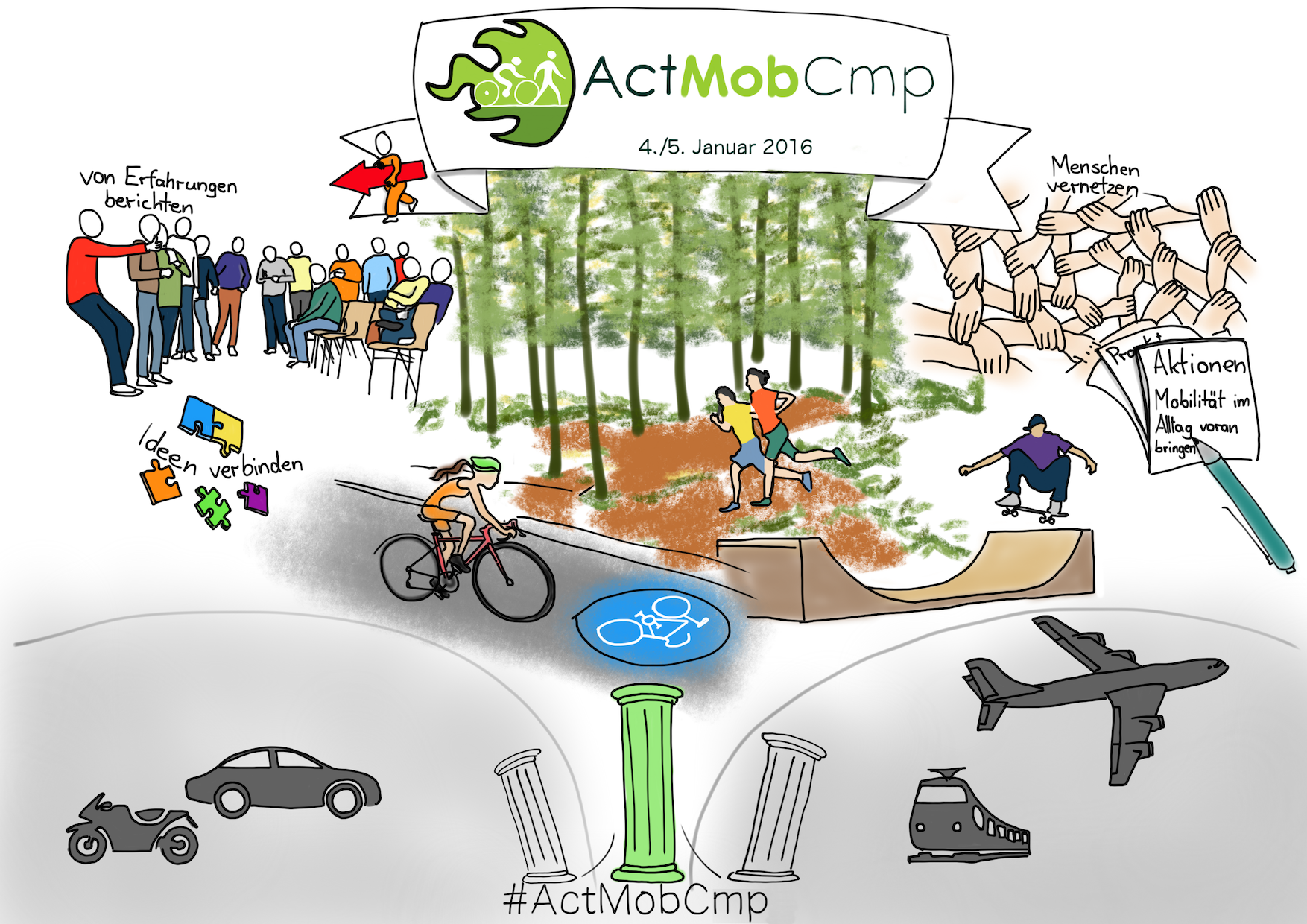
Click to scale up.
“Active Mobility in everyday life” is the third column of mobility, besides individual motorized traffic and public transportation. Unfortunately, it is often considered no more than the leftovers, both in society and politics.
We promise:
AktMobCmp will be a great barcamp that takes place at a rather uncontested time! We will experience two special days in the company of people we like to meet between January, 4th and 5th, 2016 at Unterhaching.That hurts, and we have to change it. Because we have to rationalize our mobility in order to preserve our future resources!
Many thanks to Christian and Daniel for their huge support!
RMD
(In the name of the AktMobCmp team/translated by EG)
P.S.
Here are two IF Blog links for articles on AktMob and AktMobCmp. And since it is such an important topic, I would invite you to share and re-tweet!


