
Roland DürreMonday November 9th, 2015
Vintage Project Management #4 – My Biggest Project of All Times
CLOU/HIT at InterFace Connection
Or:
How Wolf and I eventually ended up doing it ourselves.
During the Berlin PM Camp, I related the stories of four projects from my vintage time. They were all very important to me. And I told you here that I was going to describe them all in the IF blog.
 Projekt 4
Now comes the story of my fourth project:
Even before 1983, I was fed up with working for others. At the time, I was still a Softlab employee. This is where I learned to extend my one-sided competence – with the exception of a little SNA (IBM), it was mostly Siemens technology – and learn more IBM technologies. In particular, however, I was able to learn about the different systems of the “intermediate data technology”.
I am talking machines which, dependent on their storage unit, consisted of two to three parts and had the size of Bosch refrigerators. That means they were a lot smaller and also a lot simpler than mainframe. At the time, those were especially fashionable. Consequently, there was an enormous amount of European and non-European competition with differing and often very proprietorial technology. Kienzle and Nixdorf were also among those aspiring MDT enterprises. And in those days, even in a city like Munich, the same software was developed synchronously in different enterprises for different technologies.
I am sure that Softlab was one of the most innovative German “software houses”. They, too, had a proprietorial system, the famous PET-Maestro. For me, this was the first system without the permanent frustration of data loss, because the Pet-Maestro already worked in symbols – and every symbol was immediately transferred to the hard drive. Consequently, you had a current warm start with every reset – and nothing was lost! It was such a relief to finally no longer have to fear data loss at all time when working, for example, with EDT or EDOR.
On other fronts, I also learned a lot of new things at Softlab. This is particularly true for the business sector: how to formulate an offer so that it contains the least possible risk, how to talk with the VB-s of the big enterprises (Bull, ICL, IBM, Nixdorf, Siemens – even at that time, nothing was going without the big ones), or how to write studies.
This is how I became a paper tiger (totally unrelated to paper tiger, the famous Chinese theatre movement). And in those days, it was (still) true that you got better pay per hour as a paper tiger than as a programmer. Thus equipped, I wanted to do it myself. Yet I did not dare to start all alone. So I went in search of a partner. I looked for and identified persons in my vicinity who I found nice and competent. And who perhaps also wanted to found a company. There were quite a few. But again and again, nothing came of it.
Until Wolf (Geldmacher) came. Wolf was considerably younger than I. Technologically, he was super. And our view of things was similar. Meaning that our values, expectations, interests and needs complemented each other. I was more the old style programmer – and Wolf had the knowledge about everything that was modern and new in IT. Also, Wolf knew absolutely no compromises when it came to quality. And if anybody had common sense, then it was Wolf. And I guess those are the most important factors: competence, common sense, quality awareness. Then you only need to be a nice guy…
Consequently, we founded the short version of InterFace Connection. We inherited the InterFace from Peter Schnupp, the “Connection” was our own contribution. That is what we wanted to be together with our employees: a “connection” that sticks together and later shares its success. We founded the enterprise in 1983 and started business on April, 1st, 1984.
But then, the enterprise is not the project I want to talk about. The project was about developing a product. And there were two reasons why Wolf and I wanted to have a product: firstly, we were convinced that a product would be something to be proud of. It creates an identity. Secondly, a product is easier to scale than a service.
Besides, in our eyes, the then well-established concept of “body leasing” did not have a future. Basically, we still believed in the law and as founders, it was pretty obvious to us that the common form of body leasing was exactly what, according to the AÜG, was simply illegal.
It did not take us long to become quite convinced that, in those days, Unix was the best basis for future products. Also, we agreed without hesitation that, basically, everything you needed for using computers was still missing in Unix. And in particular, we saw that a text system was sadly missing. And that the first thing you would have to develop rather quickly on Unix with its new data displays (in raw or cooked mode) and especially with the language c was a comfortable typewriter.
Since we had a huge amount of respect for the production and successful marketing of a product, we started the development of the product in cooperation with InterFace Computer. It did not take long before we had a small success in the SINIX (the Siemens Unix) environment. Consequently, the development of the product was moved to us and the InterFace Computer was put in charge of the ports and the sales on the “remaining market”.
And in no time, we also had a two-digit number of team members, all of them very young. In general, they were students. They had to have programming competence and be nice. And they had to cope with the work, regardless of their double burden of studying and working. Nothing else mattered to us.
Since Wolf and I (along with a few young employed computer scientists with academic diplomas whom we got through aforementioned body leasing and whose hours cost between 150 and 120 DM) financed the entire development, the young persons were rather free to come and go as they pleased. The only control was our assistant Heidi (Kaindl). Heidi was quite in charge of all the young persons, taking good care that everybody actually worked. The only times Wolf and I met them was during meetings (soon after our foundation, women, too, were employed).
In those days, Wolf had the role of SCRUM-Master and more (even though the word SCRUM did not yet exist). He told the team about quality. And that, first and foremost, they produced quality not for our customers, not for our sales partners Siemens and not for the InterFace Connection. Instead, being honest programmers, they needed to produce quality in their own interest. And Wolf had rather high standards and was very strict. If someone was not able or willing to deliver quality, he or she had no future at the “Connection”. But Wolf also protected the team, for instance when I tried to limit resources. And he made sure that we invested were necessary.
My task was perhaps that of the Product Owner. At least in the beginning. When I had been a young boy, I had been forced to learn stenography and typing. I used to love stenography, because it is a beautiful way of writing. It does not hurt your hand, as normal writing does. But I hated the typewriter. And I knew exactly how a good editing machine would have to look. I had also written it down in the time of our foundation.
When things got more complicated and, for instance, CLOU with its “embedded sql“ was added to our repertory, I transferred the role of Product Owner to our customers. And that was one of my best decisions ever. Because the customers actually were able to tell us their ideas about an automated chip processing. They showed us how to continue on our way.
One of our rules was that all employees – with the exception of Heidi – were able to program. Heidi was our first and most important customer. As soon as the first HIT version was available, we confiscated “nroff-makros”, her “office vi”, and she had to use HIT – which, incidentally, she did not appreciate at all. After all, the vi solution had not been so bad. Later, however, she learned to love her HIT. Surprise, surprise! After all, she was one of those who built it!
All other colleagues on the HIT team had to work hands-on. In other words, all of them had to be able to program, find errors and, above all, co-work (team work).
We were very early users of tools that would be commonly used a lot later. But this was only true for tools that actually made sense, such as “lint” for the quality control of our code or “sccs” for the source code administration. I am pretty sure that, time and again, we were the first in Munich. We were also earlier than most of the others using a “tracker” and an automatic “built”. But we never used planning software. Just as we always took pains to avoid “bureaucrazy”.
So all of us involved in the project were programmers. And we actually always coordinated in the team who was going to develop what. The personalities of the people involved were very diverse. But then, we also had the magic programmer. It was not entirely in jest that we called him “God”. But the first rule was that we were a team. Everybody helped everybody. Our motto was: “one for all, all for one”. Nobody was ever left in a lurch. And whenever you did not know a way out, you asked your colleague. Pair-programming in the strict sense did not exist, because it went without saying that this was practiced quasi automatically. Consequently, there were always several persons who knew the sources of the others. It was like an overlapping system that worked well some way or other without many words.
Of course, we had a rather complicated system with an awful lot of modules, interfaces, tools, API-s in our development. In total, a huge number of lines of code was produced. There were modules for the virtualization of keyboards, terminals or printers. We had developed the first National Language Support. Later, it became part of the X-Open UNIX implementation. We had complicated modules and modules everybody feared, as well as boring modules. Once in a while, we also had to find errors in the compilers we used.
The team always decided among themselves who was going to take on which task. Everything was part of the project: our value bank, mostly constituting of OpenSource components for source code administration, for the Built and the partly automated test, for the ports to the many end systems the Unix world then offered. Even producing the customer newsletter HITNews, which at the time was printed four times a year and determining the structure of the courses were part of it. Everything was done together, everyone .gave his best.
Naturally, once in a while there were situations when perhaps someone was unable to cope. Because maybe he did not yet have enough experience or perhaps he had underestimated the task. But then a colleague would help. The right person was always available. And when it was really necessary, there was still “God”.
Of course, everybody had his own role in the team. Each of us was a project manager and as such responsible for the appointments he had made. Some had more, others less. Each of us was a quality manager. Some more so, others less. Of course, there was something like a first contact for our customers and our partners. It was always a mutual decision (“who is the best for this job?”), but he remained in the team as a programmer. But, basically, every developer answered the questions of his customers. After all, they simply came into our office. The central bell rang, and whoever was the first to answer the telephone was talking to the customer.
Naturally, some of the colleagues were more concerned with integration, planning, configuration and the built-theme, the manual, … But every one of them was always fully integrated into the team in terms of technology.
But everybody always went back to programming. And everybody was responsible for top quality. For instance because they built automatic test environments simply as a part of the project. The responsibility was totally shared.
With the success came the necessity to have teachers for our product HIT/CLOU. During the first few years, all the developers also taught the courses. This was true for teaching the end users, the special users, the systems engineers, the operators and the programmers. Even the central persons, like Friedrich Lehn, the “father” of CLOU, taught courses where beginners were instructed on how to program CLOU.
There were instances when the developers did not appreciate this. After all, developing is much more important, isn’t it? But the courses were quite popular (because, after all, the colleagues knew what they were talking about, which certainly counterbalances the occasional “didactical” weakness). But the great thing about it was that our colleagues always knew exactly what the customer wanted and needed! This is how the customers as a whole became the Product Owners.
Due to these inter-disciplinary tasks, our colleagues grew both in technological competence and personality at enormous speed – that is also true for sales competence. More often than not, it was unbelievable how young students became experts with a huge self-esteem after a few months.
Without ever saying it out loud, we on our team understood even at that time that it is all about making all the persons in the team and in the enterprise look biggger instead of smaller. And to make them be part of everything and share everything. We knew that we often had to have really steep goals, often even bold goals. Otherwise, we would never have managed our product. But we also knew, especially in this situation, the importance of living a strong error tolerance.
The colleague in the team or the customer must never ever be the enemy or adversary. Instead, the only enemies were the challenge or the detrimental circumstances.
Wolf and I were the “management”. But we were more like visitors in our enterprise. After eight to ten hours with customers every day, we came back to our employees at home in the office for recreation. They were all our friends, it felt good to be near them. And they showed us all the great things they had, again, created. We gave our feedback and then disappeared to our next day of consultancy.
And whenever a nice result was achieved, we all celebrated. It was the best time of my life. We learned so much. We also learned that thinking normal and conservatively is often nonsense. For instance, I always wanted to deliver to our customers on time. And I had to learn that this is utter nonsense.
Because if you want to create something really innovative, you will learn again and again that deadlines do not make any sense at all. It simply will not work. If a deadline can absolutely not be met, then all that matters is a functioning communication and looking for a solution that satisfies the customer. Because when they are all in one boat and want to be a success together, then there is always a solution – and we found out that it can always be done.
I already hear your objection: Well, it might work for a small project. But what about a huge project?
To be sure, we were perhaps less than 50 persons. But the very same projects had failed with more than one huge concern. They had often used five times as many persons as we or even more. Expensive, experienced and highly qualified ones. But it did not work.
I believe it can be done in the same way if you have a huge or even a very huge project if many such great teams are linked and cooperate with good-will.
RMD
(Translated by EG)
Roland DürreMonday October 26th, 2015
“Change Management“

Contemporary Ganesha Statue
Also one of those modern anti-words. In a nutshell, it means the struggle against the concept or principle:
“This is how we always did it!“
Because you assume that, in order to “improve” something, you have to change it. Yet you do not want to leave change to the evolutionary process or to “the masses”. Since there is no trust that employees or the citizens really know how to do “change” (basically, citizens and employees are mostly considered more stupid than they actually are), you suppress “grass-root movements”. Instead, you want change “from the top”, forced by managers and controlled or somehow manipulated.
This idea makes me shudder. Because in my understanding, the term manager more and more refers to an at least slightly insane priest who thinks he has supernatural powers and can make miracles happen through witchcraft.
The miracle expected by “Change Management” is innovation. Even though nobody really knows what innovation is and how it is done. It goes without saying that the magician and his witchcraft, too, will not work. If, by accident (or through other influences) something actually happens, then the magician, naturally, willingly takes the credit and the “cash”.
I often was frustrated because of the “this is how we always did it”. Regardless, I never saw it totally negative. After all, it contains some kind of conservative warning that reminds you of the fact that innovation will always have a negative destruction in its wake, even if said destruction is creative. Consequently, the often criticized sentence admonishes us to also see and answer for the consequences, regardless of the cry for necessary change. If you see the positive side of it, you get the appeal to see a challenge with all its consequences.
A short time ago, I remembered some other sentences I also often get to hear, for instance:
“Where would we end up if everybody did this?“
or
“What does he think he is doing …?“
More often than not, these sentences are uttered without much reflection. I sadly miss any positive connotation. Even more, I discover a “moral” judgement. I also heard this sentence quite a few times in my own enterprise, for instance when young employees spontaneously integrated rules that were quite questionable. The first reaction of the administrative department whose job it was to see to it that everybody sticks by the rules was doubt. Of course, mostly they did not first answer the important question: “WHY was all this done?“
Even though, basically, nobody can say why in the “social systems” created by people rules and regulations always exponentially multiply and develop lives of their own as a matter of course. Until they control the system. I like calling this effect “bureaucrazy”.
And when “bureacrazy” has us by the neck it is really high time to “break with patterns”. Even if it takes a lot of courage and you might actually get frightened. But still, it is important that, whenever we #break_with_patterns, we can answer the question: WHY!
A short time after his inauguration, our former Federal President, Mr. Roman Herzog allegedly said that the first thing one should do is abolish all laws with uneven numbers. And then look and see which laws you actually miss. You could easily re-introduce them. And then you should do the same thing with the laws that have even numbers.
Some way or other, that is also a good metaphor for #breaking_with_rules.
RMD
(Translated by EG)
About the picture:
I took the picture from a Wikipedia article on Ganesha. It is a work in its own right by onoikobangali.
Roland DürreThursday October 8th, 2015
Vintage Project Management #1 – My First Project

What you see on this picture did not yet exist – it only came when my project was over. My first project was realized in the Koppstr. (Hofmannstr.)
During the Berlin PM Camp, I told the stories of four projects from vintage times that were very important for me. And I also announced here that I was going to publish all four of them in the IF Blog.
So here I am now, beginning with the first small project:
Project #1
The first project of my life was but a small one. It was scheduled to last six weeks and it was my first professional activity in data processing.
In those days, I was a student of informatics starting for the second time. The first time had been in 1969, when I started studying mathematics and minored in informatics at Technische Hochschule München (THM). The only alternatives for the minor subject would have been physics – which I did not like – and business. However, I was a little sceptical, because I had been attending and graduating from the Jacob Fugger “Business Grammar School” in Augsburg. And at that school, accounting, which I was quite good at, had been an A-level subject. On the other hand, the knowledge taught in business and economics seemed a little questionable to me – which, incidentally, is even more true today. Consequently, the only thing to minor in left was informatics – and that sounded really exciting, too. Professor F.L. Bauer actually succeeded in whetting my appetite in the fall of 1969.
And then, on April, 1st, 1970, dark powers and a mixture of ill luck and ill advice forced me to serve in the Federal Army. That was not at all an April’s Fool Jest, which meant that I had to spend 18 months in rather questionable surroundings as a conscript.
And when, late in September 1971, I regained my freedom, I just started anew. Again in the first semester, again with the same combination of subjects, and again at the same college, which suddenly was called TUM (Technische Universität München).
But there was nothing new except the name. And I knew almost everything because in 1969 I had still been a rather diligent student who had listened attentively and learned with enthusiasm. Consequently, I was doing well and the Olympic Games of 1972 came along. Besides studying, I had a great job with good money at the German Railway (at the time still called Deutsche Bundesbahn) as a customer service person for guests from all over the world. And in some way or other, the entire world was mine for the asking …
In 1974, I finished my intermediate diploma successfully and again needed a little more money than I made as a TUM tutor (teaching Linear Algebra I and II and a programming course). I narrowly missed being eligible for BaföG and my parents – also working at the German Railway – said I could easily continue living at home in my room and commute to Munich like my father always did. But that was not what I wanted. Consequently, I was looking for a summer job – and, naturally, the favourite prospective employer was one of the leading high-tech and computer companies.
In those days, that was what Siemens was! Seen in retrospective, it is hard to believe what immense know-how was present in this company in a huge number of areas. They took me in at Siemens and so I was in the middle of the real high-tech world, first for six weeks in the summer of 1974 and then for the entire duration of my university education. I had direct access to computers, operating systems and programming languages – and I mean I was filled up with them to the brim, which was totally different from what they offered, for instance, at the so-called TUM.
And I got my first project at Siemens on my very first day! My (department) boss was Mr. Bieck. He was a hardware person and later became development head at one of the upcoming German computer manufacturers: Kienzle.
Kienzle was only one of the smaller Siemens competitors – but it was certainly remarkable to see what these enterprises – just like much larger enterprises, such as Nixdorf, or many smaller ones managed to accomplish in those days.
During my six weeks as a summer intern, I had total freedom – provided the actual task I had been assigned got finished. And they also told me that the problem I had been given might not be solvable at all. But that it would indeed be very much appreciated if I managed to solve it. It was actually the same I heard over the last few years from people about google: you give yourself unachievable goals, yet you get a nice tolerance for possible failure, which means you will be truly happy when eventually you actually manage to solve the problem.
The task was easy to formulate: The department wanted the highest possible Mersenne prime numbers. For a hardware prototype.
For non-mathematicians:
A number is a Mersenne prime number if it is a prime number derived from a power of two minus 1. In other words if (2 power n) – 1 or (2 power m) – 1, is a prime number.
That is my spontaneous definition.
Well – and my boss wanted as many n-s and m-s as possible. He was not interested in being shown how I did it – as long as I did it at all.
The background:
In those days, a lot of people were really active doing “research and development”. It was truly great. But it was not some R&D totally remote from practice. No: in almost all cases, your work would serve to promote actual applications and projects. That made it truly cool.
Practically applied R&D needs theoretical background. Business got that from the universities (in those days, there was still something you could get from them). And, naturally, Siemens AG also looked across the borders – particularly across the inter-state borders. Because the GDR universities were not so bad at all. And they gave us lots of great results.
For instance, there was a scientific work sitting on my desk – I think it had been written in Leipzig – in which someone had given the theoretical proof that it is possible to build an accidental generator from a ring connection with n binary switches.
And if you short-circuited the structure at the right place, the system would generate a maximum period of random numbers.
It would happen if and only if the number of used switches n is a Mersenne prime number. And if the short-circle is after the m-th switch – and if m is a Mersenne prime number. (please forgive my clumsy description, I was never much of a hardware person).
I never understood this work. Also those six weeks would probably be far too short. But then, this was totally irrelevant for my job. All I was supposed to do was deliver very high prime numbers of the type 2 power n -1. Even the prime numbers were unimportant. All that mattered were the m and the n.
For my software friends:
In the early 1970ies, it was totally utopian to build such a thing as random generator software. After all, the device was supposed to create the bit patterns rather quickly, because they were supposed to test the maximum flat modules for large-capacity computers. And those were rather fast gadgets, considering the times.
Also, Herr Bieck could not have cared less how I solved the problem – that meant it was up to me if I programmed something for the calculation or if I found the big Mersenne prime numbers somewhere else in the world. All options were open.
Consequently, I spent the next few days in various libraries (Siemens, StaBi, Unis – you have to remember that, in those days, the internet did not exist). And I quickly realized that there was no chance for me finding Mersenne prime numbers in this way, even if someone on this planet had already calculated them.
This is why I forced myself to come to a quick decision. I was going to forget the world around me and try it by myself – by just programming. I still had more than five weeks to go.
This was the first thing I learned about “project management”: Decide quickly, especially if it is a really hard decision and you basically know no way out.
Then I tried to do some traditional programming. I thought in terms of the decimal system, looking into integer and arithmetic calculation systems. And after two weeks, I noticed that I was never ever going to succeed with this strategy.
And this was the second thing I learned for future projects and for life: Whenever you do not know how to continue, you have to try new ways! Kiss old concepts and patterns good-bye, and do not hesitate!
So I decided to no longer look for huge numbers. Instead, I just saw a number as a field of bits. And all of a sudden, all those big numbers became small numbers. For instance, 2-to-the-power-of-256 was now a binary field with the length of 32 bytes. And you can calculate rather elegantly with bit fields each of which has the length of 32 bytes. All you have to do is some shifting. And suddenly, the huge number had lost all its scariness …
I told you this story for two reasons.
Firstly, because all of a sudden it became clear to me that, on top of deciding quickly and courageously, you also have to leave old mental concepts if you want to achieve something special. And I often suffered under this and under the typical “But this is how we always did it …”, because it blocked the way.
And because I am living proof that, more than 40 years ago, Siemens actually worked in the same way as they sometimes say Google does today. And that in those days they achieved really great things and that there was not much competition world-wide, perhaps IBM and Xerox or Hitachi. All the others were just in their initial phases.
In a short time, you will read my next Berlin #PMCampBER story on vintage project management. It is from a time when I had a contract as an employee – at the Siemens laboratory. That was in the late 1970ies. I will relate how Siemens did everything, and I mean really everything, to destroy its greatness.
It happened because they kissed their old virtues good-bye and introduced division of labour (Taylorism) in the creative areas such as product planning (Requirement Management) and quality management, specialized DV/IT teachers in their D-schools, manual copy editors and many more such roles.
And, above all, whenever there were things to decide, the questions they asked were: “What is the profit of this?” and “What is our advantage?”, instead of the question: “Why do we do this?” – as in former times.
At the time of my first project, there were no such things as project managers. The first project manager you will find in the world as I perceived it will come with my third project management vintage story. That was in the early 1980ies.
RMD
Gastautor(en) Tuesday October 6th, 2015
My Friend, the Software Cheat …
Yesterday, I received mail from Hans Bonfigt. Hans is much appreciated by me for being an excellent software and IT man. He is quite famous for his stubbornness and drastic language. This morning, he wrote to me:
Dear Roland, I hope you are fine!
A short time ago, I wanted to reply to your recent forum comment on the VW affair and your assumption that it is probably a novelty for software being used to manipulate. During a longish train trip, I took down a few – unstructured, brainstorm-like – observances on my blackberry. The final result gave even me pause.
Even if I probably do some damage to myself and although it is still a little early for a life confession at 55: here is a guest article for your IF blog.
Yours,
Hans Bonfigt
I, the Software Cheat.
 The relevant part of my life can easily be summarized in one sentence: quite often, I successfully combined basic insights from scientists like Newton, Gauß, Boltzmann, Steiner, Euler and Shannon with the technological knowledge of my customers in order to generate programs that were supposed to help the experts towards working more efficiently.
This is how, with exactly said paradigm as a mental concept, I started developing software in 1980 – for calculating electronic motors, parable springs or lifting ranks, or for controlling temperature, passage, pressure and location.
As far as I was concerned, things might have continued endlessly in that way…
As early as in the 1970ies, my old man had made fun of the “academic proletariat” by pointing towards an FAZ cartoon: loser type wearing doctoral cap is holding the door open for decadent opera goers and the title is, “Dr. rer. pol. Rolf Wüllweber, dissertational thesis supervised by professor Steiner, ‘The socio-cultural meaning of the Loden coat with special focus on the late Weimar Republic seen in the light of modern insights on socio anistrophy and abstraction analysis‘. Maybe he should have listened to his professor Steiner when he said: “Wüllweber, all you can do with this dissertational thesis is become a doorman.“.
All of a sudden, everybody studied something and nobody had any use for those affected pseudo theorists. Those empty nuts could not be used for doing a good day’s work, consequently they made their clandestine ways through the companies in the departments documentation, “communication”, internal regulations (note by the lector: product planning) …
At Siemens, this species allegedly even invented a “greeting order”, telling people who had to greet whom first where, when and following which protocol determined by rank (next note by lector: I definitely knew the regulation about which rank was entitled to having curtains in their office …).
But then, something happened that was called “QM”: Quality Management.
Nobody wanted it and all enterprises I know willingly conclude that the quality of their products definitely got worse after they introduced quality management. Well. There are at least two ways for dealing with this kind of news:
For instance the Russians and Italians simply took their DIN/ISO badges and glued them onto their products – and that was it. The same happened to the UL and CE badges. In Germany, this is something you cannot do. Hundreds of thousands of morons who had never worked in their lives, were “trained” to become ‘quality managers‘. During the time that followed, they came up with the most abstruse of regulations, none of which had anything at all to do with what the final product was actually supposed to do. Yet all these regulations made the production more and more expensive, thus driving another nail into the coffin of the already existing location disadvantage Germany was suffering from.
No enterprise can suffer a technocrat without fantasy for more than five years (let us leave VW and Carl H. Hahn out of the equation for the time being). Consequently, the hot air merchants, following the principle ‘promoveatur ut amoveatur‘, moved on to become managing directors and – even worse – to sit in all sorts of norming committees as lobby-affine lackeys. This is how works like the “DIN EN 1570″ were generated. I personally had to spend quite some time professionally with this regulation. It is a lot too specific when it comes to details and far too wishy-washy when it comes to important criteria.
And this is where my personal sin originated:
Since the norm annoyed me enormously, I started to misinterpret it intentionally and make use of all the many gaps therein. Because both the European and world-wide competition could not have cared less about this great new Euro norm – yet the products of my customer were controlled following it. Before that time, I had been proud to have produced algorithms that actually were a model of reality – now I manipulated the model by using definition gaps.
And as I am writing this, it suddenly dawns on me that, in fact, creating a wishful image, rather than modelling reality, was something I started a lot earlier than I thought.
For instance, there was the carrier who was notoriously victimized by the police and the authorities: they kept sending control brigades who took a really close look at the trip recorder discs that had to follow strict archiving regulations. Any violation was detrimental both for the carrier firm and the driver – and the grapevine said: “if you want to keep your driver’s licence, you do not want to work for W.”.
Well, what can I say? My connections to KIENZLE were quite good, so I got myself a tachograph, modified it in such a way that it got a V.24 interface and designed a computer program that expected the time, driven kilometres, starting and destination points and then “faked” a disc that was in accordance with the StVO regulations.
We also developed other devices that significantly increased transport safety for the same industry: I am sure you, too, know someone who, at least once, almost or actually hit the car in front when the driver of said car abruptly hit the brakes on seeing a radar trap? Using our active RadarJammer, you could continue driving at the same speed as before, because it interfered with the then used “Multanova 6F“ and “Traffipax“ through phase interference.
When all those impossible “intrastate” messages became compulsory for many enterprises, we were the ones who wrote a module for the then used analysis software “CBS/IRIS“. It provided the statistics experts with pure random numbers. We were especially proud to have managed printing with laser printers on forms that had to be ordered – if I remember correctly – from Saarlouis. It had been desired to concentrate on following product groups, but that was not a must. Consequently, many of our customers sent us entire boxes full of forms addressed to the statistics authorities. However, no OCR system in the world would have been able to read all these different fonts and – naturally – the dark-grid background.
We also offer solutions for the “Elektronischer Gelangensnachweis“ and for the “reverse charging“ – turnover tax procedure, but since these are currently still used, I cannot write about them. So now, having reached the last third of my professional career, I have to accept to my own horror that one third of my “work” was directed at evading bureaucracy – to say it politely.
Of course, I have a motivation for all this cheating: for instance, if the UE finance ministers go on about those “criminal turnover tax carousels”, then why don’t you abolish the entire turnover tax? You could considerably reduce the burden of the enterprises and put taxation on those who in actual fact are exclusively the ones paying it: the famous “men on the street”. So what happens instead? The already complicated and complex turnover tax regulations, incidentally without legal foundation, are added to by more harassment, which again has a detrimental effect on the competitiveness of German enterprises.
This is where civil disobedience becomes our first duty as citizens!
But there is also an opposite side of the coin. I want to illustrate it with a real-life example: it is next to impossible to build a certain type of spring with a tolerance of less than 15% – the inner friction is too high and even as you assemble it, the radius and thereby the springing rate will change. I cannot give you the type of spring I mean, because knowing it you would be able to conclude who it has been built for. Everybody knows that the norm is idiotic, the required precision is unnecessary and the assumed weight is totally unrealistic. Consequently, the quality control person of the customer will visit regularly for acceptance tests, criticise the part of the springs that are beyond the tolerance scope, take the bribe and disappear.
As I see it, the worst about it is that the bribe is ridiculously low, since it typically consists of one crate of the least expensive spirits available. I saw the crate myself but refrained from trying. Because: this acceptance lackey will also betray himself and his job for truly safety-relevant car components the characteristics of which really should be within the tolerance range in order to avoid serious accidents.
Mundus vult decipi, ergo decipiatur — there is really no other way to explain the VW “scandal”. Well, VW always cheated, and I mean in a very blunt way. I never dirtied my hands by doing anything for their products, because VW actually is an insult to the intelligence of all mature persons.
Let us remember the mid 1980ies. While BMW and Mercedes used reasonable exhaust gas treatment systems for their vehicles, for instance an air-mass controlled BOSCH Motronik with lambda regulation that produced a stoichiometric mixture in all active states, VW kept using the mechanic primitive injection with pressure plate and flow divider. The concern proudly announced: “We drive without a catalytic converter because that is what we believe in”. And for those customers who were obstinate enough to still want one, they had a full load enrichment switch everybody could see clearly on the control slot guide of the throttle valve.
As soon as the driver really asked his “Power-Through-Joy-Car” to show what it can do, the gas/air mixture was overly lubricated through full-load enrichment in order to prevent the primitive proletarian vehicles cost-optimized at the lowest possible embarrassment borderline from collapse due to overheating. Now, unburned fuel would end up in the catalytic converter, which has the effective surface of a soccer field. Now, as soon as the VW driver goes back to part-load, the oxygen can flow back to the catalytic converter which is now full of fuel. Due to its small specific heat, the ceramic substrate was not capable of discharging the energy of the strongly exothermic reaction, which means that the platinum layer evaporated.
After a few thousand kilometres, the VW catalytic converter was totally damaged – and everybody knew it! But that is only half of the story. Through targeted lobbying, not just by VW, they managed to abolish exhaust examinations for cars with catalytic converters – un unimaginable farce, but nobody noticed.
I could not believe my eyes when, in 1988, I saw a Volkswagen with a decent fuel-injection system in California. When I asked one of the VW employees, he told me: “Yes, of course, we know that our fuel injection is crap. Consequently, we reduce the power of our US models and take an injection system that actually works. Because in California, the cars have to undergo regular checks and if a catalytic converter is defunct, we have to replace it at our own cost “.
And now do not tell me you could not have known any of this, because almost everything I have been writing here was published in the daily newspapers. At the time, Lutz “Luigi“ Colani got carried away and was heard with the bonmot: “VW is a dungheap on top of which [Carl H.] Hahn is sitting“. Any intelligent person who wanted to know it knew: VW is the automobile pendant of Microsoft. For people without culture, brains, taste and the capacity to judge.
Basically, compared to the cheating I just wrote about, the current affair is ridiculous, isn’t it? They come up with a regulation that is far from practical and VW complies by doing something that is far from practical in their tests. That means they passed the tests, didn’t they? So what?
You can see the sad state of affairs when remembering that, nowadays, Audi is building “sound design” into their cars near the exhaust pipe. Besides taking up space and weighing something, they have no use whatsoever except to create a “full sound”. Because the typical AUD-iot will be satisfied with dummies.
Cheating on such idiots – well, I would have no scruples — mundus vult decipi. Secretly, I am still hoping that my manipulation would not have been discovered.
This article has been published verbatim for and in the name of Hans Bonfigt. And many thanks to Hans! – RMD
(Translated by EG)
Roland DürreSunday October 4th, 2015
I am not a hero.
After my Angry article, there is the question:
So what is my contribution?
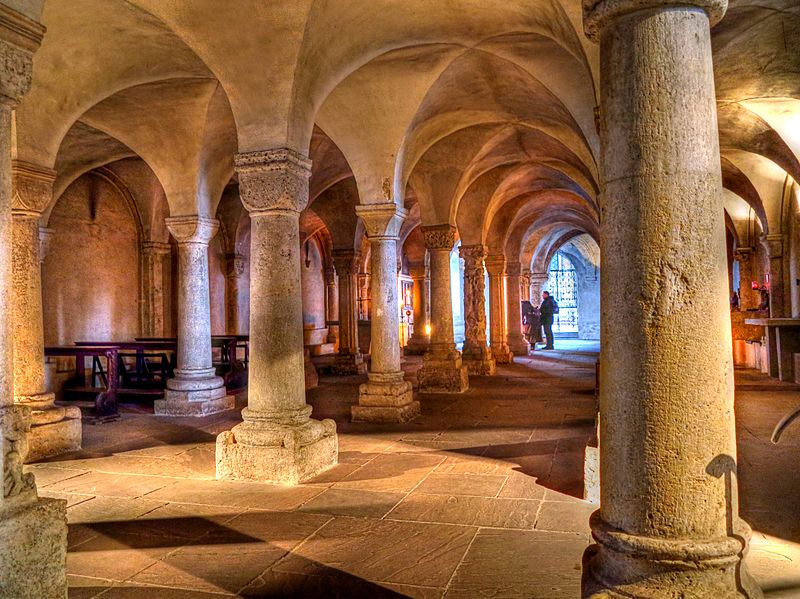
Crypt of the Freising Cathedral
For me, philosophy is something like the science of living. I think of Seneca. A long time ago, he said to his students:
Philosophy teaches you to act, not to talk.
Consequently, the angry person, too, should see if his actions speak the same language as his words. And I must admit that I am not satisfied with the outcome of my self-analysis.
To be sure, I try to leave the social norms and patterns I so criticize. And, where possible, I also try to initiate change. But is that enough?
Far too often, I realize how I am trapped in my bourgeoisie. My trainers, among others, were my parents and my teachers. Numbers of system agents tried to form me according to what they thought I should become and tell me where to go and what to do. Morals and an extremely capitalist consumption-oriented society already influence me massively on a daily basis.
Regardless, I hope I am one of those persons who basically to not consider our “trained lives” unavoidable. At least, I always tried to flee the reins of the aforementioned animal tamers. And already I feel better. But what I do is not enough. To be sure, I no longer go places by car. But then, that is something you could almost call egoism. After all, I am now suddenly a lot more mobile and free than I ever was before. And through this change and (allegedly) these restrictions, my life has become a better life. That certainly helps when it comes to thinking new thoughts.
Looking upon my own generation, it truly gives me pause to see how many of my companions never knew anything other than being trapped in their emotional jails. I know people who, in their entire lives, obediently believed all nonsense that was ever dished out to them. They actually relinquished their autonomy in small portions for the sake of being comfortable.
Others never once in their lives, when at a point of bifurcation in their lives, followed the motto “love it, change it or leave it“ . As a consequence, they were made to feel smaller and smaller. Regardless, today they think they are the most important thing in the universe, live their status and drown in their anxiety. The constant fear of losing what they own makes them inhuman. They seem to have forgotten that they, too, are just mortal beings.
I am fed up with following the nonsense of this society. In the coming years, I want to do more. So I was looking for models. I already found one: Carl Amery. I find his life and work impressive. I think he was a true hero.
Unfortunately, I am not a hero. But who knows, perhaps in the future…
RMD
(Translated by EG)
P.S.
I took the picture from Wikipedia. It is the illustration of the article on Carl Amery (real name: Christian Anton Mayer), originally by Richard Huber.
Roland DürreWednesday September 30th, 2015
#Breaking with Patterns II – Communication
In preparation of the Dornbirn PM Camp on November, 20th and 21st, we installed a blog parade on #breaking with patterns: here is my second article on this topic:

Teletype Machine (Siemens T100) – introduced in 1958. It was the modern successor of the T50.
So far, it looked to me like I was a #de-cruster. Perhaps I am also a #pattern breaker. After all, I no longer go places by car, using the bike instead. And, especially in winter, this is unbelievable for many of the persons I meet.
And whenever I do not have enough coat hangers, I throw away some of my clothes, instead of buying new coat hangers. Those and many more are the kinds of things I do.
But then, perhaps I am not breaking patterns at all, instead being trendy like everybody else? For instance when it comes to using the telephone. Because I have now come to that stage where I have completely reduced calling people. In fact, I find it impolite to inconvenience other people by calling them. And, of course, it is also because I, myself do not wish to be interrupted all the time by receiving a call.
Here is my personal “telephone history“:
I used to be a true “multi telephone person”. When InterFace connection was still very young, I spent a lot of my time with customers. Consequently, I always spent an hour in the middle of the day calling the company. And since I never use a customer’s telephone for my own purposes, I always had to go downstairs and use the public phone booth.
In those days, I also discovered the C network. However, it was expensive, you needed an extensive installation process and the network itself was as limited in its availability as its quality was poor. Besides, I always wanted to be able to totally focus on the person at the other end when having a telephone conversation. Consequently, I never used a car telephone; later, too, calling someone from the car was only the absolute ”ultima ratio“.
In the times of public phone booths, I always had a sack of change on me. Later, I always had a number of telephone cards in my briefcase. And, as soon as the D network came, I immediately had a cell phone. My fees were extremely high.
Now, I find it harder and harder to come up with good reasons and situations where I absolutely have to use a telephone. For instance after having made an appointment with someone to meet at the central train station and already having found a nice place to sit for me and my travelling companion. Then I will call him. But only if he has no Whats up, BBM or other messenger. When all is said and done, the only time when you actually need it is for the emergency call – when the murderer approaches.…
Consequently, I no longer call people. Because if there is something really important I wish to discuss with someone, then I want to do it in a leisurely fashion. Once in a while, I also want to have five minutes to prepare for a conversation. I want to see his face. If this is even possible across continents, then why should I not make use of the opportunity.
Consequently, I make an appointment with my business partner. As soon as possible and preferably through social media. If no other way is possible, then with an email dialogue. Then I will enter “video conference” in my calendar and all will – at least if it is a hangout – be initiated automatically. If the person at the opposite end does not like google, I take Skype (Microsoft) or FaceTime (Apple). If my partner likes neither Microsoft nor Apple (which is something I can easily identify with), then there are enough other alternatives.
The entire conversation will also be much pleasanter. I comfortably sit on my sofa, my chrome book is lying on my lap and my conversation partner’s friendly and smiling face can be seen on my screen. I need no headphones (and also need not press a telephone against my ear), can simultaneously formulate something with him on shared documents (perhaps for resulting notes – also called minutes), we can look at and process tables together and we can look for and show each other an image, and much more.
🙂 No – teletype machines, fax machines, telephones – those are devices we no longer need…
Doesn’t this also have something to do with “breaking with patterns”?
RMD
(Translated by EG)
P.S.
The pictures shows a teletype machine by Siemens. It is a model T100, the table version. As far as I know there was also the model T100o – but that was it.
This mechanical teletype machine had a modular structure, which means it could be added to. On the left side, you see a tape perforator for generating perforated tape. Underneath, the transparent container for the cut-out material. On the right, you can see the optional perforated tape reader, which made it possible to send pre-written messages with maximum speed. On the basic device, you can see a red note about the update to 75 Baud above the active-hours counter.
After a certain running time, the teletype machines used and rented by the Deutsche Bundespost were completely disassembled at the FZZA Elmshorn and then newly reassembled. The blank key has the switch between letters and digits on the left and right sides, which is necessary because of the Baudot-Code with only five Bit (CCITT5). The paper is an endless roll, perhaps a self-copying paper with a copy since there is a slightly crooked grey intermediate layer.
Source: Wikipedia – you can find the image under the GNU licence for free documentation ,Version 1.2 or a later version. Published by the Free Software Foundation,


