
Roland DürreSunday October 4th, 2015
I am not a hero.
After my Angry article, there is the question:
So what is my contribution?

Crypt of the Freising Cathedral
For me, philosophy is something like the science of living. I think of Seneca. A long time ago, he said to his students:
Philosophy teaches you to act, not to talk.
Consequently, the angry person, too, should see if his actions speak the same language as his words. And I must admit that I am not satisfied with the outcome of my self-analysis.
To be sure, I try to leave the social norms and patterns I so criticize. And, where possible, I also try to initiate change. But is that enough?
Far too often, I realize how I am trapped in my bourgeoisie. My trainers, among others, were my parents and my teachers. Numbers of system agents tried to form me according to what they thought I should become and tell me where to go and what to do. Morals and an extremely capitalist consumption-oriented society already influence me massively on a daily basis.
Regardless, I hope I am one of those persons who basically to not consider our “trained lives” unavoidable. At least, I always tried to flee the reins of the aforementioned animal tamers. And already I feel better. But what I do is not enough. To be sure, I no longer go places by car. But then, that is something you could almost call egoism. After all, I am now suddenly a lot more mobile and free than I ever was before. And through this change and (allegedly) these restrictions, my life has become a better life. That certainly helps when it comes to thinking new thoughts.
Looking upon my own generation, it truly gives me pause to see how many of my companions never knew anything other than being trapped in their emotional jails. I know people who, in their entire lives, obediently believed all nonsense that was ever dished out to them. They actually relinquished their autonomy in small portions for the sake of being comfortable.
Others never once in their lives, when at a point of bifurcation in their lives, followed the motto “love it, change it or leave it“ . As a consequence, they were made to feel smaller and smaller. Regardless, today they think they are the most important thing in the universe, live their status and drown in their anxiety. The constant fear of losing what they own makes them inhuman. They seem to have forgotten that they, too, are just mortal beings.
I am fed up with following the nonsense of this society. In the coming years, I want to do more. So I was looking for models. I already found one: Carl Amery. I find his life and work impressive. I think he was a true hero.
Unfortunately, I am not a hero. But who knows, perhaps in the future…
RMD
(Translated by EG)
P.S.
I took the picture from Wikipedia. It is the illustration of the article on Carl Amery (real name: Christian Anton Mayer), originally by Richard Huber.
Klaus HnilicaTuesday September 22nd, 2015
Is ‘Social Justice‘ just a Misunderstanding?
Yes – if we continue to hold onto what we have been considering the definition so far! /1/
According to this definition, everybody, strangely, thinks him- or herself socially just yet at the same time laments about the growing injustice in this world.
It seems that this discrepancy is insurmountable.
 We are simply too much in love with our unclear terminologies. In fact, we actually wallow in the concept that ‘social justice‘ has to be some kind of ‘moral, egg-laying wool-milk-sow‘, rather than just a minimum standard for human behaviour consisting just a few rules even evil persons have to stick by!
If, however, we accept this definition, we soon find out that ‘social justice‘ tends to have little in common with ‘romantic equality‘. Instead, it has a lot to do with not-so romantic ‘voluntariness‘. And that this is why politics in general have an inherent structural problem when it comes to generating ‘social justice‘, even if it very industriously tries to find and remove ‘legal loopholes‘. It is easy to show this in three steps. All you have to point out is:
A) the common principle of ‘exchange justice‘,
B) the principle of ‘equal treatment and equality of results‘ and
C) the particularly apparent ‘distribution justice‘.
Let us take a closer look at all three of them:
A) After all, we basically have a very special form of ‘exchange justice’ when, in the name of ‘social justice‘, people demand fair prices and fair incomes!
For instance when it comes to: here the aromatic Alp Butter, there the ridiculous one-euro-eighty; or here the super manuscript and there the low fee. If we were to demand ‘equality of values‘, then we would need the general ‘principle of exchange justice‘! But how to objectively determine this ‘equality of values‘ for every individual exchange process?
For instance: would one ounce of gold be too much for a bucket of water in the Sahara if it means the difference between life and death? And are 50 cents too much for two litres of milk if someone has a lactose incompatibility? Or what is the adequate fee for a manuscript which, later, will only be pushed underneath the one too short table leg?
Doesn’t this mean that the ‘evaluation‘ of an exchange object is by nature a very subjective thing and that this value has nothing to do with equality? Especially since said exchange only takes place because all the parties concerned see the object of exchange differently, which is why each considers his own deal profitable.
Naturally, this ‘exchange profit‘ is just as unprovable as the ‘exchange value‘; but it is also clear that any profit can only exist and be proved if the exchange has been voluntary! Which means that an exchange is always ‘socially just‘ if none of the parties concerned has been forced to accept it!
Of course, this voluntariness in an ‘exchange‘ does not guarantee that both parties can get what they hoped to achieve. Neither is it a protection against erroneous decisions, such as for instance the imprudent purchase of low-price milk regardless of lactose incompatibility. But this is not necessary, either. Because the evaluation of the ‘exchange profit‘ is subjective, which means that it cannot later be forced into a wrong equality measurement just because someone had erroneously and intuitively assumed that this ‘equality‘ in an ‘exchange profit‘ is closely related to ‘social justice‘!
Consequently, we can conclude that prices and incomes are always socially just when they can be accepted without one of the parties having been forced to accept!
B) Now let us discuss the allegedly socially just ‘equal treatment and equality of results‘!
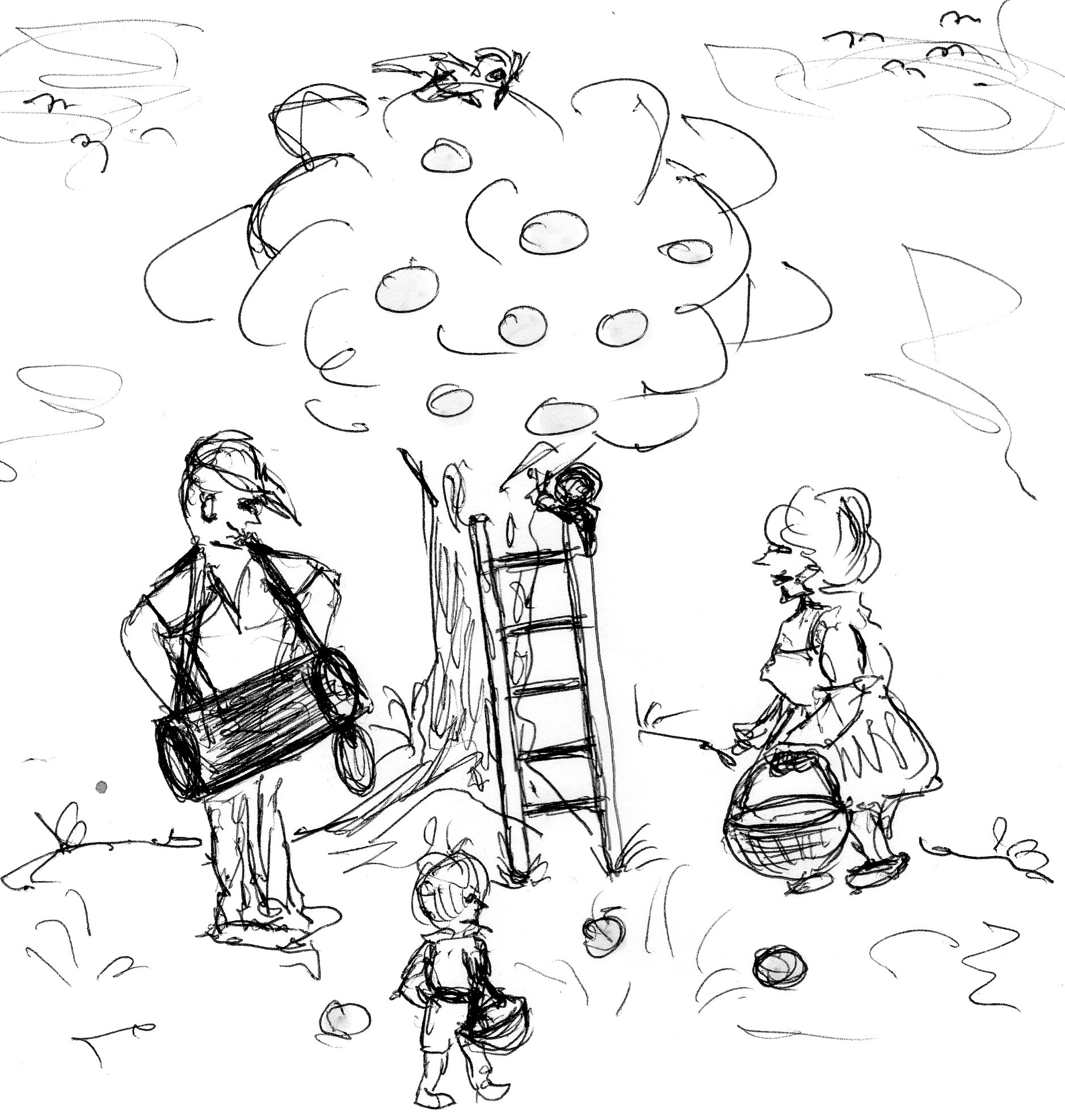
Again, our equality mania brings us into a similar logical one-way road, as can be easily shown with a simple example: If, under the aspect of equality, you ask a retired lady, a sportsman and a six-year old boy to pluck apples from a four metre high apple tree with a ladder standing at its trunk, you will get considerably different results; the help you will have to give will, indeed, be rather diverse, before all three candidates will have plucked the same amount of apples – which means they have equal results.
Since, however, there are no two identical individuals on this earth, you will never get equal results if you treat them equally, and vice versa!
And regardless of this fact being absolutely obvious, we keep demanding equality along with social justice. But if equality were really socially just, then the state of affairs where all persons are poorly off would, according to justice theory, be the best that could happen, wouldn’t it?
Luckily, nobody believes this! But still we insist that the logical consequence cannot be to stop seeing equality as a manifestation of social justice.
C) The tendency towards equalization is particularly apparent when it comes to discussions about ‘fair distribution’!
To distribute something means to hand out from a supply. Fair distribution demands that this has to done following certain rules. However, the fairness is most obvious when the owner does the distributing him- or herself, because then it is his or her will alone that counts. To be sure, it might be reasonable to consider the expectations of third parties, but that is not demanded by social justice! Social justice is served by the protection of ownership rights.
But it gets truly difficult when you cannot clearly define ownership, as it is the case with all political systems because the spheres of interests of the distributors and the recipients will often be identical. Conflicts are unavoidable and the ‘just solution‘ of said conflicts are not just a theoretical challenge, but mostly no more than a noble goal!
Compared to this, private persons and enterprises have a rather easy life, don’t’ they? All they have to do is not cheat, not steal, not use violence and not break contracts – and already they are just. They need not abide by more rules than that!
When all is said and done, this consideration not only generates a theory of justice, but also a surprising solution for economic and social politics: why not move as many decisions as possible to the private sector – since this is where you have clear and, according to what has been stated above, ‘socially just‘ circumstances?
Well, I assume this will remain wishful thinking, because many will still refuse to abandon the inacceptable ‘equality saturated‘ definition of justice! And they will be even less willing to forego the potential increase in power derived from this ‘usurpatory definition of equality‘!
KH
/1/ Dagmar Schulze Heuling; „Was Gerechtigkeit nicht ist“; Nomos – Verlag Baden – Baden
Klaus HnilicaThursday August 6th, 2015
Revenge Makes You Strong!
 When, a short time ago, I wrote my brief essay on ’Only Forgiving Makes you Free’, I related how, if possible, we should always forgive, even if we have been hurt both inside and outside. In fact, I told you that, in our own interest, we should learn and practice said forgiveness. Yet I was quite aware that the opposing end of ’forgiveness’, namely ’revenge’ must exude enormous attraction. How else would it be possible that is has such a strong impact on human society?
However, I did not have a to-the-point formulation for the phenomenon!
Hence, it surprised me so much the more when, a few days ago, I found exactly the term I had been looking for. It was in the latest novel by Siri Hustvedts “The Glittering World“.
Siri Hustvedt lets her protagonist Harry say:
Revenge ideas will always have their origin in agonizing helplessness. “I am suffering” turns into “you must suffer”! And do not let us mince words: revenge will make you strong! It gives you focus and fire, and it suppresses misery, because it transfers the emotions to the outside. In misery, we dissolve. In revenge, we concentrate all our energy and turn it into one single weapon directed at one individual goal. No matter how destructive said weapon will be in the end, it serves a useful purpose for some time!
As I see it, Siri Hustvedt got it exactly right with this statement of hers about what is so attractive about revenge, which pulls at us like a suction. But, naturally, she also knows how destructive revenge will always be in the end. And unfortunately, the current news from the Arabian World tell us on a daily basis that cultures based on revenge and retaliation can never find peace .…
KH
(Translated by EG)
Klaus HnilicaFriday July 3rd, 2015
Only Forgiveness Will Make You Free
Of course, the ’moral bookkeeper’ (moralische Buchhalter) residing inside all of us will always weigh the evil against the good!
Not long ago, Klaus Grün brought him out of anonymity to the light of day in the IF Blog! And I am sure all of you will agree that he exists.
 Because we all have been suffering under him since earliest childhood: we can never forget a slight, an injury or a humiliation (see picture) we suffered, all of which he will without fail enter in our memories as ’debits ’.
With this kind of bookkeeping, we look for the balance on the ’credit’ side: consciously or subconsciously, we will take pains to enter all the nice things we experienced: acceptance by others, spontaneous friendliness we were offered and also the joy we find in helping others, etc. …
However, on the ’credit’ side, we will also take note of the ’very secret joy’ we find when we have been able to successfully revenge some evil or other we were subjected to. If, on top of this, we see the objects of our revenge suffer, this will add to our satisfaction …
The latest moment for our personal dilemma to start is when we plan our revenge, but basically, it starts earlier than this: all of a sudden, we will mentally be concerned in a destructive way with the one person who gave us emotional or physical pain (see picture). The person we hate and abhor!
Thinking of revenge torments us day and night. These ideas escalate, leaving no room for persons whom we love and who deserve our affection!
In other words: the very subject that hurt us gets additional power over us through our ’desire for revenge’, thus determining our behaviour in a way we never intended.
But that is exactly what we avoid if we forgive!
Because that is when we not only get rid of the hurtful humiliation, but also of the person who gave us the pain.
Mind you, I am not saying this is easy!
But as soon as we understand this mechanism, we can practice and will get better and better at quickly finding back to inner peace and serenity after every humiliation.
As a side effect, we get closer and closer to the goal of becoming an ’autonomous person’ who can determine by himself what he wants to do as often as possible!
We should, however, never forget that this autonomy will always remain rather limited and that, basically, it is borrowed in all individual instances. Because the ’animal’ inside us is powerful and hard to tame.…
KH
(Translated by EG)
PS:
The picture was taken by Waldtraud Schmalenberg. It shows the author as ‘Konrad Flesser’ in the scenic performance of ‘Das Schandmahl’
Roland DürreThursday July 2nd, 2015
Entrepreneur’s Diary #110 – Manus Agere.
A short time ago, I had an experience that, again, showed me why I so dislike the terms “manager and managing”. Nor does it matter if they are combined with 2.0, 3.0 or 5.0. In fact, one of the reasons that made me me hesitant about ever using the term was that there are so many translations for “to manage” from English to German. Basically, you might well use it for “all and nothing”.
During the WebWeek, I attended an event by Techdivision in Munich that had been organized by my friend Sacha Storz (Sacha is not a typo ). The topic was 3.0 – as we all know, there is a lot of well-known, even famous, literature on the matter.
When we discussed it, Gerrit Mauch – whose contributions I very much appreciated – told us what the term “to manage” means to him. He said he thought that the original meaning of the word probably lies in the Latin: “manus agere” (’take by the hand’). It was mostly used when horses were trained.
That would mean that, as time went by, horse schools turned into “managing”.
Following this train of thought, you have to conclude that it was the ancient Roman’s BGM to care for the physical health of their horses. After all, they were important and ever so precious production animals.
And seeing humans under this light is simply the wrong concept in my eyes. Some way or other, it does not fit in our times at all. At least the developed societies should not be based on this kind of concept of humanity. And we all want to be a developed society, don’t we …
RMD
(Translated by EG)
P.S.
For more articles of my entrepreneur’s diary, click here: Drehscheibe!
Klaus-Jürgen GrünTuesday March 24th, 2015
The Moral Bookkeeper Living Inside Us All.

He is not my favourite concept of self.
How we all would like to see ourselves.
Self-confident, humorous, tolerant, spontaneous.
No: he is industrious, stubborn, accurate.
Just what we all want bookkeepers to be like.
Our moral judgement takes the characteristics of the bookkeeper. It compares words and behaviour of others with our values and then assigns consequences. In doing so, we weigh things against each other like in a debit and credit account that have nothing to do with each other. In the book “Christie Malrys Double Bookkeeping”, the author asks how we deal with all the small instances of meanness we are subjected to by others on a daily basis.
This is a question that concerns all of us. He comes up with the idea of starting a life bookkeeping in the form of double accounting. The protagonist, Christie Malrys, writes down everything he experiences under “debit” and “credit”. The slights are debits and must be made up for by corresponding credits, meaning experiences that were nice (for him). For instance, Malrys comes up with the idea of paying back a neighbour who never gives him the time of day by making a scratch mark on his car. A house that he finds offensive gets a thick painted line on its façade.
You think this is over the top? Sure. Pure Fiction? No. Our double accounting wants justice and will not hesitate to apply small or embarrassing ideas. After all, our values, which have been underscored by our sense of justice, are not officially calculable or exchangeable like Euros or Dollars. They exist exclusively in our very personal exchange rate mode. The correct exchange rate lies in our eyes or perhaps in that of our reference group.
So what is the right, appropriate, just “credit” for an Islamist who sees his God exposed to ridicule? What is it for us when we see the Greek Minister of Finances show the finger at Günter Jauch’s show? Public “beheading” by TV? Higher interest and credit rates? Appealing to the public to not spend their next vacation in Greece? As it is, the slights, that is the “debits”, are at a majority in real life, and a balance sheet that is constantly in the red numbers will easily tempt us to become more and more ingenious when it comes to looking for a balance. From the perspective of the others, we get more and more spiteful and unjust. Those who spend all their time looking to balance “old accounts” will miss a lot of life looking for suitable measures.
Wherever the moral bookkeeping is especially conservative, it will not see the accounts balanced. Practicing its balancing justice, it will also demand harsher punishment. Soft or moderate punishment would debase some behaviour. Those who believe in this system think that evil deeds cannot be paid for dearly enough. Conversely, those who criticize conservative bookkeeping look upon those strategies as upvaluation of a misdeed to turn it into a rare commodity. Not everybody is supposed to be able to afford it.
There is a general disagreement about how a balancing between good and evil should be accomplished. But there is agreement that there should be some redress. Either by revenge or by mercy, but justice must be done. You have to pay back if you overbalanced on your account.
While in financial bookkeeping we have strategies for minimizing double accounting, we get an overflow when it comes to moral bookkeeping with double standards. A moralist will certainly deny ever being calculating. This would weaken his moral position. He will not even admit that human behaviour and moral values can be measured at all.
And instead of laying open the criteria for his measuring and retribution, he simply will deny having any such strategy. Behind the moral judgement is a mental concept which transports a calculation of weighing good against evil. Yet at the same time it camouflages this background concept. Moral bookkeeping will camouflage that it is bookkeeping at all.
What humans say instead was stated by George Lakoff in his disarming book “Auf leisen Sohlen ins Gehirn“ (voyage into the brain on soft shoes) like this: “I am totally aware of what I think. It is exclusively my own decision what I think and which conclusions I draw. All persons can think in the same way. And in thinking, I understand objective truths as they are found in the world. All things have a basic meaning and can thus be mentally followed as they exist. This is why I, like all other persons, can think and speak objectively.”
Well, I wish that were how it is.
kjg
(Translated by EG)
Roland DürreSunday February 22nd, 2015
At Eye-Level – A Film about Work-Life in the 21st Century.
 A team of five started an exciting project – and eventually it turned into a film: “At Eye-Level “ (Augenhöhe).
Here is the story: During a session of the 12th intrinsify!me “wevent” in Berlin about the work-life value of the 21st century, the idea grew that you should not only describe everything in words at all times. Instead, you should show it to people – in a film.
Five session attendants remained together and got active. They made the film “At Eye-Level”. I first heard of this project on the Berlin 2015 PM Camp during a great impulse presentation by Ulf Brandes. Later, I saw parts of the film during the Munich 2014 PM Camp. Two of the protagonists playing in “At Eye-Level” are personal acquaintances of mine through PM-Camps.
Thanks to enormously well-used “social media”, the project quickly earned great acclaim, even beyond the internet. The successful crowdfunding for its financing, too, had enjoyed a huge amount of public awareness and was accordingly very successful. The opening night on January, 30th, in Hamburg, too, had a huge audience. More than 400 (!) persons came to watch the film at the Hamburg Museum der Arbeit.
The film is about good topics. Perhaps its professional quality cannot hold a torch to documentaries with similar topics, such as by Geyrhalter, Wagenhofer (among other things the trilogy We Feed the World, Let’s Make Money and Alphabet) or Carmen Losmann (Work Hard – Play Hard). But neither does it need to – it is more a refreshing production on the level of TV reports by the ARD or ZDF, for instance about shipping electric waste to Africa.
The film is about persons acting different roles in their work-lives: entrepreneurs, managers, founders. But above all, it shows employees happy to be working for “good” employers. Because they can, for example, due to innovative working hours models, dispose of their own free time more freely than is common and therefore organize their own lives as they wish.
Unfortunately, though, the highly praised project “At Eye-Level” is also one where not all is gold that glitters. Shortly before the film was finished, two articles about Adidas and Unilever were added to it.
Adidas
Suddenly, you see Christian Kuhna in the film. I first met him at the open-up Camp in Nuremburg. His job with the sports giant is about social media, Moocs and the like and he has a small but very efficient team at his disposal
I am sure that the work-life attitude in Christian’s team is good and modern. Also, I am always impressed by the competence and positive attitude of all the salespersons in Adidas shops. But I am sure this is not true for the huge majority of persons producing for the concern.
Consequently, including Adidas in the film was a source of controversy among “crowd funders”.
Unilever
At the very end of the shooting, Unilever, too, was added. Even as early as the meeting in Munich, I was surprised to find the food giant presented as a positive example. There, Sven Franke – one of the protagonists – told us that Unilever had contacted “At Eye-Level” because they had established contact during the film “WORK HARD PLAY HARD” by Carmen Losmann. In that film, they had not made a particularly good impression and consequently, they wanted to make up for it. Well, no matter what, Unilever definitely is not the best material for this kind of film.
Sven’s reasoning was as follows: they wanted to show that even a huge enterprise can have a few niches where work-life might happen at eye-level.
Well, this might be a matter of taste. To be sure, every huge enterprise also has a few “islands of blessedness”. Even if it is only the team of directors.
However, it is also possible that Adidas and Unilever were included because they are “big names”. Which might have made the producers think makes the film more attractive. This is certainly also an acceptable decision. But if so, you should also communicate it as such.
When talking “big names” and these kinds of ideas, Tomas Sattelberger, too, comes to mind. He, too – just like he also currently seems to be publicly visible all the time – appears in the film. After all, everybody wants to hear and see a repetition of the Saul-Paul story. I do not know Tomas Sattelberger personally, but only from what I read about him in the press. Consequently, I cannot give a valid estimation. But in his roles as director of famous DAX concerns, he did not look like the typical representative for “eye-level” to me.
Well, so much about the small stains on the otherwise clean slate.
Mind you, please not to misunderstand me: I find the topic “eye-level” as formulated by Sven Franke or Ulf Brandes an excellent idea. The same is true for the activity and the result. Also, the enterprises concerned are welcome to the gain in reputation they got from it and I would be happy if those who initiated the project were also reimbursed in a material sense for the huge amount of energy they put behind it.
It is a true delight to discuss the individual film scenes under the “entrepreneurial” light. Especially the founder’s enterprises shown in the film might suggest that a proper firm is only possible where you have the “good tyrant”. The question I ask is: how can the entrepreneurial culture shown in the film also be structurally included in our social system – for instance in the sense of a “democratic enterprise”.
RMD
(Translated by EG)
P.S.
The picture is not from the film “Augenhöhe – At Eye-Level”. I took it from “WORK HARD PLAY HARD” by Carmen Losmann.
Detlev SixSaturday January 31st, 2015
We, the Cheese Cover Freedom Heroes.
They said in the news that the Cologne satire wagon on the Hebdo assassination that was to have been part of the carnival procession was cancelled for reasons of safety.
Immediately afterwards, they broadcast the sitcom: “Third Floor Left”. Sitcom is short for situation comedy and (so the producers said in the pre-view) was supposed to spontaneously process current events.
Well, tough luck so far.
Because the first twenty minutes of the show were not, as I had expected, dedicated to the “Cologne Angst” (which is a sub-category of “German Angst”). Instead, they were actually dedicated to Frau Merkel. The cheese remained inside the borders set by the Islamists.
While doing so, it pretended to have applied its own cheese cover, because within the security zone, there was quite a bit of serious satire. Frau Merkel playing the harmless substitute victim for the dangerous Paris murderers. Well, that would certainly give the cabaret cheese a strong flavour.
Maneuvers? Not at all! Dutifully, everyone laughed. They all knew the western desire for freedom has nothing more to offer.
The same is true for me, which is why I wrote “we” in the title. To this day, I am glad that I did not have to show my courage during the Third Reich. The idea that I might have been a smooth follower is too close to home.
After twenty minutes, I switched off the sitcom. And I promised myself that, in connection with freedom and free talk, I will remain mute, instead of shooting my mouth off.
SIX
(Translated by EG)
Roland DürreSunday November 23rd, 2014
The End of Collaboration
Today, I am writing a fictional story which in fact could have happened.
 The story is about two important and famous protagonists working in the same field. They both work on the same topic. It is an innovative idea with which you can earn money. Let us call the two persons Mr. Je and Mr. Hy.
Both of them write about their ideas in their blogs and develop new ideas in the sense of “sharing knowledge” and “improving wisdom by sharing it”, both by themselves and together.
Mr. Je finds some ideas in one of Mr. Hy’s posts exciting. Consequently, a dialogue between the two gets under way. The dialogue is happening in Mr. Hy’s blog in the form of comments on this post.
The result is a significant extra insight, including a valuable basis for a business model. In fact, the constructive, critical and supplementary comments by Mr. Je are to a huge extent responsible for the making said model seem realistic.
Mr. Hy utilizes the thus gained insight for his business, thereby successfully promoting his business model. However, he never tells Mr. Je any of this.
Instead, he removes the dialogue between himself and Mr. Je from his blog.
Mr. Je has no problem with the fact that Mr. Hy benefited from the shared dialogue for his business. This is quite ok. After all, it is why “sharing knowledge” and “open collaboration” have been invented. However, he would have found it nice to hear from Mry. Hy and perhaps receive a cooperation offer.
As a matter of facts, he is really annoyed about the removal of the dialogue!
Of course, the story is totally fictional. Any similarities between actual events or living or even dead persons – if they can be found – are totally coincidental
RMD
(Translated by EG)
P.S.
I took the picture from Wikipedia:
en:Henry Van der Weyde (1838-1924; London, England) – http://www.photography-museum.com/jekyll.html / Originally from en.wikipedia;
Roland DürreSunday November 2nd, 2014
Wasn’t the Last Millennium Totally Crazy?
In the last century, before the turn of the millennium, everything was different.
In those days, managers still believed in the predictability of the future. What is more: they were convinced that growth is something that can continue endlessly.
People living at the time had the impression that everything can be done and that, thanks to technology and progress, all problems can be solved. After all, humans as the crown of creation felt they were omnipotent – far above the animals. And they believed everything can be controlled.
The motto was: faster, higher, bigger, further and more comfortable.
Engineers and technocrats were in charge. A life without cars was unthinkable. Individual traffic with heavy vehicles and a combustion motor, also for individual persons, was a self-evident human right for everyone – just like the short vacation in the “DomRep” or in Thailand. A society was considered “developed” if the poor, too, could afford to buy a car!
Weekend trips to London or Madrid, just like short vacations to New York or Abu Dhabi helped the people to overcome their boredom in a mundane fashion. Consumption was the method you chose in order to give yourself importance and buy happiness. Regardless, stinginess was considered cool and money was the new religion. Using this concept, it was quite easy to destroy the world.
Professors at university taught us that good managers will never have to react. Instead, they will always act. Because the good ones will see into the future. Just like, in 1968, the chain-smoking and therefore constantly coughing driving instructor, who, due to his looks, was nicknamed “Old Death” had taught me that a good (German) driver will always foresee what will happen in the next second.
The universities also taught us that a manager always has to be free of emotions and personal feelings. Decision making science recommended that, first and foremost, we always collect enough information. Afterwards, you had to evaluate and analyse them absolutely objectively. Only after this step, you would then have to decide in a very rational and logical way, without all emotion. And while doing so, you have to ignore intuition and heuristics as deceptive factors.
This was also the reason they gave why a “normal woman” had no business in management. Because women – with very few exceptions – are just too much driven by their emotions. Obviously, women in “high” management positions were the exception from the rule. And those who were actually looked like men.
Textbooks also said that an organization is good if and only if the highest manager is able to control the entire system as he desires by “adjusting just a few screws”.
Consequently, the companies oriented themselves at military ideals when forming their organizational structures. Hierarchy was the standard, only very few ultra-modern enterprises were bold enough to try a matrix cooperation and even fewer were courageous enough to try “cooperative leadership”. Terms such as self and network organization were out of the question, just like transparency and agility were feared. Everything was dominated by “simple-mindedness instead of diversity”, rather than the “wisdom of the masses”.
Taylorism, moralizing processes and globalization were held to be the success recipe for the economy and to guarantee prosperity for the entire world. All the big enterprises aimed at world market leadership at all times. At the same time, the exploitation of humans and all kinds of resources grew geometrically.
On the other hand, the mass was considered a primitive mob. Citizens were said to be stupid and taken for fools. Marketing manipulated the masses, lobbyism removed their interests. Those who voted in a democracy were considered election-booth fodder. Their wish for peace was overruled with invented and hugely propagated anxieties.
Those who reigned, along with the governments knew a lot better what is good for everybody. They even drew up laws which ignored existing judicial practice and constitutional rights. This is how the citizens were spied on and made fun of in masses. More often than not, this happened in order to satisfy interests and demands of foreign power or powerful concerns.
In extreme cases, even courts of justice were declared no longer responsible. In their place, obscure arbitral courts were instituted. Citizens who had violated tax legislation were severely punished. At the same time, the exact same countries created “tax oases” for concerns.
And worst of all was: the governments believed they could shape order in the world with wars and create peace with weapons.
Well, I am happy that those times are now over.
RMD
(June, 20th, 2030)


