
Roland DürreTuesday December 4th, 2012
Here is Another Video Recording Showing Rupert Lay on Youtube: “Responsibility and Trust”
Yesterday evening, I uploaded another recording of a presentation by Rupert Lay to Youtube. Rupert Lay gave this presentation on May, 4th, 2003 at Bad Boll. It was about:
Responsibility and Trust
When responsibility and trust in an enterprise dwindle – reasons, consequences, what to do?
I was there when the presentation was originally held and would be happy if as many of you as possible would watch it.
Both presentations were given by Rupert Lay for the Ronneburger Kreis . The video recording is by Bernd Sielaff and Friedrich Lehn did the editing.
RMD
(Translated by EG)
Roland DürreFriday November 30th, 2012
The Change in Management (Presentation)
The two presentations I gave last week on “The Change in Management” never got boring. I enjoyed them very much and I got the impression that my audience, too, had fun. Consequently, the feedback I received was also very nice for me
Since the presentations were quite interactive, it is not easy for me to put them in writing. Still, let me write down a few points, even if quite a few things that happened during the presentations will be lost to you.
Change will come – if we want it or not.
My two presentations were about
- Project Management;
- Management;
- Entrepreneurship;
- Leadership;
- Innovation as Creative Destruction;
- Craftmanship;
- The “Co” Era: co-creation, co-programming, co-operation …
- Future is Female
Why do so few women serve time in prisons?
All these are elements both of our private and professional world. In enterprises and institutions, we create future. The following factors play an important role:
- The culture we practice in the social systems and
- how said systems are organized.
Processes of communication, decision and responsibility change.
Who knows the terms:
Barcamp, Jam Session, OpenSpace, Fishbowl?
If not, maybe you should look them up in Wikipedia.
Today, the following is important:
Sharing knowledge, hand on experience. From those who are in the thick of it for those who are in the thick of it. Consumers want to turn producers.
You meet at eye-level. Fear-free rooms make creativity possible.
What was it like in former times?
- Trees grew from the bottom to the top.
- At the top, you had the hierarch, clear command structures, disciplinary bosses.
- And it worked for a long time. It was a simple and well-structured, and, above all, a stable world.
Example: German electronics concern (dealing with everything around electricity) as a hierarchical organization. It was built following the pattern of the German Reichswehr. Build up and procedures are organized, structured into enterprise sectors with up to 10 hierarchical levels, staff divisions for shared tasks, such as F&E, Marketing and all kinds of central functions. - That is how the matrix: organization with full/dotted lines and staff and central units was created.
- Example: electronics concern, business areas motors/generators, small appliances… Shared design, etc., sales, etc., research were central staff units.
- This organizational model originated with the industrial revolution – Taylorism-style and mechanically. And for a long time, all went well with it.
- After a few years, the organization (mostly only parts of it) had to be modified. But that was easy.
Today, this is no longer an option – which is why so many people lament about their enterprises suffering constant re-structuring. Except that this is not enough for following the speed of change. Consequently, “after the re-structuring” more and more often means “before the re-structuring”. Even worse: the next re-structuring will begin before the last one is finished.
And even in nature, trees grow from bottom to top. The first ones who noticed this were a few idealists in the informatics sector. They put the trees upside down.
- But then, it is not an option to turn trees upside down.
- It would make the CEO the one who supports all (big Frederick as the country’s number one servant).
- So you see, trees are not enough.
- New means of communication, too, cause change. Change brings communication.
- This is how the transition from the tree to the network happens in the shape of a ball in the three-dimensional space.
(Note: even in military dimensions and in warlike conflicts, it seems that – when all is said and done – network-like structures are superior to hierarchical command structures, even if the latter have a huge resource superiority).
Well, all of this is not precisely news. As early as in the 1980ies, there was a remarkable development, for example at St. Gallen College. They came up with a “management model” which makes the HSG world famous. Its basic points are the eight theses by Hans Ulrich – “Management – Essays, part 2, 1981 – 1998 On the Change in Management”:
- Accept the uncertainty and unpredictability of the future as normal state of affairs!
Strategy as planning of a future: acceptance that decisions will always have to be made with an uncertainty factor. - Expand the limits of your mental concept!
Against the “but” … and for freedom of ideas. But also: sharing knowledge. - Applying the categories “both-and“, instead of “either-or“!
Black-and-white is out, colorful is in. - Thinking multi-dimensionally!
Balancing of interests in an ethically responsible way. Basically, humans can only deal with three ideas simultaneously. - Self-organization and self-control as the model for your enterprise!
Responsibility, Subsidiarity. - Consider a manager’s job as a meaningful task that makes sense!
New management image. - Focus on what is really important!
Working economically. - Make use of group dynamics!
Cultures, symbols, rites, rituals.
Today, all is about producing knowledge quickly and shaping the future together. Consequently, what we need is creativity in order to find the problems (first creative obligation). After we found them, we have to make use of our knowledge and generate solutions.
Taylorism and “mechanism“ is no longer possible in modern social systems. It is better if we gain the necessary knowledge through the new communication formats.
(Note on private life: the traditional family model, too, was Taylorist and mechanistic. Does anybody still want it?)
Unfortunately, many managers to this day do not understand it and many enterprises still live in the yesterday. This also explains why the “new enterprises” are such a success. It took them only a few years to overtake the “old industry”.
The roots of what happens today and in this country can be found among the (then criticized) prophets of the Bonn republic, such as Adorno and Habermas (Frankfurter School):
Dominion-free/fair discourse as a basis (Habermas)
- No outward restraint must hinder the discussion.
- Having the best argument is the only reason for winning.
- Everyone gets an equal chance to take part in the discussion.
- Everyone must be capable of “self-portrayal without offense“ and make himself transparent for the others.
- Everyone must be prepared to talk about the basic decisions he made in life and be prepared to have them criticized. (There is a clever system of speech and counter-speech, having to prove all you say, experience, authority, etc.).
- Nobody enjoys special privileges because of his age, experience, authority, etc.
- Everyone must be prepared to change behavioral expectations with everybody else. The same is true for switching roles.
- The discussion will continue until a consensus is reached. As soon as the truth is accepted, it will determine the future life and behavior of all the parties concerned.
It all sounds unrealistic and utopian, but it will become more and more reality:
- Through formats such as jam session, barcamp, openspace, fish bowl;
- Pecha Kucha, Ignite;
- Round meeting halls;
- Web 2.0 (interactive Blogs, Twitter)
- Wikipedia and Open Source
- Social Media like Facebook and Google+ as a logical conclusion.
Thesis:
The dominion-free discourse is filled with life. In a hybrid combination with the internet (social web), the new world of shared interests gets stronger and stronger. A new society of communication and “gaining knowledge“ is built. Belonging and sharing get more and more important as values.
And being part of it will make you happier and more successful!
So I tried to give a future-oriented presentation.
RMD
(Translated by EG)
Roland DürreMonday November 26th, 2012
Now On Youtube: Video Recording of Our Latest IF Forum.
On Tuesday, November, 13th, starting at 6 p.m., we welcomed Wilfried Bommert of the WDR at our Unterhaching InterFace Building. He was the third and last speaker in our series “Living (and Surviving) in a Sustainable Way”:
Making Good on Arable Soil!
How we can avoid the crisis of deeding the world.
Here it is – the recording of Herrn Bommert’s presentation!
Enjoy!
RMD
(Translated by EG)
Roland DürreSunday November 18th, 2012
How I Prepare for the Presentation “The Change in Management”.
In November, I will be talking to various groups about the “Change in Management“. The following text grew as I prepared the material for my presentations. It is a description of the environment and is supposed to help the audience as an introduction – or maybe as an accompanying “reader“.
Over the last few years, modifications, in modern German called “change” gained in speed in geometric dimensions. The internet changes the world in a way never experienced since the “industrialization”. Post-modern times are at an end, we are quickly entering the “information times” (if that is what they are going to call it a hundred years from now).
A large part of said change is about business. The way we work undergoes change. Young enterprises – offering totally new business models, entrepreneurial cultures and unheard-of products and services – rise and dominate the world in the shortest possible time. Just think of Apple, Dell, Facebook, Google, HP, Microsoft, Oracle, SAP and many, many more. And all that remains for Siemens & Co is to look on with growing envy.
Neither is this the end. Highly qualified persons no longer wish to work under a binding employee contract. Some of them merge and work on an honorary basis, sharing their special expertise and knowledge for common goals. For instance, experts from a totally new field, the software industry, first started getting together and building small associations in the USA with ”free“ and ”open“ products in the GNU time. And this is how huge movements grew. Today, the world is unimaginable without them.
Initially, it was typically “simple“ software tools, such as the (GNU) compilers of the 1980ies. But soon enough, the show really started to get under way. The famous “lamp” software was generated: Linux, Apache, MySql and Php. Yet this is only the tip of the iceberg. Today, we have a huge “Open Source” movement consisting of many small and big communities. And this is where the most wonderful things are developed on an unbelievable scale. And all of a sudden, products that were generated in someone’s leisure time and on an honorary basis actually displace the commercial ones. Now these products are the accepted standard all around the world.
Naturally, less complicated technological parts, too, can be linked as huge software systems, such as automobiles. They can be developed openly in an “engineering” way and assembled locally. And it will only be a question of time before the first open e-mobile will cruise the streets in huge quantities.
This development is supplemented by non-IT open source movements. The most famous one is probably Wikipedia. But Wikipedia, too, is just the tip of the iceberg. You can hear the battle-cry everywhere:
“Knowledge is the only commodity that grows as you share it!”
Simultaneously, many NGOs (Non Government Organizations) are started. Among many peoples, they already enjoy a better reputation than the local government. New catchwords are: community, belonging, collaboration. The prefix “co” in particular, as found in co-operation, has become a favoured part of words. Terms such as co-creation, co-working, co-programming start having lives of their own.
New strategies such as “crowd sourcing” develop, trying to make use of the ”intelligence of the masses“. In doing so, they create a true mega trend. The internet dominates the world. Pads, smartphones and laptops are “in”. The market for apps is exploding.
A short time ago, I read that more Germans can imagine life without a car than without Facebook. Even the “Golden Calf ” (Goldene Kalb) of the last century, the car, seems to be on its last leg.
The same happens in business. Enterprises with a totally different philosophy suddenly push the traditional ones to the side. In private life, functions, career, ties, status and titles get less and less important. To make up for it, the need to live your own life as you yourself want it grows. Using the words of Old Frederik: the people want to “be happy in their own façon”, kissing late capitalism and marketing economy good-bye. As I see it, this is a very nice understanding of freedom.
But how could this have happened?
Very simple – we are living an evolution. And said evolution will not leave persons and their forms of living and group-forming out of the equation. Some people have many antennae and therefore witness quite much of the social development. Using their special training and knowledge, they think about and write down the developments of “yesterday, today and tomorrow”. As a general rule, we are talking philosophers and people trained in similar sciences doing their jobs as “observers of evolution“.
Philosophers also formulate contemporary thinking and describe the predominating values of the last thousand years. And those have changed considerably as the centuries went by.
In Medieval Times they said:
“Whatever God wants is good!”
Basically this is a rather simple rule, except you have to know what “is God’s wish”. Then came Utilarism with Thomas Hobbes (Leviathan) stating
“Whatever is good for humans is good!”
Well, basically, this does not sound bad, does it? Especially if you are a human. But then, Kant did not like it. He felt it was not as easy as this. What you need is something like moral standards. So he came up with a very categorical formulation:
The Categorical Imperative (Kategorischen Imperativ):
“All finite and rationally gifted creatures, and therefore all humans, should judge their actions according to the question if said actions can at all times and without any exception follow a prevailing maxim, thereby respecting the rights of all parties concerned, also if only as an end in itself!”
With his evolutionary theory, Darwin provoked the precise Victorian data and Nietzsche was in a hurry about enlightenment (Aufklärung). And we already knew that humans are just ordinary creatures that developed from ape-like ancestors and that they should ideally strive to abolish all uncertainties, answer questions and correct errors through knowledge acquisition.
During the postmodern era, enlightenment became a radical concept and now it can probably no longer be neglected. But the process continued.
After the war, for instance, came Habermas. He said something about the dominance-free (ethical) discourse (Diskurs) as a basis for communication and knowledge acquisition and came up with the following fantastical rules:
- No outward constraint must ever hinder a discussion.
- The best argument will prevail.
- Every participant gets the same chance to take part in the discussion.
- Every participant must be capable of “self-presentation without affront“ and make himself transparent for the others.
- Every participant must verbalize the basic decisions of his or her life and be prepared to accept criticism. (There is a highly sophisticated system of thesis and anti-thesis, the duty to give reasons for all statements, etc).
- Nobody enjoys privileges because of his or her age, experience, authority, etc.
- Every participant must be willing to exchange behavioral expectations with all others. Every participant must be prepared to switch roles with all others.
- The discussion will continue until a consensus is reached. As soon as the new truth has been accepted, it will dominate the life and behavior of all participants.
As I see it, the most important issue for our current development is the term “dominance-free discourse“. It probably originated with Habermas. To be sure, the primary literature is a little clumsy, but still nice reading. If you want to read more, I recommend this small speech (Rede). It contains a few nice suggestions.
And then, there was also an Adorno. Here is a citation:
“If the opponent will not give in, he is disqualified and accused of not possessing exactly those characteristics that were stated as the basic requirements for the discussion. These requirements will be twisted in such a clever way that the other party cannot help but be persuaded; thus, the discussion turns into a farce. Behind this tactics, there is an authoritarian principle: the dissenting person must accept the general opinion of the group. Untouchables project their own untouchability to the one who does not want to let himself be terrorized. Using all these methods, actionism becomes part of the trend it believes and professes to oppose: bourgeois instrumentalism that fetishes the means, because its practical ways cannot bear the reflection on the ends.“ (pp. 180-181).
The citation was taken from the essay: „Marginalien zu Theorie und Praxis“ (1969) and was published by Suhrkamp in the small book: “Kritische Modell 2″ by Adorno. Other than that, you will find plenty of material if you read “Strukturwandel der Öffentlichkeit” by Habermas, written in 1962.
In my opinion, Adorno and Habermas described quite well what happens today. And today, web 2.0 also helps a lot. And interactive bloggers and twitter, as well as social media like facebook and persons linked in the net are just a logical consequence. But this is only the beginning.
In economics, Hans Ulrich, “devisor of the St. Gallen Management Model“, described the coming change particularly well. I find his eight theses on “new ways of thinking in management” particularly worth reading (you will find them in: Hans Ulrich “Management – Aufsätze 2. Teil von 1981 – 1998″) :
- Accept uncertainty and the unpredictability of the future as a normal state of affairs!
- Extend the borders of your mental horizon!
- Use the categories “both”, instead of “either-or”!
- Think multi-dimensional!
- Use self-organization and self-control as future models for enterprises!
- Consider managing as a meaningful function!
- Focus on what is really important!
- Make use of group dynamics!
Today, it is all about producing more knowledge in order to shape a common future. Consequently, in order to find the right questions, we need and have new communication formats. That is our first creative responsibility, because only after we actually know our problems, we can start looking for solutions.
There was a time when requirements like the “dominance-free discourse” were considered utopian and unsatisfiable. Today, they have become reality and are lived in the internet, as well as in the non-inter-world. New formats, such as jam session, barcamp, open space, fish bowl, Pecha Kucha, Ignite and many more spread all over the place at high speed. They replace many meetings, conferences and in the end even institutions, thereby leading towards a hybrid culture that combines real and virtual life.
These were a few ideas as a pre-view for my presentation (Vortrag) to be held, among other places, at Munich University of the Armed Forces this Thursdays.
RMD
(Translated by EG)
Roland DürreSaturday November 17th, 2012
Looking Back – Wilfried Bommert at the IF Forum
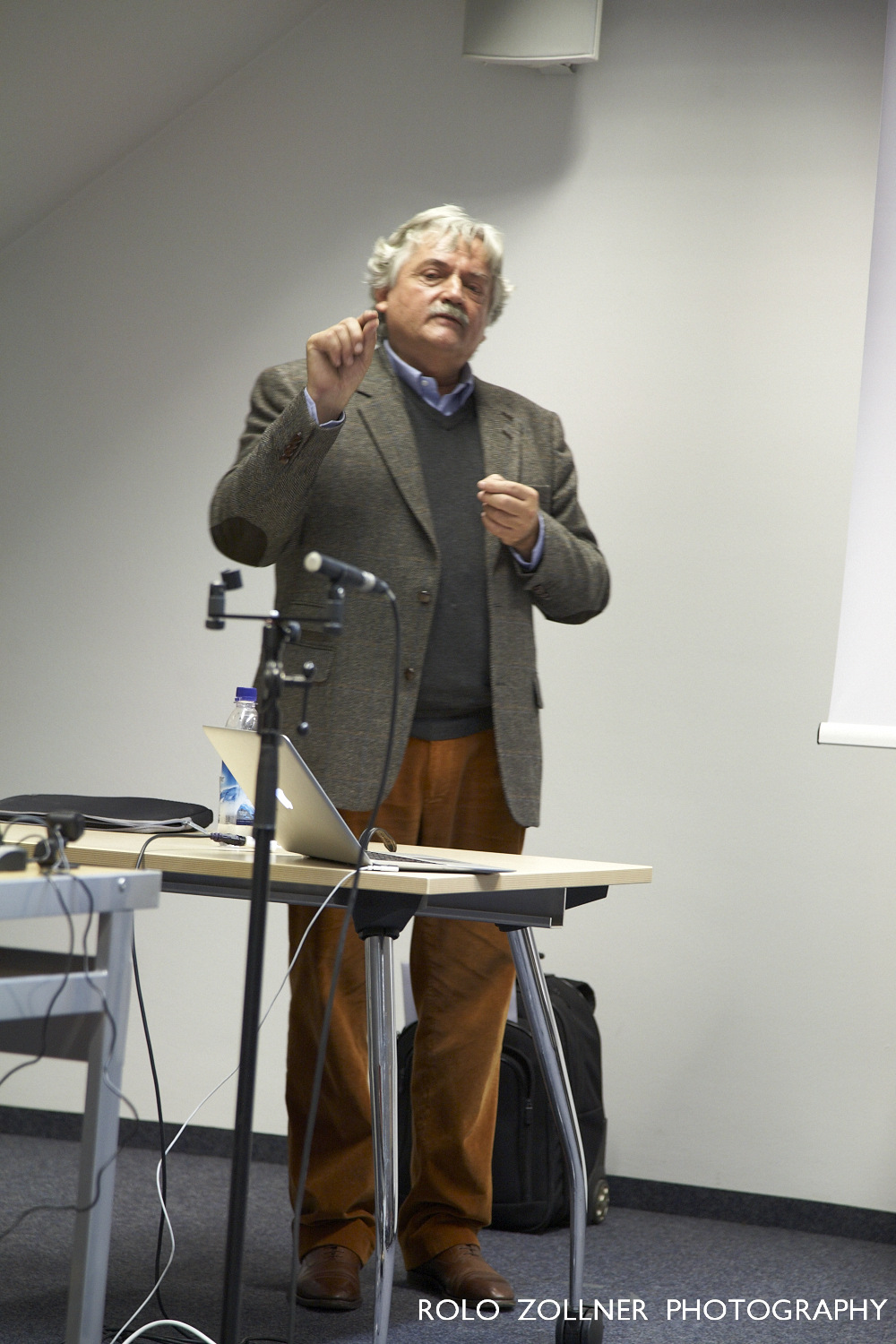 Last Tuesday, Wilfried Bommert of the WDR was our guest at Unterhaching. Wildfried Bommert is a well-known expert when it comes to “feeding the world”. He also published several books on the subject. Currently, he and a few partners are establishing the Berlin “Institut für Welternährung”.
Our last presentation in the series “living and surviving in a sustainable way” was yet again another highlight of the 2012 IF Forum. Herr Bommert deliberately kept his presentation very short and concise. We had planned this, because, after all, we wanted to produce an attractive video recording for Youtube as an extra value.
I think we succeeded. Every single sentence uttered by Herrn Bommert was right on target. Without employing unnecessary emotions and questionable judgements, he reported facts in a very objective way and came up with simple, logical conclusions.
Consequently, there was a long discussion after the presentation. It was extremely constructive and passionate. And we agreed: the messages sent by Herrn Bommert are important. He demonstrated in a very simple and rational way how feeding the world dangles on a thin string. And how easily this string could and perhaps will break.
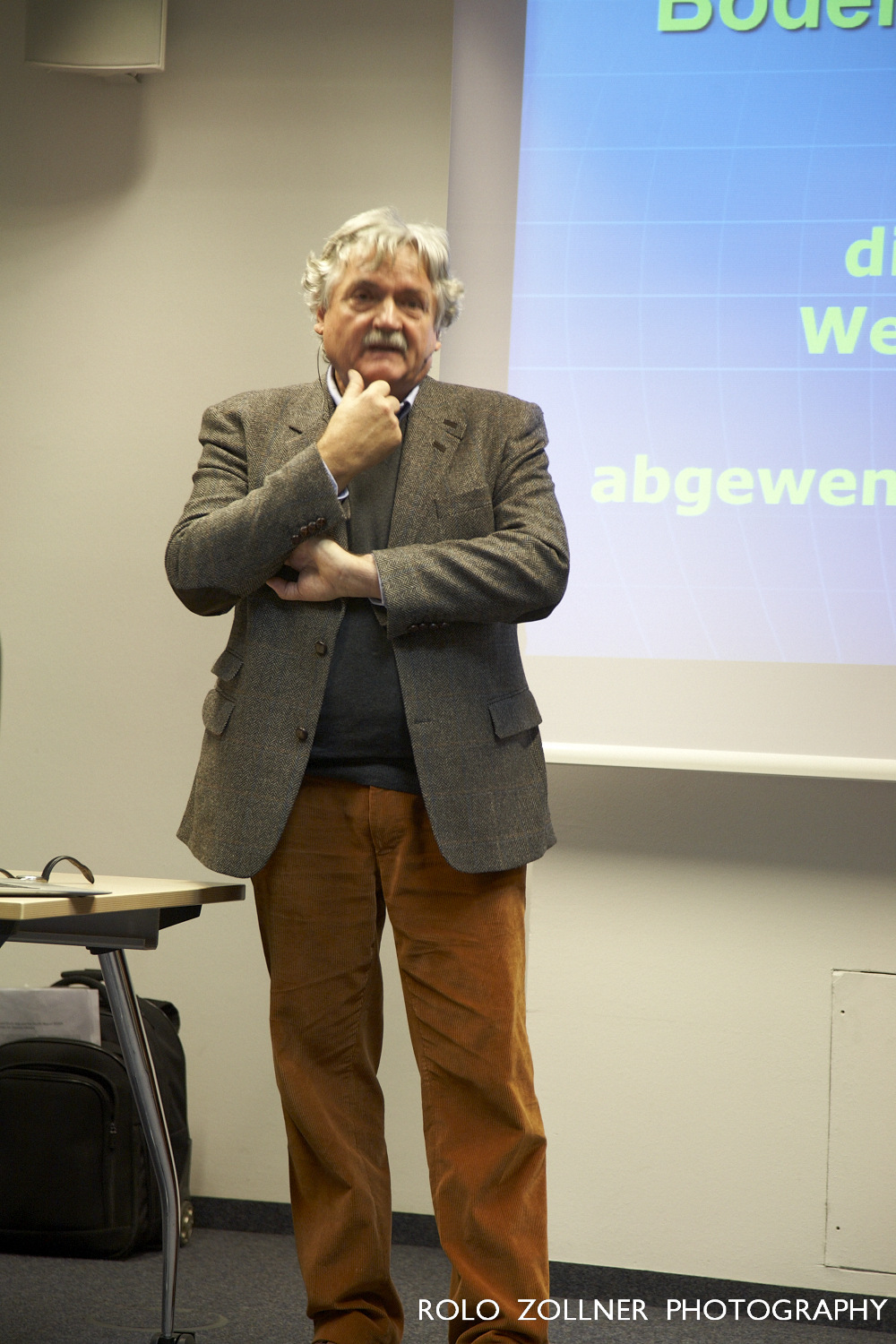 However, Herr Bommert also showed us ways to change matters. And he also showed us that it is, indeed, possible for us to prepare for the time after our stupid and eventually fatal economic habits will have caused a collapse. Consequently, his finishing lines after a very thought-inspiring list of facts and judgements were rather nice and optimistic.
With Vienna sausages and meatloaf (of course from the butcher Schlammerl of Ottobrunn), we spent quite some more time discussing things in small rounds. And finally, when the hot spiced wine and ginger bread were served – also from a local bakery: Götz of Taufkirchen – the general atmosphere was one of courage in view of a possible future and joy about all the interesting information and the culinary delicacies.
I already look forward to watching the video recording by Friedrich Lehn. As soon as it is finished, we will make it available for you on all our diverse Youtube channels.
RMD
Here are a few pictures to refresh your memory and maybe arouse your appetite for the video.
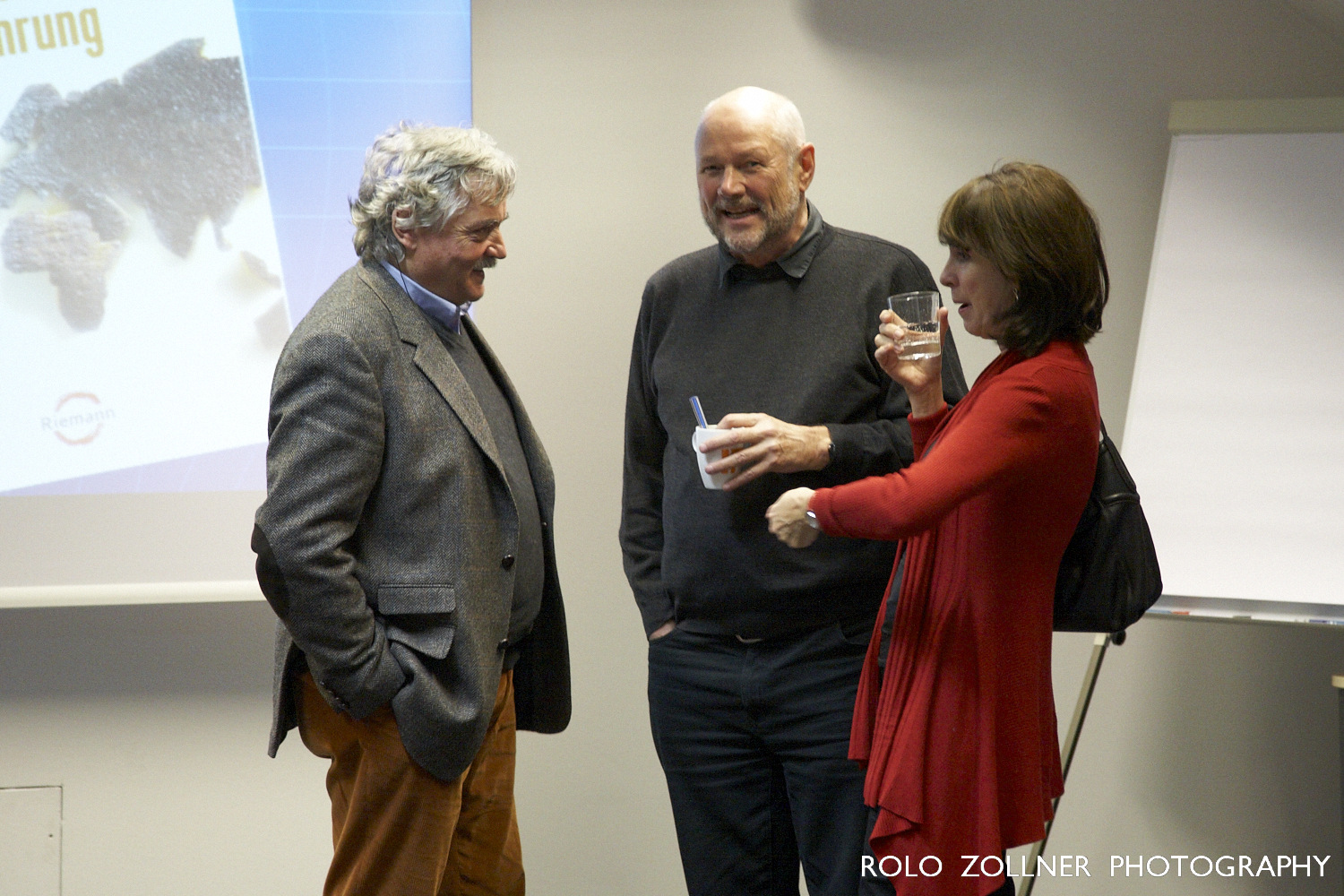
Wilfried Bommert talking to Mr. and Mrs. Gerlach. Thomas Gerlach works for the Bayerischer Rundfunk. He was the one who first introduced Herrn Bommert to me.
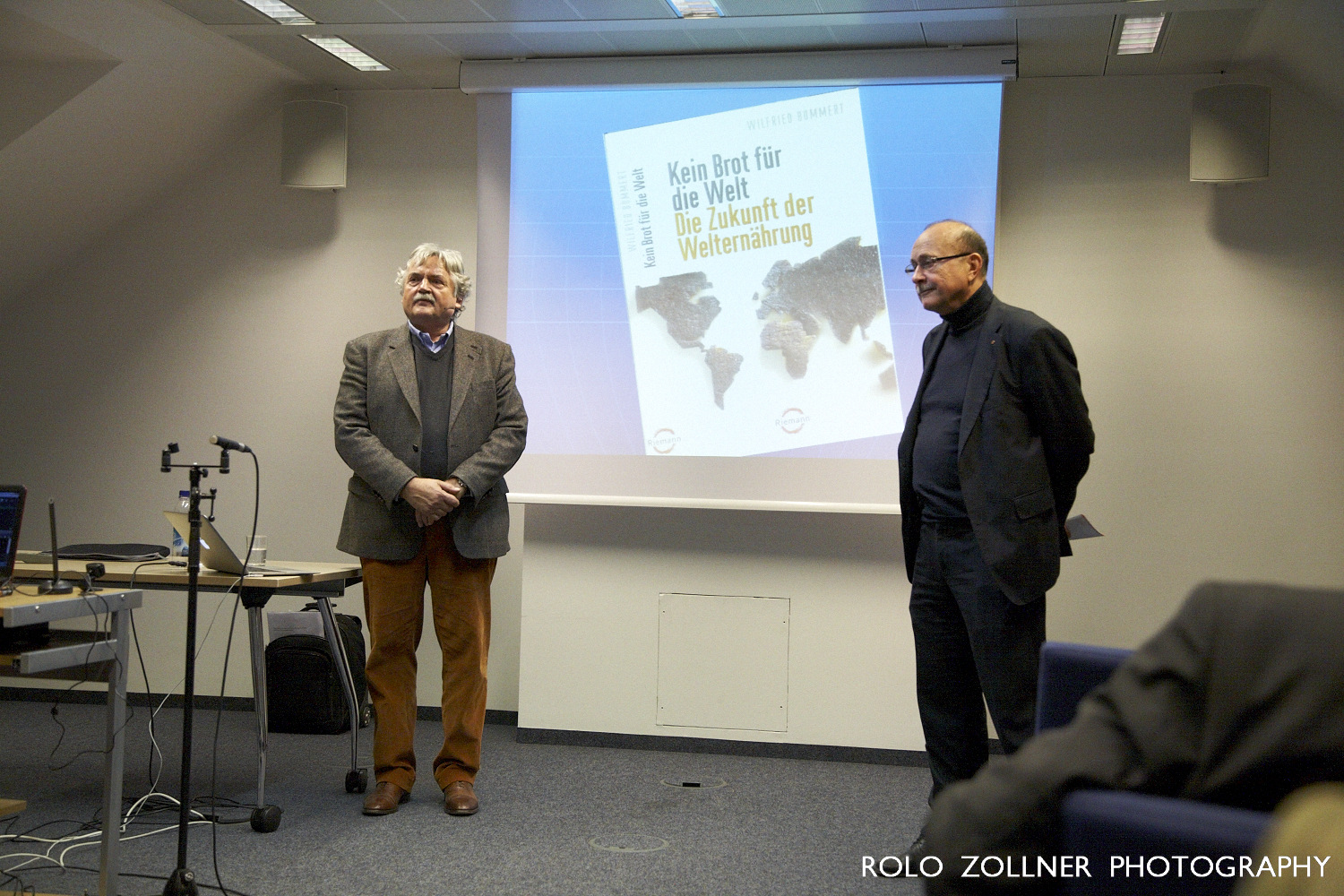
The introduction to the presentation. It will start right away …
As so often, all pictures were taken by our Rolo Zollner.
Roland DürreFriday November 16th, 2012
Presentation “Change in Management” – November, 22nd, 2012 – Universität der Bundeswehr München
As part of the EAA colloqium “Current Developments in Technology and Business“, I will give an autumn-trimester-2012 presentation at the University of the Armed Forces at Munich. I will talk about:
The Change in Management
How change will not stop before enterprises.
My presentation will introduce the world of leadership, innovation as a form of creative destruction, management, project management, organization, social systems, entrepreneurship and entrepreneurial culture.
In their organization, enterprises often follow a paradigm that belongs in the last century. To this day, hierarchical tree structures are prevalent. Since those are not terribly flexible, these enterprises are forced to execute so-called “re-structurings“ in short intervals. As a general rule, those are doing more harm than good to the enterprises.
We all should start thinking in new ways. The organization must become a dynamic network where humans in the enterprise live their relationships at eye-level. I will introduce the “Eight Theses for Management Change” as first written down by Hans Ulrich, the founder of the St. Gallen Management Model.
And I will describe how communication must function in a modern enterprise if it wants to have an impact on our future. Part of the concept is the use and utilization of innovative conference and communication formats and – last not least – the internet, including the “Social Web”.
My presentation will be held at the lecture hall 33/0101 and start on the dot at 18:15 hours. It is an open event, so guests are welcome. Of course, I would be delighted to have a big audience – just send an email to me if you are interested.
I will give a more or less similar presentation at the Bavarian Ministry of Culture in November. Said presentation, however, will be part of a non-public event. Consequently, I can only invite interested persons to the University of the Armed Forces.
Here is the full schedule of the EEA Colloquium (3) at the University of the Armed Forces in 2012. Some of the topics sound really great, so I strongly recommend you take a look at the list.
RMD
(Translated by EG)
P.S.
EAA is short for Electrical Drives and Actuators. Univ.-Prof. Dr.-Ing. Dieter Gerling
Roland DürreMonday November 12th, 2012
(Deutsch) 2-Wochen-News #31: Für Kurz-Entschlossene: Morgen – 13. November – IF-Forum
Roland DürreFriday November 9th, 2012
PM-Camp12
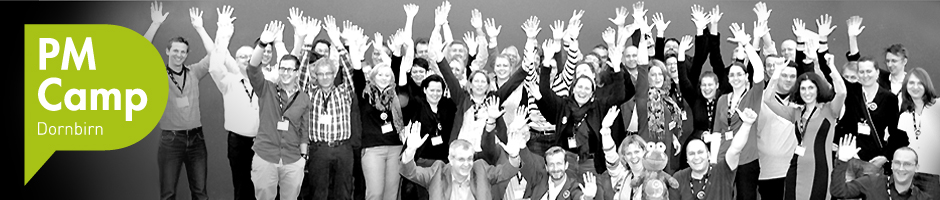 I was definitely a little nervous about my role as co-organizer of the PM-Camp 2012 when the core team (yours truly along with Eberhard, Jens, Marcus, Stefan, so far without Eileen who, unfortunately, was still travelling) met for the last organisational meeting shortly before the evening event started.
Would everything go well? Maybe there are too many participants, after all? Will everything go as smoothly as it did last year? Will we manage the spontaneous building of trust between the participants? Will the catering be as we hope? Will the atmosphere be as good as it was in 2011?
And then, this morning, it started. And everything was great. Just like last year. Now the first day is behind us. And after many super “sessions“ with much that was new for me, I am truly tired. It was absolutely worth the effort – and now we look forward to the great evening party!
If you feel like it, here are some live pictures and video recordings of the PM Camp on the Website .
Incidentally, the twitter tag of the PM Camp 2012 is #pmcamp12. On this site, you can experience live a little of what make PM Camp so special. Of course, today and tomorrow, there will be quite some activity.
RMD
(Translated by EG)
Roland DürreMonday November 5th, 2012
Next IF-Forum 2012 – November, 13th
By now, we have also agreed on the day for the 3rd 2012 IF Forum of our series “Living (and Surviving) Sustainably”.
 Herr Wilfried Bommert will speak on Tuesday, November, 13th, 2012.
His presentation will be about “How to Feed the World“. For a title, he selected:
Catching Up On Good Soil!
How we might avoid the world food crisis.
Here are a few preliminary ideas by Herrn Bommert:
Ever since 2008, the price for food world-wide only knows one direction: up. The global financial crisis and the dwindling oil reserves further push the price spiral up. Concerns selling energy, raw materials and money reach for the fields of the world. They buy or rent huge areas in Africa, Asia, Eastern Europe and South America, thereby again causing massive price increases for food. Consequently, we get famines, revolts in more and more countries that cause political instability and a collapse of world food affairs.
This vicious wheel would not turn if we did not actively contribute by our consumption habits. Our longing for biological fuel and our hunger for products from industrial farming, our money invested in farm and soil stock, they all support the global hunt for the fields of this world. It is up to us to put a stop to this mania currently prevalent in food and soil markets.
Dr. Wilfried Bommert has been working as a WDR journalist since 1979. He is head of the environmental sector at the WDR-radio station and also wrote the book: “Kein Brot für die Welt – Die Zukunft der Welternährung”, 352 pages on paper, first edition published on October, 5th, 2009 at Riemann Verlag (QUERDENKEN) .
RMD
(Translated by EG)
Roland DürreWednesday October 31st, 2012
Why So Many Conferences and So Many Presentations Are No Good!
A short time ago, some of my friends attended a forum conference on project management. Their reports when they came back were not too enthusiastic. Occasionally, there was a keynote that really made a good impression on the listener. Some streams, too, obviously were high enough quality. But all in all, most of the presentations had been rather a disappointment – dominated by insignificance, lack of practical applicability, self-importance and adverts. Besides, many presentations were rhetorically deficient and often just manuscripts read aloud.
This is no exception from the rule. Especially with expensive conferences that have a very good reputation, I have started noticing quite some time ago that the quality of the presentations deteriorates. Consequently, I only attend these kinds of events if I absolutely have to. Basically, this is regrettable, because it is really important to attend conferences and meet others. You want to contact people, make friends with them and communicate with them. However, they are also time-consuming. And who, nowadays, is keen on wasting two or three days in a row if the result is less than satisfactory?
I have an explanation for this doubtlessly existing phenomenon of poor presentations at conventional conferences. As I see it, one of the reasons is how the presentations are selected.
At regular intervals, I receive “calls for papers”, often quite personal ones. Many of these events actually have titles that I find rather interesting: business, leadership, management, projects, change, innovation, agile methods. Actually, I could even well imagine myself contributing with an interesting presentation once in a while. But in order to be on the list of speakers, I would have to hand in a paper. A paper in which I would have to make up my mind what to talk about half a year in advance.
To be perfectly honest, I find this a little too stupid and time-consuming. Even the extra motivation of being permitted to attend the conference without having to pay for it does not make a difference. Just like, basically, I do not have two days at my disposal for listening to more or less unattractive presentations.
Besides, I have enough invitations to speak at all sorts of events and institutions. That is more than satisfactory for me. If a group who asked me for a presentation is to my liking and I have time, I agree to speak for them. If it is a university and/or non-profit or “modern” forum, my presentation is always “for free”. I consider itt part of the policy “sharing knowledge”.
My friends and the good speakers I know follow the same principle. None of them needs to hand in a paper, just in order to present themselves at a conference or in order to advertise his or her enterprise. If the event is for a good purpose, they talk for free or ask for a donation for some charitable organization (I mostly choose AI). Or else, they demand a honorarum, sometimes even as high as Mr. Steinbrück.
So what kinds of people do typically hand in their work following a “call for papers“? I often find people working at the university who wish to see their work being noticed outside their direct sphere, employees of firms who want to improve their marketing. Their maxim is: the boss said “Mayer, why don’t you give presentations at conferences A, B and C?“. Sometimes you also find people who are fanatically in the grip of a topic. Or super theoretical persons who want to spread their personal theory like a Messiah. Mostly, however, you will find persons who I am sure do a good job, but basically want to earn their merits, because by improving their reputation, they hope to gain professional standing. Which is definitely not reprehensible.
Since there is usually a limited number of papers submitted, all those who have sent a paper will actually be permitted to speak. After all, the organizers will be happy to have names to put into the stream slots. If there are more papers than slots, we have the next problem. As a general rule, the selection follows the paper situation. There is no correlation between the formal quality of a paper and the competence of the speaker. Consequently, it is quite possible that even the good speakers will fail to qualify.
I can imagine solutions to this problem. For example, the committee might want to see a presentation? If this is too much ado, you could send a recorded video tape. Or, even better, a link to Youtube. To be sure, you will not have the live-effect, but at least you get a pretty good idea. It would be even better if the committee were to meet the presenters personally. They might arrange to talk about the presentation and thus be able to get a rounded picture of everything.
Here is a very pragmatic and perhaps innovative idea of mine: invite many people to attend a conference, look at all the registrations with a big team and ask those participants you know personally, directly or indirectly to give a presentation. Of course, this causes a hen-egg problem, because the attendants must be convinced it will be a super conference and the right kinds of people will attend.
But even this will not make a difference about one fact: those who actively take pains to give a presentation are usually not the good ones. The good speakers are those who are asked to speak all the time, anyway. This impression of mine got confirmed when I attended the GSA (German Speaker Association) competition. At regular intervals, the GSA does some sort of “Germany is looking for the super model“ for speakers. If you are a member or wish to become one, you can introduce yourself with a presentation. Most of the applicants are “professional speakers” who (want to) make a living as speakers or trainers. The appallingly low standards shocked me. Most of the “professional speakers” I saw could not hold a torch to the people I know from Barcamps or Jam-Sessions.
No, the good speakers are definitely those who get asked to speak, they never have to apply. Or else, they sit among us silently, just concentrating on their competence. So the trick is to find them! Or they spend a weekend at a Barcamp where they exchange knowledge. Conferences are actually the only places where you usually will not find them.
My closing remarks in this article are to advertise our PM-Camp at Dornbirn between November, 8th and 10th. (Unfortunately, it is already almost completely full).
RMD
(Translated by EG)


