
Roland DürreTuesday February 21st, 2012
Entrepreneur’s Diary #72 – Unloved Meetings …
We live in the age of meetings. Most of them are unnecessary and just create frustration.
We spend far too much time in meetings. Mind you, this happens regardless of the fact that this is the era of telephone, email, internet, iPad and Kindle, and, last not least, ”social media”, also in enterprises. Shouldn’t we, therefore, be able to collaborate quite well without all those meetings? Well, it can be done!
But, of course, the public calendars (outlook/exchange) and a seemingly democratic company culture open up countless opportunities to fill even the last free time slot of your business friends (and enemies).
Consequently, we are now more into “meetings” than ever before, regardless of the fact that, due to networks in communication, they are less necessary than ever before. You have so many meetings that there is absolutely no way you can still enjoy them! All you do is suffer through the marathon. Well, it has to be done, doesn’t it? And mostly there is not really much you gain by them.
:-)So here are some reasons why some meetings are doomed to be a failure:

- The meeting is arranged for formal reasons, as part of a legal obligation or part of a process.
Basically, you do not need it. After all, its only purpose is controlling. Consequently, you come up with some, mostly questionable, reasoning why you personally have to do it. You actually meet and then you try to, perhaps, give it some purpose. Who wants to admit to oneself that he or she is wasting his or her time with nonsense? Not that there were not something much more sensible (or enjoyable) you could do at the same time. Well, that will have to wait or be cancelled.
So: if a third party or “some anonymous agent” has forced you to arrange a meeting, then this is a perfect emotional requirement for its failure. - The meeting is a jour fixe in your calendar.
It is hard to imagine that a meeting might be necessary on a daily, weekly, monthly or three-month basis. Perhaps the daily meeting in order to know where you stand in a process like SCRUM is an exception. Except that this is usually done standing up, so it will never take long. Because woe to those who sit down… Or else you just start your work if nothing important needs to be discussed, anyway.
The normal “periodic” meetings are mostly board meetings. The very equidistance (Äquidistanz) will inevitably mean that some of these meetings are unnecessary. They are the ones you should cancel.
On the other hand, with these periodic meetings there is also the danger that you sometimes cancel them even though they are necessary. In that case, you must invite the parties concerned to an “extraordinary” meeting.
If, however, for example, you have four yearly meetings and would actually only need two, but on the other hand there is a high chance you will need an extraordinary one, then it is probably more efficient to call a situation meeting. And nobody is allowed to lament that this is not possible because all the parties concerned have a calendar that is too full (with meetings). So what is the problem if there are only five persons attending a meeting, instead of seven? Especially in the internet age?
So: a periodical meeting, perhaps planned in advance for the entire year in regular intervals, is something questionable per se. - The planned time-table is precisely adhered to.
Do you, for example, plan to eat your dinner between 7 p.m. and 10 p.m.? And do you call it a success if it is finished at 10 p.m. on the dot? This criticism is related to the last point. It is hard to imagine that tasks to be discussed will always need the same amount of time. More often than not, you will invent “pseudo problems” in order to try and fill the time. Or else, true problems will not be discussed because there is no time left.
Beware: if you manage to precisely end a meeting when it was supposed to end, then this is not an indicator that the quality of the meeting was high. On the contrary, maybe you should get sceptical about the results when that happens. - There is always the same agenda in a meeting.
This is another good chance for you to ruin a periodical meeting over some time once and for all. It leads to boredom and routine. All you do suffer through a duty. The formal character dominates and the added value is lost. A pity that the time has been wasted.
My advice: always have at least one special item on the agenda. But, please, make it one that is relevant und perhaps even interesting for those who meet. - It is always the same problem that is discussed in a meeting
A problem has to be solved. Afterwards, you no longer talk about it. Or else, it cannot be solved. Then it will do no good at all to have it on the agenda again and again. If you do that thoroughly, there will certainly be few participants left who will not get fed up. Because there is no way some of the participants will not hate it.
If that is your practice, you will find every team member quit inside! - Someone has to write the minutes with a to-do list for the next meetings.
Well, that sounds nice, but it is not a good idea. Because the world changes. And it is basically a fact of life that working on “open issues” has nothing in common with the “open issues” of life. Especially if three months have gone by between the two meetings. Because what seems very important to us today will mostly seem relatively unimportant tomorrow. Among other things, this is because the human brain is so easy to manipulate.
So – mistrust the obvious professionalism of great minutes and action items that sound wise as homework for the participants. Especially if we are talking someone has to fill paper and create numbers!
Here is some more information:
As you all know, I like talking about the old and the new world. In the “old world”, meetings were actually important. They probably worked well even in a strictly hierarchical and mechanical leader, management and enterprise culture. In those days, it was not possible to communicate quickly and be cross-linked – as is common today.
Now, however, times have changed. In the “new world” the opportunities of networking are countless. We have another concept of human nature, society and enterprises. The speed has increased drastically. Decisions have to be made in a flexible and time-critical way.
But meetings turn more and more into ghost conferences. They cost time and keep the people away from important tasks.
In other words:
I consider it absolutely necessary that humans have to meet “face-to-face” in order to exchange ideas, talk about future activities and assign tasks, both in projects and in real life. Meetings along the lines of old patterns, however, are something I consider contra-productive and sometimes even catastrophic. Because they create far too much frustration and will hinder positive momentum.
It is a tempting idea that problems might be solved rationally, well-tracked and with clear “action items”. But, unfortunately, that can only happen in an ideal world. Which is something you do not often get in real life, or maybe never …
RMD
(Translated by EG)
P.S.
Click here Drehscheibe for all the articles of my entrepreneur’s diary. mehr »
Gastautor(en) Monday January 16th, 2012
Hurrah! I Can Read the IF Blog on my Kindle!
Here is a short instruction (not just for the IF blog)
Being an enthusiastic user of my new Kindle, I find it great that I can now read Süddeutsche, Zeit, Spiegel and much more, as well as browse through the IF blog, while sitting in the S-Bahn train.
🙂 The “installation” is a little tiresome, but afterwards…
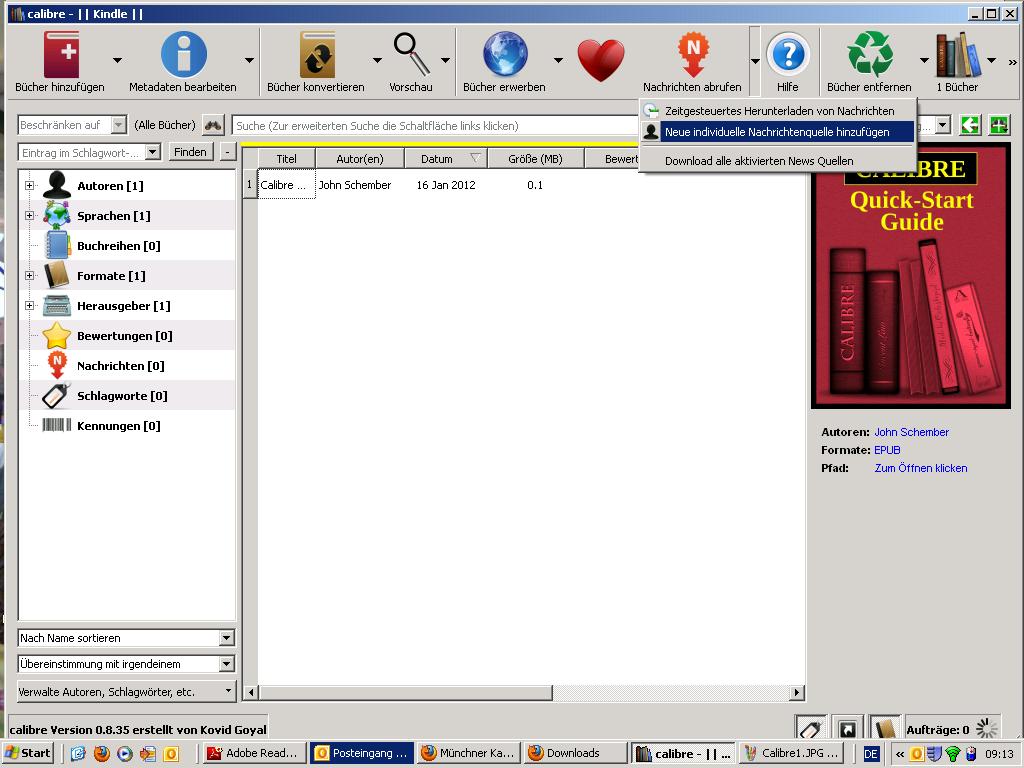
First, I installed the program Calibre on my computer. It is a free Open Source e-book management application. Using it makes it possible to convert books and files into the “Amazon format”. But you can also call up RSS feeds and then transfer them to the Kindle.
For installation, you have the option “call up news”.
You can choose between:
- Time-controlled download of messages:
what you get is countless pre-arranged RSS feeds, among others currently 68 newspapers, some of them free. - Add new individual news source:
that is what I need in order to be able to read the IF blog on my Kindle in the future.
Roland DürreFriday December 30th, 2011
Isar Network – ISARNETZ
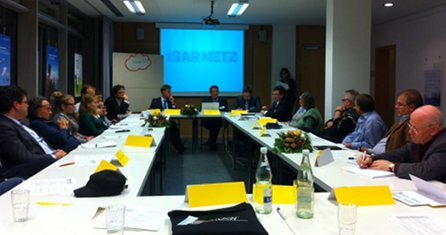 On December, 15th, I accepted an invitation sent to me by the Economic Department of the Capital City and the IHK Oberbayern. It was a kick-off meeting for a “Munich Web Week” next May.
It seems that Munich is no longer quite so attractive for young people. Besides, it is too expensive.
And, above all, it is no longer “sexy”! What is particularly galling – even if understandable – is the fact that a city like Berlin currently beats us.
Roland DürreFriday December 2nd, 2011
Advent Calendar – December, 2nd
Another 22 nights to go!
Today, there is a small story of an unknown guest author in the advent calendar. It goes well with the festival of presents, because that is what it is about.
mehr »
Detlev SixThursday December 1st, 2011
ex experts
once upon a time. we were all of us experts. everyone was proficient in something special. something none of the others was able to do. much of it was just for show. self-portrayal. rather pompous peacocking. but at least we earned money doing it. money with which we were able to pay the rent. or to buy a small house. to dress. to give our children an education.
then came the gentlemen of cloud. google and co. they had a wonderful idea. sharing knowledge. so we shared. all of a sudden, everybody was a musician. then everybody was a film producer.
the techniques were called mash up or remix. or else, everybody was an ad writer. the general formula was content, instead of idea. the programmers were those who resisted longest. some of them were given a job by the cloud gentlemen. the others usurped the open source recommendations with their favourite trick.
Werner Lorbeer
Offences Against The Fantasy of Children Around Christmas
 What does Punch think? For many years, children found it nice to have wooden-head think for them. They felt if he smiled or wept, if his approach toward a solution was circular or straighforward. Children felt empathy alongside him on stage – for bank robbers, crocodiles, sailors, market-women.
The man who currently pulls the puppet strings, Klaus Marschall, recently described in a radio interview with simple word how our children have changed due to cultural change: “For many children, it is no longer possible to follow the figure with their hearts as they used to do in former times. They immediately have to process everything externally.”
We have come to a stage where our children are supplied with and drowned in non-communicative games and toys.
Roland DürreTuesday November 15th, 2011
IF Forum – Live Broadcast on November, 18th, 2011
3rd IF FORUM 2011 – Humans&Kowledge/Science
This Friday, the day will have come!
 The last presentation in our trilogy “Humans&Knowledge(Science)” will be given by
Dr. habil Walter Riess
On Friday, November, 18th, 2011, as always starting at 6 p.m. It will be about
Nano Technology – The Future of IT
For more information, click here: IF-Open.
As before, we will broadcast the presentation live into the internet from the IF Forum on November, 18th.
In this very window, a video stream will be activated next Wednesday starting at 6.15 p.m.
Here is the web address where you can watch the entire presentation:
http://www.ustream.tv/channel/IF-Forum.
If you miss the live stream or want to see it again later? No problem! We well record it and make it publicly available.
RMD
(Translated by EG)
P.S.
There are still a few vacancies. If you want to register, please contact Claudia Toth.
Roland DürreMonday November 14th, 2011
“New And Old Dependencies“ or “Very Simple Questions“
In former times, the most important service providers were the postal service, the railway and the municipial utility. They were all state-owned. Today, they are privatized. And they can now go bankrupt. In that case, the state has to save them (make them state-owned again) and continue to operate them.
Today, there are totally innovative service providerss. We have come to love them: google – and its competition – with email and calendar, search machines, geo services like maps or other useful things like Youtube and Flickr. We have Skype, Facebook and Twitter. And much more that makes life more agreeable.
All these services are provided privately. The providers do not offer their services for philanthropic reasons. Instead, the first thing they want to do is make a profit. Many of them do not even sit in Germany.
What if they go bankrupt and no longer provide their services? Well, it could happen, couldn’t it?
There are also some useful systems like wikipedia and many Open Source products. Many helpers working on a strictly honorary basis in non-profit-organizations are responsible for those.
What will happen if highly qualified people are no longer willing to work voluntarily and for free? And what if there are no longer any donations? Well, it is not a totally unrealistic scenario.
First and foremost:
Life goes on …
Except totally different things will then again be more important …
On the other hand, some of those services are rather valuable, aren’t they. Will the state or the community of states have to interfere and keep them alive? Is there a risk insurance?
These are all just questions – to make you thoughtful!
RMD
(Translated by EG)
Roland DürreThursday October 20th, 2011
Tweets on Twittering and Blogging #087
Here are my tweets of last week on
Blogging and Twitter, Wisdoms and Rules:
111103 One in a while, you have to say something – listen, twitterers and bloggers!. #Twitter #Blogging ##Wisdom
111104 You have to understand the game they play – well, just like when twittering and blogging! #Twitter #Blogging #Wisdom
111105 You have to open your door so happiness can walk in – something all twitterers and bloggers know. #Twitter #Blogging #Wisdom
111106 You have to call a spade a spade – something all twitterers and bloggers are obliged to do! #Twitter #Blogging #Wisdom
111107 You have to grab the devil by the horns – so be courageous when twittering and blogging. #Twitter #Blogging #Wisdom
111108 You have to celebrate the parties when you have the opportunity – also true for twitterers and bloggers. #Twitter #Blogging #Wisdom
111109 You have to take hold of somethign wherever there is a handle – especially when twittering and blogging. #Twitter #Blogging #Wisdom
There is a new tweet each day. See Twitter and “follow” RolandDuerre!
Enjoy!
RMD
(Translated by EG)
P.S.
I took the proverbs from Alle deutsche Sprichwörter.
Werner LorbeerMonday September 26th, 2011
“All your life is all your apps”
 (Heard at the Radio, words of Mark Zuckerberg)
What followed was a short exchange of letters between me and the Bayerischer Rundfunk:
Dear ladies and gentlemen at BROnline,
Here are the texts:
Dear ladies and gentlemen at BR-Online,
I tried hard to remove my face-book entry. Apparently, it cannot be done. As I looked for help, I found the entries by the public data protector of Schleswig-Holstein.
Like me after all my failed attempts, he thinks that facebook violates the data security laws, both in Bavaria and Germany. Why do you support or use firms that obviously act illegally?
In my opinion, it would be no less than my right to demand of you that you no longer cooperate with facebook.
Sincerely yours
The Social Media Representative of BR sent me an interesting reply.
Dear Mr. Lorbeer,
thank you very much for being interested in our program. We at the Bayerischer Rundfunk take data protection very seriously, which is why the relevant questions asked by the county’s data security persons are currently under scrutiny and critical discussion by our ARD data security representative. The main requirements of data protection and data security with respect to social media in radio stations will be written down in a guideline.
Our using factbook at all for promoting links and information is due to the fact that many young people are simply a lot easier to reach there than through conventional channels; and it is part of our duty to reach those people with our messages.
Kind regards
In my reply, I also included a small part of the answer I gave after Zuckerberg’s disreputable phrasing. Would you like to comment on it?
Dear Mr. Primbs,
I am truly delighted to read that the BR is aware of the data security problem. There is a difference between me selling my consumption habit profile and processing my profile to politically interested parties via some published BR articles.
In my opinion, the latter, since company data processing and subsequent commercialization is just as useful to a firm as the former, has a far higher right to be protected. After all, I am not only deprived of data security as a citizen, but even potentially being made transparent as a voter – including my way of thinking and opinions.
To be sure, BR will not be able to stop facebook. But: can and may the BR use and protect facebook as long as this concern a) does not subject itself to German data security legislation and b) might even strive towards violating higher legal values by selling political opinion profiles?
In the face of this, the desire of the BR to “reach… young people” should have less priority.
Sincerely yours,
Dr. Werner Lorbeer
wl
(Translated by EG)


