
Roland DürreWednesday March 13th, 2013
Hotspot & WLAN and the Future
I often travel and meet many people. Hardly ever, I fly through the air, but I enjoy wireless world-wide communication via “air”. This is especially true when I go places by public transportation, when I sit in rooms, at universities or enterprises, in coffee shops or restaurants, at institutions or associations, or wherever.
Just like my travels and meetings promote “networking”, so I wish to be linked to the rest of the world through networks. Consequently, I always find it rather nice to find a WLAN I can actually access. Since I seem to be a demanding network user, I am not content with UTMS & CO. Personally, I do not have any experience with LTE (Long Term Evolution), because I do not own an LTE –capable device.
But I already looked over the shoulder of people who used LTE. The speed was really amazing. I got the impression that the LTE will, again, trigger a small revolution – after which the mobile world will be even more on the way up than it already is.
Who knows: perhaps soon we will only have LTE and all the many WLAN networks will be removed. That would, again, be progress in the direction of “less waste” if we no longer need all those parallel WLANs many places have.
But we are not yet at that stage. For me, using LTE would mean that I have, yet again, to buy new technology. Well, I prefer to wait a little. When travelling, I use various devices (Smartphone, Pad, Notebooks with Stick). None of them is capable of LTE, and still I am quite content using them. But since I do not wish to buy everything new now, I will wait for a truly new generation of hardware – one which, of course, will be capable of using LTE.
Consequently, I am often on the lookout for free WLANs. And as we all know, WLANs are almost everywhere. For me, however, they are not accessible. I often have a two-digit number of networks showing on my display, but they are all password-protected. Only if I am an invited guest at modern enterprises, institutions, hotels or other locations, I usually have no problem. Because especially “good” companies with a reasonable and modern (entrepreneurial) culture also have WLAN with which they can easily offer their guests access to the internet. It is basically part of their definition of hospitality.
The Telekom and older enterprises, such as the railway in its lounges in some trains – unfortunately only on few of their routes – are doing quite a good job with their internet supply. But there are numerous institutions and enterprises where it is still hard or even impossible to access WLAN. More often than not, these companies are huge and a little complex. Whenever I see this, I am surprised and hope that we may soon get area-wide LTE.
When accessing WLAN as a guest, I am overjoyed if the password is still valid after my last visit. In that case, I get immediate access to the internet. As a guest, I also find it nice if the WLAN password is written on a note and clearly visible for guests somewhere in the guest rooms.
I am just as happy not having to use a password for WLAN access and instead having to fill in a start screen where they want me to put my cross at the question: will you promise to adhere to the business conditions? I am more than willing to do both: put my cross there and adhere to the business conditions. Basically, I believe the latter alternative is the more reasonable way of doing it, because open networks help us to reduce the gigantic waste caused by all those many parallel WLANs all over the world. Isn’t it also about time for “shared economics”?
I would therefore here and now like to explicitly thank all these excellent hosts.
But now I am switching roles. Now I am no longer the guest but the host.
At home, I yielded to the fears of the rest of my family and encoded our WLAN. Mind you, all probabilities of real risk scenarios for our physical well-being and property is many, many times higher than the risk that someone might do damage to us through open WLAN.
Since, however, everything is possible und you want to protect against really everything, we bowed to the public super ego and set a password before our WLAN. But it remained the same ever since we first installed said WLAN. And the “modern segment” of our many guests is happy about this. To be sure, they forgot our password a long time ago, but their devices remember. Consequently, they are instantly back in the network when visiting us and hopefully feel at home.
At the enterprise, this seems to be more difficult. We have the explicit intent of adhering to the law. We therefore take the topics security and data protection just as seriously as quite a few other things our legislation came up with. Even if, more often than not, this does not make life any easier for us.
Consequently, we provide our guests with their own open WLAN called IF-OPEN at InterFace AG, both in the Unterhaching headquarter building and our branch offices. To be sure, said open WLAN is also password protected. But we chose a “promotionally effective” password. It alludes to the capital “F” in “InterFace” and indicates that we are already almost 30 years old.
We give our guests the password in order to make sure they feel at home in our building. In the common rooms, such as the seminar zone and meeting room, a note is pinned to the wall. Our IF-Open is also something I and several other employees like to use, since it gives you direct and proxy-free internet access.
A short time ago, someone raised the question: should we change our guest network password? And if, at what regular intervals should we change it?
If it were up to me, once in fifty years would be enough.
Let me try to explain: a stable, reliable and, above all, easily remembered password for a WLAN which is intended and referred to as open and still protected by a password is a true blessing. If you change it often, this will cause some – if only little, but constantly recurring – extra work for many people. Just because (probably only in theory) there might be someone in or near our building who “pinches” our internet access and even “abuses” it.
I have no idea how realistic this kind of fear is. However, in my estimation, it is rather negligible, considering what “real” risks we might have to face (breaking and entering, theft, …) .
But a few years from now, we will have area-wide LTE, anyway. By then, you will no longer need WLANs and all these considerations will be obsolete
RMD
(Translated by EG)
Roland DürreSaturday February 23rd, 2013
Privacy 3 – The Cloud
In the IuK (information and communication technology) sector, we constantly have “a chase after a new craze”. Now, for some time, it has been the Cloud. And although nobody wants to hear about it anymore, it is still something many people are truly afraid of. And, of course, as so often, it is again all about data security.
The official advice given by experts and data security specialists is you should always look for the “home country” Cloud. In this instance, however, the term “home country” does not necessarily mean “German Cloud”. It means “European”. In my personal opinion, the difference is not really important.
If I no longer consider myself all that important, then it is totally irrelevant where my data are stored and who can see them. And probably no huge damage will be done if they disappear. Besides, they actually cannot ever really disappear, can they?
In an ideal and transparent world, it would be unimportant to “protect data”, anyway. But we all know the world is not such an ideal place. And if you have a critical mind, you can always have a situation where you should be afraid of the powers that be. Also meaning governmental systems that are not precisely scrupulous when it comes to human rights. Some have secret state organisations monitoring your beliefs and systematically spying on people. They call themselves protective or serving or gave themselves abbreviations mostly consisting of three letters.
If you want to protect yourself from these, you should keep your data far away from the powers that be. And then you should also store your data in a very remote Cloud. This would actually be a very “foreign” Cloud. But this will not help you either.
Because the aforementioned organisations, protected by their own governments, will always find ways to extract your data from the security prisons you locked them into. Or – even easier for the powers that be – they just use and support global criminals. Just think of the “tax CD” unearthed in Switzerland, a country that used to be ever so foreign when it came to finances.
No – what has always been true is now probably more so than ever: what you acquired illegally will not thrive well! It is better to take advantage of fewer opportunities, remain transparent and not allow secrets. And if there are secrets that might be detrimental to your own person, then you should never, ever write them down. Neither on paper, nor electronically.
Consequently, we should not be all that concerned about personal data protection, data security and the Cloud. Instead, we should use civil courage, constructive disobedience and responsibility to fight against everything that might violate our rule of law and our basic rights.
And we should practice and demand the kind of behaviour that gets the world back on a sustainable course in the biological sense. And then we should continue to think about many social deficits and irregularities and deal with them. Which is something we need the internet for – including the Cloud. Because it has become the nervous system of our planet and of this global world – and we will not solve the complex challenges we face without it.
All these things will probably be a lot more important for our future and the future of our children than the fear about data. …
RMD
(Translated by EG)
Roland DürreThursday January 31st, 2013
Tweets on Twittering and Blogging #152
Here are my tweets of last week on:
Blogging and Twittering, Wisdoms and Rules:
130207 Always expect the unexpected – are you listening, twitterers and bloggers? #Twitter #Blogging #Wisdom
13008 If you don’t try, you will never get the experience – a good strategy for twitterers and bloggers! #Twitter #Blogging #Wisdom
130209 Untangled yarn is good yarn – also when twittering and blogging! #Twitter #Blogging #Wisdom
130210 Unobscured is always best – also true for bloggers and twitterers! #Twitter #Blogging #Wisdom
130211 Nothing daunted, nothing dared – also a strategy among twitterers and bloggers. #Twitter #Blogging #Wisdom
130212 The unwilling messanger is a good prophet – also true for twittering and blogging? #Twitter #Blogging #Wisdom
130213 Ignorance is courageous – especially when twittering and blogging? #Twitter #Blogging #Wisdom
There is a new tweet each day. See twitter.com and “follow” RolandDuerre!
Enjoy!
RMD
(Translated by EG)
P.S.
I took the proverbs from Alle deutsche Sprichwörter.
Edwin EderleMonday January 21st, 2013
(Deutsch) Vorsicht vor der Cloud? Erfahrungen, die ich nicht machen wollte!
Roland DürreSunday November 18th, 2012
How I Prepare for the Presentation “The Change in Management”.
In November, I will be talking to various groups about the “Change in Management“. The following text grew as I prepared the material for my presentations. It is a description of the environment and is supposed to help the audience as an introduction – or maybe as an accompanying “reader“.
Over the last few years, modifications, in modern German called “change” gained in speed in geometric dimensions. The internet changes the world in a way never experienced since the “industrialization”. Post-modern times are at an end, we are quickly entering the “information times” (if that is what they are going to call it a hundred years from now).
A large part of said change is about business. The way we work undergoes change. Young enterprises – offering totally new business models, entrepreneurial cultures and unheard-of products and services – rise and dominate the world in the shortest possible time. Just think of Apple, Dell, Facebook, Google, HP, Microsoft, Oracle, SAP and many, many more. And all that remains for Siemens & Co is to look on with growing envy.
Neither is this the end. Highly qualified persons no longer wish to work under a binding employee contract. Some of them merge and work on an honorary basis, sharing their special expertise and knowledge for common goals. For instance, experts from a totally new field, the software industry, first started getting together and building small associations in the USA with ”free“ and ”open“ products in the GNU time. And this is how huge movements grew. Today, the world is unimaginable without them.
Initially, it was typically “simple“ software tools, such as the (GNU) compilers of the 1980ies. But soon enough, the show really started to get under way. The famous “lamp” software was generated: Linux, Apache, MySql and Php. Yet this is only the tip of the iceberg. Today, we have a huge “Open Source” movement consisting of many small and big communities. And this is where the most wonderful things are developed on an unbelievable scale. And all of a sudden, products that were generated in someone’s leisure time and on an honorary basis actually displace the commercial ones. Now these products are the accepted standard all around the world.
Naturally, less complicated technological parts, too, can be linked as huge software systems, such as automobiles. They can be developed openly in an “engineering” way and assembled locally. And it will only be a question of time before the first open e-mobile will cruise the streets in huge quantities.
This development is supplemented by non-IT open source movements. The most famous one is probably Wikipedia. But Wikipedia, too, is just the tip of the iceberg. You can hear the battle-cry everywhere:
“Knowledge is the only commodity that grows as you share it!”
Simultaneously, many NGOs (Non Government Organizations) are started. Among many peoples, they already enjoy a better reputation than the local government. New catchwords are: community, belonging, collaboration. The prefix “co” in particular, as found in co-operation, has become a favoured part of words. Terms such as co-creation, co-working, co-programming start having lives of their own.
New strategies such as “crowd sourcing” develop, trying to make use of the ”intelligence of the masses“. In doing so, they create a true mega trend. The internet dominates the world. Pads, smartphones and laptops are “in”. The market for apps is exploding.
A short time ago, I read that more Germans can imagine life without a car than without Facebook. Even the “Golden Calf ” (Goldene Kalb) of the last century, the car, seems to be on its last leg.
The same happens in business. Enterprises with a totally different philosophy suddenly push the traditional ones to the side. In private life, functions, career, ties, status and titles get less and less important. To make up for it, the need to live your own life as you yourself want it grows. Using the words of Old Frederik: the people want to “be happy in their own façon”, kissing late capitalism and marketing economy good-bye. As I see it, this is a very nice understanding of freedom.
But how could this have happened?
Very simple – we are living an evolution. And said evolution will not leave persons and their forms of living and group-forming out of the equation. Some people have many antennae and therefore witness quite much of the social development. Using their special training and knowledge, they think about and write down the developments of “yesterday, today and tomorrow”. As a general rule, we are talking philosophers and people trained in similar sciences doing their jobs as “observers of evolution“.
Philosophers also formulate contemporary thinking and describe the predominating values of the last thousand years. And those have changed considerably as the centuries went by.
In Medieval Times they said:
“Whatever God wants is good!”
Basically this is a rather simple rule, except you have to know what “is God’s wish”. Then came Utilarism with Thomas Hobbes (Leviathan) stating
“Whatever is good for humans is good!”
Well, basically, this does not sound bad, does it? Especially if you are a human. But then, Kant did not like it. He felt it was not as easy as this. What you need is something like moral standards. So he came up with a very categorical formulation:
The Categorical Imperative (Kategorischen Imperativ):
“All finite and rationally gifted creatures, and therefore all humans, should judge their actions according to the question if said actions can at all times and without any exception follow a prevailing maxim, thereby respecting the rights of all parties concerned, also if only as an end in itself!”
With his evolutionary theory, Darwin provoked the precise Victorian data and Nietzsche was in a hurry about enlightenment (Aufklärung). And we already knew that humans are just ordinary creatures that developed from ape-like ancestors and that they should ideally strive to abolish all uncertainties, answer questions and correct errors through knowledge acquisition.
During the postmodern era, enlightenment became a radical concept and now it can probably no longer be neglected. But the process continued.
After the war, for instance, came Habermas. He said something about the dominance-free (ethical) discourse (Diskurs) as a basis for communication and knowledge acquisition and came up with the following fantastical rules:
- No outward constraint must ever hinder a discussion.
- The best argument will prevail.
- Every participant gets the same chance to take part in the discussion.
- Every participant must be capable of “self-presentation without affront“ and make himself transparent for the others.
- Every participant must verbalize the basic decisions of his or her life and be prepared to accept criticism. (There is a highly sophisticated system of thesis and anti-thesis, the duty to give reasons for all statements, etc).
- Nobody enjoys privileges because of his or her age, experience, authority, etc.
- Every participant must be willing to exchange behavioral expectations with all others. Every participant must be prepared to switch roles with all others.
- The discussion will continue until a consensus is reached. As soon as the new truth has been accepted, it will dominate the life and behavior of all participants.
As I see it, the most important issue for our current development is the term “dominance-free discourse“. It probably originated with Habermas. To be sure, the primary literature is a little clumsy, but still nice reading. If you want to read more, I recommend this small speech (Rede). It contains a few nice suggestions.
And then, there was also an Adorno. Here is a citation:
“If the opponent will not give in, he is disqualified and accused of not possessing exactly those characteristics that were stated as the basic requirements for the discussion. These requirements will be twisted in such a clever way that the other party cannot help but be persuaded; thus, the discussion turns into a farce. Behind this tactics, there is an authoritarian principle: the dissenting person must accept the general opinion of the group. Untouchables project their own untouchability to the one who does not want to let himself be terrorized. Using all these methods, actionism becomes part of the trend it believes and professes to oppose: bourgeois instrumentalism that fetishes the means, because its practical ways cannot bear the reflection on the ends.“ (pp. 180-181).
The citation was taken from the essay: „Marginalien zu Theorie und Praxis“ (1969) and was published by Suhrkamp in the small book: “Kritische Modell 2″ by Adorno. Other than that, you will find plenty of material if you read “Strukturwandel der Öffentlichkeit” by Habermas, written in 1962.
In my opinion, Adorno and Habermas described quite well what happens today. And today, web 2.0 also helps a lot. And interactive bloggers and twitter, as well as social media like facebook and persons linked in the net are just a logical consequence. But this is only the beginning.
In economics, Hans Ulrich, “devisor of the St. Gallen Management Model“, described the coming change particularly well. I find his eight theses on “new ways of thinking in management” particularly worth reading (you will find them in: Hans Ulrich “Management – Aufsätze 2. Teil von 1981 – 1998″) :
- Accept uncertainty and the unpredictability of the future as a normal state of affairs!
- Extend the borders of your mental horizon!
- Use the categories “both”, instead of “either-or”!
- Think multi-dimensional!
- Use self-organization and self-control as future models for enterprises!
- Consider managing as a meaningful function!
- Focus on what is really important!
- Make use of group dynamics!
Today, it is all about producing more knowledge in order to shape a common future. Consequently, in order to find the right questions, we need and have new communication formats. That is our first creative responsibility, because only after we actually know our problems, we can start looking for solutions.
There was a time when requirements like the “dominance-free discourse” were considered utopian and unsatisfiable. Today, they have become reality and are lived in the internet, as well as in the non-inter-world. New formats, such as jam session, barcamp, open space, fish bowl, Pecha Kucha, Ignite and many more spread all over the place at high speed. They replace many meetings, conferences and in the end even institutions, thereby leading towards a hybrid culture that combines real and virtual life.
These were a few ideas as a pre-view for my presentation (Vortrag) to be held, among other places, at Munich University of the Armed Forces this Thursdays.
RMD
(Translated by EG)
Roland DürreSaturday October 27th, 2012
Our Oh-So-Cherished Personal Data – Letters and Ownership?
I would like to add something similar to what I said about data security in my last article. Take, for example, the totally harmless letter?
Language is a requirement for complex communication between intelligent beings. Along with language, we got the written word. Writing made it possible to compose letters. For many centuries, letters were the epitome of bi-lateral distributed communication.
But who does still write letters today? Is there anybody among us left who actually experienced the wonderful secret of writing and receiving letters? Personally, I still have some vague memories from the first two decades of my life:
If you want to write a letter, you will need paper. You will use the paper to write – in former times often with ink – very diligently and with the best handwriting you are capable of. As a general rule, you will choose the way you address the recipient in a very special and polite way. The text will then cover one or more pages, all numbered. This work of art will be completed by a final address, as well as the place and date, before you sign it. In earlier times, it was even sealed.
Then you take an envelope, fold the paper and put it into the envelope. You glue it shut, write the address of the recipient on the front and your own name and address on the back. It had to be like this, because there was a postal rule – one which in my opinion made a lot of sense. Very long ago, letters that had no address of the sender on the back were not processed. In the age of spam, this, too, sounds rather reasonable, doesn’t it?
After this, you have to put one or several stamps onto the letter – often using your tongue. It is very important to put the correct amount of stamps on the letter, otherwise it will be returned after a few days.
Eventually, you drop your letter in one of the public letter boxes. In former times, they were yellow and had a picture of a horn. The slid on this yellow box is the entry to a cloud, called post. The organization behind this cloud had the task of transporting letters and the information therein to addresses all over the world accurately and quickly.
The post also guarantees secrecy of the post. However, this is not always something you can rely on. At all times, there are and have been instances – both illegitimate and legitimized through strange fear-inspired laws – where a letter was opened and the content was examined. Depending on the content, the letter will be re-sealed and sent on its way – or else kept. These instances work very cannily. More often than not, the recipient will never notice that his letter has actually been tampered with, opened, read and re-sealed.
Well, but I only wrote this in order to make snail-mail understandable to the reader. For me, the question is now: who is actually the owner of such a letter and its content?
A snail-mail letter has been written (diligently!) and financed (paper, ink, stamps) by the sender. The recipient will get it through a messenger from the cloud (called postman).
So who is the owner of this letter? As far as the “hardware” is concerned, it seems an easy matter to me. Being a layman in the field of jurisprudence, I would consider paper and envelope as gift. The ink and the stamps do not really play a role. You can no longer use the ink and the stamp has been devaluated, too. The sender donated the paper and the envelope to the recipient. But what about the content?
Let us assume the sender and recipient are a married couple. The content of the letter is part of their marital communication. So who is now the owner of the content:
writer (sender) or reader (recipient)? Or does it belong to them both in equal shares? What if one of them wants to publish the letter – but the other one objects?
Will the right of ownership be affected if, for instance, the basis of the relationship is removed, if there is a divorce? Will the ownership of the text then go back to the writer (sender)? Who will then be permitted to make money with the letter?
What if the letter contains intellectual property of third parties, for instance if it contains a love poem by a contemporary author that was copied from a book? If it is used for “business purposes”, this would actually be theft. Can the recipient hand this on? Or is this only allowed if it remains “private” correspondence? Or will the recipient have to hand back the commodity, ask the original owner, and then probably give back to him what belongs to him?
And if so, how can this be done? How can I hand back something I read? What happens if third parties read the letter, legitimately or illegitimately? What exactly did they steal? Who did they steal from – the sender or the recipient? What damage was actually done?
What happens if the recipient destroys the letter – perhaps even without ever having read it? Can he do that – or is he violating the sender’s rights? After all, he destroyed data (property) that belong to the sender. And what if the sender made a photocopy before sending the letter? Can he publish it years later? Without asking the recipient?
And what happens if the letter is found by a third party? Will the content then belong to the finder? Perhaps not. Can the sender intervene if photocopies of the letter are, for instance, bought from the recipient by a publishing company and incorporated into a book?
What if the letter will later become very valuable? Is it fair if I buy an allegedly worthless letter and suddenly the value of said letter increases due to something that originated in the person who sold it to me? Or would this, perhaps, be against morality?
Is there really a difference between using content privately and for business purposes? If we had an internet exchange site for letters where no money is ever involved, would that be business?
Isn’t this all just nonsense?
And now let me project all these ideas to a world full of SMS, emails, twitter, facebook, google and the internet in general. Can all these questions be reasonably discussed and regulated legally? Or are the questions as such quite useless? Would it not be about time for us to actually do a radical about-face and start afresh on the legal side when it comes to the topic of personal data, copyright, etc.?
And when we make a fresh start, maybe we should put plugs into our ears as a precaution and sew the pockets of our suits shut – in order to prevent the lobby of the content merchants from damaging everything by using their influence.
RMD
P.S.
I still remember very well some letters between Heisenberg and Einstein. In 1969, Professor Lammel (Analysis I) read from these letters during his lectures at the then TH München (today TUM). It was a very nice, even if old-fashioned student’s experience.
If you like statesmanship, you can actually read letters written by Voltaire addressed to “Old Frederik”. Or if you are a little more on the revolutionary side: next year, Jean Paul is due a special birthday celebration. He would have been 250 years old. Isn’t that a good reason to read the letters he wrote and received?
Roland DürreSunday October 21st, 2012
Ownership – Personal Data – Copyright – Ownership – The Law– Content …
Even with actual objects, no matter if mobile or not, ownership is all but a simple issue. From the ethical, moral, rational viewpoint, etc. …
It gets even harder when we are talking ownership of non-material, abstract, content or even “mental“ things. For life and survival, the latter basically is of no consequence – as opposed to a warm meal, clothes and a place to stay. And a little love. But there I remember: love, too, is something abstract, non-material. Can you own love? The phrase itself shows you how stupid the concept would be.
Debates about ownership of data and content are rather confusing. What exactly is this: data and content? And how can you own them? Who owns the date of birth of a human being? Does it belong to the mother (or the father), or to the child, or to the authorities where the child lives? Is it important who owns those data? Is the date of birth important at all? Does it exist at all in the course of the universe?
Who does a story belong to? Does it belong to the one who tells it or to the audience? What exactly is this: an idea, a concept, an invention, a story? What is its value? You cannot eat or drink it. So can it be something similar to money? A commodity of exchange?
Or is this about how something abstract can be made into money? Does such a thing as a unique story exist at all? Or is not everything based on something you experienced or learned? What can one individual person claim to be his own and what belongs to us all? Is the idea already the achievement, or is the value only created after it has been edited? Does something like justice exist?
Copyright and patents can be interpreted as the result of cunning businessmen’s work. They demanded that their interests be protected and then they put it into practice through good lobbying. Their – certainly understandable – goal was to gain a maximum of riches with a minimum of effort. Just like a Russian neo-oligarch who can become a billionaire in 10 years.
But is this goal (which actually was achieved) legitimate? Should you be allowed to “earn money” with the help of rights that have been scaled beyond all proportion – as otherwise is only possible if you are backed by capital? The motto would be: “here I am sitting at the beach and enjoying life while my money is working hard and very successfully for me”.
Except in this case it is the rights that work hard for those who own them. Historically, the entire copyright is simply another attempt at separating income from work and increase profit geometrically or even on a logarithmical scale, instead of linearly. Probably (and of course), it is all detrimental for the common good, i.e. for the people living on this planet and the planet itself.
So it is just a new method for increasing profit infinitely. Infinitely? Yes! We are talking billions – and for average citizens, one billion Euros feels like an infinite amount of money.
Thus, the interest group “intellectual property“ managed to initiate strange regulations and make them pass as law. The result is the current situation in the patent and copyright areas. These regulations have been promoted with arguments such as: otherwise there will be no progress. Mind you, those arguments were probably never true, but now, in the internet age, they have been definitely proved wrong. By now, “progress“ happens through a free sharing of knowledge. Even slogans such as “protection of intellectual property” will not make the slightest difference.
This is how knowledge and stories were confiscated (bought?) and privatized. The producers of content and illusions, in particular, claimed special rights in our cultural circle during the primitive times of media and start-up periods – and then they politically pushed those rights through with a strong lobby. Isn’t it remarkable that those laws are called “Micky-Mouse-Legislation”?
Many violations against laws thus passed, such as illegal copying, could be called self-defense. All you have to do is claim that the free sharing of knowledge is a necessary requirement for an innovative collaboration as part of the evolutionary development of humans.
Since my trip to China, I often feel Chinese. Chinese persons look upon themselves as one big family with no secrets. Regardless of the fact that there is no doubt they live in a dictatorship.
You have to share knowledge voluntarily in an open and free manner, simply in order to advance together! Isn’t the entire human race one family for which, basically, there may soon be nothing left but the struggle for survival?
RMD
(Translated by EG)
P.S.
P.S.
Two lines out of the wonderful song “Imagine” (John Lennon):
…
Imagine all the people
Sharing all the world … (yuhuuuh)
…
Roland DürreSaturday October 13th, 2012
Who is Scared of the Boogey Man?
Everybody is scared of the “Cloud”. Because the Boogey Men inside the Cloud eat our data and/or use them in an illegal way. Our precious personal data!
It is particularly bad if the Cloud is outside our country. After all, there is no control possible. The US secret service might well read our data. However, matters are not really improved if the Cloud sits (hovers over) Germany. Perhaps the US secret service cannot read our data in that case, but the German secret service certainly will. And, basically, I do not care which secret service reads my data.
Why are we feeling so protective of our data? I cannot understand it. Nothing has as little importance in my life as my data. If there is anything you wish to know about me, just go ahead and ask! It will be my pleasure to answer – even publicly. Most of the things about me will be found at duerre.de or if-blog.de, anyway.
If I were the anxious type, I would certainly be scared of Clouds. But I mean totally different Clouds. Those I am actually dependent on. Those that are the basis for all I truly need in order to survive.
Water
Water comes through the tap. It gives me access to the water Cloud. It is rather insecure, isn’t it? Evil-doers could pour poison in it at many places. To be sure, we only know the poison terror at the water station from the cinema – but it could easily become reality. An evil terrorist would be all it takes to kill us all.
Bottled water from the supermarket will not help, either. This Cloud, too, has too many weak points. An evil-doer would easily find ways in. Today, hardly anybody still has his or her own well. Incidentally, it would not help, because the Cloud of dioxins or radioactivity is already on its way to poison it, anyway.
Nor is it a brilliant idea to drink beer instead. Too often, it comes from the InBev Cloud. And on a rather risky way at that. Until finally it ends up in the safe haven of my refrigerator.
Food
All food, be it deep-frozen, corn, all kinds of basic nourishment, vegetables and fruit, fish or meat, canteen food: all comes from the Cloud. And once in a while, something unfortunate happens there. Sometimes the Cloud produces chicken that contains a little dioxin, sometimes it is the deep-frozen strawberries. They come from China and make our children sick. I certainly cannot understand why we in Germany would need to eat deep-frozen strawberries from China. After all, there are enough apples, pears, plumes… right here in the country. But the Cloud makes it possible. And certainly not from the neighborhood.
But we trust in the Cloud. It will certainly feed the entire world and continue to do so tomorrow, as well …
Energy
Electrical energy comes from the electrical socket. It is the interface to the Cloud. The fuel comes from the pump at the gas station. When the Cloud will no longer supply us with electrical energy, the lights go out. When the pump at the gas station provides only drops, the cars will just stand around and be useless.
We do not know where the electrical energy or the fuel originated. Neither do we want to know. The Cloud will certainly provide. With or without an about-face in energy politics. Besides, energy is, after all, not quite as important as water or food. Nothing serious is happening if the electrical energy is sometimes polluted.
Money
You cannot eat money. For life, it is even less important than energy. Most of us have too much, anyway. Which is why we buy all kinds of useless things we do not really need. Whatever is left of our money will be stored at the bank. That is how we learned it! For too many years, we have been instructed that the only person hiding her money in her socks or underneath the sofa is the stupid grandmother. No! Apparently, we think the money Cloud is very nice and even system relevant. And consequently, we hand our entire money over to it. Because we want the Cloud to let our money work for us. And when we do not have enough money, we go and get it there.
Water, food, energy, money and much more comes from the Cloud. Basically, I cannot imagine anything today not coming from the Cloud. And still we have no problems sleeping soundly …
Only when our data are inside the Cloud, we cannot sleep any more. Why is that so? Are we scared of our data? Why are we so afraid that others might get to know who we really are? Do our data remind us of our evil deeds? Quasi like a modern bad conscience?
I must confess that I generally fail to understand the sometimes collective sometimes individual hysterical reaction when it comes to personal data. And, to me, it does not matter if these data are in the Cloud or somewhere else. I still have quite a few plans for my life. But I would never, ever agree to do the job of data protection commissioner.
RMD
(Translated by EG)
P.S.
In my book passphrases and passwords for internet pages such as Ebay or for the bank are not data, but keys. And, of course, you should always be careful with keys. Even though I must admit that I am actually quite careless with my house keys.
Roland DürreFriday October 12th, 2012
Data _Theft
This morning, there was an extremely unsettling item of news (Nachricht) on the radio (as always, I listened to Bayern2 – Radio):
In probably two hospitals, data were stolen. We are talking of the hospitals at Rastatt and Mittelbaden in Baden-Württemberg. The objects stolen are patients’ data, diagnoses, letters by doctors and internal hospital communication. These data were probably stolen on September, 19th. According to the hospital, they filed a complaint against an unknown person. It says that the Rastatt hospital noticed the violation on September, 27th – eight days after the alleged theft.
Today, on October, 12th, this item of news makes the current headline!
Basically, I assume that, of course, some “secret” data of German hospitals will end up where they do not belong on a daily basis. It is probably unavoidable. But this case seems to be particularly important. After all, it made the current news of October, 12th, 2012!
Well, why don’t we savor this topic? There was a data theft. Theft – which means some property was stolen. But then, the property – that is the data – would have to be gone after the violation of the law happened. Consequently, the thief would have had to copy the data and then delete the file at the place of theft. Otherwise, all you get is “half a theft”.
Yet I presume this was not what happened – it is probably not even possible. All those intended copies (backups) and unintended “data in work” make it basically impossible to completely delete anything. Except if the thief practiced total vandalism and destroyed everything. Or else if he was a perfectionist who also destroyed all the backups. But only a genius can do that – and even he can only do it if he has internal knowledge.
But let us look at the person who probably committed the theft. I write “probably” because, de facto, the “theft” is only an assumption. They assume that an unknown person copied certified data from the system. So what will the thief now do with them?
Is there a personal interest, because he wants to know more about a procedure that actually concerns him? Is it simply revenge? Does he only want to look important? Is this espionage, maybe by the press? Someone who wants to detect unethical behavior on the part of the hospitals (I assume that can be found everywhere)? Or was it, maybe, even a Federal Agency working clandestinely (and rather clumsily)?
Or is it a (minor) culprit who wants to win money by using data, for example by blackmail? And in that case: who would be the recipient of blackmail? Who is the owner of the data? If it is a diagnosis, is it the hospital or the patient? If it is communication between doctors: the hospital or the doctors? The sender or the recipient of the letter?
More and more question. I am sure I could continue in this fashion for a long time. But that is not what I want. I assume that this is again one of the instances where no damage will be done by the “data abuse”. And if damage is done, it will be quite small and short-lived. A trifle. But in the land where people get hysterical about data security, this is the kind of news you can use for painting the most demonic pictures.
I file the article among “storms in the water glass”.
RMD
(Translated by EG)
P.S.
I would find it a lot more interesting to read about the number of malpractices or the many cases of operations or other therapeutic actions where business considerations and optimization, such as capacity utilization and strategic billing were the determining factors.
Roland DürreSaturday August 4th, 2012
We Are Informatics.
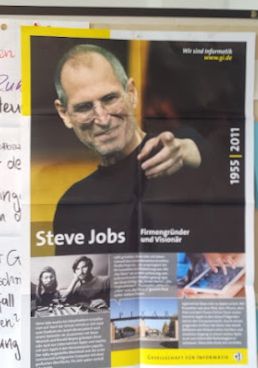 This poster in DIN A2 format was included in some of the GI Informatik Spektrum Volume 35/4 editions of August 2012.
Of course, the first thing I did was hang it on a Metaplan board in my office. Now I am eye-to-eye with Steve Jobs whenever I look up from my desk. And he always points toward me in a friendly manner as I sit at my big Apple Pro.
For all those of you who do not know it: the GI is the Gesellschaft für Informatik e.V.. Their slogan is “We Are Informatics“ and the Informatik Spektrum is the official organ of this association and their associated organizations.
I do not know what exactly the GI is. As I understand it, it is the association of German computer scientists. To me, its purpose is not conclusive. It does not seem to be an association of professionals or interests. Wanting to develop some social relevance, it still does not do any lobbying. Perhaps they see themselves more like an academic circle that wants to publish computer science topics and organize events on a regional and national level.
At least, the GI has the domain gi.de. That is doubtless some achievement, since two-letter domains were really hard to come by until recently.
Besides the GI, we also have the GChACM (German Chapter of the ACM) in Germany. That is the regional association of the big (American) ACM (Association for Computing Machinery) with the slogan Advancing Computing as Science & Profession. As it happens, the GChACM has the domain informatik.org.
In their charter, the German Chapter makes it their obligation to promote informatics by translating English articles into German.
Then there is the Bitkom – Federal Association of Information Business, Telecommunications and New Media e.V. It calls itself “Hightech Association” and is perhaps an interest association of enterprises of the IKT industry (IKT = information and communication association). Perhaps it is the lobbyist of informatics enterprises.
I do not know. But that is irrelevant. After all, I am skeptical as a matter of principle when it comes to associations, because I doubt that these institutions can still contribute significantly to either the well-being of their members or the general public.
But back to the poster:
Why does the GI now pay homage to Steve Jobs with a poster saying “We Are Informatics“? To be sure, Steve Jobs was a relevant person. Of course, he, too, had dark spots.
His first product was a device you could use in order to make free calls, because it created a signal that simulated the “service call“ at the telephone company Bell, thus making it possible to call for free. So you see: it was a device the use of which was definitely a crime. As a businessman, it was not a good joke to be working at Pixar at the time. And if you want to believe his biography, his first relationships with women were not something to be proud of, either. When all is said and done, Steve Job was only human, after all. You have to respect him and might either love or hate him.
But was he a computer scientist? And on top of this, was he one who actually fits the bill of the highly academic GI with its attempted social relevance and standards? Or is this poster just elegantly camouflaged advertising of a sponsor named Apple?
But I do not wish to foul-mouth the GI. After all, I am quite happy that the GI, a few decades ago, did not recognize the ideal moment and jump on the bandwagon of “certifications”. Because if they had done that, we would now have a GI that became really prosperous and powerful through standardizing and norming the numerous technologies of the IuK.
In this light, let us happily join in when they cheer: “We Are Informatics“! This is certainly better than the alternative: “We Certify Informatics”
RMD
(Translated EG)


