
Roland DürreSunday January 19th, 2014
As Time Goes By …
 Around the turn of the years from 1983 to 1984, Wolf Geldmacher and yours truly were rather courageous when deciding to found the InterFace Connection Association for Data Processing and Communication Software mbH together with Dr. Peter Schnupp (InterFace GmbH) and Claus M. Müller (via InterFace Computer GmbH).
And to this day, we have had much joy with what we had done. Wolf and I were the active associates. Initially, we each held a share of 30 %. Exactly 30 years ago, on April, 1st, 1984, the day had come! The InterFace Connection (today InterFace AG) officially started its work.
It was not an “April Fool’s Joke”. After all, we now can look back on 30 exciting and successful years in business. On March, 31st, the Interface will have existed thirty years on this planet. We will celebrate this birthday appropriately on June, 27th, 2014 with many, many friends.
Maybe you want to mark the late afternoon of that day in your calendar, and then the night, as well? Here on the IF Blog, I will also report at length about the event. We will also inform and invite our friends through many other channels.
After thirty years at InterFace AG, I am now in the position of holding the majority of the shares and of being the managing director. My roles at InterFace were diverse. We started out as a rather successful production firm and then developed into a service and counselling company. And we assume that the future of InterFace AG will also be a good one.
This year is my last as managing director at InterFace AG – which is certainly a reason to look back. There is no “Today” without “Yesterday” and no “Tomorrow” without “Today”. So we need to do some remembering. Well, quite a few things come to mind and also seem remarkable.
I have to think of all the many comrades who accompanied me through those 30 years or through parts of the way. I have to think of the many enterprises that came and went. I enjoy thinking of our great customers, for whom we always enjoyed working. And how it always made us happy to see that our software and services contributed to our customers’ success. In fact, there are some customers of ours we served from day one and still serve today!
Many famous and powerful enterprises appreciated us as their supplier. There is quite an illustrious sound to some of the addresses. Some of them have even disappeared by now. For instance the Kirch-Gruppe and the WestLB. But also quite recently the Weltbild publishing company. What marvellous projects we worked with these enterprises! Luckily, however, most of our big customers survived.
30 years of InterFace also means we saw many partners and competing enterprises come and go. Here, too, I have to say that there were famous names among them. We respected them greatly. And then they were gone.
As I think back in this way, I notice that we are something like a “Surviver”. And that probably not too many of those exist. And that we are actually doing quite well. So what more is there to desire?
Except a few more years of good living.
In order to make sure this will continue to be so, we plan a huge party on June, 27th, 2014. We want to celebrate our survival. We will invite as many friends as possible who accompanied us, still accompany us today and hopefully will still accompany us in the future.
RMD
(Translated by EG)
P.S.
For more information about our party, click here: IF-Open!
Gastautor(en) Wednesday December 26th, 2012
Christmas Greetings to all Sysadmins!
Here is an article by a much-loved IF Blog friend whose IF Blog comments we enjoy fairly often. It is Hans Bonfigt. For me, it was a total surprise that he now, for once, accepted the role of guest author. Here come his:
Christmas Greetings to all System Administrators
If we are totally honest, there was always this special way in which “we” IT persons have always been, well, what in our country you would call “wound up”. No, it has nothing to do with Mr. Jobs’ plagiarism. Instead, it is owed to a certain lack of understanding: “You only start working when the lights are turned on”, is what they said about us. Of course, my dear users (we know no worse name to call anybody), how else are we supposed to repair the systems you, once again, managed to damage, if you are still sitting in front of them? Formerly, it was not possible at all, because the typical work place used to be a one-desk system where, naturally, only one person could work. At some point, the machines became ‘capable of multi-tasking’, but that did not mean the users had learned to work with a multi-tasking device. We are a little more demanding – we mostly want the machine exclusively for ourselves.
And while you have been lying on your sofa since at least last Friday, a small minority has been busy since Friday noon trying to bring order back to where you produced rubbish. Their maximum number of hours of sleep is two in 24. After all, we know what outcries we again get to hear tomorrow, on Thursday, if some minor glitch is still discovered: “WE CANNOT WORK …” ! – Well, tell us something that is News to us!
Indeed, every year the Augean Stables you produce in our systems get more annoying and, above all, bigger. And you just do not seem able to learn. Mind you, I never seriously assumed you would stop putting the post-its with your passwords on them underneath the mouse mat. After all, I know what stupid expressions you choose and there must be a place where all those facebook losers originated. Well expecting something like a minimum of responsibility – that would be truly foolish. If that were what I expected, I would have chosen another job.
Yet, over the years, I actually had hoped you might at least form a habit of doing those things that would make life easier for you: but nothing could be farther from the truth!
– Use no spaces and no umlauts in file names – that is what we have been preaching for more than twenty years. And, above all, do not copy the entire text or your document into the file name. You of all people, who you are not even capable of distinguishing between a capital ‘O’ and a zero, should definitely not take for granted that umlauts, or even only upper or lower case are implemented cross-platform and interoperable in file names. Let alone in your so-much-loved windows, which, incidentally, only knows the “8.3″ nomenclature – which stank to high heavens even under DOS.
– For at least as long, we have been preaching that you should “save shared files centrally AND STOP MAILING THEM TO EACH OTHER”. And we also tell you, “USE THE CORRECT CITATION METHOD and stop forwarding all the never-ending exchanges of replies and replies to replies at the bottom of each mail”. So, guys and dolls, I have now been sitting in front of a 24 TERABYTE mail spool since last Friday and am expected to downsize it to 12 TB. And you can bet that this is exactly what I did. And you cannot make an omelette without breaking eggs.
– How often have we told you to empty your rubbish bins? But do not worry, this is also something I did for you. The razor sat as deep as your neck.
– Since we are at it: I also removed all your browser caches. Because I was simply not in the mood to save the huge pornographic collection you designed with all your clicks and to migrate it to the new SAN you claimed was necessary.
The information society definitely no longer has a slim, even face. Instead, it has a bloated visage like Dirk Bach. Thinking of former times makes me nostalgic:
I was among those who actively remember all the punch cards: the maximum source file size of the KIENZLE SLM was 2,780 lines, which just about fitted into a small suitcase. It was truly a nuisance, really heavy and it definitely took time to ‘do a quick copy’. Merging was hell on earth. We all definitely had to be word perfect in the machine language, because an assembly run with a comparable number of cards took 2 1/2 hours. If you were not able to patch manually, you were literally “at the end of your teethers”.
The ECMA-34 – cassette was a blessing. Well, my dear users, you know it as a music cassette, but basically, it had not even been intended for you. Rather, it had been intended for us. An entire suitcase of punching cards was now small enough to fit into a shirt pocket: there was room for 900 groups with 256 symbols per group and you could use both sides. Even better: the 8-inch-floppies. It was no longer even necessary to load the source data. You could process them directly.
The next revolution were the “big” hard disc drives which no longer crashed every other week: basically, you no longer needed to handle data storage media, because everything was on the system, anyway. All there was left to do was save the data. Saving data with the half-inch tapes was somewhat tedious, the maintenance was quite time-consuming: you had to set the “cat’s eyes” which resulted from the printing head signal and the phase-delayed echo by 180 degrees of the reading head correctly when using the oscilloscope (yes: that is really what they were called). The tape machines were devilishly fast and had an almost unlimited capacity.
With the Cartridges, ibs, the QIC Cassette, affordable systems were now available. Our first sweetheart managed to process 20 MB in half an hour.
We are talking about the time when those unappetizing “Commodore” machines were flooding the market. They looked like bread shelves. This was in the late 1980ies.
So what exactly had changed?
Currently, I am supposed to design a complete SAN over the holidays. ALL, and I mean rally all data of a medium-sized enterprise should be stored there. And I have to delete ALL. Of course after having made a copy on tape before and, naturally, redundantly. And because it is important: also dissimilarly redundant.
The Cartridges have become smaller and faster. Currently, more than 140 MB are flying from the tape to the hard disc per second. That means the system manages about seven times as many data as were common in the 1980ies on the QIC 20 cassette. Instead of 3.5 hours, we now need one second.
This equals a production increase of 1,259 %.
But, hey, is that REALLY true?
The enterprise I am currently working for also had a QIC-20 tape station in the 1980ies. It was connected with an IBM /38 which supplied the entire enterprise with the necessary infra-structure.
Basically, this is exactly what the new IT is doing: supplying 200 persons with diverse programs, just like it used to be. Maybe a few more persons are working there today. In the 1980ies, a migration took three days – in the new situation, I have already been at it for five days. And I will not be finished before tomorrow morning at five o’ clock. On the old machine, a well-trained service technician could do the job. The new system is ultra-complex, combining almost all the latest technologies in one box – in particular, it can no longer do without windows and the oh-so-great IBM RUBBISH-TOR – this is a pile of rubbish built from randomly connected JAVA parts that smells to high heavens. No human being can handle it. Luckily, I am not a human being.
Basically, the old machine was never out of order. To be sure, due to the redundancy, the new one is also never at a standstill, but individual components are faulty all the time. And the then necessary repair work makes you perspire with anxiety.
The old machine was really quick. So is the new one, but the JAVA/AJAX/PINGPONG – stupidity interface is extremely slow and the users are just sitting around and twiddling thumbs.
Yes, my dear users – I HAVE NO MERCY! You were the ones who wanted the GUI, now you have it. Low-quality raised eyebrows for low-quality employees. Each to his own.
But where did progress go? Didn’t we have it at some time in the past?
The answer can be found with Bertrand Russell. Let me cite once more:
Every technological growth will cause a corresponding growth in wisdom, provided it also means an increase in human happiness.
Vulgo: the IT landscape changed from being a ‘Tool’ to being a ‘Toy’. With all the unpleasant consequences. A short time ago, a secretary at Northwest AG told me how she had produced a letter ten times as fast using HIT/CLOU, an InterFace AG text program, than she can do it now with the current “Word” version. Mind you, she needed about the thousandth part of the computer capacity, main storage and disc memory.
We have become slow, obese and degenerate.
Well, and some way or other, the spirit is missing. There used to be a time when I actually enjoyed those “night-flights”. I relished the soothing noise of the air conditioning and, above all, I was absolutely certain that the job would be finished by the deadline.
After all, only the fact that I can grasp the design of a system at all will put me in a position to be able to take responsibility.
Today, I can no longer be sure I actually understand the complexity. And if there is anything I failed to notice over the last days, then 200 persons will not be able to work next Thursday. Neither on Friday. Neither the week after. Because we have neither programs nor data. Income and salaries will still be fine, that is done externally, but it is questionable if they can be paid.
And I had better prepare to live under the bridges.
And, YES, there are many persons who, even now, do something that is a lot more important. For instance all of the train drivers: unlike me, who is “haunted by” the idea of 200 persons, they are responsible for 800 persons. Or the stressed-out traffic superintendents who have to act with the highest possible responsibility, although they are given damaged machines to work with. If you take the degree of responsibility into consideration, basically everything becomes relative, even the money you get for it. For instance, what was Mr. Mehdorn “responsible for”?
In many ways, Roland is a model for me. In the years to come, I will start exercising more and downsize the admin job, which is still a third of my work life, until it dwindles to nothingness. Because it is a very tiring job. When I was an adolescent, I heard something Günter Grass said, “powerlessness tested with rubber walls”.
I would like to send greetings to all this world’s administrators who, equipped with Pizza, Cola, Junk-Food and Cigarettes, under high risk and with a relentless deadline and almost unendurable stress still manage to put enterprises back to the network on time for their first day of work.
Hans Bonfigt
I was truly delighted to read this article. Dear Hans, let me thank you very much for writing it.
RMD
(Translated by EG)
Roland DürreTuesday October 2nd, 2012
Soccer in Haching – The Spielvereinigung!
 II am a soccer player (Fußballer) who is quite serious about his hobby, both actively and passively. In my life, the football ground is of fundamental importance, just like the Rosenau Stadium used to be. And even today, I am very happy to join my friends for a game or two.
When I was a child, the worst that could happen to me was not being able to see a home-game of the BCA (Ballspiel Club Augsburg). In 1969, the BCA and the Schwaben (TSV 1847 Schwaben Augsburg) merged. The result was the “retort club”: FCA. That was when a great tradition ceased to exist for me. Additionally, I left my home town, thus becoming homeless as far as soccer was concerned.
It took years before I discovered the SpVgg Unterhaching, which is quite close to the InterFace AG headquarters. A new soccer-love developed. Ever since then, I have been taking regular trips to the Grünau and later to the Sports Park with my small and big children.
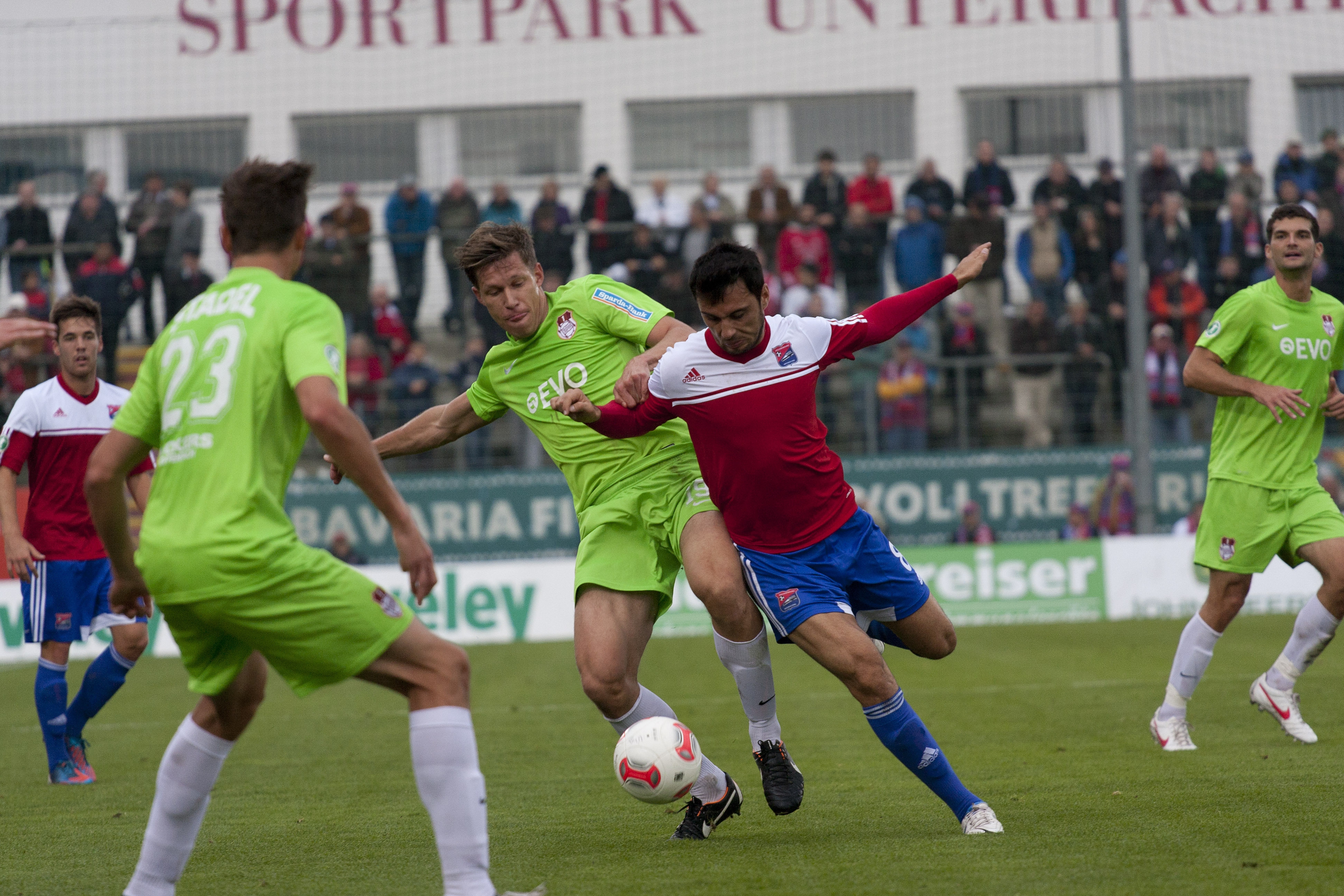 Here is a current picture of last Sunday’s game “SpVgg Unterhaching – Kickers Offenbach”. Unfortunately, we lost 0:3; the bad luck literally stuck with the Haching soccer boots. Of course, I was there and suffered with them.
In the Sports Park, we already experienced many great matches and numerous rises. In 1999/2000, we suddenly found ourselves in the Federal League. And, like many of my friends, I still very well remember that legendary own goal in the 21st minute on May, 20th, 2000. The then still “Leverkusener” Ballack scored it with his heel, thereby helping Haching to win the match and Bayern München to win the German Championship.
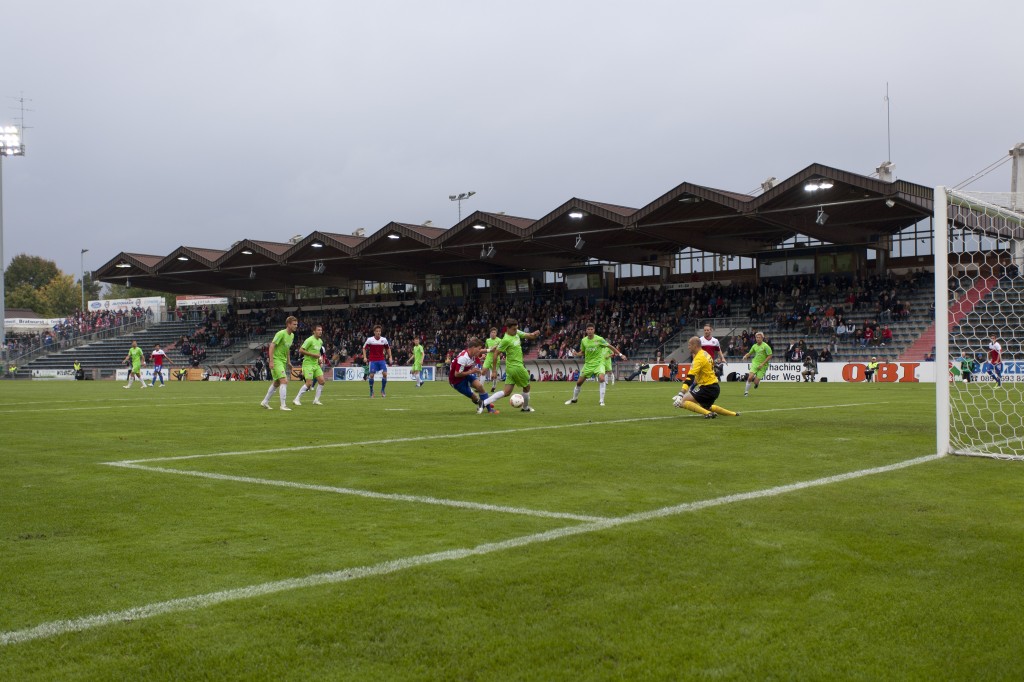
Here are the stands where I sit and watch every home game if possible at all. And, of course, mostly I can cheer, because at home, the SpVgg is a power that almost always wins!
Since the year 2000, many things have happened. There were ups and downs. In between, we Haching fans suffered quite a bit. But since last year, we are really on the way up. Before the season 2011/2012 started, the old board of presidents initiated a radical change. The new team around Manfred (Manni) Schwabl rigorously executed the changes and even improved on them.
Together with the new managing directors Markus Sieger and Florian Rensch, the new president gave the club a totally new look. Chapeaux! They built a young team with players exclusively from our region. The team of coaches around Claus Schromm and Manuel Baum and supported by Florian Ernst made this group into a team that plays truly young, fresh magic soccer. Just like Borussia Dortmund does in the Federal League.
Besides the technical competence, the character of the players was an important criterion for being selected to play in the team when it was recruiting time. And now you can see immediately how they move up. Now, all of a sudden, the SpVgg Unterhaching – with the by far lowest budget of all – plays at the top of the Third League. Still, we will remain humble, knowing full well that all that matters this year is to consolidate our place in the Third League.
But we look forward to the future. Sticking to the three “Success-C’s“ as formulated by the famous sports professor and counsellor Dr. Alfons Madeja, ours seems a good course: thanks to the high competence of the active and responsible team around Manni Schwabl and a clear, humble and well-thought-out concept, the necessary capital will also soon arrive.

Incidentally, my small Isetta also likes its trips to the Sports Park for watching soccer. Consequently, I would like to ask you to do the same and come and watch our home games at the Sports Park! You will see dream soccer. And both the team and the management really deserve more spectators!
RMD
(Translated by EG)
P.S.
Both soccer pictures were taken by Stefan Kukral (Eventfotografie Kukral, Ringstrasse 163, 82041 Oberhaching). The Isetta sitting in front of the Sports Park was photographed by Johannes Nauman of InterFace AG.
Roland DürreWednesday July 18th, 2012
Entrepreneur’s Diary #82 – So What Exactly is the Meaning of the Word: Strategy?
Well, now I have been an “entrepreneur” for quite a few years, haven’t I? And during all this time, I was “at war with“ the term “strategy“ and what is usually expected from an entrepreneur in terms of “strategic thinking“.
During the numerous strategic meetings I attended (and partly initiated myself), we wanted and were supposed to get a firm grip on the future. Looking ahead, we wanted to find out what the market was going to demand in the future. Which technologies would establish themselves. For instance the internet, which totally surprised me. Incidentally, nobody ever predicted its future.
And all the time, we were looking for new ideas, even visions. In order to make the enterprise a success, even in the future. Mind you, we knew well enough that a vision is something not too far removed from an illusion or a hallucination.
My entrepreneur’s super ego kept expecting a “good strategy” from me. And I felt I had to do something I was not at all qualified to do:
Make assumptions with respect to the future and then come to the right conclusions based on these assumptions.
🙂 But, basically, the future is something that lies ahead, and it is rather difficult (impossible) to predict developments, especially if said developments are in the future. You will not even need disruptive events.
Assumptions about the future are more often wrong than correct. To be sure, I know from logics that it is quite possible to come to correct conclusions even if your assumptions have been wrong. In particular if both an assumption and the conclusion thereof are wrong, something correct can be the result. With luck, you might even win a bet on the future. Except that this is by no means a certainty and, to me, this procedure always seemed lacking in respectability.
Consequently, I always felt rather uncomfortable during strategic meetings. Regardless, we often had quite reasonable results. Those reasonable results, however, were not because we had achieved our goals and developed a vision. They rather happened because we had discovered problems during intense discussions. It actually helped that we solved them.
During the last Zürich RISE meeting, I was introduced to another, for me new, definition and interpretation of the word strategy by Dr. Simon Grand. I immediately listened:
“How an organization moves forward”.
It seems that this definition is by Richard Rumelt and was given a few decades ago.
I rather like this definition, because it contains three important elements:
- Organization:
Organization is something “collective”. - Moves:
Movement suggests processes that take place and can or even must undergo change. - Forward:
Forward shows that there are uncertainties, because it is about the future.
Following this definition, the word strategy acquires a totally new meaning. It is all about routines, rituals, symbols and behavioral patterns in an enterprise. We have to re-evaluate them. Are they still fitting? Or are they, perhaps, antiquated?
How can I change them without harming the enterprise? How can I change them and strengthen the enterprise?
Now this is all about changing the “entrepreneurial world“ and the tools and methods used therein. About behavioral patterns with respect to how things are done in the enterprise. About the success formulae our employees use internally and externally.
And here I am, discovering a method to “develop my own strategy”!
I look for problems that might linger inside the organization of the “social system enterprise“. That alone is already quite a creative challenge. And as soon as I found the real problems, I am well under way towards developing an “actual strategy“, deciding what I can try to change in my entrepreneurial world.
The definition, however, also implies that “leadership has to be collectively supported”. Now I understand young and bold entrepreneurs who are “proud to have no strategy”. Mind you, their enterprises are literally brimming with innovation. Innovation might well be invention plus realization – and do you really need a strategy for that?
Strategy is no witchcraft designed by lonely heroes in their quiet laboratories that afterwards has to be introduced to the world. Strategy is collective change in an enterprise that preserves and increases the chances of survival for said enterprise.
RMD
(Translated by EG)
P.S.
Click here for more articles of my entrepreneur’s diary Drehscheibe.
Roland DürreSaturday March 17th, 2012
Entrepreneur’s Diary #77 – One Of My Own Irrational Decisions …
Back to the “irrational decisions”!
Continuation of Entrepreneur’s Diary #71:
“Notwendigkeit von unvernünftigen Entscheidungen” (The Necessity of Irrational Decisions “).
The InterFace, too, owes its origin to a very irrational decision. Woe if, at the time, we had had a decent person to control us. He would have called us “insane”. How could anybody try and strive towards such a utopian idea? With ZERO chance of success.
In retrospect, I am actually surprised how something so weird could have worked. All reasonable and rational arguments were certainly against what we had planned. Today, if asked, I would probably advise against what we did at the time.
Our most severe case of irrationality was when we, as “newcomers” and “nobodies” wanted to develop a UNIX text system. There were two of us, along with a few students. And in the process, we actually wanted to try to earn enough money for us and the students to live on quite well. Which meant that you had to delete the term “two of us” from the above sentence, because basically only the students were left.
What happened was the success story of HIT/CLOU. And a few years later, there was a time span of ten years during which Siemens AG created more turnover with HIT/CLOU than with their second SINIX product (which they also had taken under licence), the data base Informix of RDS (that was still the name of Informix for some time) .
At the time, we started developing HIT and CLOU with a colourful selection of young people. It happened against all rational business thinking, simply because we wanted to own a software product of our own.
Since data bases were too complex and the communication technology underwent a total re-structuring, we decided to develop an “electronic typewriter”. … To us, that seemed easier. So we took a closer look at the old “brother” and text machines such as Triumph-Adler and implemented the entire thing anew and a little better on UNIX. How simple the world can be.
And a few years later, we became the market leader in Europe – not just on SINIX, but on many UNIX systems of many producers!
Simultaneously, Siemens AG tried to develop a series of editors. At their place, the product planning team had more members than our entire development, project and sales units. They had planned everything “rationally”, developed it in the classical way and supplied huge budgets. With expensive developers and super consultants.
And still they failed again and again!
Incidentally, Siemens AG made a turnover of 500 million DM during the aforementioned ten years with HIT/CLOU. It is quite possible that, during the same period, they invested more money for all the new developments of theirs that failed either technologically or economically.
Those products were failures due to poor technological competence, such as the demand for a common (!) interface for BS2000, UNIX and DOS. I remember quite well some discussions about what nonsense such a venture was. These were discussions I took part in.
And if, for a change, they were not a failure technologically, then they failed on the market, like with ComfoText against Microsoft.
And everybody asked how it was possible that the small InterFace Connection GmbH with its limited budget could manage to do things that were out of reach for the huge Siemens AG with all the millions they invested and all those many planners, engineers, developers, testers.
Well, the reasons were quite simple: an irrational decision, the enthusiasm of great persons in a super team, an agile procedure, many partners and a little luck – and here we were working!
So here is the second part of my appeal to make “irrational decisions”. Even if they cost money and will worsen the results. We still need them in order to do great things. And, basically, there is something great to every enterprise.
RMD
(Translated by EG)
P.S.
Click Drehscheibe for all the articles of my entrepreneur’s diary.
Roland DürreThursday February 16th, 2012
Entrepreneur’s Diary #71 – About The Necessity To Make Irrational Decisions
During the last decades of the last century (millennium), huge concerns like Siemens AG had all the resources you can imagine at their disposal. The enterprise had capital to drown in and it boasted the best engineers of the world. They had an excellent reputation, the market expanded in the best possible way and their world-wide network in politics and business was perfect.
Nevertheless, these old and formerly so powerful enterprises are no longer existent in many of the segments they used to dominate. In the few areas where they are still successful, there is quite some competition. More often than not, they are endangered to become meaningless in these areas as well in the near future.
Simultaneously, new companies developed. Some of then are but a few decades younger than the old ones. And they quickly outstripped the old and formerly so powerful enterprises. As I see it, this is a fascinating development. So what exactly happened?
What strikes me is that the old enterprises tried to be very strict about only permitting “rational decisions” and “rational behaviour”. There was a high degree of planning in these organizations with the sole purpose of making “irrational decisions” well nigh impossible.
The new firms, such as Amazon, Apple, Cisco, Ebay, Facebook, Google, Microsoft, Oracle and many more – well, even SAP -, on the other hand, largely benefited from their “irrational decisions”.
Roland DürreSaturday October 22nd, 2011
Yet Again – Saving Banks!
How the director of a medium-sized enterprise gets more and more frustrated
We are again at it. “We” (that is the tax-payer) will probably again have to rescue banks. A new stress test is to be devised. The funny reason they gave for introducing the new stress test is that the old one apparently did not have the desired effect.
Besides, banks are to have more capital. The necessary funds are to be provided by the state (tax-payer, who else?). And “they” wonder if it might be a good idea to separate the conventional banking business from “investment banking”. In other words, the banks get separated. And it is all to happen under federal supervision. To me, it sounds like a terrible concept. Many banks with enormous numbers of well-paid employees to be converted into one single, huge federal conglomerate.
mehr »
Roland DürreFriday September 9th, 2011
The Meaning of Life …
Looking for the meaning of life!
Through discreet channels, I found out that the “brand eins” of October will deal with the “Meaning” as a focal theme.
🙂 Well, that shows I was right after all:
More and more, “brand eins” turns into an economical-philosophical magazine.
When thinking about “the meaning”, I remember the following anecdote out of my life:
In the 1980ies, yours truly and some friends went to a week-long seminar of Rupert Lay in Africa every other year..
When, once again, the time had come, I, together with George Brooke, was in the middle of some rather intense work on the project “Collage” – a window manager for SINIX and special “thin clients”. Or, as you called it at the time: window technology on graphics screens using simple end devices.
At the time, I regularly took lunch in the Siemens canteen with George. A few days before my departure, we talked about my trip to Africa. He wanted to know what I was going to do for more than a week in Kenia.
I told him about my seminars with Rupert Lay. That they were about management and leadership. But also about personal development. And that these seminars always also helped me towards finding the meaning of my own life.
That was something he could not entirely understand, because he was (and still is) a very functional technocrat and rationally controlled British Gentleman. He asked me about the theme of the current seminar.
My reply was:
Hi George, it’s about the “meaning of life”
My words had dire consequences. George had just put a huge forkful of spaghetti into his mouth. And suddenly he had a fit of laughter – you can easily imagine what followed …
mehr »
Roland DürreTuesday August 30th, 2011
Children&Money and SoftResearch
My vacation reading material tells me that, once again, the Berlin coalition seems not to be agreeing with each other. This time, it is about whether or not child benefits should continue to be paid. After all, it seems obvious that it had no effect, because compared with the rest of Europe, Germany is still close to the bottom with its birth rate.
Being the father of seven, I probably have earned the right to an opinion on this one. Our children are now aged between 31 and 15. When they introduced the child benefits, most of our children had already been born.
Consequently, you can see that the child benefits had no influence on our ”family planning“. However, the little bonus was not a bad thing. Even though Barbara always managed to spend a lot of time with the children, we were able to afford help. First, it was a governess, then we had au-pairs for more than a decade.
When we had the governess, the legislation for child benefits had not yet been introduced. To make up for it, the money we had to pay for the governess (including taxes and social insurance) ate up Barbara’s net income (she is a Mathematics Graduate, Univ., working part-time).
Then we had au-pairs from France, diverse Eastern-European countries, but also from South Africa. Au-pairs are not inexpensive. If I need an extra bedroom for an au-pair in a house in Riemerling, the cost of the house is easily 100,000 Euros more than without. Then you have to give them pocket money, an allowance for culture and necessities and once in a while for their travel home. Even with quite a lavish child benefit legislation, you will quickly reach the end of your teethers.
Roland DürreSaturday July 30th, 2011
What Annoys Me … #6 Writing Texts in Word
 At one time, we at InterFace also wrote a text system. It was called HIT and powered by CLOU. It was a truly great software and a huge success. The HIT turned into a true hit, because it was simple and easy to use. And there were the CLOU components. They were an enormous help to the people as they did their work.
HIT, however, was not wysiwyg (What you see is what you get). Microsoft came and dominated the office world. Along with Windows, the graphic dislays became popular on a large scale. Now the users thought they all had to have a desktop publisher in order to write simple letters. Consequently, HIT had to go. And the world got Word.
I used to do a lot of programming. My favourite was “vi”. Today, I no longer write any programs. Instead, I write a lot more texts. However, I hardly use Word or OpenOffice these days. After all, there are so many simply editors. You get them on Linux, on the Mac or integrated into web applications. Then there is google. There is nothing you cannot do with google!


