
Roland DürreMonday April 27th, 2015
Project & Product – #PMCampSTR
 The Stuttgart PM-Camp (Hashtag #PMCampSTR) will take place from May, 7th through May, 9th, 2015 at the Stuttgart “Hochschule der Medien” – and I already look forward to being part of it. I bought both the admission and train ticket and made my reservation for the room at the Commundo.
The team in charge of organising the event chose “Project and Product” as their title. This is how the Stuttgart Organizational Team wants to open its PM-Camp for interested persons outside the classical field of project management, for example for IKT (information and communication technologies), as well. Using the term “product”, for instance, they aim at engineers who build high-end products.
What is a project?
Let me cite Wikipedia:
A project is a goal-oriented, one-time proposition consisting of a number of coordinated and controlled activities. It has both a clearly defined beginning and an end and will be realized taking into consideration all necessary restrictions with respect to time, resources (such as money/cost, production and work conditions, employees) and quality in order to attain a goal .[1]
This definition, which in my opinion is a rather simplified view, of “project” means:
- Every project has a beginning (project start).
- Every project has an end (deadline for completion).
- The desired results have been defined as project goals.
- All resources to be used are pre-defined.
- The project goal must be attained on time.
- The planned resources must not be exceeded.
- There is a plan: the project plan.
- The milestones defined in the planning are to be adhered to.
As I see it, projects only deserve the name if they cause a considerable change or if they create something really innovative or new. And that tells you at first glance that something is obviously wrong with the above definition.
Regardless of excellent planning, we witness massive deviations from the goal with the resources often being enormously exceeded, even with simple engineering projects. The reason is probably that even tasks that sound simple have a surprising complexity.
Innovative Change!
The situation gets worse if we are talking projects that are supposed to creatively influence all kinds of social systems and the evolution that happens anyway. If you look at the way a project is described, you will realize that the motto “close your eyes and do is hands-on” is something you are basically forced to apply. In the process, you will not be able to integrate new and better findings into the developing project path at all times.
Even in retrospect, it will be hard to judge the causal connections between measures and their effect (usefulness?). So how is anybody supposed to do so in advance? Basically, innovative change is not something you can just plan linearly. Instead, you have to find a soft and agile way to reconcile change and permanent developments.
Consequently, projects are a contradiction to innovation. Innovation is creative destruction. Which is something that will additionally make the enemies of change interested, especially if they are parties concerned with the intended change. That will make it even harder.
Projects as a part of change?
Hence, I find a definition of project more appealing if it considers a project as one of many integrated parts of a continuing process of change and improvement. Controlled change is supposed to generate useful results. Basically, I consider all well-thought-through activities designed to change or influence developments projects. To me, it does not matter if the project is actually “tangible” or if it renders abstract “virtual” results.
What is a product?
The planning, development, and production of a product, as well as its marketing, sales, support and service are the result of many small and bigger projects. They are all multi-dimensionally linked and thus connected to form a multi-dimensional “mega project”. You will want to remember phrases such as network, dynamics, learning, trial and error, innovation… But then, this is not only true for the tangible product, but also for services.
Box product or service?
So a product might be a tangible object – meaning something you can “touch” – which has been developed by an organisation with engineering competence and in huge quantities. It is also “sold” to either many customers or produced individually and “on demand” in small numbers. As a general rule, such products need to be complemented by a support service if they are supposed to be a market success and generate a “sustainable business”.
However, a product may also be a service rendered at the customer’s place or for the customer by persons who acquired special qualifications and “best practice” with their organisation. Those qualifications are usually the result of decades of personal and collective learning.
Creating a “tangible” product might actually necessitate more projects than creating a “virtual” product.
The difference it makes for an entrepreneur.
Sometimes there is a huge difference for the entrepreneur between designing a “true” product enterprise and an enterprise the product of which is offering a special service.
For instance, whenever selling a “true” product, the entrepreneur should keep in mind that feedback from the customers and from the market usually takes a lot longer than if he offers a service. More often than not, you will invest long-term into a “true” product that still has to prove its value on the market. In that sense, such a product is easier to scale in case of success than a service. But then, it also involves a higher risk.
If you sell a service, you will have your feedback rather quickly, which also means that you can learn from mistakes and perhaps change your strategy.
Well, that is about all I can think of when it comes to product and project. Except that projects, basically, are the small modules of our lives. All conscious decisions for behaviour that makes a relevant difference – for yourself or for the market – are in some way projects.
RMD
(Translated by EG)
Roland DürreTuesday March 18th, 2014
It was a nice IF Forum with Jörg Schindler!
Turn of an era – end of fossil energy – transformation.
As of now, the IF Forum video recordings of the presentation (Vortrag) by Jörg Schindler of February, 27th, 2014 are available. The presentation was about the current turn of an era which we witness as a consequence of the “end of fossil energies”.
You can view it in four parts. The first three follow the structure of the presentation: they deal with the last two times we had a turn of an era and with the current one, which is also called the “Great Transformation”. The fourth video contains the “best” parts of the subsequent discussion, which, this time, was particularly exciting.
Here are the four videos:
Part 1: The mental turn of an era with Galileo Galilei.
Part 2: The material turn of an era during the Industrial Revolution.
Part 3: The current turn of an era, aka Great Transformation.
Part 4: Parts of the discussion.
Enjoy!
RMD
(Translated by EG)
Roland DürreSunday March 2nd, 2014
IF Forum 2014 – Starting With Jörg Schindler – TURN OF AN ERA
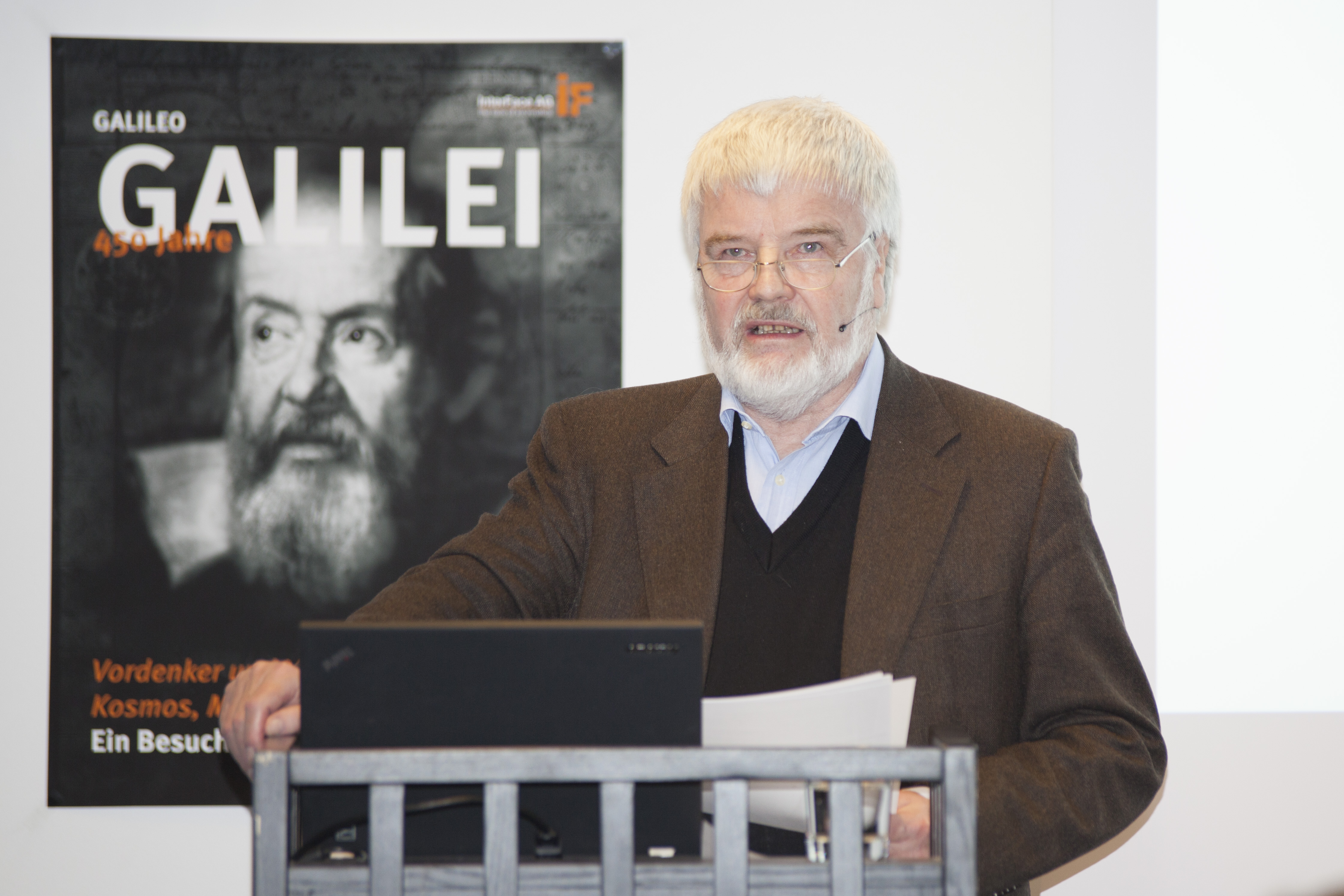 The start-up of the 2014 IF Forum “Galileo Galilei” at InterFace AG was a huge success. Under the heading TURN OF AN ERA, Jörg Schindler delivered a strong appeal in favour of “the future” on February, 27th, at Unterhaching.
With his facts about “The Beginning of the End of the Fossil Era” and the subsequent “Great Transformation of Our World”, he made is pretty clear that, even though we can perceive how the world changes, we actually cannot predict the exact consequences.
Because we are already in the middle of an absolute transformation. It will continue to take place, no matter if this is what we desire or not. Besides, we cannot come up with a master plan, because the transformation cannot be planned. All we can do is refrain from acting in ways that we perceive as non-sustainable.
As often before with other presentations, Friedrich Lehn recorded the presentation held by Jörg Schindler. I will publish the film soon on our YouTube Channel “RolandDuerre”.
There will be two more IF Forum presentations on Galilei Galileo in the 2014 IF Forum:
COSMOS
On Thursday, July, 17th, we will welcome Dr. Stefan Gillessen as our guest speaker. He will talk about:
Big, Bigger, Sharpest
Where is the development of telescopes headed? From Galilei (37 mm lens) to the European Extremely Large Telescope (39 m mirror). What could be more exciting than witnessing how material falls into a Black Hole? Insights into current research.
Stefan is one of the leading scientists at the Max-Planck-Institute for Extra-Terrestrial Physics (MPE)
HUMANS
On Thursday, October, 23rd, 2014, Thomas de Padova will give a presentation. He will talk about the
Secret of the World
400 years ago, two totally different scientists went beyond the limits of the known world. In Venice, Galileo Galilei looked through his telescope and discovered the Jupiter moons. An exciting expedition of human thinking begins – and along with it the turn of the era towards modernity.
Thomas de Padova is a physicist, journalist and historian of science.
RMD
(Translated by EG)
Roland DürreThursday January 16th, 2014
IF Forum on Thursday, February, 27th, with Jörg Schindler
Since April, 1st, 1984, the InterFace AG has now had thirty successful business years. Our thirtieth birthday is on the first of April and we want to celebrate it in the summer of 2014.
 In 2014, however, there are many other birthdays you could also celebrate. Among others, there is the 450th birthday of Galileo Galilei (1564-1642). For several reasons, our decision whose face to make the 2014 InterFace AG face was made in favour of his.
Consequently, we now invite Galileo Galilei to “visit us in the present” at our IFForum. The topics of the three presentations in 2014 will be cosmos, humans and the turn of an era.
On Thursday, February, 27th, we will start with a presentation by Jörg Schindler on the turn of an era. He will speak about
The Beginning of the End of the Fossil Age.
“The big Transformation of Our World” and “Resilience will Follow Efficiency”
 Jörg Schindler was born in Augsburg in 1943 and now lives near Munich.
In the 1960ies, he studied business at LMU München. During the 1970ies, he worked on the development of traffic control systems in various companies around Munich.
1984 – that was the year we founded InterFace AG – he changed to Ludwig-Bölkow-Systemtechnik GmbH (LBST) at Ottobrunn, where he was managing director from 1992 until the end of 2008. After that, he started his (non-) retirement.
Apart from this, he is active in many areas:
From 2000 to 2003, he was a member of the Enquête Commission of the Bavarian Senate: “Into the New Millennium with New Energy”.
Board member at ASPO Deutschland e.V. (www.aspo-deutschland.org) and managing director of the Solarinitiative München-Land e.V.
- Co-author of numerous studies and books on the future availability of fossil energy, for example diverse studies for Energy Watch Group (www.energywatchgroup.de) on coal, crude oil and uranium, the books „Ölwechsel” (München, 2002), ”Geht uns das Erdöl aus?” (Freiburg, 2009), ”Aufbruch, Unser Energiesystem im Wandel” (München, 2011), ”Postfossile Mobilität – Wegweiser für die Zeit nach dem Peak Oil“ (Bad Homburg, 2009) and last not least “Öldämmerung – Deepwater Horizon und das Ende des Ölzeitalters” (München, 2011).
Here are some of Mr. Schindler’s theories
- BAU (Business as usual) is “now” at its end.
- In actual fact, this means: with Peak Oil, the short era of abundant and cheap energy has reached its end. It had started with the “great acceleration” in the 1950ies due to the more and more and ever cheaper oil from the Middle East (the historian Christian Pfister called this development the “1950ies syndrome”). The consequence was that the industrial nations started mass motorization and developed consumer society habits following the American model. This phase started losing its momentum in the developed countries in the mid- 1970ies and came to a world-wide stop in the middle of the 2010 decade – regardless of the still prevailing development in the emerging economies of Brazil, China and India where some catching-up is under way.
- This means that the world is at a revolutionary turning point, i.e. the transition from a fossil-sponsored capitalism to a post-fossil society – the Great Transformation. (The end of capitalism as we now know it).
- Cheap and more than enough energy as a business requirement: following Karl Valentin, you could call this an “erroneous error”.
- Now we need to make the inevitable transformation as tolerable as possible. This is, in particular, also a task for the enterprises. Internally, it is a question of survival, externally one of contributing to the solution.
- There is no master plan for this transformation (nor can there ever be one).
- Since you do not know what the future will bring, it must be the goal of all enterprises to cope with as many scenarios as possible (incidentally, this is also the principle of nature).
- What does this mean for our enterprises? Above all, it means that efficiency as the highest maxim is no longer useful. You can only be efficient in a well-defined context. Instead, our new goal must be resilience.
- Mind you, we know that efficiency and resilience oppose each other …
- But resilience, too, needs management. Externally, you need a critical view of the world and you need to know the non-sustainable elements of your own world. Internally, you need a maximum of qualifications gained through flexible organizational structures and self-organization.
Registration:
This IF Forum, too, will be held in the seminar zone on the top floor of our Unterhaching InterFace AG building. We welcome you from 18.00 hours, the introduction will start at 18.15 hours. After the short presentation, there will be plenty of time for communication in a comfortable atmosphere.
As always, you can register for this IF Forum by simply sending an E-Mail. We look forward to the same kinds of interesting discussions and beautiful chats we are used to!
RMD
(Translated by EG)
P.S.
Mr. Schindler is someone I know rather well and I am always impressed by how many things he knows. Having been the head of a “Think Tank”, his professional life gave him the unique chance to do practice-oriented research for many years. I feel particularly comfortable with how rational he informs about often very emotional topics. Again, I am sure we will have an extremely nice IF Forum.
Roland DürreFriday January 10th, 2014
Self-Doubt – Comment on the “New Tools” of Management
The article of our “anonymous guest author” on tools of the new economy (Werkzeuge der Neuen Ökonomie) moved me deeply. After all, it described in a very illustrative way how an “owner-controlled” enterprise became a “shareholder value-oriented” enterprise, as can often be witnessed.
And it showed us quite clearly how you can get the impression that laws of reason and of sensible understanding have been violated and replaced by a system of dogmatic structures of mechanical and deterministic thinking. This is a story that is just too well-known and common – which basically always ends detrimental for all parties concerned.
My first reaction was to spontaneously regret this development and to call it evil. Are we not witnessing how good management technologies are replaced by bad ones? Is it not a pity that a people-centred system becomes a systemic system?
However, my second reaction was that, perhaps, we should not judge and, above all, not over-estimate this kind of development. Is there any reason at all for a “human-oriented” enterprise to live longer than, for example, its founder?
Is it not logical that social systems founded and created by mortal beings should be just as mortal as those who made them? And maybe this dogmatic mechanisation of a social system with an economic purpose – also called “enterprise” – is just the perhaps even evolutionary attempt to prolong the life of the hitherto founder- or family-oriented enterprise considerably, quasi artificially? To be sure, there is a high price to pay for it.
Perhaps it is totally normal for enterprises to die or be swallowed by other structures after a few generations of humans and enterprises? Because enterprises, too, like all living organisms, have a beginning (birth) and an end (death)?
Consequently, it might be possible that enterprises can only be dogmatically or mechanistically/deterministically controlled after having reached a certain volume or a certain age? Maybe after a certain time span, every enterprise will have to face that decisive moment from which onwards you have to either become dogmatic like the big ones, or else be swallowed by a big one – or die?
Personally, I know only very few firms that, over more than seven generations and, for instance, in the seventh generation, managed to remain both successful and still a nice medium-sized company. Most of them went bankrupt long before or have been swallowed up. Mind you, being swallowed up always means a lot of the old enterprise dies, while only little is preserved.
And perhaps a social system can basically only survive for more than a few generations if it becomes independent and de-personalized and if it develops strict dogmata as behaviour-oriented values? And if it then moves with all the power and strength it has gathered through history?
Perhaps an enterprise actually has to make its own survival the superior goal of its existence in order to survive long. Even if such social systems will quasi inevitably end up creating a fascistoid situation?
However, the result of my deliberations is something else:
It is always a pity if a biophile, democratic, self-organized and self-determined social system dies or mutates into a mechanistic and deterministic system. To be sure, the latter alternative might actually prolong the life-span of the enterprise, but it is not beneficial for the stakeholders of the enterprise. And there will come a day when it will finally die from its own inflexibility.
Under this light, it makes sense to oppose the de-personalization and economization of processes in the enterprises and to try and preserve the pro-human attitude in these social systems. Consequently, as I see it, enterprises should also try to avoid making their own survival the dominant (self-) purpose of their existence as long as possible. After all, it is their main purpose to serve the people they sell their services and/or products to, isn’t it?
How does our famous proverb say:
“Better a miserable end than endless misery.”
or
“You should finish on a high note”.
But then, this would mean to change the “old” system and make something new out of it as long as this is possible, i.e. as long as the old ways have not yet become independent. Because when that happens, it is probably too late.
Consequently:
“Love it, change it or leave it!”
RMD
(Translated by EG)
P.S.
I was privileged enough to actually meet Augustinus Heinrich Graf Henckel von Donnersmarck in person a few times. Like Rupert Lay, the Premonstratensian canon was a famous management coach and consultant for top-echelon German industry in the second half of the last century. I learned to identify both of them as the persons who introduced the term “ethics” in management.
Augustinus was a great orator who enjoyed humorously calling himself a church “lobbyist”. With equal delight, he kept reminding his audience that his enterprise, after all, had already survived almost 2,000 years – and that he knew no other enterprise that had survived as long.
If you look at it cynically, the humorous comment of this great church man might actually prove that dogmata and rigidity are important for the longevity of a social system. Even if the founder of the enterprise himself had a totally different concept of the entire matter. But then, the enterprise “church” certainly has a very special product on offer……
Roland DürreThursday July 4th, 2013
My Agile Manifesto …
🙂 … it might look like this or similar:
The more I think about “acting and behaving in an agile way”, the more I believe it to be a basic principle that makes the difference between the “old world” and the “new world”.
Consequently, “AGILE” might well be the next logical step after “enlightenment” and “using your brains”. Being AGILE also means you have to move consciously all the time between the two opposing ends individuality (what do I want, what can I do, what am I permitted to do,…) and the collective (what do we want, what can we achieve, what are we allowed to do,…).
“AGILE” describes our wish to live our lives in freedom – which, at this place, means “being prepared and capable of living your life in responsibility”. At the same time, you have to follow the principle “promote your own and the life of others, rather than reducing them”.
Being “AGILE” means knowing how to deal with responsibility. Being in favour of what change we need and opposed to what change is detrimental for us.
Being “AGILE” also includes the wish to increase your knowledge and then being able to apply them. Naturally, models and approaches, methods and concepts are an important result of additional knowledge. …
Consequently, in order to become “AGILE”, we will constantly have to learn new things, do things we are not used to, try strange things and collect experience. We have to understand and comprehend how processes in our social systems function. Thus, the “integrative and systemic understanding” of our enterprises will become the requirement for successful “leadership”.
This is it for now in a nutshell …
I was motivated to write this outpouring on agility by an article in openPM by Stefan Hagen.
RMD
(Translated by EG)
Roland DürreFriday June 21st, 2013
New Frontiers
In his wonderful blog Führung erfahren, Dr. Marcus Raitner comments on the “New-Frontiers Statement” (Neuland-Aussage) made by our Federal Chancellor on behalf of the Germans and Europe.
I had to comment on this article and did so in a letter.
Dear Marcus,
the sentence uttered by Frau Merkel that “the internet is a new frontier for us” is unfortunately a less-than-diligent abbreviation for a complicated issue, or else – if you want to give a sympathetic evaluation – a truly fitting metaphor for a general problem.
For the majority of politicians in Germany (and probably world-wide) – and especially for those who have all the power – the “change in society is a new frontier”.
And, incidentally, it is a sinister and threatening new frontier. As I see it, this is the reason why politics drift more and more away from the people and why the appreciation of democracy suffers so lamentably.
At the same time, it also explains why more and more citizens get politically frustrated.
Consequently, we have to ask yet again:
Is Frau Merkel the authentic politician who keeps hinting at the problem in a subtle way, even if only metaphorically?
and/or
is she a unique political genius who, intuitively and without further thought, sometimes says things which, if you interpret them correctly, actually hit the nail on its head?
But this frontier statement once again made it clear to me why she is so well-liked and why she will make Herrn Steinbrück look like a fly being swatted …
So who do we both vote for?
Best wishes from the Vienna #pmcamp 2013!
Roland
Here is a somewhat polemic additional comment:
Transport policy, for example, has always been made by elderly gentlemen in Germany and all over the world. Those gentlemen basically only knew the world from one perspective: that of sitting behind the wheel of a vehicle. So how should these gentlemen have known that such things as cyclists and pedestrians actually exist – or even simply people who do not wish to waste their time for things like “controlling a motorized vehicle”?
RMD
(Translated by EG)
Roland DürreMonday May 20th, 2013
#barcamp&#pmcamp: Why I Go There!
Great events will cast their shadows before:
 This year, there will be at least four more PM camps.
After the magnificent meeting at Stuttgart #pmcamp13str of May, 3rd/4th, 2013 , we will meet again in Vienna for the #pmcamp13vie on June, 21st/22nd, 2013, in Bad Homburg for the #pmcampRM on 27th through 29th, 2013, in Berlin for the #pmcamp13ber on September, 13th through 15th, 2013 and, as the year comes to an end for the “mother of all PM camps” #pmcamp13 in Dornbirn on November, 14th through 16th, 2013.
Here is the definition:
A PM-Camp is nothing other than a Barcamp, where project managers, entrepreneurs, leaders, students and similarly minded people meet.
This is the reason why I am going to start a small IF blog series on barcamps in general and PM camp in particular.
Today you will read part 1:
Why I Go There!
I was born in 1950. My generation had a nice time to live in. In our Central European home, we experienced luxury as the human race did never before in its history. We were allowed to grow up in a free society. Suppression and force were at least reduced to a tolerable degree. For most of us, education was affordable. And, above all: there was no active war fought on our soil!
To be sure – not all was well. The consumption terror born during the time of the economic miracle was negative. We, too, fell victim to it. The only unnatural threat for our lives was on the streets, where motorized traffic caused many victims, injuries and deaths (in our circles, as well). Perversely, however, we accepted those as logical consequence of our so-called new freedom.
When all is said and done, I and my central European generation probably lived in a time when we were better off than humans had been at any other time. At least that is how I perceive it. I wish to express my gratitude for this and hand as much of my experience and knowledge as possible on to many people.
At the same time, my generation did more damage to this planet than any other generation before us. As I see it, we may not have done it intentionally, but we have certainly been most careless. Because the knowledge we have today (see Club of Rome and others) was already available. Well, there is a lot we would have to make up for, but we will not succeed. For me, this means a duty to also write about the mistakes we made. After all, you can also learn from mistakes.
Consequently, I particularly enjoy doing presentations for young people. Currently, however, the best way to hand on experience and at the same time work on your constructs are barcamps.
This is why I like going to barcamps whenever my time permits it. And I particularly enjoy the PM Camp.
RMD
(Translated by EG)
P.S.
I intend to continue in my series with topics such as
What are my experiences on a PM Camp!
What is my contribution at a PM Camp!
Roland DürreSunday December 30th, 2012
The Burning Thorn Bush
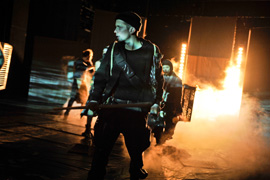 A short time ago, I saw “Moses” at the Münchner Volkstheater. I was deeply moved by the play. It also activated my knowledge about “the burning thorn bush on the Horeb Hill“. This episode marks a significant change in religious history, because here was the first time God made a pact with his “chosen people“ – at least that is how the story is interpreted by the humans. And ever since then, the traditional and often so-called “holy“ stories of human history are characterized by a God who plays the role of an alliance partner with your own interests or group.
In my book, however, the very idea of a “chosen people” drives me crazy. I think of a terrible analogy with our late history. After all, we, too, ran after a maniac less than a hundred years ago. He claimed to lead a race of superior beings into a thousand-year future, as was befitting for said race. And in doing so, he caused endless misery. Perhaps he, too, heard a ”burning thorn bush“ speak to him at some time in his life?
And there is no end to insanity. Tanks are blessed by military priests. Suicide murderers blast themselves into the sky in the name of God. And God is constantly called the alliance partner with their own interests. This is the exact opposite of a world full of love, respect and honour. And in the “Holy Land”, the situation is more complicated than ever before …
All I can recommend to you is: go and see Moses at the Volkstheater. And in a few days, I will tell you about my own religious experiences when I was between nine and ten years old.
RMD
(Translated by EG)
P.S.
The picture is part of the press release (Pressematerial) submitted along with the play. It belongs to the Münchner Volkstheater. The copyright is with the photographer Arno Declair.
Roland DürreFriday November 30th, 2012
The Change in Management (Presentation)
The two presentations I gave last week on “The Change in Management” never got boring. I enjoyed them very much and I got the impression that my audience, too, had fun. Consequently, the feedback I received was also very nice for me
Since the presentations were quite interactive, it is not easy for me to put them in writing. Still, let me write down a few points, even if quite a few things that happened during the presentations will be lost to you.
Change will come – if we want it or not.
My two presentations were about
- Project Management;
- Management;
- Entrepreneurship;
- Leadership;
- Innovation as Creative Destruction;
- Craftmanship;
- The “Co” Era: co-creation, co-programming, co-operation …
- Future is Female
Why do so few women serve time in prisons?
All these are elements both of our private and professional world. In enterprises and institutions, we create future. The following factors play an important role:
- The culture we practice in the social systems and
- how said systems are organized.
Processes of communication, decision and responsibility change.
Who knows the terms:
Barcamp, Jam Session, OpenSpace, Fishbowl?
If not, maybe you should look them up in Wikipedia.
Today, the following is important:
Sharing knowledge, hand on experience. From those who are in the thick of it for those who are in the thick of it. Consumers want to turn producers.
You meet at eye-level. Fear-free rooms make creativity possible.
What was it like in former times?
- Trees grew from the bottom to the top.
- At the top, you had the hierarch, clear command structures, disciplinary bosses.
- And it worked for a long time. It was a simple and well-structured, and, above all, a stable world.
Example: German electronics concern (dealing with everything around electricity) as a hierarchical organization. It was built following the pattern of the German Reichswehr. Build up and procedures are organized, structured into enterprise sectors with up to 10 hierarchical levels, staff divisions for shared tasks, such as F&E, Marketing and all kinds of central functions. - That is how the matrix: organization with full/dotted lines and staff and central units was created.
- Example: electronics concern, business areas motors/generators, small appliances… Shared design, etc., sales, etc., research were central staff units.
- This organizational model originated with the industrial revolution – Taylorism-style and mechanically. And for a long time, all went well with it.
- After a few years, the organization (mostly only parts of it) had to be modified. But that was easy.
Today, this is no longer an option – which is why so many people lament about their enterprises suffering constant re-structuring. Except that this is not enough for following the speed of change. Consequently, “after the re-structuring” more and more often means “before the re-structuring”. Even worse: the next re-structuring will begin before the last one is finished.
And even in nature, trees grow from bottom to top. The first ones who noticed this were a few idealists in the informatics sector. They put the trees upside down.
- But then, it is not an option to turn trees upside down.
- It would make the CEO the one who supports all (big Frederick as the country’s number one servant).
- So you see, trees are not enough.
- New means of communication, too, cause change. Change brings communication.
- This is how the transition from the tree to the network happens in the shape of a ball in the three-dimensional space.
(Note: even in military dimensions and in warlike conflicts, it seems that – when all is said and done – network-like structures are superior to hierarchical command structures, even if the latter have a huge resource superiority).
Well, all of this is not precisely news. As early as in the 1980ies, there was a remarkable development, for example at St. Gallen College. They came up with a “management model” which makes the HSG world famous. Its basic points are the eight theses by Hans Ulrich – “Management – Essays, part 2, 1981 – 1998 On the Change in Management”:
- Accept the uncertainty and unpredictability of the future as normal state of affairs!
Strategy as planning of a future: acceptance that decisions will always have to be made with an uncertainty factor. - Expand the limits of your mental concept!
Against the “but” … and for freedom of ideas. But also: sharing knowledge. - Applying the categories “both-and“, instead of “either-or“!
Black-and-white is out, colorful is in. - Thinking multi-dimensionally!
Balancing of interests in an ethically responsible way. Basically, humans can only deal with three ideas simultaneously. - Self-organization and self-control as the model for your enterprise!
Responsibility, Subsidiarity. - Consider a manager’s job as a meaningful task that makes sense!
New management image. - Focus on what is really important!
Working economically. - Make use of group dynamics!
Cultures, symbols, rites, rituals.
Today, all is about producing knowledge quickly and shaping the future together. Consequently, what we need is creativity in order to find the problems (first creative obligation). After we found them, we have to make use of our knowledge and generate solutions.
Taylorism and “mechanism“ is no longer possible in modern social systems. It is better if we gain the necessary knowledge through the new communication formats.
(Note on private life: the traditional family model, too, was Taylorist and mechanistic. Does anybody still want it?)
Unfortunately, many managers to this day do not understand it and many enterprises still live in the yesterday. This also explains why the “new enterprises” are such a success. It took them only a few years to overtake the “old industry”.
The roots of what happens today and in this country can be found among the (then criticized) prophets of the Bonn republic, such as Adorno and Habermas (Frankfurter School):
Dominion-free/fair discourse as a basis (Habermas)
- No outward restraint must hinder the discussion.
- Having the best argument is the only reason for winning.
- Everyone gets an equal chance to take part in the discussion.
- Everyone must be capable of “self-portrayal without offense“ and make himself transparent for the others.
- Everyone must be prepared to talk about the basic decisions he made in life and be prepared to have them criticized. (There is a clever system of speech and counter-speech, having to prove all you say, experience, authority, etc.).
- Nobody enjoys special privileges because of his age, experience, authority, etc.
- Everyone must be prepared to change behavioral expectations with everybody else. The same is true for switching roles.
- The discussion will continue until a consensus is reached. As soon as the truth is accepted, it will determine the future life and behavior of all the parties concerned.
It all sounds unrealistic and utopian, but it will become more and more reality:
- Through formats such as jam session, barcamp, openspace, fish bowl;
- Pecha Kucha, Ignite;
- Round meeting halls;
- Web 2.0 (interactive Blogs, Twitter)
- Wikipedia and Open Source
- Social Media like Facebook and Google+ as a logical conclusion.
Thesis:
The dominion-free discourse is filled with life. In a hybrid combination with the internet (social web), the new world of shared interests gets stronger and stronger. A new society of communication and “gaining knowledge“ is built. Belonging and sharing get more and more important as values.
And being part of it will make you happier and more successful!
So I tried to give a future-oriented presentation.
RMD
(Translated by EG)


