
Markus SeidtTuesday December 1st, 2009
Letters From Vietnam #1 – Ventilators or How the Preferences of the Rich Help Financing Educational Projects
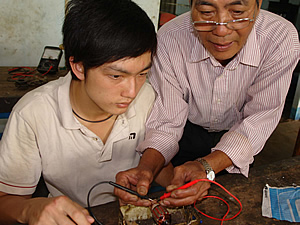 In 1995, Francis Van Hoi founded an educational centre of professional learning in Ba Thong, Hoc Mon, near Saigon. In co-operation with a mission of the Don Bosco Salesians – where he himself went to school more than 40 years ago – the centre initially provided an education in the crafts for 10 street children. By now, the number has increased to between 20 and 30 each semester. We are talking between two and six months during which the young people are to be enabled to go home and work for their own livelihoods. In Vietnam, too, accommodation, food and education cost money, regardless of the support by the Salesians.
Once in a while, we entrepreneurs philosophize about ourselves. Are we hunters or gatherers? Or maybe we are more concerned with agriculture and farming?
Before the last great climate change triggered the end of the ice-age, with the finish of the Upper Palaeolithic (between 45,000 and 9,000 before Christ), humans changed their eating habits. After having mostly acquired their food as hunters or gatherers, the disappearance of animals from their hunting grounds forced them to start agriculture and farming.
Compared with hunting and gathering, however, agriculture and farming is rather boring. It is strenuous, stereotypical work that has to be done in order to cultivate the soil and look after the livestock. Also, many factors determined whether or not the harvest was plentiful.
Roland DürreMonday November 30th, 2009
The Days Are Growing Shorter, So Do The Cucumbers!
 Some time ago, I wrote an article saying how surprised I was about the habit of enhancing the growth of vegetables in conservatories by using artificial light.
Now, an engineer working for OSRAM told me that the entire affair is a lot worse than this. In modern conservatories, no natural light at all is allowed to get in. It seems like they found out that cucumbers grow even faster on an eight-hour day with a shortened night.
Consequently, conservatories are darkened 24 hours and then the vegetables are allowed to grow on artificial light.
Is this really possible? Something inside me cannot believe it! Now I hope it is not true and our readers convince me otherwise!
RMD
(Translated by EG)
P.S. The picture of the cucumber is from wikipoedia, where it is published under GNU-Lizenz für freie Dokumentation. The copyright is with Rainer Zenz.
GRÜNSIX Sunday November 29th, 2009
Radio Philosophy #056 – MONEYPATHY.
Empathy is the ability
to sympathize
with
what other people feel.
In the extreme
this means
your activity neurons start firing
as soon as you see an activity.
So we can actually
mentally share
the activity
of a total stranger.
This practical mechanism
is called mirror neuron.
Very well.
It would be even more important
to
find another mechanism:
How some mentally shared activity
can become actual shared activity.
One such mechanism is well known.
Money.
Isn’t it strange that there is no dictionary
where you can look up “moneypathy”.
KJG/SIX
(Translated by EG)
Marc BornerSaturday November 28th, 2009
Living Happily
It took me some time to retrieve the paragraphs that originally led me onto the path of philosophy. And, by chance, these very paragraphs also have something to do with the media reports of the last few weeks. Here is some of my school Latin, some Seneca: „Living happily, my dear brother Gallio, is something everybody wants; but when it comes to see what actually makes life a happy life, then the vision is clouded“.
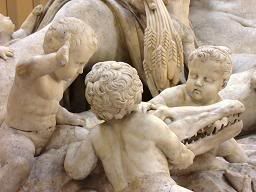 This is how Seneca starts in his letters to Lucilius. Among Seneca’s stories, the one that moved me most was that of Telesphoros of Rhodos. He had dared to anger his old friend and emperor Lysimachos and, if I remember correctly, courted his daughter. Lysimachos found this far from amusing and ordered his old friend taken prisoner, publicly exhibited in a cage and parts of his body cut off piecewise. Caught in his own excrements without eyes, ears and nose, Telesphoros was forced to crawl around like an animal.
Roland DürreFriday November 27th, 2009
“My Liberties” or “Definition and Polemics!”
Here is my small and doubtless “dilettante” contribution on rhetorics, polemics and the precision of language.
On the presentation of HYPERLINK “https://archiv.if-blog.de/rd/unternehmertum-oder-freiheit/” \o “Bericht meines Vortrages Unternehmertum” Unternehmertum, I recently gave you a list of seven possible definitions of liberty:
You are willing and able to live your life on your own authority.
- You cannot do whatever you wish to do, but you will never be forced to do something you do not want to do.
- You can balance your conscious and subconscious interests.
- You promote both your own and other people’s personal lives, rather than minimizing it. Or also:
- You fear nothing and nobody (Konstantin Wecker, “Willy”).
- You live in harmony with the Great Secret (Willy Michel, Isarindianer).
- Freedom is just another word for nothing left to lose! (Janis Joplin, Me and Bobby McGee)
Now I heard yet another definition:
- Your own liberty ends where your neighbour’s liberty begins.
To me, all these definitions seem like sincere attempts at coming to terms with the meaning of the word liberty. They assume that liberty might actually exist and try to clarify on different linguistic levels what it might mean.
Roland DürreThursday November 26th, 2009
“Bliss and Depression!” or “Inner and Outer Skeletal Support?”
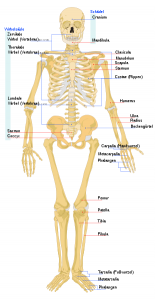 A short time ago, I read that people in former times suffered less from depressions and had more moments of bliss than we today. Emotionally, I find that hard to understand, by rationally, it makes sense.
Now a friend of mine explained it in a nice way: over many centuries, people had an “outer supportive skeleton”. Some external order was an unquestioned fact of life. It told you what to do and not to do, but it also determined the rhythm of life.
We have lost this “skeletal support”, exchanging it against fake liberty. That is why we in our times are badly in need of an inner skeleton.
However, finding it for yourself is nowhere near as easy as it sounds. And living up to it is again something that really takes energy, discipline and motivation.
Consequently, many people are left “hanging in the air”. They lost their “outer supportive skeleton”, yet cannot autonomously develop their “inner supportive skeleton”.
I think this is a nice concept.
RMD
(Translated by EG)
P.S.
I took the picture of the human skeleton from the central media archive of Wikimedia Commons. It is originally by Furfur.
Roland DürreWednesday November 25th, 2009
Depressions and What Causes Them
Now the hype about Robert Enke, deutscher Fußballnationaltorwart in Wikipedia” Robert Enke’s suicide is over. With the new “betting scandal” in European soccer, we forgot everything else. After the spectacular reports, what remains will again be silence. Yet the number of people suffering from a depression grows all the time, and the number of suicides along with it. Several years ago, the number of suicides had already surpassed the number of traffic fatalities, and it continues to increase, regardless of anti-depressive medication.
I, too, know a number of people suffering from depressions. A short time ago, a good friend of mine decided that the only way out for him was suicide, which surprised us all. Unfortunately, his tragedy, like that of many others, never came to be known publicly.
Markus SeidtTuesday November 24th, 2009
The Web, Wok and Aid for Agent Orange Children
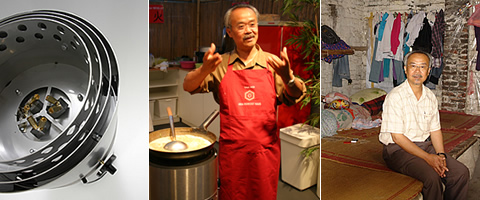
Roland asked me for an article in which I introduce myself. That is not easy, because I see myself primarily as ghost writer for Francis Van Hoi. To this role, however, I am now dedicating a considerable part of my time on various technical fields of interest.
GRÜNSIX Sunday November 22nd, 2009
Radio Philosophy #055 – WORD RUBBISHER.
They invented a new profession.
Word rubbisher.
He creates rubbish words such as “in the near future”.
In former times, we just said “promptly”.
Promptly is promptly.
But what is in the near future?
How near can you get,
to the future?
One second, one hour, one day, one year?
“In the near future” gives every leeway to the one who promises.
And nothing to the one who received the promise.
That is why the profession of the word rubbisher
has a never-ending future.
KJG/SIX
(Translated by EG)


