
Roland DürreTuesday November 8th, 2016
Anecdote on Autonomous Vehicles (if it Were not so Absurd, it Would Make me Cry)
 or:
How the Chauffeured Gentleman Imagines the Autonomous Car.
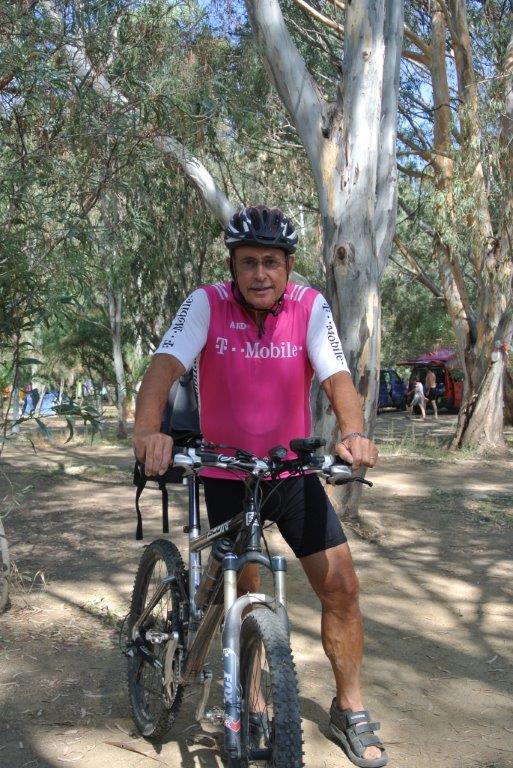
ADFC – that is the lobby club for us bike riders. Many bike riders think this club is a little stuffy and consider it just the equivalent of the ADAC. Consequently, they prefer free grass root movements, such as “Critical Mass“ and the like. Regardless, it is a pleasure for me to be an ADFC member and I also support the association with lobby work wherever possible. And I also very much recommend the membership.
The ADFC also organizes many excellent events. One of them is the lunch discussion group in Munich. At those lunches, I already witnessed many interesting presentations, for instance by Herrn Ude (when he was still mayor of Munich), Herrn Ramsauer (when he was Federal Minister of Transport), Toni Hofreiter (as mobility expert of the Green Party), but also by persons who are less publicly well-known, as for example the DB-Regio .managing director. The discussions were always very interesting and important.
Yesterday, we had another ADFC lunch discussion in Munich. The speaker was Peter Driessen , who is general manager of the IHK Munich and Upper Bavaria. For those who do not know what IHK is: it means Industrie- und Handelskammer (Chamber for Industry and Commerce). It is an organisation you have to be a member of if you own an enterprise, just as you have to pay their membership fees.
As an entrepreneur, you do not know why you have to be a member, but in return, you get a high-gloss magazine at regular intervals that is rather lacking in content and not very interesting either – and that will immediately end up In the rubbish bin. The IHK is generally quite present in people’s minds, because more often than not it has many managing directors – and those managing directors earn quite good money. After all, they are also responsible for many enterprises (see Official List of IHK on incomes of the GF team, not included other advantages such as business car and chauffeur, etc. – Offizielle Liste der IHK zur Einkünfte der GF-Teams ohne weitere Vorteile wie Geschäftsauto mit Fahrer etc.).
And then, Peter D. (without having intended to) explained with a personal true example how all the different traffic systems might be integrated in the future, at the same time disclosing his personal vision of a “driver-less car”:
“On the way to a presentation, his chauffeur-driven car got stuck in the traffic jam at Donnersberger Brücke. And since there was no chance for him to reach his destination in time using the private vehicle, he just left his car and continued on his way by S-Bahn train. And he managed to be on time. This would not have been possible without a chauffeur, since he could not have left the car standing in the middle of the Donnersberger Brücke, could he?”.
He then completed this example using his personal vision of a self-driving car:
“This is how, in such situations, you could continue by using public transportation in order to reach your destiny on time and the driver-less car could then do a leisurely turn through the congested streets and eventually retrieve its owner”.
He sounded rather serious when he said this. Perhaps he meant it as a joke? Except that such a concept of mobile future is all but hilarious. Especially if it comes from an important representative of a business association, at least one who considers himself extremely important.
RMD
(Translated by EG)
Roland DürreSunday November 6th, 2016
Digitalization: Once Again “Ethics” and “Autonomous Vehicles”.
Guido Bruch commented on my article
#Digitalization – The “Ethics” of IT and “Artificial Intelligence“
(#Digitalisierung – Die „Ethik“ von IT und „Künstlicher Intelligenz“)
Here it is:
In the book “Silicon Germany”, the ethical dimension is discussed. Here is an example: a child runs onto the street from the right side. On the left, an elderly person is walking with a walking frame. Humans behind a wheel would decide either at random or consciously whom to run down if they cannot stop their car in time. But then, what to tell a machine to do? Should we always protect the child and thus select (and this with Germany’s past?) or should there be a random generator? I think this is what it is all about.
But I am sure these are all just theoretical questions, since the number of potential accidents is probably small. The topic would probably solve itself. Have there ever been these kinds of accidents?
Another question is what the car manufacturers will do if the request changes from country to country? For instance if some Golf countries say they want to protect the natives at all costs and instead sacrifice foreign labour?
Many thanks to Guido. His article gave me many associated and emotional ideas:
The problem is that a program that is supposed to follow a balancing ethics has to have an evaluation matrix with calculable rules that can evaluate the value of human life through a well-defined systematics, covering all cases in several dimensions.
In other words, you would suddenly have to evaluate and classify the age and gender, but also the education, function and social responsibility of a person and much more. And thus you would have to reach a “personal value number” that makes it possible to calculate the relation between an individual and the set of all humans. Similar to the mathematical value “bigger than“ for whole numbers.
(In theory, you will then not have room for “equal” or “equal-same”, because that would probably mean you need a random generator, after all.)
If you continue in this way, then you will also have to think about such a relation as “bigger” in terms of a set of humans at any time and decide about one of them being the most important and one the least important.
Totally mathematically. To me, this entire discussion seems absolutely useless, even if you will find it in the book Silicon Germany.
Incidentally, this has been regulated for persons living in the FRG a long time ago. We have a constitution that clearly states that all men are equal. Consequently, an absurd metric that would algorithmically determine the “value of a person” is not permissible.
So what “ethical” definitions should a machine follow?
Here is an example:
Guido writes – and immediately doubts – that one might come up with the idea of always saving the child. Then the first question would, of course, be: what to do if you have to decide between two children?
Quite apart from the fact that this would define a two-class society: children versus the rest of society. But then, how do we define “child”? By age, size, weight, maturity? And what about a mother as part of the “rest” if she is nine months pregnant? Perhaps she is two persons – one child and one rest? I also think the “rest” would vehemently oppose this kind of regulation.
Incidentally, the dilemma is very old. What to do if, shortly before the birth, they discover that the mother would die giving birth to a baby that might live? And that the mother can only be saved by killing the baby? This is a mental experiment that actually happens in real life. And, of course, you can extend it by telling people, for instance, that the mother has two more small children (and a husband…). Can this kind of thing be forced into a series of rules that a machine could work with? Of course, the answer is: no!
Here are a few examples with which I would like to show the absurdity:
Who is worth more?
- The Federal Chancellor or the leader of the German Soccer Team?
- A CSU county representative or an SPD federal representative?
- An entrepreneur or a politician?
- A German or a Frenchman (depending on where)?
- An integrated citizen with white skin or a dark-skinned asylum seeker?
- A young man or an elderly lady?
- The person sitting in one car controlled by a robot or the person sitting in the car controlled by another robot coming from the opposite side?
- Or, to be cynical: robot A has been installed by BMW. Potential accident cars are another BMW and a Mercedes. Should he ram the BMW or the Mercedes?
- …
You can produce these examples in huge quantities. But to what end? Except in order to demonstrate how it does not make sense at all?
Let me give you a few seemingly harmless examples: cat against dog, which is of higher value? The strangling dog or the pedigree animal owned by the opera star? Or – just to top all absurdity: what should the car roll over if there is a choice between the “common German toad on its way” and a “run-away Greek tortoise”?
(Please note: when I ride my bike, it always hurts me to see all those run-over toads and in Greece all those run-over tortoises).
Most persons propose you could use a random generator for these decisions. After all, it would not really be activated very often, would it? This sounds rather pragmatic. Why not?
Incidentally, the great Isaac Asimov solves the problem quite easily in his SF work: as soon as a robot threatens to do damage to a human, the system will block itself following the three robotics rules, thereby being destroyed once and for all. But he, too, soon discovers that his proposal has a glitch (incidentally, it is from the 1940ies).
The glitch is:
What are the characteristics by which a computer identifies the human being? At one time, this seems to be the dialect of the Solaris “spacers“. Aurora “spacers” seem to have huge problem with it. And the same is true for the “settlers“. And consequently, the Solaris robots start killing intruders – even if those intruders are humans.
🙂 Here is what I propose: why don’t we take the Bavarian dialect as a determining factor whether or not someone is human? Even the big Bavarian party might want to make this idea part of its program…
However, when it comes to autonomous cars, the “laws of robotics” will not help either. It can only work if the car is driving empty :-).
No, the ethics commission for autonomous driving is nonsense – just like most ethics commissions and discussions.
To be sure, I would wish for an ethics commission for drones and war robots. However, the result of those commissions seems as clear as the fact that those who have all the power would ignore it anyway.
Another ethics commission I could easily imagine is one that answers the question if it should be allowed for private institutions (concerns such as google, amazon …, but also lobbyism as practiced in many sectors, up to private armies employed by some enterprises) to get such power as has never existed in society, in extreme cases even including psychological and even physical violence. In some cases, there should probably be a discussion about a violation of the “federal monopoly of violence”.
Except that it is absolutely clear to me that the result of such a commission could only be a clear “NO”, which would, however, be likewise ignored.
Ethics will not help when we try to solve our problems. Especially not if it is supposed to be generated by a commission. What we need is human wisdom. I always like citations by Bertrand Russell:
» All technological growth, provided said growth causes an increase, rather than a decrease of human happiness, will give us growth in wisdom.«
And, unfortunately, ethics will not at all help us to become wiser. On the contrary: it is more conducive to distracting us from wisdom.
In particular, ethics will not at all help with “autonomous systems”. It is my personal consolation that, as far as I know, there has not been a single event with track-bound traffic where “mental experiments” such as the trolley dilemma, ever happened. Consequently, there is no need to worry too much.
Perhaps the following ideas will help:
Railway tracks are made of iron. In the iron age, they were used in order to transport persons and products from A to B. The autonomous car is a result of IT. Consequently, it is a little more modern, quasi running on “tracks made of software and computers”.
And in doing so it makes use of an infra structure that was the only one to have established itself on a world-wide scale: flattened ways in concrete, also known as street network. That is why it can not only transport humans and goods on tracks along the line between A and B (A and B being fixed stations), but also between X and Y (X and Y are now variable end points that can be reached via street).
And in former times, the railway was twice redundant. First, it had to set a recovery for a “basically impossible” error. For cases when this failed, a second level was generated in order to avoid the maximum accident even for a twice “impossible” error.
Consequently, it is our task as engineers to guarantee the highest possible degree of error free roads. We should create a first “redundancy” that covers the “impossible error”. And then we should create an extra safety level, as the railway used to have it.
This is how you make errors as unlikely as possible. That is the mission!
The ethics discussion is intellectual onanism. It seems to me that politics try to deflect our attention from relevant and very uncomfortable questions about digitalization (incidentally, I ask those questions in my presentations). This is how it is abused as election campaign instrument. Politics want to make the citizen believe he has a high competence and responsibility. The goal is to win as many points in the electoral campaign.
RMD
(Translated by EG)
P.S.
There is only one instance when I remember an ethics commission coming up with a reasonable result. A few decades ago, there was a lot of discussion about the §217 (abortion). At the time, the ethics commission had the idea that abortion should continue to be illegal, but that there should be no punishment. As I see it, this was not a bad idea. After all, it also became the basis of the new abortion law.
But do you really need an ethics commission for this kind of thing? In his “Dreigroschenoper”, Bert Brecht says:
You must not punish too severely those who acted illegally!
This will help the persons concerned, because there is no punishment. But it will not help with the decision making process. Because it will always happen in the hearts and heads of the parties concerned.
Roland DürreFriday September 23rd, 2016
IF Forum on October, 19th, at 6 p.m. – this time in Stuttgart!
 IF Forum on October, 19th, at 6 p.m. – this time in Stuttgart!
It is my pleasure to advertise the next IF Forum. This time around, it will be held in Stuttgart. The topic is:
THE DITIGAL TRANSFORMATION IN IT AND SOCIETY – WHERE IS THE BREAK-THROUGH?
Time:
October, 19th, 18:00 hours
Location:
InterFace AG, Zettachring 8, 70567 Stuttgart
Speaker:
Dr. Georg Panagos, University teacher (business/media), HS Fresenius, Management counsellor for technology enterprises (telecommunication, IT, media) N-Pusle GmbH
Abstract:
Today, digitalization has arrived in everyday life and in many enterprises. Perhaps the “digital transformation” was misunderstood, or else maybe underestimated or even ignored.
Many enterprises are quite quick when it comes to selling their products and services via internet – which, as they see it, is already digitalization.
Unfortunately, though, this is the wrong approach and will often end in failure, which, for example, several print media had to experience to their detriment. They also call it newspaper demise. But other sectors, too, feel the pressure from the new online world, for instance banks and insurances.
The presentation by Dr. Panagos will discuss more sustainable and future-oriented procedures, for instance the fact that digitalization must cover the entire enterprise, even the entire society. This is because we do not only need the technology but also robust and sustainable digital business models. Examples and trends from the media and communication industries will provide an incentive for ideas and discussions.
I will also try to be there. Both the presentation and the topic should make it worth travelling to Stuttgart.
Click here for the Agenda and Registration.
RMD
(Translated by EG)
Roland DürreWednesday June 29th, 2016
A slightly different presentation: at the Berchtesgaden “Lederstubn” on July, 13th, 2016!
Digital Transformation and New Mobility – Paradise or Hell?
Or:
Our Brave New World seen with the eyes of the entrepreneur, IT pioneer, blogger, father and biker Roland Dürre.
When he still worked at the GLS bank, Carsten Schmitz often invited me to attend nice events. I met urgewald and Katrin Frische when she was “telling stories”, and many more people of interest. Now a board member of the HOHENFRIED e.V., Carsten is responsible, among other things, for networking, fundraising and financing.
One of the things he initiated is a loose series of presentations in Berchtesgaden:
“Civil Society Initiative with Current Topics at the Lederstubn“
And he asked me if I would be interested in supporting his project by giving a presentation. Which, of course, I will gladly do. After all, this is an excellent opportunity to thank him for all his hospitality and at the same time do something beneficial for a good cause.

Since I assume that the audience will be quite diverse, the first thing I plan to do is ask them about their interests and then sort the input. And then the resulting list will be discussed in good order, a little like an OpenSpeech.
Consequently, I expect it to become a really open and interactive event that will be great fun for all participants – and that will also make people thoughtful.
I will go there by train and use the Bayern-Ticket.
Currently, I plan to take the S-Bahn train S7 from Neubibert on July, 13th at 14.31 hours and then change at Ostbhanhof and in Freilassing, arriving in Berchtesgaden at 17:30 hours. I plan to return on the same day, starting from Berchtesgaden at 20:31 hours, which means I will be back in my bed around midnight.
Of course, I would be delighted to welcome friends among the audience. I will gladly take you if you wish to use part of my Bayern-Ticket.
RMD
(Translated by EG)
Roland DürreTuesday May 10th, 2016
Future, Evolution, Transformation & Digital!
One week ago on Saturday evening, we started on our way to Italy, leaving the train on the next morning in Orvieto. It took us three days to get to the congress venue at Castel Gandolfo by bike. Riding our bikes to the Albanian Ocean in the south-west of Rome was a great preparation for the international
“10th NETWORK MEETING OF THE PETER PRIBILLA FOUNDATION (MAY, 4th – MAY, 6th 2016, ROME)” I was lucky enough to be part of.
The workshop was intense and challenging. Consequently, we spent the day afterwards being truly at leisure and indulging in luxury in Labico. Subsequently, we rode our bikes through Italy for three days. The first leg was from Labico to Terracina (around 80 km). Then we continued to Nettuno (about 75 km). From there, only about 50 kilometres were left to ride to Ostia, which meant that we arrived there early in the afternoon and had plenty of time to see the ancient Ostia by bike and generally enjoy Ostia.
During the three days riding through the provinces of Roma and Latina during the wonderful Italian early summer, I had a lot of time for contemplation. It was a truly special meeting.
Tomorrow, our voyage will be at its end. We are going to Rome. There, the night train that is supposed to take us back to Munich by Thursday morning is already waiting for us. Let me write down a few memories of today’s meeting.
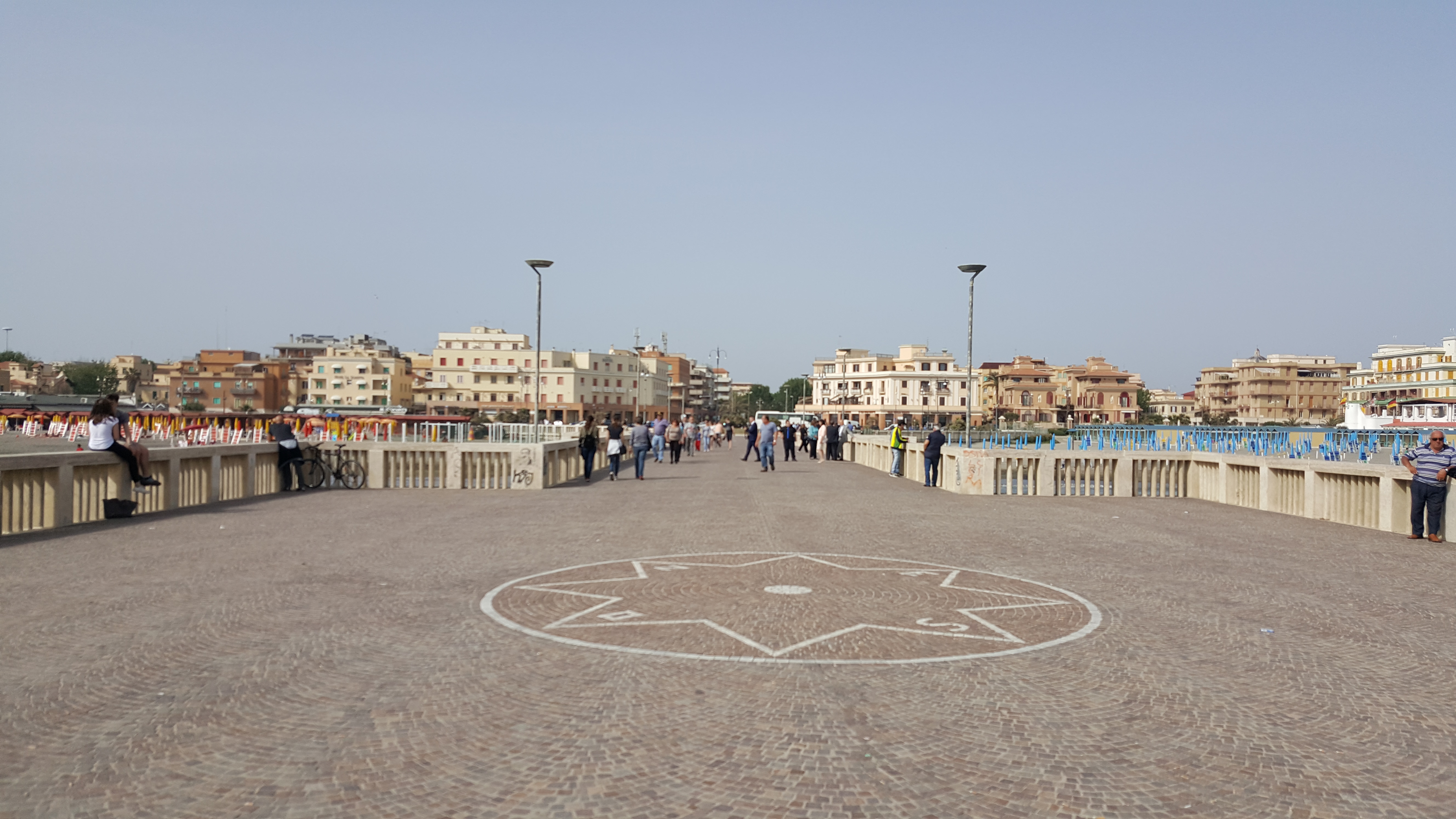
Lido di Ostia, picture taken and scenery admired from the central ocean bridge :-).
The meeting was sponsored by the “Pribilla-Foundation“ and about “Digital Transformation“: After all, this is a transformation that concerns all of us ever more, making us aware of change that is happening and growing at rapid speed.
The workshop was opened with an impulse presentation by Manfred Broy, who is the director of the Bavarian Digital Centre (Digitales Zentrum.Bayern). He gave a precise “sweeping swipe” on “digitalization”. Based on exciting facts, he pointed out to us what is currently happening. I was allowed to give one of the three (3-minute) short responses to the presentation. Here is a short version of what I said (with a few additions, because three minutes is actually quite a short time):
“The digital transformation will probably have a massive influence on the evolution and our future. It might even help on the way towards finding the necessary great transformation humanity needs badly.”
I came up with a theory on all the terms marked in this sentence – that is: I formulated my “basic beliefs”. Here they are:
- Future
As I see it, the future cannot be predicted!
That is also the first theory formulated by the great and unfortunately already dead management scientist Hans Ulrich from St. Gallen who revolutionized the theory of management in the 1980ies with his essay “Eight Theories on Change in Management”..
It may well be possible to predict the future correctly once in a wile if you use the tools of science and your common sense. That is: you might receive a “message from the future”. Yet you will never manage to correctly interpret said message.
To me, the future of humanity can be described using the metaphor of a boat on a river. The river is in the “white area”. The boat moves down the river.
You can measure the speed at which the river flows and also, for instance, the stream gradient and other data. But still, all those data will only give you limited information on what is going to happen. Using a spy glass to look into the distance will also only be of little help. It is not predictable how the river will continue on its way (will it become broader or will it find its way through a narrow gorge and become a torrential river, will there be a bend or a waterfall or will it suddenly disappear totally underground?).
And in this metaphor, we do not even know if humanity is the boat or the river (or maybe just a swarm of fish?). - Evolution
Evolution is useless. Perhaps it tries to make sure there will always be life, but we do not know why and for what purpose.
As I see it, evolution cannot be controlled – just like the future is not predictable. Basically, we cannot install a “steering committee” and tell them ”Please control evolution!”. It simply will not work (just like, incidentally, it does not work with huge enterprises and social systems). - Transformation
I think in a next step, evolution will have to and will undergo another huge transformation. This is necessary if humanity wants to survive. It will come, disregarding the question of whether humanity will continue to live or not. We know nothing about this transformation, except that it will bring basic change and come as a huge surprise. The time for this transformation is ever nearer. It will probably happen within the next few generations. - Digital Transformation
It would be nice if digital transformation could become a positive driver for this great transformation. I see quite a good chance. Even now, the world changes through digitalization – and in my opinion said change is for the better.
The friendly persons build networks, the combination of digital + social makes it possible to cooperate constructively in a way that was hardly possible in former times. Thanks to the “digital” world, something like “enlightenment 2.0” develops. To me, this looks to be more important than the “buzzword” of “industry 4.0” which, after all, is only “normal” technological progress.
What remains is the question: how can we contribute towards digitalization changing the world in a positive way?
Of course, I do not know the answer. It is my belief that we should not talk too much but instead act. Every one of us should act in his own specific way, following his personal inclination. And we all should do it together and connect with all the ”friendly persons” in our society – for instance those persons I actually met in huge numbers at the nice meeting in wonderful surroundings!
RMD
(Translated by EG)
P.S.
During the meeting, I mentioned a book that might actually help you a little to understand how totally different even our “small” children think – and how helpless the ancient concepts of thinking and teaching and education have become.
(Re-Invent Yourself! A Declaration of Love for the Network Generation by Michel Serres).
Roland DürreSunday March 13th, 2016
The Digital Mobility Revolution – CANZLER/KNIE
Can the digital revolution change the prevailing private-car-oriented order?
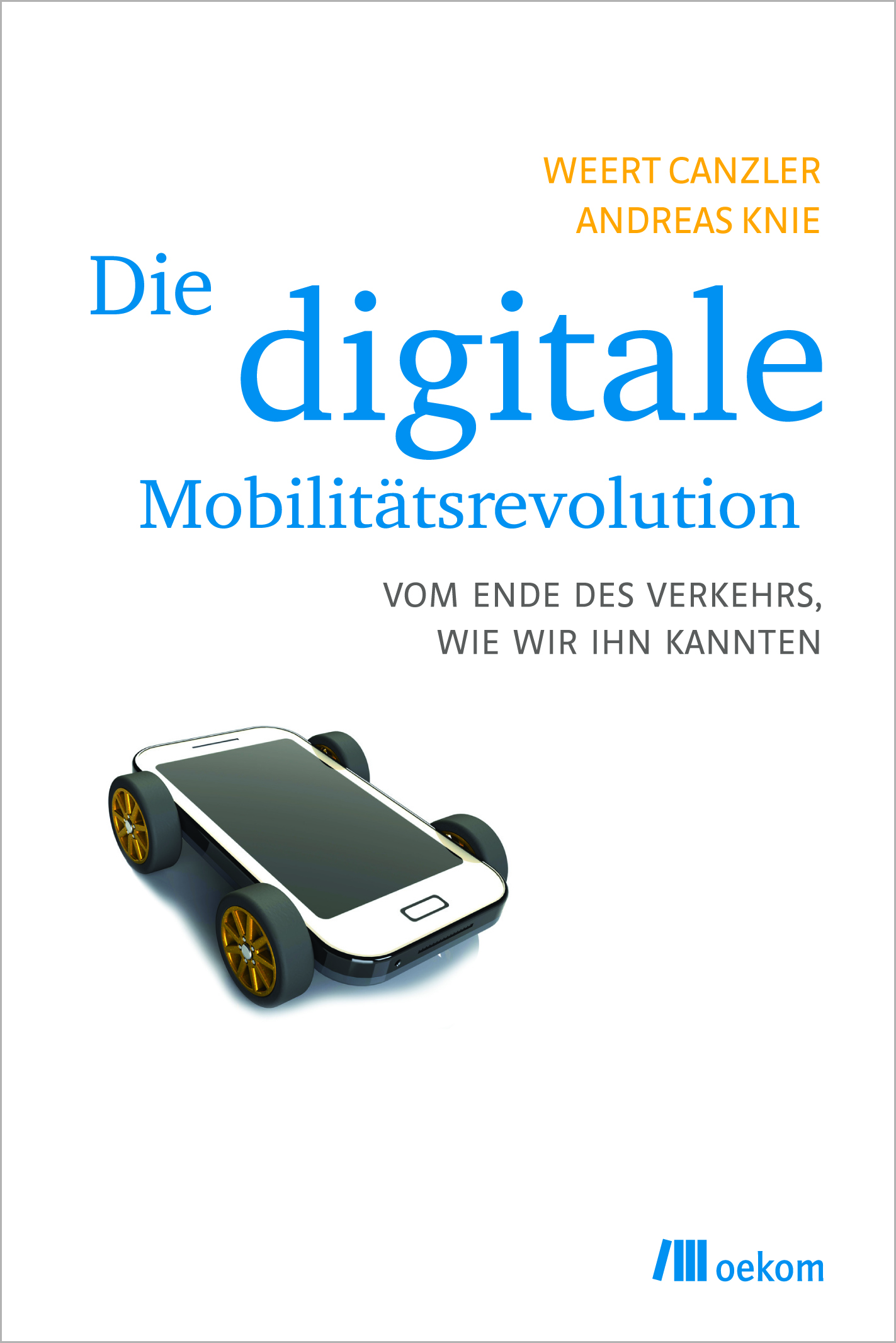 That is the central question asked in the book by WEERT CANZLER and ANDREAS KNIE. And, as I see it, they also answer the question.
But let me start from the beginning. Friends of mine had spoken with enthusiasm about the Oekom publisher and its founder Radloff for a long time. I took those comments seriously, yet had never found time to look a little closer. Until a few emails from friends reached me with actual book recommendations.
After that, I did some really extensive browsing through the Oekom website – and I was truly fascinated, both with the topics/titles and the authors I found. And, without any hesitation, I went ahead and ordered a few books, for instance the one by Anneliese Bunk and Nadine Schubert Besser leben ohne Plastik (The Better Life Without Plastic). (ISBN: 978-3-86581-784-6, first published: 22.02.2016)
Late in February 2016, they also published the small book:
Die digitale Mobilitätsrevolution
(The Digital Mobility Revolution)
The visionary sub-title is:
THE END OF TRAFFIC AS WE KNEW IT.
Since the paper version of the book only has 128 pages, it was the ideal reading material during my nostalgic trip to Augsburg on Regional Trains. I went to the beautiful City Market, then to the Inner City (where I also visited Sina Trinkwalder and her Manomama – All made in Germany, from the threat to the seams) on 4, Moritzplatz.
Last not least, I went to the venerable Augsburg Rosenau Stadium, where, even in my earliest childhood days, I spent many important hours. And behold – the FCA II was beaten to the tune of 0 : 6 by the SpVgg Unterhaching (my new soccer home) – which definitely was a good reason to celebrate in the Riegele near Augsburg Central Station with a Kellerbier.
It was nice. And reading the book during the train trip and back was just as nice. Because it says in an understandable way how our mobility has turned into something askance that is both evil and threatening our future. It also says how the “digital transformation” can and will help us to at least avoid the worst of it.
As I see it, the book is absolutely “state of the art”. It describes the current situation in a very rational way and makes short shrift of a number of very popular prejudices. It shows solutions that give you optimism, yet it also shows the absolute necessity for change. This is true both for our administrative, legal and bureaucratic world and our social (collective) and personal (individual) habits.
The authors Weert Canzler and Andreas Knie deserve praise for having written a book that is more exciting than some criminal stories, regardless of the subject matter being so demanding. And I also have a few suggestions when it comes to the content – perhaps for the second edition.
For persons who actually think about our mobile future, the book is certainly a must. This is, for instance, also true for persons who believe they might attend the AktMobCmp. Incidentally, the next one takes place in Augsburg on May, 20th and 21st!
RMD
(Translated by EG)
P.S.
Here is the Link and some information on the book.
Weert Canzler, Andreas Knie
Die digitale Mobilitätsrevolution
Vom Ende des Verkehrs, wie wir ihn kannten
144 pages, oekom verlag
München, 2016
ISBN-13: 978-3-86581-754-9
Published: 22.02.2016
The use of mobile devices increases all the time. More and more often, our smartphone will decide how we get from A to B. If you need a taxi, you use your Taxi-App and book online with services like Uber. In the future, the digital presence will be the determining factor: if something is not digitally published or available, it simply does not exist. Through digitalization, the cards in the game of transportation choice are re-shuffled. Since renting systems get more and more attractive and the car is in direct competition for customers with railways, busses and bicycles on shared digital platforms, the power structure within the transportation sector will change drastically. Consequently, the technological characteristics of cars will mean less and less. The authors show ways and chances of this network in post-fossil mobility.
Roland DürreSunday February 28th, 2016
From Digitalization to Thermomix
 Today, the word “DIGITALIZATION“ is basically a magic word. And it is, in fact, probably the most important term of our modern times. After all, digitalization changes our life at a high speed and with immens intensity. It can most certainly be compared with industrialization, which, a few centuries ago, brought a storm of change over the continents of this world.
Consequently, the digital change is the central topic in a global world. Even in the satiated and rich Bavaria, they established a “Bavarian Centre for Digitalization“ (Zentrum Digitalisierung.Bayern). Their website is certainly worth taking a look at. This centre has been initiated at the instigation of the Prime Minister and has a ten-digit budget at its disposal. It is supposed to enable the Free State of Bavaria to keep its world-wide top position. Or, to be more precise, to re-establish said top position after it has been lost in important areas.
I rather like the term “Digital Transformation“, because I see myself as a “Third-Generation IT-Pioneer” who, through all his life, has been part of teams that created “digital transportation”, initially as a programmer and later as a software and IKT entrepreneur.
As always when dealing with language, it is advisable to see the term as a “generic term” and then subdivide it in order to better understand it. Production is certainly an area that is affected by transformation. In this area, the change has already been labelled “Industry 4.0” (which is a little ridiculous). Digital transformation, however, concerns all areas of organized life, be it economy, administration, our mobility and communication, trade or the media. And, of course, it also concerns the way how we live together, changing our cognitive competence. Who among us is still able to do calculations (without using a calculator) and what young person can still find his or her way in the city (without using a GPS)? Thus, it changes our lives – both individually and collectively.
Digital change will be instrumental when it comes to how well this world functions – and consequently it will not stop before our front doors.
Now it also arrived in our kitchens. Of course not by providing the self-ordering refrigerator as some storytellers of the internet of objects have been predicting for years. Well, they do not even begin to understand, because this is actually exactly how innovation does not work.
No, the kitchen is another one of those areas where digitalization comes on soft paws. For instance first and foremost as a cooking box. Instead of as a robot that peels the potatoes and cleans the tables after the meal.
A short time ago, I found a device that tends towards “becoming digital”. It is the latest Thermomix version. It gets its recipes from the internet (well, the current version still gets it through the USB stick) and then steers the human through the cooking program by giving instructions.
RMD
(Translated by EG)


