
Roland DürreFriday March 26th, 2010
Great Orators and Their Stories – #6 Rupert Lay
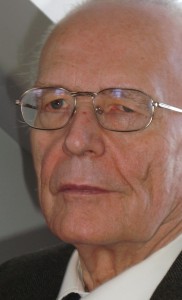 Rupert Lay was my mentor during many years of my life. As I see it, he was the most important of all my teachers. The first seminar of his I attended was in the spring of 1983, around the time of year we are now again in. For me, it was a totally new experience. Meeting him meant quite a fundamental change to my life.
When I was younger, my attitude towards seminars for personality promotion – as they were still called at the time – was a rather sceptical one. In 1980, I was lucky enough to attend a great seminar with Herr Uhlenbrock of TPM (Training Psychologisches Management) when I was working for Softlab. That took care of my scepticism.
In 1983, I attended a seminar by Rupert Lay. At the time, he was a Jesuit priest and the nestor for “Ethics and Management”. For us, he was discovered by Peter Schnupp, one of the Softlab founders. By chance, there was a vacancy for me in one of Rupert Lay’s seminars. Rupert was a celebrity! His seminars were extremely expensive and yet always full.
His three-day seminar was scheduled to take place at a rather less-than-friendly hotel near Frankfurt airport. The seminar was to start early in the afternoon. Having arrived with time to spare, I sat down in front of the hotel, enjoyed the spring sunshine and watched the people come and go. Also, I wondered what was to come next.
Roland DürreWednesday March 10th, 2010
A Professor’s Job Equals that of a Decathlete …
In her presentation about “Open Innovation” at IF Forum in our Unterhaching office building, Frau Professor Dr. Möslein recommended a paper written by Prof. Dr. Dr. h.c. mult. Peter Mertens. In the article, he compares the job of a university teacher with the challenges a decathlete has to face.
She sent us the article and we are permitted to publish it. It is certainly worth reading. So you can download and read it here.
[download id=”75″] – Setzen wir falsche Anreize?
🙂 I think managers and entrepreneurs are sort of decathletes, anyway.
RMD
Detlev SixSunday March 7th, 2010
Lack of Creativity is Just a Question of Laziness.
The idea of originality is dead. It has been dead since the German Romanticists. Even exceptional achievements of the human intellect can be traced back to forerunners. Mind you, they do not get worse by this, but they are no longer original in the sense of the genius metaphor.
However, new ideas and solutions are always an option. Incidentally, they are just a function of time and effort. Talent is of secondary importance.
Roland DürreWednesday March 3rd, 2010
“Kids, Spend Time Abroad!”
After graduating from high school, you simply have to go abroad. It would be best if you spent a semester somewhere as an exchange student. It is the only way you can learn to cope with the challenges you will be facing as a manager or entrepreneur in our globalized world.
This is the kind of advice I hear “experienced managers” give young people during various events. To me, that seems a little one-sided. If young people go abroad, the basic objective is not for them to become better managers. Rather, they should get a little experience in life and gain a little wisdom. To be sure, this is not bad news for a future manager, either.
Roland DürreTuesday March 2nd, 2010
IF Forum on Tuesday, March, 2nd, 2010: Frau Professor Dr. Möslein: OPEN-INNOVATION
„Open Worlds“ is what our IF forum of the year 2010 will be about. That is why we chose OPEN2010 as headline and tag. We plan to invite three women as speakers. All of them are quite familiar with science, business and society.
 As our first guest, on Tuesday, March, 2nd, 2010, we will welcome Frau Professor Dr. Kathrin M. Möslein in the office building of InterFace AG at Unterhaching.
She will start with a presentation on:
Open Innovation – On the Way to a Take-Part Science!
Open Innovation describes innovative processes that do not end at the borderlines of enterprises or innovation departments. Instead, they include agents independent from their institutional affiliation as fathers of ideas, developers of concepts, or appliers of innovations when it comes to the realization of said innovations.
Sabine SammerWednesday February 3rd, 2010
The Moment of Truth
Do you know what is the beastly thing about customers?
 Customers are never fair when deciding how satisfied they are with the service of an enterprise.
A customer who made a bad experience three times and a good experience five times with the service in your house will not (in a mathematically correct way) ask himself:
„Well… three times bad and five times good – so I must have a positive opinion on the company – I am sure I should recommend them, shouldn’t I?“.
He will probably remember everything a little differently:
Roland DürreMonday February 1st, 2010
Entrepreneur’s Diary – #40 “A Good Workshop” or “Are We Worth The Money We Get?”
Last week I was busy doing some advanced training at RISE. The Zürich workshop was about:
Exploring Executive Value Creation and How It Can Be Learned
We were discussing questions such as:
What is the potential contribution of the “CEO” towards the success of the enterprise?
or
What is the value contribution of the management at the top of the enterprise?
This is a question I have been thinking about fore many years. Of course, I want to do a good job for my enterprise. But how can I evaluate that? Can I measure my own achievement?
Here is a short report:
Markus SeidtTuesday December 15th, 2009
Letters from Vietnam #3 – When it Rained Destruction
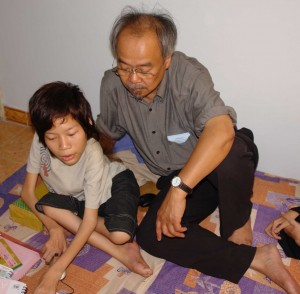 Between January of 1965 and April of 1970, destruction rained down on Vietnam. Statistics mention about 45 million tons of the herbicide Agent Orange, used for leaf stripping. They contained about 300 kilograms of Tetrachlordibenzodioxine (for reference: the Seveso catastrophe contained about 1.5 kilograms of it).
Here is how Francis Van Hoi described it:
“A few hundred metres behind our house, there were dense rain forests. We often played there when we were children. One morning, the trees had all lost their leaves. We went further into the (former) forest than ever before, collected firewood and fish in waterholes that had been unknown to us. We were glad to find enough firewood and food for a change… “.
Today, more than one million handicapped children and adolescents suffer from the after-effects of the poison.
Markus SeidtTuesday December 1st, 2009
Letters From Vietnam #1 – Ventilators or How the Preferences of the Rich Help Financing Educational Projects
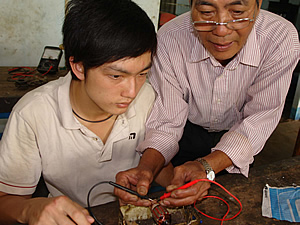 In 1995, Francis Van Hoi founded an educational centre of professional learning in Ba Thong, Hoc Mon, near Saigon. In co-operation with a mission of the Don Bosco Salesians – where he himself went to school more than 40 years ago – the centre initially provided an education in the crafts for 10 street children. By now, the number has increased to between 20 and 30 each semester. We are talking between two and six months during which the young people are to be enabled to go home and work for their own livelihoods. In Vietnam, too, accommodation, food and education cost money, regardless of the support by the Salesians.
Roland DürreThursday August 6th, 2009
The Game of Life, Parlour Games, the Royal Game, Education …
 Parlour games are “en vogue”. There are new ones all the time, and each year one game is awarded the title “game of the year”.
When I was a child, we played “aggravation or frustration”, “nine men’s morns”, “checkers”, “Chinese checkers” and chess. There were also really stupid board games (car and horse races) with really nice figures but they were so boring that we only ever played them once.
And we had the classics, such as monopoly, later risk or clue. Those are really emotional games, requiring stamina and patience, sometimes even combinatory talent. Then came the huge inflation by entertainment games. I opted out and refused to play those new games.


