
Roland DürreSaturday March 29th, 2014
Entreperneur’s Diary#95 – Entrepreneurship, Start-Ups, Enterprises – Somehow Overrated?
Last Thursday, I went to the Forum UnternehmerTUM at BMW-World. It was a nice gala with a beautiful information and discussion element. Said element was 90 minutes and was presented by Stefan Weigel with plenty of appetizing humour.
The catchphrase for the gala was “Cooperation” – topics were for instance “cooperation with added value”, “cooperation models and initiatives”, “stories of foundations” and “mistakes made by founders”.
The focal point was the cooperation of “start-ups” with established business. It was an exciting event with a great “get together” at the end. Consequently, I met many old friends again and we had many good discussions, along with nice background music. And I also made friends with some new and very likeable persons. All these factors contributed to me staying a lot longer than I had initially planned.
I am lucky enough to receive invitations to these kinds of events fairly often. Also, I am occasionally invited to be a jury member at “business-plan competitions”. It is always quite exciting and an inspiration to see the potential future entrepreneurs present their plans. However, all those wisecracks and “Jet-Set” situations I witness also make me thoughtful.
Incidentally, I get the feeling that the definition of “entrepreneur” as transported on all these events is strongly inflated. I often hear big words and get the impression that start-ups in Germany are supposed to save the entire world. Entrepreneurship as a goal in your life is glorified, you get the impression that it should be the highest goal for as many people as possible to become entrepreneurs. And this is when I start getting my doubts: is all this hype about “entrepreneurs” and start-ups really what will improve the future?
Consequently, I am writing this to give you a very objective view of “entrepreneurship”. As is the habit in philosophy, I will initially try and analyse the higher-ranking term. In my book, that is “work in order to earn money”. Today, this is what everybody must do, except those who inherited a fortune (which is true for more and more people) or if you win the lottery (which is extremely rare). If you do not wish to become a criminal, you have to think about the way you wish to earn your living.
An “unconditional basic income (BGE)”, which is something surprisingly many persons I know seem to be in favour of trying, would not make a difference, either. Because, as I see it, most people would not be willing to accept the then extremely low lifestyle.
Consequently, we in Germany only have three options if we want to make sure our families can live.
- Wage-related work
This category covers labourers, clerical workers and civil servants. Today, we hardly have any labourers left, they are probably equal to skilled workers. For those, a highly regulated system has been created in our society. More often than not, the income is determined by negotiation. We have a Law of Working Hours. There is a job protection which is asymmetrically regulated between employees and employers. We have social security systems for cases of unemployment, retirement and sickness. The Works Council Constitution Act regulates a very complicated representative participation, yet some important and reasonable elements are missing…
Reduced hours, long-range working accounts and much more has been regulated through additional rules. If you are a skilled worker, you are part of a “disciplinary” system. You have one or several “superiors”. If you want to go on a vacation, you have to apply for time out of the office. For extra time out of the office, for instance parental leave, there are complicated regulations. Your income and career opportunities are limited. A career which might give you considerably more income is only possible as an exception to the rule.
The same is true for those who are civil officers – which, to me, is a somewhat perverse variant. For the employees (the civil officers), it is possible to terminate at any time, regardless of the massive dismissal protection they enjoy – which is something no ordinary skilled worker has. “To make up for it”, the civil officers get a considerably higher pension than those skilled workers who just get their retirement money as accumulated by social insurance.
This difference will be really significant if the number of years of receiving pension (from the moment they quit the job until their death) is anywhere near the number of years of active service. If you consider a high life span, a late start into the work force and a pension age that is before the officially recommended time, you often get really huge sums. And if you do the arithmetic, you will end up with very much money, indeed.
However, in the sector of wage-related work, we have more and more persons who earn little. Their income has to be supplemented by the state, for example through support for the rent they pay. These persons have no realistic chance of providing for their old age based on capital. Now politicians want to introduce the legal minimum wages – an experiment I already look forward to with much excitement. - Service and labour contracts
Persons earning their living in this way are commonly referred to as “freelancers”. If someone cannot accept the conditions of being employed as a skilled worker – or if he cannot get such employment – he will have to live on unemployment benefit (which is only available to a limited extent) or apply for social security. If this is something he does not want either, then all that is left to him is become a freelancer (or else an entrepreneur – see next item).
Basically, he has to find customers who ask him to render services as specified in a service contract. These contracts will always have a time limit. Since a freelancer is not obliged to have social insurance, he has to make his own arrangements for old age security. Due to the ever longer times of low or slow business until his death and the high costs of nursing and rest homes, this will be almost impossible for him, even if he earns good money. Consequently, he will eventually again have to live on social security.
This is also regulated by the law. There is a clear definition what a freelance system has to look like and, more often than not, reality cannot be made to match these regulations. In order to meet these requirements, some freelancers wrap their activities up and formally establish a limited liability company (and sometimes they do it in order to be able to employ their family as labour). Statistically, these freelancers will be seen as entrepreneurs, and that is what they might, de-facto, well be, but they are definitely not entrepreneurs in the sense of the today so strongly propagated entrepreneurship.
Also, surprisingly many freelancers (allegedly one third of them) earn less than the planned minimum wages. Introducing the minimum wage law will not change anything about this, will it? For instance, if the zoo pays 10 Euros for 50 kilograms of chestnuts they will feed to their animals, then this is a totally legal business transaction. And the person who pays could and will not care less about how long the person selling them has taken to collect those chestnuts.
Many freelancers seem to earn far above average during their active time. More often than not, however, this is an illusion, especially if you consider a longer time interval. Times of little or no income put a damper on the entire scenario, extra hours and the lack of vacations seem to improve the situation. For a freelancer, it is difficult to scale his income. After all, it can only be done through higher prices and more billable hours. - Entrepreneurial activities
An entrepreneur is someone who is competent or thinks he is competent in one field and wants to be responsible for himself. More often than not, they plan something they cannot achieve alone. In order to realize their goal, they need more than their own capacity. They will need the help of third parties. Consequently, they will look for support. Such support can be partners, employees of the enterprise to be founded or freelancers as suppliers of a service. As a general rule, the founders believe to have discovered special chances on the market, seen new business ideas or, for instance, found special technologies or products.
The business idea might be based on a service and a product, as well as a mixture of the two. Usually, this idea cannot be realized alone. You need employees or a team. Especially in the product sector, you will often have to invest heavily, which might also be necessary around a service, for instance in order to make the public aware of the service, to sell the service and to make sure the conditions for delivery are met
In order to solve this problem, we have, among other things, VC’s (Venture Capital), public subsidies and supportive banks, but also private “business angels”. I am not going to comment on how well these things work.
Entrepreneurship is probably the best way to improve your income far above average. After all, the enterprise – and consequently the entrepreneur – will benefit to some extent from the achievement of every single employee or of the entire team. In other words: a relevant improvement of income is most likely if you become an entrepreneur.
Very few enterprises will actually get extremely rich. Those are the huge exceptions many people dream of. But just like, for instance, in sports, only very few will reach the top. I get the impression that the “young entrepreneurs” always dream of become a Steve Jobs or Larry Elliso, or even a new Albrecht. Well, it might be fine to have very high expectations, but personally, I appeal to being realistic. And a small but good business is also a great thing.
I am sure there are more entrepreneurs who fail than succeed. The risk of failure is high. Many enterprises I remember being founded in our field during the thirty years InterFace has now existed accompanied us for a bit of the way and then disappeared. Consequently, I would say it is fine to dream, but you should always keep in mind that a deep fall may be looming ahead at any time.
Naturally, a successful entrepreneur usually will have a good or special competence and he has to be capable of (or be lucky enough to) calculate the market potential correctly. Many virtues, such as courage, circumspection and the willingness to take risks, along with leadership characteristics such as prudence and self-assurance are useful. A certain degree of autonomy and extraversion are probably also necessary. Paired with inner serenity and self-containedness, this might be the ideal combination. And, of course, an entrepreneur will have to be very willing to learn through his entire life.
Yet, entrepreneurs need not necessarily do something new and particularly innovative in order to be a success. Often, very small things, along with industriousness, are the reason for their success. My personal respect goes to all those craftsmen who build up their own teams in the same way as to a “high-end start up”. This is especially true if the entrepreneur remains an “upright and honest merchant”, his enterprise offers products and services that make sense and he knows that his enterprise is a very important social system for the people, even if clearly with an economic goal. In other words: an entrepreneur should also be the person who guarantees a certain set of attitudes of mind, culture and values.
And here is another note on the income of entrepreneurs. To be sure, there are some who really made it big time, becoming millionaires or billionaires. I even know a few of them personally. But they are precisely the ones who know how lucky they have been.
Yet I know a lot more entrepreneurs who do their job well and still have an income that is lower than the minimum wages. According to the statistics, this is probably also true for one third. Regardless of the fact that those persons took excellent responsibility for a number of people.
These are the kinds of messages I sadly miss on the glitzy galas in the world of the entrepreneurs.
Incidentally, I also believe that there is a lot of great “entrepreneurship” in the private and honorary sector. In my opinion, starting a partnership or even a family is a true enterprise – one which takes a lot of courage and considerably more. And if a woman, for instance, decides that she wants to become a mother, I often have more respect for her than for a young entrepreneur.
Actually, I found it a bit of a pity that, during the huge UnternehmerTUM gala, all the 14 (in words: fourteen) persons sitting on the podium were men.
RMD
(Translated by EG)
P.S.
For more articles on my entrepreneurial diary, click here: Drehscheibe!
Roland DürreTuesday March 11th, 2014
Programs and Documents
In former times, we mostly dealt with programs. They were, for instance, written in “c”. They were part of a Source Control System. Initially, this was the “sccs”, then progress came along and “sccs” became “rcs” and later “ClearCase” and such.
Everyone on the team had access to all modules. Because it happened quite frequently that you had to modify something your colleague had written. Otherwise your own module could not work properly. Every modification had to be documented. Not too long and not too short. And it made me even a little proud that I had to modify other peoples’ programs more often than they had to modify mine.
Today, I work with documents. Quite a few of them are shared with or/and worked on by other persons, as well. Usually, my documents are filed on Google Drive. It is beautifully “object-oriented” (another term from former times). The tools are simple and logical. And I can work on my own and my friends’ documents from any device and place.
And I enjoy seeing all the different cursor colours of my “collaborators”. If necessary, I can “chat” with them or confer with them via “hang out”. And, of course, I also can leave comments in a document.
Which brings us back again into the middle of culture: how many comments and notes are a good idea and will make sense? But honestly, these new forms of collaboration are absolutely magnificent (in a very positive sense)!
🙂 As I see it, this is another instance where less is more.
🙁 But then, I still live in old worlds. Actually, I copy the content of my comments and send them via email!
RMD
(Translated by EG)
Roland DürreSaturday January 4th, 2014
Tools of the New Economy
Here is a guest article. At the moment, I prefer not to give you the name of the author, because this article might be detrimental to him.
Review, Moments and Retrospections.
I cannot offer a piece based on scientific research, but I can report what I experienced during my professional career.
Change is what characterizes an economic system and in the Federal Republic of Germany, said changes started in 1967 without anybody noticing. That was when the constant economic growth first suffered a temporary standstill. To be sure, the prevailing model of a free economy of western European design was not yet revolutionized, nor did that happen during the following crude oil shock experiences of the years 1973 and 1983.
The ”Deutschland AG“ with its charismatic leaders remained intact until the “Wende”. Up until early in 1990, the founding fathers of the post-war middle classes remained on their seats. After that, the beginning globalization of a single economic model rang the bells for change. This new economic model is better known as “New Economy“, others also call is neo-liberalism. An ideological basis for the “New Economy“ model was probably laid by Milton Fridman with his ”Chicago Boys“.
The ’Share Holder Value’ gained pride of place. Classic value creations and production processes apparently were too boring and had to be optimized. If a concern totalled less than >10, the performance was considered poor. If the expectation of the ’Share Holder Value’ are not met, you move on to become a managing director of the enterprise.
The value of the leaders is measured by their “Performance“ and the cost-effectiveness of the next result. After all, a high profit was promised to the shareholders in the portfolio.
Consequently, the stars of the “New Economy“ change between enterprises. Even totally different sectors were no reason not to go there: you move from insurance to electronic engineering, from media concerns to a discount chain, etc. – there is no shortage of examples.
How can this work?
In order to make an enterprise transparent for the stock market, you need special tools. “Controlling” is very important if you want to quickly determine the “shareholder value”, the equity price and the dividend.
This development also explains why SAP was such a success. Offering the necessary tools with a universal product, the programmer makes it possible to have transparency, process monitoring and control.
Let me be fair and add that these tools actually make it possible for concerns to have short-term financial success. Whether or not, however, said success is sustainable remains to be seen.
It is a fact that this “Business Model“ is now established. “Business Schools“, along with the media and all those enterprise counsellors that sprouted with the rise of the “New Economy“ preach the rules of the “New Economy“ in their seminars and activities right on location.
Model 1 – Retrospection
In all my life, I only wrote two letters of application: the first was when I applied for an apprenticeship and the second was when I wanted to terminate my career as a sailor and start working on the dockyard.
All the other jobs were coincidental.
Today, I preside over one branch of a German medium-sized enterprise. We sell technologically high-quality solutions that require some explanation. It is typical for this family enterprise that we started branching out on a world-wide scale early on and thus contributed to the German export success story.
The then director of the firm – at the time there was only the one – asked me on a workshop if, since I knew the market well and had all the technological qualities necessary due to working for one of his customers, I would be willing to establish a foreign branch.
My expected turnover was determined by none other than this director. Based on his observation of the market, he gave me a number he thought might be realistic.
It all happened without bureaucracy, quasi by handshake, as with all my foreign colleagues. Regardless of a total of 450 employees, we did not yet have a personnel department. All affairs pertaining to employees were processed by the accounting department and the head of finances.
Simultaneously, the head of finances handed me a simplified accounting plan which showed the monthly turnover, earnings, expenditure and profit. The director had a derogatory expression for this plan: ’ink piss’; yet the two gentlemen were friends. All the foreign managing directors reported back to the one director.
You can summarize it by saying we established a branch based on the understanding of the market and the director’s ’gut feeling’. He relied on his experience with humans when selecting his employee.
During twenty years of very successful leadership, he had collected his tools:
- Knowledge about products, because he promoted developments as required by the market.
- Knowledge about the production process, because problems were always discussed between himself, the chief constructor and the producers.
- Knowledge of the market, because his information came from many branches and he visited many fairs and, of course, he was involved with the major customers and the major projects.
This is no longer the case.
Model 2 – Today
Here is how a branch director is selected today:
- The company looks for an external ”Personal Consultant“.
- The typical tasks of the job are defined.
- A job description is written.
- The candidates are pre-selected by the ’Consultant’ and then the sales director decides.
- ’Human Resources’ will do the actual employing.
- A business plan is made.
- A budget for the next three years is determined.
- If there is no prior experience, the numbers will be based on machine engineering statistics.
- The work will be accompanied by a three-month ’Controlling’ phase. It documents the numbers for orders and turnover.
- Simultaneously, monthly balance sheets for the accounting department, the banks and the auditors are written.
For some of you, this list is probably not very much of a shock. Still, it makes clear that quite a few things have changed since I was first employed.
New tools were added to the old ones of my then-director, and the same is true for new leadership levels:
- Consulting
- HR = Human Resources
- Reporting
- Controlling
- R & D = Research & Development
- IT
- Marketing
Even the terminology is rather remarkable, isn’t it?
So what happened?
The medium-sized company was re-structured following the example of a modern, stock-market-oriented enterprise. Decisions that previously the owner himself or a long-serving director or the managing director made now have to follow a strict organizational pattern. They are newly distributed according to the rules and the tools of the “new economy”.
Those who now made the decisions had not grown up in the firm or the family. Instead, they came from outside and often had never worked in the field.
For them, it was not possible to rely on many years of experience in the sector and they could not rely on gut feeling. They depend on the “New Economy Tools“.
So why do we use these new tools?
All processes have to become transparent and predictable in order to make the planned results come to pass. If you cannot rely on your experience and your in-house competence, the process has to be controlled and monitored all the time. Consequently, the responsibility has to be distributed and ascertainable.
Are these tools suitable for medium-sized companies?
Not if we are talking technologically high-quality products that need explanation and are custom-made following individual specifications.
If all processes are pressed into a system and these processes are to be adhered to strictly, then there is no room for individual activities as sometimes desired by the customers.
This is absolutely deadly for someone whose expertise is on special applications.
The employees will capitulate before the technocracy. Everybody refuses to do it if something has to be done extremely fast, because “this is a sure way to get problems”. Employees have to justify why the pre-scribed path of process control was not followed. As a consequence, resignation will prevail – which can be measured by the increase of people calling in sick.
An automated controlling mechanism will inform the hierarchy about price fluctuations, process shortcuts, special bargains, etc. by email.
Result: even more frustration. Who wants to work in a company where every single movement of your hand is reported?
A universal operating program will automatically start as soon as the offer is written. It will accompany the construction, processing, purchasing and production and it increased the reaction times for the sales considerably, since the ’system’ will only work when all the required data have been entered.
So what worries me?
What I experience seems to prove that my worries were justified:
- Regardless of control, all products will naturally fatigue, which means that they reach a mature industrial age and can no longer be optimized as far as the costs are concerned – except maybe if you look for a radical solution such as outsourcing the production into a low-wage country. Your only chance to lower costs is to continue developing and come up with new ideas.
- If someone is not familiar with the sector, he or she will not be able to install new ideas from the market. Instead, he or she will always rely on management tools, following the book.
- Since all responsibility is distributed, the actual responsibility for your own decision is no longer yours, either!
But I am afraid there is no “going back”.
Results
Using the new tools does not give medium-sized companies any advantages.
Process control is only efficient for efficient production, not for sales and development.
With this approach, the traditional strength of medium-sized companies, i.e. the quick and flexible innovative power which will always smoothly adapts to the market, will no longer be a factor.
What medium-sized companies need is leadership personalities who have grown up in a special field, or else have been recommended by their customers or suppliers, thus being competent on all levels of sales, the enterprise and the customers.
A constant flow of verbal communication must be possible, not some sort of communication created by workshops, leadership circles, Kick-off-meetings, but initiated spontaneously – why not over a glass of beer?
As I see it, creativity is not something you can switch on or off and good ideas will not wait until you next can offer a time slot for meeting or after the vacation.
We actually have these sorts of leadership personalities and I often met them in my professional life. It meant that I was able to collect experience and was always willing to give my best for success.
Dogma criticism
- Who was it that laughed about the five-year plans of the communist ”COMECON“ before the Iron Curtain fell?
- Did the five-year plans work?
- To be sure, the planning was fine, but it was never good enough to prevent shortages or for the country to become a leader in product development.
- The Western European countries felt superior to the planned economy model?
Now we started on a similar path by using the tools of the financial world in order to control even the smallest companies with the „New Economy Tools“. We no longer call it planned economy, but ”Business Plan“ or ”Budget“ or ”Quarterly Reporting“.
Now I write detailed three-year plans.
The fact that they are all result-oriented is detrimental for their sustainability. Incidentally, we copied the language of the ideologists along with the New Economy.
Iktaqw
(I know the author quite well)
(Translated by EG)
Roland DürreMonday December 9th, 2013
Pro Amiability/Philantropy, Contra Hostility
Christmas 2013
Over the last thirty years, I always gave a speech at the annual InterFace AG Christmas Party. In 2012, I talked about a good education being an excellent preparation but also a necessary requirement for designing both your own future and that of your neighbours more attractively and more successfully through courage in life and joyful behaviour.
Today, I know that “life-long learning” is necessary for “a good education”. However, what I mean is not “life-long” immersion in books. This is not about being a student all the time. Instead, it is about “opening up” towards the world and people. You have to leave your own snail shell and face life. This is how you collect life’s experience, which you might perhaps also call experience – and which is so important for a content and successful life.
Consequently, I started my small speech on this year’s Christmas Party with this idea and tried to describe more factors, all of which can make us all successful. In my book those factors are philanthropy and tolerance.
I also mentioned the opposites that, almost unavoidably, cause failure: fear and, in particular, hostility. Both terms were topics of “philosophical seminars” I attended several years ago (“fear” with Baldur Kirchner, “hostility” with Klaus-Jürgen Grün), which affected me very much.
So what is the origin of hostility?
Even brain research seems to prove that hostility is not something inborn. Instead, it appears that our brains reward “doing well” with an outpouring of “happiness hormones”, which makes us quasi construction-based social creatures.
Regardless, I witness small and also big attacks of hostility from almost all people and all social systems on a daily basis.
Like weeds, hostility creeps up out of even the smallest crack. And it happens for all varieties of reasons. More often than not, it is fear that governs humans and makes them hostile. Both carelessness and the urge to know things better, or also the tendency to grumble, can be the reasons. All these and much more of the same kinds of things might be sources of hostility. You are overworked, you are “fed up”, new ideas are refused and intolerance towards all that is alien or different is nurtured.
This is how frustration and dissatisfaction accumulate, before going off in the form of more or less superficial or intense hostility. I often perceive “moralizing” as hostile and do not feel well at all if, for instance, someone says “this is how it is done” or “we always did it this way” as a reason for behaviour that looks strange to me.
What does hostility trigger in me?
Whenever I am at the receiving end of hostility, I first and foremost feel small and uncertain. I ask myself if and how I am the reason for the other person’s hostility? Did I do something evil that might have caused it? However, this sentiment soon turns into something else. I get defiant and will turn away. Until my attitude becomes one of “kiss my a…”. Being confronted with personal hostility makes me insecure. If the hostility seems systemic to me, I retreat into inner resignation and refuse to cooperate.
Hostility is often perceived as an accusation. It will create fear and is detrimental for building up trust. And my problem is that I will answer hostility with hostility (of my own). Now isn’t that a stupid vicious circle?
How to reduce your own hostility?
The only thing that works with me is: minimizing my own fear. But this is certainly one of those things that are easier said than done. Also, I try to minimize the personal distance between myself and those that are important to me. I try to accept and give empathy. And I make myself develop more serenity as days go by – and always to find my inner freedom.
Only with philanthropy can I be a success.
Wherever I am met with kindliness, I feel well. Which gives me a good feeling and makes me bigger and stronger. My fear will vanish. I like the sender of friendliness, I receive it with pleasure and am prepared to invest in it. I am surrounded by people who also feel the same. If I am “philanthropic”, I will quickly have many friends and allies. People will take me seriously, believe me and will also be prepared to do something for me. My environment is no longer against me; instead, it is for me. I am no longer surrounded by enemies, but by friends.
Basically, it is quite simple, isn’t it? Hostility is detrimental for your success, friendliness will make you a success. Consequently, it is stupid to be hostile and prudent to be philanthropic.
Well, this is roughly what my InterFace-Christmas-2013-speech should be.
RMD
(Translated by EG)
Roland DürreWednesday October 30th, 2013
(Deutsch) “A serpant in thy bosom warmed”
Händel’s fascinating oratorio SAUL
The IF Blog is one of the few blogs in Munich, and even in Germany, which is mostly published both in German and English. This is thanks to our Evelyn (EG), who translates most of our articles into English at high speed. She is doing this out of friendship and out of her love of the English language. And it sometimes happens that we like her English translations better than the original German text.
As to myself, I keep thanking Evelyn all the time for her service!
Her second and very special interest has already been mentioned . A huge amount of passion and a high degree of professionalism characterize this part of her private life. Together with her son, she sings in the choir:
arcis vocalisten
under Thomas Gropper.
 Since the picture has been taken some time ago, Evelyn and her son Martin cannot be seen on it.
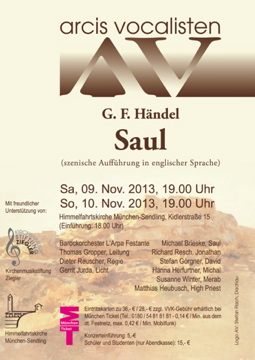
Now, the ARCIS-VOCALISTEN again realize a very special project. It is their third co-operation with stage director Dieter Reuscher and Gerrit Jurda (light effects) in the Himmelfahrtskirche at München-Sendling, Kidlerstr. 15. On Saturday, November, 9th, and Sunday, November, 10th, at 7 p.m., they will sing and perform
“A serpant in thy bosom warmed” – Händel’s fascinating oratorio SAUL
In a fully played-out version. Extraordinary soloists will sing and the special orchestral ensemble “L arpa festante” – who play in the original baroque pitch – will play. The entire concert is conducted by Prof. Dr. Thomas Gropper.
About the oratorio:
1739 – while his operatic career was still under way, George Frederic Händel turned his attention towards the famous material from the Samuel Books of the Old Testament. The Jewish king Saul invites the shepherd David who, by winning over Goliath, becomes a great hero and commander, to come to his court and then tries to link him to his family by marriage. With growing envy, he discovers how David is ever so charming and even more popular both with his people and family. He tries to kill the hated upstart boy, also wanting to induce his son Jonathan to do the deed. Jonathan’s friendship with Saul, however, is stronger than that. We are witnessing how Saul’s mind gets more and more confused and envy eats him up.
In emotional and magnificent pictures and quick musical succession, Händel draws this monarchical tragedy, the triumph of friendship and the fate of Israel – one of his greatest oratorios. It is rare for Händel to use such a huge amount of musical instruments – timbals, trumpets, trombones, carillion, flutes and oboes will complement the strings.
So what you should do now is look at your calendar and see if you can make it – and then order tickets!
RMD
Roland DürreSaturday April 27th, 2013
Taxes for the Rich …
A few years (decades) ago, those who “earned good money” enjoyed a tax relief. Today, more and more people think said tax relief was too much. Well, perhaps they are right.
And consequently, there are a number of initiatives and parties that now write into their programs that the affluent and better-earning citizens (who actually, like Uli Hoeneß, stayed, instead of emigrating like our “Emperor” Beckenbauer, Mr. Müller of Müller Milch and Schumi) should pay more taxes in the future.
The Green Party and the SPD want to increase the top income tax rate and save the FRG from capitalism. I think these, too, are things we have to live with.
But we should avoid a mistake that is made again and again: if you define in numbers from which amount of money on some income and/or property should be subjected to extra tax, then you should not see those numbers as something inflexible. Instead, they should be potentially changeable from the outset. For instance by automatically linking them with the inflation rate.
Otherwise, the same problem will probably be recurring in no time at all. To be sure, the “official” inflation rate seems to be harmless, but money loses its value at more than high speed. You can prove this with many examples in quite a trivial way. And what happens overnight? – You will have to change the tax system again, because all of a sudden the “average earners” will have been sliding into a tax situation that is not tolerable for them.
RMD
(Translated by EG)
Roland DürreTuesday February 12th, 2013
Aging and Productivity, Retirement and Cognitive Achievement
I “pilfered” the title from Prof. Dr. Axel Börsch-Supan (Director of the Munich Center for the Economics of Aging MEA) at Max-Planck-Institute for Social Justice and Social Politics. He gave a strong presentation with the same title at the event “How to Guarantee Experience for Future Generations (Erfahrung für die Zukunft sichern)” at TUM for the „Project TUM Emeriti of Excellence“ .
I already wrote about this presentation in my article: “A rolling stone gathers no moss (Wer rastet, der rostet)”. For me, the event brought many new, well-researched items of information. Professor Börsch-Supan proved in a constructive way that the early retirement habits of our contemporary times are wrong. He also told us that this is detrimental for all parties concerned: the retirees, the enterprises acting in this manner and all of us.
A short time ago, I met a friend whom I hold in very high esteem. He is the same age as I am. A few months ago, he entered the “early retirement” phase. And he is a good proof of all I learned in the presentation. Here is how I often see pre-retirement:
It is almost complex (very complicated) and serves many critical themes. If you know this, you also know how expert know-how is extremely important in this sector.
A friend of mine is a top expert when it comes to a very relevant database technology. He is particularly adept with extreme volumes and demand situations. In all Europe, there are probably only a few experts who can hold a torch to him.
My friend is the same age as I am. His employer is a first-class concern. A few years ago, this concern offered a lavish early retirement package to its older employees, practically following the principle “handing out to all and sundry”. My friend, too, took the bait.
A few years later, the day has arrived. My friend is now retired. Mind you, he is still as much of a first-class expert as he used to be. Financially spoken, he made a good deal.
However, he also realized that his knowledge will be missed by the enterprise. Consequently, he tries to hand it on to his colleagues in a pro-active way. He offers to teach workshops on a voluntary basis, even after office hours. Because, due to all the pressure during office hours, there is simply no time left. This concept, however, does not work well. He is rather disappointed to see that there is not much interest and that hardly anybody wants to come and learn from him.
Then the day of retirement comes. And now you have nothing but losers:
The concern:
Some very important know-how is lost. If, for example, in the future, a process comes to a standstill because the IT does not work as it should, it might well be because something is not as it used to be. Because the know-how is now lost and consequently there are a few things that will no longer run as smoothly as they did before.
My friend:
Initially, he found early retirement absolutely thrilling. The new “freedom” was just wonderful. There were still a number of activities left from the time as an active member of the work-force. Good intentions were formulated – and adhered to. A few months later, everything already looks different. Less social contacts, the good intensions, too, are no longer quite as strictly put into practice … And slowly frustration comes. I witness it quite closely.
This friend does actually exist. However, it is not one friend. Everything I understood from the presentation seems to match reality.
When all is said and done, everything the speaker told us and warned us against actually happens in real life:
Use it – or – lose it.
Well, let us wait and see if I can learn something from this for my future.
RMD
(Translated by EG)
Roland DürreFriday February 8th, 2013
A Rolling Stone Gathers No Moss.
Another one of those old proverbs that probably contain a lot of deep insight.
A short time ago, I heard a nice presentation by Prof. Dr. Axel Börsch-Supan. He is director of the Munich Centre for the Economics of Aging (MEA) at Max-Planck-Institute for Social Justice and Social Politics. What he said about “aging and productivity, retirement and cognitive ability“ made me quite thoughtful.
For instance: how it makes little sense to have a fixed age for retirement. Or what it might mean for a person to abruptly retire. More often than not, it first means the sudden absence of social contacts and later the degeneration of important competence.
I also was made aware of
ow important it is to live a pro-active life as you grow older. And to avoid getting entangled in the trap of “being finished” and “disappearing slowly”. And that mostly even the best of preparations will be useless. Because without an outward “framework“ that “forces“ you to continue, you will easily glide into inactivity. The consequence is that many competences will quickly get lost.
At an aside, he said:
Use it – or – lose it.
That is exactly how it is. Make use of what you have and what competence you have. If you do not adhere to this principle, it will leave you and you will lose it.
Which takes us right back to the heading:
A Rolling Stone Gathers No Moss.
RMD
(Translated by EG)
Roland DürreThursday February 7th, 2013
Work Was Not Created For Humans …
… but rather, work is supposed to help humans.
I am sure this sentence has been spoken by many people before me. At the moment, however, I do not feel like researching. After all, without feeling like it, it would actually mean work. Besides, the sentence sounds a little like Marx (juk).
But there is certainly some truth in this sentence. For me, the definition of work is if I have to or am supposed to do things I absolutely do not enjoy just for the money (among other things). If, on the other hand, I enjoy “doing things”, then this is not work. It is pleasure.
And I am probably happier if I am permitted to do things I enjoy, rather than being forced to do things I absolutely do not wish to do. And being a “white collar” or “scientist”, I actually have the chance to be in this kind of nice situation. At least that is my goal for my last years as part of the work-force.
But then, isn’t that again the arrogance of the “white collar”? And for most people it remains nothing but utopian and not possible? Because there will always be the kind of work that is so “juk“ that nobody ever will want to do it. And that means you will always need those “poor people” who have to work in order to survive. And who are consequently prepared to do things they actually do not wish to do just for getting “that funny stuff”?
RMD
(Translated by EG)
P.S.
Incidentally, I occasionally prefer wearing black turtlenecks. I hope this is not the uniform of the cherry-picks?


