
Roland DürreThursday December 20th, 2012
Tweets on Twittering and Blogging #146
Here are my tweets of last week on:
Blogging and Twittering, Wisdoms and Rules:
121227 Unjustified curses will not hit home – good to know, twitterers and bloggers! #Twitter #Blogging #Wisdom
121228 What has not yet happened, might still happen – so be patient when twittering and blogging. #Twitter #Blogging #Wisdom
121229 Blunt knives will not cut through – so please be precise in your formulations when twittering and blogging. #Twitter #Blogging #Wisdom
121230 Unoiled hinges make a lot of noise – also when blogging and twittering! #Twitter #Blogging #Wisdom
121231 Work you are not used to will give you blisters – also when twittering and blogging?! #Twitter #Blogging #Wisdom
130101 Asyncronous time makes asynchronous audience – be careful, twitterers and bloggers! #Twitter #Blogging #Wisdom
130102 Misery will make you a better person – also true for twitterers and bloggers?#Twitter #Blogging #Wisdom
There is a new tweet each day. See twitter.com and “follow” RolandDuerre! Enjoy!
RMD
(Translated by EG)
P.S.
I took the proverbs from Alle deutsche Sprichwörter.
Roland DürreWednesday December 19th, 2012
Women and Men. Found on Facebook.
Logics 2.0 (f/m).
Basically unrivalled – told by a lady (?).
I (female) go home by bus. It is rather crowded, so I would like to save myself the trouble of having to squeeze through the crowd in order to get to the ticket-cancelling machine. I am starting to ask the lady in front of me to do it for me. But how to address her? Can I thou and thee her?
Since she did not get up at the last stop, I can safely assume she will be riding with me to the final station. I take a closer look at her. She carries a bottle of wine, which means she is on her way to meet a man. The wine is not of the cheap sort, so it must be a handsome man.
In our street, there are only two handsome men: my husband and my lover. She cannot be on her way to meet my lover, because I myself am going there. Consequently, she must be on her way to meet my husband. My husband has two lovers – Katrin and Andrea. Katrin is currently on vacation. …
I: “Hello Andrea, would you be so kind as to cancel my ticket for me?”
Andrea: “How do you know me?”
From the facebook feature Nackt gefällst du mir besser through Matthias Wühle über.
What I like about the story is the unemotional and not-at-all male view of a still very emotional topic… And I hope it is neither anti-masculine nor anti-feminine, but just plain stupid.
It has been slightly modified by me (Roland Dürre).
RMD
(Translated by EG)
Roland DürreTuesday December 18th, 2012
The Courage to Tell a Lie
A short time ago, I told you in the IF blog about the Christmas Greetings I received from Klaus-Jürgen Grün. Klaus-Jürgen belongs to the realm of philosophy. He is a good friend of mine – and I learned a lot from him.
At TEDxRheinMain, Dr. Klaus-Jürgen Grün gives a presentation about the mechanisms of the incorrect speech.
„Political Correctness is basically nothing other than the fear of having to accept your own evil.”
Here is his presentation on Youtube:
Or also: why the word “because” should be replaced by the word “although”. Especially if “because” is often used for reasons of “moral justification”.
Enjoy!
RMD
(Translated by EG)
P.S.
You will find another nice presentation by Klaus-Jürgen Grün on my youtube-channel “rolandduerre”:
The Art of Negative Thinking …
Roland DürreSunday December 16th, 2012
Special Christmas Greetings
I received very special Christmas Greetings from my friend Klaus-Jürgen Grün. He and his team at PhilKoll live in the realm of philosophy.
😉 I am now downloading it to the global and eternal internet. As we all know, said internet will never forget. After all, I wish to share nice texts and preserve them for posterity.
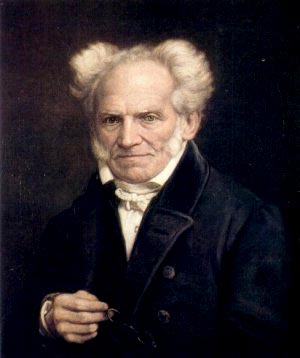
In his award-winning article: “On the Basis of Morals“, Arthur Schopenhauer tells us his definition of the festival of love:
 “Well, taste is certainly an individual thing;
But for me personally, there is no better prayer than the closing lines of dramas in ancient India (and also those of English plays performed in front of the king).
They were: May all living creatures remain free from pain.”

Somewhere else, he reminds us that the so-called religion of love
clearly is deficient in a huge and important aspect, in that it limits all its regulations and leaves the entire world of animals without rights.
It is different in moments of happiness
for the Brahmin or Buddhist. Instead of roaring a „Te Deum“, he goes to market and buys birds. Later, after having walked out of the city gates, he frees them.
No further comment!
RMD
(Translated by EG)
P.S.
Arthur Schopenhauer (* February, 22nd, 1788 at Danzig; † September, 21st, 1860 at Frankfurt/Main) was a German philosopher, author and university teacher. On October, 18th, 1813, he earned his doctorial title from the University of Jena for his work: “Ueber die vierfache Wurzel des Satzes vom zureichenden Grunde” – About the four-fold root of ample-reason-axiom.
Well, that is almost 200 years ago now!
P.S.1
I took both the picture and the signature from the central media archive Wikimedia Commons.
Roland DürreSaturday December 15th, 2012
Looking Back On the Dornbirn PM-CAMP 2012
Yesterday, I received an email from Stefan:
The video recordings of the PM Camp are finished. How do you feel about them? Any changes recommended?
“PM Camp 12 rocks”
The first thing I did was watch the video recordings – and I was fascinated! No changes recommended!
For me, the Dornbirn PM-CAMP 2012 (#pmcamp12) was doubtless one of this year’s highlights. So here is another link to Stefan’s report on the PM Camp 2012 (as a contribution in his PM-Blog.com).
RMD
(Translated by EG)
Roland DürreFriday December 14th, 2012
AGILE & ITERATIVE
Once in a while, I witness discussions held with little ratio and rather dogmatically. These discussions are between “agile persons“ and “conservatively minded persons“, such as advocators of the V-model. And then I realize that “agile” is often mistaken for “iteratively”.
Working iteratively means that you learn as you go and then actually make use of what you learned. In order to do this, you want to make your milestones less powerful, thus shortening the project cycles. The same can also be done using the V model, as well as if you use the methods that got their names from the waterfall. All you have to do is plan several small and interlinked steps as “v”s, instead of one single, gigantic “V”. That is all it takes for you to become “iterative” – and many things will improve …
However, agile means a lot more – and definitely more than the simple term as such suggests:
- All parties involved in a project cooperate voluntarily.
- The project makes sense, all persons working on it identify with it.
- The degree of identification with the project (and its goal!) is extremely high.
- The project is more than just a means to an end, such as making money.
- Individual secondary goals get no priority over the project success.
- All parties concerned use their brains and think beyond their (individual) immediate goals.
- The distribution of tasks, as well as the time table, is worked out in the team after considerable pondering.
- Tasks are taken on voluntarily.
- All parties concerned are prepared to share their knowledge and to mutually take responsibility.
- There is a readiness to learn from each other and hand on individual knowledge at all times and symmetrically.
- The climate in the project is worthy of the term “comradely”. Cooperation is always at eye-level, respect and regard for each other are the normal state of affairs.
- The state of the project in its various dimensions is always absolutely transparent.
- There is always great clarity about the current state of affairs/situation in the project, as well as its goals and relevance.
- The work on the project always happens in a “fear-free zone”, thus promoting courage and joy.
- Every individual person working on the project has a healthy “pride in a job well done”, seeing himself or herself more as a “craftsman” than a genius or hero.
I can think of quite a few more things to add to the list.…
So how about we approach and realize our “projects” both in an agile and iterative way? And then we might manage surprisingly much in small teams and achieve extraordinary feats in huge teams (sometimes made up from small teams)!
“Agile” is lived by humans. Agile is possible for projects of all complexities and dimensions. Methods such as SCRUM or KANBAN, even the ”good old“ V model are some help. Basically, however, they are not what determines whether or not a project is a success. Instead, the determining factors making a project a joy or a pain are the entrepreneurial culture and the understanding of leadership and management.
And wherever there is an imbalance in this area,”agile“ is not an option. Where that happens, you should terminate all projects and first and foremost re-structure the entire outfit.
RMD
P.S.
😉 If you take the word “interactively” and remove the “n” and the “c”, what you get is “iteratively”. I wonder if this hints at the fact that, basically, what matters is “interacting” and “communicating”.
Roland DürreThursday December 13th, 2012
God
This morning, SPIEGEL ONLINE posted the following item of news at google+ (and probably in some other social media, as well):
Why not get a little melancholy in the pre-Christmas season? For example with a prayer – by Robert Gernhardt, who would have been 75 today:
“Dear God, why don’t you just accept that I am special. And how about admitting that I am wiser than you? In the future, praise my name, or else – Amen.”
So far the original SPIEGEL ONLINE message.
Initially, I liked it very much. Later I decided I did not like it, after all. In this small poem by Robert Gernhardt, the “normal roles“ of humans and God are switched in a humorous yet sobering way.
A short time ago, one of my friends said he would be more than delighted to finally meet a God. He would give God a nice time of day and try to get along with him in the same friendly way as with all his other contemporaries.
And he meant in neither in a cynical nor in a pompous manner. Actually, I like that a lot better than the nice Robert Gernhardtian irony.
RMD
(Translated by EG)
Roland Dürre
Tweets on Twittering and Blogging #145
Here are my tweets of last week on:
Blogging and Twittering, Wisdoms and Rules:
121220 The world pays with ingratitude – do all twitterers and bloggers know this? #Twitter #Blogging #Wisdom
121221 After an accident, you get far more vigilant – regardless, you should be careful when twittering and blogging. #Twitter #Blogging #Wisdom
121222 Untended fields will seldom yield good wheat – the same is true for twittering and blogging. #Twitter #Blogging #Wisdom
121223 You will seldom receive thanks for a service given unasked – not only true for blogging and twittering! #Twitter #Blogging #Wisdom
121224 Being impatient will kill all virtue – careful, also when twittering and blogging! #Twitter #Blogging #Wisdom
121225 Bread will fill your stomach even if others begrudge it – so what does that mean for twitterers and bloggers!? #Twitter #Blogging #Wisdom
121226 The egg that has not yet been laid is a rather uncertain basis for the cake – not to forget, twitterers and bloggers? #Twitter #Blogging #Wisdom
There is a new tweet each day. See twitter.com and “follow” RolandDuerre!
Enjoy!
RMD
(Translated by EG)
P.S.
I took the proverbs from Alle deutsche Sprichwörter .
Roland DürreTuesday December 11th, 2012
The Route of a Parcel Containing a Christmas Present.
I took the time to think about the route a parcel with a Christmas present takes. For instance if I send it through Hermes. In order to know what kind of parcel I am trying to send and therefore how much it will cost, I, as the sender, will first have to take the exact measurements of said parcel. The best way to generate the parcel tag is through the internet and then you can print it. You take the parcel to a “parcel shop” – of course one run by Hermes.
Mostly, the parcel shop is a small store selling lottery tickets, newspapers, cigarettes and similar articles. The person in charge of the parcel shop will take a scan of the parcel. This is how he can verify that I chose the correct price category. If my calculation was wrong, the parcel shop assistant will correct it, either adding to the price or reducing it. Provided he actually finds the mistake. If he does not find the mistake, he risks that the next instance – that is the Hermes messenger – will find it and then the store assistant has to pay extra and make a deficit.
In the parcel shop, I pay and get a receipt. From now on, I can follow the route of the path on the internet. The “Hermes” messenger will pick the parcels up at the shop. He, too, has to make a scan of all the parcels. Both the owner of the parcel shop and the Hermes messenger are self-employed entrepreneurs. The parcel shop owner pays the Hermes messenger, who – after keeping the pre-arranged percentage – hands the money to him.
The Hermes messenger will then carry the parcels to the next distributing station. At this station, he has to hand the money he collected from the parcel shop owner to the person in charge – I am sure after having received a percentage of his own. This is also a place where the parcel is checked and subjected to scanning. And if a parcel was wrongly placed, the Hermes messenger will have to pay the balance.
From the “sending distribution station” on, Hermes logistics are at the forefront. They are responsible for the parcel finally reaching the “distribution station” of the recipient. Now the Hermes messenger responsible for this area comes. He takes the parcel, probably scans it again and then takes it to the recipient, where a protocol of the exchange is made. I do not know if he gets money for this. It is just possible that he has to survive on the difference between what he pays when picking up the parcels and what he gets from the customers.
It takes time to do all this scanning and checking. I can easily imagine that each of these processes takes a few seconds. Let us say five seconds. In other words, if the Hermes messenger gets a hundred parcels at the parcel shop, he is busy checking and scanning them for 500 seconds. This might mean 8 extra minutes for him. But that is irrelevant, because the Hermes messenger is a self-employed entrepreneur. After all, if you are an entrepreneur, the time you work does not count. You are known to enjoy working overtime. Or extra quick. Until you have a heart attack.
Allegedly, there are several advantages to this system. Many small private entrepreneurs will guarantee a cheap, quick and dependable procedure. You can follow and reconstruct the route of the parcel and you will know where it got lost if that happens.
But there is a different way of looking at it, too: a number of small (or fake) entrepreneurs control each other. They are all under pressure from the main enterprise and stressed out. In the worst case, they have to pay extra. The customer will only benefit from being able to track the route at all times if he has to assume that the enterprise he chose will not work diligently.
I am assuming that the competition of Hermes works more or less in the same way. In my personal opinion, this system is not particularly efficient. It might well work, but perhaps another method would be even better?
For me, a totally different system would be imaginable. Such as an enterprise with industrious and dependent employees who all do a perfect job. The sender of a parcel has total trust in the enterprise – and said trust is justified. He hands over a parcel and knows that it will arrive on time and undamaged. This is something he can rely on. Consequently, he will not need any “tracking information“ whatsoever.
You know, there was a time when this was what we had. It was called postal service. It was linked internationally. The employees were civil servants and normally proud to do an excellent and absolutely reliable job. Misbehaviour rarely ever happened, perhaps because it was severely punished (you lost your status and had to suffer all the consequences involved). But that was a long time ago.
The abolishment of the civil servant system might have made privatization necessary. Today, many private enterprises fight each other on the market. To the detriment both of our environment and the customers, many services are performed twice. Those who actually do the job are caught in a rat race and are exploited mercilessly. Neither is it any better for the enterprises. The market is fought for through massive advertising. But this, too, is financed by the silent customers. What other choice do they have?
Until finally the day will come when the civil servant system will have to be re-established, because the enterprises will have caused each others‘ death. Then the vicious circle can begin anew.
RMD
(Translated by EG)
Roland DürreMonday December 10th, 2012
Christmas 2012
Since we have just had our Christmas Party, I keep seeing Santa Claus wherever I look and everything looks Christmassy in our country, here are some more “Christmassy“ impressions.
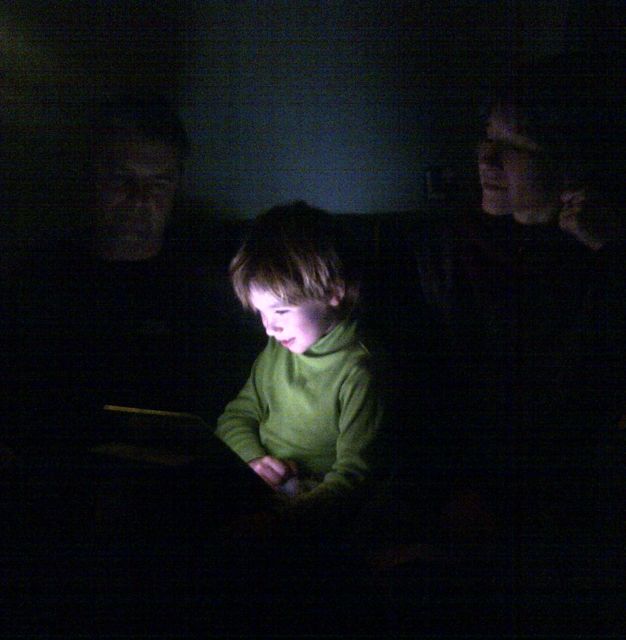 By accident, I got hold of this picture with the Christmassy motto “Mary and Joseph look upon it with joy”. Jens Gassner took the picture during a night-time train journey – of course he used his “Smart phone”. And then he added the following text to the picture:
What you are looking at on this picture is not Jesus Christ in the manger, but an iPad. For the five-year-old boy, this is the first time he touches a tablet. After a minimum of instruction, he tries game after game and is apparently absolutely thrilled.
Mary and Joseph, the joyous spectators, are not married, either – the persons you see in this scene, as well as the photographer, accidentally met because they were sitting in the same train.
Greetings, Jens
Now isn’t that already something like a modern Christmas Tale. Many thanks to Jens!
RMD
(Translated by EG)


