
Roland DürreSunday February 10th, 2013
Future – Volatile, Disruptive, Unpredictable!
At Christmas time, we sing:
O thou happy, o thou holy, glorious peace-bringing Christmas time!
And today, I will sing the song of the future:
O thou volatile, o thou disruptive, unpredictable future time!
Volatile – what a nice new fashionable word. Volatility as the illness of apocalyptic times. Five years ago, I still had to look it up. And today, I keep hearing it far too often, accompanied by far too many and mostly very empty nouns. All of a sudden, everything has turned volatile.Not to mention disru
ptive! This attribute only found its way into my consciousness two years ago. But I learned quite fast to apply it more and more often. It is also a good adjective to use if you need a killer phrase. For instance if you want to refuse concepts that seem sensible but you personally do not like. You just have to say things like: “and what are we going to do if something disruptive happens?”. Immediately, everybody will get scared and – thank God – nothing more will be said about it.
The newest development is that now all sorts of people tell me about the “unpredictable future “.
The entire science of management always tried to tell us entrepreneurs that future was something you could “make”. They said an enterprise can be planned and controlled with just the same amount of precision as a machine or a car-trip. They actually said all you had to do in order to make good decisions was collect information and then evaluate it correctly. That was the message in a nutshell. The same “management wisdom” is also available a little more detailed and seemingly even more convincing using five or seven sentences. There was a time when I, myself, fell for it.
All you had to do was “profile“ your employees correctly. Then you could assign them to deterministic processes and roles easily and totally mechanically. It was all to happen for the improvement of the sole growth criteria: turnover and marge. “Shareholder value” was the only entrepreneurial goal.
And now the business becomes volatile and is threatened by disruptive events. And, to make matters worse, the future is no longer predictable. Regardless of the fact that Hans Ulrich (the “founder“ of the St. Gallen Management Model at St. Gallen) formulated his theses about “Change in Management (Wandel im Management)” as early as the beginning of the 1980ies.
Now, even Academica starts voicing doubts about their basic believes. Well, it is never too, late, is it? Uncertainty starts invading the brains. “In former times, everything was better, anyway”.
On the other hand – would it not be sensible and nice if we became a little more modest? And perhaps the more and more frequent use of these kinds of anti-words and sentences is only a (for me: positive) signal that more and more persons understand that they are, after all, not deity. Neither are they “Creation’s Crowning Glory”. Rather, they are just very complex mammals (and I rather like the species).
Life as such has always been volatile, disruptive and unpredictable, hasn’t it? Everything else happens only inside our heads. Fear, religion, truth, …
RMD
(Translated by EG)
Roland DürreSaturday February 9th, 2013
Homo Oeconomicus
Some friends of mine organise a conference or a workshop. I am part of the team. Here is a first outline of what the conference will be about. It was written by Marc Borner (mb). We have not yet decided on a title and date.
Since the content nicely supplements one of my recent articles (Work has not been created for humans – Nicht der Mensch ist für die Arbeit da …), I would like to publish the following text by Marc:
Since the 19th century, Homo Oeconomicus has been the dominating concept of our business life. It views the individual person as part of a total mechanism that is supposed to function and can be optimized and analysed mechanically. The individual person becomes an “homme machine”, represented by a number. The belief that those numbers can then be controlled in volatile work surroundings is based on exactly this short-sighted image of business players.
This approach totally ignores who actually initially did all the work. To be sure, every individual person is also part of a company, but besides being a mere means to an end, he is always also the reason why the company exists. If this idea is forgotten, the consequence will not only suffer massive economical loss, but also a progressive alienation felt by the individual participants in a business process, which will cause damage to the emotional capital.
More recent scientific work, especially in the fields of psychology and neuroscience, proves that the aforementioned assumptions are correct. They also show a way out, pointing towards non-reduced work conditions characterized by participation, trust and responsibility. In this manner, you can create a fear-free, transparent area where clarity prevails and individual persons work together at eye-level, instead of against each other.
Generating these kinds of work conditions that meet the needs of the individual persons a lot better will stimulate a homeostasis between enterprises, entrepreneurs, managers, employees and laborers. It will create a new concept of leadership and make an enterprise not only more successful, but also take it back to where it originated: as an institution serving the general well-being.
The workshop will explicitly deal with this topic and try to both enlighten us on the current scientific state of the art and build the bridge to practical applications.
I rather like this text. We were already successful in finding eminent speakers for the event. Now I am interested in finding out how you feel about the text and/or if, for example, you would be interested in the topic and probably attend this kind of workshop.
RMD
(Translated by EG)
Roland DürreFriday February 8th, 2013
A Rolling Stone Gathers No Moss.
Another one of those old proverbs that probably contain a lot of deep insight.
A short time ago, I heard a nice presentation by Prof. Dr. Axel Börsch-Supan. He is director of the Munich Centre for the Economics of Aging (MEA) at Max-Planck-Institute for Social Justice and Social Politics. What he said about “aging and productivity, retirement and cognitive ability“ made me quite thoughtful.
For instance: how it makes little sense to have a fixed age for retirement. Or what it might mean for a person to abruptly retire. More often than not, it first means the sudden absence of social contacts and later the degeneration of important competence.
I also was made aware of
ow important it is to live a pro-active life as you grow older. And to avoid getting entangled in the trap of “being finished” and “disappearing slowly”. And that mostly even the best of preparations will be useless. Because without an outward “framework“ that “forces“ you to continue, you will easily glide into inactivity. The consequence is that many competences will quickly get lost.
At an aside, he said:
Use it – or – lose it.
That is exactly how it is. Make use of what you have and what competence you have. If you do not adhere to this principle, it will leave you and you will lose it.
Which takes us right back to the heading:
A Rolling Stone Gathers No Moss.
RMD
(Translated by EG)
Roland DürreThursday February 7th, 2013
Work Was Not Created For Humans …
… but rather, work is supposed to help humans.
I am sure this sentence has been spoken by many people before me. At the moment, however, I do not feel like researching. After all, without feeling like it, it would actually mean work. Besides, the sentence sounds a little like Marx (juk).
But there is certainly some truth in this sentence. For me, the definition of work is if I have to or am supposed to do things I absolutely do not enjoy just for the money (among other things). If, on the other hand, I enjoy “doing things”, then this is not work. It is pleasure.
And I am probably happier if I am permitted to do things I enjoy, rather than being forced to do things I absolutely do not wish to do. And being a “white collar” or “scientist”, I actually have the chance to be in this kind of nice situation. At least that is my goal for my last years as part of the work-force.
But then, isn’t that again the arrogance of the “white collar”? And for most people it remains nothing but utopian and not possible? Because there will always be the kind of work that is so “juk“ that nobody ever will want to do it. And that means you will always need those “poor people” who have to work in order to survive. And who are consequently prepared to do things they actually do not wish to do just for getting “that funny stuff”?
RMD
(Translated by EG)
P.S.
Incidentally, I occasionally prefer wearing black turtlenecks. I hope this is not the uniform of the cherry-picks?
Roland Dürre
Tweets on Twittering and Blogging #153
Here are my tweets of last week on:
Blogging and Twittering, Wisdoms and Rules:
130214 Truth spoken at the wrong time makes you a liar – also when twittering and blogging? #Twitter #Blogging #Wisdom
130215 Never detest an enemy, no matter how evil he looks to you – twitterers and bloggers! #Twitter #Blogging #Wisdom
130216 Detesting luxury is the most precious of all luxuries – especially when twittering and blogging! #Twitter #Blogging #Wisdom
130217 Camouflaged treasures are safest – not true for bloggers and twitterers! #Twitter #Blogging #Wisdom
130218 Forbidden fruits are sweet – a temptation for all twitterers and bloggers. #Twitter #Blogging #Wisdom
130219 Forbidden fruit tastes best – also true for twittering and blogging? #Twitter #Blogging #Wisdom
130220 A grumpy person will consider everything just folly – is that what can happen when twittering and blogging? #Twitter #Blogging #Wisdom
There is a new tweet each day. See twitter.com and “follow” RolandDuerre!
Enjoy!
RMD
(Translated by EG)
P.S.
I took the proverbs from Alle deutsche Sprichwörter.
Roland DürreWednesday February 6th, 2013
Entrepreneur’s Diary #87 – It Is Quite Simple …
… and yet so hard!
Today, all you get is a short article: here are just a few citations of remarkable tweets by Nils Pflaeging:
Niels Pflaeging @BetaLeadership
If you want to kill connectedness: create functional division, departmentalize and allow hierarchy to invade the work #stoos
Niels Pflaeging @BetaLeadership
All that planning doesnt earn you any money. Improving the work and fighting waste does. #stoos
Niels Pflaeging @BetaLeadership
Functional division, divisionalization and matrix structures ALWAYS result in a loss of accountability. Period. #stoos
That is exactly how I feel and could have come straight from my heart. Consequently, there is nothing left for me to say.
RMD
(Translated by EG)
P.S.
For more articles in my entrepreneur’s diary, click here: Drehscheibe!
Roland DürreMonday February 4th, 2013
brand eins in February
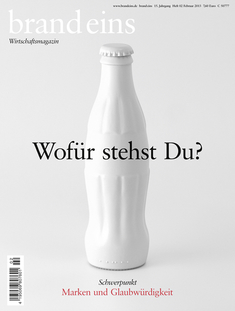 Last Wednesday, it was sitting in my letter box: the February edition of ”brand eins“. From the outside, it looks a little colorless. Since the focal topic is “Brands and Credibility”, this is not a surprise, is it? Neither does the question written on the milky coca-cola bottle make sound particularly glamorous: “What are you standing for?”.
I am sure the question is not addressed to me, but rather to the brands. And there is really nobody who knows what they stand for. What we do, however, know is what effect they are supposed to have: promote blind consumption and thus increase turnover and profits of the enterprises.
A short time ago, I went to see “Felix Krull” at the Volkstheater. They had printed a great interview with a psychologist in the program brochure. Apparently, the psychologist had studied “impostors and imposture” intensely. He called marketing and branding just another form of “systematic and goal-oriented imposture”.
But now about the magazine. After all, I went to Augsburg-Hochzoll by train on Friday evening, which gave me the opportunity to already read many of the articles. As always, they were well researched and contained interesting enterprises and respectable opinions.
However, if I read brand eins correctly, then the topic “brands” was strongly disenchanted. They are supposed to build up trust. Yet, most of the enterprises seem to use them just in order to get some advance trust which, however, is not or cannot necessarily be lived up to. Or else they want to combine the “convenient and the useful“.
In that light, it is an edition that shows me as (hopefully ex-) “ believer in brands” how much I was made a pushover. And how I spent good money for nothing but “hot air”. And that, after all, marketing – above all – creates brands that basically say nothing about the rest of the enterprise. Essentially, we are talking the generation of schizoid enterprises through willful camouflaging of reality using lies.
RMD
(Translated by EG)
P.S.
😉 A minute ago, I heard in the news of today what slogans one of the two “Deutsche Bank” directors uses in order to make it a “brand” – and yet he wants to continue the gamble with food certificates Well, it seems that here is one person who has not yet read the February edition of brand eins.
P.S.1
🙂 Basically, I am (not) surprised to see how many “brands” are, again, prevalent in this brand eins edition with their adverts. It is called capitalism.
Didn’t Marx say: “The capitalists will sell us the rope we will hang them by“? And they say Marx is now again fashionable.
Roland DürreSunday February 3rd, 2013
Rupert Lay – How Social Systems Develop and Disappear – 2004 (Youtube)
This is the last of the presentations by Rupert Lay I recorded for the Ronneburger Kreis with Bernd Sielaff between 1995 and 2004.
I can remember it quite well. On Sunday morning, I had to get up early and load the video equipment (camera, lighting, microphones, tripod…) into the red BMW. After all, we wanted to arrive in Ronneburg or Frankfurt at 9 a.m. in order to prepare everything for the recording. And late in the afternoon, we rolled back to Munich on the motorway.
Now, all recordings from this time are available on my youtube channel. It was well worth the effort.
This presentation, too, was given for the Ronneburger Kreis. The filming was done by Bernd Sielaff and Friedrich Lehn did the final editing.
It is well worth taking an occasional glimpse at and listening to – why not with interruptions or “leaks”?
RMD
(Translated by EG)
Roland DürreThursday January 31st, 2013
For Free: Eight Work Days …
I am sitting in my office. The spring sun is pouring in and the window is open. A copy of the Motorwelt magazine found its way to my desk.
Here is some information for all those nerds who do not know it: the ADAC is Germany’s most important association. It is the car drivers’ association. With 18 million members, it is the second biggest automobile club of the world (after the US’s AAA). The “Moborwelt” is the monthly tabloid and central organ of the ADAC.
Formerly, the ADAC was mainly the lobbyist of the “car-drivers’ community”. Today, the ADAC is an organisation that mainly tries to get hold of their members’ best: the money. One of the means to this end is the “Motorwelt”. Through numerous adverts, it tries to seduce the ADAC members (and others) into buying marge-strong “special bargains” (often from highly profitable ADAC subsidiary enterprises).
The focal topic of the current edition (No. 2, February 2013) is “TRAFFIC JAMS”. It demands massive investments for extending the road system.
Here are a few citations from the magazine:
“Germany needs an all-enveloping street modernization program.”
As early as the title page, we are informed that:
“Nothing but TRAFFIC JAMS – 595,000 kilometres of cars standing in line – chaos on German streets.”
On page 20, I read:
“Et an average, every German citizen spends eight work days each year sitting in a traffic jam”.
And a little later:
“Citizens and the economy suffer from street conditions getting worse and worse. The politicians witness the strong increase in traffic but do nothing about it.”
For me, this is again something that stuns me. Because I believe we in Germany have more serious problems than the condition of our streets (education, demographic data, society, climate, …). In my opinion, the chaos is not caused by the standstill, but by all this mobility. To me, it seems that not only the German car drivers, but also the citizen “with foreign roots” is stuck. I am in favour of a soft but constant reduction and de-emotionalisation of individual traffic.
And speaking of myself, I am glad to no longer belong to the species “German car driver”. After all, I won eight work days, didn’t I? And when I also take into consideration how many hours the ”German car driver“ spends not sitting in the traffic jam and instead having to work behind the steering wheel, I feel truly happy. Some way or other, I seem to save a lot of time and energy. And then I can use some of what I saved for writing an IF blog article.
RMD
(Translated by EG)
Roland Dürre
Tweets on Twittering and Blogging #152
Here are my tweets of last week on:
Blogging and Twittering, Wisdoms and Rules:
130207 Always expect the unexpected – are you listening, twitterers and bloggers? #Twitter #Blogging #Wisdom
13008 If you don’t try, you will never get the experience – a good strategy for twitterers and bloggers! #Twitter #Blogging #Wisdom
130209 Untangled yarn is good yarn – also when twittering and blogging! #Twitter #Blogging #Wisdom
130210 Unobscured is always best – also true for bloggers and twitterers! #Twitter #Blogging #Wisdom
130211 Nothing daunted, nothing dared – also a strategy among twitterers and bloggers. #Twitter #Blogging #Wisdom
130212 The unwilling messanger is a good prophet – also true for twittering and blogging? #Twitter #Blogging #Wisdom
130213 Ignorance is courageous – especially when twittering and blogging? #Twitter #Blogging #Wisdom
There is a new tweet each day. See twitter.com and “follow” RolandDuerre!
Enjoy!
RMD
(Translated by EG)
P.S.
I took the proverbs from Alle deutsche Sprichwörter.


