
Roland DürreMonday May 6th, 2013
… What I Brought Back From the #pmcamp13str …
The PM Camp 2013 on May, 3rd and 4th in Stuttgart was a magnificent experience.
Let me just write down some questions/insights I brought back from Stuttgart. I will start with the questions, because if you want to come up with insights and solutions, the first thing you have to do is find and ask reasonable and good questions:
My Questions:
- Would it not be better if the abbreviation PM were a short form for “People Management”, instead of “Project Management?”
Reason:
Projects mostly fail because of the people, not because of the tools or technology.
Consequence:
Change your strategy when you teach PM-s, use fewer and different tools!Note:
People Management as a term also has a negative connotation.
- Should you not, before you start the project, do a critical evaluation to find out whether a project is just a Routine Project or a Research Project?
Reason:
If you are talking a research project, you have a considerable amount of trial-and-error and experiments to do, but you cannot easily say in advance how much of it!
Consequence:
Perhaps you have to “forego too much innovation” in a classical project and instead should “migrate solutions into the future step-by-step”? Note: Especially where established big and powerful solutions/systems are to be completely replaced by something totally new, most of the projects fail. The remainder basically always fail to meet time and budget and are often criticized for not being satisfactory.
- Are not all projects “research projects” to some extent?
Reason:
Due to the permanent change in society and technology, the requirements, too, change permanently.
Consequence:
You have to organize the time and money needed for trial-and-error, experiments, research and well-structured “one-way-road management”.
- Is it true that technology projects are “nothing but routine”? Do we, perhaps, when talking project management, often just think routine projects and forget that “true” projects always also have a research component?
(I am sure this depends on your definition of project)
Reason:
If the requirement has been fulfilled numerous times already and the surrounding parameters have not changed, then technology projects can become routine projects (building terraced houses on gravel planes). But can these still be called projects? You will often make surprising experiences in new application/requirement situations with new technology. Social change and/or a change in values, too, can lead up to totally new and unexpected requirements!
Consequence:
Before you start a project, even if you believe it to be a routine project, you have to critically ask whether or not there might be some hidden innovation requirements and a huge amount of research and experimenting.
- Do we, perhaps, talk too much about mistakes and learning from mistakes when talking projects?
Reason:
‘The very term “trial-and-error” already includes a potential failure. If we then continue by considering the sheer process of trial and error a failure, because it was not a success, then we are belittling ourselves. You will always be wiser afterwards and if you punish yourself for failed experiments, you will kill positive courage.
Consequence:
Not to talk mistakes and learning from mistakes in PM.
- Will a greater number of parallel projects in an enterprise not considerably increase the complexity of the individual projects?
Reason:
There will be more and more dependencies, eventually even on the competitors.
Consequence:
Limit yourself to what is important, more serial than parallel working, make dependencies less complex…
My Insights:
- For whatever reasons: the incompetence among project stakeholders is on the incline.
- There is a huge amount of desperation going on in this country, especially when we are talking big projects.
- The actual usefulness of projects is often questionable.
- People do not spend enough time thinking about the usefulness of projects.
- The usefulness-scenarios of projects are often not balanced, which puts a huge damper on the motivation both of the parties concerned and the victims.
- The impact a project has on the citizens are often not taken into consideration.
- I believe that I am now better able to explain why projects never seem to have an end.
- Let us first clarify the terms we use, before discussing the issues?
I think there will probably be some IF Blog articles on this in the near future, or else there will be a PM-Camps session dealing with the problem, for instance at Bad Homburg, Wien or Dornbirn.
RMD
(Translated by EG)
P.S.
So here is the meta question:
Many bridges still collapse all over the world. How is that possible? We have more than a thousand years of experience with building bridges. Wherever a relevant bridge collapses, engineers and professors visit the site of the accident, trying to find the reasons why the bridge collapsed. And they learn from it and hand on their findings. And still, bridges collaps. Why?
Roland DürreSunday May 5th, 2013
brand eins in May
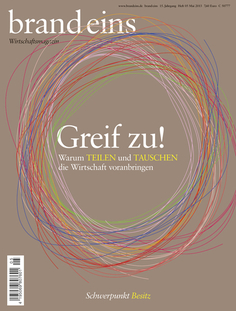 On time for the first day of the Month of Delight, the May “brand eins” edition was delivered. But it took until Saturday, when I sat in the train EC 391 back from the PC camp 2013 (tag not only in twitter: #pmcamp13str) until I was first able to take a closer look at it. After all, life is hard for a PM.
Incidentally, after what I experienced in Stuttgart, I now see PM as an abbreviation for “People Manager”. This is definitely a better term for the job that was still called project manager a short time ago.
And to me, this “brand eins” seems as dignified as my thoughts. It looks totally golden. Along with a multi-coloured, ellipse-like line design. At first sight, I almost could have taken it for a “Haute Couture” magazine. Or at least for a magazine that represents the upper-class high society life style.
But be not afraid: the title alone makes it “cool”:
Seize the Day!
The sub-title is:
Why SHARING and SWAPPING will promote business.
Of course, this is exactly how I feel. Once again, they hit on my favourite topics! And it gets even better: Frau Fischer gives her editorial the simple heading:
A New Dimension!
(
The exclamation mark is from me)
She actually admits in the editorial:
“that she found all the fuss they used to make about sharing economy rather annoying.…”
And then she continues to say:
“The Sharing Economy might well be a fashionable concept – but the development behind it has a rather huge dimension”.
Well, I am delighted. Isn’t this fantastic news? And it gets even better – in the closing line of her editorial, she even calls the predictions made at the turning of the millennia by Jeremy Rifkin “a hopeful utopia“. Which is again something that confirms my own personal opinion.
Consequently, I undertake a “small research trip” into the inner pages of the magazine. And I notice that it is about quite a few sectors and continents. It includes many multi-facetted and diverse articles.
There is “looking for oneself” (on Siemens, page 22), “ownership will become virtual” (small IT story, page 92), “the bank in the palm of your hand” (a future without banks, page 96) and much more. And in particular, the entire focal point – absolutely magnificent in my opinion!
I will not tell you more – instead, I recommend that you, too, go on a trip equipped with the May “brand eins” copy.
RMD
(Translated by EG)
Roland DürreThursday May 2nd, 2013
The Great Adventures are Not the Only Things that Happen Between the Ears
Ethics and enlightenment, too, are some kind of belief.
This sentence was something that really was hard to digest for me.
I used to believe that I am a non-believer. After all, I question everything and follow the principles of enlightenment and reason. I try to behave “ethically” – meaning that my decisions are based on a balance of values following a value system I myself worked out in a very responsible way. That would be a value system I consciously strived hard to achieve, having taken pains to finally arrive at a formula that is compatible with the world consensus which, for instance, can be found in the Golden Rule or in the UNO Charta. We are talking a value system where tolerance and civil courage are extremely important.
And then it dawned on me that this certainty of mine is also just a belief. It means that I, too, believe in something like the Christians, Jews and Muslims believe in a personalized God, or like other religions believe in their deities or just something higher in general. Or like the atheists happen to believe that there is no God. And they will probably soon come up with the foundation of a religion of their own. To be sure, this sounds logical, but then it seems to be a contradiction in itself.
Incidentally, I never asked myself the question whether or not there is a God. At least not as long as I can remember. Simply because I know I am not good at these kinds of topics. After all, it would mean that I know I know nothing.
Today, I would say: “I think I know nothing”. Well, I do not know anything and neither can I know anything… It all happens just between the ears. And how should I know if something we humans ourselves invented actually exists?
It is also part of my belief that there is no absolute truth. This is also because truth happens between the ears only. Besides the fact that “between the ears” is often a very chaotic place. As I see it, the head is capable of a lot of fantasy, but it is probably too small for reality. So how could the result be some absolute truth – if it was we ourselves who invented or felt everything?
Consequently, I now believe that all we think we know is just belief – some kind of religion. And the only hope that remains for me is that my own belief – in enlightenment and reason (which probably do not exist either, because they, too, are only our experience) – will be more help to me than the belief of others. Especially when they want to force their belief onto me (and others) – and threaten to punish us when and if we do not convert.
My second hope is that my belief in enlightenment, ethics and reason is probably a little more humane and ethical than all the varieties of believes you come across in this world.
However, I kissed the illusion that enlightenment, reason and ethics are absolute truths good-bye.
RMD
(Translated by EG)
P.S.
Well, this is one of those texts you can only write during a lonely train trip – in this case it was from Munich to Stuttgart.
Roland Dürre
Tweets on Twittering and Blogging #165
Here are my tweets of last week on:
Blogging and Twittering, Wisdoms and Rules:
130516 Forehandedness will prevent aftercare – also if you are a twitterer and blogger. #Twitter #Blogging #Wisdom
130517 Advantage is better than strength – also true for twittering and blogging! #Twitter #Blogging #Wisdom
130518 Advantage will not necessarily mean gain – also true for blogging and twittering! #Twitter #Blogging #Wisdom
130519 Cheeky is not the same as witty – especially true for blogging and twittering! #Twitter #Blogging #Wisdom
130520 To risk is better than to ponder – also true for twittering and blogging? #Twitter #Blogging #Wisdom
130521 Having to choose is painful – also true for twittering and blogging. #Twitter #Blogging #Wisdom
130522 Well-deserved mockery hurts most – not to forget, twitterers and bloggers. #Twitter #Blogging #Wisdom
There is a new tweet each day. See twitter.com and “follow” RolandDuerre!
Enjoy!
RMD
(Translated by EG)
P.S.
I took the proverbs from Alle deutsche Sprichwörter.
Roland DürreWednesday May 1st, 2013
The Working World and the E-Mobile World
Confessions of a (work) junky on May, 1st
These days, my work is done (almost) totally mobile. Meaning simply that I do it wherever I happen to be and without cables. Neither for electricity, nor for the internet. It means I can work (almost) everywhere. There are some consequences…
As soon as I wake up, I start working in my “home office”. In fact, I enjoy doing it in bed. After having finished the most important tasks, I ride my bike to the enterprise. It feels nice to ride my bike: I am all by myself, enjoying fresh air. There is time to think and prepare for what comes next.
In the enterprise, my main computer only gives me limited mobility. Usually, I work at my desk. As it happens, I actually have something as old-fashioned as a PC (and my own office). It is about time for me to do something about this, isn’t it?
My office computer is connected to the central electricity network almost at all times. The internet connection, however, is wireless. Because once in a while, I take it with me for in-house meetings of presentations. And why would I wish to plug and de-plug a second cable? Luckily, the magnetic electricity plug is easy to handle.
My times “on the road” vary greatly. Sometimes it is more, sometimes less. If I have to cover long distances, I mostly take the train. I do not carry a “mobile five-seater”. Instead, I always have one or several “mobile offices” with me. They are places, or rather devices, enabling me to work, write and read. Sometimes I can use them for relaxing, if I so desire.
Mostly, I can use the waiting times during my travels quite well. If I cannot find WLAN or a “Hotspot”, I just take my old stick or my cell-phone. To be sure, this is not quite as comfortable, but it is certainly serviceable.
In Munich, I have several “city offices”. I sometimes change places and they are mostly coffee shops or restaurants. A nice atmosphere is mandatory, because you have to be able to meet and work there. The coffee should be drinkable and, of course, there absolutely has to be a WLAN connection.
I also try to make good use of my leisure time. After all, leisure time, too, is just some sort of work (or vice versa). For instance, if you relax. You have to consciously “do nothing”: going for a swim, playing soccer or chess. In general, I always try doing just one thing at one time. Go to the theatre, listen to some music, read a book. Enjoy a film. Perhaps even watch TV. Although this is mostly too boring and tends to be nothing but vegging in front of the tube.
Incidentally, at work, I also try to only do one thing at a time. As a general rule, I do not carry my cell-phone (which, as we all know, is now a smart phone) in meetings. And I do not send emails while at the same time talking to a person. I always try to concentrate on what I am doing and then hopefully will do it well.
I used to work less. Still, I had less time. Luckily, I always had enough time for my small children. By now, they are all quite grown-up. Which (in this case unfortunately) gives me more time.
But in former times, I spent a lot more time doing stupid things. Just think of all the time I spent sitting in a car! Or all the time I sat in front of a TV set! I also used to spend far too much time reading stupid and meaningless magazines and newspapers. What a pity! But then, matters are like they are and they were like they were.
But still: in some way or other, life did improve through all these mobile devices.
RMD
(Translated by EG)
Roland DürreTuesday April 30th, 2013
The NSU Trial and the Media
On systems and their agents, epikie and civil courage
Now they are probably again going to postpone the trial in Munich. I am sure that this is quite awful for many persons, because it is all about a particularly unfortunate chapter of our national history. After the trial, said chapter will probably turn out to be even “more unfortunate”.
However, the NSU trial is also a good example for another negative development in our society. Our social systems get both a life of their own and de-personalized. The employees become more and more system agents and remote from reality. They ignore what our society actually needs and subordinate themselves to some super regulation, questionable rules and their own paranoia when having to make decisions.
For instance, from the outset, they decided to choose a trial chamber that is too small “for reasons of safety”. But what stage have we reached if we cannot even guarantee safety in our trial chambers? Can we really permit the rightist scene to restrict our freedom of decision to such an extent?
At this juncture, I just have to hint at our Federal Office for the Protection of the Constitution: maybe they should focus more on the safety of our judicial institutions, rather than doing one disservice after another to our democracy by probably illegal and totally controversial activities of their dubious v-men.
And since we are all afraid the verdict might not hold in the appeal stage, the law is interpreted in such a way that it no longer has anything to do with what our society actually needs. Of course, it was totally out of the question that, for instance, the Turkish Press representatives were not admitted as observers of the trial. Just as it is out of the question that now a newspaper like the FAZ – with its many readers – is allegedly to be excluded from trial report status.
Processes and rules obviously were often given priority over common sense. Unfortunately, they interpreted the actual wording of the law in a most restrictive way, ignoring what had actually been the purpose of the law. Instead of looking for solutions that would make sense and have a chance of survival, they bowed like slaves before what was allegedly inevitable.
In our system, epikie (Epikie), an important even if hardly known virtue, is too often forgotten. In a nutshell, epikie means you should “hold up the laws of a nation in such a way as a sensible legislative body would have meant and wished for them to be held up”. If you want to practice epikie, you often need another primary virtue, namely civil courage (Zivilcourage), also known as moral courage. Those are the virtues we need, along with common sense. Both should be applied, based on socially accepted values.
And I am afraid there are sectors of our society where these virtues, as well as a healthy and value-based common sense, dwindle more and more. But that is not a problem, because there are still humans around who actually practice all these things and have an influence. Consequently, when all is said and done, I am quite optimistic.
My readers, however, are welcome to speculate which circles I am talking about …
RMD
(Translated by EG)
Roland DürreSunday April 28th, 2013
Evolution, Innovation and “Dominant Logic”
Last week, I was permitted to attend a very special conference. It was the LEADERSHIP FOR INNOVATION, supported by the Peter Pribilla Foundation. It was about VISUALIZING THE INVISIBLE. The event was in Munich, at TUM, or – to be precise -, at IAS on the Campus Garching between April, 25th and April, 26th, 2013.
Even the fact that it was a rather conventional conference did not do any harm. There were quite a few rather “innovative” sessions. Being one of the first-timers, I quickly realized that it was mainly about “meeting” – in the environment of an important network and with the right kinds of people.
Quite logically, the highlight of those two days was the evening event “Network Convention 2013″ on Friday honouring Herrn Prof. Reichswald, who had celebrated his seventieth birthday in April, 1st, 2013. And during this event at the Seehaus in the Englischer Garten, everything was “Boundless Interaction” in the truest sense of the word.
During those two days, I talked with quite a few people about highly exciting things. There were so many new ideas raining in on me that the first thing I had to do was mentally process all the input. Here are a few personal thoughts after my first round of digestion.
DOMINANT LOGIC
It seems to be one of the main problems of our species, both in professional and private life, that we always want to solve challenges with “dominant logic”. However, “real life” is always part of the evolutionary process and said evolutionary process is all but “domineering and logical”. Today, innovation is our attempt at influencing evolution to our advantage.
To me, it seems that this is one of the central tasks of entrepreneurial behaviour: to influence the evolution every enterprise will experience anyway while undergoing the evolutionary “aging process” in such a way that its negative consequences are at least balanced by the positive “innovative change”.
And that is something you cannot do with ratio or logic. You cannot explain the ineffectiveness of dominant logic by dominant logic. All you can do is explain it with experience and wisdom gained from life. Consequently, entrepreneurs will have to live in the “now” and find out what is good and bad for the enterprise, before they hopefully come up with more “right” decisions than wrong ones.
If you deduce decisions with dominant logic from common rules, you will fail. You will end up with many wrong decisions, some of them with profound negative consequences. That is what experience shows us. In order to find more correct decisions in the innovative sense, your criteria for deciding must be based on culture and values.
Examples for absolutely common (and in my understanding detrimental) business rules are: “growth is a must”, “we have to be number one world-wide in our business sector” or “increased shareholder value is the one and only goal of the enterprise”. These are platitudes with no conceptual background, but not rational sources for behavioural incentives.
Here are a few examples for useful cultural rules: “The Golden Rule“ (Die goldene Regel), “human beings are not resources”, “creativity needs fear-free areas”, “successful communication calls for meeting at eye-level”, “generating knowledge creates new knowledge”, “leadership means respect for others”, “consideration and civil courage are the most important virtues”…
The application of these and similar rules will generate more correct decisions in the sense of a sustainable and consequently innovative enterprise development that is mindful of resources. After all, an enterprise, too, is just a social system with a business purpose.
And if management truly wants a sustainable development, the enterprise will have to live by these cultural rules when making decisions. The process may (and must) well be based on ratio and common sense. Because, ethics, too, has a lot to do with ratio – otherwise it can easily cause wrong dogmata. Mind you, even if we stick by that rule, we will not be able to avoid evolution, but maybe we can influence it a little bit to our advantage by applying innovation.
Business leaders often try to learn from mistakes and transfer what they learned into the future. This is also an area where I suspect it will not work if the basis is “dominant logic”. Because dominant logic will always fail when it comes to humans and their social systems.
I am often tempted to prove these theses by using “dominant logic”. Naturally, this cannot be done. After all, what makes evolution so sensational is the fact that it cannot be rationally explained. Instead, it is free of purpose – thus having nothing to do with “dominant logic”. It is not about survival of the fittest“ and perhaps not a “huge, collaborative process”, either. Innovation will always depend on the stream of evolution. We humans alone are bold enough to try and modify evolution through ratio and logic innovatively. But in order to do so, we need “evolutionary knowledge” that can NOT be projected on spread-sheets.
Well – and then there is this other, for me central, characteristic:
OPEN
We will never create evolutionary knowledge without being “OPEN”! We have to share our knowledge and our experience. With as many other persons as possible. Without any reservations and at eye-level. It is the only way to generate positive innovation as a modification of evolution in order to improve matters both in our enterprises and on this our only world. And this will never be done by one person alone. It will have to be a cooperation of many who will often play totally different roles.
Otherwise, evolution will waste no time in extinguishing us humans from this our planet. To be sure, in the cosmic dimension of things, it would not be much of a loss, but still: wouldn’t it be a pity?
To put it plainly: you cannot see what is invisible, can you? This is especially true for an individual being. But perhaps we can augur it, like in feel it?
RMD
(Translated by EG)
Roland DürreSaturday April 27th, 2013
Taxes for the Rich …
A few years (decades) ago, those who “earned good money” enjoyed a tax relief. Today, more and more people think said tax relief was too much. Well, perhaps they are right.
And consequently, there are a number of initiatives and parties that now write into their programs that the affluent and better-earning citizens (who actually, like Uli Hoeneß, stayed, instead of emigrating like our “Emperor” Beckenbauer, Mr. Müller of Müller Milch and Schumi) should pay more taxes in the future.
The Green Party and the SPD want to increase the top income tax rate and save the FRG from capitalism. I think these, too, are things we have to live with.
But we should avoid a mistake that is made again and again: if you define in numbers from which amount of money on some income and/or property should be subjected to extra tax, then you should not see those numbers as something inflexible. Instead, they should be potentially changeable from the outset. For instance by automatically linking them with the inflation rate.
Otherwise, the same problem will probably be recurring in no time at all. To be sure, the “official” inflation rate seems to be harmless, but money loses its value at more than high speed. You can prove this with many examples in quite a trivial way. And what happens overnight? – You will have to change the tax system again, because all of a sudden the “average earners” will have been sliding into a tax situation that is not tolerable for them.
RMD
(Translated by EG)
Roland DürreThursday April 25th, 2013
Tweets on Twittering and Blogging #164
Here are my tweets of last week on:
Blogging and Twittering, Wisdoms and Rules:
130509 Words will not fill your stomach – not even when twittering and blogging. #Twitter #Blogging #Wisdom
130510 There is a long way to go between words and actions – that is quite true for twittering and blogging! #Twitter #Blogging #Wisdom
130511 If you have to evils to choose from, choose the lesser one – also when blogging and twittering! #Twitter #Blogging #Wisdom
130512 Keep counsel before you get active – especially true for blogging and twittering! #Twitter #Blogging #Wisdom
130513 If you give a good example, others will follow – also true for twittering and blogging. #Twitter #Blogging #Wisdom
130514 Talking first will save you talking afterwards – good advice also when twittering and blogging. #Twitter #Blogging #Wisdom
130515 Being cautious never did any harm – first rule for twittering and blogging? #Twitter #Blogging #Wisdom
There is a new tweet each day. See twitter.com and “follow” RolandDuerre!
Enjoy!
RMD
(Translated by EG)
P.S.
I took the proverbs from Alle deutsche Sprichwörter .
Roland DürreTuesday April 23rd, 2013
Strange World
In its new advertising folder for Thursday, April, 25th, Aldi sells one of those multimedia notebooks for 459.- €. To be sure, I would not want it even if it cost nothing. In the flyer, they say that “Medion® recommends Windows 8”, because it is so “nice, quick and fluid”. They also wrote: “Windows 8 with Windows® Experience Surface”. Well, there we have it again, the old Wintel connection between Microsoft® and Intel®. And then, they will again wonder why so many of these computers will remain unsold at Aldi.
On the back of the folder, I read that the 1,000 giga-bytes of hard drive now cost 69.99 Euros. A decade ago, such a thing was unimaginable. It seems that hardware still develops in record time.
Other than that, everything is in motion in the IT world. Microsoft tries to get to the top again. Apple does their own thing and Google will leave the HTML community. You can never really tell what Amazon is doing. IBM and HP seem to be reduced to the role of spectators, watching how the “big ones” are fighting each other. Dell starts a new approach and Japan’s Fujitsu is also still kicking around.
Yet, all of this will not really be important, because the future of IT technology will belong to the Asians anyway. For quite some time, companies with totally new names have been setting the pace technologically and conquering the markets.
From powerful CIO circles, I hear that Java is no longer fashionable – perhaps because of the purchase of Sun by Oracle. Other augurs tell me that c# (c sharp) probably is not the language of the future, either. I no longer know which way to turn and ask myself: what will be our programming language five years from now?
Pragmatists give a shrug of their shoulders and tell us that Phyton is a fashionable way of programming in the USA. That is something I really find hard to believe. People in Academica explain to me that, unfortunately, we neglected to further research and develop programming languages during the last two decades. Moreover, they relied on the Mozilla Foundation, but apparently, it is too weak.
These are the things I hear IT analysts say. To be sure, I have no idea how much technological competence they have, because I myself do no longer understand the current developments, either. Some way or other, IT became very complex and confusing – which went (and goes) along with such breath-taking speed that I was literally run over.
But I remember a time when Unix seemed to converge (X-OPEN). It was a good thing – even if, in the end, it did not work out. In those days, I liked programming with “c” and found it the best language of my programming life. To be sure, it was a language that suffered from a certain lack of clarity – but it was rather nice for development. And the results were efficient systems and solutions.
Since everything is so complex, I repress it. And I look forward to my small Nexus with Ubuntu. I might even get it as early as tomorrow. It cost me 250 Euros, value added tax included. This is probably also a lot too expensive, considering the additional devices – like my Airbook. It was registered on November, 23rd, 2010 – which means it is almost three years old already. It still runs like clockwork, but some way or other, I keep returning to the tablet. And then the mixture Ubuntu/Nexus might replace the Airbook in my creative everyday life …
Well, let’s wait and see …
RMD
(Translated by EG)


