
Roland DürreWednesday February 4th, 2015
Defunct Legislation – Good-Bye Rule of Law?
Through Twitter, Google+ and Facebook, people constantly send me important articles. Sources are the SZ, the NZZ, the “Spiegel” and many more, also the humorous: Postillon. Especially good articles can often be found in the “Zeit”. A short time ago, one of them was about sexual offenses and the sexual crime legislation.
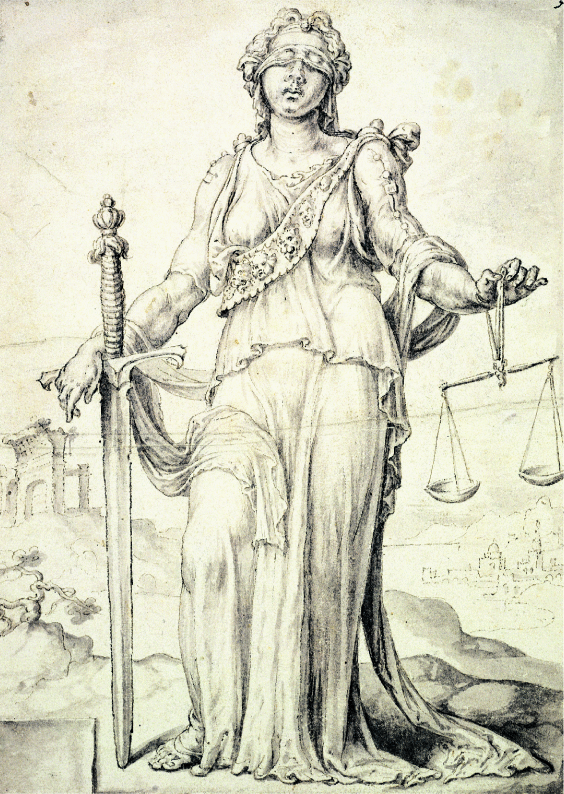
Justitia (Maarten van Heemskerck, 1556)
The author is Thomas Fischer. He is a federal judge in Karlsruhe and often writes about legal problems in the ZEIT and ZEIT ONLINE. For more articles of his column, click here – and more additional information, click on his website (Sexualstrafrecht).
The afore mentioned article on sexual crime legislation is an absolute must read. I used to believe that it is a nice concept for citizens to voluntarily subjugate themselves under the laws because they see that these laws are good for everyone.
The article showed me that this is a nice utopia which, however, cannot be realized in our country. Actually we are quite some way from reaching it and continue to move even further away.
In his article, Thomas Fischer describes why and how laws are made. He shows that your common citizen cannot really understand them anymore. Except that we citizens are those who – when all is said and done – should (and perhaps even want to) decide upon them?
Another thing the article shows is that the goals of the legislative have become completely remote from social necessity. And that is probably why the results are so devastating. Let me cite Thomas Fischer:
The most beautiful sentence was spoken by the chairperson of the committee, Renate Künast: “We”, she said (not verbatim), “have met in order to create a conclusive system of criminal legislation. We are not responsible for its practical application.”
Do we really have a system where the “legislative power” no longer cares what the “judicative power” needs, thereby leaving it in the lurch when it comes to dealing with their daily mess of contradictory and conflicting laws? The same is true for all parties concerned – us citizens?
Remembering my “entrepreneurial” past, I certainly recall how much of what was written in such bills as the Works Constitution Act, Industrial Premises Law, Workforce Supply Law, Working Hours Act and many more was contradictory and impracticable. You could truly despair. The reasons why existing legislation is amended and new laws are introduced, too, get stranger and stranger.
The article by Thomas Fischer is about sexual offense criminal law. Here is a citation:
“Paragraph number 36 of the Council of Europe Convention for the prevention of violence against women and domestic violence demands from the (58) members under the heading ‘sexual violence’ to punish all sorts of sexual behaviour “against the desires of a person”. Germany signed the convention, but so far it has not been ratified and made federal law.
After ten countries ratified it in 2014, it became European law. Ever since then, German legislators dispute whether our criminal law is already sufficient to meet the criteria of the convention or if it should again be extended …
Of those experts who already voiced their opinion, the majority believes the latter. There are legal holes. A minority (including myself) believes that our laws as they are actually should suffice.
Incidentally, the terms “majority” and “minority” in this context mean a microscopically small group of persons professionally concerned with sexual crimes legislation. Even they cannot agree what is already covered by the law in this country and what is not. Most people in Germany have no idea what this is all about.
And now they want to introduce a totally new, powerful law because of such a decree. Most likely, it will be even harder to interpret than its predecessor. And – frustrating as it is – nothing will change as far as facts are concerned.”
When I read this article, it became quite clear to me that this is how being fed up with the government will increase more and more. Laws and abiding by them will consequently lose their high social value. I understand better and better why ever more persons no longer trust in politics and remain at home on election day.
But this is not all. I assume that the sexual crimes legislation is something the actual legislators, i.e. the powerful lobbyists, could not care less about. The only groups that come to mind as being concerned are the Christian Churches, Islamic interest groups and perhaps women’s rights groups. Let us hope that at least some lawyers who want the best for humans in this sense are part of those who make the new law.
However, when thinking of laws with economic impact, matters are even worse. Formally, they are just as bad and contradictory, but additionally, most of these laws originated to a huge extend with lawyers and lobbyists. As Richard Gutjahr showed with his Lobbyplag (Richard Gutjahr mit Lobbyplag).
Our former Federal President Roman Herzog comes to mind. He is said to have proposed that, first and foremost, all laws with uneven numbers should be abolished. If then people actually miss something, you could introduce a new, minimal law. And later on, you could try the even numbers.
Well, maybe the marginalization of the legislative process is now under way in an evolutionary sense. Except totally different from what Roman Herzog proposed. The motto might be: the more terabytes full of laws we produce, the less people care.
RDM
(Translated by EG)
P.S.
Incidentally, I had to learn that many young persons no longer even know the meaning of the terms “executive”, “legislative” and “judicative”. Good-bye democracy?
P.S.2
I took the picture from Wipedia – „Iustitia van Heemskerck“ by Maarten van Heemskerck.
Roland DürreTuesday February 3rd, 2015
agile.ruhr Camp 2015
A short time ago, I had a telephone conversation with Dominik Rose. He told me that now the agile.ruhr Camp 2015 he organizes along with Berthold Barth is no longer far away. In less than three weeks, it will actually be upon us!
“Agile” is something I rather like. After all, it is my conviction that you should always approach everything “ALO”. ALO being short for agile, lean and open.

Consequently, I am glad to hear that the organizational team of agile.ruhr Camp for the first time invites people to an “Anti-Conference” for agile procedures in the vicinity of projects and software development this year. On February, 21st and 22nd, the barcamp Unperfekthaus will take place in Essen.
Of course, I find it particularly satisfying that the InterFace AG is part of the event and supports the organizational team as an official sponsor.
The agile.ruhr Camp is for change and convictions. It aims at providing a modern platform for persons, organizations and enterprises where they can exchange experience and knowledge. Because knowledge is the only raw material that increases as you share it.
How to successfully make use of agile methods and tools? What is the potential of agile concepts and behaviour? How can we manage the necessary changes? And not only with software development!
And, of course, the classic pattern for a free anti-conference on agility is the “barcamp”, where, as opposed to a classic conference, you do without a restricting agenda and instead generate above average knowledge gain through honest discourse and open dialogue.
The agenda are decided upon by the attendants. Everyone thee-s and thou-s everyone else, you meet at eye-level and listening is more important than talking. This is the only way how participants can offer “their” sessions (on a topic of their choice) and thus become true participants.
Unfortunately, I cannot attend on February 13th and 14th. I want to visit a totally different “anti-conference” where I have been a regular guest for several years at the same time: the “Biike” in Westerland on Sylt. The “Biike” is just a tradition. Good friends use the time for their anti-conference.
Well, life is a chain of missed opportunities, isn’t it?
But perhaps one of my IF Blog readers can attend the unique agile.ruhr Camp. And then report on his own blog or on twitter?
RMD
(Translated by EG)
P.S.
As soon as I know the hashtag of agile.ruhr Camp 2015, I will give it to you her.
I propose: #AgileRuhrCmp
P.S.1
In this context, you can read something worth reading (Lesenswertes) about InterFace AG.
Roland DürreSunday January 25th, 2015
(Deutsch) #AktMob Unkonferenz für aktive Mobilität … und Radfahrer … und Fußgänger … 3./4. Januar 2016!
Roland DürreSaturday January 24th, 2015
#Enterprise Foundation – Hurrah, Let Us Write an App…
Except:
If it were as easy as that, not almost all of them would fail, would they?
Here is a little story:
A start-up team wants to found an enterprise. Based on an APP, it is supposed to realize a profitable business. There is an industrious team and an intensely discussed idea, and the persons involved have more than enough enthusiasm. They are all prepared to really get under way and accept material hardships. Even nights spent working and, if necessary, postponing or even sacrificing goals of life are accepted.
Accidentally, I get involved. They asked for my help because they feel the project has come to a dead end, yet none of the parties concerned is willing to admit it. After only a few sessions, I discover that the project is off course. The team is already in the middle of implementation, which is especially painful.
During my long life, I already witnessed quite a few founders who ran aground – in the truest sense of the word. Consequently, I now have a lot of responsibility. Yet at that moment, I cannot life up to said responsibility, because the founders are trapped in their own ideas and no longer willing or able to listen. It might well be understandable that they no longer wish to hear bad news.
In this case, I give a warning and leave. And a few months later, I hear that they have “run aground”. This is why I will now give founders a few pieces of general advice.
First advice:
You cannot do it without a blueprint
What are you supposed to do in a project if you discover that there is no “shared direction” in a team? Or even worse: if every one of them has his/her own idea of what they want to achieve?

Admiralty carriage mount for a British 18-pounder carronade
I would recommend in such a situation that you immediately stop implementing anything and go back to the beginning. In other words: return to the phase of requirement engineering. It will certainly be painful, but it is the only way to save the project. As a consolation, you can remember that you can later benefit from all the experience.
But this time, it must be a modern, agile, empathic and educational requirement engineering! When defining the requirements for new and innovative solutions, you will have to “experimentally learn a technical situation”. If you want to succeed in innovation, you have to ask the right questions. And before you can ask them, you have to find them. Which is not at all easy.
Only after having finished this, you can start with defining your requirement. And only after that, you can think about solutions. You will find solutions by dividing the goal into the “right” user stories. You want to start with one of those and then analyse the underlying use case. They can be analysed and described. But, please, use the “wisdom of the masses”, rather than the “simple-mindedness of the individual person”. Especially when we are talking the future and innovation!
“Learning the market” is only possible if you use “technological empathy”. Yet we have to know the market. After all, it is where we want to sell and use the product. Especially the market of the future must be discovered through trial-and-error and experiments. Against the dogmatic brain concepts of an individual person. This is how you want to keep learning at all times. Using an honest and optimal discourse: open and agile.
If you forget this important initial work, you will program (or build) things nobody wants to buy. Whatever the team thinks will then revolve around a product that is questionable, at least on the market and that – with its technological and other problems – will detract from the main goal and eat up all the combined energy of the team.
The failure of the product is often delayed through missing functionality. Allegedly, all you have to do is even more programming, then the success will come. This is a misconception. When those seemingly so important functions are finally available, nothing changes for the better. The failure will then be attributed to poor sales and marketing. All you need is a few millions for sales and marketing …which you will never get, because there is no potential sponsor you can convince with the already existing results.
Scenarios like these will always happen when the “start-up” has no valid and flexible blueprint to start with. You have no shared interest you actually live up to and consequently you cannot convince anybody. So what you need is a blueprint. In former times, the blueprint was called “specification sheet”. As opposed to the specification sheet, however, the blueprint only specifies the essentials. And it remains active.
The word “requirement engineering” will easily give you the wrong ideas. Just like the term “specification sheet” is not modern, especially if it is understood as following the idea of the “V- model”. Modern “specification sheets” will have to be agile and improve iteratively and incrementally!
If you have a small but nice blueprint, you can test it on the market. It is easy to come up with a good blueprint. It will develop a life of its own and therefore become more and more resistent. Mind you, I would not wish you to misunderstand my argument in favour of the blueprint. I definitely would not wish to speak up in favour of the antiquated waterfall model.
On the contrary: the implementation, too, must begin at an early stage. But only with a simple and important, perhaps extremely small, user story following the blueprint. With a little luck, you can perhaps quickly gain the first “quick win”, which will carry you towards a successful future.
Consequently, founding an enterprise is a linked tightrope walk in many dimensions.
Here are some more recommendations for start-ups:
Find the right target groups
User software (like many other products), if seen exemplarily, will always have at least two target groups – the “technological department” and the users. Incidentally, that is also the difference between user software and purely technological software development, such as the construction of a compiler.
The technological department wants to achieve a simplification and improvement of the necessary processes with the product. The user is supposed to accept this solution. The product must give him a noticeable help. He can do a better job in an agreeable way.
Business Case
It is of central importance. We need a story. If you found the right target groups and have a nice blueprint, then you can develop the business case. You want to wrap it in a good, even a fascinating story. You want to fascinate potential partners, possible sales and marketing routes, multipliers and others. And then you can approach all the many chances the market offers.
Technology
Only after you have a really good blueprint (perhaps supported by the Oldie Rapper vulgo called „dummies”), only after you made the surface and the functions “understandable”, only after you determined the target groups and the business case, only after your prototypes have shown individual functions does it make sense to build the “King Version”. This “King Version” will then have to be developed quickly and goal-orientedy. Directly to the point, without much ado.
And then the agile tire can start rotating. The main purpose of such a “King Version” is to learn through and with it – on all levels. And the idea to advertise the product. Perfection is not important. Developers and engineers have to be careful, because they often think in terms of technology far too soon. That is something you can do later, after knowing what the evolution will actually accept.
Design
You cannot be too early with picking a logo. It will become the symbol of the team and send a message. As a shared team symbol. Consequently, the entire team should be consulted when the logo is determined.
When trying to find a design or a pattern or prototype, you should orientate yourself towards modern applications. Images and pictures will play an important role with the surfaces of the future. Beauty can do no harm, but is only of secondary importance. The product message is the most important thing. This will also be helpful for the founders when they have to coordinate their constructs.
Financing
More often than not, founders think about the financing far too soon. If I want financing, I first have to have something to offer. Meaning more than a business plan – which mostly is no more than a poor profession of faith. I need all the things that have been written down: the blueprint, the business case, the pattern, a beautiful design – all those things have to transport an idea and fascinate the people. Consequently, external money cannot be expected before you build the “King Version”. And that, too, is rather hard – as a general rule, only special friends will help in this kind of situation.
And above all: you have to be a strong team. VCs, SCs, federal financing, but also partner enterprises or private investors are less interested in your actual product. For them, the business case, the story, and above all, the team, are important. Incidentally, a team is only a strong team if the members themselves are truly and still realistically convinced that their product is top quality.
General Notes
There is no “stroke of genius” when it comes to ideas. Such a concept is and has always been a fairy tale. A stroke of genius is a dream which will only too quickly become a nightmare. Visions will often become hallucinations.
The success of start-ups and innovative founders has many parents. Developing a successful product means hard work. The path includes many setbacks and errors. You cannot force success. You just have to try and create the ideal environment for it to come one day.
Actually, it might even make sense – especially if you cannot operate with cost-covering turnover from the outset – to pave the way through the purgatory of a “Business Plan Contest”. As a general rule, you can benefit hugely from the experience. Finding out that a project is not realistic, too, is of huge value. It saves a lot of money and time. Taking part in such a contest can also help to create the “right” networks and find the “right” mentors.
But above all!
A start-up is not an elegant way towards self-actualization. Instead, it is a very risky and massive challenge. What you need is an enthusiastic team where every member is prepared to accept the task and open for change. If this is not the case, you should keep your distance. Because if founding your enterprise were as easy as some seem to think, we would not see so many founders, even in the IKT sector and the world of elegant APPs, ending as a failure.
RMD
(Translated by EG)
P.S.
In this article, I related my personal ideas based on my individual experiences. They do not claim to be the one and only truth. I believe that every founding process is different from the next and they all have their individual stories.
As I see it, there is no general cooking recipe for “successful” founding. However, if you follow my description, you might actually succeed. Whereas you can assume you will fail if you try a different approach!
P.S.1
About the picture: It is from 1808 and titled “Admiralty carriage mount for a British 18-pounder carronade”.
Source: Scanned from Chappelle, Howard I., The History of the American Sailing Navy: The Ships and Their Development, New York: W. W. Norton and Company, Inc., 1949, ISBN 1-56852-222-3, Plate VII, facing p. 152.
Unattributed, apparently from U.S. National Archives
Roland DürreSaturday January 17th, 2015
Legal is Illegal.
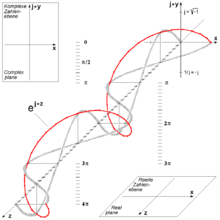
Three-dimensional representation of the Euler Formula
A short time ago, I was really scolded. Just because I wrote in this blog (Frustration Splitter – Frustsplitter) how happy it makes me to know that Uli Hoeneß has become a day release prisoner with the beginning of this year. One of the reasons is that, many decades ago, I sometimes met him when he was walking his dog. From those days, I remember him as a nice guy.
My short reasoning was as follows: Concerns get away with things for which the “common big-time tax sinner”, such as Uli Hoeneß, will be put behind bars. This follows the motto: “the truly big ones remain free and the medium-sized criminals will be hanged”. Because compared to what the concerns do, the money Uli cheated with was “peanuts”. Even if there are certainly some “tax sinners” who have to accept penalty for damage that is “peanuts” in comparison with the Uli Hoeneß operation. You have to remember that all is relative.
You cannot imagine what scolding I was subjected to. The outrage of some of my readers was immense. Basically, they said you cannot compare those things! After all, the big concerns might have acted “morally” in a bad way, but other than that, they acted totally “legally”. That is precisely the difference between the concerns and Uli.
Well, speaking of “legal”: isn’t this exactl one of the basic problems of our society? Incidentally, you cannot do all that is “legal”. This is true for many things, not just for taxes. Just think of our environment and all the things we are permitted to do, yet we certainly should not at all be permitted to do those things.
Back to taxes: no set of rules will ever be perfect enough not to make “legally possible” some things which actually are the opposite of what the set of rules wanted. Especially if we are talking something as complex as or tax legislation. As a consequence of this permanent sophistication and increase of our laws, we have an immense increase in transaction costs (not just legal and surveillance costs) and an ever stronger misconception when it comes to what we feel is right and wrong.
There is an exponential increase in amendments and new laws. More and more “legal service” and blind achievement are promoted. Only the real big ones can afford this. In fact, even now we live with a state of affairs where some laws contradict each other and reasonable interpretations and decisions are no longer possible (just think of the “data security” legislation).
It is just like with the security glitches – not just – in Microsoft software. You get ever more contradictions and one functional goal will exclude the other. You make a huge effort patching up one hole in the “firewall”, and two new ones are already in the making. It reminds you a little of the courageous slayers of multi-headed dragons: in olden days, those people made the experience that, after having cut off one head of a monster, two others grew in its place immediately. In the fairy tales, the solution lay in burning the heads with the pitch torch.
Another good example for this development is the increasing complexity of our technological and social systems. Many fear it as one of the fearsome dragons of our world. But this development, too, is very easy to explain. The systems get more and more complex because the correction of the discovered mistakes gets harder and harder. Consequently, these corrections keep increasing the complexity of the system. The next generation of errors will be even harder to handle, leading to the next increase. This is a way towards catastrophe constantly strengthening itself.
The tax evasion model is a gigantic advantage in competition for those concerns that win. They accumulate no end of net profits and can invest hugely, which again will give them new advantages. They will end up being able to remove competition they do not like (especially smaller companies) – no matter what the cost – and to steal their know-how. They can afford the most expensive marketing campaigns and, supported by expensive lobbyists, they will seek world supremacy.
This is how the wonderful spiral of power increase works!
RMD
(Translated by EG)
Roland DürreFriday January 16th, 2015
Golden Barbed Wire
Currently, it seems like both institutions and enterprises are in a state of inertia. And humans always seem to suffer. At least that is what diverse polls tell us. Also, I hear many laments during direct conversations. Frustration at work increases, more and more persons succumb to inner resignation.
I can easily understand that. The collective life in enterprises is increasingly subjected to being moulded into processes. This development has been going on for several years, step by step and consequently not really easy to make out. Yet it keeps getting stronger. Nobody can escape it. More and more regulations and written rules of behaviour are generated. There is a simple answer for every question.
Those who are still capable of feeling it feel dependent and incapacitated. A feeling of powerlessness spreads, dissatisfaction grows, you are frustrated and often do not even know why. At the same time, the systems protect you as never before. Security is all, risks are undesired. The total care through the system is the slogan of the hour.
Actually, the care is something those who enjoy it gladly accept. After all, it provides a comfort zone and promises security. Because you are in a protected area and basically there is nothing you need to worry about. Because you are part of a big “community” – one of many.
This is how the concern employee will feel comfortable. Yet this is often quite treacherous. But then, how does this situation arise? Both as a student and later as a regular employee, I spent almost ten years working for Siemens, where I personally made the experience of gliding into the world of security.
For me, the “lulling process” started with eating in the cafeteria. Usually, that was where I got good food at fixed times and for a reasonable price. And, like most people, I found “my” company cafeteria quite good. Also because it made my life easier.
Well, it means the cafeteria was the central point of the work day. It decided what we were going to eat. There were two standardized meals. At Siemens, we had one “simple” meal (green voucher, 1.20 DM) and a “higher-quality” meal (red voucher, 1.50 DM). The vouchers looked like those coins you can use instead of EURO coins when you need a trolley in the supermarket.
The vouchers were available from a very basic machine. If you paid 6 DM, you could choose between getting five green vouchers and four red vouchers. The same vouchers were available in yellow – for dessert. The price was 0.30 DM. For 1.50 DM, the machine gave you five of them. In those days, even dinner was available in the cafeteria – very comfortable.
The daily choice between green (basic) and red (better) meal became the most important part of daily life. The question “what’s to eat today” certainly gives diversity to the day. It suggests decisiveness and some last vestiges of freedom. Besides, going to the cafeteria at noon provided a break in the work routine.
This is what you get with big companies and institutions – all is provided for. You get food and warmth. The cafeteria as the tip of the iceberg consisting of a complete all-out provision by “Mama Siemens” or similar. “Mama Siemens” (as a metaphor for huge concerns) gives their people a place to work, a good income, warmth and light, and nice offices. At the gate, the security guards keep a watchful eye. The boss will select the courses his employees might find useful. And if an employee had a health problem, he or she could feel free to consult the company doctor. What more do you need?
This is what I experienced as part of the working population during my first years. I sat in a golden cage. We were domesticated and mollycoddled, like tamed pets. Until all this care – and if I am honest, there were other reasons, too – made me leave.
Many of my friends and colleagues did not manage to escape. They became prisoners inside the “golden barbed wire”. Initially, it was the company retirement money that attracted them. Then the dismissal protection. Without noticing it, they became zombies of the system that provided everything. Everything was pre-conceived and pre-arranged. No problems, no challenges.
Today, we also have set processes for everything: vacations, appraisal interviews, the hours you work, business trips, meetings, employments or notices, personnel-related issues, social media: everything is ready-made and served conveniently.
As soon as they reached their 50th birthday, if not sooner, they started looking towards the end with anxiety. And many were permitted to leave before they were sixty – well provided for, but basically too young to stop doing something meaningful.
And as systems always work: As soon as the regulations have started, they will never stop. Be it communication, creativity, development, marketing, sales: everything is standardized. „Best practice“ gives way to processes, bureaucracy will flourish endlessly, lateral ideas are not welcome.
Instead of “common sense” you get “this is how we are going to do it”. Creativity is replaced by planning. Transparency becomes an unwelcome threat. Everything must be measurable, even the suggestions for improvement. Customers’ wishes and the needs of your providers will fall victim to the Shareholder Value.
The system overshadows everything. Only what is useful for the system can ever be good – even if this is only allegedly so.
Consequently, the enterprises wear a mask that gets stronger and stronger. It is a fir tree they used to call structure organization – with mistletoes of structural concepts hanging from it.
To be sure, from the inside, those enterprises look different, because the industrious colleagues will ignore the fir tree with its mistletoes where necessary (which is quite frequently) and instead directly communicate with each other. This is how they see to it that the enterprise will be a success, after all – in violation of the rules.
Many enterprises remind me of the image of a city where the pulsating life starts to be structured by the construction of signs and barbed wire fences. Yet they leave enough – basically unlawful – holes for everything to still function.
It is called bureacracy!
RMD
(Translated by EG)
Roland DürreSunday January 11th, 2015
“The Future of Computer Science!?” or “Our Beloved Data …”
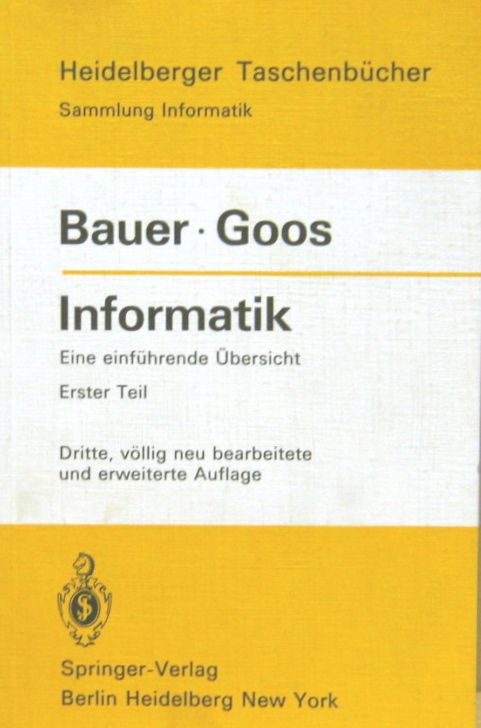 I consider myself to some extend as a third generation informatics pioneer. And I like remembering my first huge projects in the 1970ies. They were called START, ITS, Dispol or SNATCH.
In my private order of things, the second generation of IT pioneers is represented by F.-L. Bauer, whom I personally hold in high esteem. When I was a mathematics student at TUM (at the time it was still called TH for Technische Hochschule) in the fall of 1969, I sat in his lecture when I first studied my minor subject: computer science. Incidentally, the book you see on the picture is my personal copy bought at the time. As you can easily see, it has been read in quite often.
In those days, informatics was something totally new for me. And I probably chose the minor subject because I did not really know what it was. Simply because, in some way or other, it pointed towards the future.
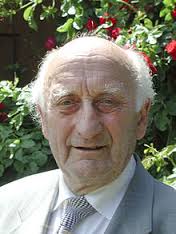 Almost as a logical consequence, I did not understand everything professor Bauer wanted to teach us during this beautiful lecture course. Very regrettably.
During the last few years, I was permitted to accompany professor Bauer when he gave several guided tours in the Informatics department of the Deutsches Museum. Those tours were held for our (InterFace AG) customers, friends and partners. Many things I had not understood as a young student became a lot clearer in the wake of those tours.
Incidentally, I count Konrad Zuse among the first computer science generation. I made his personal acquaintance at the end of the 1086 InterFace-Konrad-Zuse-Bike Tour. He gave us a great welcome, delivered a wonderful speech and presented us the picture you see here during the great reception at Hünfeld. Today, you can see the picture hanging on the wall at the InterFace AG building in Unterhaching.
 By now, informatics has moved on by “light years”. I was and still am a computer scientist with all my heart. For me, the combined meaningfulness of my work, my life and society has always been important. Consequently, the development and future of informatics is important to me. Articles written by third parties about the subject and by distinguished informatics representatives are, naturally, of special interest.
In the 14th edition of the TUM magazine “Faszination Forschung” – a first-class high-gloss TUM München magazine – dated June 2014, I found the article “Connecting the World”.
Here is the trailer:
In the future, everyday objects will be linked via the Internet, enabling them to interact autonomously. To realize this vision, computer scientists are developing virtual models they can use to test practical implementation and monitor the security, safety and reliability of connected systems.
The article describes the future of computer science on the technological level. It is basically about how systems can be coordinated in a future “cyber physical world”. Since I consider the article worth reading and a good basis for further discussion, I am providing you with the download: [download#109].
My friend and partner in the InterFace AG advisory board, Professor Dr. Manfred Broy, is cited in the article. You will also find his picture. It can be assumed that the content of the article is partly the result of the research supervised by him.
I do not totally agree with the article. To be sure, there will be remarkable future developments in our technology, perhaps even more remarkable than those described in the article. However, I do not believe in what applications are predicted. Instead, I assume that the society of the future will have to cope with totally different challenges than we assume today. And I am sure we will then find very exciting solutions. But those solutions will not be part of this “brave new world”.
Yet matters begin to get exciting (and for me alarming) when I read the reply written by Professor Werner Meixner. In a presentation, professor Dr. Meixner described how this article “strikes someone (him) who basically understands the meaningfulness of his professional life as a fascination with the natural sciences as a humanist value”.
This presentation is also part of an open letter addressed to Professor Dr. Manfred Broy with the title:
Where is informatics headed?
Like before, I am providing the link for downloading of the open letter by Professor Meixner:
[download#110]
Since I wish to motivate IF blog readers to read the articles, I will now cite a short but perhaps central part of the article:
All human decisions – and concerns know this quite well – contain an act of added value, which means they are valuable per se. The most important factor is that the owner of the produced value is the one who made the decision and is responsible for it. This is exactly the meaning of privacy and the consequence is the indisputable worthiness of privacy protection. All business behaviour is a consequence thereof.
In fact, I do not quite understand what the author wants to say. My attempt at analysing it dialectically results in me finding a random truth claim which is easy to disprove.
🙂 However, since I am a blogger, I never write open letters to anyone. Instead, I publish my personal opinion in my blog. Totally transparently, everybody can read it.
Here comes:
I find the TUM magazine article one-dimensional. The “open letter” gave me consternation.
In both articles, I find a concept of the world and humans which is no match at all with what I see in the real world. The first article reminds me a little of the nuclear energy euphoria (which at the time was controlled by business interests) more than fifty years ago. The second article glorifies a meaning of privacy and laments its worthiness of protection which – based on my experience in life and my knowledge of anthropology, neurology, psychology, philosophy and sociology – is not at all justifiable. Even theological reasoning would probably fall short
For all of us, the real challenges will quickly be others than those described. The dream image of a networked world will not help us to cope with all those challenges. Neither will the convulsive protection of our private data – which, basically, cannot be protected anyway.
The current news about the IS fronts, other wars and their consequences, refugees seeking asylum in the EU, the assassinations in France , or #Pegida and #Anti-Pegida in Germany are clear indications of a reality that quickly changes and that we have to accept. Also, we have to learn how to deal with this reality in a rational way.
A dominating global economy which creates free markets for products yet leaves labour unfree (a seamstress in Bangladesh cannot move to Europe and do her work there, even though the dresses she makes are exclusively sold in Europe) will come to its end. The rich persons of this world (we) exploit the poor more than ever in human history and the number of slaves is higher than ever.
The tensions generated by these contrasts will probably discharge themselves like earthquakes. It has already started. Basic conditions (climate, food and soil) in many regions already deteriorate and will geometrically continue to do so. Sooner or later, this process will catapult us into critical spheres. The tensions will become more and more noticeable.
In fact, we might be approaching a rough awakening from our current dreams faster than we had anticipated. It is my hope that here, too, informatics can help. Naturally, I do not yet know how this might happen. All I can do is imagine how it might be.
I think the IKT can only contribute positively towards the humaneness of mankind if it – above all – succeeds in supporting a highly complex, world-wide and truthful discourse which thus will render striking results. This is the only way to come to a consensus not based on enmity and exploitation. Instead, it should prepare humans (us) for the necessary changes in our mental concepts and life.
This is the only way to change society without violence. It is the only way to transform today’s economy into a “common-good-economy”. And it is also the only way to find solutions for a better copyright and patent system. Through the wisdom of the masses and against the simple-mindedness of the individual person.
[Note: perhaps our colleagues at Youmigo.de already understood this – which is why they wrote a wonderful APP for “world agreement”.]
As to the TUM magazine article: I would argue that we do not need a luxury world of networked technology which, when all is said and done, will only enslave us even more. As to Werner Meixner’s theses, I think he inflates the topic “pretty good privacy” like a profession of faith. However, instead of giving credible reasons, he remains dogmatic.
And I also believe that our privacy will be something we will be fairly indifferent about in the future. Because we will have other problems. Also, we humans will always move in the stress field of individuality and collectiveness. Either way. With data protection or without. And the only way we can manage to do that in a humane way is if we think and act in a value-oriented way. Dogmata and their prayer-like publication will not be helpful.
Here is another idea about personal data. Isn’t it a rather normal part of human civilization to collect information about people. After all, there were good reasons to come up with administration and, for instance, write down when a child is born. Of course, technological advancement made unbelievable things possible since they invented filing systems and cataloguing.
With “new” technologies, you can certainly collect a lot more data than formerly. Yet this is only the continuation of a development that started with the invention of writing on paper as a means to conserve and hand on information. Quite possibly, the invention of filing systems (certainly an IT invention) brought another impulse. And IKT yet another.
But: did IKT really make such an enormous difference? And how huge is the damage? And isn’t it just great that in general information can be made available by whistle blowers and that it was IT which made it easier?
I see a threat if “a-moral systems” (like unlawful systems) get hold of the data. But if it comes to that, no data protection will help us, anyway. Instead, we should see to it that “a-moral systems” never gain control over us. And that is a permanent social challenge for every citizen. Basically, you can only resist “commercial utilization” of data by being autonomous. But then, the same is true for the continuing threat of manipulation through marketing. And if you consume senselessly, it will only cost money, rarely your life.
Personally, I consider the avoidable damage the “old” technologies caused us during the last hundred years and still cause us permanently today significantly higher than the damage done by the new technology IKT during the last 25 years.
For instance, the technologies of the last century stole our piece. Does any of you still know a single place in Munich where you hear no “technology noise”? Yet the noise pollution is only a truly harmless example compared to the 1.2 million traffic fatalities each year – caused through motorized individualized mobility on a world-wide scale. And it is a fact that we also like to ignore other threats, such as the carbon dioxide content in the atmosphere.
In the same way we accepted the limitless noise emissions, we also got used to our (still very limited, regardless of all efforts) transparency. Limited, because even the networking systems used in industry and in the world 4.0 will find it hard to read our thoughts. And because, if we want to survive, we will definitely have to develop into autonomous persons in a self-determined frame.
Maybe the permanent calls for secrecy of data are nothing more than an outcry of protest, because, after all, you have to be against something, don’t you? And you are not courageous enough to actually stand up for the real threats.
But then, do not let us forget:
Only the new technologies provide us with a chance of networking and sharing our ideas with others. Which is how we can fight ignorance, intolerance, dogmata, irrationality and much more of the same.
RMD
(Translated by EG)
Roland DürreThursday January 8th, 2015
#JeSuisCharlie
Basically, I am reluctant when it comes to commenting such atrocious events. This time, however, I would like to share a few ideas. Simply because, to me, it seems like the public discussion is too oversimplified and prejudiced.
I miss people demanding from the investigating offices (or even better: the intent of said investigating offices) to investigate with a huge amount of transparency and publicity. At least parliamentary control should be guaranteed. To me, it seems like the argument that this is not possible because it would threaten the success of the investigation is not legitimate.
I would demand this because the past taught us again and again how cautious you must be with condemnation in advance of trial. Too often, we saw how in such situations offices have been pushed by individual interest or made “blind on one eye”. Even our enlightened Federal Republic of Germany gives us lots of examples: from the Octoberfest assassinations in 1980 through NSU. Consequently, you cannot and must not condemn in advance of trial in such a case as this.
It also seems remarkable to me that in the USA, a country where weapon enthusiasm and weapon lobby are ever-present, a country where the death penalty is a normal thing and where both individual persons and the executive powers react to violence with counter-violence, – that in this USA the pencil is now becoming the new super-weapon. In my opinion, this is cynicism and in itself deserving a caricature. The USA especially missed the chance of showing greatness too often, causing world-wide damage with un-thought-through politics.
So far, they are only looking for “alleged culprits” and talking “main offenders”. Even if it turns out that the culprits were Muslims, this does not mean the motivation had its roots in religion. Just like there are “insane Americans” who commit the crimes of a homicidal maniac, you will also get insane Muslims. Statistically spoken, you should actually have more of them, because there are more Muslims than Americans living on this planet…
I mentally associate this latest with assassination attempts in other countries. For instance I find public outrage rather minimal whenever a weapons fanatic in the USA massacres people in a school. And how quickly it is all forgotten in the media and then how easily the NRA (The National Rifle Association) has both the public opinion and the government again under control.
Last not least – I wonder why? – I remember the terror an Israeli army caused in Palestine not so long ago at the command of its government, laying in ruins an entire city.
Consequently, I would recommend even with this atrocious event in Paris that we retain a little serenity during the discussion. Maybe it is a good idea to first wait and see who is behind the scenes.
Imagine, for instance, what would happen if the murderer were “occidental warriors” of a French “Pegida” who staged the attack in order to make it look like “Islamic warriors”. That would be the occidental Worst-Case Scenario. And perhaps this cannot be? Also because Madame Le Pen and consorts would not appreciate it.
RMD
(Translated by EG)
Roland DürreWednesday January 7th, 2015
Entrepreneur’s Diary #106 – Re-Structuring & Number of Team Members.

“Beyond Leading”
A young computer scientist who works in the subsidiary company of a huge US IT concern told me a short time ago:
”My work is far less demanding that I would wish. The problem is that, in a little more than one year, there were three different superiors of mine. Consequently, the current boss does not even know me. Nobody really knows my true competence. It annoys me to be so misjudged and I am going to look for another job where my competence is appreciated.“
Huge enterprises and concerns organise themselves anew in ever shorter time intervals. They want to show that they are capable of and willing to react to changes. This is to increase efficiency and decrease costs. The intention is to make it clear that they understand the market and initiate new concepts. More often than not, the re-structuring is not really a consequence of some acute tragedy, but you will always find a reason.
Once in a while, a mere change of managing directors will suffice. After all, the newcomer has to show that he brings change. In the wake of such re-structuring it can easily happen that two thirds or even more of the employees suddenly have a new superior. One they did not know at all or just from a distance before.
I am rather sceptical about this tendency towards re-structuring in ever shorter time intervals. An “introductory phase” that deserves the name requires that you trust each other. And the first requirement of trust is getting to know each other. How else should you have at least some knowledge about the values, expectations, interests and needs of the persons you are working with, as well as their competence and special talents?
Today, leaders are responsible in a “disciplinary sense” for many more people than formerly. In times gone, a “boss” was directly responsible for perhaps seven employees. Today, it is often many times that number. Leadership did not get any easier through this, since, basically, there is just not enough time for the individual person. It is hardly a surprise that in surveys most of the employees say they would like to have more time with their boss.
The HR Department (“Human Resource”), relying on a sophisticated HR software, is supposed to compensate for the loss of time with your immediate superior. Said software also contains very detailed employee evaluations. The leadership work is pressed into artificial personnel processes. External support for leaders is used with counsellors from outside the company. They subject internal employees to a “profiling” and then have “professional” feedback discussions with them.
I very much doubt that this will ever work. On the contrary: if a stranger, for instance, “evaluates” an employee who has been in the company for a long time and then tells him what type of person he thinks said employee is, this will often cause bizarre or ghost-like situations. More often than not, those situations will cause frustration or at least “inner resignation”.
To sum it up, I would say all re-structuring in huge concerns, as well as in small enterprises, should be executed with a lot of sensitivity. Forming (too) big teams with only one leader should also be well-thought-out. In such a context, frivolous and radical measurements usually do more harm than good.
Change as it happens today will certainly call for a permanent change in your own organization, too (both in structure and processes), yet it should happen as a continuous process and after long consideration.
RMD
(Translated by EG)
P.S.
For more articles of my entrepreneur’s diary, click here: Drehscheibe!
Roland DürreMonday January 5th, 2015
As Time Goes By …
 I need only look back upon the thirty-one years of my life at InterFace AG to see: many things have changed over the years! On all levels and in all dimensions. Looking at society and technology, or the way knowledge is treated today, what I see is more than a little surprising.
Totally new disciplines became important and made huge progress – and, as I see it, they also changed the world. Along with technology, I am also talking sciences such as psychology, neurology, behavioural science, along with game theory and good old philosophy. Not to mention how values and morals, even the concept of life for the individual person as well as in society and collectively, underwent change.
These developments exacerbated each other, thereby increasing speed in a way that I would no longer call linear. In fact, I considered and consider it more like “geometrical or exponential”.
This is why the following model I discovered a short time ago is one I am in favour of. It is about the words knowledgeable and ignorant, as well as competent and incompetent.
You could assign these four characteristics to a matrix with four quadrants. The top line of the matrix is “incompetence”, the lower line is “competence”. The right column is “knowledge” and the left column is ”ignorance”.
The upper left quadrant would then mean “knowledgeable yet incompetent”.
If you take the real-life example of an adolescent who knows that he cannot drive a car, you get the result that he is “knowledgeable yet incompetent”.
The lower right quadrant means “knowledgeable and competent”.
In our example, the adolescent grows to become a young man and learns to drive a car. Now he knows he can drive a car. And he will drive a car. Consequently, he is “knowledgeable and competent”.
The lower left quadrant represents “ignorant yet competent”.
As the young man grows older, he drives his car a lot. Consequently, he will become very good at driving a car, yet he is no longer actively aware of said competence. Whenever he drives a car, he is “ignorant yet competent”.
The upper left quadrant represents “ignorant and incompetent”.
We already can imagine what the story will be in the upper left hand corner. The man has turned ancient. He certainly should no longer sit behind a wheel, because he is no longer fit to drive. Yet he is not aware of this. Consequently, he will continue to drive with “ignorance and incompetence”.
Well, isn’t that a nice example? Yet there is one disadvantage. It suggests that man is the one who, due to age-inflicted change, mutates from “knowledgeable yet incompetent” via “knowledgeable and competent” and “ignorant yet competent” to “ignorant and incompetent”.
More often than not, however, it is the world or the environment which quickly changes. Whenever you enter a new social system, you will immediately notice that you have to work towards “being able to participate”. You learn the new system and then you become part of it. Except that, even after a phase of being “ignorant yet competent”, you might quickly become “ignorant and incompetent’.
Because the rules and the actual functionality of the system changed so fast and so dramatically that you never even noticed it. That is when you will look stupid and no longer understand the world – in which just a short while ago you felt ever so much at home.
Well, once in a while I, too, feel I am getting caught in a chain carousel that rotates faster and faster all the time, making me feel quite dizzy.
RMD
(Translated by EG)
P.S.
The picture is called “Wellenflug auf dem Roonkarker Mart”. I found it in Wikipedia with the carousel article. It is originally be Wilfried Wittkowsky.


