
Roland DürreWednesday March 2nd, 2016
AktMobCMP – Next Stop: Augsburg!
For Active Mobility in Everyday Life!
Shortly before Epiphany this year, we started the project “Active Mobility” with a barcamp. We spent two very intense days in the Unterhaching Kubiz. More than thirty persons shared their knowledge and together worked towards the so-called “remaining traffic” finally getting a chance to find its appropriate place in the public domain and in society, rather than having the entire transport policy focus exclusively on “motorized individualized traffic”. Considering that we hardly had a network on the topic, the start was quite a good one.
By now, we have found quite a few similar-minded persons. I mean people who, like us, walk distances or else go places by using mostly their own physical strength with vehicles such as bikes, rollers, inline skates, Skate– and Snake boards. They, too, need their space and places in the public domain. This is particularly true for vehicles that are a little “electrified”. As we see it, they are still part of active mobility.
We came up with great insights and actual results. All those who came enjoyed themselves and had much fun. The shared experience gave everybody courage. We also reached a number of partners from all over Germany who were not present but followed our procedures on the social media. The networking is now under way and we can really start.
 One of the “part-givers” (an artificial word from the world of anti-conferences and barcamps) was Günter Schütz from Augsburg. He already (not only) travelled a lot as an activist in favour of modern mobility in cities that are worth living in. And he is one of the promotors and makers of the bike kitchens we now have in Augsburg, Munich and other cities. It seems that the idea originated in the USA and was then carried to Germany via Vienna.
Günter spontaneously proposed to organize another AktMobCmp this year with his friends in Augsburg. And it took no time at all to fix the date:
The first Augsburg (AUX) #AktMobCmp will be on Friday, May, 20th, 2016 and Saturday, May, 21st, 2016 in the Zeughaus – Holl Saal (Room 112, first floor) near the Zeugplatz in 8615 Augsburg. Many thanks in advance to the Swabian Capital for sponsoring the great location through its Agenda 21!
And many thanks also to the host, the Transition Town Augsburg e.V. with the team around Günter, who took upon themselves quite a task (let me cite from the #AktMobCmpAUX or also #AktMobCamp2 – because we are not yet quite sure how to adequately name the day – website):
We want to see to it that mobility under your own muscular steam is no longer seen as “the remaining traffic”. We want to build a network among persons who want to promote active mobility in everyday life. We want to exchange ideas, relate our experiences, develop new ideas and make them heard. Such a thing cannot be done in the form of a congress or conference. That is why we organize anti-conferences and barcamps on active mobility.
The team also came up with a motto for their event:
Living together in the city!
Citation:
This is all about how we work both together and against each other in traffic. How can we organize ourselves in order to make it possible for both the motorized and non-motorized traffic to function not just alongside each other, but also together in such a way that there is as little stress and danger as possible in our cities?
As I see it, much remains to be done if we want to promote a “species appropriate” life for humans in the “smart and mega cities” of the future. And we will have to start with traffic and mobility. And all this is probably about how to make it work.
First and foremost, we now have to find many participants (part-givers) who will just come and join us. Perhaps, after more than thirty “initiators” in Unterhaching, we can now attract a three-digit crowd? I am also looking for sponsors, because Günter’s fee estimations are at the low end. In order to make it possible for persons with restricted budgets to participate, he set the prices between 30 € (reduced price) and 45 € (standard price).
However, there is also a fee donation, which means that, if you wish to support us, you can also pay more on a voluntary basis, for instance 60 € (+ 15). We want it to become a really great barcamp where you can feel comfortable. Consequently, extra money is needed, for instance from sponsors who support the nice party on the first evening!
Here is the short video recording of the Unterhaching #AktMobCmp. To me, it looks to be quite motivating for prospective participants – both activists and sponsors. I mean persons who want to get active and promote a future worth living for humans in their cities.
And perhaps we can even offer more attractions at the Augsburg #AktMobCmp. For instance, I can easily imagine a display of different bikes – such as burden bikes – or special trailers. After all, the great things that have been happening in the active mobility sector, in particular lately, are really amazing!
All ideas for the camp are extremely welcome. Just drop them at www.actmobcmp.org alias www.aktmobcmp.de! Or send a tweet to @AktMobCmp or #AktMobCmp (you can write it all with small letters). We are also present in Google+ as a community – naturally under “AktMobCmp“. In Facebook, #AktMobCmp is represented as a community. You will easily find it under “Aktive Mobilität im Alltag„, You will also find other exciting contributions around new and also very old (and consequently, very much appreciated) mobility. And the ADFC will again support us!
RMD
(Translated by EG)
Roland DürreSunday February 28th, 2016
From Digitalization to Thermomix
 Today, the word “DIGITALIZATION“ is basically a magic word. And it is, in fact, probably the most important term of our modern times. After all, digitalization changes our life at a high speed and with immens intensity. It can most certainly be compared with industrialization, which, a few centuries ago, brought a storm of change over the continents of this world.
Consequently, the digital change is the central topic in a global world. Even in the satiated and rich Bavaria, they established a “Bavarian Centre for Digitalization“ (Zentrum Digitalisierung.Bayern). Their website is certainly worth taking a look at. This centre has been initiated at the instigation of the Prime Minister and has a ten-digit budget at its disposal. It is supposed to enable the Free State of Bavaria to keep its world-wide top position. Or, to be more precise, to re-establish said top position after it has been lost in important areas.
I rather like the term “Digital Transformation“, because I see myself as a “Third-Generation IT-Pioneer” who, through all his life, has been part of teams that created “digital transportation”, initially as a programmer and later as a software and IKT entrepreneur.
As always when dealing with language, it is advisable to see the term as a “generic term” and then subdivide it in order to better understand it. Production is certainly an area that is affected by transformation. In this area, the change has already been labelled “Industry 4.0” (which is a little ridiculous). Digital transformation, however, concerns all areas of organized life, be it economy, administration, our mobility and communication, trade or the media. And, of course, it also concerns the way how we live together, changing our cognitive competence. Who among us is still able to do calculations (without using a calculator) and what young person can still find his or her way in the city (without using a GPS)? Thus, it changes our lives – both individually and collectively.
Digital change will be instrumental when it comes to how well this world functions – and consequently it will not stop before our front doors.
Now it also arrived in our kitchens. Of course not by providing the self-ordering refrigerator as some storytellers of the internet of objects have been predicting for years. Well, they do not even begin to understand, because this is actually exactly how innovation does not work.
No, the kitchen is another one of those areas where digitalization comes on soft paws. For instance first and foremost as a cooking box. Instead of as a robot that peels the potatoes and cleans the tables after the meal.
A short time ago, I found a device that tends towards “becoming digital”. It is the latest Thermomix version. It gets its recipes from the internet (well, the current version still gets it through the USB stick) and then steers the human through the cooking program by giving instructions.
RMD
(Translated by EG)
Roland DürreWednesday February 24th, 2016
Jubilee – A Hundred Videos Downloaded to Youtube!
I have now had a Youtube-Channel for a few years. As with almost all my internet activities, I call myself rolandduerre or Roland Dürre. I just noticed that I published my hundredth video on January, 13th, 2016. It makes me quite happy to celebrate this jubilee. Consequently, I will now write a short post about it.
Among other things, I publish the IF Forum presentations on my YouTube channel. But you can also find considerable parts of Rupert Lay’s works on the channel. I was there for many of his presentations, especially on the Ronneburg with Bernd Sielaff behind the video camera. There are also some of my own presentations about current topics around InterFace and IT. And more often than not, my friend Friedrich Lehn (fhlcinema) was the man behind the video camera and the mixing console.
The jubilee video is a short report on the barcamp for Active Mobility in everyday life #AktMobCmp of earlier this year:
The uncrowned champion is: Klaus-Jürgen Grün. He tops all other recordings with his presentation of “The Art of Negative Thinking”.
Personally, I consider the presentations by Rupert Lay extremely important in our times. He established his philosophical heritage in two presentations. Here is part 1, where he demands a New Enlightenment.
Very much a current topic – even though already recorded a few years back: Wilfried Bommert:
My favourite video recordings are, for example, those with Eberhard Huber or Roger Dannenhauer …
But there are many more great orators on the channel. I do not want to name them all. So why don’t you just visit and browse through my Youtube-Channel?
Incidentally, I also find this presentation of mine rather nice.
RMD
(Translated by EG)
Roland DürreSaturday February 20th, 2016
Basic Constitutional Law, Article 14, Section 2

In my art article “Texts on the World Financial Crisis” and other blog articles, I already enthused about our courageous and almost lusty Bavarian Constitution.
However, the Bavarian Constitution is subsidiary to the Basic Constitutional Law of Germany. To be sure, Bavaria never officially became part of the Federal Republic of Germany – but it can be assumed that, over the last few decades, the Free State of Bavaria conducted itself in a way that implied its consent to being part of the FRG.
Yes, the Bavarian Constitution is my personal favourite – I rather like it. Now I also read the Basic Constitutional Law of Germany (Grundgesetz) and I would recommend that you all, too, read it.
And I find it truly imperfect. Here are some totally random examples I am not at all enthusiastic about. Let us begin with Article 8.
Art 8
(1) All Germans shall have the right to assemble peacefully and unarmed without prior notification or permission
(2) In the case of outdoor assemblies, this right may be restricted by or pursuant to a law
Comment: Something is guaranteed. But, naturally, you can restrict it. All you have to do is introduce a law.
Art 10
(1) The privacy of correspondence, posts and telecommunications shall be inviolable.
(2) Restrictions may be ordered only pursuant to a law. If the restriction serves to protect the free democratic basic order or the existence or security of the Federation or of a Land, the law may provide that the person affected shall not be informed of the restriction and that recourse to the courts shall be replaced by a review of the case by agencies and auxiliary agencies appointed by the legislature
Comment: Something cannot be violated. But, naturally, you can restrict it. All you have to do is introduce a new law.
Art 14
(1) Property and the right of inheritance shall be guaranteed. Their content and limits shall be defined by the laws.
(2) Property entails obligations. Its use shall also serve the public good.
(3) Expropriation shall only be permissible for the public good. It may only be ordered by or pursuant to a law that determines the nature and extent of compensation. Such compensation shall be determined by establishing an equitable balance between the public interest and the interests of those affected. In case of dispute concerning the amount of compensation, recourse may be had to the ordinary courts.
Comment: Something is guaranteed. But – all you have to do is institute a law; then you can restrict everything. You may even dispossess someone. But section (2) is even worse. Can you get less committed if you want to say that someone who owns something not only has rights, but also obligations? And can you be more slack than this if you want to say that something should also serve the public good.
The entire text continues in this way. It is the same with Art 13 (inviolability of the home), Art 16 (right of asylum) or Art 17a (restriction of rights in military or alternative service). All the time, you read that everything is allowed and then again restricted.
I found this article particularly painful:
Art 20
(1) The Federal Republic of Germany is a democratic and social federal state.
(2) All state authority is derived from the people. It shall be exercised by the people through elections and other votes and through specific legislative, executive and judicial bodies.
(3) The legislature shall be bound by the constitutional order, the executive and the judiciary by law and justice.
(4) All Germans shall have the right to resist any person seeking to abolish this constitutional order, if no other remedy is available.
Comment: I wonder if all that is left of these nice concepts is words that have totally lost their value. Who has all the power today? Well, it definitely is not the people. Instead, an oligarchy of parties and institutions, united in an ill-omened alliance with the truly powerful interest associations and lobbyists of capital and gamblers, has all the power. Through their federation, they mutually increase their power. And because it cannot be done without humans and said humans are more a hindrance than anything else, humans are manipulated and indoctrinated to serve the right purpose.
Isn’t it funny that we have the right to oppose in Art (4); even armed opposition as an ultima ratio is not totally out of the question if you follow the words verbatim…
As I see it, the legal position is unambiguous. Germany was obliged to give itself a new constitution years ago. But then, the powerful persons do not seem to care a lot about law. Consequently, no German Constitution seems to be upcoming.
And I am not sure if this should make me sad or happy. To be sure, our Basic Constitutional Law is not optimal. And, of course, in these times, we need a very strong, courageous and happy constitution – with a wide social consensus for the future, freedom, humanity and education.
Except – I am sure a new constitution, too, would be written by the lobbyists. See TTIP. Democrats would have no chance.
Instead of writing a new constitution, it might be a good idea to protect what remains of our Basic Constitution against even more attacks. Regardless of where these attacks originate. A turbo-capitalist and neo-liberal constitution, written by Parties & Germany AG and sold through populism would certainly be a great misfortune
RMD
(Translated by EG)
P.S.
The picture of the flag is common property. Here is the Wikipedia Link.
Roland DürreSunday February 14th, 2016
Current Topic: Cheap Oil – Motor for the Economy or Obstacle on the Way to Transformation?
On Tuesday, February, 16th, 2016, Dr. Martin Held and my friend Jörg Schindler will give an exciting presentation on:
Cheap Oil – Motor for the Economy or Obstacle on the Way to Transformation?
at the orange bar.
Admission from 18:30 hours | starting at 19:00 hours | finale at 20:30 hours in the orange bar, Green City Energy, Zirkus-Krone-Straße 10, (6. OG), Munich
Admission: free.
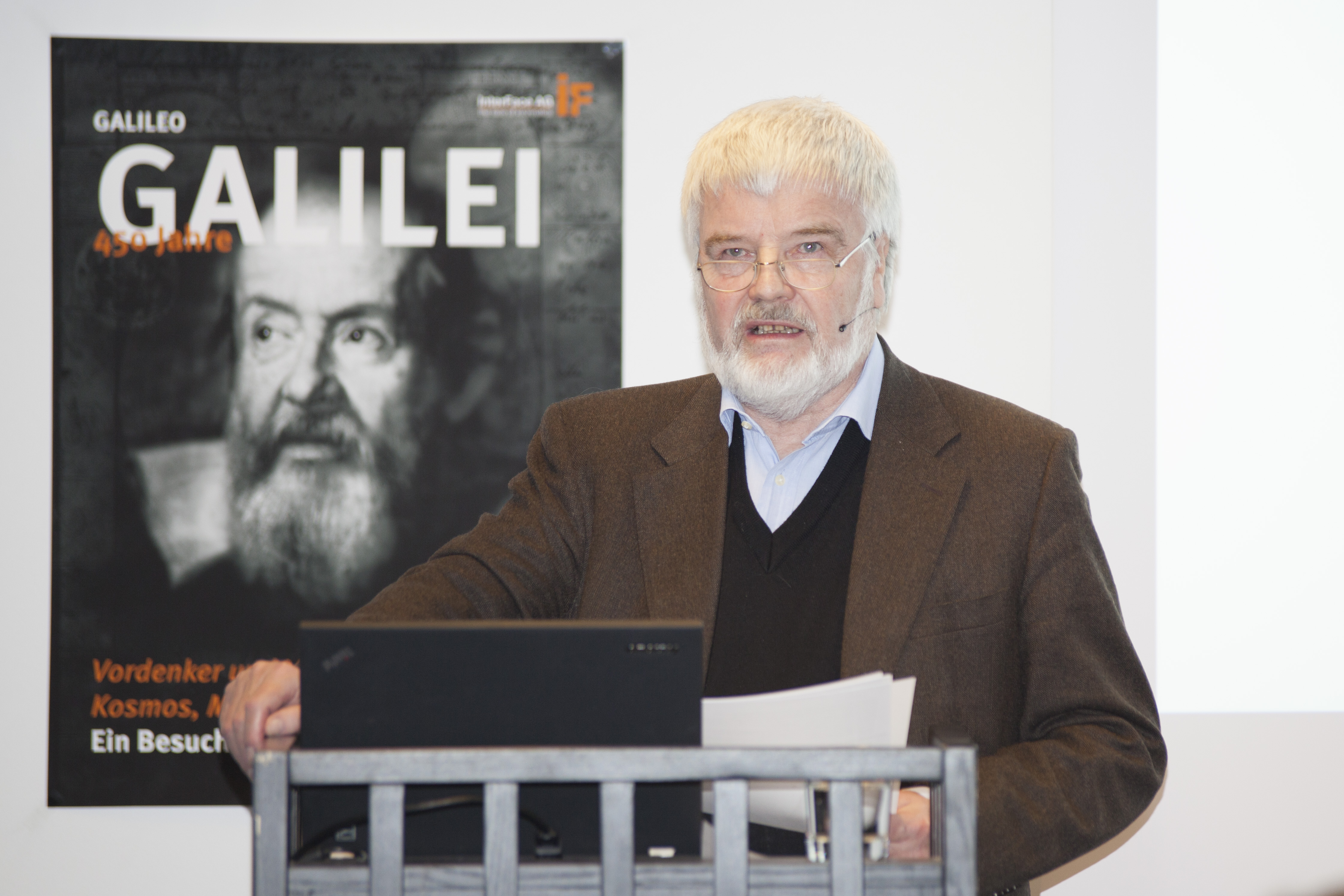
Jörg Schindler at the InterFace AG IF Forum
Are you a car driver, property owner or entrepreneur? Everybody is happy about the low oil prices and the resulting cheaper energy.
It saves money and, in the short run, has the effect of a great global economic stimulus plan. For the economy, they also expect positive impulses.
Except – the central traffic sector will remain extremely dependent on oil. This is a problem that cannot be solved by simply pulling the lever, following the motto “no more oil, electricity instead” (keeping everything else as before).
Instead of triggering the transition to post-fossil mobility, the oil production is now extended to arctic seas and ever lower oceanic altitudes at a high ecological risk. The low prices are misinterpreted and seen as fortuitous boom boosters, providing an extra motivation to again do some serious “upgrading”.
What are the reasons for the oil prices falling so drastically? What price will our society have to pay for this prolonged fossil resource consumption? Will this make a halfway tolerable transition towards a post-fossil, sustainable development (Great Transformation) even harder to achieve?
The speakers Dr. Martin Held and Jörg Schindler say that the most important factor for a successful Great Transformation is in danger: the adaptation time. What are the alternatives? Who could start working on said alternatives? What is the role of the civil society when it comes to the future transformation process?
For registration, please send an E-Mail to andreas.schuster@greencity.de or call 089/890668319.
The speakers are:
Dr. Martin Held (discussion group: Die Transformateure – Akteure der Großen Transformation, board member at ASPO Deutschland e.V. and long-time head of studies at Evangelische Akademie Tutzing, Tutzing)
and
Jörg Schindler (discussion group Die Transformateure – Akteure der Großen Transformation, board member at ASPO Deutschland e.V. and long-time managing director of Ludwig-Bölkow foundation, Neubiberg)
RMD
(Translated by EG)
P.S.
If you cannot come to the presentation but still wish to invite the speakers at another time, I will gladly connect you. Just send me an E-Mail .
Roland DürreFriday February 12th, 2016
Three Phrases that can Destroy all Joy and Courage.
And I mean both for yourself and for others.
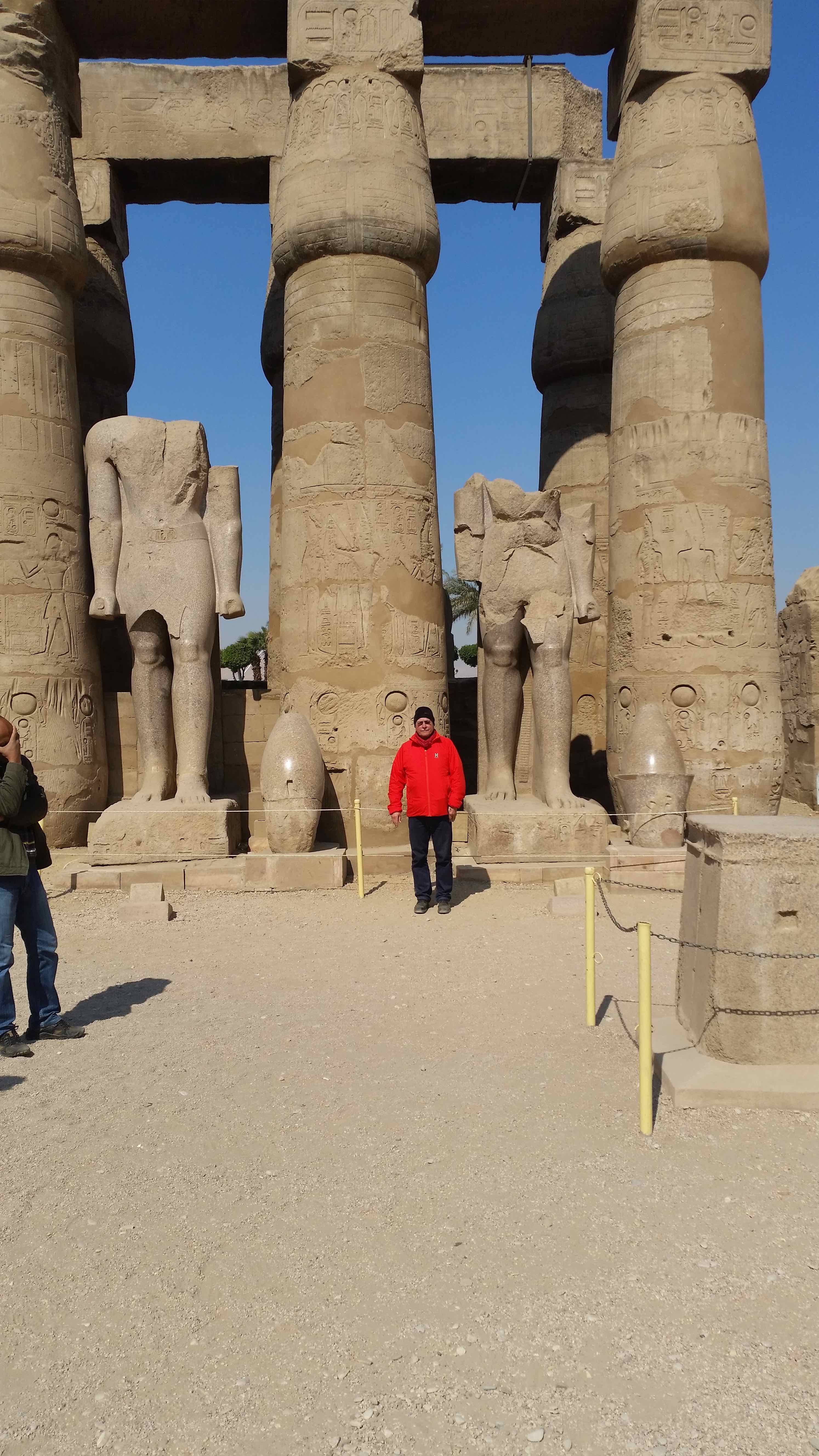
We are back home! Humans are such small creatures. On the left, you can see Muhamed, our guide and friend.
Last week was the first time I saw the tombs and temples of the Pharaos. I learned many new things and had time to ponder.
I became aware of three phrases that can make life harder. The first one is
“Yes, BUT …“
Early in life, I learned that it is probably not a good idea to say “yes, but” too often. It happened while I underwent management coaching.
In entrepreneurial everyday-life, I sometimes suffered under the “yes, but” attitude of the people around me. It probably never gained us very much.
When we decided
Hurrah, we will go on our first ever cultural Nile river trip!
the phrase re-surfaced.
I often heard it – sometimes I even heard myself saying it.
Yes, but what about our carbon dioxide footprint …
(a problem I take rather seriously)
Yes, but aren’t cultural trips always so tedious …
(a temple a day, and sometimes two…)
Yes, but what about the long travel until we get there …
(it took almost 13 hours, first the train to Nuremberg, then the flight to Hurghada on the Red Sea and from there the bus to Luxor – another 380 km).
Yes, but we cannot do it because of the terrorist threat …
(while two trains collided in Munich)
and so on, and so forth …
And how stupid we would have been had we abstained from this trip!
The second phrase I mean is
Being opposed to something!
How often do I catch myself opposing something?
I oppose the gigantic subsidies of business cars. I oppose fascism. I oppose the stupidity of politicians. I oppose the coal harbour on the Barrier Reef in Australia. I oppose waste of food. I oppose bureaucracy. And so on, and so forth …
Just a few years ago, my friend Jolly Kunjappu declared that “being opposed to something” is a negative concept that will push you down. Why don’t we, instead, focus on what is nice, what we like and what we appreciate? This concept will give us courage and joy.
The third phrase is one that I was made aware of by Moslam last week. Moslam was our guide during our Nile river trip. We became friends. He regularly travels to Germany. Consequently, we also talked about his experiences in my home country and he told me how it always moves him when his German friends keep saying:
“We must …“
I know very well from my own experience what he means. I must go and buy some milk. After that, I must write an IF Blog article and evaluate business plans. And then I must meet Barbara for lunch at the Artemis (the Greek restaurant just around the corner). And in the afternoon, I must meet friends from the university at the Forschungsbrauerei for the brown ale initiation. And tomorrow, I must go and attend the F.re.e …
But then, isn’t it wonderful that I can go and buy milk. After all, it is not at all a matter of course that, just around the corner, you can buy good milk in the brown bottle with 3.8 % fat. It actually still tastes like milk! And I always enjoy dining at the Artemis, because there the food tastes excellent and the Greek landlord and landlady are always so friendly. The Forschungsbrauerei, too, is always worth visiting and at the F.re.e , there are so many impulses waiting to tell me what I can do – thanks to the diversity of cultures and regions on our great planet.
These are all things I enjoy doing, because they are just wonderful – so why would I have to do them?
In a nutshell, I would say: It pays to think and write in a “positive” way. If that is what you decide to do, you will feel and think more and more like it!
Pure luxury between Luxor and Assuan. Isn’t life just great?
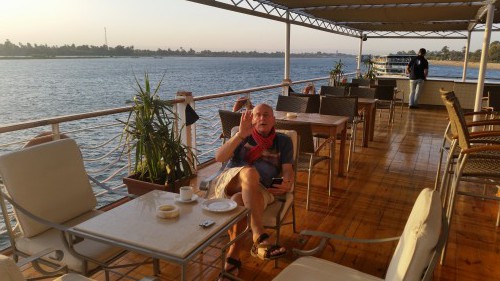
Luxus pur von Luxor nach Assuan. Das Leben ist schön!
RMD
(Translated by EG)
Roland DürreSunday January 31st, 2016
Imagine you could just pick up any car that is sitting at the curb and drive wherever you need to go.
Here is a film I would recommend all those who still believe in cars should watch.
My friend Marcus (Dr. Marcus Raitner) frequently writes about important project management topics in his blog “Experiencing Leadership“ (Führung erfahren). This week, he took a further step, writing about “on ownership and use “ (Vom Besitzen zum Benutzen). In my opinion, this is another article extremely worth reading!
That gave me a rather absurd idea. Let us assume everybody could use any car that is sitting around. During this fictitious concept, let us also forget about the fact that cars need a regular infusion of gas and that they have to be maintained and repaired. There are some sorts of fairies who see to all this. For instance the millions of jobless who do not know what to do with their time.
Let us forget our personal and emotional relationships with our cars (my Golf Diesel is my best friend).
No. We just want to go somewhere and, in order to get there, we take the next car sitting at the curb. When we reach our destination, we get out and leave the car where it is.
Now if any of you fears there might not be enough cars, then I would suggest we also mentally include the one million cars in Germany that are sitting around stockpiling or on the huge lots owned by the car-dealers.
Well, if we did that, we all would suddenly see with absolute clarity what absurd “luxury” we indulge in. All the gigantic amount of money, metal, consumption, energy that is used up by these tin boxes. How this mass reduces our living space and minimizes our quality of life.
And I would continue going by bike and wriggle through the tin avalanches. Because I need to enjoy movement, very much appreciate fresh air and dislike being locked into small rooms – where I am forced to be motionless yet attentive. Incidentally, I also rather disliked it when I was a child.
RMD
(Translated by EG)
P.S.
Let me, again, point you towards our movement #AktMob and its camps #AktMobCmp.
Roland DürreSaturday January 30th, 2016
What I Personally Just Cannot Understand
 Well, basically,
I just cannot,
or maybe no longer,
understand
or maybe I never understood,
if I am totally honest.
- Why father and mother had so many and so very unnecessary arguments;
- Why I was beaten at school, (too);
- Why there was a totally senseless war fought in Vietnam when I was young;
- Why a country like the BRD never made use of the historically unique chance to live without an army, just because they were afraid of the Russians … (re-armament);
- Why the Israeli act exactly like they basically must not;.
- Why the Federal Army is to get 130 billion euros between now and 2013 (while at the same time we urgently need money for other important things, such as education);
- Why everybody ignores and tolerates the deaths on German motorways, reasoning that otherwise jobs would be lost;
- Why they justify endless stupid projects saying otherwise jobs would be at risk;
- Why people today are not happy to see how you can drink water from all taps and how you can buy everything that makes life more agreeable – for instance fresh full milk with normal durability and 3.8 % fat in the brown glass bottle (isn’t that something to be really happy about!);
- Why the elderly gentlemen in the public swimming pools keep let the warm water under the showers run for several minutes while standing in the ante-room and having conversations;
- Why people buy yoghurt and similar things in plastic containers and why said containers are often more important than what is inside;
- Why there are still people living in Munich who eat walnuts imported from California;
- Why cars have become the means of transportation for everybody as a matter of course;
- Why sex is still a taboo topic;
- Why so many persons think prisons might be a way to make the world a better and safer place;
- Why some others believe in “creativism” but still think there is no “climate catastrophe”..
- And a whole lot more …
Well – if these things do not make you shake your head, than what does?
(Many thanks to Bert Brecht, because I took parts of his Dreigroschenoper as a model for these lines).
RMD
(Translated by EG)
Roland DürreMonday January 25th, 2016
The Democratic Opinion Building Process
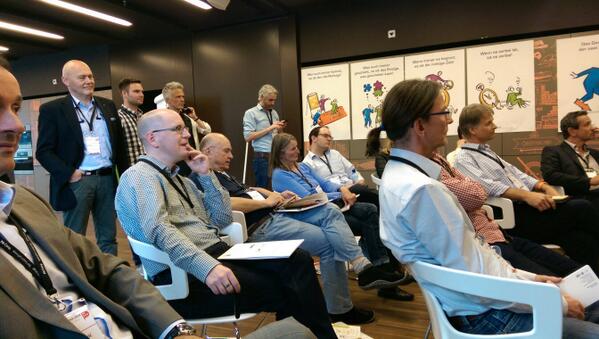
Picture of the wonderful Zürich PM Camp.
Ever since I remember thinking myself, I have been both impressed and confused by my own species. How we love and hate. How we wildly celebrate and mourn together.
How, because of totally irrational constructs, we fight each other to the death and are capable of the most unspeakable cruelty. How we quarrel and have arguments and then make up again. How we contradict ourselves. How, once in a while, we actually make some progress and yet then slide back again. How we believe in constructs we invented ourselves.
The more I learned, the more the twists of human history over time surprised me. For millennia, the course was a zigzag line and in between we went forward and back. Again and again, there was also some small progress. But we never really made the huge step forward. Consequently, humans are still incarcerated, cut up and tortured. And there is endless hypocrisy and lies. Collectively, as always, we murder and pillage in the name of God or in the name of the people or for a cause – or in the name of whatever.
It is quite fascinating to see how, on the one hand, we really made progress (I mean enlightenment and similar achievements), what great toys we developed in technology and yet how absolutely backwards and unwise (stupid) we remained at the same time. And how we find it quite normal that we are in the process of, as a matter of course, destroying our planet (and ourselves). Regardless of the fact that a different life would probably be a much more agreeable life.
To me, it seems that, especially collectively, we are stupid as one person alone could never possibly be. In fact, it is quite legitimate to follow Gunter Dueck and say that there is a very special collective sponge stupidity. Stupidity as in: the opposite of prudence.
Regardless of this threatening reality, I still believe in the utopia of a just society free of punishment, violence and war. But how to get there? If at all, it can only happen through communication and mutual understanding.
Would it not be nice if we were to manage peaceful solutions for all kinds of social challenges through teams and groups by way of consensus? And if, then, we could realize those solutions together? Following the Seneca motto:
Philosophy is not about talking, but about acting?
As we see on a daily basis, meetings are not really an appropriate means for making progress, are they? Perhaps it would be best to have peer-to-peer meetings with a fixed topic to discuss. Because everything begins with two persons meeting. But then you do not have a group or team effect.
This is how, as early as perhaps fifty years ago, Habermas defined the honest discourse. I described it in my presentation on “The Change in Management“ (Der Wandel im Management – see at the bottom of this article). And in fact, we have already come a little closer to it.
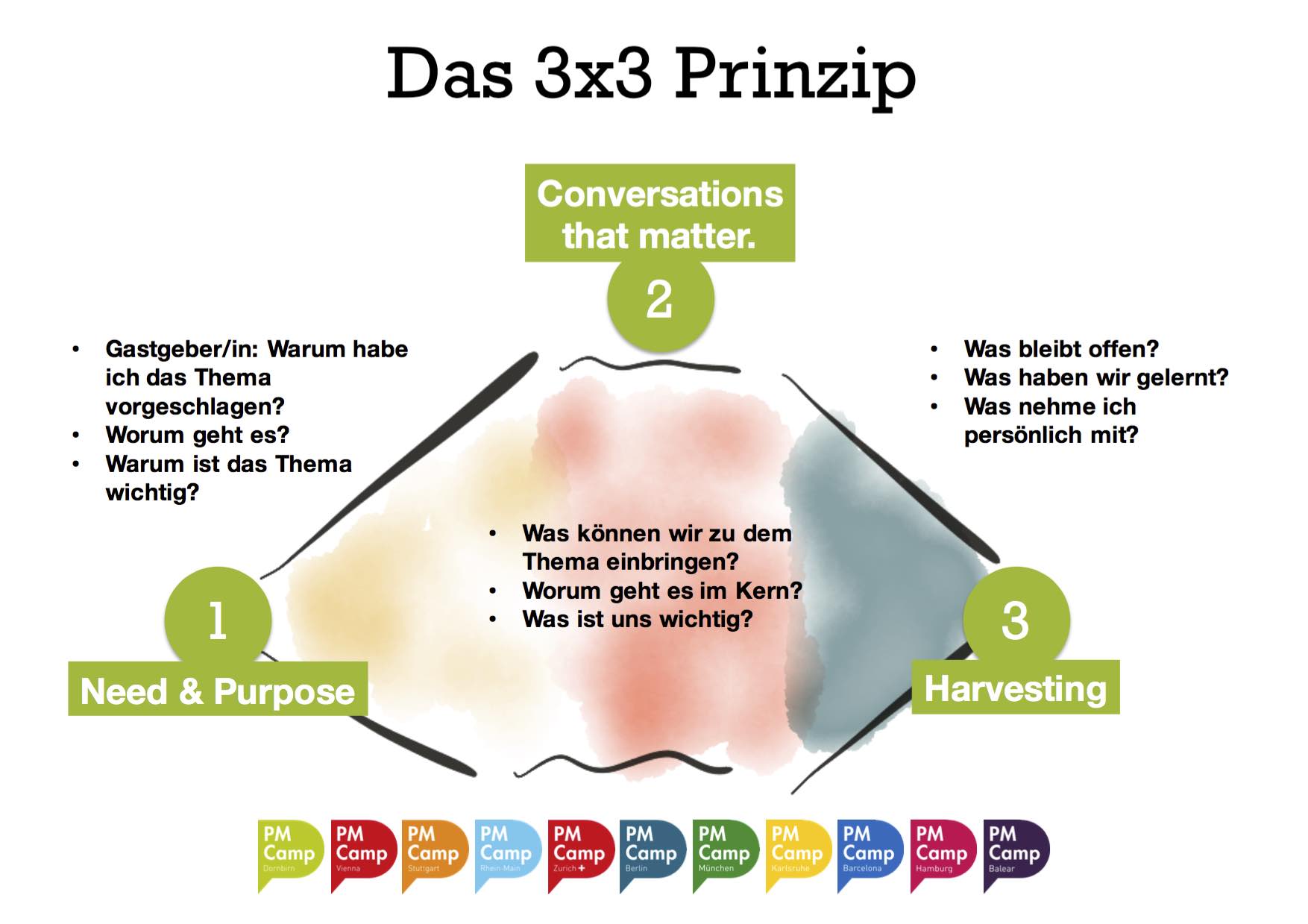 My colleagues of Art of Hosting, too, sound encouraging to me, as do the PM Camps I was able to attend.
Barcamps are very “basic” events. The hosts create a setting in order to make it possible for their guests to have good conversations. The persons who come are those we want and they will be true part-givers. And they decide in which direction we are going. It is an anti-conference, the democratic opposite of a conference.
Barcamps and similar formats like “Open Space“ are precious concepts. In Germany, there are thousands each year. They are about many topics: Sometimes they are about re-activating life in the city or the solution of social challenges. Other topics often discussed in barcamps are the work-life, education, family, research, gender issues, society, health, innovation, life, mobility, entrepreneurship, change, diversity, the future and many, many more.
I often get the impression that there is no important topic today that is not taken up on a barcamp somewhere. And I understand more and more clearly that all these anti-conferences and barcamps are the places where persons can make a difference and have an impact on the future. After all, during these events, people meet in order to share knowledge and experience – and they build networks!
Since all these many barcamps are so important, I am rather glad that, so far, I never heard about a fascist or right-wing radical barcamp. Maybe the methodology of a barcamp is a contradiction to “fascism”, thus making them mutually exclusive? Isn’t that a wonderful idea?
I related those ideas to my friend and partner Eberhard Huber. His reply was:
I think the ideas of fascism and barcamp are, indeed, mutually exclusive. Fascism is always connected with some dogma. Said dogma always claims to possess the absolute truth. Dogmata and claiming to know the absolute truth need prophets you listen to. Given an open discussion such as they happen in a barcamp, the only thing that will inevitably happen to the status of the prophet is loss.
Well, this gives you hope, doesn’t it? And perhaps, some day, we will actually manage to fulfil the requirement formulated by Bertrand Russell. He said:
» All increase in technology, if you want it to promote, rather than lessen human happiness, causes the same increase in wisdom. «
Maybe, with new communication and new formats, we will, at long last, manage to gain the crucially necessary WISDOM. And then we might hope that, by the time our generation is extinct, the future generations will do a better job.
RMD
(Translated by EG)
Roland Dürre
UPDATE: Creative Times
Unfortunately, I made some history-related mistakes in my article Creative Times (Kreative Zeiten).
(Many thanks to Claus M. Müller – then managing director and part-owner of InterFace Computer GmbH).
Here is what we currently know:
The Konrad-Zuse-Tour organized by InterFace took place between the years 1982 and 1985 and had four legs. We had planned to visit Konrad Zuse, the inventor of the electronic calculator, in Hünfeld and pay our due respect to him on his 75th birthday.
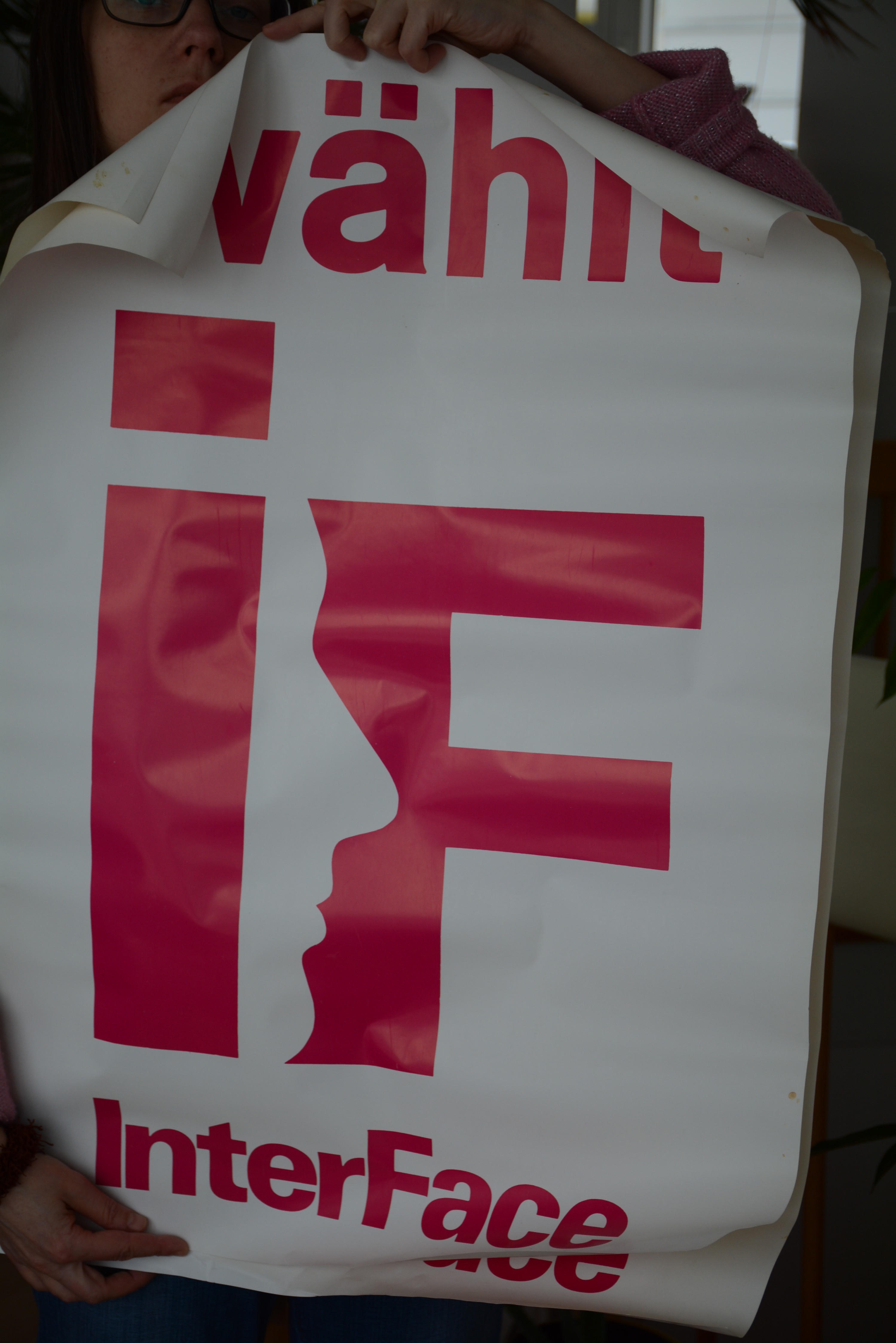 It seems that the poster was printed in 1982 and not in 1986! That was also a state election year (Landtagswahlen) in Bavaria. At the time, the interval between state elections was still four years (in 1998, they changed this to five years).
In 1982, during the first leg between Munich and Regensburg, I was not part of the cyclist group. To be sure, I knew the InterFace group around Peter Schnupp, whom I learned to very much appreciate and like at Softlab. But other than that, I did not yet have any connection with the InterFace GmbH and InterFace Computer GmbH (except that I rather liked their logo).
In 1983, the second leg from Kelheim (?) to Nürnberg (?) was scheduled. As Barbara’s husband, I was permitted to take part. At the time, she worked for the InterFace Computer GmbH, developing a syntax-based editor. Even as early as then, she was allowed to write programs in the language C that, later, I was going to love so much.
In 1984, we continued with the tour. The InterFace Connection was now part of the group (it had started as an enterprise on April, 1st, 1984).
In 1985, we had the great finale, arriving in Hünfeld to celebrate the 75th birthday of Konrad Zuse. I still remember very well how we were welcomed in a community office at Hünfeld and how pleasantly Konrad Zuse greeted us in his speech. Konrad Zuse also invited us home and gave us one of his pictures. It is still in the InterFace AG office today. In fact, the number of cyclists who went on this tour was quite large, consisting mostly of InterFace Computer GmbH and InterFace Connection GmbH employees.
We were able to reconstruct the history because of our children. In 1983, we had Sabine (born in September 1980) and Maximilian (born in April 1982) with us. In 1984, our little Martin was also with us (born in January 1984). All three of them were also riding shotgun on our bikes in 1985.
As you see, there are still a few question marks in the article – which means I would certainly appreciate more insider information on our Konrad-Zuse-Tour.
But one thing remains very clear – the tour was a wonderful adventure. It gave much joy to all those who took part and thus gave us courage for more enterprises.
RMD
(Translated by EG)


