
Roland DürreMonday December 25th, 2017
Travelling with Electrical Drive – in the Alps and on the Peloponnesus – with my E-Bike.
🙂 Well, I remember my promise to write more about sex and electric bikes. Consequently, I will now relate my experiences with my eWMe 627 from CONWAY.
I already told you about our eCargo. Not only is the car no longer at all an option when we go shopping; for the grandchildren and for leisure activities, too, the cargo has turned into the absolute favourite means of transportation for the entire family. And for me personally, the eCargo triggered the “electric bike preference”.

My E-Enduro with a 160-mm drive, the Conway eWME 627 as the second E-Bike in our family.
Formerly, I often went into the mountains with the Mountain Bike. Uphill, I was never very fast. And, naturally, I did not become faster in the last few years.
Which made it more of a challenge for me to go on bike tours in the mountains as a couple or in small groups. My younger and more athletic travelling companions always had to wait for quite some time sitting on top of the mountain until they finally saw me push my bike up. I was not the only one who found this unnerving.
Then came the summer – and consequently the yearly Peloponnesus mountain bike tour (near Gythio and Mani). So I decided to test an electric mountain bike at our familiar bike salesman (Dully’s BIKESTATION).
To say it in a nutshell: I was absolutely fascinated. Consequently, I bought one and now mountain biking is again something I truly enjoy. In 2017 in Greece, I covered about twice the distance (and altitude) from the years before.
About the bike and its technology:
As you know, my eCargo has a rear motor (GoSwissDrive), a simple ladder network and a hub dynamo at the front tyre. I find that rear motors are only ideal for a Cargo bike, the chain is not too strained and, thanks to the hub dynamo, it can also be used at night, even if the battery is empty or you do not carry it with you.
My mountain bike has a different system. It has a Shimano mid-bike motor at the crank. SHIMANO Steps-System is a system of e-bike components (motor, battery, control, range calculator, …) that was designed exclusively for mountain bikes. The same bikes are also available with Bosch technology. When I tested them, I liked the Shimano system better because of the interval-free support and the better coordination.
As with Bosch, the heart of the Steps-System is the mid-bike motor. It weighs 2.8 kg and is perhaps one of the lightest motors on the market. The mid-bike motor sits in the crank; as opposed to front or rear drivers, it is not a direct drive. Instead, it has a gearing mechanism. You can also easily ride without electricity, the motor will not slow you down. You only have some additional weight because of the motor and the electric gadgets.
That is probably the reason why mid-bike motors will always make a slightly grating noise. The only relatively soundless motors are those from Impulse and Brose, all other motors (by now, many companies along with Bosch, especially from Asia, offer them) are far noisier than direct drives – which you really cannot hear at all. You also always get a slight push when the motor turns itself on for support, which is not what you get with the direct drives that sit in the front or rear tyre.
Regardless, I believe that the mid-bike motor is the best for mountain bikes. The weight of the motor and battery are close to the crank. Whenever you go up or down steep hills, this is definitely an advantage.
Most of the electric mountain bikes have a simple ladder network (one gear-wheel at the front and quite a few at the rear), it is the mechanic Shimano XT for the Conway. It might be a disadvantage that, if you have a mid-bike motor, the entire power (both from the human and from the motor) is transferred to the chain and the gear. But, as I see it, that can be ignored for the mountain bike, because everyone knows you have to change the chain and the pinion at regular intervals.
Range
I am always asked: “How far can you go with one full battery?”. This question is not easy to answer. Naturally, the range depends on such parameters as the incline of the course a biker selected. For long inclines in one row, you need more electricity than if you go up and down the hills alternatively all the time. The frequency of pedalling is also important (If I am correct, the ideal frequency is considerably higher than 60 per minute). And, of course, it also depends on the mode you chose.
STEPS has three modes: ECO, TRAIL and BOOST. If you save electricity by using ECO and if you cut down the motor when you go downhill (due to the mid-bike motor principle, STEP cannot recuperate, so it makes sense to switch the entire drive off whenever you do not pedal – and if you do not pedal, there is, naturally, also ZERO motor-caused resistance), then the range is generally more than 100 kilometres, i.e. in the three-digit area.
If you use the mode TRAIL, I would assume that you can always easily go around 70 kilometres with 700 metres of altitude. However, if I use BOOST and really force the bike up the mountain, then I can easily imagine that the power is low after 20 kilometres. That never happened to me. I assume it would be more like a fun-ride.
For travel bikes, I would not recommend the mid-bike motor. But I will tell you more about this when I describe my Utopia London.
For me, my e-mountain-bike is a constant source of delight. If I go downhill, I no longer have to accept the high speed of former times (I always wanted to make up a little time when I went downhill, because I had always lost so much time going uphill). And above all, the electric day trips now take less time – which means I no longer need to get up so early and I also return home earlier than I used to. If, formerly, the entire Sunday was “wasted”, I now have time left for other interests.
On my trips with Barbara, I now had to wait for her at the top of the mountain. That was also true in Greece. I went with electricity, Barbara without. Circumstances were now reversed.

Barbara’s electric mountain donkey, the Conway 327.
Later, she also bought a Conway 327 – and now we have great fun together. Our day trips to the Bavarian Alps no longer take too much time and we no longer have the burdensome long inclines we used to have. And I truly look forward to the spring and am absolutely sure that, in 2018, we will often spend time in the Alps. And I also truly look forward to the two weeks of biking and swimming in August/September on the Peloponnesus!
My next article will be about my Utopia London with front drive. For me, it is the perfect travel and everyday bike. If I see similarities between the eCargo with and a VW transporter, then the eBike is more like a jeep and my London would be something like the Mercedes S-Class Limousine.
So “my Mercedes” (of Utopia) will feature prominently in my next e-bike article.
RMD
(Translated by EG)
P.S.
I took both pictures from the Conway Website – you will find several links to this site.
Roland DürreSunday December 24th, 2017
Here are two short videos on DOAG.tv
Since I am currently often pointing you towards video recordings, here is a short interview with me at DOAG@Talk:
I already told you about this interview on DOAG.tv here (on IF-Blog.de). But so far it had not been linked.
Talking of which: there is another Management interview on DOAG.tv that Dietmar Neugebauer recorded with me. It was about “PROFIT, TURNOVER, PROFIT CAN BE MEASURED – BUT THAT IS NOT TRUE FOR IMMATERIAL VALUES“:
Here is the Video.
And there is also an IF-Blog article IF-Blog article.
RMD
(Translated by EG)
Roland DürreSaturday December 23rd, 2017
DIGITAL – AGILE – OPEN – LEAN (Presentation)
On October, 26th, 2017 I gave a presentation at the Augsburg “Hotel am Alten Park” in the Frölichstr. 17 for the Bayerische Akademie für Verwaltungs-Management GmbH / Bayerische Verwaltungsschule (BVS) at 2 p.m. – it was the final presentation of the event MQ4.
I spoke about –
DIGITAL – AGILE – OPEN – LEAN
– where I wanted to and was supposed to answer the following questions:
What is agility – yesterday, today, tomorrow? What do organizations need in order to react to change in the correct way (and with due speed)? What concepts, methods, tools and competence is the idea based on?
The presentation was recorded on film, please see below. My memories of the presentation are not exclusively positive ones. For me, the day was not an easy day:

Motto of the institution (according to the Website): Health, education, care, friendliness towards guests and spirituality are the main agenda.
The event took place at the hotel am alten park, which is part of a huge building complex that belongs to the evangelischen diakonissenanstalt augsburg (diako).
In this “deacon-house”, as we used to call the hospital in our childhood, my father had died on a grey late autumn night in 2008. At the time, I had heard about him being admitted into the hospital in the late afternoon and immediately driven to the hospital in Augsburg by car.
My father was poorly, but according to the doctors, his condition was not life-threatening. Consequently, I drove back home at night – on a dark autumnal motorway with snow storm – to Riemerling. And when I arrived at home, I heard that my father had died.
Now, roughly nine years later, I was again standing in front of this building – and had to enter. This is how my presentation visit to Augsburg became a sad trip into my past. I remembered that I had been robbed of my totally intact tonsils in exactly this “Deakon House” in 1960 because I had suffered from several colds in the winter of 1959/1960. I remembered that, at the time, I fought against the operation, but naturally I lost and still suffer from the consequences (see my IF-Blog article). And I remembered much more that I had experienced in this town. Before my presentation, I had a wild emotional bob-rally through all the years of my childhood in Augsburg between 1955 and 1969.
As I watched this video, all my memories were refreshed. In my own perception, my presentation was occasionally a little lacking in concentration. Considering my personal experiences, I can forgive myself for this and will publish the presentation regardless, because it looks rather authentic to me.
However, my less than perfect emotional situation was not the only reason for the perhaps missing clear line. On the way to Augsburg, I had also considerably restructured my well-prepared presentation. The reason for this was that I had spent intense study time with Bitcoin and Blockchain during the preceding week, which had led me to some insight that had been totally new to me before.
I had not understood (and still cannot understand) why they demand and want to realize things on the internet that are rigorously withheld in real life.
Why can you participate in profound activities, conduct transactions and even own money on the internet while you are well camouflaged behind identities? Mind you, you can do all this totally anonymously! On the other hand, this is exactly what they deny you more and more in real life.
Or are there good reasons after all? Reasons that justify that it is still possible on the internet? For me, that is a very central question!
Bitcoin is a good example how, due to wrong requirements and poor execution, the wonderful idea of “democratic” money was perverted and became a criminal betting and fraud system. “Well meant but poorly executed” – as I see it, this is how you can describe the phenomenon.
Now I am eight weeks on into blockchain and bitcoin and thus can better explain my reservations and ask my questions with more precision than eight weeks ago.
I also wanted to point out in my presentation that we are again in times of a grandiose digital change. It is no longer about human-machine, but about machine-world.
Let me describe it: I have been programming since 1969. Initially it was basically about algorithms and technologies such as compilers, operating systems, batch runs, transactions, data transfer and databases, along with a few applications.
Then almost everything was about the interface between humans and applications (human-machine). That brought us from the punch card to the tablet and from typing to voice and gesture recognition. There was a virtual explosion in the number of applications.
Today, it is all about autonomous systems that often no longer need an interface with humans. Instead, they focus directly on the “environment”. That also explains why sensor technology explodes, making things possible that were held to be impossible until now.
All those things together were a little much for one short presentation. Consequently, I am quite happy that the presentation actually was more or less a success. Because “not feeling too well and free from the manuscript” is twice as hard for an orator. There were a few moments when I noticed how I did not really concentrate. If you watch the video, I would kindly ask your forgiveness.
RMD
(Translated by EG)
Roland DürreSaturday December 16th, 2017
Macabre Christmas Greetings – Car Mania – Looking at: Munich …
 The following “Christmas Greetings” were sent to me by a person I know quite well. He is a truly competent expert in the field of mobility. I would like to thank him very much, indeed!
Hello everybody,
here are a few current statistics about the number and system of drive for cars and trucks registered in Munich:
| 2017 | |
| cars – existence | Nov |
| gasoline | 427.894 |
| diesel | 287.869 |
| electric powered | 2.177 |
| trucks and others | Nov |
| gasoline | 4.831 |
| diesel | 49.770 |
| electric powered | 155 |
In particular, you can see that there are too many cars and they are equipped with the wrong drive – so are the trucks.
Basically, we are still (rather) far away from a change in mobility …
What a mess!
That made me thoughtful!
It is easy to calculate the sum of all cars by addition. You get a total of 717,940 – without trucks! And it seems that numbers are still rising.
Now let us assume that a car, if parked “bumper to bumper” needs a minimum of five metres parking space. If you multiply 717,940 (number of cars) with 5 metres (length of car with a little space in between), then you get 3,589,700 metres. In other words: if you park all cars of Munich in one long row (with little space in between), you need a street with the length of 3,590 kilometres!
According to Wikipedia Munich covers an area of
| 310,7 km2 |
And this area will not increase. It is certainly not a solution to try and build basements underneath everything. Nor would it, in this case, make sense to “suburbanize” more areas.
Let me continue with my calculations. If Munich were a square, then the length of either side would be 17.6 km!!!
Now let me divide the length of the street we would need (3,590 km) by the 17.6 km side length. The result is: in our square Munich, we would need 204 parallel streets on 17.6 kilometres of length just to park our cars! In other words: there has to be a parking lane for cars every 86 metres. The number is a gross number, because each parking lane has to have a certain width.
Isn’t that a terrible concept? To be sure, Munich is not a square but a rather unorthodox shape. But that does not change anything about the principle. Consequently, I believe that this small computation should, indeed, worry us a little bit. What a stupid waste of valuable land and what a destruction of living space!
I find another concept no less worrying:
If you remember that there are hardly any cars left that weigh less than one ton and one can assume 1.25 tons as average car weight, then we have 897,425 tons of toxic waste in our beautiful Munich just sitting there. That is nine times the weight of the Golden Gate Bridge. As soon as said toxic waste starts moving, it smells and generates dirt and makes many people sick. Moreover, it injures and kills people and, last not least, deprives them of exercise that would be so important for them – one of the consequences of which is poor health.
And I know from personal experience that, if you look closely and are even slightly willing, you only need cars on very rare occasions. There is hardly anything you cannot organize just as well without a car.
All you need is the willingness to forego a little bit of your comfort and to question what seems to go without saying. And you have to refuse to accept all the detrimental consequences, both for all of us and the users themselves (1.4 million traffic fatalities each year, destruction of our world, health damage by dirt and noise, destroying your own health by no longer exercising and becoming stress victims).
So it is all only about giving up a few sub-optimal and detrimental habits. Habits the positive effects of which are only allegedly positive effects, anyway. Those who are not prepared to do this are those for whom all help is in vain.
Consequently, the question is:
Are car drivers scum and riff-raff? Or are they just stupid? Or both?
Well, the aggressiveness of this statement is not something I like. In fact, I hate the sentence, because such generalization is not at all typical for me. But perhaps the gist is not all that wrong and perhaps, in the face of our car mania, there is no other way than to get the bat out of the sack like knave Ruprecht?
For me, this evil question is a good reason (because I want to be neither scum or riff-raff, nor stupid) to only get into a car if there are really very good and important reasons to do so. Basically, if I am actually almost forced to do it.
In my life, that happens maybe ten times a year – with a decreasing tendency. Mind you, at the same time I am more “mobile” than ever before, which I can prove by my Google-Tracking-Profile.
And my new active mobility feels absolutely great to me. I am also more efficient than I was before. I truly no longer have time to drive a car.
So, I, too, can only say:
🙂 What a mess!
RMD
(Translated by EG)
P.S.
I just received a supplementary email from the same source (i.e. the aforementioned expert). Here it is:
“looking at the low number of car-sharing vehicles (considerably less than 2,000, I am currently trying to find out the exact number) and at the fact that there will hardly be any additional railroad infrastructure for the Munich public transport although the number of inhabitants is expected to continue to grow in the next 5 to 10 years, it is quite easy to imagine how the public transport vehicles we now have and the cyclists’ paths will be even more crowded and narrow than they already are!
The negligibly small number of e-vehicles we expect in the next few years will not (be able to) contribute towards a reduction in air and noise pollution in the Munich city street network!
Consequently, the only things you can promote are active mobility (hiking and biking), public transport (short term: faster busses and special rights for busses) and the attempt at improving the vehicles’ drives (cars, trucks, busses, motorbikes, mopeds, construction machines, etc.)“.
All that remains to be done by me is thank the sender of the email and agree with everything he says. Except: when it comes to bikes, I have a slightly different opinion. We, the bikers, must fight the car drivers and thus gain the streets back from them! If there is no other way, then we must do it without legal support and by putting a little pressure on the powers that be.
Above all, we will continue with AktMobCmp. More motivated than ever!
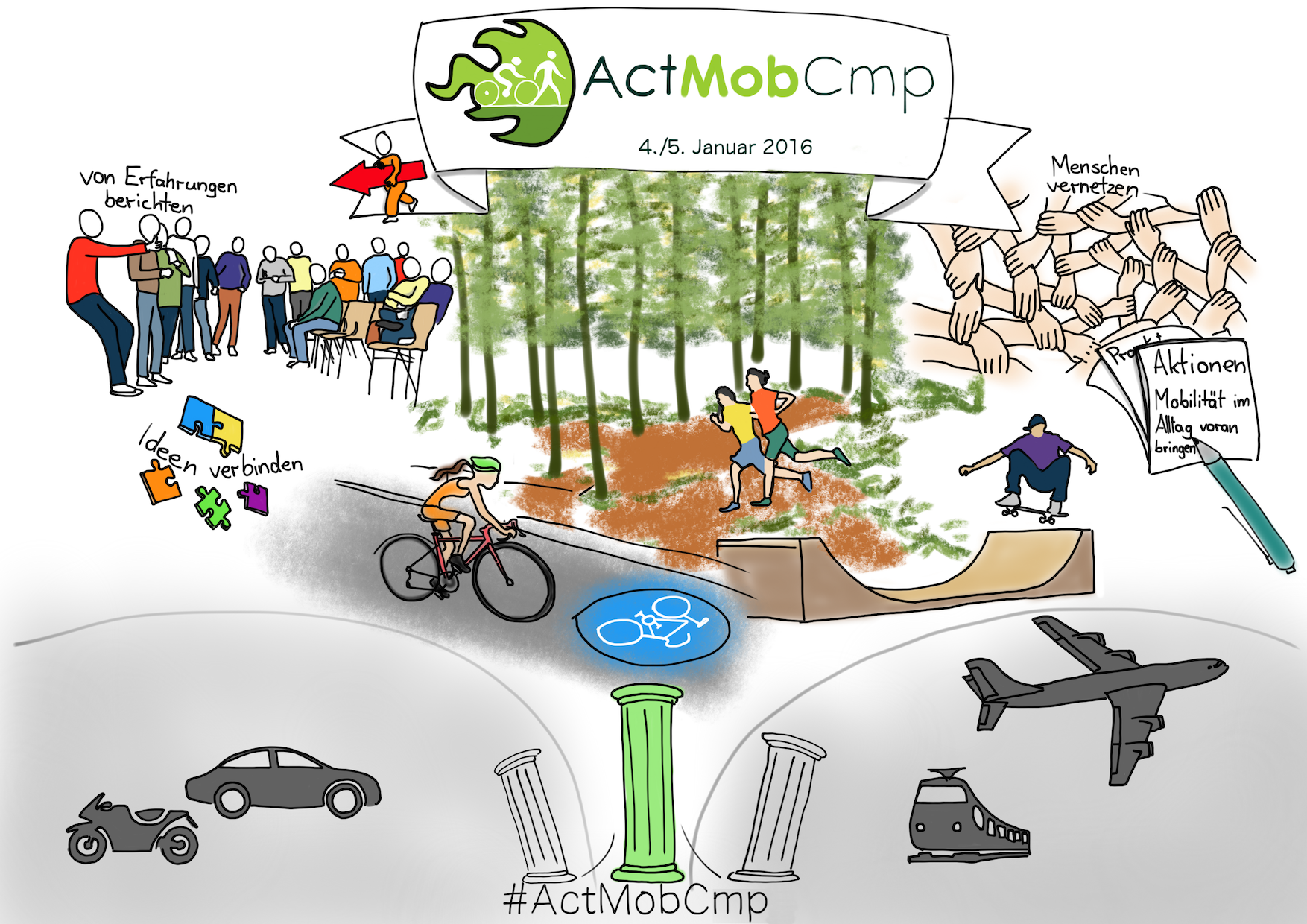
Donated by VisualBrainddump (Christian Botta & Daniel Reinold) Click image to enlarge.
Yesterday, we had our yearly InterFace AG Christmas Party. As always, it was a nice party – with lots of music, dancing and communication. We were in the Rock-Café in the heart of Munich.
On the preceding evening, they asked me to say a few personal and Christmassy words. I worked very hard on formulating something nice and I presented it yesterday evening. You can find the text under the picture.
I took my inspiration from ALTO, Knud Johanssen’s saxophone. It accompanied us beautifully during our performance on October, 22nd, 2017 at the Nuremberg DOAG.

Here is what ALTO – Knud Johannssen’s saxophone, said.
Here are my ideas on Christmas 2017. I gave it the title:
WRONG or RIGHT?
It started with my early childhood. My educators wanted to make a perfect human of me. I was to be a model person! Every mother’s pride. I was to be nice, honest, obedient, polite, well-combed at all times; I was to stand upright at all times (“do not stand like a hunchback”), as well as talk in a loud, distinct and correct way – but only when asked. And, above all, I was to be a good student.
With many of their attempts, my suppressors failed. But nevertheless, it was far from nice for me. And what had been required of me certainly marked me for life.
Later, I wanted to be a “good” person, a diligent employee, a quick (and error-free) programmer, a loving husband, an understanding father, a top manager and a super entrepreneur.
Perfection was my motto. I wanted to be a “professional”, not a “dilettante”.
In other words – I wanted to do things “right”!
Then I understood that it is not so important to do everything “right”.
It is much more important to do “the right” things!
My reasoning is simple:
What happens if I do the “wrong” things totally “right”? Can’t it easily end in a catastrophe?
🙂 Consequently, I am now glad that I remained a dilettante through my entire life. Because that means it is not so bad if I occasionally did or do the wrong things!
But who knows what is “right” and “wrong”?
I live in the NOW. More often than not, I do not know if what I did YESTERDAY was “right”. So how am I supposed to know TODAY what will be true TOMORROW?
Today, everybody talks about TRANSFORMATION and INNOVATION. People suffer under the COMPLEXITY of life (it does not matter if said complexity is imagined or real). COMPLEXITY does not make it any easier to decide whether something is “wrong” or “right”. As I see it, the only way to deal with COMPLEXITY is PARTICIPATION. And the same is true for TRANSFORMATION and INNOVATION.
So:
The only way to find the “right”, i.e., the nice way is if we try to find it together. As many persons as possible must contribute by giving their hearts and their wisdom. We need to share knowledge and pull at one string.
As an inspiration, here is a small anecdote:
In 1985, everybody who was important in music met in order to record the song “We are the world” for Africa. At the door of the music studio, they had hung a note that said: “Please leave your ego out!”
Well, that takes us back to right or wrong. Because, of course, you need to contribute by bringing the “right” parts of your ego. You only have to leave the “wrong” parts back out.
So here I stand feeling gratitude and love and wishing you a nice holiday, a good start and a successful year 2018! Thank you for everything, in love!
WE ARE THE WORLD!
If you feel like it, you are invited to hum and/or sing. Because the message is:
DO NOT LAMENT, JAM (= TOGETHER)!
Now I wish everybody and especially those who are in some way or other connected to InterFace AG a wonderful and nice Christmas and all the best for the New Year 2018!
RMD
(Translated by EG)
Roland DürreTuesday December 12th, 2017
Creative Communication” on “Yesterday – Today – Tomorrow” with: “No Lamenting, Instead: Jamming“.
October, 22nd was a rather challenging yet nice day for us (Christian, Knud and yours truly). We met in Nuremburg in the morning because we wanted to try something in the evening. The idea was to “communicate in a really creative manner”. We simply wanted to say a few things that would remain with us and be sustainable.
We, that is Christian Botta, Knud Johanssen and me. We met in a small apartment at the Nuremburg congress centre. Because on this Wednesday, we wanted to star in a small show in the evening. Consequently, we had to practice a little bit.
Before that day, we had met exactly three times. We had worked on the idea and then developed the content and the dramaturgy in a “shared document”, because that seemed the best way to overcome the space-time-distribution.
Starting at 11:00 hours, we practiced “jamming”. It took until 16:00 hours, then we relaxed. At 17:00 hours, the time had come: as the finishing number of the DOAG Yearly Conference #DOAG17 “soft tracks”, we went onstage. With “creative communication”.
On this photograph, you can see us after hard work:
 Christian, our “host” Dietmar Neugebauer, Knud and yours truly
(from left to right).
But before that, the motto was:
“Yesterday, Today and Tomorrow” and above all “Do not lament, instead jam!“
Here is the premiere of November, 22nd, 2017.
With and by us: @pottasson (man with the pen), @KJohannsen (with ALTO, the alto saxophone, or rapper and ventriloquist). And I (@RolandDuerre – at the “speech“) was also part of the team!
RMD
(Translated by EG)
P.S.
Here is the link to the video:
https://youtu.be/JZPp_OCiZPU
And for those who prefer reading about it I will publish my texts in my next post.
Roland DürreThursday November 30th, 2017
On Tuesday, December, 19th, 2017 in the Herkules Saal The Christmas Oratorio by J-S-B.
Christmas is near!!!
What would Christmas be without music?
Music without singing?
Singing without a choir?
And the choir without the Christmas Oratorio?

Johann-Sebastian Bach’s Christmas Oratorio is part of the Festive tradition as much as the lights sparkling in the tree and the butter cookies. As early as the first alto-aria “Bereite dich Zion!” and the following choral “Wie soll ich dich empfangen?”, Bach’s great music gives fulfilment with every year anew. Beating drums, blaring trumpets, magnificent flutes and oboes, the murmur of the bassoon, the satin sound of the violins, violas, celli and contrabass will welcome Christ the child.
RMD
(Translated by EG)
Roland DürreSunday November 26th, 2017
My First Electric Bike – A Cargo Bike.
In the spring of this year, electro mobility made its appearance in our household.
With a cargo bike for shopping and for the grandchildren.

Our decision was finally made in favour of a CARGO-bike by i:SY. In Germany, the bike is produced by the well-established Hermann Hartje KG of Hoya/Weser“.
Our cargo bike is the type “long john. The alternative would have been a “Christiania“. It has two front tyres so that you would even be able to remain sitting when you are waiting at a red traffic light. The name is derived from “christiania bikes“, which is used for all bikes of this type, even if other firms have produced it.
The cargo bikes of the “long john“ type are available from various producers. Mostly, they have different dimensions, which means their cargo areas length varies (and consequently also the distance between the tyres). The producer of our model, too, is currently working on a version with increased dimensions. However, for our household with currently only three persons and the grandchildren, the shortest model is more than enough. If I need to carry particularly heavy or voluptuous cargo, I still have my trailer.
Our cargo bike is called “i:SY eCAR:GO“. Our home retailer (Dully’s BIKESTATION) in Ottobrunn recommended it most warmly. We chose it because it is a very flexible, almost sportsman-like cargo bike. Consequently, we mostly also manage getting through critically narrow passages quite easily.
I will not give you the measures and technical data – you can find them in the links. In our model, the cargo is at the front, just as you see it on the picture (the picture is also from the ISY website).
As an alternative for transports, you have a simple cargo plank. For us, this extra (a wooden box with a folding seat and children’s safety belt) was particularly important, because on the (folding) children’s seat, two kids can easily sit side by side.
This was also an important reason for us to choose the cargo bike. After all, as grandparents, we occasionally have to pick the children up from their day-care centres. And for them, it is certainly most enjoyable if they can sit up front, feel the wind blow through their hair and know that “grandpa” or “grandma” is sitting right behind them.
You can also get the bike without electronic support. Even then, the characteristics of the bike are excellent. Basically, it is simply heavier than a normal bike, but in the hill-less city of Munich, that is not really a problem. The non-electric model will be quite sufficient. But if you want to remain up front during a family outing with the other (younger) family members on their fast bikes, then the c-bike version is certainly helpful. For instance if you go east towards the Alps.
The motor of our eCAR:GO is a GoSwissDrive. It is a back drive, which, to me, seems optimal for a cargo bike. As we all know, the drive of an e-bike is something like a religion. Some favour the back drive, many use the mid-bike drive, and I am basically fascinated by all three of them. That is especially true for the front drive of my travelling bike, a London by Utopia.
But I will write about that later – just like I will also write a separate article about the differences in drives. After all, by now I have everything in my stable – the cargo bike with back drive, the Conway-Mountain-Bike with mid-bike drive and the touring bike with a fantastic front drive.
Naturally, I also did a lot of googling on the GoSwissDrive of our cargo bike. They sell it in very noble (and consequently expensive) bikes. If you talk about back drive, you are not really being precise. Basically, an e-bike is always a complete electronic system. The components are: sensors, cables, the control device, the accumulator, the drive motor and the loading device.
Unfortunately, (also due to EU regulations) no two electronic systems are identical. And I cannot load the battery of another system with the loading device of one system. As I see it, this is nonsense, because they could easily have defined standards and solved safety problems in another way. But then, this is another example for the EU regulation mania, where technological competence and the technologic development often play no role at all. It is more about the big manufacturers. Although they, too, will, eventually, have harmed themselves with their interest in proprietorial solutions.
One of the things that make the GoSwissDrive so attractive is the magnet charging plug that links the accumulator to the loading device and to the bike with the motor. We of the IT sector know this from our Apples, where I was also immediately fascinated by the magnetic charging plug. To be sure, this is only a small matter, but it is a very convenient thing.
What I like is the short battery loading time, the easy and well-structured control and display of the drive at the bike and, of course, especially the total noiselessness of the motor with its perfectly adapted support on the different levels. Along with and thanks to the Shimano Acera 9-Gangman gear, you never feel any unpleasantness of the drive, you have a great pedalling frequency – and all of a sudden you are much faster, especially uphill. Of course, you also get push support.
One of the advantages of the GoSwissDrive is that it recuperates. That means the drive can retrieve energy when you go downhill, and you can even set this process at different levels. To be sure, this will not bring a lot of energy, but after a long uphill drive, you will probably appreciate it if the accumulator fills up a little bit. After all, you will want a little power for the last hill before you arrive at your final destination.
For me, the important thing is that the recuperation works like a motor brake and you have to brake less. This saves both the brakes and your hands from harm. The front hub dynamo is also a great thing – it makes it possible to ride the bike at night and without accumulator.
Our cargo bike has only one accumulator. It is plugged in at the upper rear end of the transport box. It is very easy – and the same is true for the unplugging. Then the magnet plug is pulled in and that was it. On the opposite side of the rear end, there is also room for a second accumulator. But since we only use the bike in hill-less Munich, this is totally unnecessary. After all, the range – especially if you ride considerately – is easily more than 100 kilometres.
Matters are probably different if you live in a hilly area and use the bike professionally all day long. But if you use two accumulators, you will certainly not have a problem there, either. And if one accumulator is empty, you only move the magnet plug from the one bike to the other and the bike will roll again.
Barbara equipped our cargo bike with a hand-sewn cover she herself professionally designed to fit. So now we can transport everything in the rain and it remains dry. In practice, it has been shown that, especially when we go shopping (and when we transport children), the cargo bike has gained prime position in our household. It is nice to simply pack whatever you bought and then deliver everything directly to your front door. You will never again even think of using a car if you go shopping. That is far too complicated.
Yes, I find it is a pity that we did not have such a vehicle when we were parents. But to make up for it, the grandchildren are ever so happy with it!
RMD
(Translated by EG)
Roland Dürre
Dear Evil Sexual Drive.
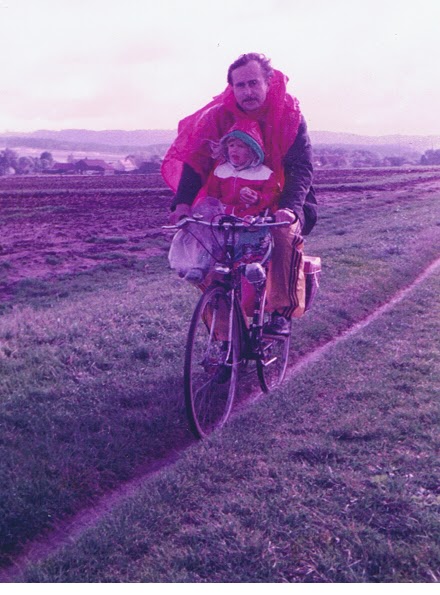
My road. On a narrow path. On a dangerous route.
Currently, I sometimes write about sex. And electric bikes. Today, it is again about sex.
For me, this is not about sex as such. It is more because it makes me rather sad to see how this is a topic where there is so much hypocrisy and moralizing. And how people lie to themselves, perhaps because they are afraid of their own urges and sub-conscious wishes.
As I see it, we could live better lives if we did not damage our own lives and the lives of the “others” by installing unnecessary taboos and morals.
If, these days, my articles are breaking patterns, then it is certainly not because I want to hurt or insult anybody. It is only because I want to promote a little thoughtfulness and questioning of your own habits.
There was quite a bit of headwind coming my way after my article on “meetoo“ (meetoo). Basically, there were two statements:
(1) “Men, too, should be able to control themselves, no matter what they are currently doing“
and
(2) “No matter in which situation, we always have to respect another person’s right to self-determination”.
Well, both of these arguments sound nice to me. And actually, I try to live by them. And I also believe both should be true for all people and all sexes, not just for men
(note: incidentally, we now have three sexes. When it comes to sexuality, the bit now has three values – informatics insider).
But then let us take a close look at (1). What does “men, too” mean? Men in the same way as women? As children? Or as pets? Or as car-drivers? Is there anyone who should not be able to control himself/herself?
On reading (2) with diligence and time, my first idea is “wow, what a nice sentence”. But then, is it not utopia, or just a phrase? What do we see in reality, where we were socialized and where we socialize our children? In my life, it happened to often that I experienced the opposite of statement (2).
It would have been so nice if other people had respected my right to self-determination! Especially those in charge of my education and upbringing!
Is there any law that protects our self-determination? I am afraid there is none. Can I deduce the right to self-determination from the guarantee of human dignity? After all, freedom also means to “live your own life in self-responsibility”. And is that not frequently limited whenever someone says they “want to protect me”? From myself!
🙂 The only self-determination I know is the self-determination as far as my data are concerned. …
My “self-determination” suffered under more powerful people or issues all the time. I could give you an endless list of experiences in life from my childhood home, school, the army, my college education, my professional life, in special situations such as for instance traffic and the “shared” everyday life. My stories would fill many pages.
However, this does not concern me alone. In the public environment, I see almost constantly how people do not respect the right to self-determination of others at all. It happens in all the dimensions we share when living. And the most harmless kind is still “moralizing”, which can easily become mobbing.
Regardless, I try to live by (2). And by (1). However, living by (1) is not so easy, either. Is it really a good thing for me to always practice self-discipline? And why should I condemn, persecute and punish others just because they are courageous enough to do things I am not courageous enough to do? For instance if they take the liberty of telling another person that they think he/she is beautiful. For fear of being called sexist, I do not dare saying such a thing. Should I condemn them because I envy them their courage and their freedom? And should it annoy me that they will then get a positive reaction to their “outrageous behaviour”?
And as far as moralizing is concerned, let me – for a change – cite the new testament (only roughly, because you cannot do it in any other way). Let those who are free of fault throw the first stone!
After all, we must never forget that, when all is said and done, “humans” (we all) are just mammals. Sometimes more sympathetic and sometimes less so. Once in a while, we are full of enmity, and then again full of friendliness/humanity! To be sure, we are mammals who have a moral cerebellum, but it is still only the small part of the brain. And it makes people believe they are ever so wise, strong and free. Regardless of the fact that the really relevant memories and experiences are saved in the sub-conscious.
How do the Bavarians pay tribute to their Franz-Josef (Strauß):
“Well, he was quite a number, wasn’t he?“.
There is so much information (almost all of it) that we cannot consciously access. Basically and de-facto, the subconscious makes and prepares all decisions. We are not the noble, god-like race, without flesh and only made of soul that is so different from animals. Consequently, we should not try to pretend or, even worse, to become such a different species.
Basically, we have no un-influenced and conscious will. Which means that our criminal responsibility, too is only very limited and very artificially constructed. This (scientifically proven by modern neurology) highly probable reality is not something we like to hear. With many (most of the) people, it will usually trigger outrage and a strong counter-reaction. The consequence is that, for instance, a prison sentence given for wrong (socially detrimental) behaviour is no longer punishment but instead a measure that wishes to prevent things from happening again.
What I ask myself is: does it make sense and is it legitimate (in the sense of truthful) if I lift myself over “culprits” or even speak in terms of “culprit categories” by condemning them? What social advantage is there in me or us becoming part of a witch hunt and also, for instance, ignoring legal facts like, in such a case, the limitation period?
Thesis (1) – not being capable of self-discipline – is something especially men are accused of all the time. I am a man and do not know the “instinct urge situation” of women. Some women told me they also knew “urge-like situations”. I believe what they said, because it matches my own personal experience. Sexual drive is part of being human (or of being an animal?). To be sure, the intensity can differ, depending on the socialization or even the genetic predisposition. Perhaps even down to the zero set.
And I am sure you can lie to yourself by just pushing the sexual drive away. Perhaps in some cases even successfully. Or perhaps doing a lot of damage to yourself in the process. The very upright but latently homosexual citizen in the piece “Orpheus steps down” by Tennessee Williams comes to mind. He hates and prosecutes homosexuals with extreme vigour. Perhaps because he secretly feels that he himself is also homosexual – but in the upright-citizen-milieu of the quiet and well-organized small Dixie town, this is unthinkable! A stranger comes – and the witch hunt starts. It is a play I saw in the Kammerspiele and it really gave me pause.
So far, they have not really found out how the brains work in this respect, and consequently, I do not know it either. But I assume that the person who hates homosexuals and kills them because he is or might himself be homosexual suffers maximum unhappiness. As is so often the case when culprit and victim are the same.
What annoys me most about discussions like the one we currently have about sexism is that groups are severely criticized. For instance single mothers. I really have all the respect in the world for them.
I know people who actually discredit them. If they do not outright call them prostitutes, they at least accuse them of having carelessly become pregnant. After all, their cerebellum could have been watchful when the sexual drive came. After all, today everybody knows how you become pregnant. The physics teacher taught us all the poem for memorizing the words concave and convex: If the girl behaves, her stomach remains concave, but if she has sex, it will be convex.
Other – particularly virtuous – moralists say they should have said NO. Which indicates a failure in the sense of (1) “Women, too, should actually be capable of a little self-discipline, no matter what they are currently doing.“ And then there are the very strict moralists who say: “It is their own fault, why didn’t they have an abortion?“.
Of course, a pregnancy has something to do with sex, and it changes the life of a woman considerably. There are women who “chose the right method of contraception” and still became pregnant. For instance because they used a product like the “copper spiral” that has the characteristic “unreliable” even written in its product description (Pearl-Index). And it was developed from men for women.
Others have become pregnant because they were weak for a total of eleven minutes. It was a huge awakening for all parties concerned. Some corrected the error and had an abortion. They were often supported and encouraged by their social environment. That is also an area where I think nobody has the right to judge these people morally. That also goes for the men involved during conception because they could not control their sexual drive?
I admit that the temptation to postulate a moral demand such as “you must be able to say NO” is huge. Both in sex and corruption. Except, as I said above: “Who has the right to throw the first stone?” Why don’t we offer all people respect, instead of morally condemning them?
Mind you, there were times when it was even worse than now. I remember times when it was amoral for a woman to have an orgasm. Because sex included a sacred mandate to multiply and not meant for satisfying your lust. If a woman enjoyed sex, she was a harlot. And, as I already wrote, the men sought the harlot and wanted the saint at the same time.
Poor stupid, in this case male, cerebellum!
Let me say it again: using violence against other people is an absolute #nogo. It is totally irrelevant to what end you apply it. There is no justification. Here is a final provocation – which is not meant as it sounds, but only as an inspiration and impulse for another thought process:
Violence and the application of violence in the context of sexual urges is severely criticized and enthusiastically prosecuted.
That is OK!
The most brutal violence against people is tolerated, promoted and actively supported or organized. By the same people and the same society!
That is not at all OK!
RMD
(Translated by EG)
P.S.
In our society, contraception is in the hands of the woman as a matter of course. I think that is rather disrespectful towards WOMAN. It is another facet of the morals in our society that I would call sexism.
Roland DürreSunday November 19th, 2017
The Road as a Metaphor für our Life.
So far, I already had the pleasure of giving the wedding speech for four of my children. When preparing these speeches, I am always (particularly) diligent and I try to formulate important ideas.
More often than not, they include ideas that helped me in the past. Which makes them probably worth handing on to others. That is especially true for the bridal pair, but also for as many other persons as possible
Consequently, I will now publish a few central ideas from my last marriage speech. Also because today is Sunday.
The road as a metaphor for our life.
The road through life starts with our birth and ends with our death. The most precious commodity on this road is the time we spend as we travel it. The reason why time is so precious is because it will never come back. If you lose friendship or money, they might come back, but time never will.
The beginning of our road is our birth.
We make our appearance in the world and are part of a social unit. We meet people who accompany us on our road, and we do not know them in advance. We have not selected them. As a general rule, they are our family.
Roads will converge and diverge.
As we grow, we will meet more people who will travel part of the road with us. The kindergarden mistress, the teacher, our first friends, …
This is how we walk on our road: some part of it with more and some fewer persons. New faces will be added, many roads diverge for longer intervals or even forever.
We are “gatherers and hunters”.
On this path of life, we collect all kinds of “toys”. Some of them are our joy and some of them might actually hurt. Many of these toys come from the past. They might be memories, disappointments, losses, injuries, etc….
Others point towards the future and are just as hard to accept in life. Among them are dreams for life, hopes, fears, expectations, projections, etc….
We do not own things, things own us.
Thus, the backpack we carry through life becomes bigger and heavier all the time. Both the backpack and its content will become ballast for us that might occasionally be quite hard to carry.
There comes a day when we marry.
“Marriage Ceremony” is a conscious decision for me – a commitment – with which we state that we will now share our road through life with another person in a very special way. It is a mutual declaration: “come with me”.
Something new starts. Consequently, a marriage is certainly not a bad time to empty your backpacks, or, better still, to leave them sitting off the road.
Get rid of your backpacks!
Because: life happens in the here and now. If and as long as the past and the future determine what we think and how we act, we do not really live.
So me plea to the bridal pair is: think also about if and how you wish to (and can) make use of today. Why don’t you shed all the ballast from the past. Here is what I would like to wish you:
Spend every day of your lives in continuously growing joy and with more and more courage!
Some of these ideas have also been inspired by the book Ein Tag mit der Liebe (Ein Tag mit der Liebe) by Moshen Charifi; it is a book I highly recommend. In this book, Charifi presents a dialogue during a hike on LOVE and INFATUATION in a wonderfully considerate and violence-free language.
Designed for Katherina and Martin on October, 27th, 2017. And for all the people of this world. In love!
RMD
(Translated by EG)


