
Roland DürreThursday March 29th, 2012
Kindle For All!
Unterhaching, March, 30th, 2012
Press Release
Kindle@InterFace
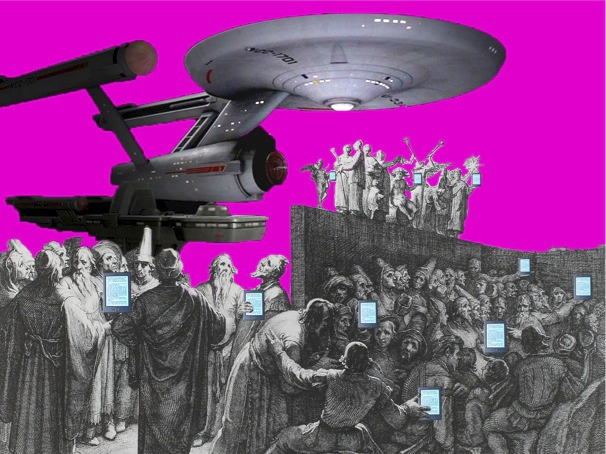 During the first ”Blue Friday“ – that is the periodical meeting of all colleagues at Unterhaching – of 2012, the InterFace AG presented all its employees, working students and interns with a new Amazon Kindle 4.
The Kindle technology caused the development of a fascinating system for knowledge distribution with various software tools both within and outside Amazon. Free software is available. Using it, you can convert texts of many formats into the Kindle format and distribute them on Kindle devices.
There is even an alternative operating system for the Kindle. You can use it in addition or instead of the one you already have. This technology literally “smells” like it has to be used in knowledge-based enterprises co-working, collaboration or co-creation. Consequently, we have to support our production processes with the new procedures and tools in the entire enterprise, thus testing where we (and others) can improve.
This is true both for generating knowledge and supporting communication and quality within the enterprise. That – and also me wanting to thank everybody for their active support during the successful year 2011 – was the reason why every InterFace employee, along with all working students, was given a new Kindle 4 for private use last Friday.
InterFace AG chairman Roland Dürre says: ”We assume that this technology – even though it is no longer all that innovative – will play an important role in the future. The paradigms for applying and using IT will continue to change and increase dramatically. By supplying all our employees with a Kindle, we want to introduce all ”InterFace-ers“ to this technology as quickly as possible, thus improving the chances for our enterprise to remain creative, vital and technologically leading.“
Contact: Roland Dürre – Mail: roland@duerre.de Tel: 0171/4850115
P.S.
Feel free to use the picture for publication
(Translated by EG)
Roland Dürre
Tweets on Twittering and Blogging #110
Here are my tweets of last week on
Blogging and Twitter, Wisdoms and Rules:
120412 Both friends and enemies will get burned in hot water – be careful, twitterers and bloggers. #Twitter #Blogging #Wisdom
120413 New brooms sweep clean – sometimes true for blogging and. #Twitter #Blogging #Wisdom
120414 New findings come from poor people – also true for twittering and blogging? #Twitter #Blogging #Wisdom
120415 Everybody likes singing new songs – also true for twittering and blogging? #Twitter #Blogging #Wisdom
120416 News is always welcome – just like when twittering and blogging! #Twitter #Blogging #Wisdom
120417 New laws will cause new fraud – material for twittering and blogging! #Twitter #Blogging #Wisdom
120418 Fresh arrivals are always welcome – also when it comes to twittering and blogging? #Twitter #Blogging #Wisdom
RMD
(Translated by EG)
P.S.
I took the proverbs from Alle deutsche Sprichwörter.
Roland DürreTuesday March 27th, 2012
Financing Political Parties Still The Right Thing To Do?
Last weekend was another election weekend. For me, this is reason enough to think about parties and politics. And about how political opinions are shaped today. After all, it is one of the tasks assigned to parties. They are paid for it by the state.
But:
Today, taking part in a democratic forum for shaping your political opinion is nowhere near as costly as it probably was 50 years ago. We live in times where this is possible without having to sacrifice long nights full of cigarettes and red wine.
The “only” thing an active citizen has to invest these days in order to shape his political opinion is his time. What is needed is the good intention and the potential of as many people as possible to acquire knowledge and evaluate the challenges of the modern society in an autonomous and self-responsible way. You have to think, understand and accept other people’s opinions and views, or else counter them.
In order to do so, you have to develop values and your competence for dialectically debating arguments. Fighting slogans and simplified dogmas are no help. Electoral promises are no longer welcome. The citizens have to remember their autonomy and refuse to accept simplified “certainties” and frivolous babble. They must start anew as responsible citizens who question things.
And, above all, they must be prepared to re-evaluate their own interests and vested rights.
Democracy is a question of culture and education. It depends on the willingness to accept the general welfare as a common value. That is something you basically need no money for!
We live in a time when the shaping of political opinions can be achieved extremely easily. Nowadays, you can inform yourself and others at a low cost, communicate and discuss matters with others without problems, make up your own mind and convince yourself and others. Even if the other parties concerned live far away. Because we now have the internet!
Consequently, the state should no longer throw the money of its citizens away by subsidizing fossilized party structures!
Basically, the money is just spent for marketing, thus strengthening the oligarchic position of the existing parties (Oligarchie der vorhandenen Parteien). And that is something the German philosopher Karl Jaspers warned us against as early as 40 years ago. Unfortunately, his warning went unheeded.
Modern parties will not need federal money for their central tasks. Giving them bounty on head for each voter only supports the crustification of grown power structures. Those who are powerful get most of the money and thus can invest even more into marketing.
I often hear the argument that party financing helps against a situation as we find it in the USA. There, a candidate only has a chance to get elected if he is either super-rich himself or/and has friends with a lot of capital who (for whatever reasons) are prepared to give him money for his electoral campaign. However, those sums are in a completely different league. Some additional (federal) money would not really make a huge difference.
So here is what I propose:
Ban marketing for politics (as has been done for tobacco and alcohol), reduce propaganda through public ostracism, base the electoral campaigns on facts, rather than influencing the opinion building process through the supply of party structures with “federal money”.
RMD
(Translated by EG)
Roland DürreMonday March 26th, 2012
Do Not Forget: IF Forum
On April, 17th, (that is a little more than four weeks from now), the next IF Forum takes place.
This time, Frau Heidi Schiller will be our guest. She will speak about
Black – White – Multi-Coloured.
Some impulses for looking upon this one world of ours a little differently.
It is all about living (and surviving) sustainably!
As always, we will broadcast the presentation by Frau Schiller live into the internet and we will also make a recording.
To put you in the right mood, here is the video of our IF Forum EXTRA of January, 25th, 2012 with
Klaus-Jürgen Grün about “The Art of Negative Thinking”!
And here are the three videos with the presentations of 2011. The motto was “Humans&Knowledge(Science)”.
“Nano Technology – the Future of IT” with Dr. habil. Walter Riess (November, 18th, 2011).
“Evolution or Creation? – An Attempt at a Synthesis”, with Prof. Dr. Gerhard Haszprunar (July, 20th, 2011).
“The Sound of the Big Bang” with Dr. Stefan Gillessen (March, 1st, 2011).
Enjoy!
RMD
(Translated by EG)
Roland DürreSaturday March 24th, 2012
Work and BALANCE
Sitting on the podium at BALANCE – the conference about how work will be organized in the 21st century – I took part in discussing the following thesis:
Flexibility is a way out of the crisis. The crisis is stability.
Flexibility also includes the process of work getting more dynamic, for instance through “borrowed labour”.
The thesis has two sentences. I did (and still do) not agree with the first sentence of the thesis. After all, it assumes that we have a common crisis that also manifests itself in a work-life crisis. That is not how I see it.
To be sure, we perhaps have a social or a moral crisis, but there is certainly no work or luxury crisis. It may (and probably will) come in the future. Currently, however, we have a luxury problem. And many among us have a strange concept of work (and life). It is roughly:
After the housework in the design flat has been done (provided you have no cleaning service to do it for you), you take your extravagant Mini out of the underground parking and drive it from your home to the parking place at work. On arrival, you get into the lift of the even more extravagant “office tower” and ride to the upper floors.
All through the long day, you practice self-fulfilment in front of your PC and in all kinds of meetings – and in the process you even climb the career ladder (and as a by-product, you get rich). Since, however, the environment is so inimical, you suffer from monstrous ailments like stress and work pressure, so you have to recuperate from those in the evening by selecting various environments full of life style.
Except, that is not life and neither is it real work.
For me, however, the entire consideration is annoying for another reason. Basically, some things are totally neglected:
Work is a very special commodity
and
The “tenure working contract” is not at all something God-given in order to pay you for the work you did.
Work is a special commodity. The “generator” of work as we here understand it is the human being. Machines “do not work”. Well, you might call what some animals, such as horses, do work. In return, they get food. In order to achieve an optimum cost-usefulness relation with animals, you also have to give them a minimum of care.
All parties concerned agree that we do not wish such a systematization of humans as work products. Because with humans, it would be called “slavery”.
Let us still use another comparison of work with a “hard” product and look at the dairy cow. There is no doubt that it produces milk. Regardless, we often mean the farmer when we speak of milk, even if today he is often an agro-industrial enterprise.
During the endless years as a father of small children, I always went to the farmer by bike in order to get all the milk we needed. Due to the structural change in agriculture, this is no longer possible for me at reasonable cost. When I was a young boy, I took the milk can and fetched the milk at a branch of the dairy – it was called “milk shop”. That, too, is something you can hardly ever do today.
It comes down to me having to get my milk from one of the monopolistic merchants. More often than not, they only sell it extremely pasteurized in the tetra package. Getting fresh milk in the bottle – which is my favoured model – is quite hard.
The situation with the product work is not all that different. It rarely happens that the end user can get a service “legally” directly from the producer. If at all, it usually happens in the form of moonlighting or in a legally conspicuous and questionable way.
As a general rule, I, too, get work through a long chain of suppliers. Within this chain, the work comes more and more often as free-lance “employment”. These contracts are often “clandestine employments”, filling a grey zone that might easily be considered a violation of the AÜG. Incidentally, work is something that comes with some sort of “directive” and a dependency upon only one supplier is quite common.
But that, too, is not my main issue. Work is a special commodity, because the producer “human being” sells himself. He sells his conscience and his personal goals (system agent), his competence (expert), his experience and his knowledge (“innovation worker”), his health (physical labour) and in some cases even his body.
So the “labourer” gives away something of his own. And the really absurd thing about it is that the process of giving something away – except if an individual or a team do piecework (which in many cases is not possible and we do not want, either) – is measured in time units?!
Because we pay according to the TIME someone has spent doing something. During employment interviews, the income is always based on this aspect. The variable time components with target agreements – I personally consider them very deficient – do not change this. Basically, it is the working time account that determines your “achievement”. Incidentally, achievement is also a difficult term – try translating it.
To be sure, employment based on a working time account with respect to the income is certainly “better” than serfdom or slavery. But I am absolutely sure we still have a long way to go when it comes to “paying human labour”.
Let us think innovatively. Time is the relevant component.
In the highly civilized societies, time might even get the function of money. It might work like this: you can have my time, during which I do something for you. In exchange, you give me your time and you do something for me.
Here is what I feel about the second sentence of the thesis:
The crisis is stability.
I would like to improve a little on this sentence. There is no such thing as a life without crises. Not for humans as persons and not for humans in a society. The type, seriousness and frequency of crises, however, changes. But this does not mean that the crisis becomes stability (or even causes stability, as the sentence seems to suggest a little). No, there will be more and more serious crises – and they will get harder to overcome. And in the future, overcoming those crises will cost ever more real or so-called sacrifices. That is something we cannot ignore.
And do not let us forget: there is a chance in every crisis. My teacher – Dr. Baldur Kirchner – showed me that the great “CIC” can change even deep characteristics of a person’s personality. “CIC” is for catastrophe, illnesses and crisis. The same is probably true for societies.
But there is a second reason for us to be optimistic. We complain on a very high level. Because we have hoarded luxury that can be dissolved before we will have to pay the price with our own bodies.
I like to give the following examples for our hoarded luxury: individualized traffic, irrational consumption and eating habits (both with respect to quantity and quality), a life style that only allegedly makes us happy, in many cases very lavish living conditions…
In our society, we have wastefulness left, right and centre. A little Kaizen would certainly do no harm in our lives. Consequently, there is no reason to despair, because there are many things that do not really make us “happy” and that we can do without.
RMD
(Translated by EG)
Roland DürreFriday March 23rd, 2012
Life Sciences (not in the meaning of pharmacy)
I studied mathematics. Mathematics has a fairly easy structure and there is little dispute about it. The axioms, such as the definition of “whole numbers” seem to be “naturally rooted”; nobody can seriously come up with arguments against them. The rest of the work of a mathematician is deduction in a very formal and strictly logical way. Every statement has to be proved in a very restricted manner. You have to determine whether a statement is “true” or “false”.
In order to make this possible they invented their own “mathematical formula and symbol language”. It is supposed to avoid communicative misunderstandings as good as can be expected.
The not quite so pure natural sciences such as biology, chemistry and physics try to avoid speculations where possible. Instead, they want to describe and explain natural phenomena as correctly as possible. These sciences use mathematics as their tool.
Thus, mathematics, even though it is very abstract and theoretical, is a rather honest science. To be sure, there are probably a few exceptions, for instance in some of the game-theory approaches and in financial mathematics.
But they are not really relevant. Everything else is very reasonable and rational. The older I get, however, the more I enjoy learning about economic sciences, social sciences, psychology including neurology, but also philosophy and history.
This Tuesday and Wednesday, for instance, I attended BALANCE von Prof. Dr. Kathrin Möslein, an economy multi-conference focusing on “innovation” and the future of work-life in Nuremberg. I was even permitted to take part in the podium discussion, where they placed my right next to Prof. Dr. Peter Mertens.
I truly enjoyed the experience. This mixture of economy, social sciences and humanities sounds rather exciting to me and I made quite a few discoveries.
To be sure, from the perspective of a mathematician, there is much that sounds rather vague. Numerous models are designed, assumptions are created and then they are discussed at great length. And it is absolutely necessary to think inter-disciplinarily. This, however, also has the consequence that you will constantly discover ideas that have already been inrtroduced in other disciplines. Or else they have been clear for thousands of years. Regardless, you get a value that is not always directly recognizable or even felt.
I see mathematics as an “assisting science” for all other natural sciences. The “non-natural sciences” work differently. In my perception, they are on the same level and have to be very tightly interwoven in order to be practically useful.
For instance, I notice that economic science is not at its best if it tries to force economical facts into mathematical models. Eventually, those models mostly fail miserably.
For me, economic science will become a positive factor as soon as it connects with the “humanities”. Such as philosophy, but also psychology or social sciences. And perhaps also with natural sciences such as biology.
I would like to call the sum of all sciences “live sciences”!
And this is not an area where we are talking “right” or “wrong”. Neither will you get final results you can apply to politics or society “in engineering fashion”, thus improving the world. Consequently, there is no way I could accept them as “sciences that solve problems” that give us good advice for future behaviour and additional technologies.
It is more like “the journey is the reward”.
The value of life sciences is that they accompany us when we get active and when we make decisions. Also, they inspire us to get thoughtful! It is their task to carry the ideas of a permanently changing world into politics, society and basically all social systems.
RMD
(Translated by EG)
Roland DürreThursday March 22nd, 2012
Tweets on Twittering and Blogging #109
Here are my tweets of last week on
Blogging and Twitter, Wisdoms and Rules:
120405 Nature beats science – careful, twitterers and bloggers. #Twitter #Blogging #Wisdom
120406 Nature and love cannot be salvaged – also true for blogging and twittering. #Twitter #Blogging #Wisdom
120407 Next to the ship is a good place to swim – also true for twittering and blogging. #Twitter #Blogging #Wisdom
120408 Beside the rod is a good place to jump – is that also true for twittering and blogging? #Twitter #Blogging #Wisdom
120409 Envy is the fool’s constant misery – something you should not forget when twittering and blogging! #Twitter #Blogging #Wisdom
120410 Envy is the devil’s advocate – also true for twittering and blogging! #Twitter #Blogging #Wisdom
120411 Envy will be its own downfall – is that also true for twittering and blogging? #Twitter #Blogging #Wisdom
There is a new tweet each day. See Twitter and “follow” RolandDuerre!
Enjoy!
RMD
(Translated by EG)
P.S.
I took the proverbs from Alle deutsche Sprichwörter Alle deutsche Sprichwörter.
Roland DürreTuesday March 20th, 2012
Entrepreneur’s Diary #78 – Let Us Assume I Am a Professor …
… I wonder if I would still be as driven by numbers as I am now.
As I see it, you cannot do the best of jobs controlling a medium-sized, manageable enterprise by numbers and target setting. On the contrary: I believe it is detrimental if you plan and report too much. The entrepreneur should make better use of his time by taking care of his employees, customers, partners and suppliers.
In order to give reasons for this opinion, let me today compare
professors with entrepreneurs, chairs with enterprises.
Holding a university chair can be compared with owning an enterprise in the brain-working sector, just like a chair holder is like an entrepreneur. The enterprise will be judged for its turnover and profit, along with its growth. So – what are the factors that determine the “performance” or achievement of a university chair?
Let me try to give a few indicators that might serve to evaluate the achievement of a university chair and the professor holding it.
- The number of students attending his lectures and seminars.
What should be the basis: the number of students who “registered” or the number of those who “actually go and listen to the lecture”? Is the relation between the two relevant? What about those who watch the lecture on the internet? What does it mean if the number of students dwindles? If you take this aspect, you would probably have to consider the general tendencies (lower birth-rate, trends). Is the percentage of non-German students relevant for the result of the evaluation? What about the number of female and male students? And how about the number of certificates awarded to the students and the grades they got in examinations?
That is also an area where you might be more sensitive. Maybe you could award extra bonuses for non-obligatory or inter-disciplinary achievements. Or you might distinguish between the grades in major and minor subjects? - The number of people working for the chair.
Perhaps the average age and the number of women is also relevant? - The number of diploma and doctorial theses supervised at the chair?
Should you only consider those that actually were finished each year? Or should you also take into account how they were graded and how long it took the students to write them? - The number of publications by the chair.
Would you have to count the number of publications or the number of pages? And what about the difference between those published in journals with a better reputation, as opposed to less relevant ones? - The sum of money acquired from third parties.
It might be quite a simple criterion for evaluating the performance of a university chair.
Well, it is quite simple – all you have to do is refine the list a little, then come up with a sophisticated evaluation pattern and then you add the results in order to get a fair evaluation grade.
At first sight, it all sounds quite plausible, doesn’t it? Yet, you will soon find out that it cannot and will not work. There will be very strange consequences, yet the quality of the lectures will not improve. Although they now actually started evaluating the quality of university chairs in precisely this way for the “excellence offensives”.
Thinking in terms of enterprises, it would mean that a good professor would have to increase the number of his students, assistants, doctorial and diploma theses, publications, etc. every year. Until at last the lecture hall will burst. You would have to structure your activities in a very target-oriented way in order to fulfil the relevant criteria. Unfortunately, this is exactly what happens – and it causes a flood of doctorial theses at some universities. It is more important to publish than to get excellent results. In fact, in the USA, the number of publications is already on the way up.
Except the quality of a professor should manifest itself in other ways. Basically, all he should be able to do is deliver good research and good teaching. And be a good leader to his team. He should put all his energy into making it possible for his students to learn a lot and making his customers (the students) happy. Then he will be highly regarded in various circles and his reputation and standing will grow.
But isn’t it the same with enterprises and entrepreneurs?
Do you have to – or can you – represent the reality of an enterprise in numbers at all? Do you need all those lists and spread sheets, especially if we are talking small and medium-sized enterprises? Do we need this high degree of precision in the planning process?
First and foremost, you have to invest a lot of precious time in the planning. And then there is the time you need for finding out what went wrong. That is what I call time wasted twice.
What about focussing on the people working in the enterprise and the customers? What about further developing the product, being ready to accept change and allowing good ideas to flourish? What about trying to remain close to reality and establishing a good entrepreneurial culture? Because if you gain those qualities, the numbers will automatically improve. Let it be accompanied by a budgeting that follows common sense in a reasonably economical way and you have all you need.
Neither reading numbers nor reading tea leaves will tell you what mistakes you made with the customers!
And why is it that enterprises always have to grow? Why should entrepreneurs constantly try to find out how they might best increase the turnover and profit? Why not look and see what you can improve, instead? You will not get bored.
Why not restrict yourself to one market, give quality priority over quantity and value over mass?
Isn’t the same true for entrepreneurs as for professors: If they do their job well, the turnover will grow and so will the outcome. Just like this.
So, my dear entrepreneurs, do not bother to analyse your BWA, burden centre, boss sheets and balance sheets for days. Instead, use the time for business, the customers and the employees! For the future!
And, dear Professors, why don’t you do the same? Let the score cards sent by the ministry not affect you.
Improve the quality of research and teaching at your university, take care of the people and the university. And forget criteria and growth.
Simply because we need a better future! As a result, both you and we will constantly get better and the success will come by itself on many levels.
But I notice more and more similarities between entrepreneurs and universities as time goes by. And then I prefer remaining an entrepreneur.
RMD
(Translated by EG)
P.S. Click here Drehscheibe for all the articles of my entrepreneur’s diary.
RMD
Roland DürreSunday March 18th, 2012
Copyright Math & Commons
Incidentally, I believe that in our “American-European Culture” (the term is used in the sense as by Edward T. Hall in his book “The dance of life”) the issue of “copyright” has been handled poorly – both socially and legally. In fact, perhaps an unspeakable mistake has been made.
Here is a comment worth watching on this from the TED world. It was found by Dr. Edwin Ederle – thank you, Edwin!
The following question(s) come to mind:
How much and what knowledge can belong to a single person? When are you obliged to share it, so that it belongs to the public? Because thinking in terms of Commons (common land, common property) will probably be relevant if not necessary if we want to solve the problems we face in the 21st century (and later).
I had hardly handed the link with this video on, and already the first comment by Thomas Mathoi in the subject came back. He recommends the free e-book #Incommunicado by @michelreimon (Michel Reimon) as an additional inspiration on the theme of copyright.
After having read the first few pages, I think #Incommunicado is a novel well worth reading and thinking about.
🙂 And on top of this, it looks like a very exciting “book” to me. I already downloaded it onto my kindle.
RMD
(Translated by EG)
Roland DürreSaturday March 17th, 2012
Entrepreneur’s Diary #77 – One Of My Own Irrational Decisions …
Back to the “irrational decisions”!
Continuation of Entrepreneur’s Diary #71:
“Notwendigkeit von unvernünftigen Entscheidungen” (The Necessity of Irrational Decisions “).
The InterFace, too, owes its origin to a very irrational decision. Woe if, at the time, we had had a decent person to control us. He would have called us “insane”. How could anybody try and strive towards such a utopian idea? With ZERO chance of success.
In retrospect, I am actually surprised how something so weird could have worked. All reasonable and rational arguments were certainly against what we had planned. Today, if asked, I would probably advise against what we did at the time.
Our most severe case of irrationality was when we, as “newcomers” and “nobodies” wanted to develop a UNIX text system. There were two of us, along with a few students. And in the process, we actually wanted to try to earn enough money for us and the students to live on quite well. Which meant that you had to delete the term “two of us” from the above sentence, because basically only the students were left.
What happened was the success story of HIT/CLOU. And a few years later, there was a time span of ten years during which Siemens AG created more turnover with HIT/CLOU than with their second SINIX product (which they also had taken under licence), the data base Informix of RDS (that was still the name of Informix for some time) .
At the time, we started developing HIT and CLOU with a colourful selection of young people. It happened against all rational business thinking, simply because we wanted to own a software product of our own.
Since data bases were too complex and the communication technology underwent a total re-structuring, we decided to develop an “electronic typewriter”. … To us, that seemed easier. So we took a closer look at the old “brother” and text machines such as Triumph-Adler and implemented the entire thing anew and a little better on UNIX. How simple the world can be.
And a few years later, we became the market leader in Europe – not just on SINIX, but on many UNIX systems of many producers!
Simultaneously, Siemens AG tried to develop a series of editors. At their place, the product planning team had more members than our entire development, project and sales units. They had planned everything “rationally”, developed it in the classical way and supplied huge budgets. With expensive developers and super consultants.
And still they failed again and again!
Incidentally, Siemens AG made a turnover of 500 million DM during the aforementioned ten years with HIT/CLOU. It is quite possible that, during the same period, they invested more money for all the new developments of theirs that failed either technologically or economically.
Those products were failures due to poor technological competence, such as the demand for a common (!) interface for BS2000, UNIX and DOS. I remember quite well some discussions about what nonsense such a venture was. These were discussions I took part in.
And if, for a change, they were not a failure technologically, then they failed on the market, like with ComfoText against Microsoft.
And everybody asked how it was possible that the small InterFace Connection GmbH with its limited budget could manage to do things that were out of reach for the huge Siemens AG with all the millions they invested and all those many planners, engineers, developers, testers.
Well, the reasons were quite simple: an irrational decision, the enthusiasm of great persons in a super team, an agile procedure, many partners and a little luck – and here we were working!
So here is the second part of my appeal to make “irrational decisions”. Even if they cost money and will worsen the results. We still need them in order to do great things. And, basically, there is something great to every enterprise.
RMD
(Translated by EG)
P.S.
Click Drehscheibe for all the articles of my entrepreneur’s diary.


