
Roland DürreThursday January 17th, 2019
(Deutsch) (Null), Eins, Zwei, Drei, Vier, Fünf. (…)
Roland DürreTuesday January 15th, 2019
Leadership Philosophy in Two Sentences (Entrepreneur’s Diary #129)
A short time ago, I found the following tweet:
Aebby (Dr. Eberhard Huber)
Zusammenfassung meiner Führungs- und Leitungs-Philosophie:
My leadership philosophy in a nutshell:
- Have AND show empathy and respect!
- Do not spread fear!
Both this statement and the tweet were from my friend Aebby (@Team_im_Projekt), also known as Dr. Eberhard Huber. I admire him very much.
? Consequently, I do not wish to weaken his message. And I would like to add three comments:
- For me, appreciation is also part of respect. Consequently, it is all about empathy AND respect & appreciation.
- It is difficult not to spread fear if you fear something yourself. And since I am often afraid, I often notice that I also spread fear. I find that a pity, but on the other hand, I forgive myself because it looks absolutely human to me.
- My third comment is only that the described leadership philosophy should not be limited to leadership but also be a common life philosophy.
All this does not make it easier. Perhaps the only thing for us to do is become more mature and wiser. Which is also easier said than done.
RMD
(Translated by EG)
P.S.
For more articles in my entrepreneur’s diary, click here: Drehscheibe!
Roland DürreMonday January 14th, 2019
It is Nice to be Sick!
Once in a while, I re-read my own IF Blog stories. After all, one of the reasons why I write IF Blog is because I write for myself. So I read the story of my childhood a short time ago:
How I lost my tonsils (Wie ich meine Mandeln verloren habe).
And then I noticed that, basically, I had related everything just as I remembered it. But there is one important point where I fell a little short of the truth by not telling the entire truth. Today, you will read the entire truth.

The beginning of four sad years in primary school (“Volksschule”).
My parents had decided that, with my start at grammar school, a medical treatment – the removal of my tonsils – was to improve my poor health. After all, during primary school, I really was very often sick.
And I liked being sick. In fact, I literally sought sickness, i.e. common colds and chills. The reasons for this are easy to understand.
I hated the school at the Wittelsbacher Park.
There were several reasons for this hatred.
In the normal subjects, such as German and Mathematics, I was bored. Boredom is quite a cruel thing.
Also, our teacher liked to beat his pupils (also as a prophylactic method). Once in a while, everyone was given beatings onto their fingers with the black square timber. For no reason. He simply wanted to get the message across what we had expect if we misbehaved. At least that was his explanation – in a way, this was even more cruel than the boredom.
Today, I would say that our teacher was simply a sick sadist. In musical education, he made me very much aware of my incompetence and in physical education, he ordered me around like a dog. It was total oppression – just like in the army.
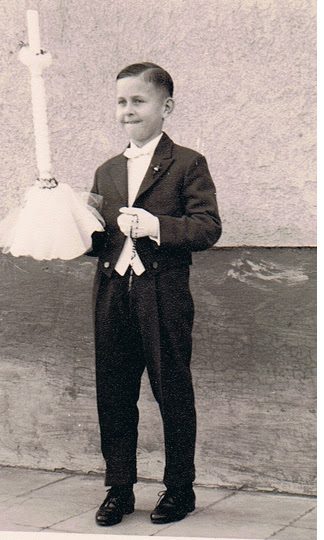
The way there was a real torture.
The worst was religious instructions. The priest presented a God whom I experienced as an evil creature who tormented his own son in the most unimaginable way.
In summer, I enjoyed the way to school through the Augsburg Wittelsbacher Park. In winter, not even this was any fun.
Even halfway to school, the shoes were wet from all the snow and ice and the feet – as well as the hands – were icy cold.
And when I went home at noon, the shoes were still wet – which was mostly also true for the next morning. Since, however, they were the only winter boots I had, I had to wear them every morning on my way to school.
In winter, there was no motivation for me to remain healthy. After all, the soccer ground where, in summer, we met every day to play soccer, was snowy and slushy – and always empty. Nor did anyone play dodgeball on the court. Some way or other, there were not many reasons to leave the house.
On the other hand, the hill near the Rosenaustadion was much loved. However, to me, tobogganing and skiing looked quite irrational. You went down the hill just to pull the thing up again. Sisyphos work has never been my preference.
So I had no reason to remain healthy. On the other hand, it was nice to be sick.
After all, whenever I was sick, I did not have to go to school. I was allowed to stay in bed and read my books. My mother mollycoddled me. She always asked me what I wanted for lunch. And I often got delicacies such as Wiener Würste, which otherwise were a rarity in our household.
And in the afternoon, I was given a marzipan potatoe from the Dichtl bakery. At the time, that was still a very small bakery in the Rosenaustrasse. Today, the Dichtl is some sort of bakery concern with numerous outlets in Augsburg. The marzipan potatoe still tastes unique.
There were other reasons that made sickness a nice thing. Even my sister, who was five years younger, treated my nicely because she felt pity for her sick big brother.
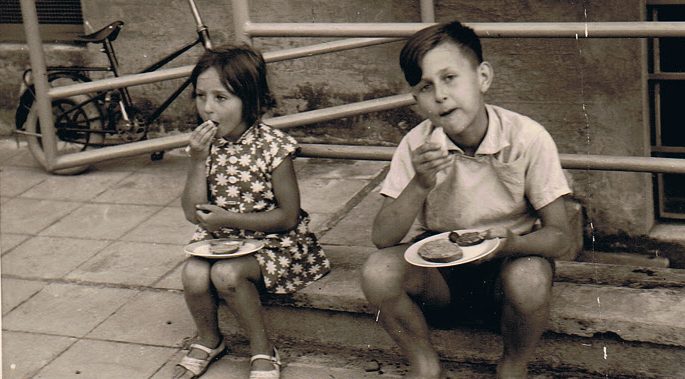
My small sister and yours truly eating sandwiches in front of the laundry door of our house in the Rosenaustrasse 18 in summer. In summer, I was hardly ever sick.
My small sister and yours truly eating sandwiches in front of the laundry door of our house in the Rosenaustrasse 18 in summer. In summer, I was hardly ever sick.
Even my father was very nice and friendly when he visited me at my sickbed in the evenings after his railway day. And he asked how I was doing and comforted me.
So as you see, it was nice to be sick because everybody treated me so well – so I enjoyed and promoted it during the bleak winter days. It worked quite well.
Early in the summer of 1960, the day of my operation neared. I was wondering if I should maybe tell the truth about how my poor health had been very much promoted and even faked by myself. Just to avoid the operation.
But then I did not tell. Above all, I saw that telling the truth would not have helped. Because even then, plans that had been made were executed in all their brutality. Even if they were very stupid plans. Just like today …
The consequences of the operation were the opposite of nice. Ever since 1960, I have a throat-ache every winter. Regardless, I was seldom sick after that year. There were no longer any advantages to being sick. Grammar school was not quite as cruel as primary school had been.
And by the time I worked, I went to the office in winter regardless of the “then normal“ throat aches and terrible colds. After all, there were always people and tasks waiting for me. At least, that is how I perceived it.
RMD
(Translated by EG)
Roland DürreSunday January 13th, 2019
EROS
For me – and I believe for many other people as well – the secret of Eros is a huge riddle. And as always, you are well advised to look into the ancient Greek theories. On Eros, I found a little book by the poet and philosopher Platon: Symposion – or the Banquet of Love.

Roman copy of a Greek Platon portrait, probably by Silanion and put up in the Academy after Platon’s death, Glyptothek München.
In the Symposion, Platon, Socrates, Aritsophanes and their friends met for a spree. These symposions were regular events.
Each time, the symposion deals with a certain topic. Today, says Platon at the beginning of his book, the symposion is about Eros.
Who or what exactly is it?
Platon introduces us to six men who all want to win the prize for the best oratory on the great God Eros:
Phaidros, Pausanias, Eryximachos, Aristophanes, Agathon and Socrates.
Aristophanes tells the story of Eros as the power of longing between people. It is the story of the ball person, which Platon invented.

Canova: Amor and Psyche, 1793, Louvre
The ball person was a creature that was both male and female. This person was so powerful that the Gods feared it could surpass them in power and wisdom.
Consequently, they sought a way to get rid of this unwanted God-Competition. A God-like human being cannot be allowed. So they separated the two parts of the ball person by force.
Ever since then, the two separated halves of the ball person that actually used to be one creature are looking for each other.
The article contains parts of Eros. If you want to read more, just click here.
RMD
(Translated by EG)
P.S.
I took both pictures from Wikipedia.
Roland DürreWednesday January 9th, 2019
“Business Theatre“ (Entrepreneur’s Diary #128)

On this picture, the person in uniform does not look happy at all.
I spent 18 months serving the country (in the army) and in these 18 months, I learned to drink and chill. To be sure, I also learned how to survive in a sick system.
However, these 18 months also showed me how enterprises should not be yet how they mostly are (perhaps because enterprises often follow army patterns when it comes to their organisation).
They drafted me on April, 1st, 1970 and assigned me to the air force at Lagerlechfeld. After a stop at Landsberg, my army career as “Flyer Dürre” started in Ulm on April, 5th. I ended up in a battalion that had its small barracks area at the Lower Kuhberg not far from the Centre of Ulm. The barracks had been named after the war-hero Boelcke (see Militär in Ulm). It was an old barracks venue, some people actually believed they could still see the (removed) swastika over the entrance.
The barracks I landed in after Landsberg belonged to the training regiment of the air force. The air force was one of the three weapons categories they had in the German Armed Forces: they also had the navy and the army.
The organization was quite simple:
The battalion (Bataillon) consisted of three companies and a few staff positions, for instance the medical group, the vehicle service group and the supply group. The battalion commander was only a major. That indicated that our battalion did not have much military significance.
Each company had three platoons. Each company had a company commander (usually a corporal) and the master sergeant, usually in the rank of sergeant major. He was the boss of the administration, including the typists’ office and he had the operative task of organizing order, which also consisted of drawing up the guard service list.
Each platoon had a platoon commander and three units. Usually, the platoon commanders were non-commissioned officers, once in a while an ensign was among them. Each unit had its unit commander who led ten learners for three months of basic training. The unit commanders were generally rank and file.
In summary, you can say that about a hundred recruits (about 3 x 3 x 11) were facing a small group of thirteen (9 + 3 + 1) coaches. Since, basically, recruits are difficult soldiers, the group had to stick together and was often a tight-knit community.
The business model was part of the compulsory service model and also very simple:
Whenever a new quarter year began (on the first of January, April, July and October), the German conscripts had to go under weapons in hordes – they were drafted. They were put into barracks distributed all over the country. Whenever a unit had problems with one of the recruits they had been assigned (regardless of the reason), then said recruit was sent to us in Ulm. That is how I, too, ended up in Ulm.
One of the problems was that the people who came a few days later were totally different from me. In July, most of the new recruits were successful high-school graduates who had been taken out of their units because of insubordinate behaviour or because they had other problems (such as drugs). At all other times, we always had many people with social disadvantages, often they had not finished any school education. Every three months, the mixture was totally new.
Our task at Ulm was to make proper soldiers of these problem cases. They were to be turned into air-force soldiers with simple tasks such as object protection (sentry) or in typing offices (today, you would probably call it back office).

During my first home visit in my parents’ sitting room.
Three of the recruits always had to be upgraded to become future commanders of each teaching regiment. I was selected because I was the only one in my regiment who had successfully graduated from high school (most of the others had not finished school at all). They needed someone who could actually teach (civics, military ranks and structures, learning to use a weapon). This is how, after no more than three months of basic training, I became unit commander with special tasks such as teaching the regimental recruits.
Our staff unit:
The staff units were responsible for the entire battalion.
- Medical unit
The medical unit consisted of two doctors and a few paramedics. Besides the general health care, they were responsible for giving out sick passes and, especially problematic, for giving someone the status of “unfit for service“. Many wanted this certificate, but the ratio allowed for each battalion was rather low. Besides, everyone who had been declared unfit by our doctors had to get a second opinion. And if one of the recruits actually managed to get both documents, he was the happiest person on earth or at least on the barracks. - Vehicle service group
This unit consisted of the mechanics and the drivers who serviced our vehicles (regardless of being part of the air force, we had no airplanes). They also moved the vehicles. The fleet had a few lorries with which the recruits were driven to the manoeuver or to shooting practice, a few accompanying vehicles, a kitchen truck and a few limousines that were used by the driving service to take the officers where they needed to go. I think we also had a bus, but it mostly sat around. As far as I know, the entire drivers’ service of the German Armed Forces (including tanks) is now outsourced. - Supplies
The supply department was responsible for everything the company needed: clothes, weapons, office hardware, toilet paper. After all, a hundred new soldiers had to get their uniforms every three months. Food, however, was only organized by the supply unit (planning, procurement). The cooking was done by civil servants, of which the German Armed Forces had plenty on top of their 500,000 soldiers.
And it all worked quite well. The teachers (Ausbilder) in the three companies mostly managed to keep all the recruits alive (regardless of recurring suicide attempts). They even made tame soldiers out of them in three months. As a general rule, we delivered the soldiers to their new companies, where they then patently served their time (usually fifteen or twelve months) as sentries or office service persons for German barracks.
We always were within the limit when it came to the number of recruits who were declared unfit. Once in a while, we even discovered a talent who later went to serve at the musical unit of the air force, and the same is true for some top players that we found for the company and battalion sports teams.
We also never starved. To be sure, the quality of the food that was served to the recruits was abominable, but we of the staff were luckier than that. That was definitely something the procurement units managed very well.
So what exactly was the task of the top management?
The company commanders had a fine life and were able to focus on the important things. They often changed (as I said, the battalion had a very good reputation). The only one who stayed long was the commander, the major. He waited for his retirement money.
We occasionally saw the decorated officers when big events were scheduled (solemn oaths, final manoeuvres, celebrations). Other than that, they were not much of a hindrance to us.
But the officers were also quite industrious and diligent. The company bosses and the battalion commander often had long meetings in the battalion mess. They worked late into the night. Once in a while, higher officers from the regiment and from higher up were also among the participants. Occasionally, even a general came, which always caused a disruption in the normal barracks procedures.
And our highest bosses were often on business trips. That was when they had to leave the barracks and the officer’s mess and travel to important Armed Forces or NATO meetings. In military life, international contacts are extremely important. And since they were leaders, they had to attend numerous courses, because, as we all know, leading is not at all easy. And when they wanted to relax, they sometimes flew. After all, the airplanes of the air force had to be moved around.
There are many questions our officers had to answer:
- How can we make sure the world remains at peace?
Again and again, they tried to find a good reason for the existence of the German Armed Forces (and, basically, to this day, they never found one). - What can we do to promote the reputation of the German Armed Forces?
That was particularly difficult in our case. Among the teaching persons – especially if they were non-commissioned – we had quite a few tough fellows. Again and again, some of them made the local news because of misconduct. But mostly, they were only mentioned anonymously. However, since we were so important when it came to taming the recruits, we had nothing to fear. When the German Armed Forces had huge events, the community of Ulm also was very interested. - How can we create a feeling of corporate identity with other units?
I remember a visit of the Bavarian Mountain Soldiers (Gebirgsjäger) from Mittenwald. It ended quite badly. What I mean is: “some of the equipment was lost, but luckily, with the exception of a few injuries, none of the soldiers became casualties.“ - How can we become friendly with the other NATO states?
To me, this seemed to be a particularly important task. - Once in a while, they had to approve our decisions.
Mostly, they did that without reservations. However, it always took time, which caused emotional disputes among the parties concerned. - Special attention was given to the athletic activities in and beyond the air force.
For instance, every company had a soccer team and a handball team. We specifically chose and kept recruits that were a precious gain to the teams. And whenever you have one of these athletic competitions, you have reason to celebrate.
I remember a soccer match against the US Army. At the time, no American was able to play soccer, so we won by 21:1. It was the highest win I ever actively witnessed in field soccer. In fact, it turned out that the biggest challenge was how to get them to score their one counter goal. Imagine all the things you do in the name of peace among nations and brothers in arms.
Why do I tell you these things? Because, with the German Armed Forces, I experienced a huge stage where big military theatre was playing. However, it was no more than what I would have expected from the German Armed Forces.
After my service time, when I continued studying and working at Siemens, I also experienced business theatre. It increased all the time and that really did surprise me.
These days, I am also perplexed when I see that many small enterprises are no longer there for the people (employees and customers). With all the business theatre, there is no time left for anything else.
RMD
(Translated by EG)
P.S.
Only two pictures of me were taken during the entire time I served (April, 1, 1970 until September, 30, 1971). Both of them were taken during my first visit home; the first in front of the parents’ house and the second at the dinner table.
P.S.1
For more articles in my entrepreneur’s diary, click here: Drehscheibe!
Roland DürreSunday January 6th, 2019
Slavery – Did Anything Change?
During my last Caribbean trip, I was made aware of a “black chapter” of human history: slavery. I wrote an article about my visit to the museum in Curaçao and how it motivated me to also inform myself about fiefdom in our so value-glorified occident. After all, we in the occident have so very Christian roots…

Dark Future!?
The more I read and think about slavery and fiefdom, the more I am convinced that both have not been abolished for “honourable” – humanitarian, humane and enlightened – reasons.
Instead, it was mostly business motives that caused the abolition of the more than thousand years-old slavery. This change would not have been possible without the consent of capitalism (i.e. of the ruling classes, both feudally and monetary).
Basically, slavery simply was no longer profitable!
Whenever something is no longer profitable in capitalism, it will be removed. That is true both for the overseas plantations and farming in Europe. It is true both for technology and for humans. The slave was replaced by the worker. The serf was made redundant by the steam engine, which later lost against the Diesel. And perhaps the Diesel will be replaced by the electro motor.
A currently enthusiastically discussed question is:
Will humans lose against artificial intelligence?
It would be the next step. I have no answer to this question.
Still, in retrospective, it seems obvious that fiefdom was abolished in favour of the steam engine. The Feudal upper classes had understood that machines functioned better and more efficiently than serfs. It is no coincidence that roboti is the underlying morpheme for robot.
In the USA, the die-hard Southern States had absolutely no chance against the profit-oriented Northern States when it came to defending the slave system. Naturally, they had to lose the war.
Henry Ford would never have been able to produce his T-Model at the conveyor belt with slaves.
His “engineers” had enough on their hands when they were asked to teach the stupid farmers how you build a car. After all, the stupid farmers came from farming and consequently had no sense of industrial timing.
And consequently, it was a good idea if these farmers who had been converted into industrial workers had to be responsible for how they lived after the hours spent at the conveyor belt. You could say that Taylorism replaced slavery. The ruling classes had found out that self-responsibility will be less expensive for them than accepting all the responsibility for their entire workforce.
Basically, workers were just less expensive than slaves.
They simply outsourced the responsibility for their lives (which, in the case of slaves, they definitely had, even if only because they wanted to preserve the value) to the workers. For the black slaves, they also had to introduce a formal act and a document that officially gave them freedom. Workers, however, already were free (as often as not, they were rejected serfs) – and had to fend for themselves. For those who failed and had to be replaced, the successors were already standing in the queue in front of the plants.
This is how the slaves were freed and how cheap labour was acquired. This was made possible by progress in medicine and farming that had caused a huge population increase. Said population explosion is only now slowly beginning to decline. Consequently, there was always a supply of cheap labour available.
Later, the workers united, they became more powerful and sometimes even were able to increase the price. Many exciting legends have been told.
But now let us look at the today and now.
Has slavery really been abolished?
My answer is: NO!
Mind you, I am not talking the still existing form of classic slavery that we still have in certain sectors where the physical ownership of persons is still profitable. Those are called modern slavery.
If you believe the source (Quelle), then between 12 and 27 million people (there is a high estimated number of unreported cases) are still slaves. Considering that we have 7.63 billion people, this sounds harmless enough (October 2018, Wikipedia).
But do we not have a new form of slavery instead?
I do not mean all the people who have been snatched up by consumptionism (Komsumismus). Yes, the word exists, I have not invented it. Especially the developed societies have many consumption slaves. That is definitely also a form of lack of freedom. Since, however, most of them are free, I will not call them slaves.
For me, the majority of people in this world who are existentially dependent on their jobs live in a sort of slavery. Even in many rich countries, the loss of your job will mean the END for more and more people. You have to pay high rents, many people have no assets (except negative assets).
If these people lose their jobs, the only thing that remains for them is unemployment insurance and/or the social systems – for instance our detested Hartz system.
However, there are many countries that do not even have such a social system. In the extreme case, losing your job means you will live on the streets.
India is one of the countries that particularly strain under this situation. Here, the slum system developed. The climb on the ladder will, in the truest sense of the word, begin “in the gutter” with a (much coveted) place in one of the surprisingly well-organized slums. These kinds of social automatisms are – still? – absent in our country.

What will the future bring?
Consequently, all those among us who have no work-unrelated income and, for instance, their own residential property, are slaves of a brutal system. As soon as we no longer function in our work environment, we are quickly gone.
There is a new kind of feudalism. Today, the leading class consists of people (and legal persons) who have a lot of capital. Some of them were simply lucky, others have inherited from a rich family (which is also luck). Basically, I actually believe that luck has a tendency to follow the industrious.
But that is not necessarily so. In any case, we can say:
If you have the funny stuff, you need not work any longer and can really live.
This means you can use your time for what you enjoy. Many of the persons who are thus independent of gainful employment work on an honorary basis.
I also know a number of young rich people who consciously enjoy their prosperity. And they do what they enjoy and what brings them happiness. Some of them are busy increasing their capital. That makes them even richer and increases the polarisation between poor and rich.
I am glad that I am not directly threatened by old-age poverty (except if our system breaks down). I am quite happy that I was so lucky in life.
However, I can easily imagine how it feels to be dependent on your job and waiting for your money at the end of each month. And having to struggle to make ends meet.
I understand quite well that, in such an environment, the loss of your job is an absolute terror that can destroy EVERYTHING. And, to me, this life style is absolutely a modern form of slavery.
RMD
(Translated by EG)
P.S.
I borrowed the two images from Hans Bonfigt. He used them for his IF-Blog The power and the glory .
Roland DürreSaturday January 5th, 2019
RADICAL.
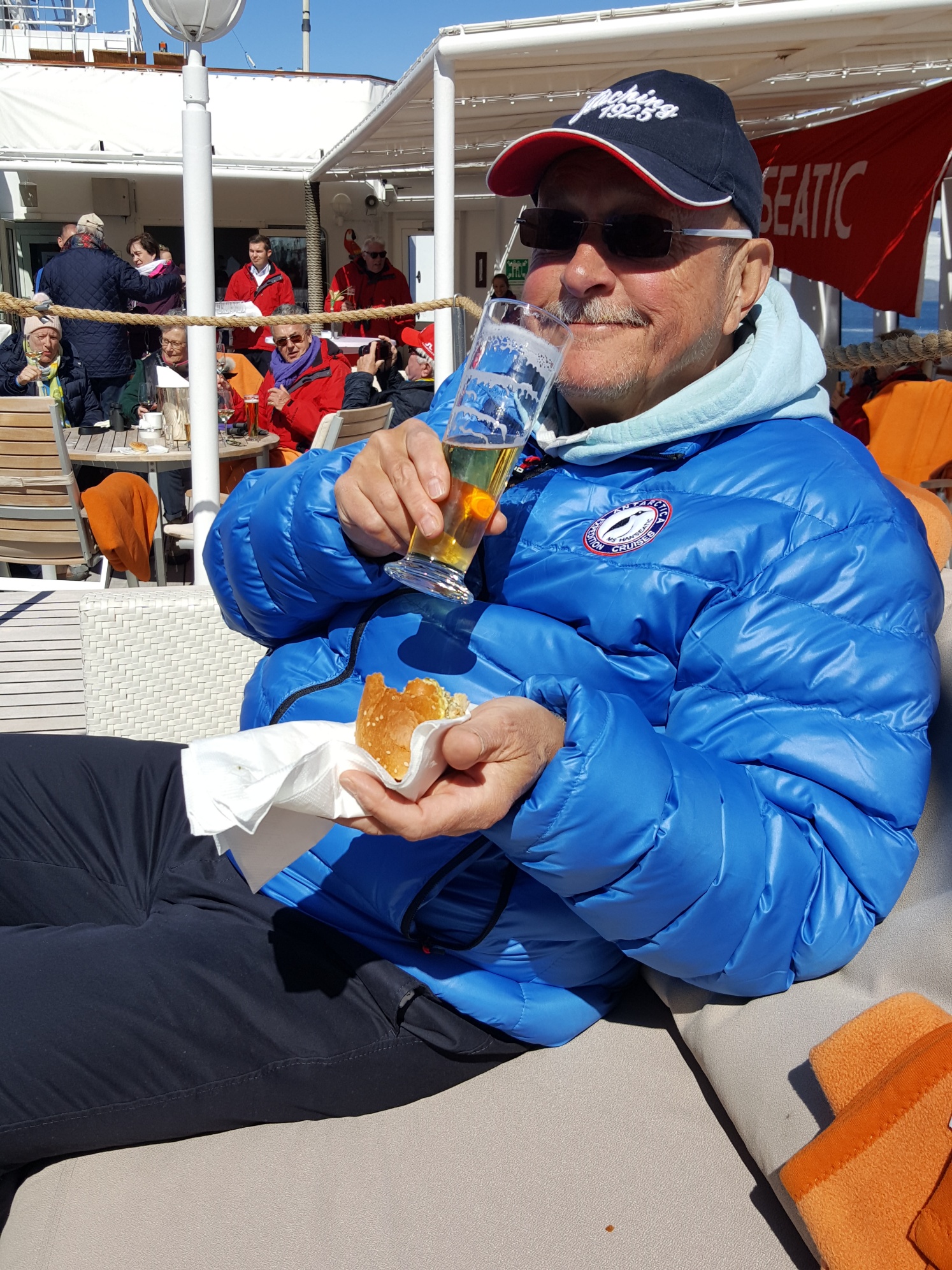
Long Live the Radical Heretics!
When Hans Bonfigt’s article was discussed and commented on, the term “radical“ played an important role. This motivated me to become contemplative about the word RADICAL. Because, to me, it seems that being radical is very important.
According to de.Wiktionary.org/wiki/, similar words are either [1] hard, ruthless, reckless, stubborn, or [2] clearly, thoroughly, noticeably, definitely, all-encompassing.
{
Laut de.Wiktionary.org/wiki/ sind sinnverwandte Wörter entweder
[1] hart, rücksichtslos, unerbittlich, unnachgiebig
oder
[2] deutlich, gründlich, merkbar, merklich, umfassend
}
I found no useful definition of the word “radical” in (the German) Wikipedia. In the political context, there is a link to radicalism . Sociologically, radicalism is a characteristic of change, see social change.
Well, at least in the German Wikipedia, there is no definition of the often-used word “radical”. This shows clearly how difficult the discussion of the term is. To me, this sounds almost logical, since we humans are famous for having arguments about things the meaning of which we do not know. Simply because we tend to put particular emotional stress on terms that we do not understand or cannot define.
Let me make some guesses as to what radical might mean. Or rather, how I understand it. It took several days of contemplation for me to come up with an answer. Then I discovered that, to me, “radical” is particularly important when it comes to thinking. That means we are talking radical ideas. Which, as I see it, Hans Bonfigt time and again does not apply.
To my way of thinking, “radical ideas” mean that our ideas can develop in straight lines without having to consider moral fields. In other words, our ideas should not be influenced by the restriction: “You do not want to think along these lines“.
And I believe that radical ideas will soon make you a heretic. I rather like heretics if they are capable of questioning their own so-called truths.
Let me describe a few theoretical results that can spring from radical ideas.
- Religions and God were invented by humans. How can a person call something an absolute truth if he himself invented it?
- Who are those who benefit most from war? The weapons industry. Consequently, the weapons industry needs war. And whenever there is no war, it will see to it that there will soon again be war.
- First and foremost, I must be considerate of myself. Because only if I love myself, I can also love other people. Consequently, martyrdom is socially detrimental and should not happen – nor should it be glorified.
- Humans are not evil. If anything, then their actions are evil. Consequently, you should not condemn humans but instead their actions.
(Rupert Lay once said that Hitler was probably not an evil person, because maybe he mostly followed his conscience. Perhaps his conscience was rather alien, if not pathological. To be sure, Rupert said it during a festive presentation for famous guests of a big German Bank. And legend has it that he was then interrupted by the managing director and escorted from the premises. Because he had broken a taboo – there are things you cannot think, let alone say).
Well, I guess I had better stop writing before someone comes and escorts me from the writing stage.
RMD
Roland DürreWednesday January 2nd, 2019
2019 – My Personal Jubilee: Fifty Years of IT
Today: why the locomotives lost their “E” and their “V”.
After having graduated from high school, I started studying mathematics and computer science at THM (Technische Hochschule München – today: TUM Technische Universität München) in 1969. Computer science was a totally new subject and this was the first year it was taught. You could only take it as a minor subject. Consequently, I take the year 1969 as the official start of my “informatics” career and that means I can celebrate fifty years of personal digitalization.
However, this was only the official start. Because I had concerned myself with computer science a lot earlier than that. And I do not mean the time when I learned to read and write, although the invention of the written language is doubtless also an informatics topic. The written word made it possible to save ideas, stories and other content “digitally”. Consequently, it is informatics.
What I mean when I am talking my first contact with informatics happened when I read a children’s book. It was probably one of the “Famous Five” stories by Enid Blyton. It was always about some villains who eventually were caught by a group of children/adolescents. And in one of the books the villains were smugglers who communicated with their team of smugglers on an island through Morse signals.
So Morse symbols (Morse-Zeichen) were the first code I learned when I was still very young. From the informatics aspect, the Morse code is something special, because it does not have a fixed word length. These days, whenever I give a presentation about codes, I often start with this so pragmatic Morse code.
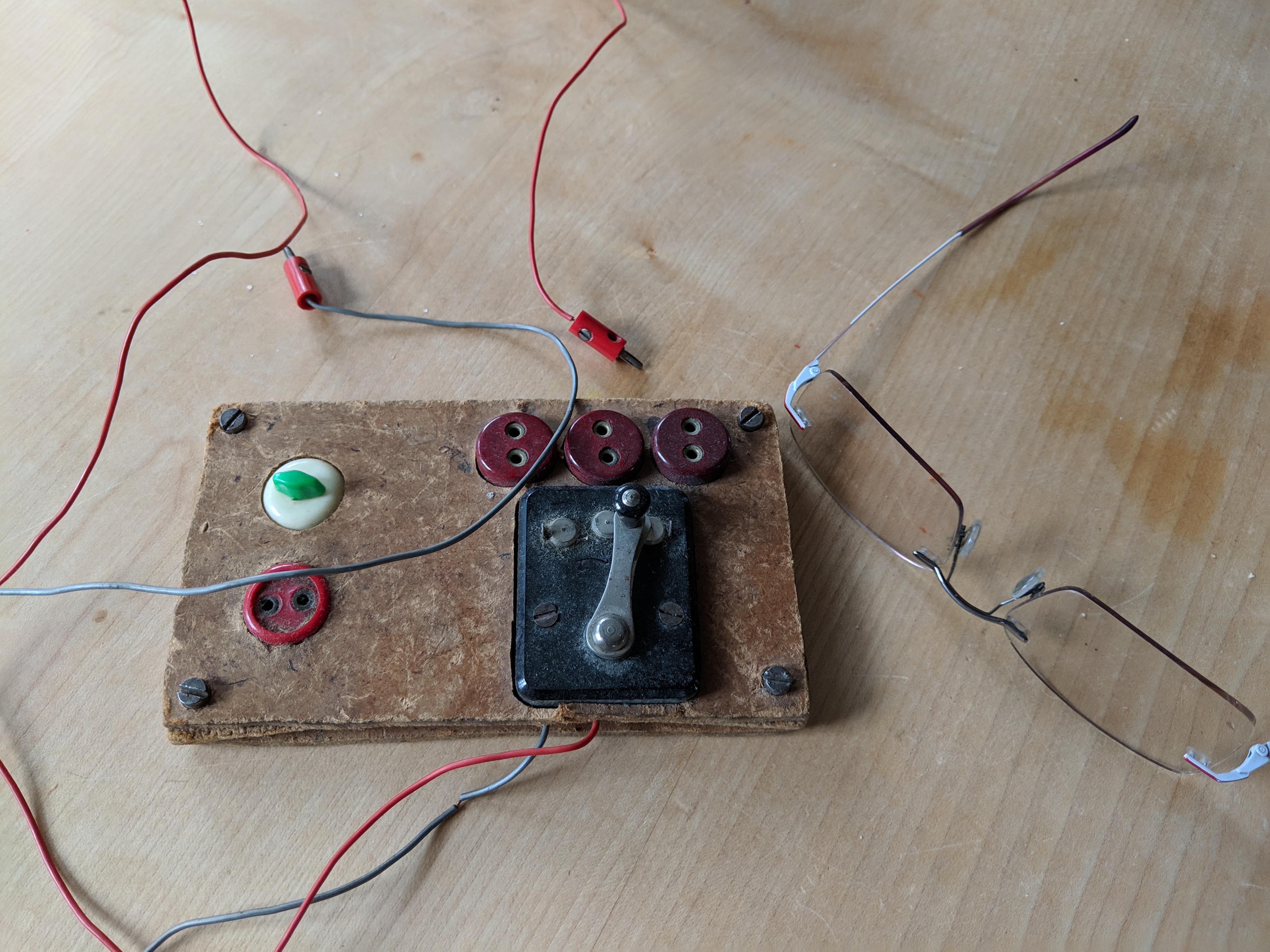
Simple control panel for three tracks and a railway station lamp.
Playing with model railways (with my Märklin model), I also learned a lot. My father designed a control panel for my model railway. It had two plywood boards, four screws and nuts from the “Stabilo set“. It also had a distributor with three exits, four electrical outlets and one lever. This must have been before 1960.
With this control panel, you could, for instance, transfer electricity to one of the three (1, 2 and 3 in separate circles) tracks at a railway station. Simultaneously, you could switch on and off the light in the station (today, they do it with IOT). There was even a glitch we used as a feature: if the levers were not precisely arranged, you even had electricity for two tracks! Of course only for 1 and 2 or 2 and 3.
My father had designed this for me because he felt that the Märklin panels were too expensive. I also only had manually worked switch points, rather than electronic ones. Well, this limited my automation drive, but nevertheless, you could do work on a few informatics gadgets.
As early as 1962, I founded a Pfiff-Club (Pfiff-Club) with some friends. We tried lots of informatics things. And we also did some true automation on a shared model. There was also a DB newspaper with exciting topics that the Club got every other month from the Deutsche Bundesbahn. It was always very eagerly anticipated.
There are several other digital things I learned from my father. He worked at the Deutsche Bundesbahn and brought the old graphic time tables (of Swabia and Bavaria) home. They were meant to be used up as note paper (also for cutting patterns for dresses to be made) – but for me, these unique drawings of train routes, along with the actual time tables, became very exciting reading material. It was absolutely informatics.
Even better were the technological DB magazines (I forgot the titles and unfortunately none of them is still available to me) my father brought home from work, I think four times each year. It was a little like “Pfiff-Club for grown-ups”. For me, it was exciting to read because it said many things about the real railway management.
It was about new railway control centres and new switch yards, and always about future technologies. About new locomotives and railway cars. In each of the magazines, you could find a particularly important topic as a highlight. I remember the opening of the as-the-crow-flies-line (that must have been around 1963), Roll-In-/Roll-Out Ferries, new sleeping compartments, the attempt at creating twin vehicles that could move both on the street and on railway tracks, new signalling and security systems and much more that definitely had an informatics background.
And in one instalment of the magazine, they celebrated the introduction of the new data processing technology at the Deutsche Bundesbahn. Let me explain:
In Germany, they used to have only state-wide railways. Some of them had their own locomotives. The Bavarian S3/6, one of which can still be admired at the Deutsches Museum, is a famous example. With the merging of the state railways to become the Deutsche Reichsbahn, there came a uniformity. The purpose of this merging had been to make the entire system more efficient through higher numbers.
Since the beginning of the railway was the steam locomotive, they noticed that the categorization would have to be between types 0 and 99. They called these types model ranges. Famous model ranges are, for instance, the 01 and the 03 (both are express train locomotives), the 10 (incidentally, that was the old Bavarian S3/6) and the 50 (a locomotive for freight trains). To the best of my knowledge, the last steam construction that actually took up work was the BR 10, but it did not work long.
With the advent of other drive systems, they put initial letters before the names. Electric locomotives received an E and the combustion motor (diesel) was given a V in front of the number. That meant the E-locomotives were now called E10 or E18 (fast train), E44 (passenger train) or E63 (switch engine) and the Diesel locomotives were now called V200 (multiple purpose locomotive) or V60 (switch locomotive). Other vehicle types were the VT (diesel railcar), the ET (electro railcar) and ETA (electro railcar with accumulator) – and more.
AND THEN THEY INVENTED DATA PROCESSING …
The species were something like CLASSES and the individual locomotives were the OBJECTS of a class. As with all huge technological devices, each OBJECT of a CLASS had its individual distinctive features that became more as time went by. In this system, the classes were described by the first two letters, then came – with a space that we today would call “blanc” – the object classification. That was the number of the individual locomotive, mostly in the same sequence as they were built. With most of the produced units, this number was a three-digit number, if the type was very successful, you occasionally got four digits.
Various BWs and BAs were assigned to the locomotives (objects). This is where they were serviced and maintained. This information was (incrementally) documented with tags on the locomotives, the same went for technological specialties as, for instance, for the compartment temperature or the compensating air (that kept the tyres away from the brakes through air pressure).
One significant difference between individual (steam) engines of a series was, for example, how they were lighted – with coal or oil. Naturally, this was quite a determining factor for the use, because a steam engine that was powered with oil could not make use of coal. If you were a member of the Pfiff-Club and spying out locomotives, you would be able to recognize the type from a long distance. Consequently, I am not sure if the lighting of a locomotive was also documented with a tag. For me, it was self-explanatory.
And there was a central register for all locomotives. In my imagination, this is a very big collection of very thick file folders. One for each locomotives – and they become thicker and thicker with time. All those data were to be transferred to electronic data processing.
And thus, there came a day when the magazine’s highlight was the information that, with the introduction of electronic data processing, the “number tags“ on the locomotives were no longer to have letters but numbers instead. Now all the locomotives got new number tags – and the old tags became well-loved collector pieces for the Pfiff-Club and other railway friends.
The number was probably the key to the locomotive in the then perhaps still sequential database. I think that must have been around 1965 – and even then, I found it rather annoying that electronic data processing (informatics) could not process letters.
? And this is how the E10 became the 110 and the V200 became the 320. What a pity.
RMD
(Translated by EG)
P.S.
After my learning years at Siemens, I had the chance to be part of the team that wrote the proposal for an X25 network based on a separate BASA cable network of the Deutsche Bundesbahn at the Munich Bundesbahnzentralamt (BZA). That must have been in the early 1980ies and it was a really great project. However, the end was not really glorious. …
(but I will write more on that at another time)
Roland DürreMonday December 31st, 2018
(Deutsch) Und schon wieder geht ein Jahr zu Ende! DANKE!
Another Year is Over! Thank You!
My Dear Friends!
Vivat the New Year!
Here is what I wish you, along with a little wish of mine for 2019!
May this piggy bring you all lots of happiness! It has been my Sylvester talisman for many years in IF Blog.
A good start!
Enjoy the new year!
Enjoy the world and honour creation!
Do not shun common sense!
Be free!
Live in lust and joy!
Be autonomous and follow your stars!
Do what you want to do!
Think first of yourself but then also of the others!
And, please, do not become martyrs for a “good cause”!
Do not act right but instead do the right things!
Consequently:
In six words and two sentences:
Enjoy life!
and
Be totally happy!
And I mean every minute of every day and night of your life in the new year 2019!
And here is my wish. Unlike my ”Christmas Greetings 2018“, it is not only for the “old white men“, but for all the people! I would wish that, in 2019, we all act a little more rationally than in 2018 and in the years before, perhaps as I suggest in my DontBuy Article!
Because it is simply a no-go that we destroy the planet with canine madness and kill each other in wars.
But above all
MANY THANKS
To all of you!
RMD
P.S.
The picture is a true click-pig. It is the first thing you get on google. Zillions of people have seen it. It was arranged by my friend Rolo Zollner. He created it for IF Blog and it is listed under Common Licence, which means you can use it if you cite the source and author.
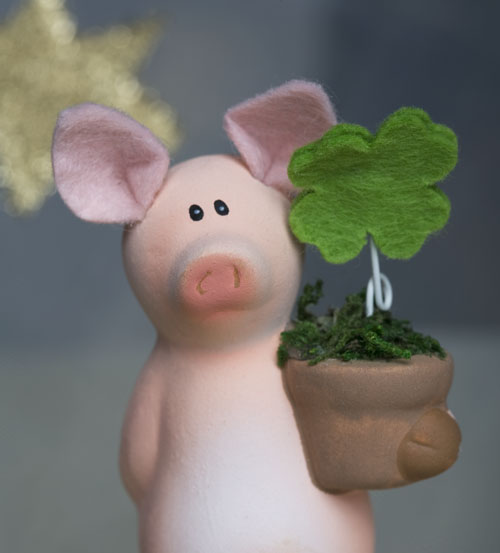
Arrangement and picture by Rolo Zollner.
Roland DürreSaturday December 29th, 2018
This Way or That Way?!
We have the choice. Continue as before or continue to live?
Here is something I found online:

Here is the translation:
Buy-Nothing List
- Do I really need this?
- How many of the same product do I have already?
- How often will I actually use it?
- How long will it remain in working order?
- Can I let someone else borrow it?
- Do I have something similar?
- Can I live without it?
- Can I repair it myself?
- Do I really want it?
- What will I do with it when I no longer need it?
- Who gets the money I pay for it?
- How and where was it made?
- How long will it make me happy?
There are two opinions:
A)
If this Mem becomes common consent, Germany can close its doors in one week.
The reason is evidently that our system will no longer work.
B)
If this Mem becomes common consent, your children and their children might at least have a chance to live off what this earth could offer.
? The reasoning is that consumption mania leads us away from ourselves. We are part of nature!
We have the choice!
It does not seem to be an easy choice.
Why?
When, on Silvester night, the rockets will again go up, I will think about it. For the new year.
RMD
(Translated by EG)


