
Detlev SixThursday August 14th, 2014
Strategic Moral: Putin’s “ShowThiefStrategy”
Well, wasn’t it a brilliant idea of Putin? An emergency convoy with food and medicine has been sent from Russia to alleviate the misery of the East-Ukrainians. Simultaneously, the Russians tell the world that they are in total agreement with the accompanying Red Cross and with the Ukrainians. Panic in Kiev. Nobody ever talked to them about it. So what now? Can we prevent the convoy, or stop it, or control it? Or should we brusquely refuse the friendly Russian gesture, because we suspect the convoy to contain weapons, instead of humanitarian aid? Regardless of the outcome: the Russians will look like the haven of humanitarianism – and they stole Kiev the limelight.
You want to know more about how strategic moral works?
Follow this link to the community “Strategische Moral“
Now that my own “live as an entrepreneur” is about to end, I probably found the ultimate success concept for entrepreneurs?
If there is indeed such a thing, then it can only be: you have to rigorously question all your relevant decisions measures, following the following concept:
1 What use is it for the business?
2 How will the employees benefit from it?
3 What good will it do your customers?
4 What damage will it do?
The constructive questions one through three are of central importance for all activities we enter into. Because entrepreneurs enter into something.
The fourth question is a “counter indicator” you should once again answer just to be on the safe side. In order to lay open the (potentially) destructive side of all measures, as well.
Question one will almost automatically answer positive if numbers two and three render constructive results. Regardless, it is very important, since it emphasizes the important requirement which alone makes a functioning enterprise possible.
If questions one to three give you a rich harvest and question four has been answered in the negative, then you usually fulfilled another requirement sufficient for the next step towards success.
Otherwise, you should quickly terminate your intended measure and analyse how you could ever have entered such a misleading path.
There are other criteria you should also distrust.
- There is no alternative to the decision.
- This is how it is always done!
- The competition does exactly the same.
- We have to do it in order to minimize the cost.
As soon as you hear this kind of sentences in an enterprise, you should immediately start being sceptical. They are a sure sign for helplessness and lack of creativity
“There is no alternative to this decision.“
Stating that there is no alternative is the end of entrepreneurship. If you arrive at this point, you should resign.
”This is how it is always done!“
In other words: we have to do it in this way because everybody else does, too. A closer look, however, will reveal that actually not everybody does it in this way. There are quite a few exceptions where it is “not done exactly in this way” and where, surprisingly, as a general rule, you will find more successful business.
Let me give you one example: the tendency towards certifications. There is no law that says you have to get all business processes certified according to ISO. And there are many successful enterprises that never got themselves certified. Regardless, many follow the doctrine: “certify”. And as soon as they have managed ISO 9001 (mostly through corruption), they have to introduce the next level.
To me, such doctrines sound sadly like the general problem people have with morals. There is a “higher rule” which has to be adhered to. “Moral” arguments are a trap when it comes to decisions relevant for business. A trap you will easily get caught in. They have no right at all to be guiding your actions and are a special kind of threat for the enterprise.
”The competition does the same.“
The competition starts a useless advertising campaign, abuses its employees, introduces SAP, expands to Australia, suffers losses… Is there any reason for your enterprise to do the same? Of course, this is nonsense! After all, the word “competition” includes “differentiation”! Consequently, you have to say: “We are not like the others!“ And hopefully, we are better.
”We have to do this in order to minimize the cost.“
Elaborate initiatives that are supposed to minimize the cost are something you should always distrust. Especially if they are expensive and necessitate strong measures. More often than not, the cost of the entire affair is calculated lower than it will actually be. Big projects – also those that are supposed to reduce costs – are usually a lot more expensive than planned. As a general rule, the amortisation process will fail. Besides, the collateral damage caused by such measures can and will also always be approximated. Consequently, you mostly get follow-up projects for which the same is true. How easily will a devilish vicious circle begin…
Trick:
Here is a trick I would like to recommend in this context:
Dear entrepreneurs, why don’t you do a “negative concept experiment”? Take the perspective that you actively aim at destroying your enterprise! More often than not, you will discover very interesting ideas. For instance, a creative service provider will simply have to employ the wrong kinds of people. It is a guarantee that the enterprise will slowly but constantly “go down the drain”.
And then compare the result of your experiment with what you actually do!
RMD
(Translated by EG)
P.S.
For more articles on entrepreneurship, click here: Drehscheibe!
Roland DürreSunday August 10th, 2014
Two Short Retrospective Glances at the 30-Year Jubilee.
Late in June, we celebrated 30 years of InterFace. It was a colourful and lively party, more than 400 persons found their way to us at the Sportpark Unterhaching.
Friedrich Lehn and his team took video recordings. And on top of a lot of great bonus material, he supplied us with two beautiful Potpourris.
Impressions from the Party
Voices on the party
Many thanks to all those who were kind enough and willing to give an interview.
It will make me glad if you all like what you see.
RMD
(Translated by EG)
Roland Dürre
Feel it! – Dr. Andreas Zeuch
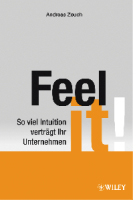 I knew Dr. Andreas Zeuch only through the internet (Twitter @zeuch …). We first met in Berlin at the PM Camp. On the second day (June, 22nd, 2014), he gave an “impulse presentation” that made a huge impression on me.
Afterwards, we spent a lot of time together, which meant that I missed a few other sessions. But such is the nature of PM Camps: like life, it is a collection of missed opportunities. Yet it is just as beautiful!
Andreas Zeuch is not only an entrepreneur and counsellor, well known as a team with Gebhard Borck, but also the author of several books. His book “Feel It”, with the sub-title: “This is the amount of intuition your enterprise can manage…” is among the things I acquired directly at the PM Camp (including a beautiful dedication written by Andreas).
By now, I have spent quite some time reading the book – and I learned a lot.
Many of the things I intuitively felt (for instance that the standard business textbook by WÖHE actually contains quite a bit of nonsense) have now suddenly become something I can actually prove rationally.
Also, I think I can now understand even better than before which traps the majority of start-up entrepreneurs fall into. Why so many start-uppers have nothing but empty hands to show after a certain time span, regardless of how much time, money and idealism they invested. At best, they will then have “failed successfully”, after collecting experience but paying a high price for it.
The book also showed me that the path I recommend for start-ups, which is a little different, is not so bad after all. This wonderful reading material is not the only reason why I will write a series of articles on “start-ups” during the upcoming vacation (two weeks spent on the southern-most campground on the Peloponnesus, just before Mani). The concept has already been determined…
And about the book “Feel it” by Andrea:
Why don’t you just trust me and read it?
You might find it changes your world!
Thanks!
RMD
(Translated by EG)
P.S.
Here is where you can order the book at Amazon.
P.S.1
🙂 On IF-AGORA.de, you can find the presentation of the book “Feel It” by Andreas Zeuch..
Why don’t you buy both, the presentation of “Feel It” and the book!
Roland DürreSaturday August 9th, 2014
I, too, am a “Meeskite”.
Last week, I took a three-day time-out (Auszeit). With my bike and my significant other, I went to Würzburg by train. We spent some time looking at the residential town and then went on to the Torturmtheater Sommerhausen by bike. They played “Emma”, which fascinated us. On the next day, we rode around 90 kilometres from Sommerhausen on the river Main to Feuchtwangen (in the district of Ansbach).
After what turned out to be quite a few metres of altitude, we ended up directly at the Feuchtwangen market place and checked into the “Lamm”. Having found our rooms and enjoyed our beer, we heard that the Kreuzgangfestspiele were currently played at the local open-air stage. And that tonight the musical “Cabaret” can be seen.
As we see it, a musical such as Cabaret on an open-air stage is definitely a nice finish to a sunny day on our bikes. Tickets for good seats are also still available. Consequently, we buy them and go to see the musical at night.
And it was a beautiful evening.
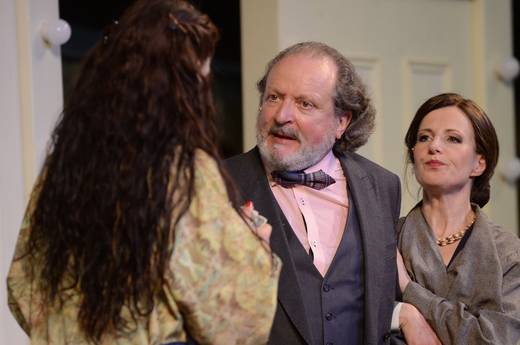
Sina Schulz (Fräulein Kost), Peter Kaghanovitch (Herr Schulz), Gabriele Fischer (Fräulein Schneider)
Well, Caberet is one of those musicals that go under your skin. The songs are beautiful earworms, the story actually is on a high level and the performance was good. Consequently, we enjoyed a wonderful theatre evening under the starry sky.
And then “Herr Schulz” sang his song about the Meeskite! And this was when I felt more than a little touched at the core of my being.
In Google, I find the meaning of “meeskite”: “ugly and not good or something”.
The song moved me so much that I looked up the lyrics. I found them on songlyrics.com.
Why was I so enthusiastic?
Well, it is because I myself felt I was a “meeskite” for many years. In my estimation, this phase lasted until I was around thirty. And even after that, I sometimes was a “meeskite”. Many of my friends also felt they were a “meeskite”. Even today, I often come across young persons who have the “meeskite” syndrome.
And I am sure that none of them has even the slightest reason to feel like they were a “meeskite”. On the contrary: these are all wonderful persons. Still, they feel “small and ugly”.
To me, the reason seems simple: people from their (our) surroundings, such as parents, school and other systemic and non-systemic influences and instances made both them and us look small. Or else, they managed to make them and us feel small.
And I fail to understand why this is so and why it should always be so. I think there were definitely systems where, in ancient times, it was different. Perhaps among the savages, who were still allowed to live in their natural environments? But does our cultural world really force us to feel “small”?
Should not the “cultural world” we ourselves created do the exact opposite: help us to liberate ourselves! And make us love ourselves?
Would it not be a beautiful utopia if humans stopped making each other look small and if we then no longer needed to feel we are “meeskites”? Wouldn’t this be a nice start of the “project freedom”?
Well, this is all I wish to say.
On stage, before his recital, Mr. Schultz says you only have to know the Yiddish word “Meeskite” in order to understand the song. And again, I get the suspicion that the “meeskite” will thrive particularly well in strongly religious and moralizing societies.
And if that turns out to be the truth, then the “meeskite syndrome” is yet another consequence of the “medicine” religion. “Religious Freedom” is and will always be an obligation derived from a tolerant concept of humans and society, but it must not be more than that. The super-elevation of religion I often witness in permanently grotesque forms of governmental obeisance right up to the point where an entire population subjugates itself under religious groups sounds absolutely inconceivable to me.
Incidentally, my mentor Rupert Lay taught the exception for intolerance: the only instance where intolerance is acceptable and even demanded is where intolerance comes into the picture. In other words: intolerance cannot and must not be tolerated!
Easily said, not so easily done – but certainly a good principle.
Miscellaneous
Meeskite
HERR SCHULTZ:
[spoken]
Now the only word you have to know to understand this
little song is the Yiddish word “meeskite”.
Meeskite means: ugly, funny looking…
Meeskite means:
[singing]
Meeskite, meeskite
Once upon a time there was a
Meeskite, meeskite
Looking in the mirror
He would say
What an awful shock,
I’ve got a face
That could stop a clock.
Meeskite, meeskite
Such a pity on him
He is a
Meeskite, meeskite
God up in his Heaven left him out on a shaky limb
He put a meeskite on him!
[spoken]
Listen, he grew up. Even meeskites grow up.
[singing]
And soon in the Heder (means Hebrew School)
He sat beside this little girl
And when he asked her, her name
She replied: “I’m Pearl!”
He ran to the Zeiddah (that’s grandfather)
And said in the scratchy voice of his
You told me I was the homeliest
Well, gramps, you’re wrong, Pearl is!
Meeskite, meeskite
No one ever saw a bigger
Meeskite, meeskite
Ev’rywhere a flaw
And maybe that is the reason why
I’m going to love her, until I die!
Meeskite, meeskite
Oh, it is a pleasure, she’s a
Meeskite, meeskite
She’s the one I’ll treasure
For I thought there could never be
A bigger meeskite, than me!
[spoken]
Listen to what happened:
[singing]
And so they were married
And in a year she turned and smiled:
“I’m afraid, I am going to have a child”.
Nine months she carried
Worrying how’s that child would look
And all the cousins, well, worried too,
But what a turn fate took:
Gorgeous, gorgeous
They produced a baby that was
Gorgeous, gorgeous
Crowding ’round the cradle
All relatives awed and wooed
He ought to pose for a baby-food.
Gorgeous, gorgeous
Would I tell a lie?
He’s simply
Gorgeous, gorgeous
Who’d have ever thought
That we will see such a flawless gem,
Out of two meeskites like them?
[spoken]
Wait! Wait! This story has a moral. All my stories have morals:
[singing]
Moral, moral
Yes indeed the story has a
Moral, moral
“Thou you not a beauty
It is nevertheless quite true
There may be beautiful things in you”.
Meeskite, meeskite
Listen to a fable of the
Meeskite, meeskite
Anyone responsible for loveliness large or small
Is not a meeskite at all!
Das Bild ist von der Website “Kreuzgangspiele – Stadt Feuchtwangen”
RMD
(Translated by EG)
P.S.
For those who did not want to follow the Link: here are the lyrics.
Here are my tweets of last week on
Blogging and Twittering, Wisdoms and Rules:
140821 It is an evil mouth that speaks with two tongues – also true for twittering and blogging! #Twitter #Blogging #Wisdom
This was the last wise proverb in the alphabet, all of which I found Alle deutsche Sprichwörter.
Consequently, there will be no more daily tweets to twitter and blog. Some of you will be glad to hear it – after all, I know that some IF Blog readers did not enjoy this column at all.
On the other hand, these German proverbs are certainly something extraordinary. For me, it was a positive experience to see how much experience and wisdom some of the proverbs contain. Also, I found it nice that the English translation (many thanks for EG for this great achievement) sometimes sounded more powerful than the German original. Also, the English version was actually “retweeted” fairly often.
What I did not like was the huge amount of moralization I seemed to detect I many of the proverbs. After all, moralizing is something I personally absolutely abhor and it is not at all what I had intended to do.
When all is said and done, the total impression is mixed. But perhaps I managed to cite some of the wisdom and intuition of the masses?! This would be something I would be glad to accept.
RMD
(Translated by EG)
Roland DürreThursday August 7th, 2014
Tweets on Twittering and Blogging #231Tweets on Twittering and Blogging #231
Here are my tweets of last week on
Blogging and Twittering, Wisdoms and Rules:
140814 Two pairs of eyes will see more than one – also true for twittering and blogging? #Twitter #Blogging #Wisdom
140815 Killing two flies at one blow – something we also occasionally manage to do when twittering and blogging! #Twitter #Blogging #Wisdom
140816 Two quarrelling parties will eventually always come to terms – also true for twittering and blogging! #Twitter #Blogging #Wisdom
140817 Doubt has many walls to hide behind – also when blogging and twittering? #Twitter #Blogging #Wisdom
140818 Failing to turn up twice is still acceptable – also when blogging and twittering! #Twitter #Blogging #Wisdom
140819 Between two honest parties, no invoice is necessary – not to forget when twittering and blogging. #Twitter #Blogging #Wisdom
140820 The gap between joy and sadness is not a huge one – also true when twittering and blogging! #Twitter #Blogging #Wisdom
RMD
(Translated by EG)
P.S.
I found the proverbs at Alle deutsche Sprichwörter gefunden..
Roland DürreSaturday August 2nd, 2014
“For Freedom” or “My Post-InterFace Life“
“Minutes and notes on and how I felt and results of my session “project freedom” at the Berlin PM Camp on June, 24th, 2014″
In former times, I was in search of the meaning of life. I tried to find meaning in as many things as possible. When I founded an enterprise, this, too, of course, was to be meaningful. That was more than thirty years ago. At the time, I was totally convinced that all social systems – including the economically-oriented ones – should have meaning.
And today – with every speaker demanding that enterprises must have meaning – I think that this demand is correct and yet wrong. Today, I believe the important thing is not whether life or an enterprise makes sense. Instead, what matters is how a human being or an enterprise affects its or his environment.
When I was a child, I, like many of my friends, was surrounded by a traumatized generation. In the early 1950ies, this generation knew exactly what you do and what you do not do. They felt like they owned the truth – which was often defined through totally irrational categorizations. They had a strange understanding of freedom and peace. And we were victims of their advice.
At school, we were “educated” by traumatized persons. Seemingly purged, they now sublimely tried to pass their dogmata and hatred on to the new generation, which was: us. Mind you, it was not just the teachers. The parents and family were no different. Even strangers who passed us on the street abused us. Because we wore jeans or because our hair was too long – regardless of the parents having threatened us with the worst possible punishments.
But in other respects, too, this generation never appreciated us. They knew exactly what the world should look like and we simply did not fit. Consequently, they made us look small. Being beaten was normal. Both at home and at school. Having to stand in the corner or having to spend a few hours in the coal cellar or locked into the bathroom were the humane forms of punishment.
We suffered and never understood the reasoning behind this kind of education. Instead, we saw it as a revenge model. We had to pay for our non-conformity and undesirable behaviour. And then we opposed and reciprocated with hatred.
We felt particularly ill-treated when we were punished for activities we had felt truly courageous, noble or great about. How it hurt us when we had been doing good things and they made us pay for it! – When we were called traitors.
Even when we had enjoyed doing something too much, we were scolded. Because it definitely would not do to have too much fun and therefore the rulers of our childhood objected to it.
Do not play with the street urchins …
When I was an adolescent, I liberated myself and the question about the meaning of life was never far from my mind. I was totally devastated by the fear of death. What meaning can a life have if it ends with death? To me, eternal life did not seem to be the right answer, either.
And on top of the meaning of life, there was another hope – peace. Big, never-ending peace. Both between humans and with creation.
After all, I and my friends never understood the nonsense about war. John Lennon was one of our heroes. I never experienced war first-hand. But I experienced how US GI’s sobbed in Augsburg, because they were ordered to fly to Vietnam early on the next morning. They certainly knew what to expect and they also knew that many of them would never return.
I can imagine how cruel war always is and will be and how perverse it is when “industrialized”. For me, the concept of an idealized war where clean modern technology is used, the reduction to using weapons as some kind of high-tech game where fighters control the death-spelling drone standing behind the game board is horrifying. Not to mention all those necessities that make all these things mandatory: weapons, soldiers, mines, fighting robots, …
I know no war that changed anything for the better. Also, I doubt that there can ever be a justified war. Perhaps even the Nazi problem could have been solved in a better way. Without WW1, there would probably never have been a WW2.
However, I do not only wish to oppose the big war. The war inside and on a small scale, too, is bad for us. Is it really necessary that humans always integrate so much animosity into their daily communication? Why is it so hard to come to peaceful terms with oneself?
Why do we always tend to make other people look smaller, rather than bigger? Wouldn’t it be an obligation both for our “leaders” and everyone else to make others look bigger? Because this is the only way the social system might work in favour of humans, rather than against them. So why do we fight ourselves and prevent the flourishing of our own life in many possible dimensions?
Isn’t it a great project goal to reach your inner and outer peace? A goal everyone – not just leaders and managers – should work towards? Don’t we all “manage” something or other most of the time in our lives? And no matter what it is we manage, it will always have something to do with people.
Consequently, I wish to dedicate the years remaining in my life to working towards peace.
During the Berlin PM Camp was the first time I tried to contribute by a session on “project peace”. Ulf Brandes had inspired me with his introductory presentation. I wanted to fascinate as many persons as possible for a “project peace”. Regardless of the topic being a little beyond our usual range, quite a few people came to attend my session. What we discovered was both encouraging and discouraging:
- Working for peace is definitely worth the effort.
- There is a lot of scepticism whether the project goal can be reached.
- Peace will definitely not come through religion and dogmata.
- A project goal “peace” commanded “from the top” will not help.
- Peace will not be installed by politicians, functionaries and other system agents.
- Traditional forms of protest for peace, such as Easter Marches, etc. will not have any effect.
- The project peace needs persons whose personality has reached a certain degree of maturity.
- In order to get peace, we need a new social consensus.
- Said consensus can only be obtained through a network supporting the process of forming opinions.
- Only a grass-root movement can make the “project goal peace” a success.
Now we can start.
Many thanks to all those who attended my Berlin PM Camp session on “project goal peace” and helped me a lot. Today, all I want is to really live – both in peace and for peace.
I see myself doing this against the generation I witnessed as a child that is still present in such huge numbers.
RMD
(Translated by EG)
P.S.
Let me note that, almost exactly a hundred years ago, something ultimately unbelievable happened for many people – systemic mechanisms culminated in WW1.
This war was the first media war (see documentations for instance at ARTE) to be started so cunningly. For instance, historical research was convinced for a long time that a majority of the people living in the two empires actually went to war jubilantly.
New historical research reversed this concept. Today, it is generally accepted that the entry of war in 1914 was mostly against the wishes of the people living in Germany and Austria and that, in truth, it was something the then elites and powerful wanted and instigated.
Nobody can seriously doubt the uselessness of WW2. The world was burning and there was an industrial waging of war in many places aiming at the total destruction of the enemy without any consideration for all kinds of loss.
On the scale of atrocities committed during the war that, unfortunately, is open at the top, the trench warfare on the German-French border, as well as the “mountain fights” in the Alps are perhaps the outstanding examples of cruelty and irrationality.
War is no constructive means to solve problems!


