
Roland DürreSunday January 12th, 2014
Uniting Personal and Collective Usefulness?
A short time ago, a group of us discussed India, the social situation in that country and values, along with and in particular the ever-present and noticeable differences between “extremely rich” and “extremely poor” on the Google+ Community “Strategic Morals“.
One of us reported about his last trip to India and also told us about a skyscraper in Mumbai which an Indian billionaire built for his family of four. Allegedly, one family (parents and three children) live there with 400 employees serving them.
I know the skyscraper. Some friends of mine told me that especially the health of the children of the family are in a catastrophic state. They also said that there is a complete, high-standard surgical department in this private skyscraper and that there is even a medical on-call service for this family.
I do not know if my information is correct. But regardless of whether or not it is correct, I would not wish to change places with this property owner.
However, I do not understand why even we here in our country tolerate and even promote a society with social rules that make it possible to get immensely rich in one short life. In my opinion, the question how these riches have been gained is irrelevant.
The prosperity of the “new” Russians or Chinamen, called oligarchs, is something I deeply distrust. The same is true for the money a “Michi Schumacher” (with whom I would not wish to change places either, even though he is considerably younger than I) who became a billionaire through “sports”. I also have my doubts about the “method” of a Steve Jobs (another person I would not wish to change places with), who managed to quasi become immensely rich as an entrepreneur.
The same is true for the million-dollar incomes of some DAX enterprise board members, especially if their salary is then added to by huge bonuses. Because I actually doubt that they are totally socially justifiable.
To be sure, I, too, know how hard it is to find a healthy social consensus. Where is the correct line or border for “tolerable riches”?
What might be a possible solution of the “social question”?
A short time ago, I read about the idea that, basically, it should be enough if we managed to “unite” individual and collective usefulness. The only thing that would be necessary for this idea to work is the development or establishment of a common awareness: only if something is collectively useful will it also be useful for an individual. And the same is true vice versa: only if something is useful for an individual will it be useful for the entire society.
How about making this the basis for an ethical “criterion” which might be used as a relevant maxim for “ethical behaviour”, just like the “golden rule” or the “law of behaving in a biophile manner”?
For instance:
“Always behave in such a way that the consequences of your behaviour will equally be beneficial for yourself and the collective social systems you are integrated in. And vice versa!”
RMD
(Translated by EG)
P.S.
I took the picture from Wikipedi. It is by Krupasindhu Muduli and under Creative Commons Attribution-Share Alike 3.0 Unported.
Roland DürreFriday January 10th, 2014
Self-Doubt – Comment on the “New Tools” of Management
The article of our “anonymous guest author” on tools of the new economy (Werkzeuge der Neuen Ökonomie) moved me deeply. After all, it described in a very illustrative way how an “owner-controlled” enterprise became a “shareholder value-oriented” enterprise, as can often be witnessed.
And it showed us quite clearly how you can get the impression that laws of reason and of sensible understanding have been violated and replaced by a system of dogmatic structures of mechanical and deterministic thinking. This is a story that is just too well-known and common – which basically always ends detrimental for all parties concerned.
My first reaction was to spontaneously regret this development and to call it evil. Are we not witnessing how good management technologies are replaced by bad ones? Is it not a pity that a people-centred system becomes a systemic system?
However, my second reaction was that, perhaps, we should not judge and, above all, not over-estimate this kind of development. Is there any reason at all for a “human-oriented” enterprise to live longer than, for example, its founder?
Is it not logical that social systems founded and created by mortal beings should be just as mortal as those who made them? And maybe this dogmatic mechanisation of a social system with an economic purpose – also called “enterprise” – is just the perhaps even evolutionary attempt to prolong the life of the hitherto founder- or family-oriented enterprise considerably, quasi artificially? To be sure, there is a high price to pay for it.
Perhaps it is totally normal for enterprises to die or be swallowed by other structures after a few generations of humans and enterprises? Because enterprises, too, like all living organisms, have a beginning (birth) and an end (death)?
Consequently, it might be possible that enterprises can only be dogmatically or mechanistically/deterministically controlled after having reached a certain volume or a certain age? Maybe after a certain time span, every enterprise will have to face that decisive moment from which onwards you have to either become dogmatic like the big ones, or else be swallowed by a big one – or die?
Personally, I know only very few firms that, over more than seven generations and, for instance, in the seventh generation, managed to remain both successful and still a nice medium-sized company. Most of them went bankrupt long before or have been swallowed up. Mind you, being swallowed up always means a lot of the old enterprise dies, while only little is preserved.
And perhaps a social system can basically only survive for more than a few generations if it becomes independent and de-personalized and if it develops strict dogmata as behaviour-oriented values? And if it then moves with all the power and strength it has gathered through history?
Perhaps an enterprise actually has to make its own survival the superior goal of its existence in order to survive long. Even if such social systems will quasi inevitably end up creating a fascistoid situation?
However, the result of my deliberations is something else:
It is always a pity if a biophile, democratic, self-organized and self-determined social system dies or mutates into a mechanistic and deterministic system. To be sure, the latter alternative might actually prolong the life-span of the enterprise, but it is not beneficial for the stakeholders of the enterprise. And there will come a day when it will finally die from its own inflexibility.
Under this light, it makes sense to oppose the de-personalization and economization of processes in the enterprises and to try and preserve the pro-human attitude in these social systems. Consequently, as I see it, enterprises should also try to avoid making their own survival the dominant (self-) purpose of their existence as long as possible. After all, it is their main purpose to serve the people they sell their services and/or products to, isn’t it?
How does our famous proverb say:
“Better a miserable end than endless misery.”
or
“You should finish on a high note”.
But then, this would mean to change the “old” system and make something new out of it as long as this is possible, i.e. as long as the old ways have not yet become independent. Because when that happens, it is probably too late.
Consequently:
“Love it, change it or leave it!”
RMD
(Translated by EG)
P.S.
I was privileged enough to actually meet Augustinus Heinrich Graf Henckel von Donnersmarck in person a few times. Like Rupert Lay, the Premonstratensian canon was a famous management coach and consultant for top-echelon German industry in the second half of the last century. I learned to identify both of them as the persons who introduced the term “ethics” in management.
Augustinus was a great orator who enjoyed humorously calling himself a church “lobbyist”. With equal delight, he kept reminding his audience that his enterprise, after all, had already survived almost 2,000 years – and that he knew no other enterprise that had survived as long.
If you look at it cynically, the humorous comment of this great church man might actually prove that dogmata and rigidity are important for the longevity of a social system. Even if the founder of the enterprise himself had a totally different concept of the entire matter. But then, the enterprise “church” certainly has a very special product on offer……
Klaus HnilicaThursday January 9th, 2014
The Magician’s Death
Ladies and gentlemen, before I make myself scarce, I would like to give you a very short version of the magnificent story of my death – and, please, understand that I am in a hurry, because in but a few minutes Jasmine will appear and I would find it totally inappropriate if she were to meet me while…
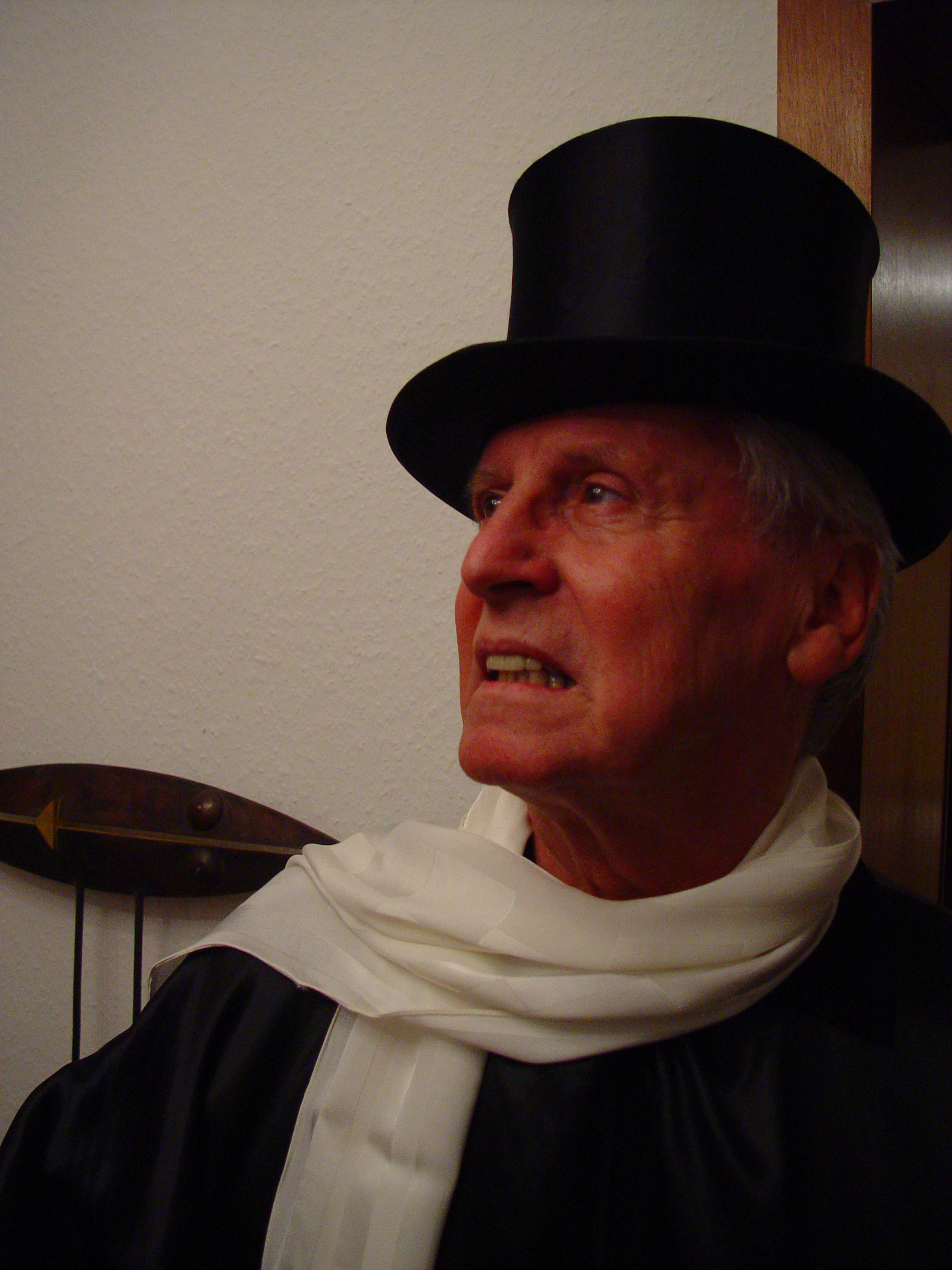 The best way to tell this story is to begin with another death fantasy of mine! Namely the one when, for the first time, I was going to throw my deeply detested wife Abigail Hadley at the wall of our chimney chamber very realistically!
And I have to admit – even if this is not necessarily one of my life’s highlights – that, from the first moment, the image of the ’splashy impact’ of her contour-lacking body was not the only thing I dearly longed for. In fact, the mental concept of the sinfully expensive Francis Bacon hanging opposite the chimney being taken down followed immediately. Strangely enough, the thing I envisaged along with Abigail ’splashing ’ on the freshly designed white wall was that of her subsequently being transformed to become one of those expanding relief portraits with the help of a few quick mummifying tricks and a golden frame which these days are shown even in the Tate Gallery. …
For myself and my pixyish Jasmine, it would certainly have been an often dreamt dream come true if Abigail – silently agreeing – were to drape the wall behind us in this heroic way while we emptied our glassed of champagne saluting her from the light-coloured bear fur in front of the chimney…
My God – what a great little joke this would have been for my fun-loving Jasmine! But unfortunately, this was not what came to pass! Because this happy-go-lucky angel Jasmine, who virtually emanated lust for life and vitality, fell into a heavy coma on November, 21st at twelve o’ clock noon totally unexpectedly – I will never forget that day!
And none of our so highly praised London doctors had even the faintest idea how this could have happened! The entire assembled London medical fraternity of the famous ’Royal Brompton Hospital’ knew of nothing to say or do except shake their heads sheepishly and blow their noses when confronted with this terrible event!
I am sure you cannot imagine what it means if such combined helplessness is thrown at someone like me! Me, Sir Ethan Hadley, the greatest magician of England, who is at home on all the world’s show stages and whose financial situation is such that I could easily have bought up this entire sorry heap of doctors and let them rot! Or even better: I could have cut every one of these incompetent “dottores” up into small, ’anti-septic pieces’ with my saw without ever having to fear any kinds of conseuences at all!
But even those, admittedly evil fantasies, were basically only how I coped with my absolute helplessness when faced with this bottomless bumbling incompetence of the London doctors!
This might well also be the reason why, at the time, I lost it so totally, spontaneously yelled at the doctor standing nearest to me and slapped him in the face rather loudly! Without another word, I stormed out of this damned hospital head over heal, spent several days roaming through all the rooms of my huge property at Esher, promised ruthless revenge, hid in every mouse hole I could find, eventually fell onto a heap of oily rags in a total state of exhaustion and wanted nothing more than die.…
And if Bob, our caretaker, had not accidentally found me at the time after I had been sick into the oily stink of the rags several times, I am sure I would have kissed this world good-bye without further ado. Yet it would have been even more embarrassing if Bradley, our butler, instead of Bob, had found me at the time! He certainly could easily have killed and disposed of me there and then. I am sure he would have done anything for money! This, however, is something I must admit to not yet having known at the time …
The only strange thing about it was that, from the moment Jasmine had disappeared from everybody’s sphere, my entire conniving mesh poke suddenly was ever so touchingly concerned about me! Even my eternally dribbling Abigail seemed to be a new person: in an unexpectedly tender way, she cared for and pampered me day and night. And I must admit that it felt nice – I enjoyed these long-missed benefactions more than I like to admit.
Naturally, along with Abigail, my agent Florence Bloomfield made her immediate appearance. She tried to distract and stabilize me by proposing numerous appointments! In fact, I even had to use all my persuasion to keep her from starting a new world tour with me immediately! In order to pacify her, I made her understand that there was really no time for this, since I needed her for a very personal task!
And – now this is only between you and me – I expected as much reliability and discretion of her as of Freya, the black sheep of the glorious Nelson family! Incidentally, in the noble Nelson family, who are extremely proud of tracing their line back to Admiral Nelson, Abigail’s younger sister Freya defined herself more through ’latex and leather’‚ which meant that she had a very creative and successful way of satisfying even the most out-of-the-way fantasies of London High Society in her atelier – as she called it! Yes, I must admit – I am also one of those who had huge respect for her! I appreciated her immense professional standards, her hidden sympathy towards myself and her mute understanding when she helped me to relax with her hard whip and barking commands – I will spare you the details!
As expected, Florence acted with similar professionalism when I told her to initiate the foundation ’Doctors for Brains’ in my name. In this way, I want to be able to have the maximum possible influence on Jasmines recuperation process.
Of course, Florence was present during the first discussions with Professor Gordon, who is a well-known expert when it comes to coma patients. Even the most hopeless cases were re-awakened by him. But then, during a confidential interview, he confronted me with information that caused a new state of shock in me.
Incidentally, I am not ashamed to admit that, without Freya and her – let me call it – ’despotic care’, I would never have been able to cope with this new blow on the back of my neck, let alone with the diagnosis of Professor Gordon!
”… we have to assume”, he said, “that your acquaintance, Jasmine Moore, has been administered a poison injection! Even if this is now hard for you to bear, I have to tell you that it really seems like she was to have been killed, but the amount of poison needed was incorrectly calculated”.
”O My God”, I moaned, “who on earth would want this? This is totally absurd!“
”I do not know, mister Hadlay, but I am absolutely certain that the poison that was injected is identical with the one the Amazon Indians are still using to poison their arrows today“!
”Please do not say this, Professor Gordon”, I begged him, “please, no …!”, because I knew immediately what this would have meant: after all, Abigail’s brother was an anthropologist who had been working and doing research in the Amazon region for many years.
And when, on top of everything else, I discovered that my agent Florence Bloomfield had set out to cheat me out of a few million dollars when she organized the foundation ’Doctors for Brains’, it was, of course, Freya, who punished me in the most agreeable way for my stupid blind confidence with face mask and whip. This is something I have to admit to quite honestly, since today is obviously confession day!
Even more so since the situation grew worse through the joyful yet rather disastrous additional call by Professor Gordon! In fact, since he told me on the telephone that my much-loved Jasmine Moore finally came out of her coma after three years, even Freya suddenly belonged to those people I now had to fear – even tonight!
In retrospect, however, I also can assure you that I will never again go and attend my own funeral: because you really cannot imagine how my angel Jasmine, who at the time had just come out of her coma, suffered during my funeral. Incidentally, I myself would not have believed it, either! Neither could I watch it! Consequently, I left the assembled mourners during my own consecration ceremony. Of course, this is impossible behaviour! But then, everything about this lie of a funeral ceremony was nothing else:I was among the mourners wearing a perfect mask that made me look like Butler Bradley, while Bradley himself silently lay in the consecrated coffin.…
My God – what a scene had he made when I, who had been presumed dead, stepped out of the coffin unharmed shortly before the consecration ceremony and ordered the overwhelmed ’camouflage killer’ to lie in the box in my stead. To make his next few hours a little easier, I offered him a potent special drink. Well, I would not really want to elaborate, but Bradley certainly did not empty his ’cup of hemlock’ anywhere near as courageously as that Socrates had done, you can believe me! .In fact, he even went so far as to beg for his miserable, small life in a disgustingly feminine fashion! He sobbed until his eyes fell out of his head and told me all the names of those who had ordered him to eliminate me for quite a sum without me having even asked for those names – and I have to tell you we are talking practically all the persons I mentioned tonight, of course, with the exception of my much-loved Jasmine. But I guess she will go totally crazy when she hears about me still living!
Naturally, Freya was not among those names, either. But she suddenly started hating me when I made her understand that, from now on, I was going to exist exclusively for Jasmine! And since I know only too well what Freya can do to me without me having anything to fight her with, I want to hide somewhere outside Europe as fast as possible, maybe even tonight – but where?
Well, it has to be a place where it is always warm and where you can get macro-biological food. Besides, Jasmine hates all sorts of small animals, in particular cockroaches and mosquitoes! And I need a written guarantee that this strange German Boris Becker with his Lilly will never cross my path. Because that is something that must not happen at all!
But now I really have to make myself scarce: Jasmine can turn up every second now and I really would not wish to inflict her hysterical outcries on you! A very good evening to all of you! I am sure some of you will meet me again at Freya’s – but do not have any illusions about discovering me there! By now, my face masks and all-body corsages are more than perfect; not even Freya will know if the famous magician Sir Ethan Hadley is still deigning to visit her establishment.
KH
(Translated by EG)
Roland Dürre
Tweets on Twittering and Blogging #201
Here are my tweets of last week on:
Blogging and Twittering, Wisdoms and Rules:
140116 Those who show love towards me will cause me worries – also true for twittering and blogging! #Twitter #Blogging #Wisdom
140117 Someone who harms me can also serve me – for instance when twittering and blogging. #Twitter #Blogging #Wisdom
140118 If you refuse to socialize with people, you have to move out of this world – also true for twittering and blogging. #Twitter #Blogging #Wisdom
140119 Obligation gives you no choice – also true for blogging and twittering. #Twitter #Blogging #Wisdom
140120 If you marry money, you will lose your freedom – also true for blogging and twittering. #Twitter #Blogging #Wisdom
140121 Envying someone means suffering – also true for twittering and blogging? #Twitter #Blogging #Wisdom
140122 You do not know sweetness unless you have tasted bitterness – also true for twittering and blogging? #Twitter #Blogging #Wisdom
There is a new tweet each day. See twitter.com and “follow” RolandDuerre!
Enjoy!
RMD
(Translated by EG)
P.S.
I took the proverbs from Alle deutsche Sprichwörter.
Roland DürreMonday January 6th, 2014
The Deutsche Bahn and the Döner in Lindau
I spent Friday night and Saturday in Switzerland, staying with my partner Wolf. He lives in Goldach on the lake Bodensee. As usual, I went by train.
My favourite route is through Lindau. You go from Munich via Buchloe, Kaufbeuern, Kempten, Immenstadt, Oberstaufen and see the entire beautiful Allgäu. I always enjoy it very much. And while I travel, I can read a little bit and prepare for various topics.
Unfortunately, it is not possible for me to buy a ticket all the way to Goldach in Munich. You can neither do it on the internet, nor at the counter. To be sure, you can buy a ticket to St. Margrethen, but not to the small villages such Rorschach or – well – Goldach. The same was again true last week.
Mind your, I can easily print the time schedule to Goldach via Lindau in Germany. First, you take the Alex to Lindau. Consequently, I buy a “Bayern Ticket”. It is valid as far as Lindau, where I have to change anyway.
Normally, the change of trains to the Bregenz S-Bahn or even directly to St. Margrethen takes a little more than 20 minutes. That means I usually have enough time to purchase my ticket for the way from Lindau to Goldach in Lindau.
This time, however, my schedule says I only have five minutes. And since a German train is never on time, this will be tight. Of course, I was right. Although my Alex was on time all the rest of the way, it had to sit in front of a red signal for five minutes just before Lindau Central Station.
And (of course) we arrive late in Lindau. The connecting train to Bregenz/St. Magrethen is waiting, but the voice coming through the loudspeaker advises us to hurry. However, I have no ticket for continuing my travel. Nor can you buy a ticket in Austrian trains.
Consequently, I must make up my mind real quick.
Alternative 1: board without valid ticket.
The risk of being caught is not very high. The train ticket is about 10 Euros, as far as I know, the penalty is 40 Euros. The risk of getting caught is actually even lower than 10 %. Following game theory, a lot can be said in favour of riding without a valid ticket.
Alternative 2: buy ticket.
If I buy a ticket, I will arrive forty minutes later. And additional inconveniences will follow: I have to inform my friend about my delayed arrival, because he told me he is going to meet me. Also, I have to change more often. And the stay in Lindau is rather long.
Decision: Döner-Man
.
I remember the Döner Man at Lindau Railway Station. The Döner he sells is really tasty. Consequently, what I do is not go towards the Bregenz S-Bahn to St. Margrethen. Instead, I turn towards the Lindau Station concourse.
The first thing I do is buy my ticket to Goldach. I have to use an Austrian ticket machine. Because the German ticket machine cannot deliver. I pay 10.50 Euros for the short way from Lindau to Goldach.
For those of you who never go by train: Lindau, just like Salzburg used to be (Germany/Austria) or St. Margrethen (Austria/Switzerland) is a Border Station ; you will find the ticket machines for two railway companies.
Afterwards, I go to the Döner Man, wishing to buy a Döner. Since I now have plenty of time, I take a closer look at the prices. In Lindau, you get the “normal” Döner for 4 Euros. The tasty one with cheese is 4.50 Euros and the Dürüm Döner is five Euros!
Some way or other, I seem to remember totally different Döner prices. Even without thinking way back to times when we paid with the Deutsche Mark.
Now I offer a bet: five years from now, the normal Döner at Lindau Central Station will be 7.50 Euros or more. And the ticket from Lindau to Goldach will be at least twice the price of the Döner.
Who wants to bet against me?
RMD
(Translated by EG)
P.S.
In the evening, we meet Barbara in St. Margarethen. All the Swiss trains on the display are on time. Only one train – the EC from Germany – is expected to be late. The loudspeaker just says: “Due to something that happened abroad, the train will be 10 minutes late”.
On the way back, something similar happened. We departed Switzerland and Lindau (!) on time, then had to wait for the second part of the train in Immenstadt. We changed trains in Buchloe – fortunately, the connection to Munich was also late. …
Roland DürreSaturday January 4th, 2014
Tools of the New Economy
Here is a guest article. At the moment, I prefer not to give you the name of the author, because this article might be detrimental to him.
Review, Moments and Retrospections.
I cannot offer a piece based on scientific research, but I can report what I experienced during my professional career.
Change is what characterizes an economic system and in the Federal Republic of Germany, said changes started in 1967 without anybody noticing. That was when the constant economic growth first suffered a temporary standstill. To be sure, the prevailing model of a free economy of western European design was not yet revolutionized, nor did that happen during the following crude oil shock experiences of the years 1973 and 1983.
The ”Deutschland AG“ with its charismatic leaders remained intact until the “Wende”. Up until early in 1990, the founding fathers of the post-war middle classes remained on their seats. After that, the beginning globalization of a single economic model rang the bells for change. This new economic model is better known as “New Economy“, others also call is neo-liberalism. An ideological basis for the “New Economy“ model was probably laid by Milton Fridman with his ”Chicago Boys“.
The ’Share Holder Value’ gained pride of place. Classic value creations and production processes apparently were too boring and had to be optimized. If a concern totalled less than >10, the performance was considered poor. If the expectation of the ’Share Holder Value’ are not met, you move on to become a managing director of the enterprise.
The value of the leaders is measured by their “Performance“ and the cost-effectiveness of the next result. After all, a high profit was promised to the shareholders in the portfolio.
Consequently, the stars of the “New Economy“ change between enterprises. Even totally different sectors were no reason not to go there: you move from insurance to electronic engineering, from media concerns to a discount chain, etc. – there is no shortage of examples.
How can this work?
In order to make an enterprise transparent for the stock market, you need special tools. “Controlling” is very important if you want to quickly determine the “shareholder value”, the equity price and the dividend.
This development also explains why SAP was such a success. Offering the necessary tools with a universal product, the programmer makes it possible to have transparency, process monitoring and control.
Let me be fair and add that these tools actually make it possible for concerns to have short-term financial success. Whether or not, however, said success is sustainable remains to be seen.
It is a fact that this “Business Model“ is now established. “Business Schools“, along with the media and all those enterprise counsellors that sprouted with the rise of the “New Economy“ preach the rules of the “New Economy“ in their seminars and activities right on location.
Model 1 – Retrospection
In all my life, I only wrote two letters of application: the first was when I applied for an apprenticeship and the second was when I wanted to terminate my career as a sailor and start working on the dockyard.
All the other jobs were coincidental.
Today, I preside over one branch of a German medium-sized enterprise. We sell technologically high-quality solutions that require some explanation. It is typical for this family enterprise that we started branching out on a world-wide scale early on and thus contributed to the German export success story.
The then director of the firm – at the time there was only the one – asked me on a workshop if, since I knew the market well and had all the technological qualities necessary due to working for one of his customers, I would be willing to establish a foreign branch.
My expected turnover was determined by none other than this director. Based on his observation of the market, he gave me a number he thought might be realistic.
It all happened without bureaucracy, quasi by handshake, as with all my foreign colleagues. Regardless of a total of 450 employees, we did not yet have a personnel department. All affairs pertaining to employees were processed by the accounting department and the head of finances.
Simultaneously, the head of finances handed me a simplified accounting plan which showed the monthly turnover, earnings, expenditure and profit. The director had a derogatory expression for this plan: ’ink piss’; yet the two gentlemen were friends. All the foreign managing directors reported back to the one director.
You can summarize it by saying we established a branch based on the understanding of the market and the director’s ’gut feeling’. He relied on his experience with humans when selecting his employee.
During twenty years of very successful leadership, he had collected his tools:
- Knowledge about products, because he promoted developments as required by the market.
- Knowledge about the production process, because problems were always discussed between himself, the chief constructor and the producers.
- Knowledge of the market, because his information came from many branches and he visited many fairs and, of course, he was involved with the major customers and the major projects.
This is no longer the case.
Model 2 – Today
Here is how a branch director is selected today:
- The company looks for an external ”Personal Consultant“.
- The typical tasks of the job are defined.
- A job description is written.
- The candidates are pre-selected by the ’Consultant’ and then the sales director decides.
- ’Human Resources’ will do the actual employing.
- A business plan is made.
- A budget for the next three years is determined.
- If there is no prior experience, the numbers will be based on machine engineering statistics.
- The work will be accompanied by a three-month ’Controlling’ phase. It documents the numbers for orders and turnover.
- Simultaneously, monthly balance sheets for the accounting department, the banks and the auditors are written.
For some of you, this list is probably not very much of a shock. Still, it makes clear that quite a few things have changed since I was first employed.
New tools were added to the old ones of my then-director, and the same is true for new leadership levels:
- Consulting
- HR = Human Resources
- Reporting
- Controlling
- R & D = Research & Development
- IT
- Marketing
Even the terminology is rather remarkable, isn’t it?
So what happened?
The medium-sized company was re-structured following the example of a modern, stock-market-oriented enterprise. Decisions that previously the owner himself or a long-serving director or the managing director made now have to follow a strict organizational pattern. They are newly distributed according to the rules and the tools of the “new economy”.
Those who now made the decisions had not grown up in the firm or the family. Instead, they came from outside and often had never worked in the field.
For them, it was not possible to rely on many years of experience in the sector and they could not rely on gut feeling. They depend on the “New Economy Tools“.
So why do we use these new tools?
All processes have to become transparent and predictable in order to make the planned results come to pass. If you cannot rely on your experience and your in-house competence, the process has to be controlled and monitored all the time. Consequently, the responsibility has to be distributed and ascertainable.
Are these tools suitable for medium-sized companies?
Not if we are talking technologically high-quality products that need explanation and are custom-made following individual specifications.
If all processes are pressed into a system and these processes are to be adhered to strictly, then there is no room for individual activities as sometimes desired by the customers.
This is absolutely deadly for someone whose expertise is on special applications.
The employees will capitulate before the technocracy. Everybody refuses to do it if something has to be done extremely fast, because “this is a sure way to get problems”. Employees have to justify why the pre-scribed path of process control was not followed. As a consequence, resignation will prevail – which can be measured by the increase of people calling in sick.
An automated controlling mechanism will inform the hierarchy about price fluctuations, process shortcuts, special bargains, etc. by email.
Result: even more frustration. Who wants to work in a company where every single movement of your hand is reported?
A universal operating program will automatically start as soon as the offer is written. It will accompany the construction, processing, purchasing and production and it increased the reaction times for the sales considerably, since the ’system’ will only work when all the required data have been entered.
So what worries me?
What I experience seems to prove that my worries were justified:
- Regardless of control, all products will naturally fatigue, which means that they reach a mature industrial age and can no longer be optimized as far as the costs are concerned – except maybe if you look for a radical solution such as outsourcing the production into a low-wage country. Your only chance to lower costs is to continue developing and come up with new ideas.
- If someone is not familiar with the sector, he or she will not be able to install new ideas from the market. Instead, he or she will always rely on management tools, following the book.
- Since all responsibility is distributed, the actual responsibility for your own decision is no longer yours, either!
But I am afraid there is no “going back”.
Results
Using the new tools does not give medium-sized companies any advantages.
Process control is only efficient for efficient production, not for sales and development.
With this approach, the traditional strength of medium-sized companies, i.e. the quick and flexible innovative power which will always smoothly adapts to the market, will no longer be a factor.
What medium-sized companies need is leadership personalities who have grown up in a special field, or else have been recommended by their customers or suppliers, thus being competent on all levels of sales, the enterprise and the customers.
A constant flow of verbal communication must be possible, not some sort of communication created by workshops, leadership circles, Kick-off-meetings, but initiated spontaneously – why not over a glass of beer?
As I see it, creativity is not something you can switch on or off and good ideas will not wait until you next can offer a time slot for meeting or after the vacation.
We actually have these sorts of leadership personalities and I often met them in my professional life. It meant that I was able to collect experience and was always willing to give my best for success.
Dogma criticism
- Who was it that laughed about the five-year plans of the communist ”COMECON“ before the Iron Curtain fell?
- Did the five-year plans work?
- To be sure, the planning was fine, but it was never good enough to prevent shortages or for the country to become a leader in product development.
- The Western European countries felt superior to the planned economy model?
Now we started on a similar path by using the tools of the financial world in order to control even the smallest companies with the „New Economy Tools“. We no longer call it planned economy, but ”Business Plan“ or ”Budget“ or ”Quarterly Reporting“.
Now I write detailed three-year plans.
The fact that they are all result-oriented is detrimental for their sustainability. Incidentally, we copied the language of the ideologists along with the New Economy.
Iktaqw
(I know the author quite well)
(Translated by EG)
Roland DürreThursday January 2nd, 2014
Tweets on Twittering and Blogging #200
Here are my tweets of last week on:
Blogging and Twittering, Wisdoms and Rules:
1401209 Getting annoyed easily means you will easily commit sins – also true for twittering and blogging! #Twitter #Blogging #Wisdom
140110 If you want to lie, you should have a good memory – also true for twittering and blogging. #Twitter #Blogging #Wisdom
140111 Believing in your own wisdom comes close to being asinine – also true for twittering and blogging. #Twitter #Blogging #Wisdom
140112 If you believe you are nothing, you will be nothing – if you believe you amount to much, you are nothing – also true for blogging and twittering? #Twitter #Blogging #Wisdom
140113 The master craftsman will always win against the others – also true for blogging and twittering? #Twitter #Blogging #Wisdom
140114 If you shoot at me, I will shoot back – also true for twittering and blogging? #Twitter #Blogging #Wisdom
140115 I learned to give from those who gave to me – also true for twittering and blogging? #Twitter #Blogging #Wisdom
There is a new tweet each day. See twitter.com and “follow” RolandDuerre!
Enjoy!
RMD
P.S.
I took the proverbs from Alle deutsche Sprichwörter.


