
Roland DürreWednesday February 13th, 2013
Concerning Myself …

I am wearing my new cap, imported from China!
The picture was taken on October, 3rd, 2012 in the “Waldwirtschaft”.
People keep asking me:
Why on earth do you write all those articles?
I spent a long time thinking about the answer.
Of course, I am glad to know that many people read what I write. Being famous and once in a while getting invited to do a presentation is nice. Whenever someone writes a nice and useful comment, then this is really something that makes my day. All these things are not too bad, are they? But they are not really what matters.
For me, the IF blog is not about additional profit, either. Regardless of the fact that – as I heard from some other bloggers – there are actually ways.
Yet I never tried to earn a few extra Euros through If blog.
Neither is it my intention to evangelize or convert anybody. I do not want to know everything better or give advice. Perhaps it is because I wish to give back a little of what I received and learned in life. But that, too, is not really what is most important.
No, actually, first and foremost, I write because I like writing. And it would be boring to just keep all those articles hidden in the secret album of prose. Consequently, I publish them.
RMD
P.S.
Incidentally, this is also the picture under which I currently twitter:
Roland M. Dürre @RolandDuerre
Roland DürreTuesday February 12th, 2013
Aging and Productivity, Retirement and Cognitive Achievement
I “pilfered” the title from Prof. Dr. Axel Börsch-Supan (Director of the Munich Center for the Economics of Aging MEA) at Max-Planck-Institute for Social Justice and Social Politics. He gave a strong presentation with the same title at the event “How to Guarantee Experience for Future Generations (Erfahrung für die Zukunft sichern)” at TUM for the „Project TUM Emeriti of Excellence“ .
I already wrote about this presentation in my article: “A rolling stone gathers no moss (Wer rastet, der rostet)”. For me, the event brought many new, well-researched items of information. Professor Börsch-Supan proved in a constructive way that the early retirement habits of our contemporary times are wrong. He also told us that this is detrimental for all parties concerned: the retirees, the enterprises acting in this manner and all of us.
A short time ago, I met a friend whom I hold in very high esteem. He is the same age as I am. A few months ago, he entered the “early retirement” phase. And he is a good proof of all I learned in the presentation. Here is how I often see pre-retirement:
It is almost complex (very complicated) and serves many critical themes. If you know this, you also know how expert know-how is extremely important in this sector.
A friend of mine is a top expert when it comes to a very relevant database technology. He is particularly adept with extreme volumes and demand situations. In all Europe, there are probably only a few experts who can hold a torch to him.
My friend is the same age as I am. His employer is a first-class concern. A few years ago, this concern offered a lavish early retirement package to its older employees, practically following the principle “handing out to all and sundry”. My friend, too, took the bait.
A few years later, the day has arrived. My friend is now retired. Mind you, he is still as much of a first-class expert as he used to be. Financially spoken, he made a good deal.
However, he also realized that his knowledge will be missed by the enterprise. Consequently, he tries to hand it on to his colleagues in a pro-active way. He offers to teach workshops on a voluntary basis, even after office hours. Because, due to all the pressure during office hours, there is simply no time left. This concept, however, does not work well. He is rather disappointed to see that there is not much interest and that hardly anybody wants to come and learn from him.
Then the day of retirement comes. And now you have nothing but losers:
The concern:
Some very important know-how is lost. If, for example, in the future, a process comes to a standstill because the IT does not work as it should, it might well be because something is not as it used to be. Because the know-how is now lost and consequently there are a few things that will no longer run as smoothly as they did before.
My friend:
Initially, he found early retirement absolutely thrilling. The new “freedom” was just wonderful. There were still a number of activities left from the time as an active member of the work-force. Good intentions were formulated – and adhered to. A few months later, everything already looks different. Less social contacts, the good intensions, too, are no longer quite as strictly put into practice … And slowly frustration comes. I witness it quite closely.
This friend does actually exist. However, it is not one friend. Everything I understood from the presentation seems to match reality.
When all is said and done, everything the speaker told us and warned us against actually happens in real life:
Use it – or – lose it.
Well, let us wait and see if I can learn something from this for my future.
RMD
(Translated by EG)
Roland DürreMonday February 11th, 2013
Water
Whenever we managers go and eat lunch, we drink water. Either the flat type or the type that sprinkles a little. Regardless of the fact that such nice drinks as juice and spritzer, CocaCola and many other artificial soft drinks are available. Not to forget the world’s best beer and quite a few good vintages.
Still, we drink water. One reason is that it is good for our health. But perhaps it also has something to do with a type of “new modesty”. Why not just forego a little of all the detrimental luxury. Fifty years ago, when I was still working at Siemens, matters were still different – in those days, the managers of the OFK (upper leadership circle) hardly ever took their meals in the guest casino without a small glass of wine to go with it. And sometimes they smoked a cigar after the meal, too. Mind you, the leaders’ performance was probably no worse in those days than it is today.
But basically, the only reason I write about good old times now is that I now understand better and better how important water is and will become for us and our world.
Now, however, the EU commission also wants to privatize the market for rights of water. And, for example, also force communal authorities to privatize their water works. On December, 13th, Monitor did a program about this:
Secret Operation Water (Geheimoperation Wasser):
How the EU Commission wants to make water an article of trade.
This is all about those responsible at EU wanting to open the market for a privatization of water rights. According to WDR, Portugal is already forced to do it – and consequently they now have to pay four times as much as before for their water. Greece will not fare any better.
Privatization also means that in the future the water price might depend on the stock market. Water might actually become an export hit and its quality might then no longer be regulated by the usual control mechanisms. As a final consequence, the huge concerns will be able to control the water market even better than – according to my knowledge – they already do.
A signature campaign (Unterschriften-Aktion) against this EU plan has already been started. As of now, they already collected more than a million votes.
My personal feelings about all this is that it gives me pause. After all, I know how important water is for many humans and how many people even today suffer greatly because they have no access to water. I also know statistics that show that water might soon be worth more than oil.
It seems to make sense to me to have and leave companies that distribute resources and infra-structure in public hands. To me, this always seems to be a prudent compromise between forms of Allmende organizations and regulations on the one hand and privatization as part of global capitalism on the other hand.
The older I get and the more I learn about our business, lobby and political structures, the more my personal judgment tends to lean towards correctly dimensioned and de-centralized Allmende solutions.
RMD
(Translated by EG)
Roland DürreSunday February 10th, 2013
Future – Volatile, Disruptive, Unpredictable!
At Christmas time, we sing:
O thou happy, o thou holy, glorious peace-bringing Christmas time!
And today, I will sing the song of the future:
O thou volatile, o thou disruptive, unpredictable future time!
Volatile – what a nice new fashionable word. Volatility as the illness of apocalyptic times. Five years ago, I still had to look it up. And today, I keep hearing it far too often, accompanied by far too many and mostly very empty nouns. All of a sudden, everything has turned volatile.Not to mention disru
ptive! This attribute only found its way into my consciousness two years ago. But I learned quite fast to apply it more and more often. It is also a good adjective to use if you need a killer phrase. For instance if you want to refuse concepts that seem sensible but you personally do not like. You just have to say things like: “and what are we going to do if something disruptive happens?”. Immediately, everybody will get scared and – thank God – nothing more will be said about it.
The newest development is that now all sorts of people tell me about the “unpredictable future “.
The entire science of management always tried to tell us entrepreneurs that future was something you could “make”. They said an enterprise can be planned and controlled with just the same amount of precision as a machine or a car-trip. They actually said all you had to do in order to make good decisions was collect information and then evaluate it correctly. That was the message in a nutshell. The same “management wisdom” is also available a little more detailed and seemingly even more convincing using five or seven sentences. There was a time when I, myself, fell for it.
All you had to do was “profile“ your employees correctly. Then you could assign them to deterministic processes and roles easily and totally mechanically. It was all to happen for the improvement of the sole growth criteria: turnover and marge. “Shareholder value” was the only entrepreneurial goal.
And now the business becomes volatile and is threatened by disruptive events. And, to make matters worse, the future is no longer predictable. Regardless of the fact that Hans Ulrich (the “founder“ of the St. Gallen Management Model at St. Gallen) formulated his theses about “Change in Management (Wandel im Management)” as early as the beginning of the 1980ies.
Now, even Academica starts voicing doubts about their basic believes. Well, it is never too, late, is it? Uncertainty starts invading the brains. “In former times, everything was better, anyway”.
On the other hand – would it not be sensible and nice if we became a little more modest? And perhaps the more and more frequent use of these kinds of anti-words and sentences is only a (for me: positive) signal that more and more persons understand that they are, after all, not deity. Neither are they “Creation’s Crowning Glory”. Rather, they are just very complex mammals (and I rather like the species).
Life as such has always been volatile, disruptive and unpredictable, hasn’t it? Everything else happens only inside our heads. Fear, religion, truth, …
RMD
(Translated by EG)
Roland DürreSaturday February 9th, 2013
Homo Oeconomicus
Some friends of mine organise a conference or a workshop. I am part of the team. Here is a first outline of what the conference will be about. It was written by Marc Borner (mb). We have not yet decided on a title and date.
Since the content nicely supplements one of my recent articles (Work has not been created for humans – Nicht der Mensch ist für die Arbeit da …), I would like to publish the following text by Marc:
Since the 19th century, Homo Oeconomicus has been the dominating concept of our business life. It views the individual person as part of a total mechanism that is supposed to function and can be optimized and analysed mechanically. The individual person becomes an “homme machine”, represented by a number. The belief that those numbers can then be controlled in volatile work surroundings is based on exactly this short-sighted image of business players.
This approach totally ignores who actually initially did all the work. To be sure, every individual person is also part of a company, but besides being a mere means to an end, he is always also the reason why the company exists. If this idea is forgotten, the consequence will not only suffer massive economical loss, but also a progressive alienation felt by the individual participants in a business process, which will cause damage to the emotional capital.
More recent scientific work, especially in the fields of psychology and neuroscience, proves that the aforementioned assumptions are correct. They also show a way out, pointing towards non-reduced work conditions characterized by participation, trust and responsibility. In this manner, you can create a fear-free, transparent area where clarity prevails and individual persons work together at eye-level, instead of against each other.
Generating these kinds of work conditions that meet the needs of the individual persons a lot better will stimulate a homeostasis between enterprises, entrepreneurs, managers, employees and laborers. It will create a new concept of leadership and make an enterprise not only more successful, but also take it back to where it originated: as an institution serving the general well-being.
The workshop will explicitly deal with this topic and try to both enlighten us on the current scientific state of the art and build the bridge to practical applications.
I rather like this text. We were already successful in finding eminent speakers for the event. Now I am interested in finding out how you feel about the text and/or if, for example, you would be interested in the topic and probably attend this kind of workshop.
RMD
(Translated by EG)
Roland DürreFriday February 8th, 2013
A Rolling Stone Gathers No Moss.
Another one of those old proverbs that probably contain a lot of deep insight.
A short time ago, I heard a nice presentation by Prof. Dr. Axel Börsch-Supan. He is director of the Munich Centre for the Economics of Aging (MEA) at Max-Planck-Institute for Social Justice and Social Politics. What he said about “aging and productivity, retirement and cognitive ability“ made me quite thoughtful.
For instance: how it makes little sense to have a fixed age for retirement. Or what it might mean for a person to abruptly retire. More often than not, it first means the sudden absence of social contacts and later the degeneration of important competence.
I also was made aware of
ow important it is to live a pro-active life as you grow older. And to avoid getting entangled in the trap of “being finished” and “disappearing slowly”. And that mostly even the best of preparations will be useless. Because without an outward “framework“ that “forces“ you to continue, you will easily glide into inactivity. The consequence is that many competences will quickly get lost.
At an aside, he said:
Use it – or – lose it.
That is exactly how it is. Make use of what you have and what competence you have. If you do not adhere to this principle, it will leave you and you will lose it.
Which takes us right back to the heading:
A Rolling Stone Gathers No Moss.
RMD
(Translated by EG)
Roland DürreThursday February 7th, 2013
Work Was Not Created For Humans …
… but rather, work is supposed to help humans.
I am sure this sentence has been spoken by many people before me. At the moment, however, I do not feel like researching. After all, without feeling like it, it would actually mean work. Besides, the sentence sounds a little like Marx (juk).
But there is certainly some truth in this sentence. For me, the definition of work is if I have to or am supposed to do things I absolutely do not enjoy just for the money (among other things). If, on the other hand, I enjoy “doing things”, then this is not work. It is pleasure.
And I am probably happier if I am permitted to do things I enjoy, rather than being forced to do things I absolutely do not wish to do. And being a “white collar” or “scientist”, I actually have the chance to be in this kind of nice situation. At least that is my goal for my last years as part of the work-force.
But then, isn’t that again the arrogance of the “white collar”? And for most people it remains nothing but utopian and not possible? Because there will always be the kind of work that is so “juk“ that nobody ever will want to do it. And that means you will always need those “poor people” who have to work in order to survive. And who are consequently prepared to do things they actually do not wish to do just for getting “that funny stuff”?
RMD
(Translated by EG)
P.S.
Incidentally, I occasionally prefer wearing black turtlenecks. I hope this is not the uniform of the cherry-picks?
Roland Dürre
Tweets on Twittering and Blogging #153
Here are my tweets of last week on:
Blogging and Twittering, Wisdoms and Rules:
130214 Truth spoken at the wrong time makes you a liar – also when twittering and blogging? #Twitter #Blogging #Wisdom
130215 Never detest an enemy, no matter how evil he looks to you – twitterers and bloggers! #Twitter #Blogging #Wisdom
130216 Detesting luxury is the most precious of all luxuries – especially when twittering and blogging! #Twitter #Blogging #Wisdom
130217 Camouflaged treasures are safest – not true for bloggers and twitterers! #Twitter #Blogging #Wisdom
130218 Forbidden fruits are sweet – a temptation for all twitterers and bloggers. #Twitter #Blogging #Wisdom
130219 Forbidden fruit tastes best – also true for twittering and blogging? #Twitter #Blogging #Wisdom
130220 A grumpy person will consider everything just folly – is that what can happen when twittering and blogging? #Twitter #Blogging #Wisdom
There is a new tweet each day. See twitter.com and “follow” RolandDuerre!
Enjoy!
RMD
(Translated by EG)
P.S.
I took the proverbs from Alle deutsche Sprichwörter.
Roland DürreWednesday February 6th, 2013
Entrepreneur’s Diary #87 – It Is Quite Simple …
… and yet so hard!
Today, all you get is a short article: here are just a few citations of remarkable tweets by Nils Pflaeging:
Niels Pflaeging @BetaLeadership
If you want to kill connectedness: create functional division, departmentalize and allow hierarchy to invade the work #stoos
Niels Pflaeging @BetaLeadership
All that planning doesnt earn you any money. Improving the work and fighting waste does. #stoos
Niels Pflaeging @BetaLeadership
Functional division, divisionalization and matrix structures ALWAYS result in a loss of accountability. Period. #stoos
That is exactly how I feel and could have come straight from my heart. Consequently, there is nothing left for me to say.
RMD
(Translated by EG)
P.S.
For more articles in my entrepreneur’s diary, click here: Drehscheibe!
Roland DürreMonday February 4th, 2013
brand eins in February
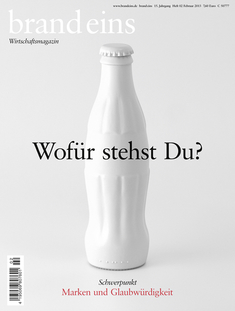 Last Wednesday, it was sitting in my letter box: the February edition of ”brand eins“. From the outside, it looks a little colorless. Since the focal topic is “Brands and Credibility”, this is not a surprise, is it? Neither does the question written on the milky coca-cola bottle make sound particularly glamorous: “What are you standing for?”.
I am sure the question is not addressed to me, but rather to the brands. And there is really nobody who knows what they stand for. What we do, however, know is what effect they are supposed to have: promote blind consumption and thus increase turnover and profits of the enterprises.
A short time ago, I went to see “Felix Krull” at the Volkstheater. They had printed a great interview with a psychologist in the program brochure. Apparently, the psychologist had studied “impostors and imposture” intensely. He called marketing and branding just another form of “systematic and goal-oriented imposture”.
But now about the magazine. After all, I went to Augsburg-Hochzoll by train on Friday evening, which gave me the opportunity to already read many of the articles. As always, they were well researched and contained interesting enterprises and respectable opinions.
However, if I read brand eins correctly, then the topic “brands” was strongly disenchanted. They are supposed to build up trust. Yet, most of the enterprises seem to use them just in order to get some advance trust which, however, is not or cannot necessarily be lived up to. Or else they want to combine the “convenient and the useful“.
In that light, it is an edition that shows me as (hopefully ex-) “ believer in brands” how much I was made a pushover. And how I spent good money for nothing but “hot air”. And that, after all, marketing – above all – creates brands that basically say nothing about the rest of the enterprise. Essentially, we are talking the generation of schizoid enterprises through willful camouflaging of reality using lies.
RMD
(Translated by EG)
P.S.
😉 A minute ago, I heard in the news of today what slogans one of the two “Deutsche Bank” directors uses in order to make it a “brand” – and yet he wants to continue the gamble with food certificates Well, it seems that here is one person who has not yet read the February edition of brand eins.
P.S.1
🙂 Basically, I am (not) surprised to see how many “brands” are, again, prevalent in this brand eins edition with their adverts. It is called capitalism.
Didn’t Marx say: “The capitalists will sell us the rope we will hang them by“? And they say Marx is now again fashionable.


