
Edwin EderleThursday October 18th, 2012
(Deutsch) Sicherheit im Amtsgericht
Jörg Rothermel
Report from Melbourne #2
Immigration
Since I myself am now also an immigrant, I made myself knowledgeable on the subject.
For information about Australia as an immigration country, you might wish to start with the Victorian Immigration Museum. Up until the 1960ies, the government encouraged Australian citizens to talk to friends or relatives in Europe about immigrating to Australia.
Without the immigration waves between the 19th and the middle of the 20th centuries, the conquest of this huge country would not have been possible. (It is a separate story how the rich Aborigine culture was almost totally destroyed in the process).
By now, much has changed. To be sure, in absolute numbers, Australians with origins in Europe and the USA are still the majority. But immigration from India and, above all, China, increases considerably.
A few days ago, there was a long article in the local newspaper „The Age“, announcing that apartments in a new building in the district of Glen Waverly were open for inspection on the weekend (that is standard procedure if someone wants to sell or rent out property: a certain day for inspection of the objects is set, and then they are sold according to the principle „first come first serve“). For the agent, it came as a total surprise that the interested parties were almost exclusively Chinese. Some of them were actually prepared to pay up to 40,000 $ above the asked price for a certain apartment. The fact that 16 apartments were sold for a total of 40 million dollars on that day shows how solvent the interested parties were.
By now, the ratio of Australians with Chinese origins (who have a permanent permit to stay) in those 15 districts of Melbourne where Chinese like to live is between 27% and 16%. According to a survey, these districts are chosen because they have good schools, good public transport and an active Chinese community. For the Melbournians of Caucasian descent, this situation is a challenge, because they witness how – right under their noses and quite obviously for everybody – Melbourne is changing. Unfortunately, it also causes numerous racist escapades.
The name of the first Chinese school in Melbourne is quite remarkable: „Xin Jin Shan Chinese Language and Culture School“. Xin Jin Shan roughly translates into ”New Golden Mountain“. Incidentally, that is the name the Chinese gave the Australian gold mines in 1850 to distinguish them from the Californian gold mines that were running dry at the time. Those were called Jiu Jin Shan (”Old Golden Mountain“).
Mind you, today the majority of modern Chinese who immigrate to Australia are no longer looking for their one chance in life; they are already a success and wish to secure and maintain their prosperity.
Downtown Melbourne
Here is a totally different issue: to be sure, we live quite nicely in the outskirts of Melbourne at Williamstown, but downtown Melbourne (also known as CBD “Central Business District”) has an inimitable flair. In fact, it can even hold a torch to Paris.
Traffic is more or less what you would expect to find in a city with 4.5 million car enthusiastic citizens. Even a reasonable public transportation system, along with the fact that one hour parking at the garage is 16 $ and a parking ticket costs a minimum of 180 $ do not seem to make any difference. In between the densely packed cars, you will frequently find bike couriers maneuvering their way through the traffic. They must either have finished all they ever wanted from life and are thus ready to die, or else are practicing for the next Tour-de-France.
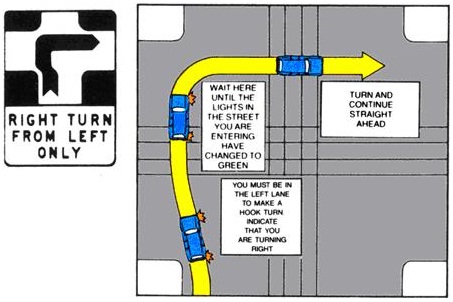
Information for all car drivers: in the city centre, you will find so-called Safety Zones where you will have to use the left (!) lane if you want to turn right – it is the notorious Melbourne ”hook-turn“. It is supposed to make it possible for those on the right lane to go ahead unimpeded; however, it will only work if the first driver who wishes to make a turn starts in Formel-1 fashion; if he fails to do that, there will be an ear-splitting signal-horn concert, because, naturally, nobody behind him wants to remain sitting in the middle of the crossing.
Many houses in the city centre were built in the middle of the 19th century, when Melbourne was the world’s richest city. Of course, this was due to the gold rush – at the time, around 1/3 of all the world’s gold was mined in Australia, with the most yielding gold fields in Victoria, not far from Melbourne. To this day, this prosperity is obvious if you look at all those noble bourgeois and business houses.
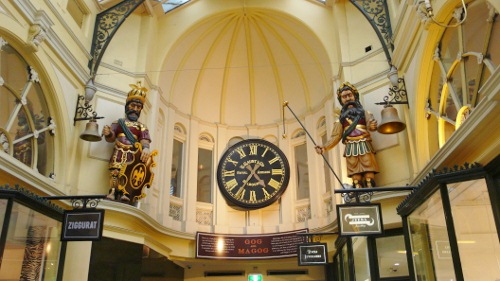
The special flair of the city centre is also due to the arcades and lanes, the creative (sometimes also endearingly scurrilous) shops and the thousands of bars, coffee shops and restaurants. The most beautiful and elaborately decorated one of them is the Royal Arcade.
The Royal Arcade is guarded by the biblical giants Gog and Magog.
Apparently, some of the arcades in a side lane simply came into being because the owners of the restaurants and bars joined forces and had some protection against rain spun over the street; all you need after that is a few chairs and (in winter) an electric heater and the place will quickly be so crowded at lunch and in the early evening hours that you can no longer pass.
The place is particularly full on Fridays after 4.30 p.m. – because that is when almost all employees working in the CBD offices go to the pub for a pre-weekend drink. Now, in spring, you can hear street musicians playing at almost all corners. To me, it seems that the quality of the music is considerably better than, for instance, in Munich. In Australia, Blues and Country are particularly popular.
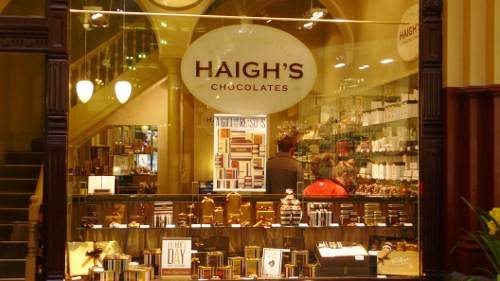
Chocolatiers and candies shops are currently very much loved in Melbourne. In fact, the Melbournian love of sweets sometimes borders on the bizarre. For instance, there is an Italian restaurant in Carlton where you can get “Chocolate Pizza“.
In the CBD, there are excellent restaurants serving Mediterranean cuisine (Spanish, French, Italian, Greek, Turkish, Lebanese, Moroccan,…). Melbournians are enthusiastic about European cuisine – if you want to eat out for dinner, you have to make a reservation no matter where you are going.
For the critical immigrant from Munich, it remains to be noted that the price-performance ratio cannot always come up to Munch standards. To make up for it, many restaurants and bars have the sitting-room atmosphere of first-class English pubs.
I will be back with my next report – No Worries
JRO
(Translated by EG)
Roland Dürre
Tweets on Twittering and Blogging #137
Here are my tweets of last week on:
Blogging and Twittering, Wisdoms and Rules:
121025 A prostitute’s finance is dance – careful, twitterers and bloggers. #Twitter #Blogging #Wisdom
121026 An oldie dancing means lots of dust – also true for twittering and blogging? #Twitter #Blogging #Wisdom
121027 A brave attack is half the way to winning the fight – also when twittering and blogging! #Twitter #Blogging #Wisdom
121028 A courageous horse will ignore the dogs’ barking – as will the courageous blogger and twitterer! #Twitter #Blogging #Wisdom
121029 If you can suppress your anger, you are showing true courage – also true for twittering and blogging! #Twitter #Blogging #Wisdom
121030 Activity will automatically lead to advice – also true for twittering and blogging. #Twitter #Blogging #Wisdom
121031 Exchange is no robbery – also true for twittering and blogging #Twitter #Blogging #Wisdom
There is a new tweet each day. See twitter.com and “follow” RolandDuerre!
Enjoy!
RMD
(Translated by EG)
P.S.
I took the proverbs from Alle deutsche Sprichwörter.
Roland DürreWednesday October 17th, 2012
Video: Jens Hoffmann at the IF Forum “Project Coaching”
After the “fish bowl” of the first section and a short break, Jens Hoffmann opened the second part of our technological IF Forum. The second part consisted of three presentations. Jens started with an appeal for “systematical creativity“ or “creativity with systems“.
I hold Jens in very high esteem. In my perception, he has an exceptionally precise way of thinking things through and is a critical listener. Regardless of being rather critical (or perhaps because of it), he always has an open ear for fantastical and creative ideas. He is someone you can wonderfully make plans with. As a sparring partner, he is irreplaceable. Here is his presentation:
The Third Technological IF Forum was about “Project Coaching“ and the speakers were from “The best of PM-Camp“.
Jens came all the way from Hamburg just for his presentation – of course he came by train. I am particularly delighted about that. So here I am, thanking Jens for his contribution, which truly enirched our IF Forum.
RMD
(Translated by EG)
Roland DürreTuesday October 16th, 2012
Video: Dr. Marcus Raitner at the IF Forum “Project Coaching”
After the introductory presentation by Dr. Stefan Hagen at our technological IF Forum, Dr. Marcus Raitner (Esc Solutions) saw to the second part of the first section. It was quite exciting and very impressive to watch how the arguments and explanations of the two speakers complemented each other. The presentation by Dr. Marcus Raitner, too, is now available on Youtube.
The Third Technological IF Forum is about “Project Coaching“, which included “Best of PM-Camp“.
I would also like to, again, thank Marcus very much for his presentation. He contributed hugely towards our IF Forum becoming a success. Marcus is also the author of what is, in my opinion, the most beautiful blog for project management world-wide – misc.raitner.de.
RMD
(Translated by EG)
Roland DürreMonday October 15th, 2012
Video: Dr. Stefan Hagen at the IF Forum “Project Coaching”
You can now watch the opening presentation of our technological IF Forum by Dr. Stefan Hagen from Lustenau on Youtube. It is a true pleasure to watch.
The Third Technological IF Forum was about “Project Coaching“, the motto was “best of PM-Camp“.
Again, many thanks to Stefan for his presentation. He was responsible to a huge extent for making our IF Forum a success. Stefan is also the author of the most frequently read German language blog on Project Management – pm-blog.com.
RMD
(Translated by EG)
Roland DürreSaturday October 13th, 2012
Who is Scared of the Boogey Man?
Everybody is scared of the “Cloud”. Because the Boogey Men inside the Cloud eat our data and/or use them in an illegal way. Our precious personal data!
It is particularly bad if the Cloud is outside our country. After all, there is no control possible. The US secret service might well read our data. However, matters are not really improved if the Cloud sits (hovers over) Germany. Perhaps the US secret service cannot read our data in that case, but the German secret service certainly will. And, basically, I do not care which secret service reads my data.
Why are we feeling so protective of our data? I cannot understand it. Nothing has as little importance in my life as my data. If there is anything you wish to know about me, just go ahead and ask! It will be my pleasure to answer – even publicly. Most of the things about me will be found at duerre.de or if-blog.de, anyway.
If I were the anxious type, I would certainly be scared of Clouds. But I mean totally different Clouds. Those I am actually dependent on. Those that are the basis for all I truly need in order to survive.
Water
Water comes through the tap. It gives me access to the water Cloud. It is rather insecure, isn’t it? Evil-doers could pour poison in it at many places. To be sure, we only know the poison terror at the water station from the cinema – but it could easily become reality. An evil terrorist would be all it takes to kill us all.
Bottled water from the supermarket will not help, either. This Cloud, too, has too many weak points. An evil-doer would easily find ways in. Today, hardly anybody still has his or her own well. Incidentally, it would not help, because the Cloud of dioxins or radioactivity is already on its way to poison it, anyway.
Nor is it a brilliant idea to drink beer instead. Too often, it comes from the InBev Cloud. And on a rather risky way at that. Until finally it ends up in the safe haven of my refrigerator.
Food
All food, be it deep-frozen, corn, all kinds of basic nourishment, vegetables and fruit, fish or meat, canteen food: all comes from the Cloud. And once in a while, something unfortunate happens there. Sometimes the Cloud produces chicken that contains a little dioxin, sometimes it is the deep-frozen strawberries. They come from China and make our children sick. I certainly cannot understand why we in Germany would need to eat deep-frozen strawberries from China. After all, there are enough apples, pears, plumes… right here in the country. But the Cloud makes it possible. And certainly not from the neighborhood.
But we trust in the Cloud. It will certainly feed the entire world and continue to do so tomorrow, as well …
Energy
Electrical energy comes from the electrical socket. It is the interface to the Cloud. The fuel comes from the pump at the gas station. When the Cloud will no longer supply us with electrical energy, the lights go out. When the pump at the gas station provides only drops, the cars will just stand around and be useless.
We do not know where the electrical energy or the fuel originated. Neither do we want to know. The Cloud will certainly provide. With or without an about-face in energy politics. Besides, energy is, after all, not quite as important as water or food. Nothing serious is happening if the electrical energy is sometimes polluted.
Money
You cannot eat money. For life, it is even less important than energy. Most of us have too much, anyway. Which is why we buy all kinds of useless things we do not really need. Whatever is left of our money will be stored at the bank. That is how we learned it! For too many years, we have been instructed that the only person hiding her money in her socks or underneath the sofa is the stupid grandmother. No! Apparently, we think the money Cloud is very nice and even system relevant. And consequently, we hand our entire money over to it. Because we want the Cloud to let our money work for us. And when we do not have enough money, we go and get it there.
Water, food, energy, money and much more comes from the Cloud. Basically, I cannot imagine anything today not coming from the Cloud. And still we have no problems sleeping soundly …
Only when our data are inside the Cloud, we cannot sleep any more. Why is that so? Are we scared of our data? Why are we so afraid that others might get to know who we really are? Do our data remind us of our evil deeds? Quasi like a modern bad conscience?
I must confess that I generally fail to understand the sometimes collective sometimes individual hysterical reaction when it comes to personal data. And, to me, it does not matter if these data are in the Cloud or somewhere else. I still have quite a few plans for my life. But I would never, ever agree to do the job of data protection commissioner.
RMD
(Translated by EG)
P.S.
In my book passphrases and passwords for internet pages such as Ebay or for the bank are not data, but keys. And, of course, you should always be careful with keys. Even though I must admit that I am actually quite careless with my house keys.
Roland DürreFriday October 12th, 2012
Data _Theft
This morning, there was an extremely unsettling item of news (Nachricht) on the radio (as always, I listened to Bayern2 – Radio):
In probably two hospitals, data were stolen. We are talking of the hospitals at Rastatt and Mittelbaden in Baden-Württemberg. The objects stolen are patients’ data, diagnoses, letters by doctors and internal hospital communication. These data were probably stolen on September, 19th. According to the hospital, they filed a complaint against an unknown person. It says that the Rastatt hospital noticed the violation on September, 27th – eight days after the alleged theft.
Today, on October, 12th, this item of news makes the current headline!
Basically, I assume that, of course, some “secret” data of German hospitals will end up where they do not belong on a daily basis. It is probably unavoidable. But this case seems to be particularly important. After all, it made the current news of October, 12th, 2012!
Well, why don’t we savor this topic? There was a data theft. Theft – which means some property was stolen. But then, the property – that is the data – would have to be gone after the violation of the law happened. Consequently, the thief would have had to copy the data and then delete the file at the place of theft. Otherwise, all you get is “half a theft”.
Yet I presume this was not what happened – it is probably not even possible. All those intended copies (backups) and unintended “data in work” make it basically impossible to completely delete anything. Except if the thief practiced total vandalism and destroyed everything. Or else if he was a perfectionist who also destroyed all the backups. But only a genius can do that – and even he can only do it if he has internal knowledge.
But let us look at the person who probably committed the theft. I write “probably” because, de facto, the “theft” is only an assumption. They assume that an unknown person copied certified data from the system. So what will the thief now do with them?
Is there a personal interest, because he wants to know more about a procedure that actually concerns him? Is it simply revenge? Does he only want to look important? Is this espionage, maybe by the press? Someone who wants to detect unethical behavior on the part of the hospitals (I assume that can be found everywhere)? Or was it, maybe, even a Federal Agency working clandestinely (and rather clumsily)?
Or is it a (minor) culprit who wants to win money by using data, for example by blackmail? And in that case: who would be the recipient of blackmail? Who is the owner of the data? If it is a diagnosis, is it the hospital or the patient? If it is communication between doctors: the hospital or the doctors? The sender or the recipient of the letter?
More and more question. I am sure I could continue in this fashion for a long time. But that is not what I want. I assume that this is again one of the instances where no damage will be done by the “data abuse”. And if damage is done, it will be quite small and short-lived. A trifle. But in the land where people get hysterical about data security, this is the kind of news you can use for painting the most demonic pictures.
I file the article among “storms in the water glass”.
RMD
(Translated by EG)
P.S.
I would find it a lot more interesting to read about the number of malpractices or the many cases of operations or other therapeutic actions where business considerations and optimization, such as capacity utilization and strategic billing were the determining factors.
Roland DürreThursday October 11th, 2012
Tweets on Twittering and Blogging #136
Here are my tweets of last week on:
Blogging and Twittering, Wisdoms and Rules:
121018 Standstill does not mean peace – a warning for twitterers and bloggers. #Twitter #Blogging #Wisdom
121019 Strictly insisting on justice often means the greatest injustice – so expose it when twittering and blogging! #Twitter #Blogging #Wisdom
121020 If you search, you will find – so please do not give up when twittering and blogging! #Twitter #Blogging #Wisdom
121021 Defending sinners means sinning yourself – also true for blogging and twittering? #Twitter #Blogging #Wisdom
121022 Sweet songs have tricked many a bird – also true for twittering and? #Twitter #Blogging #Wisdom
121023 Sweet wine will turn into sour vinegar – just like when you are a twitterer and blogger? #Twitter #Blogging #Wisdom
121024 Dance when your luck is the piper – twitterers and bloggers #Twitter #Blogging #Wisdom
There is a new tweet each day. See twitter.com and “follow” RolandDuerre!
Enjoy!
RMD
(Translated by EG)
P.S.
I took the proverbs from Alle deutsche Sprichwörter.
Roland DürreWednesday October 10th, 2012
News of the Day – the Price of Electrical Energy
In the morning, I often enjoy listening to Bayern 2 on the radio: die Radiowelt. Today, everybody seems to be upset about the price of electrical energy. I see that a little more diverse:
As I perceive it, a quite substantial “Inflation” is taking place. No matter if I go eating out or go places by underground train, everything gets more expensive. Even electronics products, such as mobile phones and laptops do not seem to get less expensive if you take the “State of the Art” into consideration. Not to mention realty. Salaries and incomes, too, are on the way up, at least nominally (wage agreements, doctors). To make up for it, the small number of poor persons grows.
This inflationary situation – even if statistics cheat to make it look lower – is quite easily explained. Just look at the money policy of the EU administration. Or the development in other currency zones, such as the dollar, the RMB (Chinese yuan), or other economies with whatever small currency you choose to look at. All over the place, prices climb. Be it in China, the USA, or elsewhere. And, after all, we are part of a globalized world, aren’t we?
If, in an environment of inflation, a product kept its price stable, it would in fact get less expensive. The only way I could say something got more expensive would be if the increase in price were considerably above the inflation rate. Under this light, all you should be able to say is you have a relative price increase, one that remains after you have considered the “true” inflation rate.
Looking at the increase in prices for oil, you notice that the price for electrical energy is actually far behind. As I see it, it is a good idea to have the price of electrical energy climb as long as most of it is still produced from fossil materials. When, at long last, the moment arrives when we can produce electrical energy exclusively in an environment-friendly way, it should be cheaper.
For me, however, it seems doubtful that this will ever be possible to the extent we allegedly need it. That means it is still absolutely obligatory for us to treat energy in a responsible and efficient way. And that is an area where regulations and laws are mostly not really helpful. Sad as it may be, it is a fact that rational thinking mostly only happens through the purse (like a man’s heart is won through the stomach).
What is really annoying, however, is the fact that we now have a modified co-called electrical network regulation (StromNEV). It says that those enterprises that use up more than ten Gigawatts of electricity each year and need the full capacity for a minimum of 7,000 hours each year will no longer have to pay the network organizations for the transport of electrical energy, which, basically, is an additional subsidy. And the number of these big subsidies has increased drastically.
This caused Germany to become an expensive country in terms of electricity for those who need small amounts. Yet, for those who need huge amounts, it is rather attractive.
Naturally, those who use up small amounts are now worse of in terms of money, while we are counter-acting the goal of using energy more efficiently on a huge scale. Incidentally, this has nothing at all in common with an about-face in the energy sector. All it means is another subsidy for dedicated interest groups.
It sounded like a confirmation to me when, this very morning, I heard a CSU politician say on the radio that even Norwegian enterprises now started transferring their electricity-intense production parts to Germany.…
Incidentally, the author assumes – and I am sure this is totally unprofessional – that most of the enterprises that use up huge amounts of electricity need it for such “reasonable” things as the production of beer and drinks cans. That alone makes me furious. Because beer is definitely one of those things that you must never drink out of cans. Mind you, our throw-away society is something I detest, anyway.
RMD
(Translated by EG)


