
Werner LorbeerFriday September 21st, 2012
Desertification Caused by the EEG: Desert Tec #18
 More than 240 different prices paid for those who feed in solar energy (source: Handelsblatt). Financial promises made to investors in the solar industry over 20 years at a total sum in the multi-billion range. Whoever feels like it can feed in energy at a fixed price which, according to economic theory, must cause a surplus. Simultaneously, those who feed in cheaply are now forced out of competition. Consequently, they, too, have to be subsidized.
Electrical energy gets so expensive that they now have to start thinking about compensatory money. One measure influencing the market is followed by the next. We are now in the desperate situation of a central planning economy without owning the glass ball of omniscience.
At the same time as this planning economy takes place, technological progress is being pigeonholed – the many bankruptcies in the solar industry tell their own story.
Is there a chance for solar energy? I think yes. It is very simple: stop all subsidies and re-establish the market economy.
Will that mean the end of solar technology? No way! Latest developments show that solar energy can actually be produced based on polymer solar cells. OLED technology in energy production. As I see it, the current cost for the products will be around 15% of what Si-based solar cells cost.
Organic solar cell-based printing methods for producing solar energy will be something you can use in a totally different way when constructing buildings and making them energy-autonomous.
http://www.solarserver.de/solarmagazin/solar-report_0807.html is an interesting source if you wish to read about the development on this extremely fast-growing technological sector. In the future, we will be able to weave solar panels, then print them and install them at proper places. And it might all happen at perhaps 10% of what it costs now. For the economists among us who believe in planning, this is definitely a reason to come up with a new legislation:
Every citizen must take a certain amount of energy from the network in order not to make the EEG a failure?
wl
(Translated by EG)
Roland Dürre
A Different China (I)
After the wonderful wedding on Tuesday, we said good-bye to the Chinese family of our “new” daughter-in-law. Now there are four of us travelling China (the newly-weds, Barbara and yours truly). Today is Friday, we are staying at the Hangzhou Sheraton Wetland Park Resort – which, incidentally, is an excellent hotel – and I feel a little like I am starring in an American Road Movie. Except that it is played out in China. But what I see might just as well be happening in the USA.
If only there were not a few specialties that do not at all fit into the “American-European Culture”. Let me just write some unstructured and, hopefully, non-judgmental comments:

Our Hotel Howard Johnson at Wuhan
It is not just the gas masks you find in every hotel. More often than not, I feel like in Israel. Except that I have no idea what enemy might be capable of threatening this huge and powerful China. It cannot be Japan, even if, currently, this neighbour is not very much appreciated.
The speed with which they celebrate and also live in general seems to be a little faster in China than in our cultural circle. For example, even at our wedding, the rather elaborate installation was de-installed immediately after the ceremony.
The wonderful wedding meal, too, was eaten at surprising speed. I am almost tempted to say it was gulped down. Mind you, the ceremony was very intense and impressive.
 For a Bavarian wedding, you could never imagine it being over after such a short time.
Work is highly dynamic. As I perceive it, EVERYTHING here happens at a racy speed. Finishing quickly is all that counts.
I often ask myself if the same is true for sex in this country? The people work long and hard. Often they have two jobs. To be sure, everything is not (yet) quite as efficient as at home, but most of the Chinese who helped us on our trip have a remarkable ability to imagine what we might need. This is totally different from what I am used to, for instance, from Southern Europe or Africa.
And wherever you go, there is always a little “Bollywood” – although we all know this did not originate in China. In every show, every event, every hotel, every museum. The enterprises, too, celebrate their events for increasing their employees’ motivation very “emotionally”. You always get a great “Show”.
The sound of a monumental hymn is not restricted to after you went somewhere by ship. Federal authorities and police are so omnipresent, you might feel tempted to call them “operetta-like”. But with monumental theatre. For me, it is always quite impressive how their constant presence in many cities is apparent. After all, the vehicles are always different and often surprisingly dissimilar.
 But there are other exciting differences, as well. For example with the toilets. In Chinese English, they are always called “washroom”. In the top hotels, you will not notice any difference between China and Europe.
In general, you often come across a “Pit-Latrine” in China. Well, I am fine with this. It might perhaps make it necessary for us to practice a little more physical discipline than our “sit-down toilet”. But – thank you very much – I can still manage.
The story gets interesting with the urinal. There is always plenty of wetness in front of those. Mostly you actually find quite a puddle. Even the written recommendation you often find to, please, for reasons of hygiene, come closer to the urinal, does not really help.
Basically, you only have two options: either you piss from afar, or else you do a very broad splits. Otherwise you will end up with disagreeably wet feet.
🙂 I decided in favour of the second option. …
Incidentally, you will find ashtrays on all toilets, even though smoking is prohibited at many places. This is also true for many toilets. Except that nobody cares! But I will tell the story of prohibitions and how they affect life in my next article. Along with other “specialties”.
RMD
(Translated by EG)
Roland DürreThursday September 20th, 2012
China – Episodes II – Do you want a baby?
I was just standing around not thinking of anything in particular…
In Yangshuo, I happened to stand all by myself on a central place for five minutes. Life goes on all around me. Visitors and vendors are aplenty. There is nothing you cannot buy. Many things look quite fascinating, even if they are stupid. I stand there looking a little abandoned, waiting for the rest of our group. All the time, people offer me all kinds of products.
And suddenly, a lady appears and asks me: “Do you want a baby?. I am a little confused and do not immediately understand what she means. As often in life. My first assumption is that she suggests I should adopt a child. But I already have seven and am too old for this kind of thing. I shake my head, and at the same moment it dawns on me what she must have meant. And she is already very disappointed when she asks me: “No Sex?” and continues on her way.
 I remember that, while I was preparing for the trip, I read that prostitution is prohibited in China and the punishment is severe. Consequently, I am a little surprised – and I have to do a lot of thinking.
Back at the hotel, I open my English Wikipedia and look up prostitution in China.
It says that my information was (partly) correct. I China, prostitution is illegal and prohibited. But the number of prostitutes is estimated at more than four million. The government knows it quite well and came up with seven categories for the prostitutes. Prostitution is tolerated by turning a blind eye and in some places rather appreciated as an economical factor. In some regions, it is actually promoted in a strange mixture of administration and corruption. Regardless, there are some instances where there is a punishment on prostitution – sometimes even a severe punishment. I also read that the Chinese men prefer blond Russians and that, after Russia was opened, many Russian ladies came to China in order to do the job.
 Well, here it is again, the world-wide hypocrisy. Perhaps it is even stronger here than at home. In a way, it seems to me that prostitution is a good example for the paradigm of many principles I meet with in this country. But I do not mean this in a negative sense! Things are as they are.
RMD
(Translated by EG)
Roland DürreWednesday September 19th, 2012
China – Episodes I : Pay My Beer!
About the raftsman who would like to have a lunch break.
 There are three of us going down the river Yulong on two rafters. We pass our hotel on our way towards the destination. Shortly after this, our rafter stops at a floating snack platform. He fastens the rafter and jumps over.
A lady from Malaysia who is also on vacation is already sitting there and doing the translation for us. The raftsman would like to have a short lunch break. Do we mind? We are assured the journey will soon continue.
We are on vacation, so there is plenty of time. Of course, we agree. We drink a glass of beer while he eats his fish. As always, we are treated in the most friendly way.
It seems that the raftsman and the snack saleslady know each other quite well. The food on this floating island looks delicious. They advise us to buy some fish.
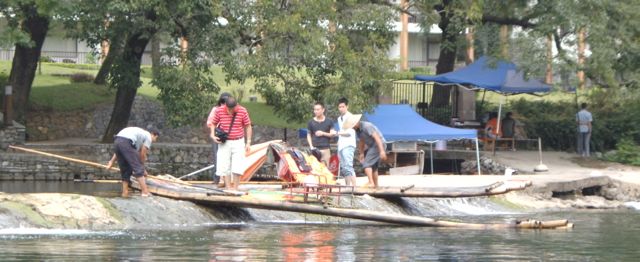 Since, however, we have made our plans already, we are going to eat later. Still, we take one bottle of beer (595 cl) for the three of us.
Regardless of the fact that we know quite well how, in places like these, beer is extremely expensive, rather like at the Munich Marienplatz.
Then we continue. I want to pay for the beer. As expected, it is rather expensive. I nod my head without bargaining and get my purse.
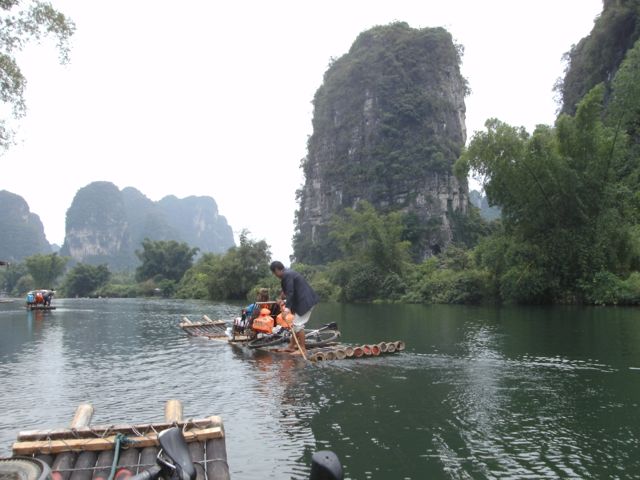 The snack saleslady is encouraged by this. Now she thinks I should also pay for both glasses of beer our raftsmen have had. She tells us all this with real nice gestures and a very friendly smile.
I refuse. And I seem to get my way. The raftsman gets on the rafter with us and we continue on our journey. And apparently, the raftsman never paid for his snack.
My insistence not to pay, however, does not make the slightest difference with his friendliness. After all, this is just him not making even more profit. All you can do is try, isn’t it?
I could relate quite a few similar stories to you.
RMD
P.S.
Incidentally, my totally harmless rafting trip was illegal. It was not permitted for children under six and adults over the age of 60. A poster announcing this rule – like many others – is posted quite prominently. Yet nobody seems to care – which is also true for other rules, such as you have to wear safety belts, you may not carry a camera or electronic device… – these rules are simply ignored.
Roland DürreTuesday September 18th, 2012
Guilin / Wulan
Today, there is only a very short report and three pictures.
After all, if time is as scarce as now, a weblog author might well run out of steam.
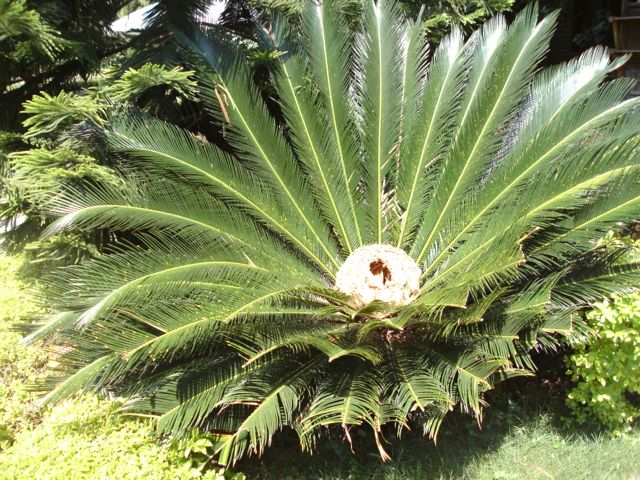
We say good-bye to the Yangshuo Mountain Restaurant. It was a nice place to stay. We spent four agreeable nights and three wonderful days in this sustainably and ecologically run hotel directly on the river Yulong.
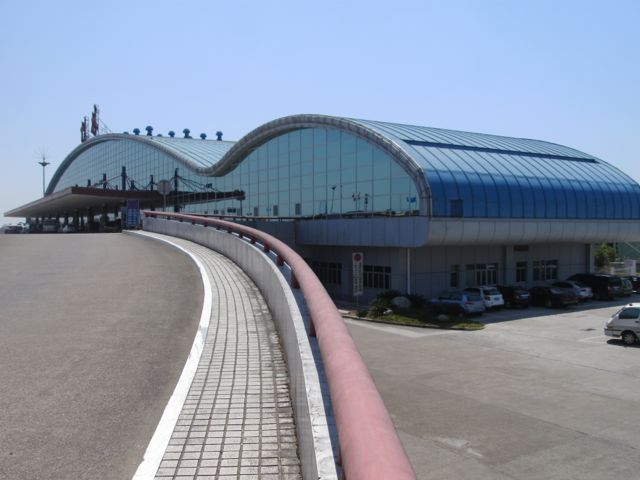
On this picture, you see the “small” Builin airport. Our next stop is Wulan. By Chinese standards, it is close: around one hour’s flight.
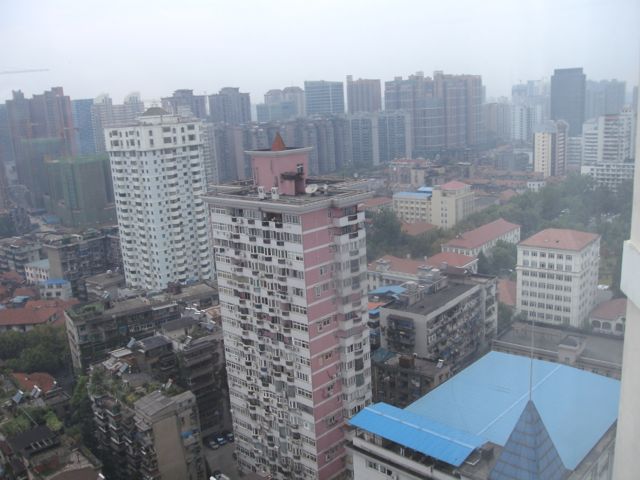
And as usual, the first view is out of the hotel window – here looking east (?).
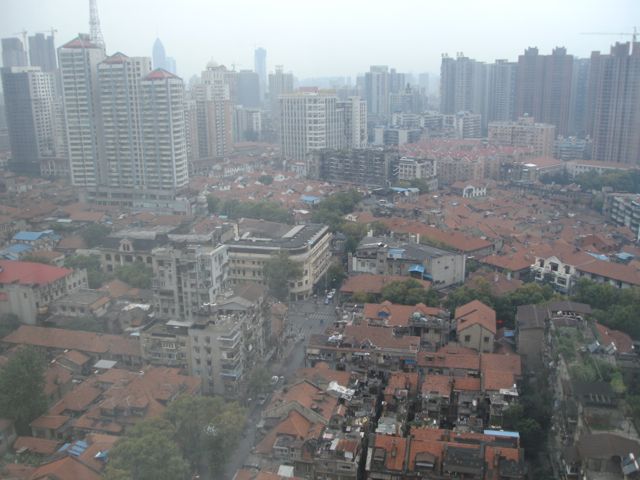
And here looking west …
Yes, this is Wulan.
To make up for it, we had some really nice adventures. We were lucky enough to meet our new Chinese in-laws. We also got very complicated instructions for the marriage ceremony and, again, ate deliciously several times.
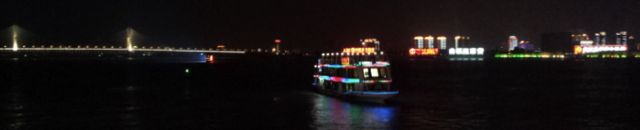
And late on Monday evening, after having spontaneously decided to go and discover something new, we spent 90 minutes on the Jangtsekiang.
This showed us a totally different side of Wuhan – the fascinating light display of the colourful skyline with its huge bridges spanning the long river (長江 / 长江) and the river Han (漢江 / 汉江).
RMD
(Translated by EG)
Roland DürreSunday September 16th, 2012
China – Where Do You Stand?
Our journey continues – today in the afternoon, we go to Yuhan. Looking upon what I experienced so far, I realize that I am still a little at a loss about China.
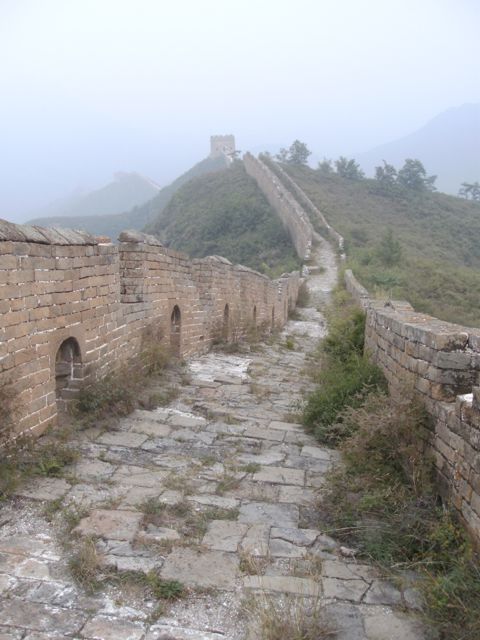 In modern China, it seems that tradition mutated into nostalgia. High-tech and antiquity live side by side. I have not yet been able to get a clear idea about which “values” are currently accepted and lived in China. Also, I have not really noticed any “ethical behavioral considerations” when people interacted.
What I experience is a balancing act between unlimited freedom and total administration. The people actually seem to do what they want. But still it seems that there are huge and sincere restrictions. And wherever you go, the police is very visible. They certainly have a very watchful eye on things and see to it that nothing untoward happens.
I do not perceive any sort of traumatization among the people due to the Cultural Revolution or because of individual restrictions such as the on-child-family. In fact, to me the people look full of harmony and very content. It seems like this is true both for their personal circumstances and the current political and administrative system.
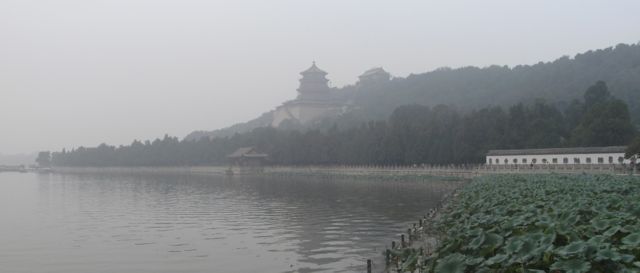 Is it possible that there is a far-east harmony gene? A gene which survived both the Cultural Revolution and the extremely harsh change?
In China, however, the motto seems to be: “Money Talks“. Mind you, this attitude seems to be extremely exclusive. Corruption seems to be a matter of course. Without any hypocrisy as I experience it at home.
It is quite simple: if you want something, you must be prepared to pay well for it. Perhaps this is a new form of ethically correct corruption?
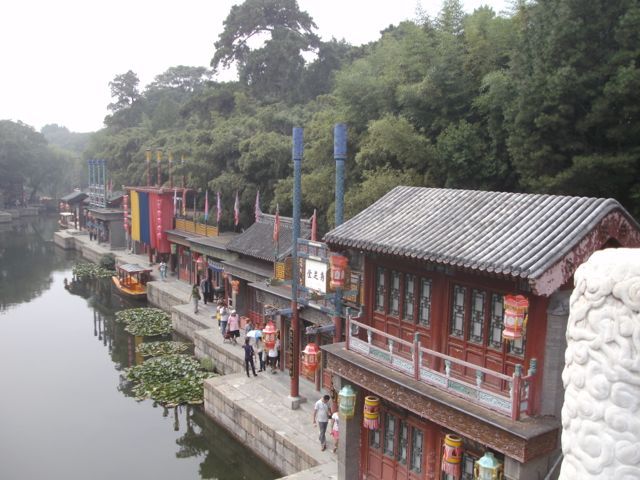 Money is where they particularly like to cheat you. They try it all the time, but they will not be angry if they fail. Some way or other, it seems like “selling things for more than their value” belongs to the entire system.
Consequently, what I experience is a total clash of “doing what you like to do” with a highly restrictive collective shared society. For us relatively prosperous guests, this means a mixture of high quality of living and a profound “feeling of well-being”.
In a world where most Chinese, too, are basically content and happy.
RMD
(Translated by EG)
Mähnicke & Six Saturday September 15th, 2012
(Deutsch) Der tägliche Wahnsinn: Biodioten
Roland Dürre
A Lazy Day at Yangshuo (Friday)
🙂 Today, we are into “laziness”.
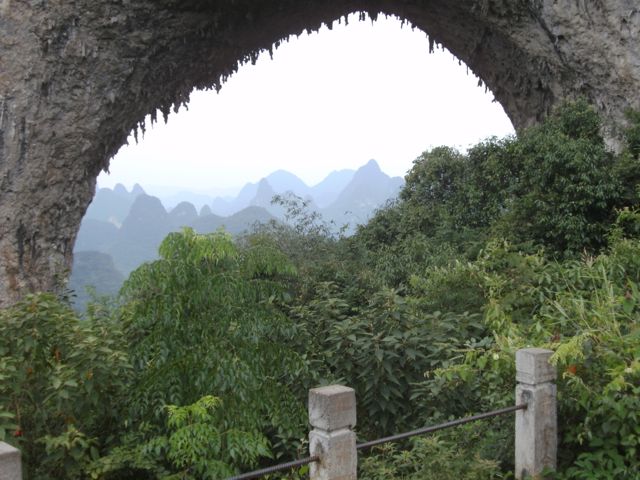
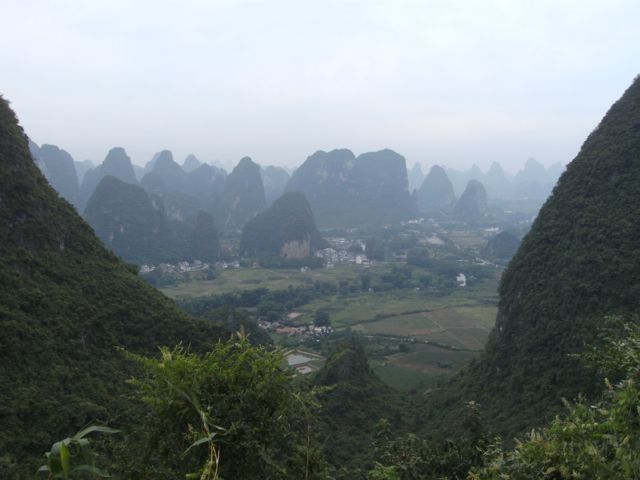 That means: in the morning, we go to the Moon Mountain by bike, where we climb up 800 steps. As a reward, we get a wonderful view from the top.
The mountain got its name because its peak cut-out looks a little like the sickle of the moon. It is rather huge – and very impressive.
Afterwards, we ride a little through the land on our bikes – just enjoying the scenery. The YULONG rafters are beckoning. The YULONG is the river you can see right next to our hotel at the Yangshuo Resort.
 Our room has a view of the river. And whenever we look out of the window, for instance when taking a meal on the hotel patio near the beach, we see the boats passing. The raftsmen are pushing them with long bamboo poles.
A little upriver, there is one of those stations where the rafters start. We go there by bike. We have to buy tickets for boarding the rafters. As always, you have to bargain in order to get the price that is officially considered appropriate.
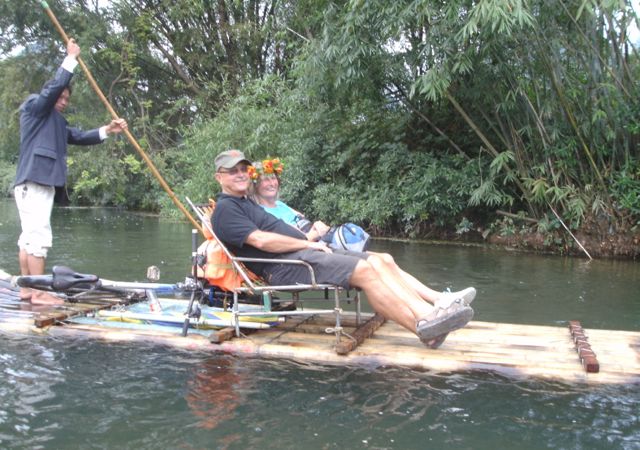 The bikes can be carried at the rear end of the rafter (for the price of two seats). We go downhill for one hour, passing the hotel. Afterwards, we ride our bikes back to the hotel and have a (late) lunch.
In the afternoon, we are really lazy. At night, we go to see a musical theatre with “light show”. They play a historical story, allegedly it is very trashy and sentimental.
They say a few hundred people are on stage. And there will be perhaps around four thousand spectators. It is an impressive theatre on the river. With many boats and ships, surprising effects, beautiful music, great choirs, ballet and impressive mass scenes.
It is a little like Oberammegau on the river. Not quite as long and not quite as bloody, but even more monumental. With illuminated mountains. I am sure it is quite spectacular for tourists. But since we are here already, we definitely have to go and see it!
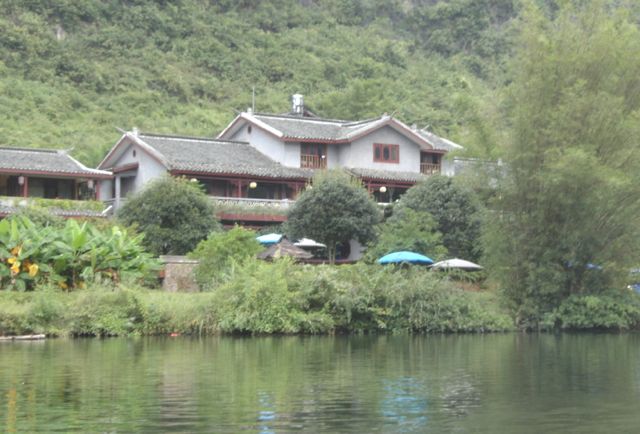
Unser Hotel im Yangshuo Ressort
Here you can see out hotel at the Yangshuo Resort
When buying those tickets, you also have to bargain. Initially tickets are offered for around 300 RBM, but finally you pay 200 RBM – including the shuttle transport to the huge open-air stage on the water.
And it was really worth it – this was a wonderfully emotional finish to our short stay at Yangshuo.
Now we also learned why the region with its several thousand (8,000?) cone-shaped mountains is so beautiful in a bizarre way. We are actually at the bottom of the sea! The ocean changed the landscape. And then it withdrew and left behind this flat landscape with its rivers and mountains in such strange shapes.
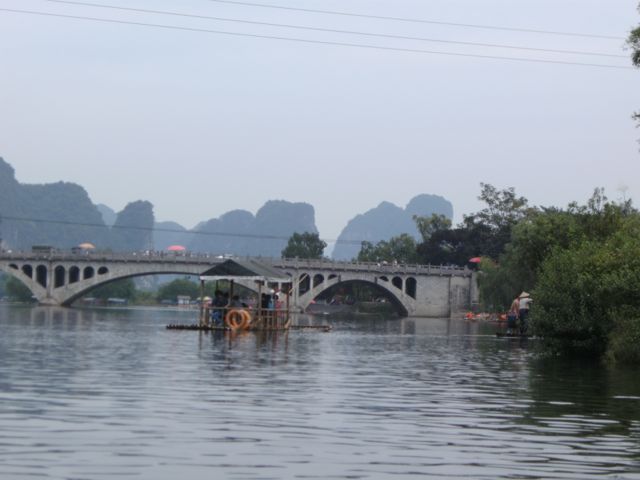 Tomorrow, we will leave this land of cone-shaped mountains. We are going north-west to Wuhan – where the “official part” of our trip will take place.
Our first week in China is over. Here are some short impressions:
China is huge and has many faces. Economically, they are moving up, consumption has become an important value. To me, current China looks a little like the FRG looked after WW-II, during the economic miracle time.
Although most Chinese seem to be well off as far as food is concerned, they remained slim. I find that rather remarkable in modern times. The few obese persons I saw are the exception to the rule and those few who have a belly to show do so with pleasure. If the weather is hot, the t-shirt will often be pushed up. Then you can see the rounded stomach between the trousers and t-shirt. I, too, tried it. It is great fun.
In China, you say hello with Ni Hau, that means “you well?“. This is easy for me to remember: do not beat me in German sounds like Ni Hau… No problem phonetically!
So far!
RMD
(Translated by EG)
Roland DürreFriday September 14th, 2012
Yangshuo and the River Li
We are now in what is probably one of the world’s most beautiful landscapes. It was a fantastic day. We went by boat and did some hiking. We enjoyed life at its fullest and in harmony.
Consequently, today’s report is totally without words, because “pictures say more than a thousand words”.
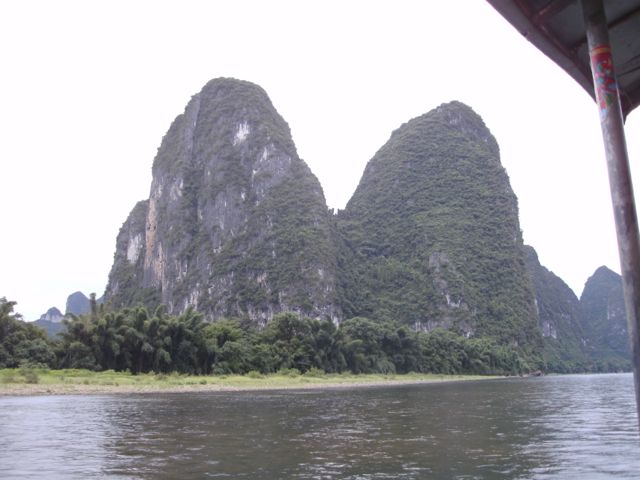
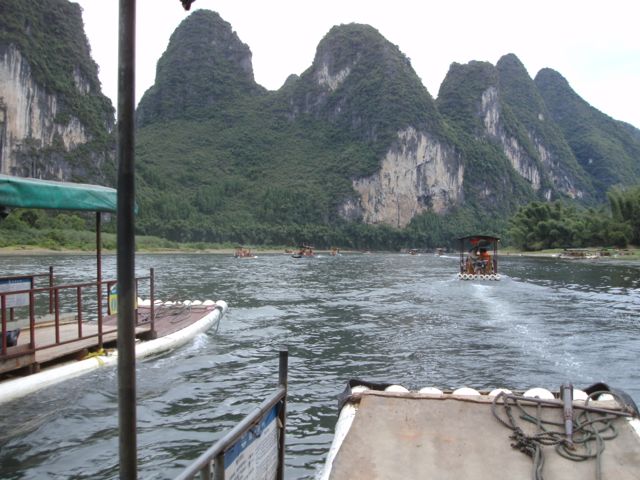
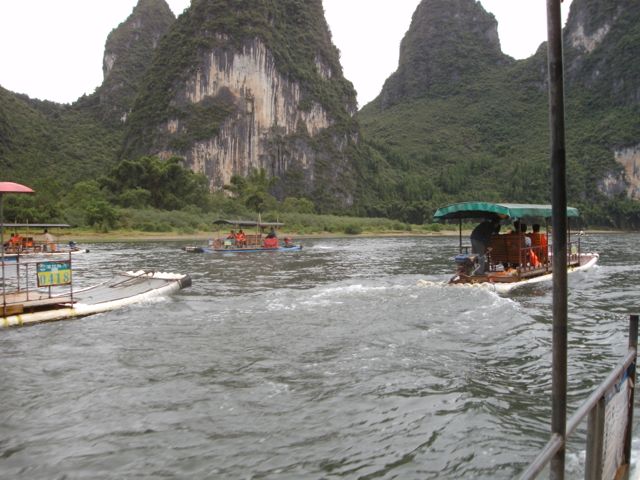
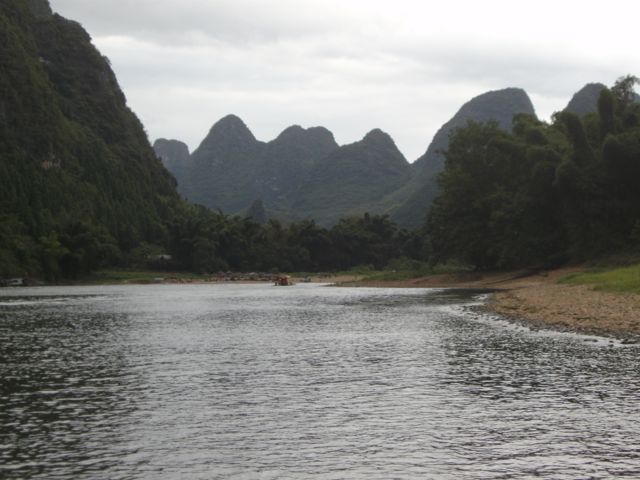
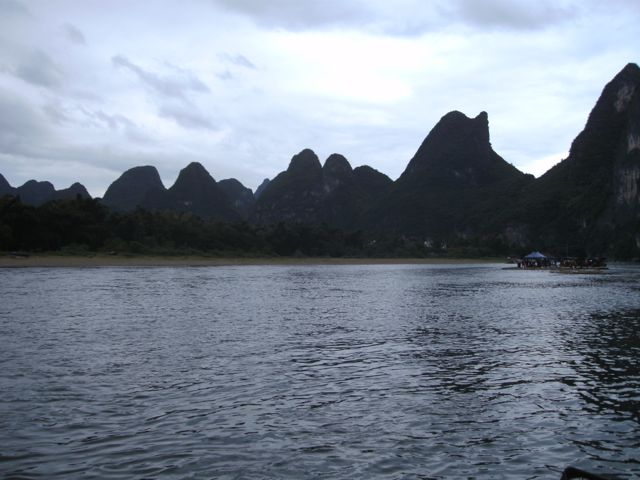
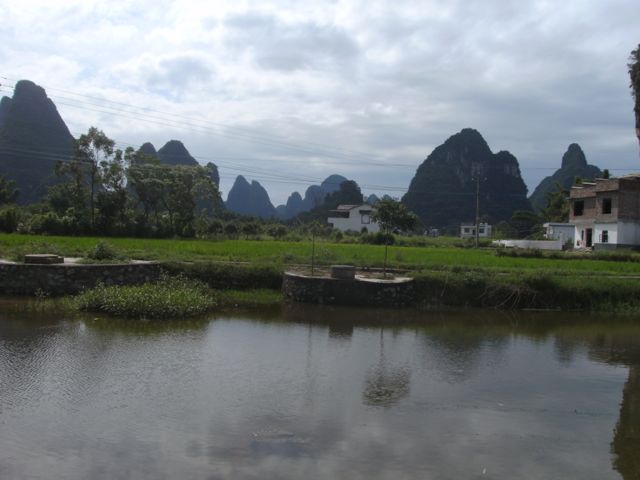
RMD
Roland DürreThursday September 13th, 2012
Going South and “China and the Internet”
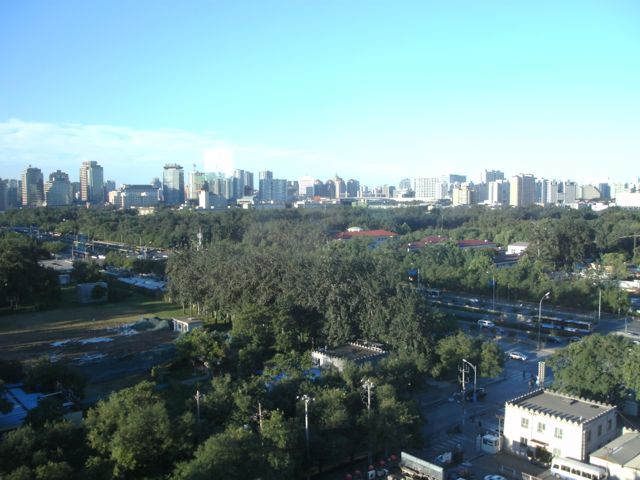 On this Wednesday morning, which is the day of our departure for GUILIN, I open the curtains.
And behold: all of a sudden, the sun shines over Peking! It seems like the air is clear. The view from the hotel Sheraton “THE BIG WALL” bedroom is totally different from the last days. As a farewell to me, there is sun and clear skies.
Today is a day of travels. In the morning, we will go to the airport, Terminal 3. It goes without saying that this airport is very impressive.
Flying Air China, we arrive at GUILIN – which is situated 1,500 kilometres to the south – after about three hours of flight at roughly 15:30 h. Our final destination is YANGSHUO.
It is a dream of a destination. I can see many high cone-shaped mountains, sitting in a huge, flat area, looking like someone told them to form a line. You get the impression that a dragon might be hidden behind every one of those mountains. Since we are in the country of dragons, this is hardly a surprise, is it? …
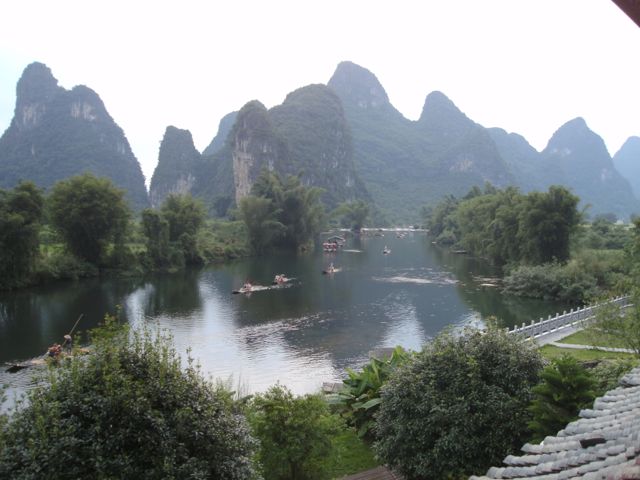 And the climate is warm and agreeably tropical – the only other place I know where it is like this is Africa. This is the ideal region to recuperate. A great contrast to Peking – and still part of a “very well-tended China”.
Recuperation is the word: consequently we decide to call it a leisurely day today. Instead of a travel report, you just get a few comments on the internet in China.
Basically, you get access to the internet everywhere – and at a very low cost at that. The supply of the email client with Imap and/or Exchange on my Airbook is also excellent. The same is true for the access to most WEB addresses. My VPN access, too, functions most of the time – except some times. I have no idea why.
The search engines are also ok.
Social media pages, such as Twitter and FB, however, are among the most prominent pages I cannot directly access. The same is true for Youtube. VPN is the only thing that helps here. Strangely enough, this is also true for some very harmless pages, such as “alle deutschen Sprichworte”.
Now I came up with the following solution to the problem: I keep switching between “normal“ internet access (for my email client and the IF blog pages I can access) and VPN (for Social Media and inaccessible pages).
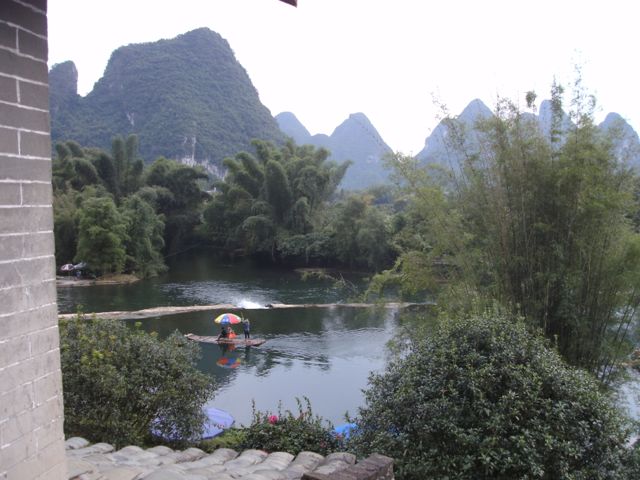 To this end, I collect all WEB pages I can directly access on a browser (Mozilla). On Chrome, I have all pages I can only access through VPN. In this manner, I can manage quite well.
But the real problem is not technology. The real problem is time. We are very busy, the days are full of important and often beautiful encounters Returning to the hotel late at night, I no longer feel like logging into the internet. And on the next morning, we also always get up early, preparing for our next adventure…
For instance tomorrow – we will go on a riverboat on the “Li-River” at 8 o’clock.
Consequently, there is no time to really process all these many impressions and stimulations, let alone report them.
RMD
(Translated by EG)


