
Roland DürreMonday July 9th, 2012
Germany – Country of Associations
It is a constant source of wonder for me how many associations and institutions of all kinds we have in this our country – and also all over Europe. As often as not, said associations hardly have any more anything in common with what was historically their purpose. The same is true for their members. They now have their own expanding, flourishing and expensive structure. Lots of employees and managers are paid in order to see to it that the association continues to live, even if, basically, it has been out of reach for quite some time.
Most of these associations only exist in order to increase their own power.
The usefulness has degenerated and become an end in itself. Some associations survive on the fees of their members. Those members pay, because they expect something in return (mostly some sort of lobbyism), or because they think you just have to be a member (after all, this is how it has always been and you never know what dire consequences a cancellation might have), or – and this is the worst case – because they have to be members (forced membership, like IHK). Some associations also manage to get money from public authorities regularly.
But how did the associations originate?
In my opinion, both humans and companies always had and still have a basic need to belong and associate. This caused the establishment of federations. They organized themselves as associations, constituting some sort of community of similar-minded people, either at work or in business. It was often their way of advertising their special interests – be they justified or not – publicly and demand a certain degree of support from the state.
Most associations, however, no longer offer a sense of belonging or home today. More often than not, they mutated from a federation to a lobbyist group. As a general rule, the only thing they aim at is their own survival and the strengthening of their own system.
Are associations still necessary?
Today, you could probably do without most of the associations. You can meet similar-minded people at eye-level. The opportunities abound. Besides virtual platforms on the internet, you will also find real and local meetings for almost everything. All kinds of organizations, as well as universities, offer all sorts of things – perhaps far too much. And wherever you really cannot find an opportunity for a special need, you will find it quite easy to create one yourself.
Here is what I recommend:
Cancel your membership with all the associations you subscribed for. Never let yourself be recruited as a member. And, above all: establish your own association!
RMD
(Translated by EG)
Roland DürreSunday July 8th, 2012
Utb #2 Prague – The First Leg to Rokycany
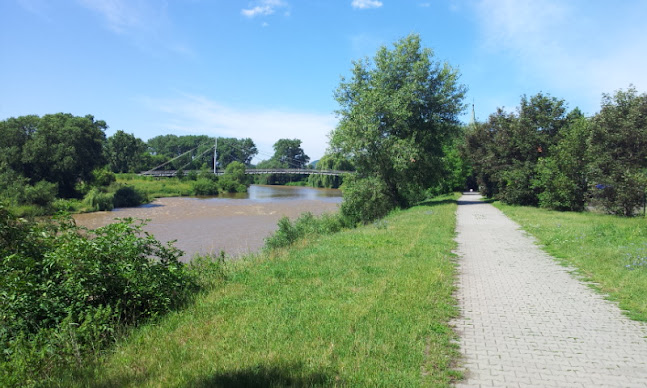
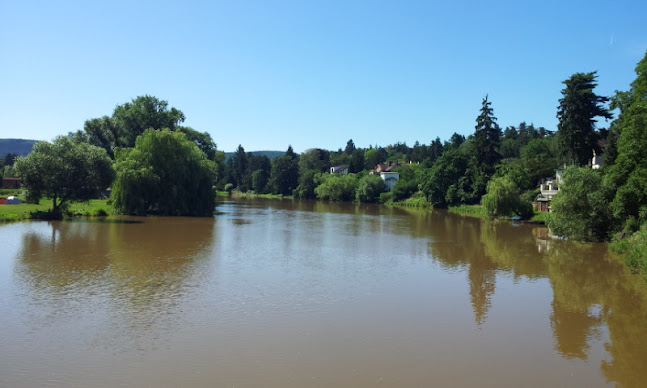
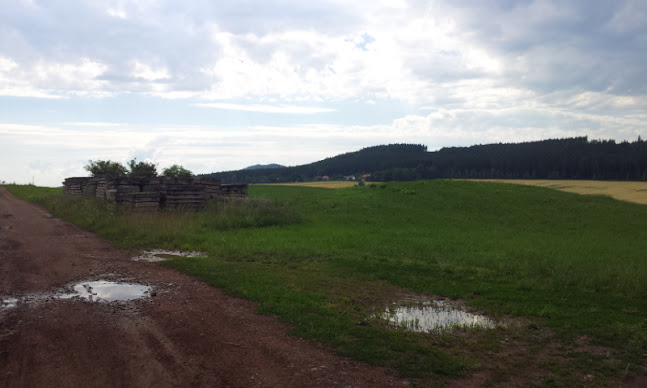
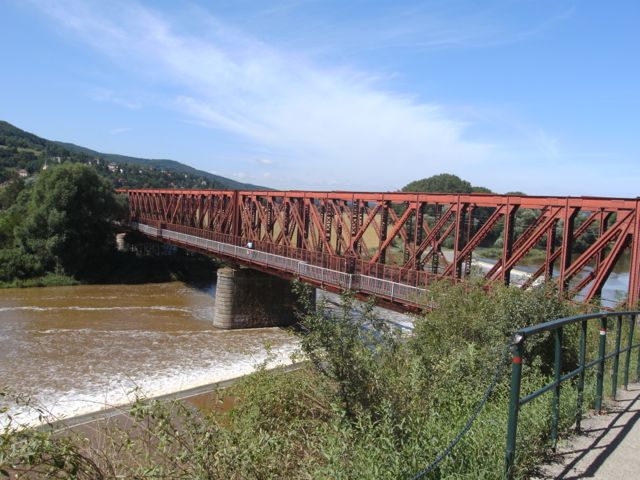
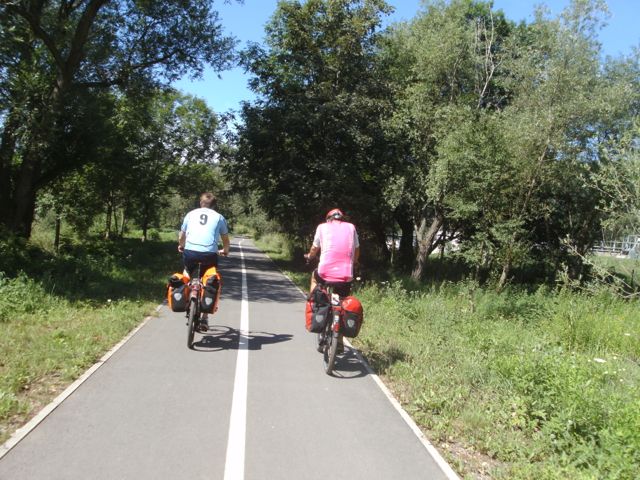
It was a beautiful 96 kilometres! But they also made me tired. And then the tasty dinner.
Consequently, all you get today is a few pictures taken on the way:
RMD
Roland Dürre
Utb #1 Prague – The City
Yesterday was the first time in my life I saw Prague. Getting was quite easy. You just board the “Albert Einstein” at Munich Central Station at 9:01 hours. Then you will arrive in Prague at 14:51 hours. The total cost for three adults (including three bikes!) is less than 75 Euros! Because the Bayern-Böhmen-Ticket is valid through Pilsen. From there, it is not far.
It has been a long time since I last had five hours in a row to myself like now in this beautiful slow train with its five ancient but nicely renovated carriages that formerly belonged to the Deutsche Bundesbahn.
Actually, the Alex is the only direct connection between the two enchanting cities Munich and Prague. As an alternative, you could take the ICE from Munich to Nurembourg and then a long-distance coach of the DB AG to Prague. Even though you have to change on the way, the entire travel time is a little less than by Alex, but somehow or other, this does not make sense.
I was in a position to really enjoy the time on board. First, I read the Saturday “Süddeutsche”, then I did some work and finally I continued reading my current novel on my Kindle. And in between, I enjoyed the view from the window.
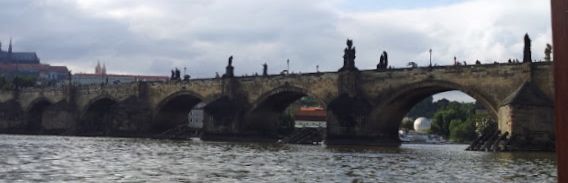 And I must say, I was surprised and fascinated about the city on the river Vitava. Basically, I have hardly ever (maybe never) been at a place brimming with love of life as this city does.
Prague is a very international city. It is a city with pedestrian’s zones that seem to stretch endlessly and with almost uncountable places of interest. It is a city where you can feel how powerful it used to be in the past and how much potential for the future it contains.
It is a city where you seem to hear music everywhere. A bigband here, gypsy music there. First the accordion-player, then the Country Sound, then Skiffle and Classic Music. And in the evening, it seems like the city belongs to Jazz.
🙂 Maybe along with the lovers.
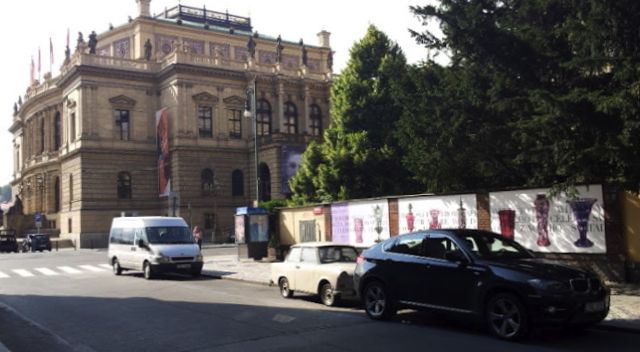 In Prague, you will see a Trabi parked next to an X5 (a reader told me, that the car is an X6 – sorry about my missing knowhow of cars). But – note the difference in dimensions.
Here, the world of the high-society is directly next to the world of the tramps. In Prague, you might be asked out of the blue if, maybe, you need some hashish – and the girls selling themselves can be found directly among the “window-shoppers”.
Yet, compared with the rest of Czech, Prague is a really expensive city. And it is also a city where you seem to get WLAN in all the hotels as a matter of course.
Yes, this was certainly a nice afternoon/evening in Prague. I think I will come back again at some other time.
Starting today, we will ride (our bikes) home via Regensburg. Our final destination is Munich, or, more precisely, Riemerling. I want to arrive on Thursday, hopefully not too late, because I would like to do a little work at home.
Greetings from Prague!
RMD
(Translated by EG)
Roland DürreSaturday July 7th, 2012
pmcamp meets munich – best of pmcamp
Now the time has come – our technological IF Forum of 2012 is planned. The day is set and the content has been decided upon. Even the speakers have all agreed to come.
At the third “Technological IF Forum” after 2010 (AGIL) and 2011 (LEADERSHIP) on September, 25th, starting at 14:00 hours “PM Camp will come to Munich”! We want to tackle the problems of
“Projects – Work, Coaching, Success”
To be sure, this is not (yet) a barcamp. It would not be possible to do that on one afternoon. But still, we will try to create something like a barcamp atmosphere.
The agenda and program are still in the planning stages. But it is clear that we will start at 2 p.m. And at 6 p.m., we plan to have the “happy hour”. This is when we can get some recreation after the tedious and exciting afternoon.
During those four hours, the IF Forum will be the “stage” for PM Camp and for the people who had considerable impact on the development of the PM Camp. The InterFace AG will provide the setting. I will give a short introduction about the “PM Camp” (#pmcamp) idea – and then we will spend four hours with modern project management. In a broader sense, it is also about leadership and entrepreneurship.
Together, we will discuss methods and creativity, emotional and foul, prudent and wise, upright and unethical project management. It will all happen on a high level and short presentations, along with open discussions will make for quite some diversity! You will be surprised!
Here are some persons who already agreed to come: Dr. Stefan Hagen (Dornbirn http://pm-blog.com/), Dr. Marcus Raitner (München http://misc.raitner.de/), Jens Hoffmann (Hamburg http://www.23actions.com/), Nadja Schröer-Petranovskaja (Seevetal http://petranovskaja.com/) und Dr. Eberhard Huber (Ludwigsburg http://www.pentaeder.de/). They will report what, to them, project management means and tell you what is particularly important for them.
We will discuss the presented theses together with passion during two “Fishbowls”. As always, we will broadcast live into the internet and also make recordings of the presentations and highlights on video tape.
It makes me happy to see that the day is now decided upon and I hereby want to thank all my PM Camp friends very much, indeed! I really appreciate that you spontaneously agreed to come and will even travel quite far in order be in Munich!
So – save the date – September, 25th, starting at 2 p.m. in Unterhaching.

And not to forget:
As of now, you can register for the Dornbirn PM Camp 12 (November, 10 to 12)! You do not want to miss it!
RMD
(Translated by EG)
Roland DürreFriday July 6th, 2012
An Interview with Rupert Lay
I found this interview by Thomas Pfister and Madeleine Stäubli-Roduner with Rupert Lay in the “Denkpausen Edition No. 11″.
Denkpausen (pauses for reflection) is a brochure edited by the Management School St. Gallen (BETTER BUSINESS). It provides “Inspiration on Management and Leadership”.
I remember well how Rupert called the top-managers the “poorest of the poor”. Mostly, he said, they are the loneliest persons in the world. And he felt he had to “help those poor creatures“.
Consequently, the initial question asked in the interview was:
“Are managers poor creatures?”
For me, this interview is a wonderful summary of many ideas we shared with Rupert. Ideas still as important today as they were then.
Here is the original text taken from the “Denkpausen”:
——————————————————————————————————————————
Are managers poor creatures?
The principle «posting, premium, prostitution» still works today. What is ignored is entrepreneurial culture. This is a conversation with Rupert Lay, a famous German business ethics teacher. We will talk about leadership personalities, overcharged managers, an ethics that has gone down the drain in many enterprises and disheartened executive boards.
Herr Lay, do you despise managers?
What an idea! I despise no person at all.
Well, after all, you write that you know «no more miserable people» than the managers when you look at the people attending your courses!
I even said that quite a few managers are poor, miserable creatures. And there is nothing more ridiculous than poor, miserable creatures in a permanent state of erection. But that is no reason for me to despise them. It is more that I pity them, because so many people own so much, yet have lost themselves.
Now that sounds quite arrogant. Is this how you treat your customers?
Yes, certainly, if it helps them to find themselves. I am sure you want to know what made me say this? Well: meeting managers. This sentence of mine is the essence of my experience from hundreds of seminars where I met thousands of managers. But, please, not to mistake me: that is how they were before they attended my seminars…
At least you say that managers have potential for learning…
Yes, I tried to convert managers who were pure leaders into true leadership personalities. Because many of them did not know ethics as a social necessity. A considerable number of them, however, learned new patterns of behavior in my seminars.
Are you telling us that your positive influence made good leaders out of managers who before had been poor creatures? Isn’t that a little arrogant?
At least, the managers had the equipment for this mutation. Quite frequently, I did cause some development. And we always continued to meet regularly in order to see whether or not some social and psychological maturing had taken place.
What, by your definition, is a good boss?
He must be a personality who will not be governed by systemic forces and who will not bend to any dictatorship. To be sure, leadership is also a question of skills. But it will often be very tedious and ineffective if you just let it degenerate into commanding. You also have to lead people in an atmosphere of goodwill. A good boss also wants to be loved.
A good boss does not pay. Or do you disagree?
In fact, he pays considerably better than a bad boss. All investment factors are smaller: the social, emotional, psychological and the financial investment. You could easily prove this if those factors were taken into consideration at the time of business evaluation. Charisma is something you either have or don’t have. Or can you learn to develop a personality? There are certainly some social and psychological requirements. And every person can develop them through striving and a strong will.
Every person? 90 per cent of all managers are said to be overtaxed by the age of 50 …
Yes, they are not only said to be overtaxed, they actually are overtaxed! Often rationally, but also socially and emotionally.
So how are those overtaxed managers supposed to become better persons?
Practice, practice, practice!
Is that enough? There are certainly many leaders, but only few of them have true leadership qualities.
As a matter of facts, there are too many leaders. Quite a few of them are unnecessary. They should immediately be made redundant, because they create unnecessary costs. But, as you say quite correctly, we have too few leadership personalities.
What – in your opinion – is the difference?
A leader is purely a system agent full of restraints. A leadership personality, on the other hand, is free inside. I know some who developed into leadership personalities, but later were made redundant by administrative boards because they were useless as system agents.
«We have too many leaders. Quite a few of them are unnecessary. They should be made redundant. »
In other words: if you behave ethically correct, you will disrupt the system?
Exactly. Because the system agents will be made insecure as soon as they meet ethically oriented persons. System agents are those who slowly grew accustomed to this forced world and all they now do is execute the systemic morals. In business and politics, you will find many of them. In order to be one of them, you also need a certain psychological and social disposition.
«A leader is a system agent full of forced mechanisms. A leadership personality, on the other hand, is free inside.»
How do ethics and economy contradict each other?
Basically, there can be no contradiction, because ethically responsible business practice will have a sustainable positive economic effect. But economic forces may call for moral behaviour that is contrary to ethical compulsions. More often than not, however, these compulsions only seem to be necessary.
You say only a personality with a humane education has leadership qualities. That would mean what we need is education.
To be sure, during professional education, we will have to watch carefully and look for a person’s natural aptitude towards becoming a leadership personality. But it is especially important before you actually give someone a job. That is why I am in favour of the trainee system. A trainee will get acquainted with various departments and functions of his enterprise during his test phase. The trainee work should always be supervised by a board member. If he is a leadership personality, his style will automatically have some influence on the trainee, because education does not happen through words. It happens through models. This trainee time should be two to three years. The trainee must learn to identify and accept the entrepreneurial culture with its moral, economical, personal and structural values. It seems that this way of selecting future employees is definitely superiour to assessment centres.
«Neglecting entrepreneurial culture is economically very short-sighted.»
Why?
Because it is the best education you can give anybody. It guarantees that leadership personalities will grow inside the enterprise without intervention from outside.
This is remarkable. What you are saying is that ethical education is not something people should learn at university or from their parents …
Exactly. This is definitely something a university should not be asked to teach. When it comes to education in the family, the parents will, apparently, play a significant role, but in the enterprise, the leaders are responsible.
And where do the board members get their norms and values?
Those among the board members who are best suited should be educated at an external seminar.
In order to enable personalities to change the system, you have to support them …
Most certainly. This is where the administrative board is responsible. When Alex Krauer was still president of the board at Ciba-Geigy, I was permitted to do a lot of work there and also introduce my principles But after they merged with Sandoz and became Novartis, it was no longer nice. Regardless of the financial success, a precious entrepreneurial culture suffered its demise. In the long run, the entrepreneurial success is not something you can measure exclusively by financial success.
In many enterprises, it was financial success that brought higher incomes, rather than better entrepreneurial culture. Is that supposed to replace missing values?
Quite possibly. Disregarding entrepreneurial culture is economically a rather short-sighted attitude. Well-paid managers should also take the worst case into consideration when organizing their lives and think about what they would need in such a case, instead of always itching for the best possible future scenario and wanting more and more. At least, they are models. Or that is what they should be.
«Many men lack the experience that you can gain more through care than through using your elbows.»
Words spoken by the priest. More success will also give you more power. And power can be abused, as, for instance, shown by Dominique Strauss-Kahn, Silvio Berlusconi or Sepp Blatter of the Fifa.
Unfortunately, power and abuse of power are close associates. Many people kiss moral norms good-bye the moment the acquire power. They see themselves as standing above the rules, all the others are just norm executors. It is a sign of omnipotence if the common codes no longer apply to me.
It is mostly men who act in this way. Would it be different if more women were at the forefront?
I do not know. The female heads of state in Great Britain, India, Israel and Turkey also all waged wars. But I certainly think more women should sit on administrative boards, if they are qualified. Women do not become system agents quite so fast, which is probably why they more often develop true leadership personalities.
Which are the better qualities in women?
During their education, women were not subjected to quite such strict codes. They were brought up in a more biophile way. In other words, they do not quite as easily follow those norms that were made exclusively for serving the system. Instead, they ask what is useful for life…
… which is why they do not get a career quite so often in this system.
Exactly. They resist being drawn too deeply into the systems. Women are also more prepared to fight power abuse than men.
Men need elbows, is that a stereotype?
Many men move to the top using pure force, because they lack the experience that you can make easier progress with love than with your elbows.
Small wonder that they then feel lonely when they have reached the top!
Only bad leaders will be lonely when they have reached the top. A good leader will do his job in the way as it is partly common in Japan: from bottom to top, according to the principle of subsidiarity. That would be the ideal scenario – an ideal leadership model.
Maybe for some managers, the concept of power is so attractive because it enables them to control everything single-handedly?
Yes, powerless power persons cannot bear to have anything happen they do not know about. They want to be omniscient. This is where quite a few Western enterprises make a huge mistake, since they think from top to bottom. Many enterprises are controlled like fiefdoms. Nothing can happen against the wishes of the top leaders.
And the bigger the organization, the stronger the hierarchical concept …
At one time, there was a tendency in business towards re-establishing small cells and divide huge enterprises into small units. That was in the 1970ies. As globalization advanced, these ideas died.
Formerly, everything was smaller. Above all, there were strict hierarchies with stern patrons. Is that supposedly the ideal?
The patron felt responsible for the entire enterprise. He had personal connections, he knew the families of his employees. His company was a huge family association with codes totally different from a large company. You will not easily be released from a family association. In a huge enterprise, the administrative boards would have to take up the role of patron. Mostly, this does not happen.
You are telling us that the administrative boards do not live up to their duties?
Mostly not. An administrative board should also be courageous enough to make the managers redundant if they abuse their power. But what administrative board member will ever do such a thing? More often than not, they are more concerned with business success than with a responsible entrepreneurial culture.
They also should prevent excessive incomes.
For me, it is a mystery how system agents who hinder the optimization of the company success can remain on their posts. Unfortunately, the principle of the three “p’s” still works: posting, premium, prostitution – even though it is both economically and socially far from the optimum. Sleaze is still at the forefront, you must not underestimate its role. The augurs will smile at each other, because each one of them knows what a villain the other is.
«Power and power abuse are in close proximity.»
Is that the reason why hardly ever anybody is punished for what he did?
Correct. Purely in terms of the system, there is a defect. Those whose work is detrimental for the company cannot be punished. More often than not, system agents are a structural element of the system and thus taboo. They will only be punished if they commit fraud, perfidy, or some such crime.
After the financial crisis, everybody talked new values. Today, nobody says anything of the sort.
That is something I am also truly worried about. The political and economic society seems to have become valueless in the truest sense of the word.
Did we understand correctly: you said if there were ethical codes in an enterprise, the business results would look better. If you do not do this, you will inevitably harm the firm.
That is indeed what I am saying. Stupidity or not being a success, however, are not punishable. Some managers actually know no better. Stupidity and not being a success are pre-destined. In those firms where I presided over the administrative board, I tried to divert the focus from the purely economic business success to more indirect aspects.
For example?
One category of being a business success is also the reputation you have, both internal and external. The positive ones are: I give people a job, I pay taxes, I provide service, etc. The negative ones are: I make people jobless, I pollute the environment, etc. These external factors can be represented in terms of money, just like the ecological factors. Every enterprise should make a balance sheet of these external factors…
«Business success can certainly not be measured exclusively by financial success.»
… and publish it.
Naturally. If you compare well with the competition, this will be quite attractive for the enterprise. It improves your external reputation. But it also improves the internal reputation, because an employee will prefer working in an enterprise that has a good external reputation. And this will also have an impact on the advertising power of a company. Many have now realized that the reputation of an enterprise is actually worth money. But if the internal reputation is not a match for the external reputation, you have a problem. Your credibility will suffer. A good external reputation combined with a bad internal reputation will not work. As a general rule, an employee will leave the enterprise if it is poorly governed. And an enterprise is poorly governed if it lacks leadership personalities.
That is if the bosses remain poor, miserable creatures!
Rupert Lay is a German philosopher, theologian, entrepreneur’s counsellor and psycho-therapist. He is also concerned with ethics and communication. In 1967, Rupert Lay established a psycho-therapeutic practice. Since the 1970ies, he has spent more and more time as a coach in management seminars, where he helped numerous persons from business and politics by providing advice. Among his customers are Federal Ministers and board chairpersons of huge concerns. In 1988, Lay also started coaching enterprises and sitting on administrative boards of enterprises himself. In 2004, Lay, who is also known under the titles «Manager‘ Pope» or «Ethics Guru», was awarded the Fairness Prize by the Fairness Foundation for his life’s work.
—————————————————————————————————————————–
Rupert Lay was my mentor and became an important friend.
Thank you, Rupert!
RMD
(Translated by EG)
Detlev SixThursday July 5th, 2012
Dictionary of Term Accuracy: Growth Politician
 There is no such thing as a politician in general.
There is just one sort of politician.
The growth politician.
The only thing he ever learned is how to distribute growth. It is the easiest way of doing the job, because being a growth politician, you will not have to hurt anybody by taking something from them. Everybody gets something. Of the growth. One politician shows generosity towards his voters, so does the next. If there is no growth, you create growth: by debt.
The debt is distributed and becomes part of the total economical product. Its increase each year is about 1 to 2 per cent. If you have a 3% rate of new debt each year, you basically get the result that you have no growth, but since nobody comes and actually puts the two numbers next to each other, what you get is: growth.
In theory, there should also be such a thing as a politician of shortage. But there is no place where you can train to be one. Consequently, he does not exist. He would certainly not be very popular. Even in Germany. The only politician in this country who ever took something away from the people since WW-II was Gerhard Schröder.
He did not last long, did he? Angela Merkel, who orders other countries to be more thrifty, does nothing of the sort in this country. As before, our national debt increases all the time. But, as I said, you cannot hold that against a growth politician, because there is no place where the other sort of politician is trained. The only institution that trains politicians of shortage is life. Only a catastrophe will drastically change your curriculum.
Politicians of shortage learn to do their own thinking, instead of chasing their voter’s carrots. Even growth politicians do not always fall for what their voters say. (At the moment, they actually tell us it is good to be thrifty. But as soon as it is all about their own standards, they cannot bark loud enough while pointing their fingers towards the others.
Experienced growth politicians ignore these kinds of polls). Since old, satiated societies with high standards stand against young, hungry societies with low standards, waiting for the catastrophe will not get boring for us. Perhaps those who are a little older today will even see a new generation of politicians of shortage. To be sure, they will not bring us prosperity, but perhaps, with a little luck, the way down to the bottom can be slowed a little.
Politically correct, we might call this hyper growth brake (haven’t we seen a good example of the beneficial effect of phrases with debt brake? Because whenever we talk about it, what we mean is not at all minimizing old debts. All it means is that the new debt will not increase quite as fast as the old one did). Besides, all catastrophes also proved to bring something good in their wake: afterwards, the societies that were affected had a little more equality.
SIX
(Translated by EG)
Roland Dürre
(Deutsch) Tweets zum Twittern und Bloggen #124
Here are my tweets of last week on:
blogging and twittering, wisdoms and rules:
120719 Look at your own reflection first – good advice for bloggers and twitterers? #Twitter #Blogging #Wisdom
120720 Appearances are deceiving – some basic wisdom, also for twitterers and bloggers? #Twitter #Blogging #Wisdom
120721 A joke often becomes serious business – also true for twittering and blogging? #Twitter #Blogging #Wisdom
120722 Adapt to the world around you – a good motto for twittering and blogging! #Twitter #Blogging #Wisdom
120723 Go with the times – also good advice for twittering and blogging #Twitter #Blogging #Wisdom
120724 If you shoot golden bullets, you will hit the mark – not to forget, twitterers and bloggers? #Twitter #Blogging #Wisdom
120725 Criticism will give you room for praise – not to forget, twitterers and bloggers! #Twitter #Blogging #Wisdom
There is a new tweet each day. See twitter.com and “follow” RolandDuerre!
Enjoy!
RMD
(Translated by EG)
P.S.
I took the proverbs from Alle deutsche Sprichwörter .
Roland DürreWednesday July 4th, 2012
IF Forum: Presentation by Frau Susanne Hofmann now Available as a Video Recording
Frau Susanne Hofmann of Tölzer Kasladen gave a presentation at the IF Forum of June, 21st . Regardless of many (unfortunate) cancellations – due, among other things, to soccer and June being a party month – our seminar zone at Unterhaching was quite full.
I was truly glad to receive so many positive comments by the people who had attended. Unfortunately, I myself could not be there. When I watched the video with the presentation, I was truly enthusiastic. The presentation was really great – and not only for cheese fans. Here it is:
Quality Beats Quantity.
How high-quality food should be produced!
Many thanks to our speaker!
Again, the video was produced by Friedrich Lehn. For more presentations, not just from the IF Forum, try the youtube channel rolandduerre.
Our next IF Forum guest will be Wilfried Bommert of the WDR. He is the author of the book “Kein Brot für die Welt”.
He is a nutrition expert and the last in our series of IF Forum speakers 2012 about “Living (and Surviving) Sustainably”. Herr Bommert will talk about the future of feeding the world. You will shortly read the preview and title – but here is the date:
November, 13th – not to forget.
RMD
Roland Dürre
Openness and Transparency
Why we make our projects and enterprises transparent and why openness is a central value for us, not just as responsible leaders.
Or:
This is another one of my provocative articles!
I would like to have a society of openness. All meetings, results and protocols should be available for everyone.
Because there is no need for us to fear competition or imitation. We are good and we know it. Keeping things secret will not do any good, anyway. On the contrary: transparency is the chance to demonstrate the quality of our own work (and thus also be appreciated for it). And this is the only way for us to receive the valuable mirror-image and useful replies we need for our development.
I want total transparency!
I would wish for a society where it goes without saying that you talk about your work freely and openly. So we openly submit our ideas in blogs and/or other publications. And we share our entire knowledge in order to better discover the problems that might endanger and threaten us. And then we could also find necessary solutions for the future more quickly. It would generate creativity and true innovation.
This transparency should not stop with the “money bag”. What reason is there for keeping secret what you earn or own?
Whenever we make a mistake or do something stupid, we must be permitted to admit to it without having to justify our behaviour. And we have to be prepared to accept the same from others and not hold mistakes against them.
And when our behaviour is transparent and open, we will soon also learn verbal hygiene. And, as we all know, hygiene is healthy.
🙂 Well, now the only question is what was so provocative about this article?
Now back to reality:
I know quite well that most persons today will still call my wish for transparency totally unrealistic. After all, the world is not as we, perhaps, would wish it were. On the other hand, quite a few utopias that were still unthinkable not so long ago have become reality (monopoly of power for the state, no serfdom or slavery, the role of the women, enlightenment,…).
Social change is part of evolution. And, just as the word change suggests, a person’s socialization is subject to constant change, both for individuals and social collectives. Through the technological advance during the last century, this change seems to have drastically gained in speed (and continues to do so), currently having gained its high point with information and communication technologies (IKT), that is: through computer science and the internet.
Thus, my utopia might now already be closer to coming true than, for example, it would have been a hundred years ago. May I remind you that in 1912 we were heading towards WW-I. Since then, much has happened and even more has changed.
Consequently, it might well be that enterprises and organizations, even today, have a huge competitive advantage if they are transparent, both on the inside and outwardly. Even if, as you consider the past and employ some scepticism, you might think this impossible and totally absurd.
The same is true for humans. I assume that, as reality of life develops, humans who open their lives openly and transparently for others will be a lot more successful than the rest. And I also assume the same is true for all kinds of organizations.
Yet before openness and transparency, there always has to be trust. In other words: openness and transparency must happen voluntarily. First and foremost, they must concern your own life and your own organization, rather than that of the ”others“. This is not about making others transparent, but first and foremost about making yourself and your own behavior transparent.
The only exceptions to the rule should be when danger is imminent. But that is a totally different and not at all trivial problem. We are approaching ethics – and it always gets tricky when we get to that stage.
So here is my advice – be happy if you yourself are open, while others are still close-cut. When it comes down to competitiveness, you will be one up.…
RMD
(Translated by EG)
Roland DürreTuesday July 3rd, 2012
brand eins in July
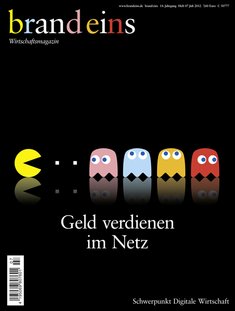 The newest “brand eins” is titled
Earning Money On The Internet
Now, isn’t that to my taste?
It is definitely something yours truly and all “digital natives“ have been dreaming of for a long time. The sub-title is hard to find, even for me.
This seems to be a “brand eins” without any sub-title – a novelty. At the bottom right-hand corner, I finally discover something that hints at the focal point:
Digital Economy.
Yet, before opening the cellophane wrapping, I do my usual act and ask myself:
What comes to mind when I read this title?
Well, it is quite simple, isn’t it? It is certainly nice to earn money on the internet. All I have to do is find the right method – and suddenly everything is very easy. In fact, it reminds me a little of the lottery except that “filling in the lottery ticket“ is easier and less expensive – and also less hopeless than “earning money on the internet” – at least for the likes of us.
But maybe the magazine will now teach me how to do it properly! And then I will end up truly wealthy. I get impatient and dispose of the wrapping…
The first thing I discover is that there is a second magazine, as well. Oh God, I think, all this advertising. But the second magazine looks a little like the brand eins. Yet it is no brand eins. Instead, it says:
Help! Between illness, provision and business.
And underneath:
A magazine about the pharmaceutical industry.
I take a closer look at the legal notice. The magazine is edited by the Federal Pharmaceutical Association (BPI) e.V., but it seems like it was designed by the brand eins editorial staff. So is this some sales lobby? Fine by me. I will also take a closer look at this additional magazine.
But back to brand eins.
This time, many articles are about “rights” to intellectual property. These rights are controversial, perhaps antiquated. It is about cultures where these kinds of rights do not even exist. It is about sectors where people lament on an extremely high level and about sectors that have actually learned to handle intellectual property.
After having browsed through some of the articles, I think this brand eins mostly shows problems that accompany our current right to intellectual property. Unfortunately, however, it offers no solution to the problem. Still, one can see that the current legal situation is far from adequate for mirroring life in our society and that it is high time for some changes.
Otherwise – and this is now again my own personal opinion – we are heading towards a discrepancy between the nation and its citizens. In the end, the citizen would have to basically ignore the laws – just in order not to end up feeling stupid all the time. Such a situation will undermine the legal situation even more, before – absurdly – creating even more regulations. Because the more laws you have, the less people will abide by them. Which is why you need even more laws. And so on.
But what will happen if the citizens see the state and its laws as just some inconvenient antiquity more and more often? And if they then – perhaps even justifiably – ignore the inflationary multitude of stupid laws – by doing what they intuitively feel to be the right thing? We would tend more towards anarchy, instead of democracy or a constitutional state. But perhaps that is our future?
On the other hand, if laws are no longer taken seriously, the situation might be rather dangerous for a democracy. I frankly do not know what to say to this.
But back to the magazine. It wakes you up and contains radical truths and ingenious articles.
My special recommendation for you to read are pages 26 and following: “as time goes by”. It is a diary of national bankruptcy written in a way that truly makes you smile. Absolutely fantastic!
I also find the information on pages 74 and following quite interesting: the turnover of the pornographic industry. Somehow or other, the numbers seem rather low to me. They look almost like InterFace could get similar results.
So good-bye till the next brand eins. Your faithful “brand eins” reader, Roland Dürre.
RMD
(Translated by EG)


