
Roland DürreWednesday May 2nd, 2012
Preventive Medical Check-Ups
All the medical check-ups you are advised to have!?
 As it happens, the human body is rather complicated, if not complex. Of course, everything about it has to be checked and maintained. On a regular basis.
It starts with your blood picture. In order to get laboratory results, you have to send a little of your body blood into the lab once in a while.
Then there are numerous organs that can become defunct. They, too, should be monitored in regular intervals to see if they are still working properly.
Your heart and your circular flow must be tested for capacity again and again. How fast can an infection or defect develop? And, of course, there is always the infarct risk.
Not to forget the lungs. The liver and kidney are also constantly endangered. You should have a proctoscopy every so often. And all those glands, be it pancreas or thyroid gland, are also a liability. And then there is the lymphatic system with all its small knots.
Nor must we forget the bone density, which must be regularly measured. And careful – the spine is constantly under threat of a herniation.
Rheumy infections and gout might also hit you…
Naturally, the eye-doctor, too, keeps calling. Is the pressure still fine or are we already suffering from glaucoma?
And I almost forgot – the skin – a very important organ. It is particularly sensitive. Especially since we now have the ozone leak.
Because cancer lurks behind all corners. Be it the prostate glands or the sexual organs, everything is at risk and therefore must undergo regular controlling procedures.
All of these parts of the body must undergo ”preventive medical check-ups“. It seems like health costs a lot of time and money. Basically, you have to spend many days of the year seeing the doctor about all kinds of check-ups. And then you would have to have costly and time-consuming therapies and medication.
Well, incidentally, I do not believe this is good for us. However, it is good for the economy, because, after all, it is some sort of “high-quality consumption”. And that is exactly what we need for our growth – after all, we all want to continue to earn good money and consume much. Even if consumption makes us ill (for instance around the middle).
Regardless, I often get a bad conscience. My super-ego knocks on the door whenever I refrain from doing any of the aforementioned things. Whenever I pass a doctor’s office (by bike), I give it a wide berth. I only go to see a doctor when I consider it necessary – for instance if I have an ulcerous fingernail or a wart.
I simply stopped smoking. I try to spend as much time as possible in fresh air and exercise a lot. I avoid noise and negative stress situations. If possible, I never go places by car, instead using my bike. And I try to hardly ever get annoyed. The magic phrase is love instead of hate. Be content.
The only thing I still seem to have a problem with is eating less and in a more healthy way. And drinking less beer. Well, I certainly have a little leeway there, but even here, the tendency is towards the right direction.
To make up for it, another one of my goals gets closer and closer to perfection:
I never take any drugs. The only antibiotics I remember taking are one I had to take after a very severe infection I suffered from after having attended the CeBit. To this day, I am not sure if the drug helped or if, perhaps, I just got healthy again through the natural functionality of my body. And I am talking decades back. And I am sure I will definitely never need a kidney transplant …
So now you know my recipe. But I, too, am worried. What will happen when I am really old? Where will malady hit? My mother is suffering from dementia. Years ago, a doctor told me her brains are no longer the original dimension. And that there is nothing you can do about it, except – and even that requires a great effort by the patient – stabilize the current state.
Will that be how I am going to end up? Is it possible that I have a hereditary disposition? After all, I am almost 62 years old. To be sure, so far I cannot identify anything wrong, but you cannot be skeptical enough, can you?
In fact, I think that, because of the ever increasing number of people suffering from dementia, a preventive medical check-up for the brains will probably soon be introduced. I am sure such a check-up would sell well. Money will be spent on it and then, as a consequence, there will be costly treatments and medication. Even if it does not help at all.
Except – does any of this make any sense? Either you will suffer during the treatment and die anyway. Or else the treatment will be a success, your life will be artificially lengthened and thus the probability of becoming a case of endlessly lingering illness is a lot higher?
I do not know.
The only thing that might make sense is perhaps mentally prepare yourself a little bit for dying. Because there is going to be a time when it comes – and then there is no way out. But in the meantime, I want to enjoy as much of life as I can.
RMD
(Translated by EG)
P.S.
The illustration was made by Luc Viatour (Luc Viatour / www.Lucnix.be)
Roland DürreTuesday May 1st, 2012
Travel Journal Stralsund #6 From Liebenwalde to Berlin
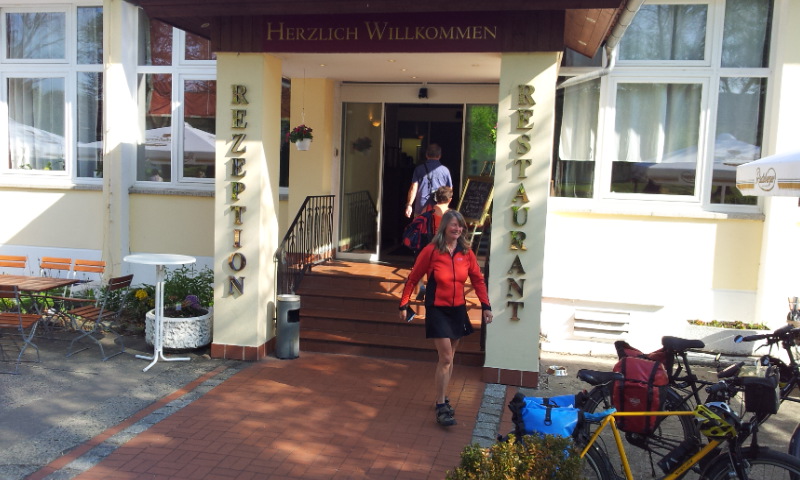 And again, we enjoy a wonderful day. The beautiful hotel Preußischer Hof at Liebenwalde even has its own swimming pool. Mind you, we are talking a rate of 48 € for the double bedroom (although breakfast is not included and booked through HDS).
So I start the day at half past seven with some swimming. To be sure, it is only 15 minutes, but this will suffice for making the body flexible. Then I indulge in the big buffet breakfast and shortly before 10 o’clock, we remount our bikes. We are going to Berlin, taking a detour through Oranienburg, because the cyclist’s path is just too attractive.
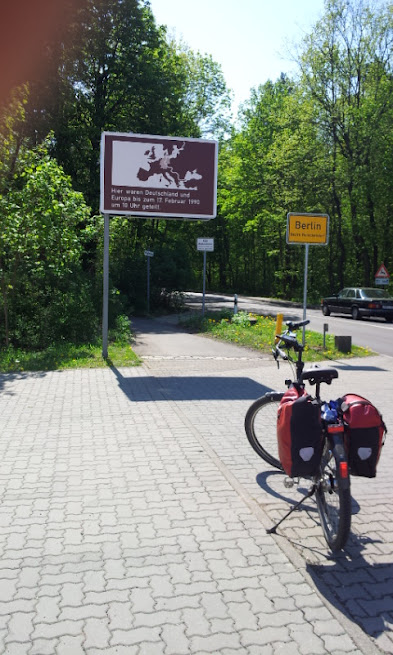 Today, we can afford to be really slow, which is what we do. The weather is hot, almost 28 degrees Celsius in the shadow. A few minutes after 1 p.m. we arrive at the new Central Station of Berlin. Well, I cannot say I am fascinated by the building: it is one of those modern stations on many levels. Besides, it is not at all situated in a “capital-like” area. But they are busily building houses for Federal offices in the vicinity.
We study the itineraries. And we discover that our train will come fresh from Gesundbrunnen. To get to the station of Berlin-Gesundbrunnen, we would only have to ride four kilometres. So we quickly ride there.
After our arrival there, we have two hours left. We take a leisurely meal and are back 15 minutes before the scheduled departure of the train on platform 7. Today, we only rode 60 kilometres. The train is on time, we can load the bikes without problems and now I am sitting behind a table with a power outlet, preparing for my next three work days.
To sum it all up, I can say:
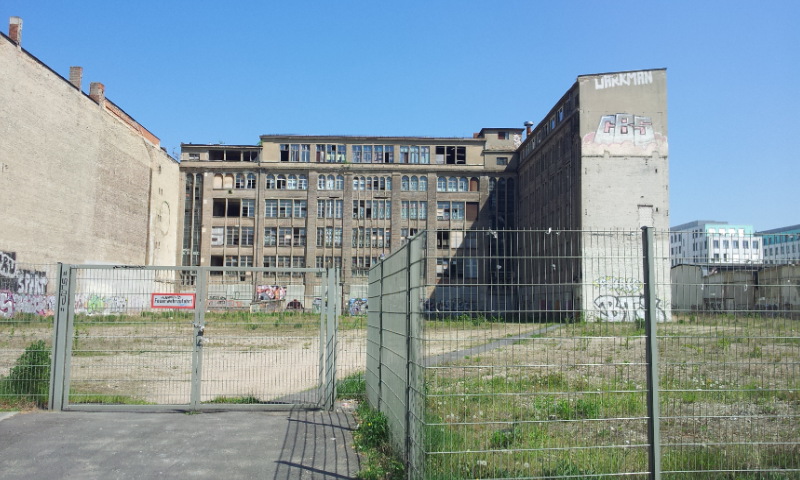 It was a dream of a journey. Six days on the bike, riding 580 kilometres. Wherever we were, we found nice hotels, no rain. One day was a little cloudy, one day a little windy.
About the bike: this was my first tour with my Roadster. Mostly, I take my Road Traveller (Koga), or if I go mountains, my Mountain Bike. The Roadster did a very good job. The thick “Big Apple” tyres were the optimum on the paths that were occasionally very rough and sandy. The Rohloff gear hub was perfect, I truly enjoyed how I could shift gears all the time.
Basically, the paths were easy going. You can also choose a shorter route. Staying overnight is excellent everywhere.
So – why don’t you follow my example?
RMD
(Translated by EG)
This is our firth day “on the road”. And tomorrow will mark the end. At 4 p.m., our train will leave Berlin Central Station for Munich Central Station.
 Consequently, we want to reach a place that is “within a reasonable distance” from Berlin on this last day of April 2012. And it turned out to be the best of all days.
Shortly after 9 a.m., we leave our friendly hotel and first ride to the harbour of Waren. And, surprise, surprise, a small ship is just making ready for departure. Its destination is the opposite end of the lake, which brings us nearer to Berlin by 25 kilometres.
Without much ado, we board with our bikes and enjoy 90 minutes on the “small ocean”. Because we learn – among other things – that Müritz is originally Slavic, that the ending “itz” is a diminutive form and that “Mür” means ocean. Not bad, is it?
 The two of us enjoy the ocean trip and the best of weathers (so do our bikes). It is just great. We also learn that the Müritz is the biggest German inland lake. The only competitor would be the Bodensee, but it also belongs to Austria and Switzerland. At 11 a.m., the ship gives us free at the Boeker Mill – and now we have 110 wonderful kilometres to ride ahead of us.
We pass Rechlin, Mirow, Wesenberg, In Fürstenberg, we are reminded of the atrocities of German history. Himmelpfort feels like paradize.
Then we arrive at Zehdenick and from here, it is not far to our destination – Liebenwalde.
 The entire way is just one huge piece of pleasure biking! Soft hills, green landscape, again and again lakes, channels, water-gates. The entire country looks like a single large vacation paradise. But totally authentic. Just a fairy tale. But instead of Disney-Land, you get a beautiful landscape, even if frequently marked by the years gone by.
We meet many happy people and enjoy two wonderful rests – and shortly after seven o’clock, we can practically see Liebenwalde. And what a coincidence: right next to the cyclist’s path, along the channel, we see the hotel “Preußischer Hof”. There are still some vacancies. In the evening, they dance into the May and have a May bonfire.
We gladly stay. The hotel is one with history. And it has some charm, even though it cannot deny its GDR past. Finished in 1791, the first person it served was Frederic William II for horse breeding. In 1813, it became a military hospital, and in 1899, the biggest champignon plantation of Germany was right here. From 1934, it served as a Landjahrheim with leadership camp.
In 1936, the Reichsinnungsverband of the shoemakers bought it and the building was converted into a Reichs School. And then, on May, 14th, 1946 the SED first made it the party high school “Karl Marx”, then the Berlin Regional Party School “Friedrich Engels”. Later, it was used for housing the school of “Politleiter of MTS”, until it then was made “Institut zur Ausbildung von Funktionären für die sozialistische Landwirtschaft” until 1989.
Yes – and then, like many other buildings, it became part of “Treuhand”. And tonight I will sleep in these historical rooms. Tomorrow, we will only have to ride a stone’s throw to Berlin (about 50 kilometres). Chances are quite good that we will actually catch our train home.
RMD
(Translated by EG)


