
Roland DürreMonday August 10th, 2009
Haching Sports Camp
 During the holidays, there is another round of the Haching Sports Camp (Hachinger Sportlercamp). It first started during the Easter holidays of 2006, and grew in popularity ever since.
The organizers want to make children enthusiastic about sports. We want to give them the experience of being successful together and show them that it can be fun to make a huge effort, along with strengthening their self-respect.
Here is some information:
Camp 1: August, 17th through 19th, 2009
Disciplines: gymnastics, baseball, handball, Judo, rock climbing and trampoline
Camp 2: September, 7th through 9th, 2009
Disciplines: gymnastics, tracks-and-fields, basket ball, rock climbing and trampolin
Camp 1: Kids aged 6 to 12
Camp 2: Kids aged 5 to 10
I like children and I love sports. And we at InterFace appreciate the honorary work of all the coaches who give so much of their time for the public good. That is why we support the Haching Sports Camp with a pecuniary donation. All participants get a T-shirt to remind them of these always beautiful days. On the T-shirts, you will also see the orange InterFace logo.
It would make both Helene Neugebauer, who initiated the camp, and InterFace AG very happy if we could motivate more enterprises and people to sponsor these kinds of events.
RMD
(Translated by EG) mehr »
 The motto of this year’s IF forum is “60 Years of German History”. So far, our speakers were Dr. Heribert Prantl (60 Years of German Constitution) and Dr. Wolfgang Herles (60 Years of Bundesrepublik), now we welcome Klaus Kastan (BR/ARD).
On Thursday, November, 12th, he will be our guest at IF forum. His presentation will be about:
“60 Years of German-American Friendship – All Obama?”
I look forward to his presentation.
Roland DürreSunday August 9th, 2009
“Wrappings Gone Crazy” or “I Will Never Again Eat Yoghurt!”
 This is how a German refrigerator looks like after a visit to 86850 Aretsried where we went shopping at the “company outlet” of Müller Milch. Sometimes, the products cost less than 10 cents, so the thrifty housewife really restocks when going there.
You can only buy huge quantities, a dozen of each or more. But these easy-to-eat products have been well marketed and are therefore much loved. Consequently, they sell like “hot cakes”.
Many management schools teach sensational bangs, radical cures, drastic behavioural change and rigorous control mechanisms. Is it really the bombshells that bring a company not running smoothly or functioning as it should back on track? In my practice, management training means “low impact”. Small, subtle, almost invisible circumstances have much more impact than the brutal force of an ever-so-.modern doctrine. And what is more: their “soft influence” does not invite resistance.
Last weekend, a friend of mine who has a company of his own in Vienna told me a story that illustrates exactly what I mean. In the storage area of his wholesale house, everything runs smoothly and in harmony during the entire year. Thanks to his natural talent as a leader, this is not the only department of his internationally active company where everything is just fine. However, one week ago, he says, some people in the storage area had an argument and he was called in order to mediate. The cause is irrelevant and was marginal. After he had talked with all the parties concerned, he had literally “poured oil on troubled water”.
The summer is almost over.
This is the last flashback.
Can you remember 5 years back?
The Pope is angry,
because in the European Constitution
the
Christian legacy in Europe is not mentioned.
Did the fathers of the constitution only forget this one sentence?
Or was it something else they wanted to forget?
The murderous crusades?
The atrocities of the inquisition?
The church critics who ended up on the stake?
The 30-years war?
Popes who had nothing to do with heaven,
but a lot with hell?
The list of forbidden books,
that was only repealed in 1967?
Maybe it is a blessing
that the fathers of the European Constitution
did not forget all those contributions by the church.
Instead, they forgot this one sentence in the Constitution.
KJG/SIX
(translated by EG)
Roland DürreFriday August 7th, 2009
“Lemonade in the Wawi” or “What a Blessing: There is No Inflation”
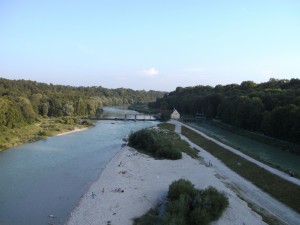 Yesterday, we decided on a bike tour in small formation: Barbara, my small daughter Maresa, and yours truly. We rode to the Wawi (forest restaurant).
The WAwi is a beer garden with music entertainment in Grosshesselohe, on the high Isar shore. As long as I can remember, there has always been beautiful music played there – Jazz, Blues and sentimental songs.
I enjoy going there, listening to the music, taking in the good mood all around and relishing the beautiful way along the Perlacher Forst. Getting there from the east (from my home in Riemerling), you cross the Grosshesseloher Bridge. The view from there alone is rewarding enough to make the trip worth while.
Roland, you did it.
Now you are in the media.
Here is the reaction of GRÜNSIX to your latest article.
Today, young people love luxury.
They have no manners.
They despise authority.
They do not respect their elders.
They discuss endlessly where they should work.
They contradict their parents
and tyrannize their teachers.
That is what Socrates said.
2,500 years ago.
Now I wonder:
If young people were always
as evil as this,
how come we have
so many nice older people?
KJG/SIX
(translated by EG)
Roland DürreThursday August 6th, 2009
The Game of Life, Parlour Games, the Royal Game, Education …
 Parlour games are “en vogue”. There are new ones all the time, and each year one game is awarded the title “game of the year”.
When I was a child, we played “aggravation or frustration”, “nine men’s morns”, “checkers”, “Chinese checkers” and chess. There were also really stupid board games (car and horse races) with really nice figures but they were so boring that we only ever played them once.
And we had the classics, such as monopoly, later risk or clue. Those are really emotional games, requiring stamina and patience, sometimes even combinatory talent. Then came the huge inflation by entertainment games. I opted out and refused to play those new games.
Klaus-Jürgen GrünWednesday August 5th, 2009
Kopf oder Bauch
 People working in the business sector usually claim that their decisions are based on rationality. Almost everybody makes business decision every day. Although it has been emphasized by numerous economists of the 20th century – if not earlier – that a decision culture based exclusively on rationality has a limited potential, it is still considered “polite” to give rational reasons for your decisions.
The latest crises in global financial business seem to prove the economical theories developed since the 20th century. To be sure, complex systems can be described rationally, but when far-reaching decisions have to be made, rationality is apparently only of minor importance. The course of the current crisis in particular shows almost in a “student model” way how decision processes work. The real cause has less to do with reasons consciously given and much more with emotions like fear, striving for power, and avoiding shame.
If we assume that it was based on rationality, the question must be asked if it could not all have been prevented before it happened, or else: why is it apparently so difficult to get the crisis under control now?
Roland DürreTuesday August 4th, 2009
“What You See is NOT what you get (WYSInWYG)!” or “China at Home?”
 Yesterday, we had a nice visitor from China at InterFace. A German manager I am friends with is currently staying in China for a program sponsored by the EU and China, where she is also enthusiastically learning Chinese. We went to have lunch with her in Unterhaching’s “small Italian” restaurant and there she told us many interesting stories.
Among other things, we heard that much looks great and promising in China at first sight, but usually falls far short at close inspection. It starts with accommodations and continues practically through all products. It is all one huge sham.
Then I thought: what is it like at home? I am afraid we are not much better, either.
mehr »


