
Roland DürreWednesday June 24th, 2009
Should a List of Recipients of Agricultural Subsidies be Published?
Why is the Bavarian Government against publishing who are the recipients of agricultural subsidies? The legal situation seems pretty clear. There is, after all, a leading decision. Besides, the distribution of the money is in the public interest. Also, the European Union take a rather high penalty fine in case of non-publication (a fine which, eventually, the tax payers would have to pay).
Roland Dürre
Our Poll on the Economical Crisis Is Finished!
There are many people who are fed up with the world-wide economic crisis. So are we. That is why we close down our poll on the matter.
Here are the results:
How do you feel about the world-wide economic crisis?
– It can be solved with acceptable effort (54,0%, 20 Votes)
– By this summer, nobody will remember (24,0%, 9 Votes)
– It should be hard to overcome (8,0%, 3 Votes)
– Everything will go from bad to worse (0,0%, 0 Votes)
Total Voters: 37
What is it we learn from this small poll? First and foremost, only few people participated. What a pity. Secondly, nobody believes that everything will go from bad to worse. That is very positive. Also, less than ten per cent of the voters believe that the crisis will be hard to overcome.
A quarter of our readers think that by this summer, nobody will remember. Well, now we are into summer, which means that these readers are not (yet) entirely correct. On the other hand, the IFO-Index for the economic climate has improved for three months in a row!
Now we would like the answer to another question: “What will happen after the federal elections?” Will the great wave of lay-offs begin, because all the big firms have refrained from sacking people out of consideration for federal chancellor Merkel? And what do you think will happen to taxes and retirement money?
Starting now, we conduct a new poll! Your opinion is really wanted here! Thank you so much for joining us and giving your vote!
RMD
(translated by EG) mehr »
Klaus-Jürgen Grün
Know Yourself!
During the last 2,500 years, almost everybody took a liking to the great Socratian proverb: “Know Yourself”. It is like you are encouraged to free yourself by the act of thinking. But why is it that people, even if they are impressed by the proverb and prepared to bend their knees before it, only do so as an exception from the rule? If it were easy to do what the proverb demands, then it would have vanished from our brains a long time ago.
“Know Yourself!” is a moral imperative that has to be permanently repeated because people would not come up with the idea by themselves. Knowing yourself is not what comes naturally when you think. It is actually the opposite. Thinking is basically about defending against ideas that would be insufferable for individuals or groups. Knowing oneself is probably the highest degree of insufferableness.
“Much is monstrous, nothing is more monstrous than man”, is one of the basic verses in the entry-choir of “Antigone” by Sophocles. For humans who wish to see themselves as images of God, loved by God, and ethical beings transporting human rights to the deepest corners of the universe, this is a pathological contradiction.
As soon as, therefore, knowing yourself means you have to accept the monstrosity inside the human being, you no longer perceive it as self-knowledge. Self-awareness will automatically meet with resistance as soon as a certain fear appears at the horizon, namely the fear that you will have to understand yourself more as your projection of the devil than as something created by the beloved God you had conceived as so very similar to yourself.
The imperative demand “Know Yourself” is offensive for human narcissism. Living up to the mandate as formulated in the proverb is only possible to the extent you can cope with the fear of your own (sexual) drive. Humans prefer issues received from far away: perception of God and the beginnings of the world, perception of an after-life, perception of paradise and the end of the world. But man does not at all like the perception of what is nearest and dearest to him. He is afraid of the truth.
Our perception of what is good, ethical or moral would probably be totally different if we were better able to withstand the perception of the monstrous. Sophocles showed us the abyss we would find inside ourselves if we had the courage to know ourselves:
“Birds that fly happily,
He catches them to kill.
Wild animals of all species, too,
Even what breeds in the salty sea,
He catches with plaited nets.
Clever, prudent man, he conquers
With art and cunning
Whatever flew free or climbed mountains.
He puts the joke around the shaggy horse
And around the stubborn mountain goat.”
(Antigone)
Sophocles needed no imperative. And today, too, only all those many people who think of themselves as having already delivered enough of what was demanded need imperatives. They believe that all that remains for them to do is encourage others. But even if the others start knowing themselves, this must not end in them perceiving the monstrous, and if they do, they will be subjected to contempt.
The request “Know Yourself” looks upon humans as they are. However, people find it easier to discuss how they should be. Because then we see our beautiful concepts of ourselves, rather than our actual selves. Much in the world is monstrous, but nothing is as monstrous as man, is what Sophocles says. But who is interested in this kind of self-perception?
KJG
(translated by EG) mehr »
Roland Dürre
When to Buy Domestic Fuel? Good Advice by an Insider! Or “Domestic Fuel in Agriculture”
 For some time now, the price for domestic fuel has been rising. There is a very informative graphic representation of this process by tecson.
Unfortunately, my family still depends on domestic fuel for warmth. Since our house is quite big (and the “children” often take showers), we need plenty.
Besides, this June is rather cold. So I have to remember to buy domestic fuel. If you buy domestic fuel at the right time, you can save a lot of money. After all, over the last three years, prices have varied between almost a Euro and less than 50 cents.
By accident, I meet the man who always delivers my domestic fuel on one of his delivery rounds. Since he has been delivering domestic fuel for 40 years, he is the one who should know. So I ask his advice.
Well, he cannot really help me. However, he thinks that very late in autumn, after the corn has been reaped and dried, should be a good time. Most of the private containers are full by that time and the great demand of domestic fuel by the farmers is over. Consequently, there would usually be a market surplus and prices should drop.
I am rather surprised as I ask: “Are you telling me that the farmers dry their corn with domestic fuel?”. “Yes”, he replies. He always has to work overtime after the corn has been reaped, because “that is the time when really a lot of domestic fuel is needed. And after that, there is always a decrease of demand, little work and lower prices. “
Well, I have to say that came as a surprise to me. When I was a child, I sometimes helped on a farm. All the crops were dried along with the hay in the sun. We loaded the dry straw and hay on the trailer, where it was piled up high and smelled delicious.
To me, that looks like a use of solar energy that makes sense. And now we grow corn. Corn is not healthy for the soil. Then we spray chemistry over it and finally we dry it with oil. And all that just because business profits are (or may be) a few extra cent per square metre. In a way, that sounds like ecological nonsense to me. I believe saving energy should start on the field.
Now I hope that the corn will not end up at the petrol station as biological fuel. But no! After all, I learned that the “regenerative material” for biological fuel comes from Africa.
RMD
(translated by EG) mehr »
Roland DürreTuesday June 23rd, 2009
“What About Long Hours?” or “Work Time and Leisure Time”
 As we all know, discussing the wage of an employee also means discussing the overtime issue. Are you entitled to extra payment for long hours, or are they already included in the generous wages? What about an extra bonus?
These days, this is no longer so easy. Who can really distinguish between work time and private time?
Many people answer their emails around the clock (except when they sleep). A distinction between private and business mails is no longer made.
When is reading a textbook advanced training, when leisure time? What about trips? And what about the time we spend in our cars, in trains, or at the airport?
There is a rule for everything. But do they really help?
Roland DürreMonday June 22nd, 2009
We All Deserve More Than We Earn – on Salaries, Wages and Justice
The Dough is What Counts!
or
We all deserve more than we earn.
 Many employees think they should be earning more than they do. At the same time, their bosses believe the employee’s wages are too high already. Both can easily be justified. There is no truth when it comes to income and wages.
Fair income is not possible. Performance fairness remains utopian.
Why does a hard-working cleaning lady earn less than a glamorous manager?
The criterion of value improvement achieved by a person, too, is not easily applicable. The spotless toilet is definitely the direct result of the cleaning lady’s work.
The director as figurehead!
It is a little harder when it comes to the managing director. What exactly is due to the highest manager if the enterprise can show an excellent balance? To what extent does he benefit from the prevailing position of the company and the current market situation?
During his years in office, how can a director actually influence an enterprise? When do changes start to have an effect? Maybe he is just the face and representative of the company? Does this justify the exorbitant salary, given that the success has many fathers, including chance?
Director and cleaning lady are the examples at the opposing ends of the scale.
For “normal workers”, it is also everything but easy to find a “fair price”. And it must be said that agreeing on a suitable wage is an important requirement for people to feel comfortable with their job.
The personnel departments in big companies try to evaluate achievement fairly. They use the most sophisticated and delicate methods for measuring and evaluating achievement. Artfully designed goal agreements and manuals for goal achievement discussions are generated. More often than not, the superior employees have to do some prudent moderating; otherwise the whole structure might collapse when put to the practice test.
A prudent wage policy should also contain the factor of justice in terms of need. – Which poses new questions immediately.
Many people work only for the money.
There are people who “sale” the product of their hands and brains. The income is a compensation for lost time and autonomy. It becomes smart money for suffered heteronymous control.
Monday to Friday, they slave away, weekends they live.
Money gets to be the extrinsic motivation. This is contrary to an enlightened concept of humanity. We spend a lot of time in our lives at work. That is why it is important for our work to make sense for us and have a fun aspect, as well. And that we can also build up our strength to a significant extent from intrinsic motivation!
RMD
P.S
.
That is why we, at InterFace, also like employing people who are not altogether “streamlined”.
(Translated by EG) mehr »
Roland DürreSunday June 21st, 2009
BRD – Party Oligarchy and Whip System? A Criticism of Our Political Scenery.
 During the last years of his life (in the late 1960ies), the German psychologist and philosopher Karl Jaspers – who then became a Swiss citizen – concerned himself with the future of the Federal Republic of Germany.
In his last two books, he writes that the German democracy might well turn into a party oligarchy. This scenario gave him pause. I read a very interesting article of February 1983 by Rolf Hochhuth on this in the Zeit.
Politicians earn pitifully little.
Our Federal Chancellor leads Germany.
Which is an enterprise with 80 million people.
She earns 180,000 Euros per year.
The managing director
of a company
with 80,000 employees
gets 75 times as much.
The consequence:
There are only two kinds of candidates left
who apply for the job:
Idealists.
And losers.
Well, we can cope with some idealists.
But not with that many losers.
So we should not talk so poorly about our politicians.
Instead, of paying them better.
KJG/SIX
(translated by EG)
Detlev SixSaturday June 20th, 2009
What is Worth More? The Job of an Opel Employee or the Job of a Karstadt Salesperson?
In my article “What is it the People Want?”, I gave the answer to this question from the buyer’s perspective. The result was: both have the same pitifully small value. Now I will introduce the perspective of the political decision-makers.
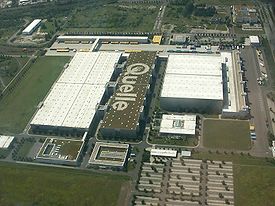 Until recently, our federal chancellor and the Great Coalition wanted to save the entire economy. Then some polls showed that apparently the majority of the citizens are not in favour of saving enterprises that have financial problems using the taxpayers’ money.
Our federal chancellor was quick to react – now she no longer saves companies in distress. The first company to fall victim to this new strategy was Arcandor. The great mail-order company Quelle in Fürth, an Arcandor daughter and for me one of the great symbols of the economic miracle, threatens to go under. Incidentally, the beautiful picture of the Quelle building is from Wikipedia.
Now the Bavarian state government wants to save Quelle GmbH through a guarantee of payment to the tune of 20 million Euros. The state of Saxonia wants to contribute 5 million Euros. Along with an extended federal guarantee (what exactly is that?), the total guarantee should be 50 million Euros for Quelle. However, in the same news report it says that Quelle will need another three-digit million Euros in order to survive. That does not inspire too much confidence in me.


