
Roland DürreWednesday January 22nd, 2014
The Secret of Wise Decisions…
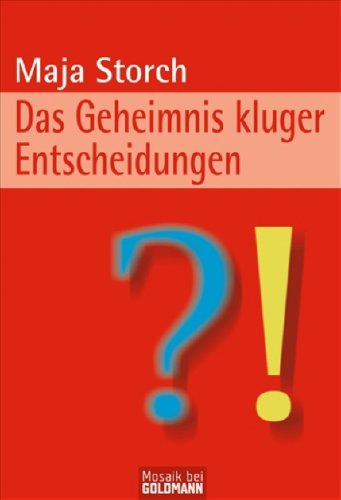 This small book is only one of many on “decisions”. It helped me to understand myself a little better. After all, I was frequently a huge riddle to myself. And I often did not understand why I felt so uncomfortable with “rational” decisions.
Many strategic meetings where seemingly rational varieties of scenarios were presented, analysed and then again discarded were something I hated. I often suffered during these meetings, because they seemed totally useless to me.
With all these deliberations and doubts, I never knew if I was coming or going at the end of these long and strenuous meetings. I became unable to make decisions and felt paralyzed. Even though before the exercise, all had been rather clear, nothing was clear afterwards.
Occasionally in my life, I also thought I had to free myself from my “gut decisions” and follow “ratio”. After all, a “good manager” makes himself independent from feelings and instead follows ratio! In all those cases, it turned out to have been a huge mistake.
Books like this one will not prevent us humans from falling victim to the ratio trap. But at least they explain why this is totally normal. And that my feeling bad was totally justified. It is not me who is crazy when I am struggling against ratio. Instead, it is all those “ratio-persons” who make life hard for themselves.
The special thing about this book is that Maja Storch feeds us this rather high-standard food in a very easily understandable way and with lots of humour. You can actually read this book like an entertaining who-done-it.
Thanks to reading this, I was again capable of coming to terms with my “strange” managerial style a little. And I am glad to know that my method was not all that bad. Instead, it is in accordance with how humans basically function. Now I know that the strict (self) criticism against my usual decision-making process of my rational super-ego was wrong. And consequently, I am now again a little more content.
Here is the Amazon “affiliate link”.
RMD
Roland DürreMonday January 13th, 2014
“Love it, change it or leave it”
What a nice sentence! Consequently, I put it at the end of my next to last Post. As a recommendation how you could deal with annoying developments in your enterprise.
I rather like the sentence. The same is true for this recommendation:
“Cook it, boil it, peel it or forget it!” or, slightly changed “Cook it, peal it or leave it!”,
which is a recommendation you should strictly adhere to when visiting tropical countries when it comes to eating and if you want to stay healthy
“Love it, change it or leave it”,
however, sounds a little too menacing for my taste. Consequently, I would like to take the sting out of it a little bit. In this context, “love” does not mean the heated and ardent love of a fan for his club which will easily switch from total exultation to great despair. No: what it means in this context is the “mature, well-pondered preference” of a social system you can identify with even after having discovered its advantages and disadvantages.
“Change” does not call for the radical element of a revolution. Instead, it means the process of change or improvement which can also happen in small steps and be very valuable.
Only “leave” is digital. If you clearly feel it cannot go on in this way, then you should come to a decision and, if necessary, even say farewell.
RMD
(Translated by EG)
Roland DürreFriday January 10th, 2014
Self-Doubt – Comment on the “New Tools” of Management
The article of our “anonymous guest author” on tools of the new economy (Werkzeuge der Neuen Ökonomie) moved me deeply. After all, it described in a very illustrative way how an “owner-controlled” enterprise became a “shareholder value-oriented” enterprise, as can often be witnessed.
And it showed us quite clearly how you can get the impression that laws of reason and of sensible understanding have been violated and replaced by a system of dogmatic structures of mechanical and deterministic thinking. This is a story that is just too well-known and common – which basically always ends detrimental for all parties concerned.
My first reaction was to spontaneously regret this development and to call it evil. Are we not witnessing how good management technologies are replaced by bad ones? Is it not a pity that a people-centred system becomes a systemic system?
However, my second reaction was that, perhaps, we should not judge and, above all, not over-estimate this kind of development. Is there any reason at all for a “human-oriented” enterprise to live longer than, for example, its founder?
Is it not logical that social systems founded and created by mortal beings should be just as mortal as those who made them? And maybe this dogmatic mechanisation of a social system with an economic purpose – also called “enterprise” – is just the perhaps even evolutionary attempt to prolong the life of the hitherto founder- or family-oriented enterprise considerably, quasi artificially? To be sure, there is a high price to pay for it.
Perhaps it is totally normal for enterprises to die or be swallowed by other structures after a few generations of humans and enterprises? Because enterprises, too, like all living organisms, have a beginning (birth) and an end (death)?
Consequently, it might be possible that enterprises can only be dogmatically or mechanistically/deterministically controlled after having reached a certain volume or a certain age? Maybe after a certain time span, every enterprise will have to face that decisive moment from which onwards you have to either become dogmatic like the big ones, or else be swallowed by a big one – or die?
Personally, I know only very few firms that, over more than seven generations and, for instance, in the seventh generation, managed to remain both successful and still a nice medium-sized company. Most of them went bankrupt long before or have been swallowed up. Mind you, being swallowed up always means a lot of the old enterprise dies, while only little is preserved.
And perhaps a social system can basically only survive for more than a few generations if it becomes independent and de-personalized and if it develops strict dogmata as behaviour-oriented values? And if it then moves with all the power and strength it has gathered through history?
Perhaps an enterprise actually has to make its own survival the superior goal of its existence in order to survive long. Even if such social systems will quasi inevitably end up creating a fascistoid situation?
However, the result of my deliberations is something else:
It is always a pity if a biophile, democratic, self-organized and self-determined social system dies or mutates into a mechanistic and deterministic system. To be sure, the latter alternative might actually prolong the life-span of the enterprise, but it is not beneficial for the stakeholders of the enterprise. And there will come a day when it will finally die from its own inflexibility.
Under this light, it makes sense to oppose the de-personalization and economization of processes in the enterprises and to try and preserve the pro-human attitude in these social systems. Consequently, as I see it, enterprises should also try to avoid making their own survival the dominant (self-) purpose of their existence as long as possible. After all, it is their main purpose to serve the people they sell their services and/or products to, isn’t it?
How does our famous proverb say:
“Better a miserable end than endless misery.”
or
“You should finish on a high note”.
But then, this would mean to change the “old” system and make something new out of it as long as this is possible, i.e. as long as the old ways have not yet become independent. Because when that happens, it is probably too late.
Consequently:
“Love it, change it or leave it!”
RMD
(Translated by EG)
P.S.
I was privileged enough to actually meet Augustinus Heinrich Graf Henckel von Donnersmarck in person a few times. Like Rupert Lay, the Premonstratensian canon was a famous management coach and consultant for top-echelon German industry in the second half of the last century. I learned to identify both of them as the persons who introduced the term “ethics” in management.
Augustinus was a great orator who enjoyed humorously calling himself a church “lobbyist”. With equal delight, he kept reminding his audience that his enterprise, after all, had already survived almost 2,000 years – and that he knew no other enterprise that had survived as long.
If you look at it cynically, the humorous comment of this great church man might actually prove that dogmata and rigidity are important for the longevity of a social system. Even if the founder of the enterprise himself had a totally different concept of the entire matter. But then, the enterprise “church” certainly has a very special product on offer……
Roland DürreSaturday January 4th, 2014
Tools of the New Economy
Here is a guest article. At the moment, I prefer not to give you the name of the author, because this article might be detrimental to him.
Review, Moments and Retrospections.
I cannot offer a piece based on scientific research, but I can report what I experienced during my professional career.
Change is what characterizes an economic system and in the Federal Republic of Germany, said changes started in 1967 without anybody noticing. That was when the constant economic growth first suffered a temporary standstill. To be sure, the prevailing model of a free economy of western European design was not yet revolutionized, nor did that happen during the following crude oil shock experiences of the years 1973 and 1983.
The ”Deutschland AG“ with its charismatic leaders remained intact until the “Wende”. Up until early in 1990, the founding fathers of the post-war middle classes remained on their seats. After that, the beginning globalization of a single economic model rang the bells for change. This new economic model is better known as “New Economy“, others also call is neo-liberalism. An ideological basis for the “New Economy“ model was probably laid by Milton Fridman with his ”Chicago Boys“.
The ’Share Holder Value’ gained pride of place. Classic value creations and production processes apparently were too boring and had to be optimized. If a concern totalled less than >10, the performance was considered poor. If the expectation of the ’Share Holder Value’ are not met, you move on to become a managing director of the enterprise.
The value of the leaders is measured by their “Performance“ and the cost-effectiveness of the next result. After all, a high profit was promised to the shareholders in the portfolio.
Consequently, the stars of the “New Economy“ change between enterprises. Even totally different sectors were no reason not to go there: you move from insurance to electronic engineering, from media concerns to a discount chain, etc. – there is no shortage of examples.
How can this work?
In order to make an enterprise transparent for the stock market, you need special tools. “Controlling” is very important if you want to quickly determine the “shareholder value”, the equity price and the dividend.
This development also explains why SAP was such a success. Offering the necessary tools with a universal product, the programmer makes it possible to have transparency, process monitoring and control.
Let me be fair and add that these tools actually make it possible for concerns to have short-term financial success. Whether or not, however, said success is sustainable remains to be seen.
It is a fact that this “Business Model“ is now established. “Business Schools“, along with the media and all those enterprise counsellors that sprouted with the rise of the “New Economy“ preach the rules of the “New Economy“ in their seminars and activities right on location.
Model 1 – Retrospection
In all my life, I only wrote two letters of application: the first was when I applied for an apprenticeship and the second was when I wanted to terminate my career as a sailor and start working on the dockyard.
All the other jobs were coincidental.
Today, I preside over one branch of a German medium-sized enterprise. We sell technologically high-quality solutions that require some explanation. It is typical for this family enterprise that we started branching out on a world-wide scale early on and thus contributed to the German export success story.
The then director of the firm – at the time there was only the one – asked me on a workshop if, since I knew the market well and had all the technological qualities necessary due to working for one of his customers, I would be willing to establish a foreign branch.
My expected turnover was determined by none other than this director. Based on his observation of the market, he gave me a number he thought might be realistic.
It all happened without bureaucracy, quasi by handshake, as with all my foreign colleagues. Regardless of a total of 450 employees, we did not yet have a personnel department. All affairs pertaining to employees were processed by the accounting department and the head of finances.
Simultaneously, the head of finances handed me a simplified accounting plan which showed the monthly turnover, earnings, expenditure and profit. The director had a derogatory expression for this plan: ’ink piss’; yet the two gentlemen were friends. All the foreign managing directors reported back to the one director.
You can summarize it by saying we established a branch based on the understanding of the market and the director’s ’gut feeling’. He relied on his experience with humans when selecting his employee.
During twenty years of very successful leadership, he had collected his tools:
- Knowledge about products, because he promoted developments as required by the market.
- Knowledge about the production process, because problems were always discussed between himself, the chief constructor and the producers.
- Knowledge of the market, because his information came from many branches and he visited many fairs and, of course, he was involved with the major customers and the major projects.
This is no longer the case.
Model 2 – Today
Here is how a branch director is selected today:
- The company looks for an external ”Personal Consultant“.
- The typical tasks of the job are defined.
- A job description is written.
- The candidates are pre-selected by the ’Consultant’ and then the sales director decides.
- ’Human Resources’ will do the actual employing.
- A business plan is made.
- A budget for the next three years is determined.
- If there is no prior experience, the numbers will be based on machine engineering statistics.
- The work will be accompanied by a three-month ’Controlling’ phase. It documents the numbers for orders and turnover.
- Simultaneously, monthly balance sheets for the accounting department, the banks and the auditors are written.
For some of you, this list is probably not very much of a shock. Still, it makes clear that quite a few things have changed since I was first employed.
New tools were added to the old ones of my then-director, and the same is true for new leadership levels:
- Consulting
- HR = Human Resources
- Reporting
- Controlling
- R & D = Research & Development
- IT
- Marketing
Even the terminology is rather remarkable, isn’t it?
So what happened?
The medium-sized company was re-structured following the example of a modern, stock-market-oriented enterprise. Decisions that previously the owner himself or a long-serving director or the managing director made now have to follow a strict organizational pattern. They are newly distributed according to the rules and the tools of the “new economy”.
Those who now made the decisions had not grown up in the firm or the family. Instead, they came from outside and often had never worked in the field.
For them, it was not possible to rely on many years of experience in the sector and they could not rely on gut feeling. They depend on the “New Economy Tools“.
So why do we use these new tools?
All processes have to become transparent and predictable in order to make the planned results come to pass. If you cannot rely on your experience and your in-house competence, the process has to be controlled and monitored all the time. Consequently, the responsibility has to be distributed and ascertainable.
Are these tools suitable for medium-sized companies?
Not if we are talking technologically high-quality products that need explanation and are custom-made following individual specifications.
If all processes are pressed into a system and these processes are to be adhered to strictly, then there is no room for individual activities as sometimes desired by the customers.
This is absolutely deadly for someone whose expertise is on special applications.
The employees will capitulate before the technocracy. Everybody refuses to do it if something has to be done extremely fast, because “this is a sure way to get problems”. Employees have to justify why the pre-scribed path of process control was not followed. As a consequence, resignation will prevail – which can be measured by the increase of people calling in sick.
An automated controlling mechanism will inform the hierarchy about price fluctuations, process shortcuts, special bargains, etc. by email.
Result: even more frustration. Who wants to work in a company where every single movement of your hand is reported?
A universal operating program will automatically start as soon as the offer is written. It will accompany the construction, processing, purchasing and production and it increased the reaction times for the sales considerably, since the ’system’ will only work when all the required data have been entered.
So what worries me?
What I experience seems to prove that my worries were justified:
- Regardless of control, all products will naturally fatigue, which means that they reach a mature industrial age and can no longer be optimized as far as the costs are concerned – except maybe if you look for a radical solution such as outsourcing the production into a low-wage country. Your only chance to lower costs is to continue developing and come up with new ideas.
- If someone is not familiar with the sector, he or she will not be able to install new ideas from the market. Instead, he or she will always rely on management tools, following the book.
- Since all responsibility is distributed, the actual responsibility for your own decision is no longer yours, either!
But I am afraid there is no “going back”.
Results
Using the new tools does not give medium-sized companies any advantages.
Process control is only efficient for efficient production, not for sales and development.
With this approach, the traditional strength of medium-sized companies, i.e. the quick and flexible innovative power which will always smoothly adapts to the market, will no longer be a factor.
What medium-sized companies need is leadership personalities who have grown up in a special field, or else have been recommended by their customers or suppliers, thus being competent on all levels of sales, the enterprise and the customers.
A constant flow of verbal communication must be possible, not some sort of communication created by workshops, leadership circles, Kick-off-meetings, but initiated spontaneously – why not over a glass of beer?
As I see it, creativity is not something you can switch on or off and good ideas will not wait until you next can offer a time slot for meeting or after the vacation.
We actually have these sorts of leadership personalities and I often met them in my professional life. It meant that I was able to collect experience and was always willing to give my best for success.
Dogma criticism
- Who was it that laughed about the five-year plans of the communist ”COMECON“ before the Iron Curtain fell?
- Did the five-year plans work?
- To be sure, the planning was fine, but it was never good enough to prevent shortages or for the country to become a leader in product development.
- The Western European countries felt superior to the planned economy model?
Now we started on a similar path by using the tools of the financial world in order to control even the smallest companies with the „New Economy Tools“. We no longer call it planned economy, but ”Business Plan“ or ”Budget“ or ”Quarterly Reporting“.
Now I write detailed three-year plans.
The fact that they are all result-oriented is detrimental for their sustainability. Incidentally, we copied the language of the ideologists along with the New Economy.
Iktaqw
(I know the author quite well)
(Translated by EG)
Roland DürreThursday December 26th, 2013
About the Uselessness of Projects …
Many years (decades) ago, a well-loved colleague of mine (in those days he was still some kind of “construction chief/department head”) defined the new term “project” in an introductory presentation on the topic “Project Management” as follows:
“Every project has a beginning and an end. The goal is precisely defined. It is the task to reach the desired goal exactly in the frame defined for “time and material.”
In those days, nobody called anything or anyone “project” or “project manager”. There were tasks and duties we had to fulfil and functions we had to build. We were developers in a team playing various roles in one person: planner, architect, tester, programmer and manual writer.
I was fascinated by the new term “project”. This was not just because I am easily inflammable, but also because it does sound reasonable, doesn’t it? Today, I no longer agree. Take for example my life. According to the aforementioned definition, it is also a project, isn’t it? My birth is the starting point. And there is a clearly defined end: my death. Basically, I entered this world in order to leave it again.
So what is the goal of my project “life”? It cannot be the end of my life, my death, can it? The only goal imaginable is to give meaning to my life – that is the time between my birth and my death. But what meaning?
As I see it, the meaning of my life is to do the right thing most often and to not do the wrong thing.
Isn’t more or less the same true for entrepreneurs? Or even countries and other social systems?
As a general rule, social systems are just temporary constructs. They develop, change and disappear again. Most of the enterprises I saw in my sector had a life span that was considerably shorter than a human life should be.
I only know very few enterprises that survived several generations. And now they are the ones who are most seriously in danger of dying, because they can or will (?) not adapt to the changes to the necessary degree. The only social system I can think of that has survived longer (two millennia) is the Catholic Church. Well, it sells a special product: belief. However, I can easily imagine that here, too, the success story will at some time in the future come to an end. Without humanity being extinguished.
Projects happen in social systems.
The sum of all projects will be swallowed by the evolution of a social system. They can be either part of a continuous improvement, or part of a downward spiral. In order to reduce complexity, the projects of a social system are separated from the context of the entire system. This seems to make it easier. However, due to the isolation, it causes the reaction time to changes in the system to increase.
So what is the consequence? We have to behave “sensibly” as far as our possibilities and frameworks in our real environment allow it. This is where projects are sub-optimal, because they limit you to a pre-defined combination of situation and goal, often totally randomly set.
This means we have to open and improve our perspective and learn to distinguish between what is good and what is evil. It is the only way for us to orientate ourselves in a reality we are confronted with both internally and externally in the system. This is a general truth applying to all humans who are willing to take responsibility in an enterprise or social system. I mean humans who actually want to change and shape the future.
Well, if you look upon it in this way, the projects lead us astray. Life is not about defining a goal and then reaching it. Actual goals and projects always need to be questioned. For instance, it can be a good project result if a project is terminated. To put it plainly: “You do not want to throw good money after bad”. Well, this is only an example.
Instead, what we should do is approach the future iteratively. We should experiment with creativity and fantasy. We should try things, take mistakes as experiences and try again. Because, basically, we cannot plan or mechanically control the world and our social systems.
This is what the suddenly appearing and then radically utilized use of fossil energy in the 19th and 20th centuries suggested. Which led towards the belief that humans are omnipotent and all problems can be solved mechanically. Technology and planning became the belief of the future.
We now live in the 21st century. The last millennium is definitely over. Our dream of using energy at will and for free and without negative consequences for our biosphere is over. To be sure, the mechanists and technologists among us still dream of an endless source of energy at zero cost, but even if – against expectations – such a scenario should come to be, there is no way back to the dream world of past times.
Consequently, we have to radically question all our prejudices and dogmata, along with our habits and what we consider self-evident. We have to try to draw prudent and correct conclusions from these questions. This process might be extremely painful. A lot of courage and greatness will be necessary in order to manage the necessary “turn over” and to integrate ourselves into the already beginning transformation in a halfway acceptable way. In the world, in our society, in our enterprises, in our projects and in our lives.
RMD
(Translated by EG)
P.S.
A short time ago, I published an article that is a little more “down to earth” in Change in Management (Wandel im Management).
Roland DürreTuesday December 24th, 2013
Enmity and Distrust
The older I get and the more I learn, the more I realize that enmity is the major reason for failure and grumpiness. Unfortunately, enmity keeps creeping up from even the smallest cracks of human life. And mostly it is totally unnecessary.
Like hatred, enmity is a parodoxon (Parodoxon). One person hates another person and wants to destroy him. Yet, the hated person remains unscathed, while the person who hates is destroyed. This means that a person who hates someone will always first and foremost destroy himself. And the person who was hated can laugh. …
The same is true for enmity. You are annoyed about something or someone. And you want to find a way of showing this to your environment. Perhaps it happens totally subconsciously – you just want to tell someone about what annoys you. This is how you grow enmity towards others and yet the one person you harm most is yourself.
Fear is the mother of enmity. It nourishes enmity and its siblings. The big sister of enmity is distrust, the small brother is sadness. Sadness, like grief, sorrow, balefulness and heartaches are the opposite of joy. They will destroy joy and lead towards frustration. Which is the enemy of success and contentedness. Thus, fear destroys courage and without courage there is no joy.
The opposite of enmity is philanthropy. You will succeed best if you learn to distinguish between good and evil and if you do the right thing more often than the wrong thing.
To be sure, you must avoid looking at others and succumbing to “but this is how everybody does it”. You have to question your own prejudices and your decisions have to follow your goals in life. This also means that you must not act because of some unimportant context or for reasons of wrongly interpreted considerateness.
And above all: trust must be your “default value”. This is the only way to overcome your own lack of courage and the fear that will always linger in the back of your mind. Fear, distrust and enmity will kill us. But we should kill what kills us. Consequently, we have to make anti-fear, anti-distrust and anti-enmity our tools and practice courage, trust and joy. Because those are the simplest keys to success …
Incidentally, this has nothing to do with “being a good person”. No: “being good” is egotistical. After all, this is about making yourself a success. Only if you are a success yourself, you can also make others a success. Only if we feel well, we can do well by others. And we should only safe the world if we think of ourselves. After all, we are a part of the world that is not insignificant to us.
RMD
(Translated by EG)
Roland DürreSunday December 22nd, 2013
brand eins in January (2014)
Yesterday, I found it in my letter box: the new “brand eins”. A nice message for 2014 reached me.
Think New! With the focus on: Originality.
 Thinking New,
I rather like that!
The same is true for the first few sentences in the editorial by Frau Fischer. Here is a citation:
“The publication of the coalition agreement finally made it clear for everybody: we will have to find our way into the future by ourselves. This compendium of rules and prohibitions lacks courage and literally asks the mature citizen to fight for his own free space, conquer new territory and decide what he wants to accept and what not. And it seems that the current constellation does not make any difference, anyway: politics lost the ability to dream and the best it is prepared to do is administer”
So far the words of Frau Fischer. Incidentally, I share her opinion and would add to it:
“How can you expect politics to dream when even the parties have given up on actively forming a social consensus for change and the future? If all we want is administration, then we need no politics – a more or less adequate administrative sector will do the job quite fine, thank you very much.”
Frau Fischer continues as follows: “Mind you, I do not mean this to sound like I was giving up at all.”
Here, too, I agree with her. After all, I have believed for a long time that it is rather irrelevant what politics do, talk, regulate and forbid, subsidize or put taxes on. The course of events will remain unmoved by it and the evolution will follow its own laws. For instance, if we will still burn brown coal in Germany in the future will not be decided by politicians. The only thing they will decide is how much of it is subsidized. The developments continue and all the clueless politicians can do is ask with Loriot:“But where are they going in such a hurry?”. And the politicians can look on and deliver their Sunday speeches.
Frau Fischer’s words remind me of the slogan “Define Yourself New!” by Michel Serres in his current booklet “A Declaration of Love for the Network Generation”. Incidentally, I think this book, too, is extremely worth reading.
About the magazine.
For a change, the adverts I shake out of the magazine are interesting. First, a very attractive flyer of mymuesli sails to the ground. Mymuesli now has a new target market : enterprises! “New Müsli for German Enterprises” is the slogan. In my opinion, the gadgets are horrible. Yet, the brochure is really and truly ingenious – congratulations to the marketing enterprise. To this day, the purpose of mymuesli has remained hidden to me. In fact, I would rather like to see the mymuesli balance sheet. It probably looks more like beetroot than oatmeal. But perhaps the creativity and power of duration of the founders, as well as their excellent marketing, will be rewarded with a “lucky exit”. After all, it is not a bad life you can live if you have a few million Euros on your bank account.
Apart from my-muesli, another well-designed brochure of Metaplan is striking. Metaplan has now existed for more than 40 years. As long as thirty years ago, when we founded InterFace AG, I used the colourful cards and foldable Metaplan tables. Even good old Habermas is used in this brochure (ethical discourse, etc).
Another brochure also looks special. It is from the “NÜRNBERG ACADEMY for distributive trade”. With the great slogan education needs curiosity (?). And the sub-title is just as “ingenious”: Seek, learn, win.
I wonder how much time they spent brainstorming before they came up with it. Or rather, how long their marketing service did it. Well, nothing wrong with trying, is there? We all want to find a way to acquire customers, don’t we? After all, it is no longer as easy as it used to be ….
Back to the magazine: after having at least freed it of the “mobile” adverts, I look at the “non-mobile” adverts. Many beautiful objects are made to look attractive, none of which I need (any more?). On top of wanting to make me buy great cars and beautiful watches, they suggest beautiful designs, solidarity and trustworthiness The high-tech and classical messages court me and, strangely enough, I find rather few erotic messages in “brand eins”. It seems that the rule “sex sells” does not apply here.
And since “brandeins” is apparently rather a success, each edition seems to contain a little more advertising. On top of the adverts, however, the content of the magazine also offers quite a bit of material. To start with, there is the “world of numbers”, which I always enjoy looking first. As always, the “focal point” is quite convincing. Everything has been researched with lots of love, is told beautifully and is served in a charming way. And almost all the articles either contain a positive message or else make you thoughtful.
So: if you are still looking for a present to put under the tree at Christmas Eve, I can recommend this “brand eins” edition. It is a true joker and will most likely differ from the Christmas consumption terror as a small present in an agreeable way. There are many persons who do not yet know “brand eins”, which might give them some extra pleasure at discovering something new. And when they read it, they will think well of the person who gave it to them for quite some time.
In other words – “brand eins” is a very efficient Christmas present and it might even help the readers to grow resilient.
And I will close this article with greetings to Frau Fischer and her wonderful team and my best wishes for a Happy Christmas, especially in the direction of “brand eins”.
RMD
(Translated by EG)
Roland DürreSunday December 15th, 2013
Entrepreneur’s Diary #93 – Efficiency Versus Resilience
Change and Transformation
As I see it, the technological and social developments of the last decades have caused a drastic change in our world. We actually live during a phase of turning of ages which will perhaps be as relevant as the beginning industrialization or the realization that the earth is in fact not a disc but rotates around the sun.
And this turning of ages is accompanied by a high degree of abrupt change. It is a change that concerns our private lives as much as our social and economic interactions. And especially those social systems that have an economic purpose –called enterprises – and are so very important for us humans are particularly affected by these changes.
For instance, I am reading things like more than half of the top thousand enterprises of this world are seriously in trouble and will perhaps disappear during the next few years. And since I witness quite a lot, I take this information rather seriously.
So what exactly did change? In the past, “being efficient” was the most important factor for success. To a huge extend, efficiency was supported by the massive use of fossil energies kept deliberately cheap. Yet, it also affected humans, causing an “economization” of our business and social procedures.
However, the age of efficiency is nearing its end. For many people, the continuing increase of efficiency caused an absurd “rat race situation”. Humans have literally been formatted by marketing (I am citing Michel Serres). Consequently, we humans en masse follow an allegedly forced target setting that tells us our happiness can only be generated through mass consumption and we make having as much luxury as possible our highest priority in life.
If that is not what you want, you have to change. If you want to survive change, you will – voluntarily or by force – have to undergo a transformation phase. And I am sure it will be more fun if it does not happen by force, but rather on purpose and proactively.
That is why companies that want to survive will have to develop more and more resilience. In Wikipedia, you will find a definition for common “Resilience” and for “Resilience in Management“. I find the metaphor of the “tilting doll” which will always right itself very attractive. Mind you, with this I certainly do not mean the American meaning of “weeble wobble but they won’t fall down”.
We need resilience, because efficiency alone will no longer suffice.
However, efficiency also meant that, for the producer, remaining competitive basically was guaranteed through “asking for a lower price”. “Asking for a lower price” is not helpful when it comes to sustainable survival. On the contrary: having to produce and deliver at less and less cost is a poor cycle. It is no fun and also makes us very replaceable. There will always be someone else who can offer it at an even lower price – you become replaceable and eventually you will be replaced. And this is how the basic rule develops: someone who is replaceable will be replaced.
We will gain resilience by opposing replaceability. The only way to do this is “being different”. And the transformation towards “becoming different” is necessary in order not to have to become cheaper. This will affect our service.
But how to know where exactly we need to be “different” in order to remain successful? This can certainly not be planned or even calculated! Consequently, we must try out the change. And trying out inevitably means that not everything we try will work. Which means that “trying out” will be an important investment into the future.
And it will only be successful through creativity, fantasy and passion.
RMD
(Translated by EG)
P.S.
For more articles of my entrepreneur’s diary, click here: Drehscheibe!
Roland DürreThursday December 5th, 2013
Men Wearing Dark Suits are Not Lateral Thinkers (?)
At the Nuremberg 2013 DOAG Conference from November, 19th to 21st, I was permitted to be part of the Podium Discussion (Podiums-Diskussion) after the keynote by Dr. Peter Kreuz on “Instigation to Lateral Thinking”. And I had lots of fun.
 However the podium turned into something a little lateral. Regardless of the fact that the program committee had – for good reasons as I see it – decided against a “Twitterwall” in the big lecture hall, the tweets on the event were always provided directly to the podium by a friendly and helpful lady (you will find the tweets on the hashtag #DOAG2013).
And at least the “twitterers” in the lecture hall were not at all happy about the fact that, when the topic “thinking laterally” was discussed, there were six (mostly elderly) gentlemen on the stage – all of them wearing dark suits, four of them wearing a tie and five of them wearing shirts (which made them “tweedy”). Mind you, I had opted against wearing my “DOAG-Speaker”-T-shirt, because I considered it lacking respectability. …
 Apparently, some of the audience concluded from the dress code displayed on the stage that the people sitting there were all but “lateral thinkers”. Consequently, I did not find it very hard to play my role on the stage. After all, I firmly believe that the first thing you should do is think.
And that these days thinking apparently is something that happens less and less often. And if you start thinking, I recommend you first think straight. Instead of first around far too many corners. If, however, thinking straight does not help, then, of course, you have to think laterally. Publicly and noisily. Not just secretly.
 In order to be accepted as a lateral thinker, it was necessary for me to point out my “barefoot-shoes”. On the first picture, you can see them quite well. I like wearing them on barcamps (as well as on anti- as well as proper conferences). After all, I want to enjoy days spent there, rather than suffer from uncomfortable shoes all day long (and often half the night, as well).
This is how I managed to make a few persons think less poorly about our discussion. Simply by demanding that things you get served should always be thoroughly questioned. Simply with the question that is typical for children and philosophers: “How do you know that?”. And if then you hear whatever source, you can still ask: “How do you know that what this source says is true?”
And if you remain insistent, the most rigorous prejudices will easily become nothing but dust.
I myself learned a lot during this discussion. And I also understood very well how all my fellow discussants achieved a lot in their respective organisations through lateral thinking.
RMD
(Translated by EG)
P.S.
The pictures were taken by Bischof & Broel (http://www.bischof-und-broel.de/)
Roland DürreMonday December 2nd, 2013
Entrepreneur’s Diary #92 – Good Advice/Bad Advice – Some Episodes
The “multiplication tables” and the “basics of management” are something you could call my hobby. Ever since I founded InterFace AG with Wolf Geldmacher (and even before), I always wondered what exactly is an enterprise. What is its potential meaning? What would be the correct mental concept of an entrepreneur? And what characterizes a good manager?
How can you continue your education in order to become a good manager? What competences can you actually learn and what personal talents do you have to develop in order to survive as a manager? So is it only natural to just ask some experienced managers and successful entrepreneurs you know and appreciate, isn’t it? Consequently, I always asked “managers” I looked up to: what can I do in order to become “better”?
One of them was Rudolf Jansche. At the time, he was an important business leader in the pharmaceutical sector in the Federal Republic of Germany. To me, his position seemed one that was unattainable for me and later he became both my teacher and friend. I asked Rudi:
Name a term which is particularly important for an entrepreneur or manager and/or for an enterprise!
After thinking about it for a short time, he said:
Clarity!
This answer convinced me. And the more I think about it, the more important the term “clarity” gets in this context. At an aside, I tried to define “clarity” (Klarheit) in Wikipedia, using a language game of leadership, management and business. In fact, I was fairly successful with my definition.
At the time – we are talking long ago – I also met another very prominent entrepreneur. His first name is Gerd. Gerd is a great person. He can motivate people, almost always manages to get them on his side and is very successful as a businessman. So I asked Gerd:
Can you recommend a book to me that might help me to become a good manager?
He took some time before answering. At long last, he recommended the “DAS BOSTON CONSULTING GROUP STRATEGIE-BUCH” (sub-title: “The most important management concepts in practice”). I bought the most current edition (that was the sixth edition of 1998, published by ECON) and was rather disappointed, because to me it looked like a series of platitudes. And then it even contained errors when it came to subject matters I knew something about – such as playing chess.
I told Gerd about my disappointment. His excuse was simple:
He had never read any books of the sort, but still wanted to recommend something to me. And he found the title promising.
This was a very long time ago. But somehow or other, not much changed until today.
RMD
(Translated by EG)
P.S.
The book is sitting in my office. I like to show it to people.
P.S.1
For more articles of me entrepreneurial diary, click here: Drehscheibe!


