
Roland DürreThursday December 1st, 2016
Digitalisation Today: “Automated Society” and Other Buzzwords
About stand-by-jobs, facilitation and driverless underground trains. And about Uli.
I short time ago, I was introduced to Ulrich Sendler. Uli is an “Independent technology analyst” and musician. He writes books (that are even translated into Chinese, where they are best-sellers), gives presentations (judging by what I saw of him, I assume his presentations are rather competent and entertaining) and he also works as a counsellor and moderator. When we met, he told me that he will soon be speaking in Gütersloh on the keynote topic: “Automated Society”. You order a service via internet and the delivery or service will be carried out automatically.
For me, “automated society” and “self-service society” are also “buzz words” often used when people characterize our “new digitalized society” in our “post-fact everyday life”.
These expressions immediately triggered a few association and ideas:
Technology is there to make life and work easier for humans. There is a nice and nowadays often used buzz word for this:
Facilitation!
In Wikipedia, you find the definition:
Facilitation is any activity that makes tasks for others easy, or tasks that are assisted.
In everyday life, this is responsible for the fact that work humans used to do is now easier because of technological advances. We might even end up having to do nothing at all.
Just think of Lufthansa pilots. Currently, they are often written about in the press because of their passionate attitude towards strikes. Your average poor pilot will only be allowed to actually become active for ten minutes of a long-distance flight, for instance to the Caribbean: when initiating and realizing the start and landing phases. He spends the rest of the time watching the plane fly. The poor pilot is not allowed to relieve his boredom by playing computer games. Presumably, alcohol is just as forbidden as visiting ladies – like stewardesses – in the cockpit. All that remains is boredom.
 In my vocabulary, these jobs are “stand-by-jobs”. Since I used to be a programmer, this would be like having to watch the computer programming itself and then being allowed five minutes to evaluate if the resulting program is what it should be. To me, such a job description sounds rather cruel. It is quite possible that such a stand-by job will cause depressions.
Two decades ago, there was a phase of about two weeks after I had switched to a new employer during which there was nothing to do for me. I sat in my office from morning to evening, was terribly bored and tried with all my might to do something meaningful. And the digits of the clock seemed to really, really creep.
Never again in my work-life was I as unhappy as then.
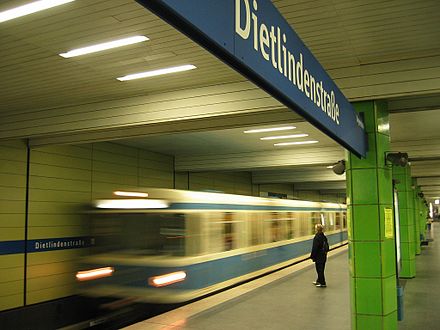
Munich Underground station Dietlindenstraße (U6) – by FloSch, under CC BY 2.5 published in Wikipedia (2005)
One of the systems the Stadtwerke München (SWM) supervise is the Munich Underground Network. The SWM are intelligent employers. They know that humans do not appreciate “stand-by-work”. Underground train drivers, too, have become “stand-by-workers”.
But the Stadtwerke want happy underground train drivers who are motivated to do their jobs. A short time ago, I learned that all underground train drivers have to exit at every station to control how full the train is. And after this has been done successfully, they have to signal that the train can continue. That is an important task.
This activity was introduced to make the platforms safer. Above all, however, it is a measure that serves the driver, because in this way his job gets more responsible and diverse, and he even gets a little exercise. That is good both for the body and the soul.
Except that in Nuremberg, the underground trains have been moving without a driver for many years now. And those in Lyon have been doing so for decades. And in both cases, the model seems to work quite fine, actually even better than with a driver.
May my readers come to their own conclusions.
RMD
(Translated by EG)
P.S.
Yesterday, I used the MVG Bus number 210 from Neuperlach Station to Ottobrunn, Jahnstrasse. The driver sat in his dark cabin and was rather isolated. All contact between vehicle and passengers was automated: the display and announcement of stops. The driver is reduced to being the one behind the wheel. He will stop the bus whenever he can see someone at the bus stop or if someone has pressed the button inside the bus. On this evening, I was lucky, because the driver drove very sensibly. He never accelerated too abruptly or stomped on the breaks with too much force. I found that rather agreeable. But there are also some drivers who really let their hair down. That is when you think a self-driven bus might have its advantages. Technologically speaking, I am sure it is already possible.
Roland DürreFriday November 4th, 2016
#Digitalisation – The “Ethics” of IT and “Artificial Intelligence”.
The Federal Minister of Transportation and Traffic, Alexander Dobrindt followed the mandate of the Federal Cabinet and his Chancellor and constituted an Ethics Commission . Among other things, it is supposed to clarify whose liability it is if an autonomous vehicle causes an accident – the driver’s or the manufacturer’s.
After all, it is quite possible that one of those crazy autonomous computers will cause an accident because they made the car speed! Who will then get the ticket – or even the complaint?
However, the ethics commission is also supposed to find out if there are ethical norms which the autonomous vehicle has to adhere to in conflict situations. The former Federal Constitutional judge Udo di Fabio will preside over the commission. The minister gave the “Wirtschaftswoche” an interview about it.
 Ever since my first seminar with Rupert Lay in the early 1980ies, ethics has been something that interested me very much. As I understand it, ethics is also concerned with moral dilemmas. One of the fundamental examples is the Trolley-Problem (Trolley-Problem).
Let me cite a Wikipedia Article:
Due to a wrong switch stand, a freight train is threatening to collide with a stationary train full of passengers. A worker discovers the threat and moves the switch in such a way that the freight train will end up on an auxiliary track where it runs into a group of maintenance workers, all of whom die. How accountable is the person who moved the switch?
Welzel is said to have asked this question in 1951. In the following years, up until today, many “mental experiments” of this or a similar nature were formulated. One of the most acute, at least one of those that impressed me most, is the following:
A doctor has ten patient waiting in his medical practice. Every one of them is at death’s door because one of his inner organs (a different one for each patient) is completely destroyed. In order to get well, they all need an “organ donation” immediately. But there is no chance that any organs will be available.
By chance, a healthy person enters the practice. He has all the organs the doctor would need in order to save all his patients. Should the doctor kill the man in order to save all the other ten?
Well, the example brings the topic to a culmination. Regardless of it ethically being absolutely within the scope of consideration to kill one person in order to save ten, most people will consider this solution completely inacceptable. Why? Perhaps because then nobody would ever again dare to go and “see the doctor”.
To me, this seems the real purpose of moral: we want to make things we are afraid of impossible. Things that we want to avoid at all costs. Consequently, those are the things where you have to say: this is a no-go! The very idea is a taboo.
For me, this “mental experiment” is so valuable because perhaps it teaches us what lies behind morals (You do not do this!).
The public television channels, too, are now concerned with ethics. On October, 17th, 2016, the ARD broadcast the TV experiment “Terror – Your Verdict“. And then they asked the audience to decide how the film ends (guilty or not guilty for the pilot with the ethical dilemma). However, the critical voices I read afterwards were not really enthusiastic about the experiment.
Incidentally, I find the doctor example a lot more realistic than the one with the trolley. I imagine that doctors will actually once in a while be faced with this sort of dilemma, for instance if, after a catastrophe such as the Bad Aibling train crash, they have to decide what patients to help first. Even if this, too, is a lame example.
Let us go back to all those mental experiments with trolleys, trams, freight trains, etc. They are all rather exciting material for an intellectual discussion. But for practical application, it all seems extremely useless to me.
All those constructs originate in examples with traffic that is bound by tracks. However, I never heard of a single event where something like this happened in reality. Which means that no worker in transportation world-wide ever was confronted with this kind of situation. So we actually discuss and work intellectually and ethically with pure mind games.
In week-end SZ edition, you can find a well-written “digital” article about the Bad Aibling train accident. Twelve persons were killed and 89 wounded on the morning of February, 9th. The digital article is titled
Chronologie eines vermeidbaren Unglücks
(Chronology of an accident that could have been avoided).
I strongly recommend that you read the article by clicking on the link.
This shows that reality looks totally different. Especially if you have an accident situation. We learn that:
- With those electronic signal-boxes that are technologically up-to-date as far as DB standards are concerned, the station inspector would have been notified of his first ok-signal a lot more sternly: at least by a thick, red, sparkling arrow. However, there is no such display at the Bad Aibling signal-box, because the technology was older. This was a safety risk the Deutsche Bahn had long been aware of. An internal guideline would have recommended as early as in the 1980ies that the relay signal-box should be updated. If the signal-box had been “digitalized” to meet the “current state of technology”, there might have been a good chance that the accident would not have happened. A complete digitalization would probably have prevented the entire accident. Maybe we should discuss if that is ethical?
What else do we learn?
- Shift work is not a good thing! The station inspector had started work at 5 a.m. The way from his family residence on a farm to his place of work at Bad Aibling – ten kilometres west of Rosenheim – is forty-five minutes. Due to a storm the German Weather Service had announced during the night, the station inspector had probably left home even earlier than usual. This makes me assume that his alarm clock will have rung around 3.00 a.m. In other words: he cannot have had a very long night. Shift work is always a problem. It is detrimental for your health. There are many studies that prove this fact. And whenever I sit in an S-Bahn train early in the morning (with which I mean before 6.00 a.m.), I only see grey faces (except those of the young girls and boys who enter at Ostbahnhof on their way home from the “Kunstpark Ost”). And all those people are not really at their best at this time of day. At least I am not. But here the good news: Computers (digital systems) do not mind night shifts!
We also learn that you should not play computer games when working.
- Computer games are dangerous! At 5.11 a.m., the station inspector starts the video game “Dungeon Hunter 5“ on his smartphone. In the virtual role play, he is hunting monsters and villains as reward hunter. It says in the railway service regulations that station inspectors may use their smartphones at work when it is necessary for their job. Games are explicitly forbidden. And everybody will immediately say that, of course, computer games are not allowed at work. But is that realistic? Who abides by the rule? After all, we get more and more standby work places. The best example is the extremely well-paid job of the pilot. They are top earners and their job is tough. Shifting work schedules, night shifts, climate changes, etc. Except that they told me that the average pilot of a long-distance flight of around eight hours only has two five-minute intervals during which he actually has to work hard. So what to do during all the other hours? Drink? Well, that is something you are not allowed to do. So the only thing you can do is play. I also remember well all the fairs I attended where the bored personnel enjoyed playing solitaire on their PCs – and I freely admit that I, too, had a time when I was solitaire addicted. Mind you, this is not because of the game addiction. Anybody can get game addicted. Instead, it is because this game was probably the reason why Windows ever became great. The good news is again: Computers (digital systems) do not play! They focus on their work!
That is why I believe we should – first and foremost – get digitalization well under way in order to make life healthier and safer.
Except – the cars of the future are now supposed to solve these problems by using programs – at least that is what the ethics commission thinks. And they have to decide which cyclist is to be victimized if in a situation (mental experiment!) there is a choice between killing one or the other cyclist. Let us assume the one cyclist is a man riding without a helmet. The other cyclist is a woman wearing a helmet. Should the system decide that the woman will be overrun because – due to her helmet – she has the better chance at survival? Or the man as punishment for not wearing his helmet? Or should they base the decision on gender or age? Or on what social responsibility the man or the woman has …
To me, this all looks like nonsense. Consequently, I do not appreciate the Dobrindt ethics commission. As likely as not, it is just another small piece in the mosaic for the next election race with which the Big Coalition wants to show what important topics it – as the only administration world-wide, just like with data security – has been tackling so courageously and prudently, thus having a particularly responsible position in digitalization. Even if such a position is actually far from reality in current times.
Someone once said: all politicians talk digital change and throw terms such as block chain and big data around. Yet they have no idea what those terms mean! Just like they want reforms but no change (reform is violence-free change). And innovation is promoted, but nobody promotes destruction. Except: innovation is basically nothing other than creative destruction. I always get the impression that politicians who hear stories of bloggers and blogs always secretly contact the block warden in order to prevent things from happening.
If at all, I would wish for an ethics commission in the ministry of Frau van der Leyen. Such a commission could relate how ethically desirable the use of fighting drones and robots is, for instance, for freely killing humans. The problem that the internet runs following the motto “the winner takes it all” and the question if it is ethical that some day a concern like google might determine the world alphabet are perhaps useful commission topics. Why not for the Ministry of Trade and Social Relations?
RMD
(Translated by EG)
Roland DürreThursday October 27th, 2016
#Digitalisation – The Filter Bubble“.
 We live in times of irresponsible blabber. I feel it with special intensity whenever I hear how even self-appointed prophets speculate about digitalization. How much nonsense we have to read. Then, I also notice how many persons jump the bandwagon, uncritically repeating what they have heard or read. Thus they promote fear at places that will only deflect from the real dangers.
For me personally, the “digital change” is just the continuation of the change that has been caused by technology in the age of the complete electrification of our planet (or something similar). Since I myself experienced said change and was even part of it, I often try to contradict all the nonsense I often hear repeated by individual persons.
For me, for instance, a “driverless” car, be it a truck, bus or car, is nothing other than technological progress where iron is replaced by IT. Basically, the new vehicles simply do without tracks, instead using IT in order to reach their destination without a driver. That is far from witchcraft – it is simply engineering.
A harmless example of how panic is created is, at least so I see it, the much-cited “filter bubble”. In their Sunday speeches, more and more people state that a huge danger is looming because of it and that we are manipulated by algorithms. Here is a text I copied from a Wikipedia article (version of October, 27th, 2016, german)
The filter bubble or informational bubble is a term used by the internet activist Eli Pariser in his book of the same title. According to Pariser, the filter bubble is generated because websites try to predict what information a user wishes to find by using algorithms – based on available information about the user (for instance about his location, history of searches and click behaviour). The consequence is an isolation from information that does not match the position of the user.
So – tell me what is new about this!
I, for instance, have been living my filter bubble since I was a small child. As soon as I was able to read, I went to the library (first the catholic library, later the public library) and borrowed exactly those books that matched my VEIN (values, expectations, interests and needs).
As a reader of newspapers, I soon preferred the SZ over the Münchner Merkur. Later, I learned that newspapers try to write exactly what their readers want to read…
When I was an adolescent, I went to the “Republican Club” meetings, rather than the “Young Christian Party” and fraternities.
This is how, due to my limitations, I maneuvered myself into my private “bubble”. At the time, the radio got me out of it. At Silvester Evening, for instance, there was the Lach&Schieß, coming up with totally new ideas and unheard concepts and thereby drawing my mind towards completely different issues.
What used to be the radio in the form of “public broadcasting” is now the internet. I communicate with other persons, read their blogs and, once in a while, even listen to their PodCasts. In that respect, I am a little old-fashioned, because I actually still do some reading, not wishing to run around with headphones all the time. But even my behaviour will not have an influence on the future. Consequently, audio will win against the written word when it comes to knowledge transfer and exchange of opinions.
This is how I see and do many new things on the internet. Because, basically, the internet is not just google and facebook. Above all, it is about persons who blog and podcast their evaluations and their lives and who provide me with many ideas that, indeed, counter my prejudices and remind me to be tolerant. And this is how I learn to respect and appreciate opinions and persons that and who I just used to dismiss without any good reason.
My friends are like me in that respect. I feel rather well living in that bubble. I could not care less about the algorithms. Nor do I see a great danger in them. More often than not, I get the impression that the internet is made to be the big culprit just in order to camouflage how massively we are controlled by manipulation and lobbyism. Because it actually makes you more free and autonomous, thus being a danger to prevailing structures and systems. Consequently, they also do not like the idea of freedom of the internet and see to it that online freedom is torpedoed with all possible arguments – no matter how stupid.
RMD
(Translated by EG)
Roland DürreSunday May 22nd, 2016
Entrepreneur’s Diary #117 – Why is it that, in the same enterprise, success and failure can be so close to each other?
I told a nice story in my Entrepreneur’s Diary #41 (Unternehmertagebuch #41). I had heard the story from a US professor. It answered the question why the British Empire under Queen Victoria thrived so uniquely, regardless of communication at the time being all but easy and, above all, taking a very long time.
Today, I want to answer another question in a similar way – again metaphorically with an example:

Airbus A400M, Shadow Images, created by Hilbertz, source see P.S.1
How is it possible that Airbus is so successful with developing products such as the A 380 while at the same time the M400 seems to be a disaster?
A380
As often, we can read all the important information about the A380 in Wikipedia. I am truly impressed to read the extraordinary achievements of the Airbus. They developed a new and totally extraordinarily big plane in high precision. They moved to new dimensions, also using totally new materials.
I would consider the difficulties that arose during the project as very normal and absolutely below the average for this size of project, especially if you consider the delays the competition Boeing had to accept with their “dreamliner“.
A400M
You will also find all you need to know about A400M in Wikipedia. And over the last few years, bad and very negative news about this project have reached us. The worst accident was probably the crash of an A400M with the production number MSN023 during its first test flight in Spain on May, 9th, 2015. To the outsider, the project A300m looks totally “out of time und budget“. It seems to be a true “big project catastrophe”, and getting worse.
Here is the question:
How is it possible that, in the same enterprise, an airplane has been so successfully developed? And at the same time, the development of another is such an extreme failure?
I assume that the development of the two planes were two different projects with different humans working on said projects. Consequently, the answer is quite simple:
It is because of the humans working in the projects.
Here are potential reasons:
- The A380 was a civil project and was
- communicated as a positive vision and a huge challenge for Airbus.
- It represented innovation and a revolution in the flying industry and became
- the metaphor for the future of Airbus.
- The A400M was a military plane and
- at least the outsiders perceived it as “just another military aircraft“.
- Which certainly was true for the short-sighted view based on conservative technology.
And now here is my question:
Which project would you have volunteered for?
RMD
(Translated by EG)
P.S.
For more articles of my entrepreneurial diary, click here: Drehscheibe!
P.S.1
I took the picture from Wikipedia. Created by with imaging software in April 2014, published under CC BY-SA3.0.
Roland DürreFriday March 11th, 2016
“Inspect-and-Adapt“ Your Estimates!
 I always like visiting the Munich Techdivision. For me, this event, organized by my PM-Camp accomplice Sacha Storz, is very attractive. The next event is on March, 16th, 2016, between 7 and 8.30 p.m. They finish earlier than usual, because they want the visitors to have the chance to be back home in front of their TV sets for the Bayern Soccer Game. The location is the TechDivision offices at 73, Balanstr. (building 8, 3rd floor) in 81541 München.
Here is the official call for participation:
According to estimations by User Stories, project planning still plays a central role in agile software development. Imprecise estimations will, for instance, cause higher costs than planned or a longer production time than originally agreed upon.
During a TechDivision study, we investigated the User Story Estimates in four different projects. The goal was: identify problems and propose improvements. It is a rather well-known principle – after all, there is always an “inspect-and-adapt” framework in Scrum.
But: how can it be adapted to estimates? And how are the results of the study related to the #NoEstimates discussion?
I find the topic rather interesting. After all, I am a supporter of the provocative theory: “don’t estimate“– and I can find numerous reasons for this theory. In addition, I find it quite motivating that my own son Rupert will be the speaker.
About the speaker:
 Rupert Dürre is a consultant at the Swedish IT company Netlight. His interests are various areas of agile software development in requirement engineering and development practices, such as also the question how to organize teams in order to make an effective cooperation possible.
Note:
There is no admission fee for the event. Please register at the website: event.
Well, next Wednesday at 7 p.m., I will be at Balanstrasse and I look forward to seeing many friends!
RMD
(Translated by EG)
Roland DürreSaturday November 7th, 2015
Founding my Own Company in 1983 – A Retrospective Analysis
 Looking for a HIT logo, I found this article. It is based on an interview I gave in August 2014. It was perhaps during one of those (totally confusing) many state-sponsored contests for founders of medium-sized firms. Well, one of those many sponsoring opportunities. I no longer know the name of the person who interviewed me at the time.
The article was published in:

The basic message of the article is:
My own company founding process went well because many necessary requirements were met. Yet we had not planned them a-priori and rationally. Instead, we only found out about them a-posteriori.
It is a personal report on how InterFace was founded. I will modify it a little for publication in if-blog.de, because it is part of my personal life story. With this report, I would like to encourage young founders and also prepare you for the almost finished fourth instalment of my series “vintage project management”, which is soon to come. Here is the text:
Ever since the early 1980ies, I was tempted to become self-employed. One of the reasons was that I (like many founders of today I know) wanted to take responsibility for an enterprise and decide its future, thus also enjoying my work more. Another reason was that I wanted to earn more money. Strangely enough, this is a motive that does not seem to be so important to many founders of today I know – perhaps because today the restrictions at the work-place are a lot more than they used to be and many people are no longer prepared to sacrifice their private life for their career.
For starters, I set out looking for the “ideal partner” as early as 1982 (I did not look for the “ideal business idea”, because even then I firmly believed that there is no such thing as an ideal business plan). Mind you, it was not easy to find the “ideal partner”, either, but after a little more than a year, I was lucky enough to find Wolf Geldmacher.
He brought enormous entrepreneurial power and was down-to-earth, just like I was. With Wolf, founding the “InterFace Connection Gesellschaft für Datenfern-verarbeitung und Entwicklung von Software mbH“, which was the predecessor of InterFace AG, did not take long. Our topics were IT and Unix. On the then new Unix platform, we wanted to create a successful product. It was important for us to actually have a product, because we assumed it was harder to scale a service. Besides, in 1983 (before the foundation in 1984), we were not sure if body-leasing was going to be a business that would endure. Even then, we believed that Body Leasing (“Letting of Workers” AÜG) would be a sector that, from the legal point of view, occupies a grey zone at the least.
Consequently, it was clear that we wanted to build a product. After various ideas (data base, networking,…), we decided in favour of an office-compatible typing system on Unix. As a name, we chose what we wanted it to become: a HIT: Seen in retrospective, we actually succeeded with something rather risky. It took us only a few years to become the most successful text system by far on Unix in Europe. It was like a dream!
Thinking about it later, I identified persons and important requirements or events without which it would never have worked. We simply were moving in the right time and had enormous luck that made so much just right.
The duo “Wolf & Roland“
Even in the early 1980ies, the two of us firmly believed in agile, lean and open. We were in favour of self-organization and self-determination, formulated our ideas and our requirements and then let our teams do the job. It was all done in a profound sense of belonging together.
Necessary “skills“
In 1960, my parents had managed to get me a place at the Augsburg “wirtschafts-wissenschaftliche Oberrealschule Jakob Fugger” after the four years of primary school at Wittelsbacher Volksschule. This had by no means been an easy task. Later, this school was re-named “„wirtschaftswissenschaftlichen Gymnasium“ (until 1960, it had still been a business school). Book-keeping and business administration, both of which I was taught at the “wirtschaftswissenschaftlichen Gymnasium”, were certainly useful skills when it came to founding a company, but they were not an absolute necessity. The things I had learned at TUM in computer science were basically also not much use. I had learned programming as a student at Siemens. In the Siemens Laboratory, I had learned team work, in the sales department communication, and at Softlab: business.
“The method“
We had developed and lived our own private method of software development. It was a little like what they call SCRUM today. Wolf was the “SCRUM-Master“ (and more than that). He was responsible for the technology and the people. He pointed the colleagues towards quality and made it clear to them that they had to live and give quality, first and foremost for themselves. And I was something like the “product owner” and business director.
There are a few persons who hugely contributed to our success. I would like to give my special thanks to them:
Anton Böck
Stenography and typing had been obligatory at the Jacob Fugger school until 1960, and later, during my time, elective courses. My father forced me to learn both, because he considered these two techniques important advantages when it came to fighting for your professional position.
Anton Böck was my teacher of these two elective courses. I always did quite well in stenography. Whenever I was forced to learn at home, I spent hours drawing stenographic symbols. For me, this was just like calligraphy. Beautiful. And my parents thought I was learning. In reality, I fled into some kind of “meditative drawing”, thus finding solace in my dreams.
Mr. Böck was a strict teacher and he rather liked me because I was an excellent stenographer. But he also forced me to sit behind the typewriter. I hated the typewriter and even when I was sixteen, I dreamed of what a “nice” and “beautiful” typewriter would have to look like. It may sound a little ridiculous, but I am sure that, without this early negative experience of mine with the generation of text, the InterFace Connection would never have developed a text processing system. Which means it would never have become the rather successful product enterprise it was.
Hans Strack-Zimmermann
Hans was my mentor and the person who had made Unix big, both in Europe and at Siemens (here under the brand name Sinix). He awoke my enthusiasm for his vision and believed in our team. And he helped us a lot. This is how, in the end, our success proved him right.
Dr. Peter Schnupp
Peter was a second generation IT pioneer (I see the generation Zuse as the first and myself as part of the third). IT expert, column writer in the Computer-Woche and also quite famous for many other activities. He had an excellent reputation as an expert.
Peter managed to convince the strategic decision-maker of a huge agency that the future of IT lies in Unix and that there is a great local product for text on the market.
Without this stroke of luck, the project CLOU/HIT would never have been a success.
My projects
Even as a young software developer for Siemens AG in the mid-1970ies, I had worked on a great task. In the course of the development of Transdata, I had developed the “Connection Handling“ and also been part of the team that developed “APS“ (user programming language). “Connection Handling“ has a central importance for “Remote Data Transfer”, as it was then called. With APS, it was possible to decentralize computing power to local “data station computers” (operating system PDN) and thus to be the first to break the centralized main frame principle.
With this “superior knowledge”, it was easy for me to shine during big projects and as a logical consequence of this, I was able to change into the department “special projects sales” at Siemens AG. In this department, my most important project was DISPOL, a central project of the Bavarian Police Force – which, early in the 1980ies had given itself the task of changing from paper filing (data), typewriters (documents) and teletext machines (communication!) to electronic data processing.
I accompanied this project until I founded my own company and in the process, I understood how market, customers and in particular authorities work.
Without this personal history of mine, HIT/CLOU would never have become a successful product.
The people at InterFace We employed very young persons for production. More often than not, they were still students when they first came to work for us. And in (almost) all cases, they were the right persons to hire. The speed with which these people became overachievers and took upon them a high responsibility was truly amazing.
The right principles
Along with product development, almost as an accidental by-product, a high-quality counselling and co-operation with Siemens in the field of “Unix Operating Systems” developed. Technologically, we were at the source and we learned many extremely helpful things from our operation systems partner. For instance, we were among the first who started using tools that were not at all common in Europe. And we created many novelties, such as for instance the “National Language Support (NSL)”, which later even made it into XOPEN, becoming the basis for all Unix systems.
We used methods (or rather, we invented them intuitively) such as the four-eye-principle of programming, peer2peer-reviews, “extreme programming“, developer rotation and much more. Those methods did not even exist at the time, or else were not known to us. But it just made sense to do it in this way. In fact, it brought us more than fundamental advantages when it came to developing speed, user-orientedness and quality.
Our developers were always in direct contact with the customers. For instance, they taught the HIT courses for our customers themselves and thus understood what the customers wanted. All these factors contributed hugely towards the quality of our product.
Finances
We were well aware of the difficulties. Consequently, we shared the IF computers during our initial founding phase. For the second phase, the marketing, we had planned to share tasks. The InterFace Connection developed the product and looked after our big customer Siemens. InterFace Computer did the porting to the many other Unix systems and the sales for more hardware producers and partners. Until, later, the InterFace Connection took over the entire affair.
Developing a product necessitates a huge “man power”. And men cost money. In 1984 and the year after that, we solved this problem in a very simple way. Wolf Geldmacher and yours truly worked as consultants. Evenings and sometimes also Saturdays were used to look after the product and the team.
As consultants, we charged 150.- DM per hour. That was a terrific rate and the only reason we got away with it was that US consultants with equal know-how were a lot more expensive.
Now you can do a simple calculation: A good month will bring you 200 man hours (we were rather industrious). Multiplied with 150.- DM, that would earn us 30,000 DM in a good month. Subtracting our salary of 5,000 DM each, after taxes, which makes around 6,000 before taxes, this left us with 18,000 for hardware, Heidi (our assistant, who worked for us right from the start) and our students, the product developers.
As early as a few months after our foundation on April, 1st, 1984, we were able to recruit, and immediately use as consultants, some young computer scientists. They brought us similar money to dispose of. Money we used exclusively for product development. And from late in 1985, the product itself saw to it that we quickly had increasing marginal returns.
Events
Moreover, there were some rather lucky circumstances that helped us very much.
For instance, Siemens had started a very huge project, wishing to develop their own text system for BS 2000 and Unix. Regardless of the fact that these projects had several times more people working for them than our development team, and also regardless of the fact that the Siemens project developers were all grown software developers, none of these projects seemed to get anywhere. They all turned out more or less complete failures.
Yet the concern Siemens needed such software in order to achieve what they wanted to achieve. Consequently, they had to buy licences from two providers – we were one of them. This is how we became the provider and licenced producer of the then market leader in Germany on Linux.
The “technological time frame” worked in our favour: At the time, Unix replaced the numerous varying computer systems of the “medium-sized data technology” MDT. Our product HIT could not have come at a better time.
Those were also the times when using databases became more and more common. As a brand new definition, you had SQL as a “query language“ based on natural language. There even was a German SQL version! So what better than to extent CLOU, the 4GL (programming language of the fourth generation) that enabled HIT to program text elements, to also include an “embedded SQL“ which would suddenly make it possible to send dynamically generated queries to a database during the running of an element program and to then automatically use the received data for creating a document? That was really sensational, and it also came at exactly the right moment.
Lots of luck and just a little ill luck
It was certainly something special that a federal agency was courageous enough to base its future technology on a totally new technology created by a very small provider. A wonderful market development favouring UNIX. Then there were many more courageous and, for us, lucky customer decisions. And a super team…
There were also some problems
Buying the hardware for the development was extremely expensive. As early as 1985, we had to buy MX500 – which at the time was listed at more than 300,000 DM. For us, this was an unbelievable sum. But it was clear that, without this system, we would never be able to manage the necessary speed of development. Two years later, the machine was already totally outdated. We worked on SUN computers and quasi overnight, new fast PC-s with diverse Unix variants that were considerably less expensive came onto the market.
InterFace Computer backed out, the strategic cooperation was no longer working. Consequently, we were forced to buy the rights to the product. This was a huge investment and a hard decision, yet, in retrospect, it was a decision that paid off.
Other necessary requirements
I am sure there are several more causes and incidents without which the enterprise HIT/CLOU would never have become a success. Some of these might be things I no longer even remember or things I am not really consciously aware of. But without all the aforementioned factors, the InterFace Connection as the producer of HIT/CLOU would never have existed. Many special circumstances and coinciding events taken together caused our huge success.
With this article, I wanted to use my own example to show that many requirements must be met if you want to succeed. And that there are things you cannot plan. I also wrote this to encourage you towards having a (reasonable) readiness towards leaving things undone. Yet I also want to show you that it is not all that easy to found a company and that a pragmatic approach is fundamentally important.
RMD
(Translated by EG)
Roland DürreWednesday April 22nd, 2015
Entrepreneur’s Diary #107 – Twenty Hours of Continuing Education During your Leisure Time?
 In 2013,we at InterFace AG had a beautiful “Technological IF Forum”. It was about “Software Craftsmanship”. We had great guests and competent speakers. The discussions were about questions such as: So how do you become a champion? How to get the necessary experience? How can you get motivated towards perfection? How to best achieve optimality and quality in a team?
One comment in this workshop, in particular, remains unforgotten: at the time, Bernhard Findeiss related (perhaps he also meant it a little provocatively) that a good “craftsman” who wants to become a real champion in his field will have to invest up to 20 hours for his continuing education. And that usually this will not be possible during working hours. Instead, a significant part of your leisure time will have to be sacrificed for it.
Initially, I was surprised to hear the number. I had to think of how many people strictly divide their time between leisure and work. And I remembered quite a few discussions I had with my colleagues. For instance about how much of the time you spend on your continuing education program can be considered official work time. Consequently, I did a lot of thinking on the topic during the last two years. On the one hand, you certainly need twenty hours each week for practicing and learning if you strive towards championship.
I totally agree. On the other hand, you still need plenty of time in order to work towards success. And then, you also want enough time for your family and private affairs. And I think it can be done. Many of my friends – experts, managers and entrepreneurs, both male and female – live and love their jobs. They are true “champions” and basically spend all their time tackling topics they consider important. And still they are good spouses and mothers/fathers.
I am now a “retiree”. And still, I learn and practice twenty hours each week. Except, I doubt if I am a champion. But I will continue practicing …
RMD
(Translated by EG)
P.S.
For video recordings of the IF Forum, click here: “Craftsmanship“.
P.S.1
For all articles of my entrepreneurial diary, click here: Drehscheibe!
Roland DürreTuesday February 3rd, 2015
agile.ruhr Camp 2015
A short time ago, I had a telephone conversation with Dominik Rose. He told me that now the agile.ruhr Camp 2015 he organizes along with Berthold Barth is no longer far away. In less than three weeks, it will actually be upon us!
“Agile” is something I rather like. After all, it is my conviction that you should always approach everything “ALO”. ALO being short for agile, lean and open.

Consequently, I am glad to hear that the organizational team of agile.ruhr Camp for the first time invites people to an “Anti-Conference” for agile procedures in the vicinity of projects and software development this year. On February, 21st and 22nd, the barcamp Unperfekthaus will take place in Essen.
Of course, I find it particularly satisfying that the InterFace AG is part of the event and supports the organizational team as an official sponsor.
The agile.ruhr Camp is for change and convictions. It aims at providing a modern platform for persons, organizations and enterprises where they can exchange experience and knowledge. Because knowledge is the only raw material that increases as you share it.
How to successfully make use of agile methods and tools? What is the potential of agile concepts and behaviour? How can we manage the necessary changes? And not only with software development!
And, of course, the classic pattern for a free anti-conference on agility is the “barcamp”, where, as opposed to a classic conference, you do without a restricting agenda and instead generate above average knowledge gain through honest discourse and open dialogue.
The agenda are decided upon by the attendants. Everyone thee-s and thou-s everyone else, you meet at eye-level and listening is more important than talking. This is the only way how participants can offer “their” sessions (on a topic of their choice) and thus become true participants.
Unfortunately, I cannot attend on February 13th and 14th. I want to visit a totally different “anti-conference” where I have been a regular guest for several years at the same time: the “Biike” in Westerland on Sylt. The “Biike” is just a tradition. Good friends use the time for their anti-conference.
Well, life is a chain of missed opportunities, isn’t it?
But perhaps one of my IF Blog readers can attend the unique agile.ruhr Camp. And then report on his own blog or on twitter?
RMD
(Translated by EG)
P.S.
As soon as I know the hashtag of agile.ruhr Camp 2015, I will give it to you her.
I propose: #AgileRuhrCmp
P.S.1
In this context, you can read something worth reading (Lesenswertes) about InterFace AG.
Roland DürreSunday January 11th, 2015
“The Future of Computer Science!?” or “Our Beloved Data …”
 I consider myself to some extend as a third generation informatics pioneer. And I like remembering my first huge projects in the 1970ies. They were called START, ITS, Dispol or SNATCH.
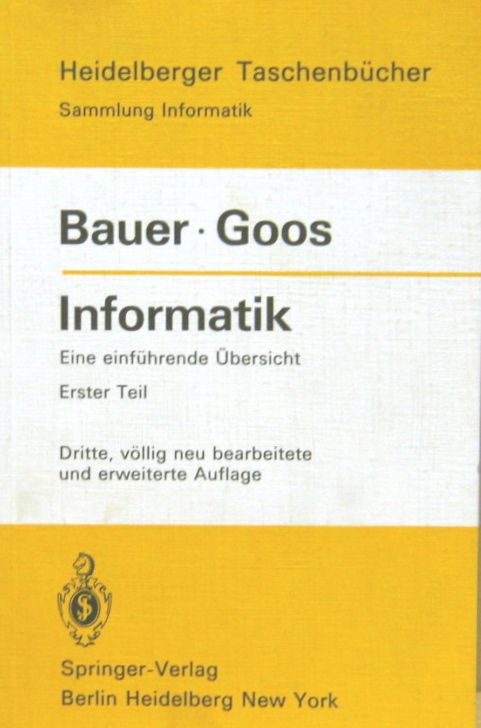
In my private order of things, the second generation of IT pioneers is represented by F.-L. Bauer, whom I personally hold in high esteem. When I was a mathematics student at TUM (at the time it was still called TH for Technische Hochschule) in the fall of 1969, I sat in his lecture when I first studied my minor subject: computer science. Incidentally, the book you see on the picture is my personal copy bought at the time. As you can easily see, it has been read in quite often.
In those days, informatics was something totally new for me. And I probably chose the minor subject because I did not really know what it was. Simply because, in some way or other, it pointed towards the future.
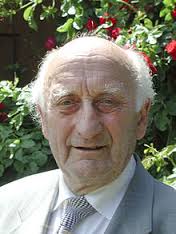 Almost as a logical consequence, I did not understand everything professor Bauer wanted to teach us during this beautiful lecture course. Very regrettably.
During the last few years, I was permitted to accompany professor Bauer when he gave several guided tours in the Informatics department of the Deutsches Museum. Those tours were held for our (InterFace AG) customers, friends and partners. Many things I had not understood as a young student became a lot clearer in the wake of those tours.
Incidentally, I count Konrad Zuse among the first computer science generation. I made his personal acquaintance at the end of the 1086 InterFace-Konrad-Zuse-Bike Tour. He gave us a great welcome, delivered a wonderful speech and presented us the picture you see here during the great reception at Hünfeld. Today, you can see the picture hanging on the wall at the InterFace AG building in Unterhaching.
 By now, informatics has moved on by “light years”. I was and still am a computer scientist with all my heart. For me, the combined meaningfulness of my work, my life and society has always been important. Consequently, the development and future of informatics is important to me. Articles written by third parties about the subject and by distinguished informatics representatives are, naturally, of special interest.
In the 14th edition of the TUM magazine “Faszination Forschung” – a first-class high-gloss TUM München magazine – dated June 2014, I found the article “Connecting the World”.
Here is the trailer:
In the future, everyday objects will be linked via the Internet, enabling them to interact autonomously. To realize this vision, computer scientists are developing virtual models they can use to test practical implementation and monitor the security, safety and reliability of connected systems.
The article describes the future of computer science on the technological level. It is basically about how systems can be coordinated in a future “cyber physical world”. Since I consider the article worth reading and a good basis for further discussion, I am providing you with the download: [download#109].
My friend and partner in the InterFace AG advisory board, Professor Dr. Manfred Broy, is cited in the article. You will also find his picture. It can be assumed that the content of the article is partly the result of the research supervised by him.
I do not totally agree with the article. To be sure, there will be remarkable future developments in our technology, perhaps even more remarkable than those described in the article. However, I do not believe in what applications are predicted. Instead, I assume that the society of the future will have to cope with totally different challenges than we assume today. And I am sure we will then find very exciting solutions. But those solutions will not be part of this “brave new world”.
Yet matters begin to get exciting (and for me alarming) when I read the reply written by Professor Werner Meixner. In a presentation, professor Dr. Meixner described how this article “strikes someone (him) who basically understands the meaningfulness of his professional life as a fascination with the natural sciences as a humanist value”.
This presentation is also part of an open letter addressed to Professor Dr. Manfred Broy with the title:
Where is informatics headed?
Like before, I am providing the link for downloading of the open letter by Professor Meixner:
[download#110]
Since I wish to motivate IF blog readers to read the articles, I will now cite a short but perhaps central part of the article:
All human decisions – and concerns know this quite well – contain an act of added value, which means they are valuable per se. The most important factor is that the owner of the produced value is the one who made the decision and is responsible for it. This is exactly the meaning of privacy and the consequence is the indisputable worthiness of privacy protection. All business behaviour is a consequence thereof.
In fact, I do not quite understand what the author wants to say. My attempt at analysing it dialectically results in me finding a random truth claim which is easy to disprove.
🙂 However, since I am a blogger, I never write open letters to anyone. Instead, I publish my personal opinion in my blog. Totally transparently, everybody can read it.
Here comes:
I find the TUM magazine article one-dimensional. The “open letter” gave me consternation.
In both articles, I find a concept of the world and humans which is no match at all with what I see in the real world. The first article reminds me a little of the nuclear energy euphoria (which at the time was controlled by business interests) more than fifty years ago. The second article glorifies a meaning of privacy and laments its worthiness of protection which – based on my experience in life and my knowledge of anthropology, neurology, psychology, philosophy and sociology – is not at all justifiable. Even theological reasoning would probably fall short
For all of us, the real challenges will quickly be others than those described. The dream image of a networked world will not help us to cope with all those challenges. Neither will the convulsive protection of our private data – which, basically, cannot be protected anyway.
The current news about the IS fronts, other wars and their consequences, refugees seeking asylum in the EU, the assassinations in France , or #Pegida and #Anti-Pegida in Germany are clear indications of a reality that quickly changes and that we have to accept. Also, we have to learn how to deal with this reality in a rational way.
A dominating global economy which creates free markets for products yet leaves labour unfree (a seamstress in Bangladesh cannot move to Europe and do her work there, even though the dresses she makes are exclusively sold in Europe) will come to its end. The rich persons of this world (we) exploit the poor more than ever in human history and the number of slaves is higher than ever.
The tensions generated by these contrasts will probably discharge themselves like earthquakes. It has already started. Basic conditions (climate, food and soil) in many regions already deteriorate and will geometrically continue to do so. Sooner or later, this process will catapult us into critical spheres. The tensions will become more and more noticeable.
In fact, we might be approaching a rough awakening from our current dreams faster than we had anticipated. It is my hope that here, too, informatics can help. Naturally, I do not yet know how this might happen. All I can do is imagine how it might be.
I think the IKT can only contribute positively towards the humaneness of mankind if it – above all – succeeds in supporting a highly complex, world-wide and truthful discourse which thus will render striking results. This is the only way to come to a consensus not based on enmity and exploitation. Instead, it should prepare humans (us) for the necessary changes in our mental concepts and life.
This is the only way to change society without violence. It is the only way to transform today’s economy into a “common-good-economy”. And it is also the only way to find solutions for a better copyright and patent system. Through the wisdom of the masses and against the simple-mindedness of the individual person.
[Note: perhaps our colleagues at Youmigo.de already understood this – which is why they wrote a wonderful APP for “world agreement”.]
As to the TUM magazine article: I would argue that we do not need a luxury world of networked technology which, when all is said and done, will only enslave us even more. As to Werner Meixner’s theses, I think he inflates the topic “pretty good privacy” like a profession of faith. However, instead of giving credible reasons, he remains dogmatic.
And I also believe that our privacy will be something we will be fairly indifferent about in the future. Because we will have other problems. Also, we humans will always move in the stress field of individuality and collectiveness. Either way. With data protection or without. And the only way we can manage to do that in a humane way is if we think and act in a value-oriented way. Dogmata and their prayer-like publication will not be helpful.
Here is another idea about personal data. Isn’t it a rather normal part of human civilization to collect information about people. After all, there were good reasons to come up with administration and, for instance, write down when a child is born. Of course, technological advancement made unbelievable things possible since they invented filing systems and cataloguing.
With “new” technologies, you can certainly collect a lot more data than formerly. Yet this is only the continuation of a development that started with the invention of writing on paper as a means to conserve and hand on information. Quite possibly, the invention of filing systems (certainly an IT invention) brought another impulse. And IKT yet another.
But: did IKT really make such an enormous difference? And how huge is the damage? And isn’t it just great that in general information can be made available by whistle blowers and that it was IT which made it easier?
I see a threat if “a-moral systems” (like unlawful systems) get hold of the data. But if it comes to that, no data protection will help us, anyway. Instead, we should see to it that “a-moral systems” never gain control over us. And that is a permanent social challenge for every citizen. Basically, you can only resist “commercial utilization” of data by being autonomous. But then, the same is true for the continuing threat of manipulation through marketing. And if you consume senselessly, it will only cost money, rarely your life.
Personally, I consider the avoidable damage the “old” technologies caused us during the last hundred years and still cause us permanently today significantly higher than the damage done by the new technology IKT during the last 25 years.
For instance, the technologies of the last century stole our piece. Does any of you still know a single place in Munich where you hear no “technology noise”? Yet the noise pollution is only a truly harmless example compared to the 1.2 million traffic fatalities each year – caused through motorized individualized mobility on a world-wide scale. And it is a fact that we also like to ignore other threats, such as the carbon dioxide content in the atmosphere.
In the same way we accepted the limitless noise emissions, we also got used to our (still very limited, regardless of all efforts) transparency. Limited, because even the networking systems used in industry and in the world 4.0 will find it hard to read our thoughts. And because, if we want to survive, we will definitely have to develop into autonomous persons in a self-determined frame.
Maybe the permanent calls for secrecy of data are nothing more than an outcry of protest, because, after all, you have to be against something, don’t you? And you are not courageous enough to actually stand up for the real threats.
But then, do not let us forget:
Only the new technologies provide us with a chance of networking and sharing our ideas with others. Which is how we can fight ignorance, intolerance, dogmata, irrationality and much more of the same.
RMD
(Translated by EG)
Roland DürreWednesday July 16th, 2014
The speech by Dr. Gerhard Saeltzer for our 30-Years-InterFace AG Jubilee Party that was never delivered
At the 30-years of InterFace jubilee party, Gerhard Saeltzer was one of the guests of honour. Being the surprise guest from Dresden, he had prepared a wonderful speech. As the party progressed to become a rather excessive and noisy affair, there was, unfortunately, no opportunity to give this speech its due place. The first part of the speech describes a rather impressive chapter of East-German/West-German history. InterFace and yours truly were lucky enough to witness some of this history first-hand during the very early stages.
It is truly nice that you all exist!
Dear Roland Dürre, dear InterFace folks, dear guests!
Today, we meet to celebrate the thirtieth birthday of InterFace. Many thanks for the invitation, which I gladly accepted. I immediately decided to come here with my wife.
It is truly nice that you all exist and that we all found each other here today!
Let us remember some events of 24 years ago. It was the time of the German Re-Unification. What exciting and upsetting times those were! And how frustrating they were in East Germany! For instance, Germans from Bavaria came to visit us Saxonians – and they spoke a language that sounded totally alien to our ears. And the second word all those Bavarians uttered was one that had been totally eradicated in the East: God. Wherever you saw them, you heard them say: “Grüß Gott“ – the only thing the Saxonians could do by way of reply was to give an embarrassed and shy “Na goodden Taach“.
And we also learned that the Godly greeting was accompanied by something else: the church tax collected by the federal tax office and often shockingly high back pays for us persons living in the East. And then something extraordinary happened: countless special knights stormed into the East – fortune-hunting knights and robber-knights. Along with attorneys and politicians, counsellors and realtors, functionaries and unionists. Many of them – let us be honest about this – had become redundant or put to pasture in the West. In no time, the con artists came: the car salespersons who sold four-wheel junk as new cars. The textile merchants who sold used clothes as new. The quick property hunters who bought huge dilapidated East-VEB’s for one DM, then demolished the houses and sold the property for millions. And the agents for all kinds of things and totally useless items, above all for life insurances. I, too, unnecessarily, “nibbled”.
In the East, I met attorneys and civil servants from the West who, for example, did not even know that you had to put your signature underneath a legal complaint before you submit it at court. And even show-masters and magicians turned up. One of them actually came right from heaven – he landed in Dresden with a borrowed helicopter – like a God of Fortune. He built a new suburb of Dresden in a swampy area, sold the best soccer players and eventually disappeared behind prison bars. And there were also great IT counsellors who were really absolutely incompetent. They did not even know the meaning of the words software engineering and software quality.
Well, my dear Bavarians, you can imagine how, after the re-unification, there was plenty of frustration and negative culture shocks in the East. We had to undergo a total re-programming. And then, all of a sudden, a miracle happened. I witnessed the reverse, some kind of positive culture shock. In Dresden, I met the entrepreneur Roland Dürre and parts of his young team, his wife and even his youngest offspring Rupert.
Now this man was totally different. He was an entrepreneur who did not just talk big, but was competent and knew what he was doing. A man you could talk to, from man to man, without arrogance. He met me at eye-level without first looking at the contents of my purse (it was empty, anyway) before starting to talk. A man who, even as the head of the entire firm, met his employees like family, wearing felt slippers. With his athletic and unpretentious life-style, he used soap from army supplies for his daily ablutions, rather than certain perfumed chief soaps. Roland Dürre, the entrepreneur who was such a good listener. A man who it was a pleasure to talk to and to cooperate with. A flexible team manager in the truest sense of the word.
Well, let me put it bluntly: for me as someone who was frustrated with re-unification, Roland Dürre and his team looked like extra-terrestrials landed from another, positive star. And they successfully mastered the last 30 stormy years! And I admire all those at InterFace who were part of it.
You all are just terrific! It is so nice to have you all here!
Many thanks to Roland Dürre for this silver lining I was permitted to experience, this East-German/West-German post-re-unification culture shock! Dear Roland Dürre! In those days, we both were quite bold, deciding to organize the first East-German/West-German technological conference for modern software and application systems SoftSys 9/90 in Dresden. Regardless of our rather limited resources, we were both even faster than the high and mighty politicians.
As early as 9 days before the re-unification on October, 3rd, 1990, our East-German/West-German re-unification conference took place in Dresden! The good communication between the two of us had some considerable effect. Everything was done faster. Later, unfortunately, our connection came to a standstill.
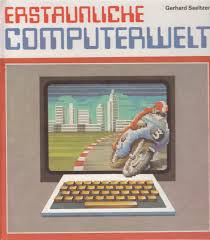 So much the more wonderful that, after 24 years, we re-united. I found InterFace on the internet when I entered my own name and accidentally found a book review about my computer science book for children and later for primary school in Saxonia: ”Erstaunliche Computerwelt“.
Dear Mr. Dürre, dear InterFace Team!
Looking back makes me a little sad: unfortunately, there are currently far too few enterprises in Germany and Europe where such a nice, communicative, faire culture is lived as at InterFace. In these times of company bankruptcies and mergers, where quite a few enterprises have not survived, you managed to stick it out on the market. Wonderful! Many others could learn from you.
I admire you!
It is really a pity that, as of today, science has not yet mastered one art: perfect cloning. Both Germany and Europe would be better off if you and your enterprise could be cloned – maybe five times, or, a little more boldly, 20 times! And since, unfortunately, this cannot yet be done, they really should erect a plinth or at least a memorial table for InterFace here in Unterhaching. Well, even if they cannot do that at the moment, here are my heart-felt congratulations – you might find some similarities to Theodor Fontane:
”May sorrow be lame, may worries be tame!
Hear our wishes for the birthday child:
Another thirty years unharmed and mild!“
And, my dear Roland Dürre, here is another small wish for the future – because it is such a pleasure to cooperate with you. How about a new shared project with world-wide potential? I have an idea I would like to discuss with you.
Best health and good luck for all of you!
Grüß Gott! Godden Taach, and so long – perhaps with amusing anecdotes from my life with the computer in the East! You are all cordially invited!
Dr. Saeltzer, Unterhaching, June, 27th, 2014
 The invitation was for the session “fascinating things and anecdotes around the present and the future of computer application” by Dr. Saeltzer during our 30-year-jubilee party. In this session, he told us amusing things about the start of IT in the GDR during the 1960ies. He also took the role of helping to build courage and showed with small reading sessions from his book “Wedding in the River” (which is an “introduction to resilience”) how people can retain optimism even in grave situations, such as the Dresden flood catastrophe.
When I read this text, my ears turned purple, but I was certainly very delighted.
My most heartfelt regards and many thanks to Dr. Saeltzer.
RMD
(Translated by EG)
P.S.
Here are a few catchwords to characterize our “surprise guest” Dr. Gerhard Saeltzer:
Computer Scientist, Software Technologist, Simulation Expert, Author, Speaker, Trainer (more than 10 books, among them best sellers, 100 printed technological reports, 1,000 presentations and seminars, exposes for educational TV), entire pages and interviews in the daily newspaper devoted just to him, Chairman of big technological conferences in the East, Designer of Innovations such as ProgFox, LEMA. His last position was as governmental director of the Saxonian data-security center in Dresden. Currently, he is in anti-retirement; he has been jogging through Dresden for 20 minutes between 6 a.m. and 9 a.m. on a daily basis for the last 45 years.
P.S.2
The text is the original by Dr. Gerhard Saeltzer. I added the two pictures of the books mentioned in the article.


