
Roland DürreSaturday June 15th, 2013
Retirement Concept …
On June, 20th, 2013, I will be sixty-three years old. I graduated from high-school in 1969. Eighteen months of my life have been donated to the country. Forcibly. It was called military service. After this compulsory service, I studied and earned the necessary money during that time myself. I always had (at least) two jobs synchronously. Regardless, those were good times. I have no reason to complain.
Then my “work life” began. After a few initial years, I paid the maximum amount into the old age insurance for almost twenty years. After the change of the InterFace Connection GmbH – which was then turned into an association – I mutated from being managing director to being board member. Nevertheless, I continued to pay the basic amount into the old age insurance out of solidarity.
I brought up seven children. Six of them have successfully graduated from high school, one of them hopefully will still do so. My children have all kinds of diplomas, so far, one of them is holding a doctorial title.
A few days ago, I received my notice of pension granted (of June, 10th, 2013):
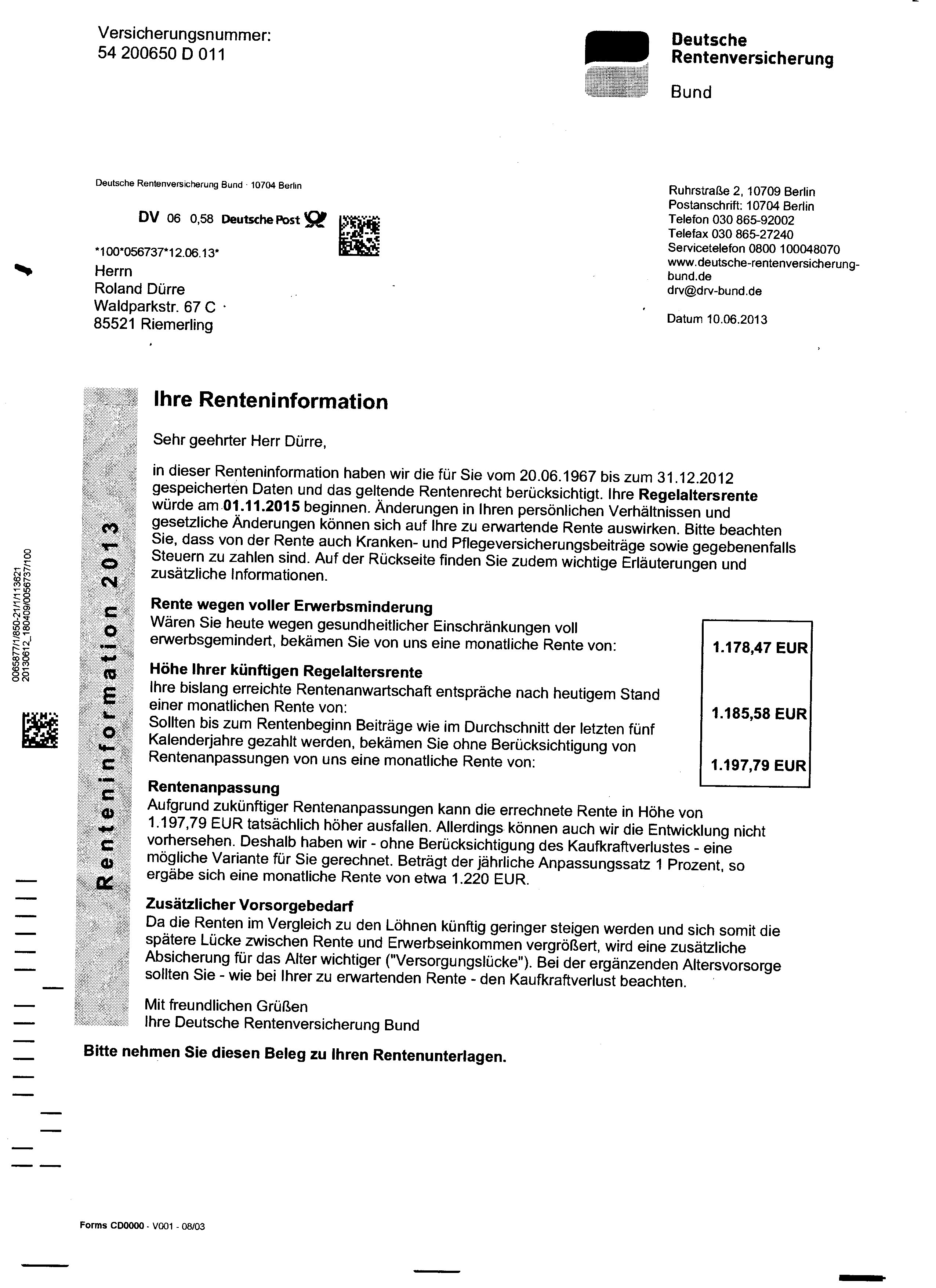 So I would get 1,185.58 Euros old age money, starting November, 1st, 2015. You have to pay health insurance from it and it is also subject to taxation. I have no idea how much will then remain. Presumably, it is not going to be very much.
It is interesting that my wife, Barbara, who basically was always busy either having children or working, gets considerably less than I. Her old age money will be around two thirds of mine.
We are not complaining. We were rather lucky in life and even had the chance to accumulate a small fortune. It actually looks like, even in old age, I can afford a good life in the beautiful south—east of Munich.
But I think of other people, who have probably spent their entire life paying just a little over the minimum into the old age insurance. Maybe they have some gaps in their work life.
Which means they will definitely get less than I (and my wife) will get. And they were not able to build up any sort of helpful fortune: zero.
I also think of the inflation I feel every day. And of the federal debt which, regardless of all the promises and flops such as “debt brake”, keeps increasing (!). I think of the risky government securities and the many singles and what a home for the elderly costs each month. However, I equally think of the constantly increasing percentage of carbon dioxide in the air we breathe, although this has basically nothing to do with our old age money. But still, it has all the world to do with our future.
How is that supposed to work? Or else: please find what went wrong! Incidentally, I think there are many things that went wrong.
RMD
(Translated by EG)
P.S.
My father was a public servant at Deutsche Bundesbahn. He had never studied at university, but he was industrious and climbed up gradually. Yet his career was limited. My mother is a widow, but being the wife of a public servant, she still gets about twice (pension and a small old-age money) what I will get as old-age money. Regardless of this, her few savings keep dwindling each months, because the cost for the home for the elderly and “health” (private extra payments in an exorbitant health-care system that we cannot really influence) are a lot higher than her income.
5 Kommentare zu “Retirement Concept …”
Kommentar verfassen


Es lohnt sich, den original abgebildeten Rentenbescheid mal genau zu lesen. Es ist erstaunlich, was die alles zu wissen meinen. Z.B. dass die Löhne steigen werden. Ich meine, dass in vielen Bereichen das gar nicht so ist.
Hallo Roland!
Dann geht es Ihnen ja jetzt wie damals den Herstatt-Kleinsparern, da gab es ein lustiges Lied von “Klaus dem Geiger”:
Ich bin der Pleitegeier
von Müller, Lehmann, Meier,
die ham’ mich vollgestopft
für ihre spät’re Sicherheit –
Doch mein Boß
und sein Troß
saßen auf ‘nem hohen Roß,
und das Roß, das fraß –
Euer schönes Moos…
Das ist der Herstatt-Blues,
das ist der Herstatt-Blues,
man öffne den Tresor –
und was kommt da hervor?
Der Pleitegeier,
mit ‘nem ganzen Sack voll Eier
und dem Schnabel voller Schmus,
da krächzt er seinen Blues,
den Her-statt, Her-statt, Her-statt – Blues,
den I-van – Herstatt – Blues…
Wunderbar …
Tja, Roland, dann werden wir fast dieselbe Rente bekommen, obwohl Du erfolgreicher warst als ich. Habe aber eine Freundin, die deutlich mehr zu erwarten hat. Klammere mich wie eine Zecke an sie. Unsere zukünftigen Sessions in den wunderbaren Münchner Biergärten werden also andere Sponsoren als der Staat finanzieren.
OK, Roland does not want to grumble. He and I should not. We have earned well and live in a comfortable prosperous country. Our computer occupations have probably helped bring prosperity and spread knowledge, so we can feel we were not parasites.
But in truth, Roland is grumbling a bit. Things may be getting less comfortable. The main problem is the exhaustion of resources by the increasing human population. The European population is not increasing, but uses much more resources per head than the average.
There are three possible extreme solutions to the problem:
1. The developed countries maintain their hegemony, and let the rest starve.
2. The developed countries drastically reduce their consumption, while helping the rest to limit population, (e.g. by helping women to run their own lives).
3. The developed countries muddle along, not helping the rest, leading to war and chaos.
At present, scenario 3 is in operation, but there is still time to switch to 1 or 2. Now I turn to the less dramatic matter of German pensions.
Globalisation and mechanisation have resulted in a dearth of unskilled jobs in Europe. Of course work can be found, but only at wages that are here unacceptable, and which are not profitable enough to support the pensions that Roland and I want, (together with our wives).
Roland and Barbara with their seven children have contributed to the depletion of resources. The children can expect to get good jobs and help support the pensioners, but will even one of them do anything to improve the global resource problem, (or to preserve hegemony)?
Germany resists taking in poor foreigners. This fits the policy of doing little to educate or integrate them. Some other European countries take in relatively more, or do more about education, but are not structured to provide jobs for all. Of course, none of the desirable measures come for free, and nobody wants to accept short term disadvantages.
I don’t believe the German national debt is really a problem for coming generations. For a start, it is too small. It could be worked off in ten years with very little austerity. At present Germany is doing well, borrowing at low interest rates. Of course the interest rates will have to increase, and countries like Greece have much higher rates. Anyway, a lot of the money is borrowed from pension funds and life insurances, which are often forced by law to borrow at low rates! This money then is used by Roland’s mother and other old people to avoid becoming too much of a burden on the state! So everything goes in circles.
Borrowing by the state at low interest, coupled with inflation is a form of disguised tax. The state naturally tries various tricks to keep people not too dissatisfied; after all we have a democracy! In particular it looks after civil servants and politicians; the pants are nearer than the trousers.
I think I am old enough to say that it seems silly to spend huge sums keeping old people alive in misery, or when demented. At least the state should not fight like mad against assisted suicide. The money could be better spent on happiness and/or sustainability.
Roland worries about people who will get worse pensions. But it sounds as if he is thinking about Germans. What about the other millions who have no chance of getting any pension?