
Roland DürreWednesday September 21st, 2011
Free Public Transport?
Now that the “Pirate Party” won some seats in the Berlin Senate, I heard it again:
The cry for free public transport.
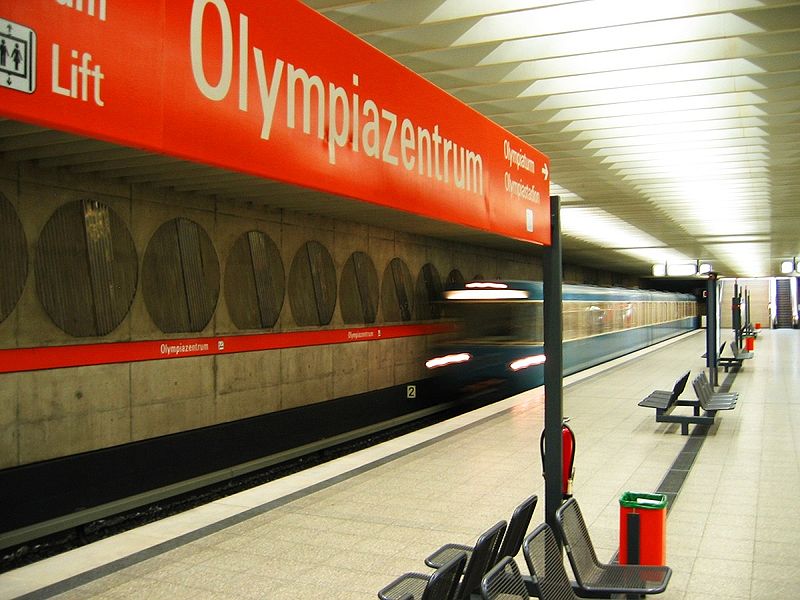
Auch die U-Bahn gab's zu Olympia
The Underground Trains were also something they installed because of the Olympic Games.
I still remember the year 1972. Munich hosted the XXth Olympic Games of Modern Times (Spiele der XX. Olympiade). The S-Bahn trains were new; Munich got a nice Olympic stadium and many other beautiful things. In those days, my father worked at the revision department of the “Deutsche Bundesbahn” and whenever schools were closed, I worked at DB service, staffing the information desk at platform 26 for guests from abroad.
The revision department had to determine if the railway system had cost-efficient structures on various levels. My father was in charge of analyzing the Munich S-Bahn train system.
Well, he made surprising discoveries. The cost of just running the trains was less than half of the total cost. The necessary federal and state subsidies, however, amounted to more than half of the entire cost of the Munich S-Bahn system.
That means the subsidies were higher than the S-Bahn operating cost. Passengers paid exclusively for the privilege of being permitted to pay.
I was easily able to understand those numbers. Years later, I was still quite stunned when I learned how much a ticket machine cost at the Hannover Fair (even though at the time they were already less expensive than in 1972). In addition, you have to think of the initial construction and installation costs – not to mention the maintenance and supply. In those days, they invested about as much as in the “payment structure” as in the rolling material: the white-and-blue S-Bahn trains.
If you look at it the naive way, you might say ”free rides for all“ would actually have saved money, because the operating cost in 1972 was lower than the subsidies.
It seems unlikely to me that the calculation might still be the same for today with the S-Bahn trains. But even if the subsidies are less than the operating costs, a free ride for all might still have advantages (less individualized traffic…) and therefore be profitable.
Of course, from a mercantile point of view, this is naïve. Because the gigantic investments into the entire intra-structure are not deductible and would therefore be due at once if people no longer had to pay for their rides. After all, it is hardly likely that you would find buyers for ticket machines, or is it? Maybe in under-developed countries? And I am sure the ticket machine infrastructure cannot be made to pay its way if you simply put up beverage machines. The lobby of the machine builders, too, would probably object. Jobs would go lost in the sector. Less people would go into the city by car. Which is not what petrol stations and parking garages want, is it? Moreover, they would probably have to buy additional trains. This also is something that would have to be paid for. The train conductors and MVV marketing people would all suddenly face unemployment.
Well, those practical constraints make free rides impossible. Isn’t it a pity? After all, it was a revolutionary idea – and it would have had quite a few immediate advantages.
There is another idea of the Pirate Party that I also find quite interesting. If I understand correctly, then “illegal parking” is not really a crime, just a misdemeanor. You pay the penalty and everything is fine.
On the other hand, you are committing a crime if you dodge your fare, at least if you are caught a second time. Although all you are doing is taking illegal advantage of public utilities.
Well, I find that not quite fair.
RMD
(Translated by EG)
P.S.
This file and the information underneath the red line have been taken from the central media archive Wikimedia Commons. Many thanks to the author FloSch!
3 Kommentare zu “Free Public Transport?”
Kommentar verfassen


Sehr guter Ansatz und interessante Ideen deinerseits dazu. Schade eigentlich, dass man so ein eingefahrenes System so schwer ändern kann – wenn überhaupt.
Really good information about human stupidity! In contrast, Babage, (the father of the stored-program computer), got it right when he decided that postage cost in Britain should be independent of distance.
Everybody over 30 has difficulty with the new touch-screen ticket machines! They are a horror particularly for foreigners.